IJBCP
International Journal of Basic & Clinical Pharmacology
Original Research Article
Study on drug utilization pattern of antihypertensive medication in
tertiary care hospital of Telangana, India
K. Vashishta*
INTRODUCTION
Hypertension is the most common disorder affecting the heart and blood vessels. Approximately 7.6 million deaths (13-15% of the total) and 92 million disability-adjusted life years worldwide were attributable to high blood pressure in 2001.1 Hypertension attributes to 10% of ischemic heart
disease, 21% of peripheral vascular disease, 24% of Acute
MI, and 29% of Strokes.2 The overall burden of
hypertension related disease is rapidly rising in the developing world as a consequence of the aging population
and increasing urbanization.3 Classifying stages of
hypertension: Stage 1 hypertension: 140-159/90-99mm Hg. Stage 2 hypertension: at or greater than
160-179/100-109mm Hg.4Drug Utilization Evaluation (DUE) is study
of ongoing, systematic, criteria-based evaluation of drug use ensures that medications used appropriately (at the individual patient level). If therapy is found to be inappropriate, significant interventions with patients will be necessary to optimize drug therapy. A DUE is evaluation of drug as well disease-specific and can be structured to assess the actual process of prescribing, dispensing or administering drugs e.g. (indications, dose, ABSTRACT
Background: Hypertension is leading cause of deaths in the world. It is the major risk factor for systemic disorders including cardiovascular, renal and brain disorders. A drug utilization review on antihypertensive drugs should be done to determine different classes of antihypertensive medications with respect to diagnosis. Aim was to study drug utilization pattern of antihypertensive medication in a tertiary care hospital, Telangana.
Methods: A cross sectional observational study was done in the patients with hypertension for duration of one year i.e. from April 2017 to May 2018 in the department of Pharmacology at Mallareddy Narayana multispecialty hospital, suraram, Telangana. A total 130 Patients who were suffering with acute, chronic hypertension and admitted in general medicine department and undergoing antihypertensive treatment were included.
Results: A Total of 130 patients with history of hypertension were included. majority of patients i.e., 46.1% (60/130) were among 51-60 years, followed by 24.6% (32/130) patients among 41-50 years., Male predominance 80/130 61.5%) compared to females 50/130 (38.4%). In the Present study, 105(80.7%) prescriptions had Monotherapy prescription and 25/130 (19.2%) has combination of two. The most frequently prescribed drug as monotherapy was Calcium Channel Blockers (CCBs) about 52.3%, Beta blockers constitute about 14.2%, and diuretics about 19%, 9.5% Angiotension Receptor Blockers (ARBs) and alpha-Adrenergic Blocker (AABs), 4.7% ACE inhibitors.
Conclusions: Calcium channel blockers are the highest among the drugs that are used as monotherapy. In combination therapy, diuretic with angiotensin receptor blocker and calcium channel blocker with beta blocker are the frequently prescribed drugs.
Keywords: Antihypertensives, Calcium channel blockers DOI: http://dx.doi.org/10.18203/2319-2003.ijbcp20183487
Department of Pharmacology, Mallareddy Medical College for Women, Hyderabad, Telangana, India
Received: 29 June 2018
Accepted: 27 July 2018
*Correspondence to:
Dr. K. Vashishta,
Email: vashishtakanchanpally@ gmail.com
drug interactions, etc.). DUE is the same as drug utilization
review (DUR) synonym terms.5 Until about 1950, there
was no effective treatment, and the development of antihypertensive drugs has been a major therapeutic success story. Now, high blood pressure can be controlled through existing antihypertensive drug therapy by following some guidelines. The Joint National Committee (JNC-7) is considered the “gold standard” consensus guidelines for the management of hypertension. The other guidelines are 2007 American Hypertension Association (AHA) and the 2007 European Society of Hypertension/
European Society of Cardiology.6-8 Treatment of
hypertension with monotherapy or combination therapy is updated time to time according to JNC I to VII guidelines.9
METHODS
Ethical permission was taken from concerned institute. Informed consent was taken from all the patients who were included in the study. A cross sectional observational study in the patients with hypertension for duration of one-year i.e. from April 2017 to May 2018 in the department of Pharmacology at Mallareddy Narayana Multispecialty Hospital, Suraram, Telangana. A drug utilization review on antihypertensive drugs was done to determine and evaluate the different classes of antihypertensive medications with respect to diagnosis.
A Total of 130 patients who were suffering with acute, chronic and uncontrolled hypertension were included. All patients who were admitted in General medicine department and undergoing antihypertensive treatment were included. All the patients were screened thoroughly including age, sex, occupation, past history of hypertension, information on drug therapy (drug name, dosage form, frequency, route of administration, duration of treatment). Treatment data obtained from the patient's case sheet on a daily basis.
Inclusion criteria
• Age group 30 years to more than 80 years.
• Both genders
• Patients diagnosed with acute, chronic and
uncontrolled hypertension.
• Patients willing to take antihypertensive drugs.
Exclusion criteria
• Patients not suffering from hypertension
• Gestational hypertension.
• Patients refusing consent.
RESULTS
A Total of 130 patients with history of hypertension were included.
In the present study majority of patients i.e., 46.1% (60/130) were among 51-60 years, followed by 24.6%
[image:2.595.312.544.163.266.2](32/130) patients among 41-50 years, 15.3% (20/130) were 61-70 years.7.6% among 30-40 years, 3.8% were among 71-80 years, least were more than 81 years i.e., 2.3%. Present study showed male predominance 80/130 (61.5%) compared to females 50/130 (38.4%) (Table 1).
Table 1: Age distribution of hypertensive patients.
Ageinyears No.ofcases %
30-40 years 10 7.6
41-50 years 32 24.6
51-60 years 60 46.1
61-70 years 20 15.3
71- 80 years 05 3.8
>81 years 03 2.3
Total 130 99.7
Table 2: Personal history.
Personalhistory No.ofcases %
History of Alcohol present 45 34.6
History of Smoking present 35 26.9
Both alcohol and smoking 30 23.0
History of Alcohol and
smoking not present 20 15.3
Total 130 99.8
In the present study 46.1% (60/130) patients had family history of hypertension, 53.8% (70/130) had no family history of hypertension. In this study Majority of patients 70/130 (53.8%) with hypertension were having weight of 51-60kg. In the Present study 90 (69.2%) were significantly higher systolic blood pressure ranging more than 160mm Hg. 50 (38.4%) were having higher diastolic blood pressure ranging more than 100mm Hg (Table 2).
Table 3: Distribution of different stages of hypertension.
Stageofhypertension No.ofcases %
Prehypertension 10 7.6
Stage I 90 69.2
Stage II 30 23
Total 130 99.8
The patients were categorized depending on the stages of the hypertension- 10 /130 (7.6%) patients belonged to pre-hypertension stage, 90/130 patients (69.2%) belonged to stage 1 hypertension and 30/130 (23%) patients belonged to stage 2 hypertension (Table 3).
Table 4: Usage pattern of drugs in mono therapy.
Drugtherapy No.ofcases %
Monotherapy 105 80.7
Combination therapy 25 19.2
[image:2.595.315.543.700.753.2]In the present study, 105 (80.7%) prescriptions had
Monotherapy prescription and 25/130 (19.2%) has combination of two drugs (Table 4).
Table 5: Antihypertensive drugs prescribed as monotherapy.
Drugs Drugs No.of
drugs %
Diuretics 20 Furosemide 10 19
Torsemide 10
ACE
inhibitors 05
Ramipril 2
4.7
Enalpril 3
Angiotensin II receptor blockers
10
Telmisarten 5
9.5
Losartan 5
Calcium channel blocker
55 Amlodipine 55 52.3
β adrenergic
blockers 15 Metoprolol 15 14.2
α- β adrenergic blockers
10 Carvidilol 10 9.5
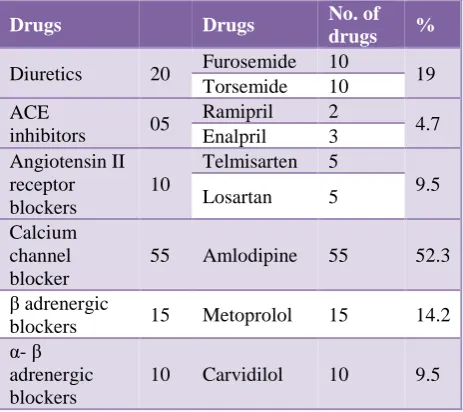
[image:3.595.52.284.152.358.2]The most frequently prescribed drug as monotherapy was Calcium Channel Blockers (CCBs) about 52.3%, Beta blockers constitute about 14.2 %, and diuretics about 19%, 9.5% Angiotension Receptor Blockers (ARBs) and alpha-Adrenergic Blocker (AABs), 4.7% ACE inhibitors (Table 5).
Table 6: Antihypertensive drugs prescribed as combination therapy.
Class Drugs %
ARB+DIURETIC 10 40
CCB+ β BLOCKER 9 36
ARB+CCB 7 28
ACEI+DIURETIC 6 24
CCB+DIURETIC 4 16
Authors also observed few combination drugs in the prescription. Drug combinations were categorized depending on their class. The most frequently prescribed
drugs combinations were ARB+Diuretic (40%),
CCB+betablocker (36%), ARB+CCB (28%),
ACEI+Diuretic (24%) and CCB+Diuretic (16%) (Table 6).
DISCUSSION
Present study included a total of 130 cases involving antihypertensive drug therapy were included. In Georgy M. Varghese et al study, 118 cases were included. Amit Sharma et al, study 150 patients were studied, Sharminder Kaur.10-12 A total of 297 prescriptions were studied. Rajeev
Mishra et al, study128 prescriptions were evaluated.13
In the present study majority of patients i.e., 46.1% (60/130) were among 51-60 years, followed by 24.6% (32/130) patients among 41-50 years., In Georgy M. Varghese et al, study most of the patients were between the ages of 51-70 years old, accounting for 75.21% of total cases, in Amit Sharma et al.10,11 The mean age (mean±SD)
of the patients was 59.28±11.0894 years with range 21-85 years and the median age was 60 years. Test of proportion showed most of the patients 58 (38.7%) were significantly higher in the age group 51-60 years., Sharminder Kaur et al, study.12 The patients were in the age group of 20 to 90
years with mean age being 56.21, Supratim Dattastudy.14
The mean age of males was (56.5) 15.9 as compared to (53.03) 19.3 in females. A total of 68.5% of the patients were in the 18-64 years age range whereas 31.5% were 65 years and as mentioned.
In the Present study, showed male predominance 80/130 (61.5%) compared to females 50/130 (38.4%). In Amit Sharma et al, study ratio of the patient’s male: female was found to be 1.2:1.11 Out of the 150 studied patients, 55.3%
(83) of patients were male and 44.7% (67) of patients were female. In Sharminder Kaur et al, study male predominance (Male/Female ratio as 1:.85), Rajeev Mishra et al, study found that the prevalence of hypertension was more in male patients (66.1%) as compared to females (33.9%), Supratim Datta study Hypertension was observed to be more common in males (63.6%) than in females (36.4%).12-14
In the present study 46.1% (60/130) patients had family history of hypertension, 53.8% (70/130) had no family history of hypertension. Where as in Amit Sharma et al, study showed most of the patients were not having family history of hypertension, i.e., 147 (98.0%) while 3 patients (2.0%) were having family history of hypertension.11
In this study, majority of patients with hypertension were having weight of 51-60kg. Where as in Amit Sharma et al, study, it was found that the highest no. of hypertensive patient (55) were falling in the weight group of 51-60kg which were the 36.7% of total collected case.11
Usage pattern of individual drugs in mono therapy
In the Present study, 105 (80.7%) prescriptions had Monotherapy prescription and 25/130 (19.2%) has combination of two drugs .The most frequently prescribed drug as monotherapy was Calcium Channel Blockers (CCBs) about 52.3%, Beta blockers constitute about 14.2%, and diuretics about 19%, 9.5% Angiotension Receptor Blockers (ARBs) and alpha Adrenergic Blocker (AABs), 4.7% ACE inhibitors, In Georgy M. Varghese et al, study among individual drugs, amlodipine (43.22%), telmisartan (33.89%) and furosemide (27.11%) were the most utilized in all cases encountered.10 Others were
In this study was coinciding with Juno J. Joel et al, study
as the most frequently prescribed drug as monotherapy was Calcium Channel Blockers (CCBs) 48.2%, Angiotension Receptor Blockers (ARBs) 19.4%, Beta blockers (9.4%), ACE Inhibitors (8.8%), Diuretics (8.2%), Alpha Adrenergic Blocker (AABs) 2.9% and Centrally
Acting Agents (CAAs) 2.9%.1,15 Whereas Amit Sharma et
al, study showed most of the patients 142 (94.7%) were on poly therapy significantly higher than mono therapy, double therapy and triple therapy 1 (0.7%), 0 (0%), 7 (4.7%), Rajeev Mishra et al, study it was observed that the monotherapy (81.7%) is more common than combination therapy (34.8%.).13,11
Authors also observed few combination drugs in the prescription. Drug combinations were categorized depending on their class. The most frequently prescribed
drugs combinations were ARB+Diuretic (40%),
CCB+betablocker (36%), ARB+CCB (28%),
ACEI+Diuretic (24%) and CCB+Diuretic (16%).
In Georgy M Varghese et al, study Among 2 drug combinations combination of calcium channel blocker with angiotensin receptor blockers were utilized most, followed by calcium channel blockers + diuretics.10 In 3
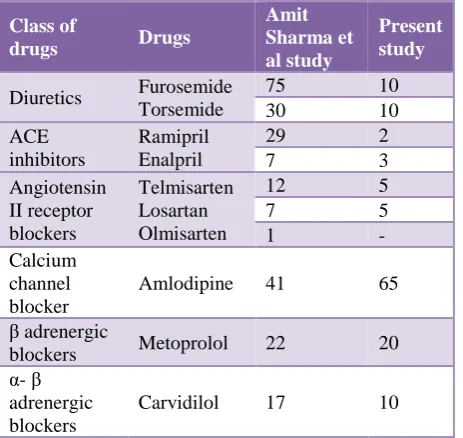
[image:4.595.54.286.509.728.2]drug combinations, angiotensin receptor blocker + calcium channel blocker + diuretic was most utilized combination, in Jainaf Nachiya et al, studymono therapy was more frequently used than combination therapy (54.17% vs. 45.83%) Angiotensin II receptor antagonist 32 (1.5%), angiotensin converting enzyme inhibitor (ACE I) + angiotensin II receptorantagonist 22 (1.03%) and diuretics + calcium channel blockers + β-Blocker 17 (0.79%) proposed in this present study.16
Table 7: Drug prescribing pattern of hypertensive patient.
Classof
drugs Drugs
Amit Sharmaet alstudy
Present study
Diuretics Furosemide
Torsemide
75 10
30 10
ACE inhibitors
Ramipril Enalpril
29 2
7 3
Angiotensin II receptor blockers
Telmisarten Losartan Olmisarten
12 5
7 5
1 -
Calcium channel blocker
Amlodipine 41 65
β adrenergic
blockers Metoprolol 22 20
α- β adrenergic blockers
Carvidilol 17 10
Georgy M. Varghese et al, study Calcium channel blockers (50.84%) were the most utilized in all cases, followed by
diuretics 35.59%, angiotensin receptor blockers 27.95%, beta blockers 18.64%, alpha blockers 5.93%, and least utilized were angiotensin converting enzyme inhibitors 2.54% of all cases.10
Rajeev Mishra et al, study Calcium channel blockers (CCBs) (31.2%) were the most commonly prescribed antihypertensive agent as monotherapy, followed by angiotensin receptor blockers (ARBs) (22.3%) and
angiotensin-converting enzyme inhibitors (ACEIs)
(14.3%).13 9.8% patients were treated with combination of
ARBs with CCBs, while 5.3% received combination of diuretics with ARBs.
CONCLUSION
Calcium channel blockers are the highest among the drugs that are used as monotherapy. In combination therapy, diuretic with angiotensin receptor blocker and calcium channel blocker with beta blocker are the frequently prescribed drugs. Amlodepin was commonly prescribed.
Funding: No funding sources Conflict of interest: None declared
Ethical approval: The study was approved by the Institutional Ethics Committee
REFERENCES
1. Longo DL, Fauci SA, Kasper DL, Hauser SL, Jameson
JL, Loscalzo J. Harrison’s Principles of Internal Medicine. Eighteenth edition, McGraw-Hill Medical, New York, United States of America; 2012.
2. Mohan S, Campbell N, Chockalingam A. Time to
effectively address hypertension in India. Indian J Med Res. 2013;137(4):627-31.
3. Yusuf S, Reddy S, Ôunpuu S, Anand S. Global burden
of cardiovascular diseases: part I: general
considerations, the epidemiologic transition, risk factors, and impact of urbanization. Circulation. 2001 Nov 27;104(22):2746-53.
4. National Cardiovascular Disease Database: availablea
at:
http://www.searo.who.int/india/topics/cardiovascular _diseases/NCD_Resources_Nat
ional_CVD_database-Final_Report.pdf?ua=1.
5. Anchala R, Kannuri NK, Pant H, Khan H, Franco OH,
Angelantonio ED, Prabhakaran D. Hypertension in India: a systematic review and meta-analysis of prevalence, awareness, and control of hypertension. J Hypertens. 2014;32(6):1170-7.
6. Chobanian V. Seventh Report of the Joint National Committee on Prevention, Detection, Evaluation, and Treatment of High Blood Pressure. Hypertension. 2003;42(6):1206-52.
7. Rosendorff C. Treatment of hypertension in the
Epidemiology and Prevention. Circulation
2007;115:2761-8.
8. Bope TC, Kellerman RD. Conn’s Current Therapy
2013. Saunders-Elsevier, Philadelphia, United States of America; 2013.
9. Shirley C, Nagavi BG. Impact of community
pharmacy basedpatient education on the quality of life of hypertensive patients. Indian J Pharm Educ Res. 2007;41(2):164-9.
10. Sharma A, Gupta TK, Rathore MS, Chhabra M, Gaur
A. Drug utilization Study on Oral Hypertensive Medication Patients and Assessment of Medication Adherence to JNC-8 Guidelines in North Indian Tertiary Care Hospital: A Cross-Sectional Study.
11. Kaur S, Gupta S, Kumar D, Lal M, Gilani Z.
Prescribing pattern of antihypertensive drugs in a tertiary care hospital in Jammu: a descriptive study. JK-Practitioner. 2012 Oct;17(4):38-41.
12. Mishra R, Kesarwani P, Keshari SS. Prescription pattern of antihypertensive drugs in a tertiary care
teaching hospital. Int J Med Sci Public Health. 2017 Apr 1;6(4):684.
13. Datta S. Utilization study of antihypertensives in a South Indian tertiary care teaching hospital and adherence to standard treatment guidelines. J Bas Clin Pharma. 2016 Dec;8(1):33.
14. Daniel N, Sharma R, Shastry C. Drug utilization pattern of antihypertensives in a tertiary care hospital in south India. World J Pha Pharmaceut Sci. 2014;3(10).
15. Nachiya JRA, Parimalakrishnan S, Rao RM. Study on
drug utilization pattern of antihypertensive
medications on out-patients and inpatients in a tertiary care teaching hospital: A cross sectional Study. Afr J Pha Pharmacol. 2015 Mar 22;9(11):383-96.