Copyright © 2014 (Alberto Posso & Meg Elkins). Licensed under the Creative Commons Attribution Non-commercial No Derivatives (by-nc-nd). Available at http://ijoc.org.
Ignorance Is Bliss!
Internet Usage and Perceptions of Corruption
in a Panel of Developing Countries
ALBERTO POSSO
MEG ELKINS
1 RMIT University, AustraliaIn a world of open-ended access to social media, the ability of governments to control information is slipping away. It is plausible in countries with limited Internet access for citizens to remain ignorant of the true amount of corruption. We built a cross-country panel of 124 developing nations to analyze the effect of Internet usage on perceptions of corruption from 1996 to 2009. We find that, ceteris paribus, the information citizens receive from the World Wide Web leads to deteriorating views of the state of corruption in their country. Greater perceptions of government effectiveness are unsurprisingly found to negatively and significantly decrease perceptions of corruption within countries.
Keywords: corruption perceptions, Internet usage, panel data, developing countries
Introduction
Press freedom and open access to Internet are powerful tools that can be used to reduce corruption. Brunetti and Weder (2003) argue that in the presence of a free media, journalists have incentives to uncover any wrongdoing by government. In turn, by creating awareness of these wrongful acts, a free press, perhaps inadvertently, increases the risk associated with engaging in corrupt activities (Chowdhury, 2004; Freille et al., 2007.2 The rise of the Internet and social media is an effective, important and growing mechanism by which these wrongdoings can be widely publicized. Persistently, corruption is linked to countries with a low GDP per capita and lower levels of freedom (Svensson, 2005;Treisman, 2007). This study focuses solely on how developing countries’ perceptions of corruption are being altered by the rise in access to the Internet.
Alberto Posso: [email protected] Meg Elkins: [email protected] Date submitted: 2013–10–03
1 The authors wish to thank Tim R. L. Fry, Simon Feeny, Lisa Farrell, Abelardo Posso Serrano, Aaron Soans, Martin Byford, and two anonymous referees for valuable comments on earlier drafts. All remaining errors are ours.
As the media landscape changes across the world, anyone with access to YouTube, Facebook, Twitter, Google+, blogs, and live-video streaming can become an investigative journalist or whistle-blower. In corrupt societies, the rise of free social media is likely to lead to increased awareness of government officials’ wrongful acts (Treisman, 2007). In fact, using Google and Yahoo searches of “corruption,” Goel, Michael, Naretta, and Michael (2012) find that increased online awareness of corruption is associated with overall decreased corruption across countries. Using a cross-section of countries in 2009 and 2011, their study suggests that countries that are better at monitoring corruption through the Internet tend to be less corrupt. Goel et al. (2012) argue that the Internet has made government controls of the media less effective, allowing for an increase in the supply of information about corruption. Their premise is that a more informed population will be better able to counter corrupt acts and be more aware of their rights.
The hypothesis posed in this study is slightly different. We agree that the Internet has made government controls of the media less effective, allowing for an increase in the supply of information about corruption. However, this increased supply of information has resulted in increased perceptions of corruption. That is, Goel et al. (2012) look at how more online awareness of corruption is associated with lower levels of corruption across countries. On the other hand, we argue that the Internet is an important medium by which awareness of corruption increases through time within countries. This, in turn, can have destabilizing effects as people in corrupt societies begin to push for improved political conditions. Most recently, the experiences in Egypt, Tunisia, Libya, and Yemen illustrated this point. In these countries, cyber-connectedness was crucial for shedding light on corruption scandals and government misbehavior, culminating in widespread social revolt (Anderson, 2011; Eltantawy & Weist, 2011). So, the catalyst for any ensuing social change resulting in a decrease in actual corruption will be increased perceptions of corruption over time within countries.
Examining a panel of developing countries from 1996 to 2009, this study shows that perceptions of corruption increased alongside a rise in access to the Internet. Moreover, unlike previous studies, the use of panel data techniques allowed us to control for potential endogeneity, which can lead to biased and inconsistent results. Therefore, we conclude that a rise in Internet access causes increased perceptions of corruption. It is this mechanism that has allowed for social disharmony and injustice to gain a voice that is no longer constrained by the government or monopolized by media outlets.
Davoodi, and Alonso-Terme (2002) finds that corruption increases both poverty and inequality. Likewise, O’Higgins (2006) argues that corruption increases poverty and inequality while distorting markets, resource allocations, and incentives. She notes that this results in a loss of productive infrastructure investment as funds are diverted to support corrupt activities.
A comprehensive review of literature on corruption in developing countries by Olken and Pande (2011) highlights a number of reasons why corruption can propagate underdevelopment. For example, they find evidence to suggest that corruption in the form of bribes paid to bureaucrats increases the cost of doing business. Moreover, these added costs can serve as a deterrent to firms and investors, as some countries or sectors become marginally more expensive and less attractive. Additionally, corruption raises the marginal costs of public funds, making some government projects economically unviable. This efficiency loss arises when projects that would be cost effective at the true costs are no longer cost effective once the costs of corruption are included. Finally, corruption also lowers the ability of governments to correct externalities. Olken and Pande (2011) argue that, for example, if someone can bribe a member of the judiciary instead of paying an official fine, the marginal cost of breaking the law is reduced from the official fine to the amount of the bribe. Furthermore, if a police officer extracts a bribe regardless of whether the person has broken the law, the marginal cost of breaking the law falls to zero, and the law ceases to be a disincentive altogether. Not surprisingly, these costs generate larger burdens on those with less money and fewer connections (World Bank, 2001).
This article is structured as follows: The next section presents the data. The third section presents the econometric methodology. The fourth section discusses our results, and the fifth section presents our conclusions.
Data
We built a cross-country panel of 124 developing nations from 1996 to 2009 to analyze the effects of Internet usage on perceptions of corruption.3 There are two widely used composite international measures of corruption available for econometric analysis: Transparency International’s (TI) “Corruption Perceptions Index” and Kaufmann, Kraay and Mastruzzi (2009) “Control of Corruption” (cc). We focus on the latter measure in this study for four reasons. First, cc includes household-survey-based data sources, and TI does not.4 It is important to include household-level information when examining whether a rise in Internet usage can affect the general public’s perception of a country’s corruption. This is particularly important because cc taps the perceptions of populations directly, whereas TI does not because respondents to those surveys are drawn from groups whose membership is not necessarily representative of the population.5 Second, cc provides measures on over 200 countries, whereas TI only covers 177
3 Developing nations are defined following the classification used by the World Bank. Countries are determined to be “developing” if GNI per capita was less than $12,746 in 2013.
4 The indicator is an index combining up to 22 different assessments and surveys, depending on availability, each of which receives a different weight depending on its estimated precision and country coverage.
nations. As a result, cc gave us a more complete picture of the perceptions of corruption across developing countries. Third, cc weights available sources according to the precision of the individual data sources; in contrast, TI weights all available sources equally. Finally, Kaufmann et al.’s (2009) methodology provides margins of error for their estimates.
We echo Treisman (2007) and note that time-series analysis using cc may be problematic because the authors have altered the set of sources used in successive years, so changes in the index could reflect changes in sources, not in perceptions. Importantly, TI also suffers from this problem. Having said that, Kaufmann et al. (2006) convincingly argue that while changes in corruption over short periods of time are difficult to measure, changes in the cc index over longer periods follow significant trends in governance in a number of countries. Moreover, TI suffers from two additional problems that affect its reliability. First, TI has changed the methodology employed for constructing its measure over the years; therefore, changes in the index may have nothing to do with changes in corruption perceptions. Second, TI has sometimes reused the same survey responses in successive years, automatically reducing year-to-year variation.
Control of corruption is defined as the extent to which public power is perceived to be exercised for private gain, including both petty and grand forms of corruption and capture of the state by elites and private interests. For ease of interpretation, we rank the data in percentiles ranging from 0 to 100, where a higher rank indicates that the country is perceived to be less corrupt. Our key independent variable is Internet users (people with access to the worldwide network), measured per 100 people. These data are readily available from the World Bank’s World Development Indicators.
To explain movements in a country’s perception of corruption, we also used the following variables in our econometric specification: (a) real GDP per capita measured in U.S. dollars from the year 2000, because of the causal relationship between economic development and corruption (Mauro, 1995); (b) CPI inflation, to test the effect of macroeconomic instability on perceptions of corruption; (c) trade, defined as exports plus imports on GDP, to test whether developing economies with greater access to the outside world can have a relatively higher perception of the amount of corruption in a given country; (d) population density, because it is possible that societies where people live in close proximity have stronger community networks with greater levels of interaction and are therefore more likely to be critical of government activity; (e) primary school enrollment (percent of gross), because a country’s level of education can similarly create a more critical population; and (f) telephone lines per 100 people, to examine whether general levels of communication among individuals can generate changes in perceptions of corruption. These variables were sourced from the World Bank’s World Development Indicators.
government’s commitment to policy; (h) voice and accountability, which measures perceptions of the extent to which a country’s citizens are able to participate in selecting their government and also measures freedom of expression, freedom of association, and free media; (i) political stability, which measures the perceptions of the likelihood that the government will be destabilized or overthrown by unconstitutional or violent means; (j) regulatory quality, which measures perceptions of the government’s ability to implement policies that promote private-sector development; (k) rule of law, which measures perceptions about the quality of contract enforcement, property rights, the police, the courts, and the likelihood of crime and violence. These variables are measured in the same way as control of corruption and are also available from Kaufmann et al. (2009).
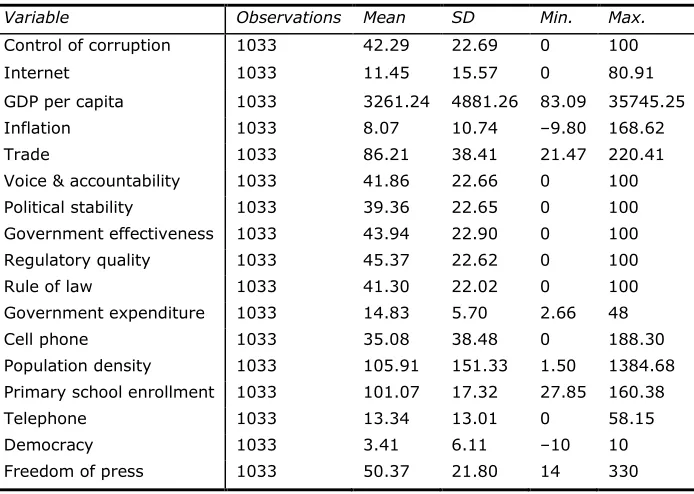
[image:5.612.125.472.356.603.2]Finally, we included measures of (l) democracy and (m) freedom of the press to explain movements in corruption. Our measure of democracy uses the Polity score from Marshall, Jaggers, and Gurr (2010), which captures a regime’s authority on a 21-point scale ranging from –10 (hereditary monarchy) to +10 (consolidated democracy).6 Freedom of the press is a composite non-negative index ranging from 0. The variable encompasses freedom in print, broadcast, and Internet media sources. The variable is readily available from Freedom House. Table 1 presents the summary statistics.
Table 1. Summary Statistics.
Variable Observations Mean SD Min. Max.
Control of corruption 1033 42.29 22.69 0 100
Internet 1033 11.45 15.57 0 80.91
GDP per capita 1033 3261.24 4881.26 83.09 35745.25
Inflation 1033 8.07 10.74 –9.80 168.62
Trade 1033 86.21 38.41 21.47 220.41
Voice & accountability 1033 41.86 22.66 0 100
Political stability 1033 39.36 22.65 0 100
Government effectiveness 1033 43.94 22.90 0 100
Regulatory quality 1033 45.37 22.62 0 100
Rule of law 1033 41.30 22.02 0 100
Government expenditure 1033 14.83 5.70 2.66 48
Cell phone 1033 35.08 38.48 0 188.30
Population density 1033 105.91 151.33 1.50 1384.68 Primary school enrollment 1033 101.07 17.32 27.85 160.38
Telephone 1033 13.34 13.01 0 58.15
Democracy 1033 3.41 6.11 –10 10
Freedom of press 1033 50.37 21.80 14 330
Econometric Methodology
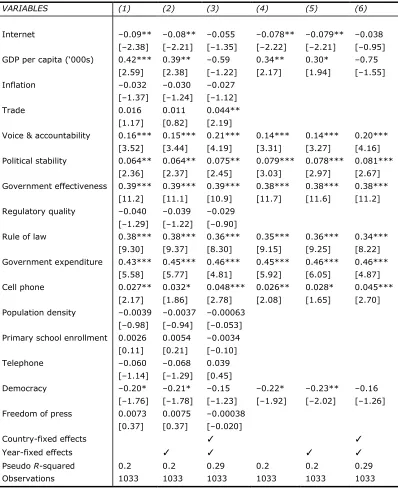
The dependent variable, control of corruption, is censored from 0 to 100. There are two options available for dealing with this type of variable in econometric analysis. The first option (presented in Tables 2 and 3) is to fit a Tobit model for panel data. Columns 1 and 4 in each table fit random-effects Tobit models. Columns 2 and 5 include year-fixed effects, whereas columns 3 and 6 include both year- and country-fixed effects. Note, however, that the maximum likelihood estimator in Tobit panel-data models with fixed effects can be biased and inconsistent when the length of the panel is small and fixed.7 As a result, the second option (see Table 4) is to follow Cameron and Trivedi (2005) and transform the corruption variable (cc) to an unbounded variable (ccʹ) in the following manner:
. (1)
The regressor ( ) computed from using ccʹ as the dependent variable must consequently be transformed as follows prior to interpretation:
, (2)
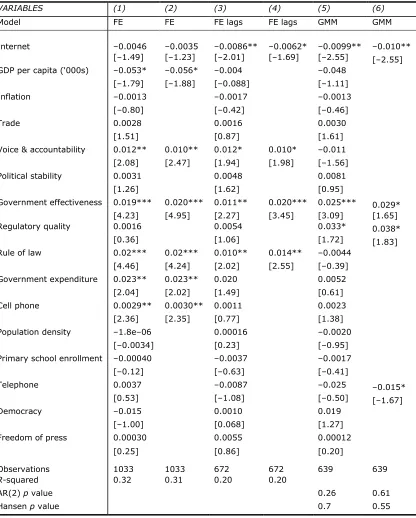
where b is analogous to a regressor obtained from a simple Tobit regression model. The variable ccʹ is used to fit two-way fixed effects and generalized method of moments (GMM) regressions in Columns 1–4 and Columns 5–6 of Table 4, respectively.8
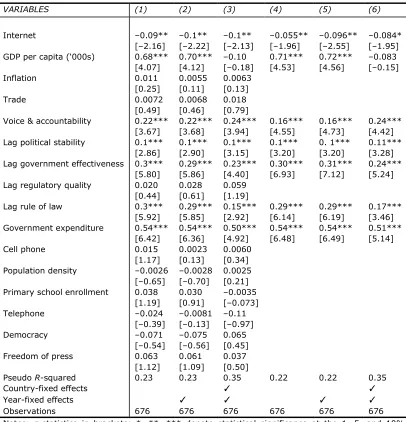
It is possible that a number of the explanatory variables introduced in the previous section are endogenous with the dependent variable. This is particularly true for those variables that are also measured as perceptions of the quality of governance, which come from the same surveys. Durbin-Wu-Hausman tests found that voice and accountability, government effectiveness, regulatory quality, and rule of law are endogenous at the 5% level of significance. In the absence of natural instruments, we used two different methods to account for this problem. First, Table 3 uses one-year-lagged values of the endogenous variables to ensure that causality goes in the right direction. We use a similar method in Columns 3–4 of Table 4 with the unbounded variable as the dependent variable.
In Columns 5–6 of Table 4, we also use difference GMM, which handles the estimation of endogenous panels using internal instruments (our preferred specification). The AR(2) tests at the bottom of the table show that the first-differenced error term is not serially correlated. AR(1) values are not reported, as they are expected to reject the null hypothesis of no serial correlation when using first-differenced equations. The Hansen statistic at the end of the table shows that the instruments are exogenous as a group. This statistic is preferred to the Sargan test when standard errors are robust to heteroscedasticity and to serial correlation, as in this case.
7 The implications of this for the current study are discussed below.
Following Bertrand, Dufloand, and Mullainathan (2004), the standard errors in Table 4 are clustered by country, as this allows for arbitrary error correlations among country-year observations within each country, as these specify standard errors that are asymptomatically robust to serial correlation. Heteroscedastically robust standard errors are also computed. Note that all specifications employ time-period dummies.
Results
Tables 2 and 3 present the results from the Tobit models, and Table 4 presents the results from the fixed-effects and GMM models using the unbounded dependent variable. The tables show a positive and significant relationship between the rise of Internet usage and perceived corruption. The Tobit models with and without year-fixed effects in Table 2 (Columns 1, 2, 4, and 5) show that if an additional 10 out of every 100 people in a developing country (in our sample) obtain access to the Internet, then the control of corruption index will decrease 0.85 points. The coefficient estimates from the two-way fixed effects model are found to be negative but statistically insignificant (p values in Columns 3 and 6 are 0.18 and 0.34, respectively). The insignificance of these coefficient estimates, however, is likely to stem from the fact that fitting unconditional fixed effects in Tobit models generates biased likelihood estimators. The coefficient estimates from Table 3, which addresses potential endogeneity issues, are consistent with those found in Table 2. Moreover, the effect of Internet usage on cc is robust to the inclusion of two-way fixed effects in that case.
As above, the coefficient estimates for the effect of Internet usage on the uncensored corruption index (ccʹ) are found to be statistically significant only when we attempt to address the aforementioned endogeneity problem. In Columns 1 and 2 of Table 4, the effect of Internet usage is found to be negative and marginally insignificant (the p values corresponding to the coefficient estimates are 0.14 and 0.22, respectively). The two-way fixed effects with lagged endogenous variables and the GMM models indicate that if Internet usage increases by an additional 10 percent of the population, then cc will decrease by approximately 0.5 points.9 Overall, these results suggest that the information the average citizen in a developing country is receiving from the World Wide Web results in a deteriorating view of the state of corruption in their country, ceteris paribus.
In discussing the remaining variables, we focus on our preferred specification, the GMM models of Table 4. However, the results from these models are consistent with those found in Tables 2 and 3. Greater perceptions of government effectiveness are unsurprisingly found to negatively and significantly decrease perceptions of corruption within countries. The GMM models suggest that an increase in perceptions of government effectiveness by 1 standard deviation (26 index points) is associated with a 13-index-point increase in control of corruption. Similar results are obtained from Tables 2 and 3.
An improvement in perceptions of regulatory quality is found to significantly decrease perceptions of corruption within countries. The GMM models in Table 4 suggest that a 1-standard-deviation increase in the regulatory quality index (23 index points) is associated with an 11.5 point increase in the cc index,
ceteris paribus. These coefficient estimates could not be replicated in the fixed-effects and Tobit models, however, and must therefore be interpreted with caution.
Results from Internet usage in Column 6 of Table 4 also suggest that greater communication among individuals in the form of telephone calls can increase perceptions of corruption. The results show that if an additional 10 out of 100 people get access to telephone lines, then the control of corruption index will decrease by 0.5 points. Note, however, that this result could not be replicated in the fixed-effects and Tobit models. One possibility behind this inconsistency may be due to the collinearity between telephone and Internet usage (correlation coefficient is 0.67). Telephone infrastructure in developing countries is a necessary condition for Internet usage.10
The remaining explanatory variables are found to be insignificant in the GMM models. However, as expected, voice and accountability, rule of law, political stability, and government expenditure are also found to be positive and significant in Tables 2 and 3. Table 3, for instance, indicates that an increase in voice and accountability in the previous year by 1 standard deviation (26 index points) will result in an increase in control of corruption perceptions by 5 index points. Not surprisingly, an increase in rule of law by 1 standard deviation (25 index points) is found to increase the control of corruption index by 7.5 points. Similarly, an increase in political stability by one standard deviation (27 index points) is found to increase the control of corruption index by approximately 2 points. Finally, note that Tables 2 and 3 also show that an increase in government expenditure by one standard deviation (6% of GDP) will result in a rise of the control of corruption index by 3 points. This may result from the government being seen as active in the promotion of public goods and services to the public.
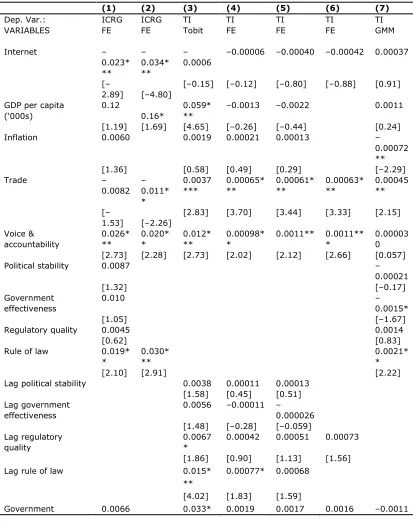
The data section of this article argues that cc is our preferred measure of perceptions of corruption but that this is not the only available measure. Therefore, Table 5 presents the results of a set of robustness exercises using the aforementioned TI measure and the well-known political corruption component of the Political Risk Index used for the International Country Risk Guide rating (ICRG). The Political Risk index is based on 100 points, ranging from 0 to 100—the higher the measure, the lower the risk. Note that this measure is solely used as a robustness exercise, as it is a measure of political instability caused by corruption, not an index of perceptions of corruption. Hence, cc and the ICRG measure could be potentially very different—the correlation coefficient between cc and the ICRG index is 0.76 and significant at the 1% level (Graf Lambsdorff, 2005).
Table 2. Tobit Regressions, Dependent Variable: Perceptions of Corruption.
VARIABLES (1) (2) (3) (4) (5) (6)
Internet –0.09** –0.08** –0.055 –0.078** –0.079** –0.038 [–2.38] [–2.21] [–1.35] [–2.22] [–2.21] [–0.95] GDP per capita (‘000s) 0.42*** 0.39** –0.59 0.34** 0.30* –0.75
[2.59] [2.38] [–1.22] [2.17] [1.94] [–1.55]
Inflation –0.032 –0.030 –0.027
[–1.37] [–1.24] [–1.12]
Trade 0.016 0.011 0.044**
[1.17] [0.82] [2.19]
Voice & accountability 0.16*** 0.15*** 0.21*** 0.14*** 0.14*** 0.20*** [3.52] [3.44] [4.19] [3.31] [3.27] [4.16] Political stability 0.064** 0.064** 0.075** 0.079*** 0.078*** 0.081***
[2.36] [2.37] [2.45] [3.03] [2.97] [2.67] Government effectiveness 0.39*** 0.39*** 0.39*** 0.38*** 0.38*** 0.38***
[11.2] [11.1] [10.9] [11.7] [11.6] [11.2] Regulatory quality –0.040 –0.039 –0.029
[–1.29] [–1.22] [–0.90]
Rule of law 0.38*** 0.38*** 0.36*** 0.35*** 0.36*** 0.34*** [9.30] [9.37] [8.30] [9.15] [9.25] [8.22] Government expenditure 0.43*** 0.45*** 0.46*** 0.45*** 0.46*** 0.46***
[5.58] [5.77] [4.81] [5.92] [6.05] [4.87] Cell phone 0.027** 0.032* 0.048*** 0.026** 0.028* 0.045***
[2.17] [1.86] [2.78] [2.08] [1.65] [2.70] Population density –0.0039 –0.0037 –0.00063
[–0.98] [–0.94] [–0.053] Primary school enrollment 0.0026 0.0054 –0.0034
[0.11] [0.21] [–0.10]
Telephone –0.060 –0.068 0.039
[–1.14] [–1.29] [0.45]
Democracy –0.20* –0.21* –0.15 –0.22* –0.23** –0.16
[–1.76] [–1.78] [–1.23] [–1.92] [–2.02] [–1.26] Freedom of press 0.0073 0.0075 –0.00038
[0.37] [0.37] [–0.020]
Country-fixed effects ✓ ✓
Year-fixed effects ✓ ✓ ✓ ✓
Pseudo R-squared 0.2 0.2 0.29 0.2 0.2 0.29
Observations 1033 1033 1033 1033 1033 1033
Table 3. Tobit Regressions with Lagged Dependent Variables, Dependent Variable: Perceptions of Corruption.
VARIABLES (1) (2) (3) (4) (5) (6)
Internet –0.09** –0.1** –0.1** –0.055** –0.096** –0.084*
[–2.16] [–2.22] [–2.13] [–1.96] [–2.55] [–1.95] GDP per capita (‘000s) 0.68*** 0.70*** –0.10 0.71*** 0.72*** –0.083
[4.07] [4.12] [–0.18] [4.53] [4.56] [–0.15]
Inflation 0.011 0.0055 0.0063
[0.25] [0.11] [0.13]
Trade 0.0072 0.0068 0.018
[0.49] [0.46] [0.79]
Voice & accountability 0.22*** 0.22*** 0.24*** 0.16*** 0.16*** 0.24*** [3.67] [3.68] [3.94] [4.55] [4.73] [4.42] Lag political stability 0.1*** 0.1*** 0.1*** 0.1*** 0. 1*** 0.11***
[2.86] [2.90] [3.15] [3.20] [3.20] [3.28] Lag government effectiveness 0.3*** 0.29*** 0.23*** 0.30*** 0.31*** 0.24***
[5.80] [5.86] [4.40] [6.93] [7.12] [5.24] Lag regulatory quality 0.020 0.028 0.059
[0.44] [0.61] [1.19]
Lag rule of law 0.3*** 0.29*** 0.15*** 0.29*** 0.29*** 0.17*** [5.92] [5.85] [2.92] [6.14] [6.19] [3.46] Government expenditure 0.54*** 0.54*** 0.50*** 0.54*** 0.54*** 0.51***
[6.42] [6.36] [4.92] [6.48] [6.49] [5.14]
Cell phone 0.015 0.0023 0.0060
[1.17] [0.13] [0.34] Population density –0.0026 –0.0028 0.0025
[–0.65] [–0.70] [0.21] Primary school enrollment 0.038 0.030 –0.0035
[1.19] [0.91] [–0.073]
Telephone –0.024 –0.0081 –0.11
[–0.39] [–0.13] [–0.97]
Democracy –0.071 –0.075 0.065
[–0.54] [–0.56] [0.45]
Freedom of press 0.063 0.061 0.037
[1.12] [1.09] [0.50]
Pseudo R-squared 0.23 0.23 0.35 0.22 0.22 0.35
Country-fixed effects ✓ ✓
Year-fixed effects ✓ ✓ ✓ ✓
Observations 676 676 676 676 676 676
Table 4. Fixed Effects and GMM Regressions, Dependent Variable: Perceptions of Corruption (Uncensored).
VARIABLES (1) (2) (3) (4) (5) (6)
Model FE FE FE lags FE lags GMM GMM
Internet –0.0046 –0.0035 –0.0086** –0.0062* –0.0099** –0.010**
[–1.49] [–1.23] [–2.01] [–1.69] [–2.55] [–2.55]
GDP per capita (‘000s) –0.053* –0.056* –0.004 –0.048
[–1.79] [–1.88] [–0.088] [–1.11]
Inflation –0.0013 –0.0017 –0.0013
[–0.80] [–0.42] [–0.46]
Trade 0.0028 0.0016 0.0030
[1.51] [0.87] [1.61]
Voice & accountability 0.012** 0.010** 0.012* 0.010* –0.011
[2.08] [2.47] [1.94] [1.98] [–1.56]
Political stability 0.0031 0.0048 0.0081
[1.26] [1.62] [0.95]
Government effectiveness 0.019*** 0.020*** 0.011** 0.020*** 0.025*** 0.029*
[4.23] [4.95] [2.27] [3.45] [3.09] [1.65]
Regulatory quality 0.0016 0.0054 0.033* 0.038*
[0.36] [1.06] [1.72] [1.83]
Rule of law 0.02*** 0.02*** 0.010** 0.014** –0.0044
[4.46] [4.24] [2.02] [2.55] [–0.39]
Government expenditure 0.023** 0.023** 0.020 0.0052
[2.04] [2.02] [1.49] [0.61]
Cell phone 0.0029** 0.0030** 0.0011 0.0023
[2.36] [2.35] [0.77] [1.38]
Population density –1.8e–06 0.00016 –0.0020
[–0.0034] [0.23] [–0.95]
Primary school enrollment –0.00040 –0.0037 –0.0017
[–0.12] [–0.63] [–0.41]
Telephone 0.0037 –0.0087 –0.025 –0.015*
[0.53] [–1.08] [–0.50] [–1.67]
Democracy –0.015 0.0010 0.019
[–1.00] [0.068] [1.27]
Freedom of press 0.00030 0.0055 0.00012
[0.25] [0.86] [0.20]
Observations 1033 1033 672 672 639 639
R-squared 0.32 0.31 0.20 0.20
AR(2) p value 0.26 0.61
Notes: Robust Huber-White corrected t-statistics in brackets; *, **, *** denote statistical significance at the 1, 5, and 10% levels, respectively. Control of corruption is unbounded following Cameron and Trivedi (2005). Fixed-effects regressions include country- and year-fixed effects. GMM regressions are differenced and include year-fixed effects. Voice and accountability, political stability, government effectiveness, regulatory quality, and rule of law are lagged by one period in Columns 3 and 4.
The econometric techniques presented in Table 5 closely mirror those presented in previous tables. Columns 1 and 2 show a fixed-effects model with the ICRG as the dependent variable. We were able to run a simple fixed-effects model because the index is not censored for any of these countries, and none of the explanatory variables were found to be statistically endogenous. Columns 3–7 show the results using the TI index as the explanatory variable. Column 3 presents a simple Tobit model. Columns 4–6 show variations of fixed-effects models. Note that endogenous variables are lagged by one year in Columns 3–6. Finally, Column 7 presents the GMM results.
Table 5. Fixed Effects, Tobit and GMM Regressions, Dependent Variables: ICRG and TI.
(1) (2) (3) (4) (5) (6) (7)
Dep. Var.: ICRG ICRG TI TI TI TI TI
VARIABLES FE FE Tobit FE FE FE GMM
Internet –
0.023* ** – 0.034* ** – 0.0006
–0.00006 –0.00040 –0.00042 0.00037
[–
2.89] [–4.80]
[–0.15] [–0.12] [–0.80] [–0.88] [0.91] GDP per capita
(‘000s)
0.12
0.16*
0.059* **
–0.0013 –0.0022 0.0011
[1.19] [1.69] [4.65] [–0.26] [–0.44] [0.24]
Inflation 0.0060 0.0019 0.00021 0.00013 –
0.00072 **
[1.36] [0.58] [0.49] [0.29] [–2.29]
Trade –
0.0082 – 0.011* * 0.0037 *** 0.00065* ** 0.00061* ** 0.00063* ** 0.00045 ** [–
1.53] [–2.26]
[2.83] [3.70] [3.44] [3.33] [2.15] Voice & accountability 0.026* ** 0.020* * 0.012* ** 0.00098* *
0.0011** 0.0011** *
0.00003 0
[2.73] [2.28] [2.73] [2.02] [2.12] [2.66] [0.057]
Political stability 0.0087 –
0.00021
[1.32] [–0.17]
Government effectiveness
0.010 –
0.0015*
[1.05] [–1.67]
Regulatory quality 0.0045 0.0014
[0.62] [0.83]
Rule of law 0.019*
*
0.030* **
0.0021* *
[2.10] [2.91] [2.22]
Lag political stability 0.0038 0.00011 0.00013
[1.58] [0.45] [0.51]
Lag government effectiveness
0.0056 –0.00011 –
0.000026
[1.48] [–0.28] [–0.059]
Lag regulatory quality
0.0067 *
0.00042 0.00051 0.00073
[1.86] [0.90] [1.13] [1.56]
Lag rule of law 0.015*
**
0.00077* 0.00068
[4.02] [1.83] [1.59]
expenditure **
[0.35] [3.60] [1.54] [1.40] [1.34] [–0.88]
Cell phone –
0.0021
0.0002 5
0.00013 –
0.000056
0.00002 8
[–
0.89]
[0.26] [1.00] [–0.30] [0.13]
Population density – 0.0027 7.1e– 06 – 0.000098 ** – 0.00012* ** – 0.00011* ** 0.00004 1 [– 1.08]
[0.023] [–2.14] [–2.79] [–3.97] [0.31] Primary school enrollment – 0.0026 0.0003 4
–7.4e–06 –0.00031 0.00057
*
[–
0.52]
[0.13] [–0.021] [–0.76] [1.74]
Telephone –
0.063* ** – 0.063* ** – 0.0007 6
–0.0019 –0.0021 –0.0022* – 0.00037
[–
3.34] [–3.58]
[–0.14] [–1.43] [–1.60] [–1.75] [–0.34]
Democracy –
0.063* * – 0.063* * – 0.0091 – 0.000043
–0.00024 0.0013*
*
[–
2.45] [–2.45]
[–0.90] [–0.074] [–0.43] [2.44]
Freedom of press 0.0002 8
0.0047 0.00015 7.5e–06 –
0.00005 4
[0.14] [1.15] [0.39] [0.018] [–0.69]
Constant 0.33
[0.75]
R-Squared 0.34 0.30 0.16 0.18 0.16
AR(2) p value 0.26
Hansen p value 0.62
Observations 685 685 420 420 420 420 350
Conclusion
This study investigates whether a relationship exists between Internet access and perceptions of corruption. We find evidence that access to the Internet has significantly influenced the populace in developing countries to generalize a perhaps ongoing dissatisfaction with government. This is not to say that these citizens were not otherwise aware of existing corruption but that the Internet has allowed people to harness their collective voices to incite action. As a caveat, this study measures only Internet access and not social media access, though there is a clear relationship between the two.
References
Anderson, L. (2011). Demystifying the Arab Spring: Parsing the differences between Tunisia, Egypt, and Libya. Foreign Affairs, 90(2).
Bardhan, P. (1997). Corruption and development: A review of the issues. Journal of Economic Literature 35, 155–194.
Bertrand, M., Dufloand, E., & Mullainathan, S. (2004). How much should we trust differences-in-differences estimates? Quarterly Journal of Economics, 119(1), 249–275.
Brunetti, A., & Weder, B. (2003). A free press is bad news for corruption. Journal of Public Economics, 87, 1801–1824
Cameron, A. C., & Trivedi, P. K. (2005). Supplement to microeconometrics: Methods and applications. New York, NY: Cambridge University Press.
Chowdhury, S. K. (2004). The effect of democracy and press freedom on corruption: An empirical test. Economic Letters, 85, 1020–1046.
Eltantawy, N. & Weist, J. B. (2011). Social media in the Egyptian revolution: Reconsidering mobilization theory. International Journal of Communication, 5, 1207–1224
Freille S., Haque, M. E., & Kneller, R. (2007). A contribution to the empirics of press freedom and corruption. European Journal of Political Economy, 27, 586–599
Graf Lambsdorff, J. (2005). Consequences and causes of corruption: What do we know from a cross-section of countries? 34(5). Passauer Diskussionspapiere: Volkswirtschaftliche Reihe.
Goel, R. K., Michael, N., Naretta, A., & Michael, A. (2012). The Internet as an indicator of corruption awareness. European Journal of Political Economy, 28, 64–75.
Gupta, S., Davoodi, H., & Alonso-Terme, R. (2002). Does corruption affect income inequality and poverty? Economics of Governance, 3(1), 23–45.
Kaufmann, D., Kraay, A., & Mastruzzi, M. (2006). Measuring governance using cross-country perceptions data. In S. Rose-Ackerman (Ed.), International Handbook on the Economics of Corruption, Cheltenham, UK: Edward Elgar.
Marshall, M. G., Jaggers, K., & Gurr, T. R. (2010). Polity IV: Political regime characteristics and transitions, 1800–2010. Retrieved from http://www.systemicpeace.org/polity/polity4.htm
Mauro, P. (1995). Corruption and growth. Quarterly Journal of Economics, 110(3), 681–712.
Mo, P. H. (2001). Corruption and economic growth. Journal of Comparative Economics, 29(1), 66–79.
O’Higgins, E. R. (2006). Corruption, underdevelopment, and extractive resource industries. Business Ethics Quarterly, 16(2), 235–254.
Olken, B. A., & Pande, R. (2011). Corruption in developing countries, NBER Working Paper No. 17398.
Pellegrini, L., & Gerlagh, R. (2004). Corruption’s effect on growth and its transmission channels. Kyklos, 57(3), 429–456.
Roycroft, T. R., & Anatho, S. (2003). Internet subscription in Africa: Policy for a dual digital divide. Telecommunications Policy, 27(1), 61–74.
Svensson, J. (2004). Eight questions about corruption. Journal of Economic Perspectives, 19(5), 19–42.
Treisman, D. (2007). What have we learnt about the causes of corruption from 10 years of cross-national empirical research? Annual Review of Political Science, 10, 211–244
Vaidya, S. (2005). Corruption in the media’s gaze. European Journal of Political Economy, 21, 667–687.
Whitten-Woodring, J., & James, P. (2012). Fourth estate or mouthpiece? A formal model of media, protest, and government repression. Political Communication, 29(2), 113–136.