21.1 Animals obtain and ingest their food in a
variety of ways
• Most animals have one of three kinds of diets.
1. Herbivores eat plants and include cattle, gorillas,
sea urchins, and snails.
2. Carnivores eat meat and include lions, owls,
whales, and spiders.
3. Omnivores eat plants and other animals and
21.1 Animals obtain and ingest their food in a
variety of ways
• Animals obtain and ingest their food in different
ways.
• Suspension feeders capture food particles from
the surrounding medium.
• Substrate feeders live in or on their food source
and eat their way through it.
• Fluid feeders suck nutrient-rich fluids from a living
host.
21.1 Animals obtain and ingest their food in a
variety of ways
Checkpoint question Red pandas munch large
21.2 Overview: Food processing occurs in
four stages
• Food is processed in four stages:
1. Ingestion
2. Digestion
3. Absorption
4. Elimination
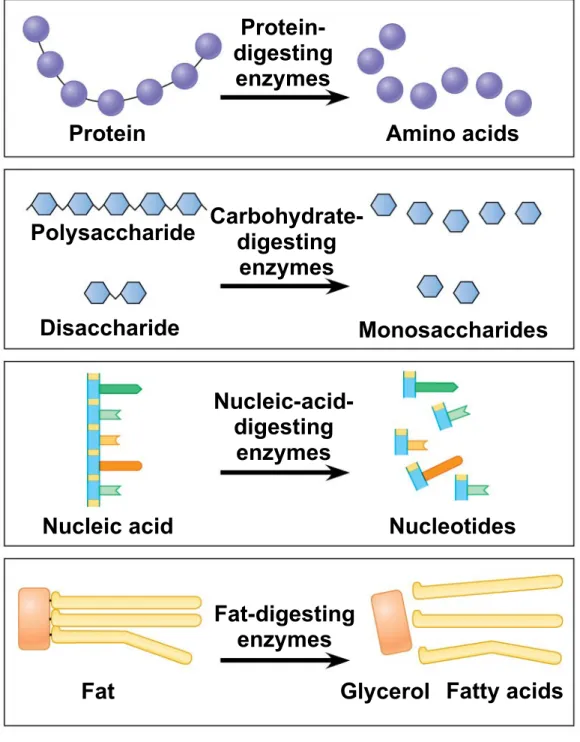
• Chemical digestion is necessary because animals cannot directly use the proteins, carbohydrates, fats, and nucleic acids in food.
Figure 21.2a
Pieces of food Mechanical
digestion Chemicaldigestion (hydrolysis) Small molecules Nutrient molecules enter body cells Undigested material Ingestion 2 Digestion 3 Absorption 4 Elimination
Figure 21.2b Food Molecules Protein-digesting enzymes Protein Carbohydrate-digesting enzymes Components Amino acids Polysaccharide Disaccharide Nucleic-acid-digesting enzymes Nucleic acid Fat-digesting enzymes Fat Monosaccharides Nucleotides
21.3 Digestion occurs in specialized
compartments
• Sponges and protists digest food in vacuoles. • Most animals digest food in compartments.
• Cnidarians and flatworms have a gastrovascular
cavity with a single opening, the mouth.
• Most animals have an alimentary canal that runs from mouth to anus with specialized regions along the way.
Checkpoint question What is an advantage of an
21.4 The human digestive system consists of
an alimentary canal and accessory organs
• In humans, food is
• ingested and chewed in the mouth, or oral cavity,
• pushed by the tongue into the pharynx,
• moved along through the alimentary canal by the rhythmic muscle contractions of peristalsis, and
• moved into and out of the stomach by sphincters.
• The final steps of digestion and nutrient absorption in humans occur in the small intestine.
• Undigested material moves slowly through the
21.5 Digestion begins in the oral cavity
• Mechanical digestion and chemical digestion begin in the mouth.
• Chewing cuts, smashes, and grinds food, making it
easier to swallow.
• The tongue
• tastes the food,
• shapes the food into a ball called a bolus, and
21.6 After swallowing, peristalsis moves food
through the esophagus to the stomach
• The pharynx, or throat, opens to two
passageways:
1. the esophagus (part of the digestive system) and
2. the trachea (or windpipe, part of the respiratory system).
• The swallowing reflex moves food into the esophagus and keeps it out of the trachea.
Checkpoint question What is happening in the
21.8 The stomach stores food and breaks it
down with acid and enzymes
• The stomach secretes a digestive fluid called
gastric juice, which is made up of a protein-digesting enzyme, mucus, and strong acid.
• Pepsinogen and HCl are secreted in the stomach.
• HCl converts some pepsinogen to pepsin.
Figure 21.8 Esophagus Sphincter Lumen (cavity) of stomach Sphincter Stomach
Inside of stomach
21.8 The stomach stores food and breaks it
down with acid and enzymes
Checkpoint question If you add pepsinogen to a
21.9 CONNECTION: Digestive ailments
include acid reflux and gastric ulcers
• Acid reflux of chyme from the stomach back into
the esophagus causes the feeling of heartburn.
• Gastroesophageal reflux disease (GERD) results
from frequent and severe acid reflux that harms the lining of the esophagus.
• Open sores in the lining of the stomach, called
gastric ulcers, may form.
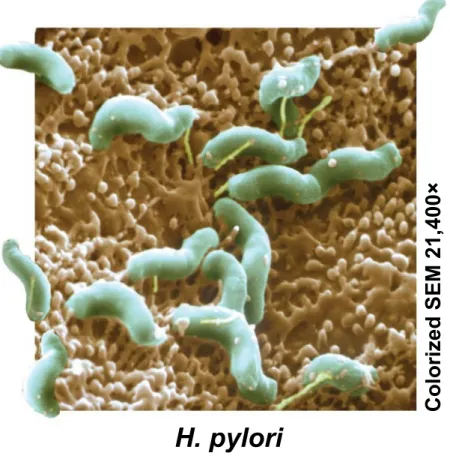
• Bacterial infections (Helicobacter pylori) in the
21.9 CONNECTION: Digestive ailments
include acid reflux and gastric ulcers
Checkpoint question In contrast to most microbes, the species that causes ulcers thrives in an
21.10 The small intestine is the major organ
of chemical digestion and nutrient absorption
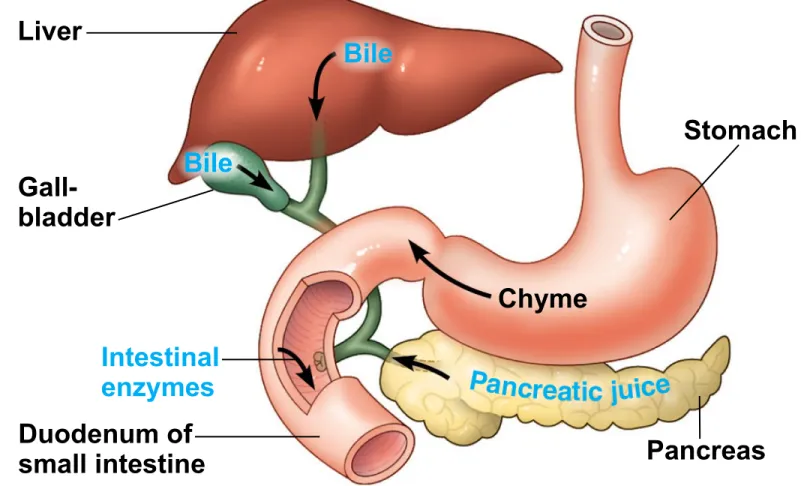
• Enzymes from the pancreas and cells of the
intestinal wall digest food molecules.
• Bile, made in the liver and stored in the
gallbladder, emulsifies fat for attack by enzymes.
• Folds of the intestinal lining and finger-like villi
(with microscopic microvilli) increase the area across which absorbed nutrients move into
Figure 21.10a
Liver
Stomach
Gall-bladder
Chyme
Intestinal enzymes Duodenum of
small intestine Pancreas
Bile
21.10 The small intestine is the major organ
of chemical digestion and nutrient absorption
21.11 The liver processes and detoxifies
blood from the intestines
• Blood from the digestive tract drains into the
hepatic portal vein and then into the liver.
• The liver regulates nutrient levels in the blood,
detoxifies alcohol and drugs, and synthesizes blood proteins.
Checkpoint question Between which two body
Figure 21.11
Heart
Liver
Hepatic portal vein
21.12 The large intestine reclaims water and
compacts the feces
• The large intestine has a pouch called the cecum
near its junction with the small intestine, which
bears a small, finger-like extension, the appendix.
• Some bacteria in the colon produce vitamins.
• The large intestine
• absorbs these vitamins and water into the bloodstream, and
• helps form firm feces, which are stored in the
21.12 The large intestine reclaims water and
compacts the feces
• Diarrhea occurs when too little water is reclaimed
from the contents of the large intestine.
• Constipation occurs when too much water is
reclaimed.
Checkpoint question Explain why treatment with
21.13 EVOLUTION CONNECTION:
Evolutionary adaptations of vertebrate
digestive systems relate to diet
• The length of the digestive tract often correlates with diet.
• Herbivores may have
• longer alimentary canals than carnivores and • compartments that house cellulose-digesting
microbes.
Checkpoint question Name two advantages of a
Figure 21.13
Stomach
Small intestine Cecum