Physical Quantities, Units and Measurement Physical Quantities, Units and Measurement
C h a p t e r
1
Introduction
what is physics
The dictionary definition of physics is “the study of matter, energy, and the interaction between them”, but what that really means is that physics is about asking fundamental questions and trying to answer them by observing and experimenting. Physicists ask really big questions like:
How did the universe begin? How will the universe change in the future? How does the Sun keep on shining? What are the basic building blocks of matter?
Physical Quantities, Units and Measurement Physical Quantities, Units and Measurement
C h a p t e r
1
PHYSICAL QUANTITIES
•
A quantity that can be measured.
•
A physical quantities have numerical value
and unit of measurement.
•
For example temperature 30 degrees
celcius, 30 is numerical value & ‘degree
celcius’ is the unit. Written as 30
oC
.Temperature = 30 degree Celcius = 30o c
Physical Quantities, Units and Measurement Physical Quantities, Units and Measurement
C h a p t e r
1
*The physical quantities can be classified into base
quantities
and derived quantities.
1-Base Quantities
are physical quantities that cannot
be derived from other physical quantities.
There are
seven base quantities
:
length mass time current
temperature,
Physical Quantities, Units and Measurement Physical Quantities, Units and Measurement
C h a p t e r
1
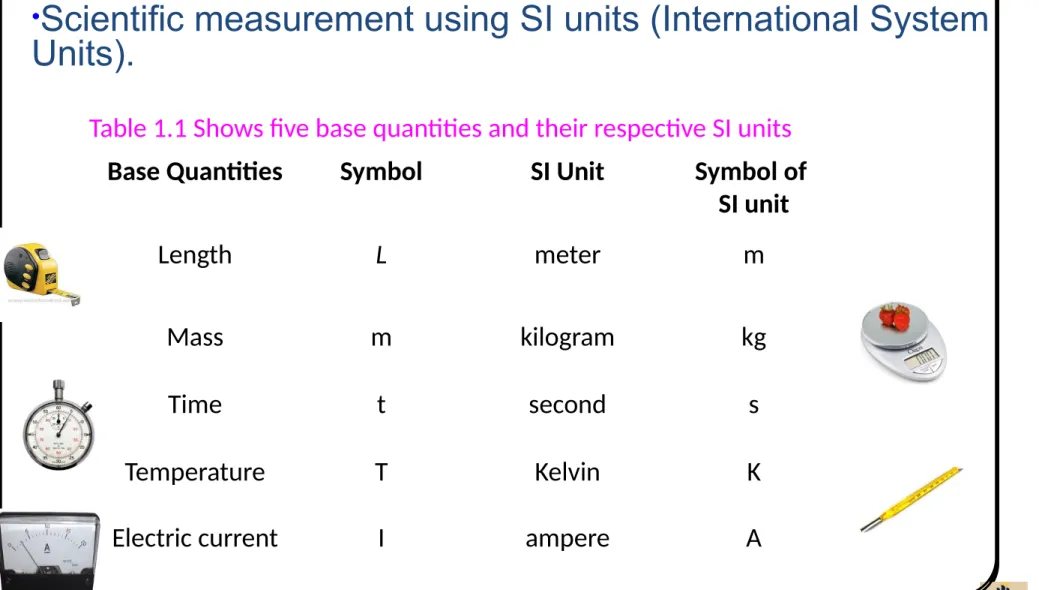
BASE QUANTITIES
•Scientific measurement using SI units (International System
Units).
Base Quantities Symbol SI Unit Symbol of SI unit
Length L meter m
Mass m kilogram kg
Time t second s
Temperature T Kelvin K
Electric current I ampere A
Physical Quantities, Units and Measurement Physical Quantities, Units and Measurement
C h a p t e r
1
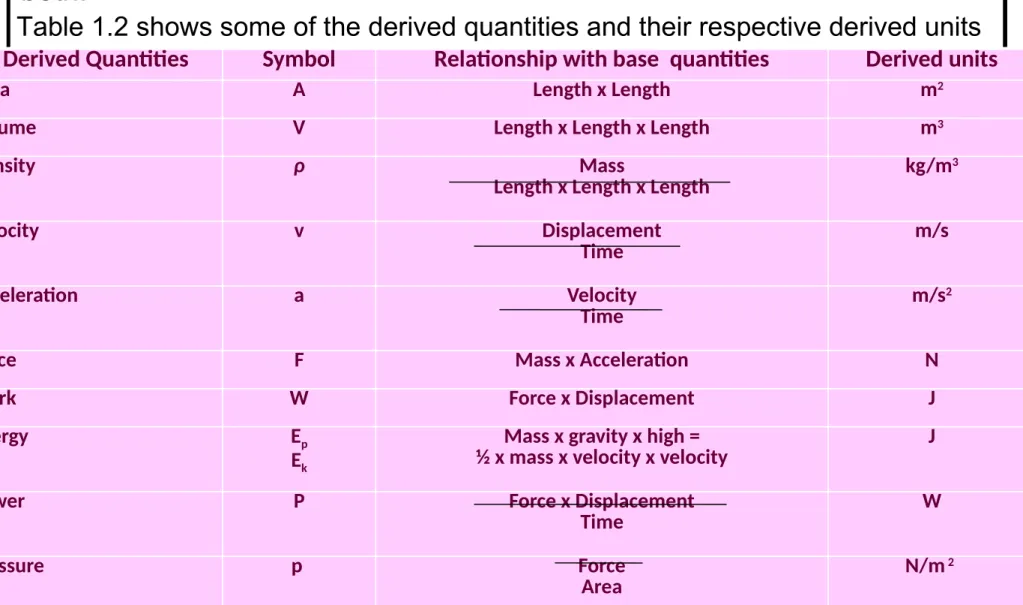
• 2-Derived Quantities :are physical quantities derived from
combination of base quantities through multiplication or division or both.
Derived Quantities Symbol Relationship with base quantities Derived units
Area A Length x Length m2
Volume V Length x Length x Length m3
Density ρ Mass
Length x Length x Length kg/m
3
Velocity v Displacement
Time m/s
Acceleration a Velocity
Time m/s
2
Force F Mass x Acceleration N
Work W Force x Displacement J
Energy Ep
Ek
Mass x gravity x high =
½ x mass x velocity x velocity J
Power P Force x Displacement
Time W
Pressure p Force
Area N/m
2
Physical Quantities, Units and Measurement Physical Quantities, Units and Measurement
C h a p t e r
1
• Vector quantities are quantities that have both
magnitude and direction
Magnitude = 100 N
Direction = Left A Force
The physical quantities can be classified into
Scalars and Vectors
Physical Quantities, Units and Measurement Physical Quantities, Units and Measurement
C h a p t e r
1
• Scalar quantities:
are quantities that have magnitude only.
Two examples are shown below:
Physical Quantities, Units and Measurement Physical Quantities, Units and Measurement
C h a p t e r
1
Mass
:
The amount of matter in a body.
• SI Units: kilogram (kg)
• Common Units:
pounds (lbs) and ounces (oz) 1 kg is approx. 2.2 lbs
1 kg = 1000 g 1 oz = 28.35 g
Physical Quantities, Units and Measurement Physical Quantities, Units and Measurement
C h a p t e r
1
Length: A measure of distance.
• SI Unit: meter (m)
• Common Units: inches (in); miles (mi) 1 in = 2.54 cm = 0.0254 m
1 mi = 1.609 km = 1609 m
Physical Quantities, Units and Measurement Physical Quantities, Units and Measurement
C h a p t e r
1
Volume: Amount of space occupied by a body.
• SI Unit: cubic meter (m3)
Physical Quantities, Units and Measurement Physical Quantities, Units and Measurement
C h a p t e r
1
Density: Amount of mass per unit volume of a substance.
•SI Units: kg/m3
•Common Units: g/cm3 or g/mL
Physical Quantities, Units and Measurement Physical Quantities, Units and Measurement
C h a p t e r
1
International system SI Unit (m K s)
International system (c g s) Unit
International system (f b s) Unit
Measuring Systems
Length
Mass
time
Meter m
Kilogram Kg
Second S
centimeter cm
Gram g
Second S
Foot ft
Bound b
Physical Quantities, Units and Measurement Physical Quantities, Units and Measurement
C h a p t e r
1
1.2 SI Units
• Example of derived quantity: area
Defining equation: area = length × width
In terms of units: Units of area = m × m = m2
Defining equation: volume = length × width × height
In terms of units: Units of volume = m × m × m = m3
Defining equation: density = mass ÷ volume
In terms of units: Units of density = kg / m3 = kg m−3
L
W
H
Physical Quantities, Units and Measurement Physical Quantities, Units and Measurement
C h a p t e r
1
1.2 SI Units
• Work out the derived quantities for:
Defining equation: velocity =
In terms of units: Units of speed = m/s
Defining equation: acceleration =
In terms of units: Units of acceleration = m/s2
Defining equation: force = mass × acceleration
In terms of units: Units of force = Kg m/s2
time
nt
displaceme
Physical Quantities, Units and Measurement Physical Quantities, Units and Measurement
C h a p t e r
1
Defining equation: Work = Force x Displacement
In terms of units: Units of Work = J = Kg m2/s2
1.2 SI Units
Defining equation: Energy = Mass x gravity x high
In terms of units: Units of Energy = J = Kg m2/s2
Defining equation: Power = Force x displacement / time
Defining equation: Pressure = Force / area
In terms of units: Units of Power = W = Kg m2/s3
Physical Quantities, Units and Measurement Physical Quantities, Units and Measurement
C h a p t e r
1
Temperature
:
is the measure of how hot or cold an object is.
• SI Unit: Kelvin (K)
• Common Units: Celsius (ºC) or Fahrenheit (ºF)
Converting between K , ºC and ºF:
T
K= T
C+273.15
T
C= T
K– 273.15
T
F= 9/5 T
C+ 32
Physical Quantities, Units and Measurement Physical Quantities, Units and Measurement
Physical Quantities, Units and Measurement Physical Quantities, Units and Measurement
C h a p t e r
1
“When the thermometer is held in the mouth or under the armpit of a living man in good health” it indicates 98 F
Black board example 19.1
a) What is the temperature in Celsius (centigrade)?
Physical Quantities, Units and Measurement Physical Quantities, Units and Measurement
C h a p t e r
1
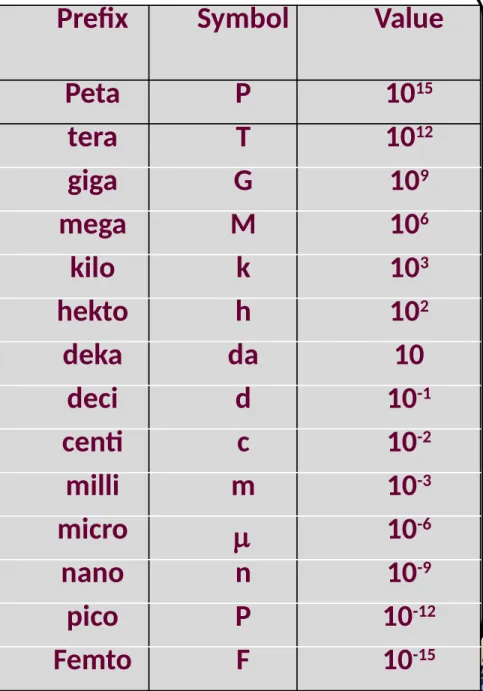
PREFIXES
• Prefixes :
• are used to simplify the
description of physical
quantities that are either very big or very small.
Prefix Symbol Value
Peta P 1015
tera T 1012
giga G 109
mega M 106
kilo k 103
hekto h 102
deka da 10
deci d 10-1
centi c 10-2
milli m 10-3
micro m 10-6
nano n 10-9
pico P 10-12
Femto F 10-15
Physical Quantities, Units and Measurement Physical Quantities, Units and Measurement
C h a p t e r
1
STANDARD FORM
Standard form or scientific notation is used to express magnitude in
a simpler way. In scientific notation, a numerical magnitude can be written as : A x 10n, where 1 ≤ A < 10 and n is an integer
For each of the following, express the magnitude using a scientific notation.
1-20000000 2-345000 3-0.0000023 4-0.00000006 5-123402123100 Solution:
1- 2x 10⁷ 2- 345x 103
3- 23x 10-6
4- 6x 10⁻⁸
Physical Quantities, Units and Measurement Physical Quantities, Units and Measurement
C h a p t e r
1
Dimensional Analysis
The word dimension in physics indicates the physical
nature of the quantity. For example the distance
has a dimension of
length
, and the speed has a
dimension of
length
/
time
.
Physical Quantities, Units and Measurement Physical Quantities, Units and Measurement
C h a p t e r
1
Example
Using the dimensional analysis check that this equation x = ½
at2 is correct, where x is the distance, a is the acceleration and t is the time.
Solution
x
= ½
at
2
Physical Quantities, Units and Measurement Physical Quantities, Units and Measurement
C h a p t e r
1
Example
Show that the expression
v =
v
o+ at is dimensionally
correct, where v and v
oare the velocities and a is the
acceleration, and t is the time
Solution
The right hand side
[
v
] = L/T
The left hand side
L/T + L/T
Physical Quantities, Units and Measurement Physical Quantities, Units and Measurement
C h a p t e r
1
Example
Suppose that the acceleration of a particle moving in circle of radius r with uniform velocity v is proportional to the rn and vm. Use the dimensional analysis
to determine
the power n and m.
Solution
Let us assume a is represented in this expression
a
=
k r
nv
mWhere k is the proportionality constant of dimensionless unit. The right hand side
n+m=1 and m=2 Therefore. n =-1 and the acceleration a is
Physical Quantities, Units and Measurement Physical Quantities, Units and Measurement
C h a p t e r
1
Exercise
Part A:
See if you can determine the dimensions of the following quantities:
volume
acceleration (velocity/time) density (mass/volume)
force (mass × acceleration) charge (current × time)
Check your answers
You are correct if you wrote down:
1.Volume L3
2.acceleration (velocity/time) L/T2
3.density (mass/volume) M/L3
4.force (mass × acceleration) M·L/T2
Physical Quantities, Units and Measurement Physical Quantities, Units and Measurement
C h a p t e r
1
answers
1. pressure (force/area) M·L-1·T-2
2. (volume)2 L6
3. work (in 1-D, force × distance) M·L2/T2
4.
energy (e.g., gravitational potential energy = mgh = mass × gravitational acceleration × height)
M·L2/T2
Now find the dimensions of these:
1.pressure (force/area) 2.(volume)2
3.work (in 1-D, force × distance)
4.energy (e.g., gravitational potential energy = mgh
Physical Quantities, Units and Measurement Physical Quantities, Units and Measurement
C h a p t e r
1
Which one of the following quantities are dimensionless?
1
-68
2
-sin
(68 )
3
-e
4
-force
5
-6
6
-frequency
Physical Quantities, Units and Measurement Physical Quantities, Units and Measurement
C h a p t e r
1
What are the dimensions of the following?
1.[sin (
w
t)]
2.[3]
3.[force]
4.[height]
5.[frequency]