10
PERFORMANCE MANAGEMENT AND DEVELOPMENT SYSTEMS
WITH BALANCED SCORECARD AS A PERFORMANCE APPRAISAL
TOOL AT A SELECTED Eastern Cape Hospital – A Case Study Approach
Adekanbi Busola Adejoke
Masters Research Student –Management College of Southern Africa (Mancosa)
Prof M.S.Bayat
Director –Management College of Southern Africa (Mancosa)
ABSTRACT
Performance management includes activities that ensure that organisation goals are consistently being met effectively and efficiently. The performance appraisal is a review and discussion of an employee’s performance of assigned duties and responsibilities.
Presently, in the Eastern Cape Department of Health, the performance appraisal tool used is the Performance Management and Development System (PMDS). Despite its policy’s review over the years, workers are of the opinion that it does not eliminate the problems encountered while implementing PMDS. The Balanced Scorecard (BSC) which could be integrated with the PMDS in order to identify performance enhancement and to help promote professional growth.
The Balanced scorecard ensures that the visions and goals of the organisation are met, ensuring strategic decision making at the top management level.
An Organisation can develop its vision or strategic intent in order to achieve its mission and implement its strategies. The Organisation’s ability to be a success depends on the performance of its staff and the BSC which also help in aligning their performance and the strategies would be useful.
The PMDS and BSC combined would not only be a measurement system but also a management system that enables organisation to identify their strategies and transform them into actions.
INTRODUCTION AND BACKGROUND
Performance management is an aspect of management that is described by Dr. Aubrey C. Daniels in late 1970s has a technology for managing both results and behaviour. Its main purpose is to enhance quality, reduce cost and converge processes in new ways to achieve goals and respond to challenges (Saxena, 2010:27). To implement this aspect of management, a well designed measure needs to be carried out in order to bring out the best in people and thereby affecting the long-term goal of the organisation.
11
in assessing or appraising individual staff’s performance periodically to ascertain that they perform according to the organisation criteria or objectives.
Several performance measures are used in different organisations but for the purpose of this study, the researcher intends to integrate the balanced scorecard with the existing performance measurement framework that is currently in use in the department of health.
The assessment of individual employee is based on a proposed framework in which ratings outcomes are influenced by interactions between individuals and in the context in which assessment occurs. Improvement of performance generally benefits from frequent feedback on specific performance dimension (Govaerts, Van Der Vleuten, Schuwirth, and Muijtjens, 2007:246). According to the Eastern Cape Provincial Performance Management and Development System manual, the PMDS review task team recommended some non-negotiables which includes that; each staff member must receive feedback on their performance outside of the formal review done on annual basis, feedback based on 360 degree principle, except in cases where it is practically impossible to achieve, in the event of disagreements arising with regard to either measures that have been set or the final evaluation, each staff member is entitled to voice his or her disagreement and have it dealt with procedurally (ECPMDM,2013/2014:14) Whereas the summative assessment could have its flaws in that performance ratings could be inflated (Govaerts et.al. 2007:247). Raters will tend to bias their decisions towards what is acceptable to others. They may feel accountable to their supervisors (and management) and to the ratees. It is therefore in the interest of an organization to maximize the effectiveness of performance appraisal by reducing the rater errors (Zewotir, 2011:44).
In a performance appraisal setting, a rater’s reactions to accountability include efforts to enhance or protect his or her self-image and attempts to maximize rewards and minimize punishment (Lerner and Tetlock, 1999); cited in (Palmer and Feldman, 2005).
Performance appraisal systems are improved by rectifying common shortcomings, for example; reducing bias, training those involved and using a format with research substantiation (Kondrasuk, 2011).
Organisations adopt performance measurement systems for various reasons, especially the Balanced Scorecard (BSC), according to Kaplan and Norton (1996); a typical BSC may employ 20-25 measures. However, in almost all cases, when developing a BSC the people involved in the process end up with a huge list of measures. Identifying which measure should be employed for the development of the BSC is a crucial step (Valiris, Chytas, and Glykas 2005:159)
PURPOSE OF THE STUDY
The aim of the study is to evaluate the integration of PMDS and balanced scorecard in the appraisal of health care staff at Mthatha General Hospital, Eastern Cape.
12
To evaluate the effectiveness of PMDS as the current performance appraisal tool.
To determine the impact of using BSC on healthcare staff.
To analyse how the PMDS and BSC can be integrated in healthcare
To make recommendations to Mthatha General Hospital on the integration of PMDS and BSC
RESEARCH QUESTIONS
How effective is the PMDS as a performance appraisal tool?
What is the impact of using BSC as a performance appraisal tool in Health care sector?
How can PMDS and BSC be integrated?
What are the possible recommendations for integration of PMDS and BSC in Healthcare?
PROBLEM STATEMENT
Health care managers use Performance Management Development System (PMDS) to appraise the performance of the staffs within the health sector. This appraisal tool has its limitation in the aspects of aligning individual staff performance with the overall goal and vision of the health care sector, its evaluation is done in a summative assessment thereby, concentrating on improving on weighted self assessment scores as oppose to self development and unaware of their weaknesses. The balanced scorecard is an appraisal tool which can be based on results obtained by the employee in his/ her job, not on the employees’ personal characteristics; therefore, it is not biased, the balanced score card provides complex information to managers at a glance and facilitates strategic management decision making. The study will therefore aim to validate the use of the balance scorecard in Mthatha General Hospital, Eastern Cape.
SIGNIFICANCE OF THE STUDY.
PMDS covers knowledge, skills, behaviours and attributes required to assess the performance expectations of the employees by the employer.
In recent times, research has been done on balanced scorecard and has been introduced in the healthcare sector in developed countries such as the United Kingdom, USA, Asia and some other European countries.
The balanced scorecard measures skills and accomplishment with reasonable accuracy and uniformity. It provides a way to help identify areas of performance enhancement and also to help promote organisation’s goal. The researcher intends to evaluate how both tools can be used in the health care sector by complementing each other.
The findings from the research could be implemented at Mthatha General Hospital to improve on the performance of the hospital by not only assessing personal characteristics but also to ensure team effectiveness among member of staff by identifying their strengths and weaknesses and also to create opportunities for improvement.
13
LIMITATION OF THE STUDY
Limited number of workers are aware of balanced scorecard. As BSC include customer’s perspective, in the case of healthcare, patients would not be a part of the research.
PERFORMANCE MANAGEMENT AND DEVELOPMENT SYSTEM IN SOUTH AFRICA
Performance Management and Development System (PMDS), was authorized by the Public Service Regulations, 2001 (Chapter 1, Part VIII) and it has been in use since.
Previously in South Africa, the PMDS comprises of the Individual Work plan agreement, Standard Framework agreement and the Assessment instrument. Following the reviews and evaluation by the department of public expenditure and reform, it was found out that the PMDS has not been working well as it should. It was discovered that the PMDS needs to be streamlined and simplified. (PMDS Guidelines, 2011)
PERFORMANCE MANAGEMENT IN AN ORGANISATION
Performance management can focus on the performance of an organisation by ensuring that employees’ activities are congruent with the organisational goals (Noe, Hollenbeck, Gerhart and Wright 2010:343), reviewing and discussing the employees’ performance in their various assigned duties and responsibilities is of utmost importance to improve and focus on the organisational goal.
The Hospital has its means of ensuring the performance of staff. This involves appraisal of excellent performance through the means of completing a form known as the Performance Management and Development Service (PMDS). The form covers various aspect of employer’s expectation of individual staff in terms of their skills, knowledge, behaviours and attitudes required to assess their performance based on the PMDS policy of the Health Department in the Province.
Once the individual staff is employed, he/she would complete the Performance Work Plan Agreement, which would be used as the basis for assessing the suitability of the employee and to assess the employee has met the performance expectations applicable to the job.
In the event that the employee has significantly exceeded the performance expectations, the employee may qualify for appropriate rewards.
BALANCED SCORECARD APPROACH
14
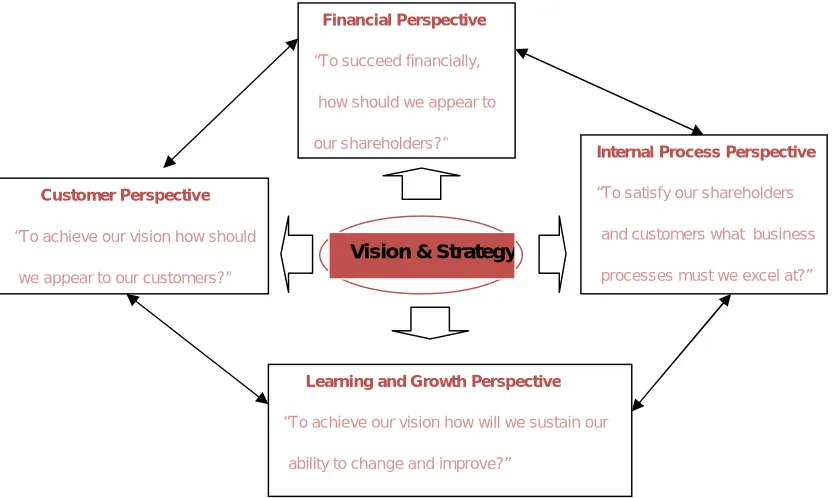
According to Hodgkinson and Kelly (2007:83) cited in Kampanje (2012), a BSC can be seen as a strategic management system, the model facilitates the translation of an organisation’s vision and strategy into objectives, measures and targets in four different areas: the financial perspectives, the customers perspectives, the internal business perspectives and the innovation/Learning and growth perspectives.
Figure 1: Perspectives of the Balanced Scorecard.
Balanced Scorecard as Management Framework (Pravdic, 2012:108)
According to Kaplan and Norton, (1992) and Kaplan and Norton (1996), in the center of all of the four areas is the mission and vision of the organisation. This is where the key performance indicators are derived from to enhance implementation of the organisations strategy. The balance with the balanced scorecard model comes only not from the four perspectives, but that they have different timelines in mind. The financial perspective deals with the current state of business, the customer and internal-business-process look to achieve the future financial goals and objectives, while the learning and growth perspective deals with the improvement and effectiveness of customer and internal-business-process perspectives achievement by closing the gap in between the perspectives. This all makes the Balanced scorecard not only a four perspectives separate from each other, but a full circle approach to making organisations work and achieve financial goals today, tomorrow and years in to the future. It is a tool for continues improvement and approach like the Plan-Do-Check-Act cycle or other quality assurance models. (Fronnt, 2010:21)
However, in November 2011, it was done through the introduction of a new PMDS form where a single form replaced the three separate forms which have covered each stage of the traditional PMDS cycle.
Financial Perspective
“To succeed financially,
how should we appear to
our shareholders?”
Customer Perspective
“To achieve our vision how should
we appear to our customers?”
Internal Process Perspective
“To satisfy our shareholders
and customers what business
processes must we excel at?”
Learning and Growth Perspective
“To achieve our vision how will we sustain our
ability to change and improve?”
15
The Performance Management and Development System (PMDS) is a performance management tool that is intended to monitor the performance of public officials. The necessity of effectively monitoring and evaluating officials is imperative because this would indicate whether or not officials are attaining prescribed performance standards. If the prescribed standards are not attained, corrective measures need to be taken to prevent a potential case of poor performance occurring in the department (Omotoye and Malan, 2011:166).
The PMDS policy was last reviewed in 2011 in South Africa by the Directorate of Human Capital Measurement where the roles and responsibilities of employees were listed.
INTEGRATION OF PERFORMANCE MANAGEMENT AND DEVELOPMENT SYSTEM WITH BALANCED SCORECARD
1. Optimizing Performance Measurement
According to the Eastern Cape department of Health’s mission statement;
“To provide and ensure accessible comprehensive integrated services in the Eastern Cape, emphasizing the primary healthcare approach, optimally utilizing all resources to enable all its present and future generations to enjoy health and quality of life” (Annual Performance plan, 2012/13-2014/15,:13).
Fulfilling this mission of optimally utilizing all resources, the integration of the PMDS and BSC can be used as a performance measurement. The Balanced scorecard proves to optimize performance measurement system which enables flexibility and also to facilitate transparency and accountability. The scorecard embraces quality service as well as cost containment to help compete for resources that are based on performance. (Yuen and Ng, 2012: 423).
2. Absorption on fulfilling Organisational Objectives
Organisation using BSC could be more satisfied than PMDS. In the researcher’s observation, the PMDS users either respond to the evaluation with the lowest scores or the ones that are easiest to improve on. It is observed that the respondents, rather than using the Self assessment to identify areas that needs improvement, they concentrate more on improving their weighted self-assessment scores in order to improve their key performance results and outcome of their services.
The essence of PMDS is based on strategic goal of the Organisation, but seems to be ignored based on mode of assessment. An instance in the UK, where a summative assessment like the PMDS is used to assess the performance of healthcare staff which intends to support the long-term objectives of the healthcare plan in long-terms of effective delivery, healthcare outcomes, reducing health inequality and improving service user’s satisfaction which was believed would contribute to the performance improvement, however, the use of the assessment had little impact on improving performance value by managers in the national health system. (Chang, 2007:101).
16
The qualitative method of research was used in order to gain in-depth understanding on how to evaluate the integration of PMDS and balanced scorecard in the appraisal of health care workers at Mthatha General Hospital, Eastern Cape.
The target population for the study were the employees of Mthatha General Hospital. Eastern Cape Province. Population is the events, things or individuals to be represented in the study. The population comprises of the medical, nursing, dentistry and other health professions.
The analysis was done with a Software Package for Statistical Analysis (SPSS) by a statistician. A semi-structured method was used where respondents view will be assessed on the evaluation of the integration of PMDS and BSC in healthcare organisations.
To ensure reliability, structured interviews, in which a carefully worded questionnaire was, administered. The researcher carefully made provision to conduct open-ended questions which was used to encourage and capture respondents’ opinion in their own words to validate the data from the interview. The consideration of the reliability and validity was also ensured.
FINDINGS AND RECOMMENDATIONS
This study was evaluating Performance Management and Development Systems with Balanced Score Card as a performance appraisal tool at Mthatha General Hospital- Eastern Cape Province, It desired to find out the significance of these mechanisms on the day to day activities of workers it was designed for and there was 80% return rate.
To evaluate the effectiveness of PMDS as the current performance appraisal tool.
60% of respondents thought that the training was effective when eventually provided. Some went to the extent of saying that people successfully completed the training provided to them and it was very effective. “Very effective because you gain skills relevant to the work you do”. One participant alluded.
52% of respondents agree that the desired targets of the organization are achieved through the existing performance appraisal. 47% disagree and 5.0% did not respond.
60% of respondents think that customers do not directly benefit from the current performance appraisal. Some of them thought the reason for that was because of equipment. They did not specify what it was, about equipment that prevented the customers from benefiting.
40% of respondents thought customers did directly benefit from this performance appraisal system. Some of those who said yes, were of the opinion that customers needed their best performance while others thought the customers’ benefit from this appraisal system is that they get proper care and love.
About 57.5% of respondents said the existing performance appraisal did not add value because workers are de-motivated because of it. They said it created a lot of problems because others are rewarded while others are not. About 5% thought it did not add any value because it is not being implemented properly while 2.5% said they did not know if it added any value.
17
50% of respondents said the existing performance appraisal system supported the quality of patient care, while on the other hand 37.5% did not think so.
To determine the impact of using BSC on healthcare staff.
When asked if the existing performance appraisal allowed workers in decision making only 57.5% of respondents agreed, 40% disagreed and 2.5% did not comment.
Whether the existing appraisal system encouraged workers to improve competencies by furthering their studies 66% of respondents agreed, 32% of respondents disagreed.
52% of respondents said no when asked if workers were equipped to their job. 35% of this had a variety of reasons to support why they said that. For an example one of them said there were very few workshops and trainings, but health workers seldom attend them due to lack of funds. On the other hand 48% of respondents said yes to this question. Included in this, was the 10% who said training was provided those who qualified.
When asked how often they went to training about 20% of respondents said it depended on a variety of reasons including a system that is apparently used for dental personnel particularly to score points for workers every time they go for training, with some say it took about once a year. Others said it even took about two years while other do not get an opportunity to go for training at all.
When asked if existing performance appraisal tool is helpful for improving personal skills 48.7% agreed while and 51% disagreed.
When asked if they were rewarded as a result of the existing appraisal system 92% respondents said there were no rewards at all. Some went to the extent of they had never been rewarded ever since they started working for the hospital. One respondent said. “There is no consistency. Some are still fighting for their PMDS to be paid for the past 10 years”.
To analyse how the PMDS and BSC can be integrated in healthcare.
70% of respondents agreed that they needed a performance appraisal while 30% of respondents disagreed.
When asked if they were aware of the balanced score card 60% of respondents agreed while about 35% of respondents disagreed.
When asked if their personal objectives were aligned with organizational objectives 70% of respondents agreed. 26% of respondents disagreed.
30% of respondents said they had no idea where there was a facility to run reports. “If it exists, it is non-operational”. Another respondent said. 45% of respondents said there was no facility to run reports.
To make recommendations to Mthatha General Hospital on the integration of PMDS and BSC.
18
system was outdated and did not allow for skills development. There were also those who said no one understood the current appraisal tool.
Respondents were asked what they thought should be done to create positive excellent work environment these were the answers they provided. “Performance appraisal should be done timeously and rewards thereof, opportunities for development should be more available and visible, constant recognition at good work should be employed to improve employees’ motivation”. “Recognize excellence and reward it”. “Remunerate for excellent work/service, Punitive measures for those who desirably not pulling their weight at work”.
In light of the findings from the research, the following recommendations will be suggested to the relevant health authorities in order to improve the appraisal of the performance of healthcare workers.
1. A task team comprising of health managers, hospital managers, representatives of the various categories of healthcare workers should be formulated to address the weaknesses of the PMDS and integrate the balanced score card benefits.
2. The new appraisal tool should encompass a well-defined health sector vision, and mission which must aligned to individual goal of the healthcare workers.
3. Awareness of the appraisal tool must be created among healthcare workers through periodic workshops and seminars in order for every Health care worker to be comfortable with the completion of the form.
4. The implementation of the appraisal tool should be coordinated by a monitoring team in each health facility and centrally monitored by the provincial department of health officials.
5. The appraisal tool must form major criteria for promotion/notch increase for health care workers.
6. Healthcare workers should be rewarded accordingly with various incentives.
7. The researcher would like to suggest or make a recommendation that, it is important organisation strategies be current and relevant and must be reviewed to where they fit within the four BSC perspectives.
CONCLUSION
According to the respondents, 60% thought that the current appraisal system should be integrated with a new one. In Eastern Cape Department of Health, the trainings on the implementation of PMDS policy are still continuing. The compliance is still poor as the managers and the employees are not yet familiar with the policy. Some of the respondents are of the opinion that the PMDS form of assessment is too long and time consuming. Balanced Scorecard would therefore if integrated with the PMDS will channel the expectations of workers and what they are expected of into the various perspectives that the BSC comprised of.
19
continuous quality improvement and high performance in Mthatha General Hospital- Eastern Cape Province.
REFERENCES
Chang, L.-C. (2007). The NHS performance assessment framework as a balanced scorecard approach: Limitations and implications. International Journal of Public Sector Management, 20(2), 101-117.
Chen, H.-F., Hou, Y.-H. & Chang, R.-E.( 2012). Application of the balanced scorecard to an academic medical center in Taiwan: The effect of warning systems on improvement of hospital performance. Journal of the Chinese Medical Association.
ECDOH. (2012). Eastern Cape Department of Health: Annual Performance Plan
2012/2013/2014/2015. [Online]. Eastern Cape Department of Health. Available:
http://www.ecdoh.gov.za/ecdoh/reports_and_publications.asp?cid=8&mid=47. Accessed on 27th
January, 2013
Fronnt, P. (2010). Work motivation through a balanced scorecard approach–motivational leadership for the 21st century.
Govaerts, M. J., Van Der Vleuten, C. P., Schuwirth, L. W. & Muijtjens, A. M. (2007). Broadening perspectives on clinical performance assessment: Rethinking the nature of in-training assessment. Advances in Health Sciences Education, 12, 239-260.
Hough, J., Thompson, A., Strickland, A. & Gamble, J. (2008). Crafting and executing strategy: south african edition, Berkshire: McGraw-Hill Education.
Kampanje, B. (2012). Twenty Years after Balanced Scorecard. Available at SSRN 2099830. Kondrasuk, J. N. (2011). So what would an ideal performance appraisal look like? Journal of Applied Business and Economics, 12, 57-71.
Lichiello, P. & Turnock, B.J. (2011). [online] Guidebook for Performance Measurement. Washington, DC. Available from http://www.turningpointprogram.com Accessed on 18th February, 2013.
Noe, R. A., Hollenbeck, J. R. & Gerhart, B., Wright, (2007). Human resource management: gaining a competitive advantage 6th Edition, McGraw-Hill.
Omotoye, A. & Malan, L. P. (2011). Conceptualising labour turnover and retention management in the senior management service.
Palmer, J. K. & Feldman, J. M. (2005). Accountability and need for cognition effects on contrast, halo, and accuracy in performance ratings. The Journal of Psychology, 139, 119-138.
PMDS Guidelines (2011) [online] Guidelines for completion of the new PMDS form. Available from: http://per.gov.ie Accesses on 12th November 2012.
Pravdić, P. (2012). BALANCED SCORECARD AS MANAGEMENT FRAMEWORK. Center
for Quality.
20
Valiris, G., Chytas, P. & Glykas, M. (2005). Making decisions using the balanced scorecard and the simple multi-attribute rating technique. Performance Measurement and Metrics, 6, 159-171. Yuen, P. P. & Ng, A. W. (2012). Towards a balanced performance measurement system in a public health care organization. Int J Health Care Qual Assur, 25, 421-30.