D
ELEGA
TEE: Brokered Delegation Using
Trusted Execution Environments
Sinisa Matetic
ETH Zurich
Moritz Schneider
ETH Zurich
Andrew Miller
UIUC
Ari Juels
Cornell Tech
Srdjan Capkun
ETH Zurich
Abstract
We introduce a new concept calledbrokered delegation. Brokered delegation allows users to flexibly delegate cre-dentials and rights for a range of service providers to other users and third parties. We explore how brokered delegation can be implemented using novel trusted ex-ecution environments (TEEs). We introduce a system called DELEGATEE that enables users (Delegatees) to log into different online services using the credentials of other users (Owners). Credentials in DELEGATEE are never revealed to Delegatees and Owners can restrict ac-cess to their accounts using a range of rich, contextually dependent delegation policies.
DELEGATEE fundamentally shifts existing access control models for centralized online services. It does so by using TEEs to permit access delegation at the user’s discretion. DELEGATEE thus effectively reduces mandatory access control (MAC) in this context to dis-cretionary access control (DAC). The system demon-strates the significant potential for TEEs to create new forms of resource sharing around online services with-out the direct support from those services.
We present a full implementation of DELEGATEE us-ing Intel SGX and demonstrate its use in four real-world applications: email access (SMTP/IMAP), restricted website access using a HTTPS proxy, e-banking/credit card, and a third-party payment system (PayPal).
1
Introduction
Delegation, the ability to share a portion of one’s author-ity with another, is a well-studied concept in access con-trol. However, delegation remains mostly unsupported in today’s online services. Email provides no delegation support at all, for example, while other services, such as Facebook, support delegation in a limited and coarse-grained way. Facebook allows a user to delegate to a third-party application the authority to post to the user’s wall, but not to impose a limit of three posts per day. In any case, the expression and enforcement of delegation
policies lies entirely at the discretion of the services. The ability to delegate access to existing online ac-counts and services, safely and selectively, could give rise to new forms of cooperation among users. Delega-tion may be useful for sharing digital content, such as ac-cess to streaming services like Netflix. Users may wish to delegate online tasks to remote workers, for example to reply to emails involving a particular topic or group. Delegation of access to financial services, such as Pay-pal, could enable broader access to banking.
Today, when delegation is needed in a way unsup-ported by the service, users must resort to credential shar-ing. This results in theDelegateesgaining full access to theOwners’accounts. Such delegation mostly works only in closed circles with high levels of mutual trust.
In this work, we argue that the emergence of trusted execution environments (TEEs), such as Intel Software Guard Extensions (SGX), has enabled an alternative way to achieve fine-grained delegation without trust between the Owner and Delegatee. We refer this new type of del-egation — specifically with deldel-egation restricted under a policy enforced by a TEE enclave holding the credential — asbrokered delegation. Brokered delegation is a new and powerful tool that allows users to flexibly share and delegate access, without requiring the explicit support (or even knowledge) of the service providers.
To demonstrate the potential of brokered delegation, we design DELEGATEE, a system that provides brokered delegation for many existing web services according to complex contextual access-control policies. DELEGA
requires no changes to the service managing the resource or to users’ accounts.
We present two design variations for DELEGATEE. The first design encompasses a purely decentralized peer-to-peer (P2P) system in which a Delegatee that wants to use brokered credentials executes the secure en-clave on her machine. The Owner of the credentials con-nects to the enclave and delivers the credentials along with the access control policy under which the Delega-tee can access a specific service. The second design is based on a centralized broker service operated by a third party. In this architecture, an Owner can register creden-tials and an accompanying policy, authorizing use by a specific population of Delegatees. Both system designs provide a comprehensive solution for brokered delega-tion and can be used based on users’ preferences.
DELEGATEE also demonstrates a broader insight about the security consequences of trusted hardware: TEEs can fundamentally subvert access-control policy enforcement in existing online services. Depending on the application, DELEGATEE can either enrich a tar-get service or undermine its security policies (or both). For example, reselling limited access to a paid subscrip-tion service in regions where the service is unavailable undermines the service’s security policy, while delegat-ing access to office tools such as mail, calendar, etc. to administrative assistants can enrich the capabilities and usability of the service itself. Brokered delegation can also facilitate violations of web services’ terms of use. Users may thereby circumvent mandatory access con-trol(MAC) policies, reducing them todiscretionary ac-cess control (DAC). The effect is similar to allowing use ofsetuid [28] in Unix irrespective of MAC poli-cies [39, 36].
The fine-grained delegation offered by DELEGA -TEE can support new forms of meaningful coopera-tion among users, which existing online services do not provide. In this way DELEGATEE may be related to new technology-fueled resource-sharing models such as Airbnb and Uber, which have challenged legal and regu-latory frameworks while creating and delivering appeal-ing new services. We thus view DELEGATEE as a cata-lyst for such new contributions to the sharing economy.
In summary, we make the followingcontributions:
• Brokered delegation: We advance a new model for user-specified safe delegation of resources and services governed by fine-grained access control. Our approach involves credential outsourcing to trusted hardware.
• DELEGATEE: We present DELEGATEE, a system that realizes brokered delegation via Intel SGX. We present two implemented versions: One based on a hard-ened third party acting as a credential broker and the other as a peer-to-peer system where users directly store, manage, delegate, and use credentials.
• Security analysis: We show that both DELEGATEE versions provide security in a strong adversarial model, protecting against some compromised SGX platforms as well as the full software stack of victims’ machines.
• Prototype implementations: We describe and imple-ment four applications on top of DELEGATEE: Dele-gated email, PayPal, credit card/e-banking, and full web-site access through an HTTPS proxy. We run these with commercial services such as Gmail and PayPal us-ing real user credentials. We document minimal perfor-mance overhead and the ability to support many concur-rent users.
• Impact on access control: We show that TEEs can be used to circumvent MAC policies in online services and allow discretionary access control, enabling users to del-egate rights and access at their discretion.
2
Motivation and Problem Statement
2.1
Motivation
There are two major motivations for our work: To demonstrate the many settings in which brokered dele-gation gives rise to new functionality, and to demonstrate how (for good or bad) trusted hardware TEEs can trans-form practically any mandatory access control policy in an online service into a discretionary one. Our four dif-ferent application scenarios illustrate both motivations.
Mail/Office. Full or restricted delegation of a personal
mailbox or other office tasks can be appealing for many reasons. These include a desire to delegate work to ad-ministrative assistants (e.g., read-only access, send mail only to a specific domain) or to allow limited access to law-enforcement authorities (e.g., read emails from a certain time window relevant to a court case). The first is especially valuable for virtual-assistant services, which outsource office tasks off-site [26]. Today, these services require users to completely share their credentials, a dan-gerous practice that discourages many potential users.
Payments. Virtually all payments, cash and
cryptocur-rencies excepted, happen through intermediaries. Users may naturally desire a richer array of choices of these in-termediaries. Consider, for example, a payment system where the users pay using each others’ bank accounts, credit cards, or third-party providers (e.g., PayPal). This can have large benefits in terms of cost-saving, business operations, and anonymity guarantees.
resulting in a highly inefficient process.
Delegation of payment credentials can also enable di-rect cost-savings for the end user. An example online system based on this premise is Sofort [25]. Sofort works as an internet payment middleman, with lower transac-tion fees than for credit cards. Sofort pays merchants for clients’ online purchases and is repaid by clients via bank transfer. To guarantee repayment, Sofort requires users to share their e-banking credentials with the service, a practice that clearly raises security and privacy risks.
Finally, delegation of payments can benefit “under-banked” populations with limited access to online pay-ment systems, by enabling them to leverage social ties (e.g., via brokered delegation to the bank accounts of friends, family, and peers).
Full Website Access. The most versatile form of
dele-gation is deledele-gation for arbitrary existing web services, which typically authenticate user accounts through pass-word challenges and then cookies over HTTPS. This model includes access to users’ social networking sites, video services, online media such as news and music, and general website content available only to registered users. One appealing example from the academic world isSci-Hub. “The site bypasses publishers’ paywalls us-ing a collection of credentials (user IDs and passwords) belonging to educational institutions which have pur-chased access to the journals.” Many anonymous aca-demics from around the world donate their credentials voluntarily [9]. Some services, such as Netflix and var-ious news sites, already offer users the ability to log in from different devices. Users can thus share their subscriptions by sharing credentials, but only in a dan-gerous all-or-nothing manner. More fine-grained, e.g., service-specific, and secure delegation could facilitate much broader sharing (for good and bad).
Sharing Economy. The examples above involve an
Owner delegating credentials to known Delegatees, e.g., friends or colleagues. However, Owners can also offer access to their services on an open market to a wide range of potentially pseudonymous or anonymous Delegatees. This would result in a shared economy in which Owners sell time-limited and restricted access to their accounts in return for other services or financial compensation. For example, users could sell access to Netflix accounts on an open market. They could also sell space in their so-cial networking accounts to advertisers; e.g., a user could sell the ability to post in her name, enabling an advertiser to target her social network. The right to post could be restricted to a certain volume and type of content to pre-vent abuse by advertisers.
2.2
Problem Statement
If service providers regularly offered richly featured na-tive delegation options, there would be no need for
bro-kered delegation. Most do not, however, usually for
business or regulatory reasons. Our work aims to change this situation fundamentally — DELEGATEE empowers users to delegate their authority, making use of any exist-ing internet service, such that:
• The Owner’s credentials remain confidential.
• The Owner can restrict access to her account, e.g., in terms of time, duration of access, no. of reads/writes etc.
• The system logs the actions of Owners and Delegatees so that post-hoc attribution of their behaviors is possible (as a means of resolving disputes).
• The system minimizes the ability of a service to dis-tinguish between access by the Delegatee and that of the legitimate Owner, thus, preventing delegation. (As we shall discuss, this is not achievable for all services.)
2.3
Why the Problem is Hard
DELEGATEE leverages SGX to implement functionality that without SGX or equivalent mechanisms would be infeasible or impossible to achieve. Consider our dele-gated payment scenarios involving PayPal, credit card or e-banking. Such delegation would be easy to support on the back end; e.g., PayPal could offer a delegation API.
Without back end support, however, there are only two possible implementation strategies. The first is that the Owner remains online and mediates requests, which forecloses on the possibility of private transactions or her inability to provide continuous service availability.
The second is that the Owner provides the Delegatee with a digital resource for unmediated access to the target resource. This, however, would require black-box obfus-cation to construct a functionality that establishes a TLS connection, authenticates a user with a concealed pass-word, and supports a series of policy-constrained trans-actions. General virtual black-box (VBB) obfuscation is known to be impossible [5]. It is unclear whether in-distinguishability obfuscation (iO), whose realization re-mains an open problem [12], could achieve this function-ality. iO, would in any case require circuit complexity well beyond the bounds of feasible deployment. It would also be subject to replay attacks unless the functionality could somehow change or revoke the credential atomi-cally with permissible operations. In summary, SGX is required to solve our problem as stated, and even with SGX, as we now explain, solution remains challenging.
3
D
ELEGATEE
3.1
TEEs and Intel SGX Background
Modern TEE environments, most notably ARM Trust-Zone [3, 42] and Intel SGX [13, 1], enable isolated code execution within a user’s system. Intel introduced SGX in the 6th generation of its CPUs as an instruction set architecture extension. Like TrustZone, an older TEE that permits execution of code in a “secure world” and is used widely in mobile devices, SGX permits isolated execution of the code in what is referred to as secure enclaves. In TrustZone, transition to the secure world involves a complete context switch. In contrast, the SGX’s secure enclaves only have user-level privileges, withocall/ecallinterfaces [20] used to switch control between the enclaves and the OS. The SGX architecture enables the app developer to create multiple enclaves for security-critical code, protecting it from malicious appli-cations [43], a compromised OS, virtual machine man-ager [11], or BIOS [24], and even insecure hardware [16] on the same system. Additionally, SGX includes a key feature unavailable in TrustZone, calledattestation.
In summary, the main protective mechanisms sup-ported by SGX are: runtime isolation [33],ocall/ecall interfaces [20], sealing [2], and attestation [22, 13]. We relegate further details below; for in-depth treatment of SGX, see [13, 21].
Readers familiar with Intel SGX can skip the rest of this subsection. The main protection mechanisms of SGX, in more detail, are:
Attestation. Attestation is the process of verifying that
enclave code has been properly initialized. We distin-guish between two types:
• Inlocal attestation, a prover enclave requests a state-ment containing measurestate-ments of its initialization se-quence, enclave code, and issuer key. Another enclave on the same platform can verify this statement using a shared key created by the processor.
• In remote attestation the verifier may reside on an-other platform. A system service called Quoting Enclave signs the local attestation statement for remote verifica-tion. The verifier checks the signature with the help of an online attestation service run by Intel. The signing key used by the Quoting Enclave is based on a group signa-ture scheme called EPID (Enhanced Privacy ID) which supports two modes of attestation: fully anonymous and linkable attestation using pseudonyms [22, 13].
Runtime isolation. As mentioned, the SGX security
architecture guarantees enclave isolation, using protec-tive mechanisms enforced in the processor, from all soft-ware running outside of the enclave. The control-flow in-tegrity of the enclave is preserved and the state is not ob-servable. The code and data of an enclave are stored in a protected memory area called Enclave Page Cache (EPC) that resides in Processor Reserved Memory (PRM) [33].
Sealing and Memory encryption. Enclaves can save
confidential data across executions trough sealing, a pro-cess for encrypting and authenticating enclave data for persistent storage [2] controlled by the untrusted OS. Each enclave is provided with a sealing key, private to the executing platform and the enclave. The sealing key is derived from a Fuse Key (unique to the platform, not known to Intel) and an Identity Key (either Enclave Idtity or Signing IdenIdtity). Additionally, all runtime en-clave memory is encrypted and cannot be accessed by the OS as described above. In Section 4 we consider an attacker that cannot break the SGX hardware protection mechanism but can have all SGX keys used to, e.g., de-crypt seals or the extracted memory content.
Ocall/Ecall. The interface between the trusted
en-clave and the untrusted application is implemented us-ing ocalls and ecalls, calls from the trusted to the untrusted part, and vice-versa, respectively. Dur-ing an ocall/ecall all arguments are copied to trusted/untrusted memory and then executed in order to maintain a clear partition of trusted and untrusted parts. These interfaces are defined and implemented by Intel in the Intel SGX SDK [20].
3.2
System Design
We explore the DELEGATEE design space through two system architectures: a purely decentralizedP2P system, and what we call aCentrally Brokeredsystem, in which a third party runs the enclaves. Both architectures involve three distinct classes of parties: credentialOwner(s)A, Delegatee(s)B, andservice(s)G. Additionally, the sys-tem distinguishes 2 data types: credential(s)C and ac-cess control policy(ies) P. Owners and Delegatees are generically referred to asusers.
The system supports a potentially large population of credential Owners A1...An(henceforth referred to as Owners) and Delegatees B1...Bn. In general, the Owner Ai has access to a service Gk. The Delegatee Bj does not have access to the service, but she can get access by using credentials Cx of the Owner Ai. However, the Owner Aidoes not want to reveal the credentials to the Delegatee Bj. The Owner Ai wants her credentials to remain confidential and used only by an authorized Del-egatee. Additionally, the Owner wants to restrict access to the services that she enjoys (i.e. Gk) according to an access control policy Pi jxkspecific to this delegation re-lationship. Pi jxk defines an policy involving Owner Ai,
Delegatee Bj, credentials Cx, and service Gk. The type
and structure of the access control policy depends on the service that the Owner delegates. Definition and enforce-ment of the policies are described in Section 3.4.
P2P system architecture. In our peer-to-peer system,
deliver access control policy Pijxk
establish secure communication
Owner Ai Delegatee Bj
Initial agreement any informal comms
1
2 prepareenclave
7 5
8
3 send executable
4 start enclave connect, attest
6 deliver credential Cxfor service Gk
connect to service using delegated credentials
9 if expired, terminate enclavecheck access control policy service access*
Service Gk
X
* enforced and constrained under specified access control policy mutual authentication
enter secret info for auth
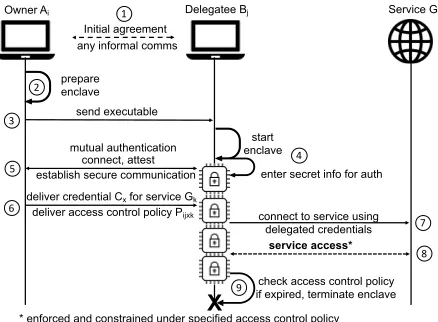
Figure 1: DELEGATEE’s P2P system architecture
can directly coordinate with the Owner to gain access to a specific service from group G. In order to execute this setup, a Delegatee from party B has to have a Intel SGX supported machine. The steps to execute secure creden-tial delegation, also given in Figure 1, are:
(1) The Owner Aiagrees directly with the Delegatee Bj for which specific service (Gk) access will be granted us-ing her credentials (Cx). The agreement is done at the users discretion and through any available channel such as online messaging, email, phone call etc. Addition-ally, users need to establish a method for authentication upon enclave start (e.g. pre-shared key, certificates). This step can be executed in an any informal communication channel that the users consider appropriate. However, the emphasis should be on the confidentiality of the channel (e.g., chat over a coffee).
(2) (optional1) After that, Aiprepares the enclave.
(3) (optional1) Owner Aisends the executable to Bj.
(4) The Delegatee Bj starts the enclave and enters the secret information (shared secret exchanged during the initial agreement) to the enclave needed for mutual au-thentication and secure connection establishment.
(5) After the Delegatee Bjstarts the enclave, the Owner Aiconnects to the enclave, attests it to verify that it is the correct code with respect to the requested service dele-gation, and subsequently uses the secret information to authenticate and create a secure communication channel.
(6) The Aisends credentials Cxfor the service Gkwith the access control policy Pi jxkusing the secure channel.
(7) The Delegatee Bjnow uses the enclave as a proxy to connect to the service Gkusing the delegated credentials.
(8) The scope of usage is strictly limited by the defined
1Enclaves used for the credential delegation can also be downloaded
from a trusted source. Each different service requires implementation of specific enclaves due to access complexity. The Owner and the Del-egatee can verify the enclave trustworthiness with attestation.
policy and therefore Delegatee Bjcannot use the parts of the service not allowed by the Owner Ai.
(9) If the access control policy has a time limit, the Del-egatee Bj’s access to the service is terminated after the time has passed, unless the Owner Aiextends the policy. The enclave restarts do not change this fact, requiring the connection from the Owner Ai to the enclave to deliver the information again. The enclave is stateless, meaning that any interruption, restart or termination after the ini-tial start and the delivery of confidenini-tial information is going to result in service abortion.
Authentication mechanisms. The agreement between
the users and their mutual identification and authentica-tion is of utmost importance. The Owner needs to be certain that the enclave used to access a specific service with her credentials is running on the machine of the in-tended Delegatee. Attestation only gives us proof that the enclave is executing the presumed code, but without any information under whose control the machine is. To allow mutual authentication between the Owner and the Delegatee, a separate authentication method is needed.
Several authentication mechanisms are possible. First, the parties could use an out-of-band confidential and au-thenticated channel to exchange a shared secret key. Af-ter the enclave start, the Delegatee enAf-ters this pre-shared key into the enclave. The Owner uses the same key to establish a TLS (PSK mode) session with the enclave. If an attacker attempts to establish an impostor or man-in-the-middle session with the Owner, the keys will mis-match. As an alternative, we could use a trusted PKI so that the Owner obtains Delegatee’s public key certificate, later used to establish a TLS session. This requires the Delegatee to provide her private and public keys to the enclave. Our design is agnostic to the used authentica-tion method while the prototype uses the first opauthentica-tion.
Centrally Brokered system architecture.Alternatively
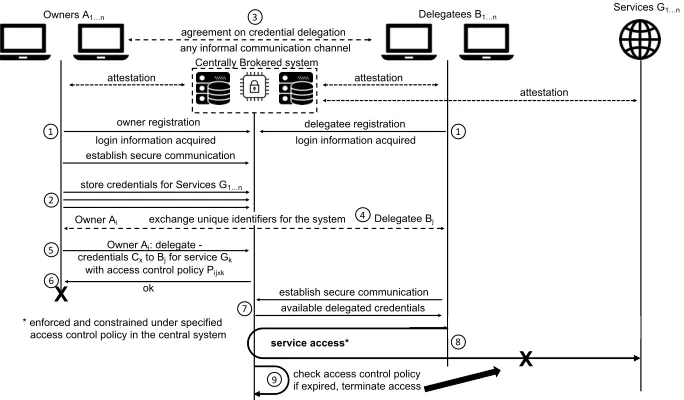
to the P2P configuration, the Centrally Brokered sys-tem consists of a central server that mediates all trans-actions and communication between the involved parties and also serves as a management entity. The server has a trusted execution environment (SGX enclaves) that per-forms security-critical operations. Thus, the system can be attested to verify the running code and authenticated to verify the service provider. In this case, the Own-ers and the Delegatees do not need to have SGX. Steps needed to execute secure delegation follow Figure 2:
(1) Both the Owners (A1...An) and the Delegatees (B1...Bn) need to register with the system to acquire unique login information (username and password) for access. After registration, both Owners and Delegatees can execute credential delegation for service access.
stor-Owners A1…n Delegatees B1…n
any informal communication channel
3
attestation attestation
Services G1…n
attestation
owner registration delegatee registration
1 1
login information acquired login information acquired
store credentials for Services G1…n
2
agreement on credential delegation
4
Owner Ai: delegate
-credentials Cxto Bjfor service Gk
with access control policy Pijxk
establish secure communication
Owner Ai Delegatee Bj
ok
5
6
X establish secure communication available delegated credentials
7
9 check access control policyif expired, terminate access 8
service access*
* enforced and constrained under specified access control policy in the central system
X
Centrally Brokered system
exchange unique identifiers for the system
Figure 2: Centrally Brokered system architecture for credential delegation with DELEGATEE
ing the credentials C1...Cnfor specific services G1...Gn. The variety of credentials that can be stored depends on the supported services (see Section 5 for details).
(3) The Owners A1...An may agree directly with the Delegatees B1...Bn for which specific service (Gk) the Owner will grant access using her credentials (Cx). The agreement is done at the users discretion through any available out-of-band channel and is limited by the im-plemented technical capabilities of the system (i.e., for supported use cases implemented by DELEGATEE).
(4) During the agreement, users exchange their unique identifiers (i.e. system username) so that the Owner from party A knows whom to authorize from party B.
(5) The Owner Ai establishes a secure channel to the system, specifies for which credentials (Cx) she wants to perform the delegation, for which service (Gk) and to whom (username of Bj), while she additionally specifies the access control policy Pi jxkthat restricts usage.
(6) After receiving the confirmation, Aidisconnects.
(7) The Delegatee Bj now establishes a secure channel to the system and can immediately see that she has been delegated credentials for a certain service. The creden-tials are hidden for the Delegatee Bj. If the Delegatee wants to access the service Gk, she may proceed.
(8) The access to the service is always proxied through the central broker with no direct communication between the Delegatee and the service. Any attempt to circumvent this results in protocol termination (e.g., if the user clicks an external link outside the proxied service).
(9) After the defined access control policy expires (e.g. if it is time limited) the Delegatee Bjloses access and the credentials are no longer delegated.
Interoperability. In Section 5 we describe the
imple-mentation of DELEGATEE. Our prototype implemen-tation is based on the Centrally Brokered architecture, since this is the most plausible deployment scenario, al-though we discuss how the P2P model applies to each supported application. The implemented enclaves have two operation modes that can be chosen and set prior to the execution. In case of the Centrally Brokered system, the enclave retrieves important data regarding services, credentials, and access control from the management en-clave, while in the P2P system, the enclave awaits the connection from its issuer to receive all information.
3.3
Usage with and without anonymity
DELEGATEE supports both identity-based (non-anonymous) and anonymous use models, as follows.
Identity-based model.An identity-based model follows
directly from the model and examples given above. Here, the users know each other in some way, have a commu-nication channel and can mutually identify each other. The Owner directly delegates her credentials to a specific Delegatee. Common use case examples include family sharing, delegation among friends and colleagues, etc.
Anonymous model. As DELEGATEE conceals
an Owner’s credentials, it naturally preserves her anonymity, even in the P2P model where the Delega-tee operates the enclave executing DELEGATEE.
In the P2P model, the bulletin board can be hosted on a third-party website, while the protocol runs through Tor Hidden Services, thereby ensuring privacy protection for both the Owner and Delegatee.
3.4
Policy Creation and Enforcement
Securely enforcing defined policies presents a challenge on its own. We aim to prevent all attackers from modify-ing the policies or circumventmodify-ing the enforcement by ap-plying a combination of allowed actions in order to reach a desirable state. While the security analysis (Section 4) ensures that the owner-provided access control policy is respected, the burden remains on the Owner to choose an appropriate access control policy in the first place. An Owner who wants to delegate restricted access for a specific service needs to be able to define all allowed actions through a rich access control policy, denoted as Pi jxk. For increased security, we prefer the white-listing of operations based on the least-privileges in order to prevent unwanted access and usage of the delegated ac-count. Unfortunately, a general model for a wide variety of different services cannot be used. For every specific service category, and sometimes even for every specific service provider in the same category, a new policy must be created that resembles the exact capabilities and ac-tions which a fully allowed user may invoke. We discuss the limitation of policies in Section 7.
Policies in DELEGATEE. We designed and
imple-mented policies for all scenarios defined in Section 2.1, namely, for mail, payments, and full website access.
In mail, DELEGATEE relies on the IMAP and SMTP protocols which are standardized and well defined. In-side the enclave we parse all incoming and outgoing re-quest (to and from the Delegatee) and compare them against the defined access policy. Consider a concrete scenario: the organizer of a conference wishes to dele-gate her email account to an assistant to respond to lo-gistical questions from attendees. The Delegatee should be granted read access to onlysubsetof the organizer’s email (e.g., defined by a regular expression query like (*#Usenix18*)). The organizer might also wish to en-force restrictions on message sending. Rather than send-ing to any possible email address, the assistant may only be allowed toreplyto emails and deleting emails should be prevented. In general, for the inbox requests the Dele-gatee can be limited based on criteria such as date, time, sender, subject or content of the email. In outgoing re-quests, the limitation is set on the subject or content, and the intended recipient(s). Additionally, the Owner can rate-limit emails sent within a time interval, applying a spam and abuse filter for outgoing messages.
In payments, the main restriction is on limiting the allowed amount per transaction or the total amount us-ing the delegated credential for either a credit card or
any other third party payment service. Additionally, the DELEGATEE can enforce restrictions on the source, lim-iting the Delegatee to perform payments only on specific sites or identified merchants/services, and white-listed geographical locations based on the IP address.
In the full website access, DELEGATEE implements limiting the use of login credentials to specific sites (e.g., the Owner can have the same credentials for two different services. However, full access is only achieved to the site allowed by the policy). As work in progress, the policies are expanded to restrict specific actions on sites after the login, including, clicks on various links, loading of specific site content or access to the account settings.
Our prototype implements delegation policies targeted at particular services, directly in C++. These policies rely on the mechanisms explained above; the Owner only needs to configure the value of the policy attributes (e.g., time limit, max amount, regular expression, etc.). In principle, the credential Owners could describe their own delegation policy in a general programming language. In Section 8 we mention existing and generic ways to ex-tend our general functionality regarding access control. However, specifying the policies is difficult to do cor-rectly. We envision that a likely deployment scenario is a curated “app store”, to which entrepreneurs or power users submit useful policies they develop. These policies are then evaluated by experts and users. Web services are constantly updated, and the interfaces change over time, requiring delegation scenarios to be continuously main-tained as well. In Section 7 we discuss further challenges if the services seek to actively prevent delegation.
4
Security Analysis
Brokered delegation provides a new usage pattern for po-tentially any existing online service. It, therefore, pro-vides new security challenges as well, arising especially because each new service requires a customized delega-tion mechanism. In this secdelega-tion we describe the main se-curity properties that DELEGATEE is designed to ensure across all applications:
(a) First and foremost, the Owner’s access credentials remain confidential.
(b) The use of the delegated credentials is defined by the access control policy which will not be violated.
(c) Use of the credentials should only be granted to the intended Delegatee, as authorized by the Owner.
everything else (i.e., including the standard Dolev-Yao adversary [14] that can read and manipulate network traf-fic between parties). The two architectures we develop, P2P and Centrally Brokered, differ mainly in where the enclave is hosted (respectively, on the Delegatee’s own device or at an independent third-party). Although we rely on a TEE, our system is designed to tolerate vul-nerabilities in the SGX enclaves as long as the software stack on the machine running the enclave is also not com-promised. Below we discuss several attacker configura-tions and the design decisions made to mitigate them. It is of utmost importance to note that our system is de-signed in a way that breaking the SGX protection mech-anism on an arbitrary enclave will not subvert our sys-tem. The attacker would need to break the exact enclave running DELEGATEE, bypass the authentication mech-anism, and compromise the full software stack on the same machine to violate the security properties. Addi-tionally, we consider side-channel attacks to be out of scope of this work.
4.1
Security through trusted enclaves
We first describe how these properties are ensured as-suming the TEE enclaves are secure, even if the software stack of the Centrally Brokered system is compromised. In the Centrally Brokered architecture, the TEE guar-antees security properties (a) and (b) even if the central broker and the Delegatee are otherwise corrupted. The Owner only transmits her credential after validating the attestation that the enclave is running the correct code and if the authentication is successful. The mechanism for authenticating the Delegatee to the broker also lies in-side the enclave, in the broker’s API enclave. This means that property (c) is guaranteed even if the broker’s full software stack is compromised since all security-critical operations are performed inside the enclave.
In the P2P architecture, even if the Delegatee’s soft-ware stack is corrupted, the Owner’s credentials are kept confidential. In Step (5), the Owner receives a TEE attes-tation before communicating further over the TLS chan-nel, and validates it against the DELEGATEE enclave executable. Since the Owner only sends her credentials along this channel directly to the enclave, it is never ex-posed to the Delegatee’s host machine, thereby ensuring property (a). The only way the Delegatee can make use of the credentials is by providing commands as input to the enclave (all access is proxied through the enclave), where they are processed according to the access con-trol policy Pi jxk, ensuring the enforcement of (b). Since the TEE is hosted locally by the Delegatee (that also has to authenticate to the Owner using the agreed shared se-cret), then property (c) is ensured against an external at-tacker if he cannot steal the shared secret; against a rogue Delegatee, this property is not meaningful anyway.
We note that in either architecture, the code running in the enclave must use the credentials in application-specific ways. We stress that in our proposed system, the owner-provided access control policy Pi jxkfor service Gk is a configuration parameter given as input to one of the supported application specific enclaves. Hence the proof burden is on us to show that properties (b) and (c) hold for any policy Pi jxk. We refer the reader to Section 3.4 and Section 5 for a detailed explanation. To summarize, each application makes use of the credentials only to au-thenticate with the corresponding service.
Finally, we note that Denial-of-Service attacks is out-side the scope of our security guarantees since an exter-nal (network) adversary can always drop messages.
4.2
Robustness to compromised enclaves
Our system relies on the TEE to provide security against a compromised Delegatee or the broker service. How-ever, DELEGATEE is also designed to provide defense in depth where possible, such that even a partial com-promise of the TEE does not impact security (as long as the host machine is also not compromised). In particular, we consider an attacker that can recover the internal keys (e.g. sealing, memory encryption, etc.) of the Intel SGX. This strong attacker would be able to decrypt any sealed persistent storage or encrypted memory pages and create false attestations. As of the time of writing, there have not been any such attacks on Intel SGX keys. Regard-less, by arguing security against this attacker model we reduce the harm if such a vulnerability should be found. We address these concerns by designing our proto-col so that all communication channels are authenticated end-to-end, even when communicating with an attested SGX enclave. To illustrate, first consider the P2P archi-tecture. Our authentication mechanism defends against such an attacker by requiring authentication input from the Delegatee before establishing the TLS endpoint in the enclave. Notice that by Step (5), the Owner Aiopens the TLS endpoint to the Delegatee’s enclave, over a poten-tially insecure channel. At this point, if the attacker can forge an enclave attestation, then the TLS channel may actually be an impostor channel. However, by authenti-cating the TLS channel against the pre-shared secret ini-tially established with the Delegatee, the Owner would detect and invalidate such an impostor channel. This au-thentication occurs before the Owner ever transmits the credentials, ensuring desired property (a). Furthermore, the enclave software is guaranteed to be the correct DEL
Our Centrally Brokered architecture is also designed with end-to-end authentication to mitigate against a potentially compromised TEE. The Delegatee and the Owner each establish authenticated TLS channels to the central broker (authenticating the broker’s enclaves using the typical certificate PKI), and only communicate to the broker over this channel. Hence all three security prop-erties are ensured as long as the service’s own software stack is not accessible to the attacker, regardless of any forged TEE attestations the attacker may produce or if the attacker can guess the SGX keys used by the enclave. We also avoid the use of persistent encrypted storage in the P2P model, thus, preventing potential rollback at-tacks [32], which may otherwise occur if the enclave’s sealing keys can be derived by the attacker. Our DELE
-GATEE enclaves, therefore, do not provide any means to resume a previously-established delegation session if the processor is power cycled. Instead, their state is restarted from scratch. In the Centrally Brokered system, we do presume that the attacker has no presence on the full soft-ware stack, thus, for continuous operation of the system we make use of the persistent encrypted storage. If the attacker model would be expanded to allow attacker pres-ence on the software stack, methods and techniques de-scribed in [32] could be applied to prevent rollback.
For ease of exposition, we have only discussed the highlights of our security design. A systematic security analysis can be found in the online (eprint) version of our paper athttps://eprint.iacr.org/2018/160.
4.3
Other Security Properties
Mandatory Logging. A well-chosen policy should
ide-ally prevent any misuse from occurring. To be prudent, we would also like to ensure support for forensic investi-gation in the case that an incorrect policy is abused. We propose that all the requests and responses exchanged between the service provider and the Delegatee are se-curely logged using a timestamped statement signed by the enclave, for a possible later review. For example, in the payment scenario, if the Delegatee uses the Owner’s credit card, the following events are registered: time and date, the website and the amount of the executed pay-ment. As another example, in the mail scenario, if the Delegatee manages to evade the abuse filter and send of-fensive emails, these messages should be logged. We imagine such logs may be used later on to prove that the Delegatee herself performed some action and indemnify the credential Owner. This discourages the Delegatees to perform any actions that could harm the Owner. To detect suppression of log entries, we could make use of a hardware monotonic counter. The enclave could addi-tionally require a “receipt” from an independent backup service that replicates the log entry, before continuing.
Delegatee protection. So far our security analysis has
Enclave type Core mbedtls Total API 4.0 (7.3%) 51.0 (92.7%) 55.0 Mail 1.9 (3.6%) 51.0 (96.4%) 52.9 Paypal 2.6 (4.9%) 51.0 (95.1%) 53.6 CreditCard 2.5 (4.7%) 51.0 (95.3%) 53.5 HTTPS Proxy 2.7 (5.0%) 51.0 (95.0%) 53.7
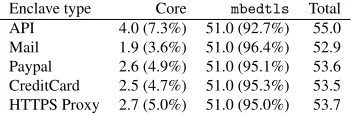
Table 1: TCB of DELEGATEE in LoC (thousands).
only focused on protecting the Owner. Security for the Delegatees may be important too. For example, if a Dele-gatee wishes to use the Owner’s payment account to pur-chase a sensitive item, they may not wish for the trans-action details to be disclosed to the Owner. A delegation policy supporting the Delegatee could, in this case, offer a way to automatically delete payment transaction logs (if this is possible at all using the payment service).
5
Prototype Implementation
In this section we describe our prototype implementation for the selected use cases mentioned troughout the paper. All enclaves rely on the OS to handle incoming and out-going TCP connections while the SSL endpoints reside in the trusted enclaves. We use thembedtlslibrary de-veloped by ARM [29], which also comprises the bulk of our trusted-computing-base (TCB). The interface be-tween the OS and the enclaves consists of oneecalland tenocalls, all of which are needed by the SSL library to use the OS’s capability to handle the TCP connections. The small number of calls and the small TCB, as shown in Table 1, facilitate code verification and reduce the sur-face area that may be affected by vulnerabilities.
To demonstrate our use cases, we implemented four service specific enclaves for delegated use of mail, PayPal, credit card/e-banking, and full website access through an HTTPS proxy. Additionally, a fifth man-agement enclave is used to authenticate the users and store credentials, implemented as a RESTful API, fur-ther referred as the API. The API enclave is not used in the P2P system since it is not needed. Only service specific enclaves are deployed on the Delegatee’s ma-chine. Additionally, we implemented a browser exten-sion that communicates directly with the Centrally Bro-kered system and allows ease-of-use for the delegated credentials by the Delegatee (page parsing, detection of forms, choosing delegated credentials, etc.). All commu-nication between the users, the enclaves and the browser extension is done using TLS with replay protection. We refer the reader to Appendix B for prototype screenshots of chosen examples. In these implementation details we presume that the Owner Ai and Delegatee Bj already registered to the system and that the Owner authorized the Delegatee by storing the credentials Cxand defining the access policy Pi jxk for a specific service. Thus, the Owner Aiis not shown in the figures.
sup-SMTP server
IMAP server 1
5 Delegatee Bj
2
4 Mail enclave
3
Centrally Brokered system API
(a) Mail model
Delegatee Bj
Centrally Brokered system
PayPal Merchant 1
3
2
6 5
7 4
8 9
API
PayPal enclave
(b) PayPal transaction model
Delegatee Bj
Payment service provider 5
3 2
Merchant
4 1
6
Centrally Brokered system API
Credit Card/E-Banking enclave
(c) Credit card / e-banking model
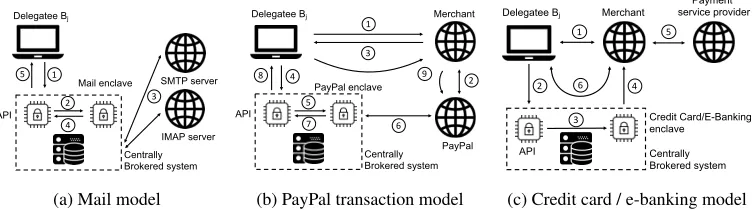
Figure 3: Architecture overview for the Centrally Brokered system
port traditional multithreading within an enclave. Addi-tional threads cannot be started by an enclave, instead multiple threads of the untrusted app can simultaneously perform anecall, resulting in parallel enclave execu-tion. The amount of concurrency is specified during compilation of the enclave and is limited by the number of logical cores in the processor.
Additional Authentication. In Section 7, we
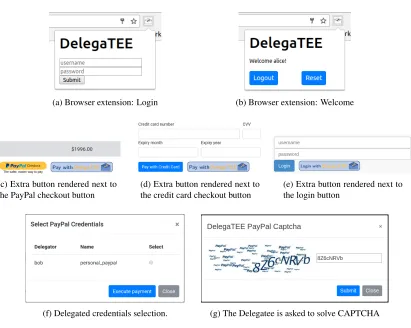
dis-cuss limitations concerning the modern authentication challenges and DELEGATEE. Our implementation sup-ports one advanced authentication method involving CAPTCHA. In case of website login or PayPal, a captcha may be required as an additional authentication step. We successfully overcome this issue by extracting the secret image, presenting it to the Delegatee through browser ex-tension generated pop-up, allowing her to solve it and continue with executing the desired operation. We refer the reader to Appendix B for prototype screenshots.
5.1
Mail/Office
Delegation of email accounts under a specific access pol-icy, one of the DELEGATEE motivated applications, is implemented in the mail enclave. IMAP and SMTP clients are implemented to allow a Delegatee Bj to read and send emails using the delegated credentials Cx. Be-low we describe the architecture depicted in Figure 3a:
(1) The Delegatee Bjwants to use some credentials Cx that have been delegated by Ai. Bj connects securely to the centralized API using her username and password (for P2P model the communication is established as de-scribed in Section 3.2, with both methods supported). She then requests to perform some action using Cx.
(2) The API verifies that the Delegatee has access to Cx and then forwards the request, Cxand the corresponding policy Pi jxkto the mail enclave.
(3) The mail enclave connects to either the SMTP server (for sending mail) or the IMAP server (for receiving mail) and executes the requested operation.
(4) Pi jxk gets applied to the response from the external servers (IMAP) or to the outgoing requests (SMTP) and the resulting response gets forwarded to the API.
(5) The API delivers the final response to Bj.
5.2
Payments
PayPal. PayPal does not want to endorse giving away
your credentials or automating the payments as this could compromise their security. Thus it is non-trivial to au-tomate a PayPal payment and there is no public API. We must emulate a browser inside our enclave that accu-rately simulates a real user. Normally the payment pro-cess relies on a javascript library but running a javascript interpreter in Intel SGX would bloat the TCB, and create potential vulnerabilities associated with running an un-measured, externally provided script inside an enclave. We instead use the no javascript fallback mechanism from PayPal. Our implemented emulated browser fol-lows redirects, fills known forms, and handles cookies until the final confirmation page is reached. The enclave then returns a confirmationidto the issuer that is used by the merchant to finalize the payment. Our implemen-tation was tested using PayPal’s sandbox and real-world environment, executing a real payment. Our browser ex-tension simplifies the use of delegated PayPal creden-tials by adding a DELEGATEE checkout button next to the original PayPal checkout button if the Delegatee is logged in to our system and has some delegated creden-tials. Upon clicking on the DELEGATEE checkout the Delegatee can choose one of the available PayPal creden-tials delegated to her and then the automated payment process starts (please see Appendix B for screenshots). After that, no further user interaction is needed and the Delegatee will be forwarded to the confirmation page of the merchant if the payment succeeds. Below we de-scribe the architecture depicted in Figure 3b:
(1) The Delegatee Bj wants to buy something from a merchant using credentials Cxdelegated by Ai. Bj con-nects to the merchant and asks for a PayPal payment.
(2) The merchant uses PayPal API to create a payment.
(3) The payment is then forwarded to Bj.
Centrally Brokered system
Delegatee Bj Website
Proxy enclave
1
2
5
6
4 3
API
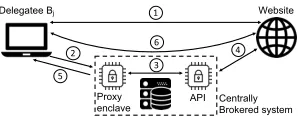
Figure 4: Login model
She then requests to pay with PayPal using Cx.
(5) The API enclave verifies that the user can access to Cxand then forwards the request, Cxand the correspond-ing policy Pi jxkto the PayPal enclave.
(6) The PayPal enclave connects to PayPal and pays the payment with Cxif it is allowed by the policy Pi jxk. The PayPal service responds with a confirmation number.
(7) The confirmation number is forwarded to the API.
(8) The API delivers the confirmation number to Bj.
(9) Bj forwards the confirmation number to the mer-chant and then the PayPal payment is finalized by the PayPal API using the received confirmation number.
Credit card/e-banking. Payments are similar to
Pay-Pal payments: upon checkout on the merchant’s website, the browser extension is triggered if the payment form is available. The Delegatee chooses any delegated creden-tials she is authorized to use. The enclave fills the form with the credentials received either from the centralized API or directly from Aiusing the P2P model. Our imple-mentation was tested without any service provider that would finalize the transaction. Figure 3c shows the de-tailed architecture and the steps follow bellow:
(1) The Delegatee Bj wants to buy something from a merchant using some credentials Cx containing credit card or e-banking information that have been delegated by Ai. Bj connects to the website and the browser ex-tension renders a second button beside the normal credit card and e-banking credentials submit button.
(2) Upon clicking the injected button, the browser ex-tension requests a payment with Cxfrom the API.
(3) The API verifies that the user has access to Cx and then forwards the request, Cxand the corresponding pol-icy Pi jxkto the credit card/e-banking enclave.
(4) The enclave fills Cxinto the request while taking the policy Pi jxkinto account and forwards it to the merchant.
(5) Finalization is done by the payment service provider.
(6) Response is routed through the enclaves to Bj.
5.3
Full Website Access
HTTPS Proxy. For secure browsing we implemented a
HTTPS proxy enclave. We want to proxy selected web-sites and if a user leaves the website, he also leaves the proxy. We implemented this by using cookies to set the correct host name. The user sends any request to the
proxy and he sets a cookie with the host name he wants to visit through the proxy. The enclave then parses the re-quest, replaces the host name and sends it on to the real website. The response is also modified by the enclave so that the host name points to the proxy again. All links in the response are left unmodified so all relative links point to the proxy but all absolute links direct to a differ-ent website. The website certificates are checked against the statically compiled root certificate list in the enclave.
Login. To log into a service using delegated credentials
we leverage similar technologies as in the HTTPS proxy and we thus only extended the proxy enclave to support delegated authentication for websites. Analogous to the HTTPS proxy we use cookies to specify the Delegatee’s session tokenand which credentials Cxshe wants to use. The enclave then asks the API whether the Delegatee with the specifiedsession tokenis allowed to use Cx. If everything checks out, the API responds with the details of Cxand Pi jxkand the proxy enclave fills the login form before forwarding it to the website. As websitessession tokensare usually stored in cookies, we encrypt all cook-ies forwarded to and from the website in order to prevent session stealing by an adversarial Delegatee. We use the browser extension in the same way as in the PayPal ex-ample: a button is rendered next to the original login. Figure 4 depicts the architecture and the detailed steps:
(1) The Delegatee Bjwants to log into a website using some credentials Cxthat have been delegated by Ai. Bj connects to the website and the browser extension ren-ders a second button beside the normal login button.
(2) Upon clicking this button, the browser extension changes the URL pointing to the proxy and appends cookies, specifying the credentials Bjwants to use.
(3) The proxy asks the API for Cx. The API checks if Bjhas the rights to use Cxand then forwards Cx.
(4) The proxy enclave fills in the username and pass-word into the login request and proceeds to send it to the website and receives the response.
(5) The proxy rewrites the header of the response to en-crypt cookies and then forwards it to Bj.
(6) All subsequent connections have to go through the proxy where the policy Pi jxkcan be enforced.
6
Performance analysis
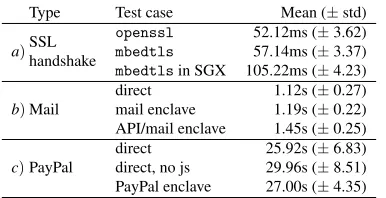
In this section we show that the overhead imposed by our solution stays within reasonable bounds. The per-formance testing was done using two i7-7700 machines with 16 GB RAM, connected via the internet and local network. We can serve around 100 users concurrently even running on consumer grade hardware.
Type Test case Mean (±std)
a)SSL handshake
openssl 52.12ms (±3.62)
mbedtls 57.14ms (±3.37)
mbedtlsin SGX 105.22ms (±4.23)
b)Mail
direct 1.12s (±0.27) mail enclave 1.19s (±0.22) API/mail enclave 1.45s (±0.25)
c)PayPal
direct 25.92s (±6.83) direct, no js 29.96s (±8.51) PayPal enclave 27.00s (±4.35)
Table 2: Latency fora)SSL handshakes,b)receiving e-mails in inbox, andc)executing PayPal transactions. Sample: 1000.
Target (site) Test case Mean (±std) small
(2.6KB)
direct 5.0ms (±2.7) proxy enclave 64.3ms (±2.5) medium
(411KB)
direct 12.2ms (±1.2) proxy enclave 76.8ms (±3.3) big
(15.7MB)
direct 202.6ms (±19.9) proxy enclave 432.2ms (±16.0)
Table 3: HTTPS proxy latency with various page sizes.
least three ocalls/ecalls, all of which have to copy buffers. In our measurements we recorded 19ocalls during a request to the enclave. Overhead forocalls andecallsis measured and analyzed in [40] and is sig-nificant for copying buffers from the untrusted memory.
The mail enclave incurs minimal overhead (Table 2-b) with the extra handshake to the IMAP server (P2P sys-tem). In our test we retrieve all emails from the account inbox. In the Centrally Brokered system an additional handshake with the API is leading to a higher delay.
The PayPal example does not seem to suffer from any delay added by our implementation (Table 2-c). Note that we performed tests using the sandbox environment, provided by PayPal itself for testing integration with their services. This environment is feature-complete but slow as it is only functionality-oriented. Most time falls in waiting for the PayPal servers. As the enclave uses the fallback mechanism to execute PayPal transactions with-out JavaScript, we measured both variants: one allow-ing JavaScript and one blockallow-ing it. We also conducted tests in the real PayPal environment using the Centrally Brokered system, executing a real payment and buying an item online with a merchant supporting PayPal. How-ever, due to theCAPTCHAprotective mechanism involv-ing the Delegatees’ actions, it is not feasible to measure performance, since it depends on the user input.
Table 3 shows that the proxy adds the biggest latency overhead compared to normal browsing but still below 0.1 seconds for small to medium websites, a response time limit for seamless user interaction [35]. A part of the high delay stems from the enclave waiting for the whole web server response before forwarding it to the Delegatee. Message parsing, the additional hand-shake, and the fact that all communication has to cross theocall/ecallinterface twice also adds to the
over-0 4 8 12 16 20 24 28 32
concurrent users 0
100 200 300 400 500 600 700
throughput [requests/second]
throughput with ssl session reuse throughput without ssl session reuse
0 100 200 300 400 500 600 700
avg waiting time [ms]
avg waiting time with ssl session reuse avg waiting time without ssl session reuse
Figure 5: Concurrency shown in throughput and average wait-ing time. Each user tries to send 100 requests.
head. A full HTTPS proxy enclave is in the works to re-duce the waiting time and support all client connections.
We have also tested video streaming through our proxy, supporting DELEGATEE’s streaming service ex-amples (i.e., Netflix). We modeled streaming as a client that requests some video from a webserver. Therefore the performance of video-streaming through DELEGA -TEE is analogous to the ordinary HTTPS proxy use case. There was no additional overhead compared to normal streaming for a single user, e.g. as in the P2P model (the standard deviation is larger than the initial waiting time, for both the normal streaming and the proxied one). The streaming service was tested on the Centrally Brokered system where the delegatee connects to the proxy from the internet. This test was only done for a single user streaming at one point in time due to hardware and band-width limitations. As in the previous test, the overhead is negligible once the streaming starts while the initiation depends on the current latency.
Our multithreaded implementation was tested using 8 threads. Incoming connections are kept in a queue and served by the enclave threads, thus reaching maximum throughput with 8 concurrent users sending requests, as shown in Figure 5. The average waiting time stays con-stant until the same 8 user threshold, increasing linearly as new requests get queued. Our implementation sup-ports SSL session reuse which significantly improves the throughput and lowers the waiting time. Without session reuse we can accommodate maximum 100 req/sec for 32 concurrent users, while with session reuse this grows to 500. Numbers could vary depending on the chosen ci-pher suite (ECDHE-RSA-AES256-GCM-SHA384).
7
Discussion & Limitations
Authentication challenges. Authentication in modern web services is complex. It can involve not just pass-words but additional factors such as personal questions, email challenges, phone challenges, and “two-step au-thentication” apps such as Authy and Google Authen-ticator. Some of these can be supported with DEL -EGATEE, such as, email challenges or 2FA apps that could run inside the enclave as well, while for some, e.g. phone challenges, DELEGATEE cannot overcome the challenge.
Contextual factors often additionally come into play, such as the IP address, time of day, and nature of ser-vice requests. Financial serser-vices, e.g., PayPal, have par-ticularly sophisticated fraud detection regimes; e.g., or-dering unusual products with Paypal may trigger a fraud alert. Consequently, a single credential in the form of a password may not suffice to delegate a resource or ser-vice via DELEGATEE. In Section 5 we outline a solu-tion for an addisolu-tional authenticasolu-tion method in form of a CAPTCHA, that is required by some online services.
To illustrate, consider a scenario in the P2P mode where an Owner Alice (an inhabitant of the U.S.) dele-gates a password to DELEGATEE and allows her PayPal account to be rented. Suppose then that Delegatee Bob, in Nigeria, rents Alice’s PayPal account in a prescribed way and attempts to execute a transaction. Paypal will see an unusual request coming from an IP address in a country with a different risk profile than the U.S., and potentially one that Alice has never visited. Bob’s trans-action request is likely to be suspicious. PayPal may then deny the transaction or request additional confirmation, e.g., via e-mail, to proceed. If Alice is unavailable or de-nies the transaction - which she may fail to recognize as originating with her delegation - the transaction will fail. For future production deployment of DELEGATEE, we will address these complications in several ways:
• Application-specific delegation: Authentication sys-tems vary considerably across applications and service providers. Each DELEGATEE application will include configuration not just for the APIs of a given target Ser-vice, but also its authentication policies.
• Delegation of multiple credentials: For services that require multiple credentials, DELEGATEE may require more than a password from an Owner. For example, two-step authentication apps can be executed within the enclaved DELEGATEE application and set up by an Owner as an additional authentication factor. Similarly, an Owner may delegate her email to the enclave to re-spond to email-based authentication challenges. The SGX platform performing the delegation may be situ-ated in the same country or region as the Owner. Finally, an Owner can perform a set of legitimate transactions through DELEGATEE in order to confirm that required credentials are present and to white-list the platform with
the authentication system of the target service.
• Failure modes: Periodic delegation failures are in-evitable, just as legitimate users’ transactions fail spo-radically due to false positives in the fraud-detection systems. As DELEGATEE is not intended for mission-critical uses, it could include graceful failure modes.
Authentication collisions. Attempts at simultaneous
use of a resource may fail, as many web services do not support multiple concurrent sessions for a given account. For example, if Alice has delegated use of her bank ac-count to Bob, then she may be unable to use it herself while Bob (or DELEGATEE, to be precise) is logged in. Such collisions can be treated by invoking failure modes like those for basic authentication failures. Other poli-cies are possible, however. For example, Owner Alice may set a policy that only delegates her resource at times when she is unlikely to use it. A small enhancement to DELEGATEE can also enable Alice to preempt the ses-sion of a Delegatee if desired.
Usability, Deployment and Service Prevention.
Throughout the paper we have presented multiple use-cases and implemented prototypes that support delegation of different services. The usability of these services by potential Delegatees is as if they were using the original service as its Owner. However, the usability of the DELEGATEE in general depends on the supported use-cases. A limitation of our system is that for each and every use-case a specific module (that matches the capabilities and technical challenges) has to be implemented. Until now, we have not found a way in order to develop a generic module that could support a wide variety of services. For example, interpreted languages, such as Javascript, remain an open problem since by executing unmeasured code in an enclave running the interpreter we cannot guarantee the security properties of DELEGATEE. In addition to that, almost all services (even the ones from the same category) have different user mechanisms, UI and control. Thus, a specific policy needs to be created that matches these controls in order to allow Owners to specify how their service could be used by potential Delegatees. Due to the complexity, for now, the policies have to be created beforehand along with the implemented delegation scenario, while the end-user involvement is limited to configuring parameters, out of a set of given policy characteristics.
dis-cussed complexity of complete policies that require seri-ous engineering and evaluation of each specific use-case scenario.
However, it is hard to imagine that the service opera-tors would view the above even as a viable option. In many cases, DELEGATEE allows the creation of sec-ondary markets (see the last paragraph of the section) and poses a threat to the revenue stream of the original ser-vice operator. Additionally, DELEGATEE reduces the operators’ ability to control and track their users since virtually, the number of users could grow but they would be seen only through the increased activity of users regis-tered to the original service. Thus, most service operators would try to deny service access if executed through this form of delegation. As already mentioned, IP geofenc-ing, pattern matching of actions and service usage, 2FA, along with the already existing fraud-detection mecha-nisms may endanger the functionality of our system. We have addressed several of them, however, future work in-volves investigation into further improvements that could make the distinction between the Owner and any Delega-tee less possible.
Scalability. Scalability for all other supported services
except video streaming is generally not a constraint. It comes down to running a proxy which can be adapted in terms of processing power (adding more enclaves horizontally) like any other service provider, while the bandwidth requirements remain moderate. However, in the case of video streaming in the centralized approach, the limitation is in the number of running connections since all video material is re-routed through the proxy. Namely, the proxy would need to have extremely high bandwidth, processing power and be scalable almost as the video service provider itself. We did not perform scalability tests to see how many users in parallel we could support for the video streaming example. This would require server grade hardware which we do not possess and any reported results would be meaningless. However, for the P2P model, since the enclave resides on the Delegatees themselves, a single Owner can sup-port multiple delegation of his, e.g. Netflix account (at least based on the limit of Netflix itself – 2 or 4 devices based on the subscription). The streaming is done di-rectly to the Delegatee, and the access will be valid until the policy expires.
Secondary markets. Brokered delegation could give
rise to offerings that compete directly with those of the very platforms hosting the delegated resources.
Facebook users could sell opportunities for “spon-sored post” - unsolicited advertisements sent to their net-works of friends or shown on their walls, as discussed above. Facebook users would then compete with Face-book itself in selling ads. Similarly, users could rent use
of their Netflix account. Account sharing is already com-mon within families and close friend circles. Brokered delegation could enable broad reselling and foster com-petition with direct sales of the subscription service.
Such secondary markets would in many cases violate providers’ existing terms of service and might resem-ble markets for underground sales of virtual goods [27, 44]. Those underground markets have met with two re-sponses, sometimes used in tandem: (1) providers aim to detect facilitators of secondary markets and penalize or ban them, and (2) providers themselves seek to cap-ture the revenue streams generated by secondary mar-kets; e.g., online role-playing game providers have of-fered virtual goods for sale through their own shops [31]. DELEGATEE could provoke similar responses.
Peer-to-peer cryptocurrency-for-fiat exchanges is an-other setting that can benefit from DELEGATEE. Today, websites like LocalBitcoins.com receive Bitcoin deposits and hold them in escrow. Then they match-make and al-low a buyer and a seller to negotiate a e-banking trans-fer. When the receiver gets the bank transfer, they in-struct the LocalBitcoins service to complete the payment from the escrowed funds. If the receiver raises a dispute, then the service must investigate and ultimately deter-mine whether to release the funds. However, such ser-vices naturally have limited investigative ability. They may call the user’s bank, or ask both parties for evidence (i.e., screenshots). Neither option is satisfactory; the lat-ter is prone to forgery, while the former may inadver-tently draw suspicion to the user’s bank account. Creden-tial delegation provides an alternative, simplifying this business model and implementing a secure intermediary that guarantees execution and fair exchange.
8
Related Work
TEEs are widely used today. ARM TrustZone, for ex-ample, is commonly used to protect data on mobile de-vices, e.g., biometric templates and encryption keys in iOS devices [4]. Intel SGX has been proposed for a num-ber of applications, including confidential map-reduce tasks [37], trustworthy data feeds for blockchain ora-cles [45] and retrofitting of legacy applications [7], se-cure payment channels [30], etc. With DELEGATEE we extend this line of work with a new class of applications based on credential delegation.