R E S E A R C H
Open Access
Existence theorems of an extension for
generalized strong vector quasi-equilibrium
problems
Kanokwan Sitthithakerngkiet
1and Somyot Plubtieng
2**Correspondence:
2Department of Mathematics,
Faculty of Science, Naresuan University, Phitsanulok, 65000, Thailand
Full list of author information is available at the end of the article
Abstract
In this paper, we study generalized strong vector quasi-equilibrium problems in topological vector spaces. Using the generalization of Fan-Browder fixed point theorem, we provide existence theorems for an extension of generalized strong vector quasi-equilibrium problems with and without monotonicity. The results in this paper generalize, extend and unify some well-known existence theorems in literature.
MSC: 49J30; 49J40; 47H10; 47H17
Keywords: quasi-equilibrium problems; variational inequality; monotonicity; Brouwer fixed point theorem
1 Introduction
The minimax inequalities of Fan [] are fundamental in proving many existence theorems in nonlinear analysis. Their equivalence to the equilibrium problems was introduced by Takahashi [, Lemma ] Blum and Oettli [] and Noor and Oettli []. The equilibrium problem theory provides a novel and united treatment of a wide class of problems which arise in economics, finance, image reconstruction, ecology, transportation, network, elas-ticity and optimization. This theory has had a great impact and influence in the develop-ment of several branches of pure and applied sciences. During this period, many results on existence of solutions for vector variational inequalities and vector equilibrium problems have been established (see, for example, [–]).
Recently, the equilibrium problem has been extensively generalized to the vector map-pings (see [–, –]). Let X and Y be real topological vector spaces and K be a nonempty subset ofX. LetCbe a closed and convex cone inYwithintC=∅, whereintC denotes the topological interior ofC. For a vector-value functionF:K×K→Y, at least two different vector equilibrium problems are the following problems:
WVEP: findx∈Ksuch thatF(x,y) /∈–intC for ally∈K (.) and
VEP: findx∈Ksuch thatF(x,y) /∈–C\ {} for ally∈K. (.) The first problem is called weak vector equilibrium problem (see, for instance, [, , ]) and the second one is normally called strong vector equilibrium problem (see []).
However, Kazmi and Khan [] called problem (.) the generalized system (for short, GS). Recently, many existence results extended and improvedWVEPand its particular cases (see, for instance, [–]), but notVEP.
For a more general form of vector equilibrium problem, we letA:K→K be a multi-valued map with nonempty values where Kdenotes the family of subsets ofK. Then we
consider the following problem: findx∈Ksuch that
x∈A(x), F(x,y) /∈–intC for ally∈A(x). (.)
It is known that a vector quasi-equilibrium problem (for short,VQEP) was introduced by Ansariet al.[]. If the mappingFis replaced by a multivalued map, sayingF:K×K→Y
withYbeing a topological vector space,VEPcan be generalized in the following way: find x∈Ksuch that
F(x,y)–intC for ally∈K. (.)
It is called generalized vector equilibrium problem (for short,GVEP) and it has been studied by many authors; see, for example, [, , , , ] and references therein. In , Ansari and Flores-Bazás [] introduced the generalized vector quasi-equilibrium problem (for short,GVQEP): findx∈Ksuch that
x∈A(x), F(x,y)–intC for ally∈A(x), (.)
which is a general form ofGVEP; more examples can also be found in [–, ]. In an-other way, Kum and Wong [] considered the multivalued generalized system (for short, MGS): findx∈Ksuch that
F(x,y)–C\ {} for ally∈K. (.)
Throughout this paper, unless otherwise specified, we assume thatXandY are Haus-dorff topological vector spaces,K is a nonempty convex subset ofXandCis a pointed closed convex cone inYwithintC=∅. For a given multivalued bi-operatorF:K×K→Y such that{} ⊆F(x,x) for eachx∈K, where Ydenotes the family of subsets ofY, the new
type of generalized strong vector quasi-equilibrium problem (for short,GSVQEP) is the problem to findx∈Ksuch that
x∈A(x), F(x,y)–C\ {} for ally∈A(x), (.)
whereA:K→Kis a multivalued map with nonempty values. If we setF(x,y) =Tx,η(y–
x)for allx,y∈K, then theGSVQEPreduces to the following generalized quasi-variational like inequality problem (for short,GQVLIP): findx∈Ksuch that
x∈A(x), Tx,η(y–x)–C\ {} for ally∈A(x), (.)
above formulation is the generalization of vector variational inequalities, variational-like inequality problems and vector complementarity problems in infinite dimensional spaces studied by many authors (see [–] and references therein).
The main motivation of this paper is to establish some existence results for a solution to the new type of the generalized strong vector quasi-equilibrium problemsGSVQEP with and without monotonicity by using the generalization of Fan-Browder fixed point theorem.
2 Preliminaries
Let us recall some definitions and lemmas that are needed in the main results of this paper.
Definition .[] LetXandYbe two topological vector spaces, and letT:X→Y be
a set-valued mapping.
(i) Tis said to be upper semicontinuous atx∈Xif for eachx∈Xand each open setV
inY withT(x)⊂V, there exists an open neighborhoodUofxinXsuch that
T(y)⊂Vfor eachy∈U.
(ii) Tis said to be lower semicontinuous atx∈Xif for eachx∈Xand each open setV
inY withT(x)∩V=∅, there exits an open neighborhoodUofxinXsuch that
T(y)∩V=∅for eachy∈U.
(iii) Tis said to be continuous onXif it is at the same time upper semicontinuous and lower semicontinuous onX. It is also known thatT:X→Y is lower
semicontinuous if and only if for each closed setVinY, the set{x∈X|T(x)⊂V}
is closed inX.
(iv) Tis said to be closed if the graph ofT,i.e.,Graph(T) ={(x,y) :x∈Xandy∈T(x)}, is a closed set inX×Y.
Definition .[] LetX,Y be Hausdorff topological vector spaces,K be a nonempty convex subset ofXandCbe a pointed closed convex cone inYwithintC=∅.
(i) A multivalued bi-operatorF:K×K→Y is said to beC-strongly pseudomonotone
if it satisfies
∀x,y∈K, F(x,y)–C\ {} ⇒ F(y,x)⊆–C.
(ii) A multivalued mappingG:K→Y is said to beC-convexif for allx,y∈Kand for allλ∈[, ],
Gλx+ ( –λ)y⊆λG(x) + ( –λ)G(y) –C.
And the mappingGis said to begeneralized hemicontinuous(in short, g.h.c.) if for allx,y∈Kand for allλ∈[, ],
λ→Gx+λ(y–x) is upper semicontinuous at+.
Definition .[] LetT:K→L(X,Y)andη:K×K→Xbe nonlinear mappings. Then: (i) Tis said to be hemicontinuous if, for any givenx,y,z∈Kand forλ∈[, ], the
(ii) Tis said to beC-η-strongly pseudomonotone if, for anyx,y∈K,
Tx,η(y,x)–C\ {} implies Ty,η(x,y)⊆–C;
(iii) ηis said to be affine in the second argument if, for anyxi∈Kandλi≥(≤i≤n), withni=λi= and anyy∈K,η(y,
n
i=λixi) =
n
i=λiη(y,xi).
The following lemma is useful in what follows and can be found in [].
Lemma . Let X be a topological space and Y be a set.Let T:X→Y be a map with
nonempty values.Then the following are equivalent:
(i) T has the local intersection property;
(ii) There exits a mapF:X→Y such thatF(x)⊂T(x)for eachx∈X,F–(y)is open for
eachy∈YandX=y∈YF–(y).
Subsequently, Browder [] obtained in the following fixed point theorem.
Theorem .(Fan-Browder fixed point theorem) Let X be a nonempty compact convex subset of a Hausdorff topological vector space and T:X→Xbe a map with nonempty
convex values and open fibers(i.e.,for y∈Y,T–(y)is called the fiber of T on y).Then T has a fixed point.
The generalization of the Fan-Browder fixed point theorem was obtained by Balaj and Muresan [] in as follows.
Theorem . Let X be a compact convex subset of a topological vector space and T:X→ Xbe a map with nonempty convex values having the local intersection property.Then T
has a fixed point.
Lemma .[] Let X be a bounded subset of E.Then the usual pairing·,·:E∗×X→R is continuous.
3 Main theorem
In this section, we shall investigate the existence results forGSVQEPandGQVLIPwith monotonicity and without monotonicity. First, we present the following lemma which is of Minty’s type forGSVQEP.
Lemma . Let K be a nonempty and convex subset of X,let A:K→Kbe a set-valued
mapping such that for any x∈K,A(x)is a nonempty convex subset of K and let F:K× K→ybe g.h.c.in the first argument,C-convex in the second argument and C-strongly
pseudomonotone.Then the following problems are equivalent:
(i) Findx∈Ksuch thatx∈A(x),F(x,y)–C\ {},∀y∈A(x). (ii) Findx∈Ksuch thatx∈A(x),F(y,x)⊆–C,∀y∈A(x).
Proof (i)→(ii) It is clear by theC-strong pseudomonotonicity.
(ii) →(i) Letx∈K. For anyy∈A(x) andθ ∈(, ), we setzθ=θy+ ( –θ)X. By the assumption (ii) and the convexity ofA(x), we conclude that
SinceFisC-convex in the second argument, we have
∈F(zθ,zθ)
⊆θF(zθ,y) + ( –θ)F(zθ,x) –C
⊆θF(zθ,y) –C.
Then we haveF(zθ,y)∩C=∅, becauseCis a convex cone. SinceF is g.h.c. in the first argument, we havex∈A(x),F(x,y)∩C=∅,∀y∈A(x). It implies thatx∈A(x),F(x,y)
–C\ {}for ally∈A(x). This completes the proof.
In the following theorem, we present the existence result forGSVQEPby assuming the monotonicity of the function.
Theorem . Let K be a nonempty compact convex subset of X.Let A:K→K be a
set-valued mapping such that for any x∈K,A(x)is a nonempty convex subset of K and for each y∈K,A–(y)is open in K.Let the set P:={x∈X|x∈A(x)}be closed.Assume that
F:K×K→Y is C-strongly pseudomonotone,g.h.c.in the first argument,C-convex and
l.s.c.in the second argument.Then GSVQEP has a solution.
Proof For anyx∈K, we define the set-valued mappingS,T:K→Kby
S(x) =y∈K|F(y,x)–C , T(x) =y∈K|F(x,y)⊆–C\ {} ,
and for anyy∈K, we denoted the complement ofS–(y) by (S–(y))C={x∈K|F(y,x)⊆
–C}. For eachx∈K, we define multivalued mapsG,H:K→Kby
G(x) =
S(x)∩A(x) ifx∈P, A(x) ifx∈K\P and
H(x) =
T(x)∩A(x) ifx∈P, A(x) ifx∈K\P.
Clearly,G(x) andH(x) are nonempty sets for allx∈K, and by theC-strong pseudomono-tonicity of F, we have G(x)⊆H(x) for all x∈K. We claim that H(x) is convex. Let y,y∈T(x) andθ∈(, ). SinceFisC-convex in the second argument, we have
Fx,θy+ ( –θ)y
⊆θF(x,y) + ( –θ)F(x,y) –C
⊆–C\ {}–C
⊆–C\ {}.
and by the definition of (S–(y))C, we have (S–(y))Cclosed and soS–(y) is open inK. By
assumption, we obtain that
G–(y) =S–(y)∩A–(y)∪A–(y)∩K\P
is open inK. It is easy to see that the mappingHhas no fixed point because ∈F(x,x),
∀x∈K. From the contrapositive of the generalization of the Fan-Browder fixed point the-orem and Lemma ., we have
K
y∈K
G–(y).
Hence, there existsx¯∈Ksuch thatG(x¯) =∅. Ifx¯∈K\P, we haveA(x¯) =∅, which con-tradicts the assumptions. Thenx¯∈Pand henceS(x¯)∩A(x¯) =∅. This means thatx¯∈A(x¯) andF(y,x¯)⊆–Cfor ally∈A(x¯). This completes the proof by Lemma .. The following example shows thatGSVQEPhas a solution under the condition of The-orem ..
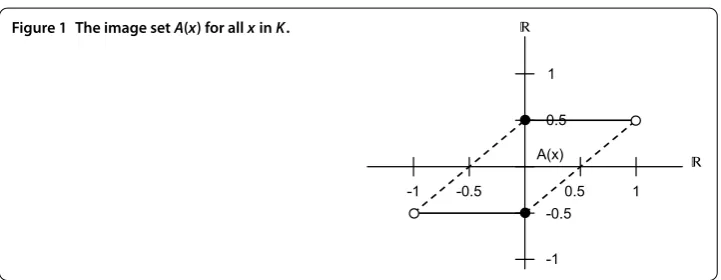
Example . LetY=R,C= [,∞) andK= [–, ]. Define the mappingA:K→Kand
F:K×K→Y by
A(x) = ⎧ ⎪ ⎨ ⎪ ⎩
[–.,x+ .) if – ≤x< , (–., .) ifx= , (x– ., .] if <x≤ and
F(x,y) =
[,y–x] ifx<y, [y–x, ] ifx≥y,
respectively. By the definition ofA, see Figure , we have the setP={x∈X|x∈A(x)}= [–., .] which is closed and for eachy∈K,A–(y) is open inK.
We see thatFisC-strongly pseudomonotone. Indeed, ifF(x,y)–C\ {}, then we only consider the casex<y, soF(x,y) = [,y–x]. That is,
F(y,x) = [x–y, ]⊆–C for allx<y.
Letx,y,z∈Kandλ∈[, ]. Ifx<λy+ ( –λ)z, then
Fx,λy+ ( –λ)z=,λy+ ( –λ)z–x
=,λ(y–x) + ( –λ)(z–x)
⊆,λ(y–x) + ( –λ)(z–x)–C =λ[,y–x] + ( –λ)[,z–x] –C
=λF(x,y) + ( –λ)F(x,y) –C.
Similarly, in another case, we haveFis C-convex in the second argument. Clearly,Fis g.h.c. in the first argument and l.s.c. in the second argument.
Moreover, this example asserts that –. is one of the solutions because ifx= –., then A(x) = [–., ). Note that for ally∈A(x),y>x. ThereforeF(–.,y)–[,y+.]–C\{} for ally∈[–., ).
Now, we present an existence theorem forGSVQEPwhenFis not necessarily monotone.
Theorem . Let K be a nonempty compact convex subset of X,let A:K→Kbe a
set-valued mapping such that for each x∈K,A(x)is a nonempty convex subset of K,and let the set P:={x∈X|x∈A(x)}be closed.Assume that F:K×K→Yis C-convex in the second
argument and for each y∈K,the set{x∈K|F(x,y)⊆–C\ {}}is open.Then GSVQEP has a solution.
Proof We proceed with the contrary statements, that is, for eachx∈X,x∈/A(x) or there existsy∈A(x) such that
F(x,y)⊆–C\ {}. (.)
For everyy∈K, we define the setsNyandMyas follows:
Ny:=
x∈K:F(x,y)⊆–C\ {}
and
My:=Ny∪PC.
By the assumption, we have the set My is open in K and we see that {My}y∈K is an
open cover ofK. Since K is compact, there exists a finite subcover{Myi}ni= such that
K=ni=Myi. By a partition of unity, there exists a family{βi}
n
i=of real-valued continuous
functions subordinate to{Myi}
n
i=such that for allx∈K, ≤βi(x)≤ and
n
i=βi(x) =
and for eachx∈/ Myi, βi(x) = . Let C:=co{y,y, . . . ,yn} ⊆K. Then Cis a simplex of a finite dimensional space. Define a mappingS:C→Cby
S(x) =
n
i=
Hence, we have Sis continuous sinceβiis continuous for eachi. From Brouwer’s fixed
point theorem, there existsx∈Csuch thatx=S(x). We define a set-valued mapping
T:K→Y by
T(x) =Fx,S(x) for allx∈K. (.)
Now, we note that for anyx∈K,{yi|x∈Myi} =∅. SinceF isC-convex in the second argument, it follows from (.), (.) and (.) that we have
T(x) =F
x,
n
i= βi(x)yi
⊆
n
i=
βi(x)F(x,yi) –C
⊆–C\ {}–C = –C\ {}
for allx∈K. Sincex∈K and it is a fixed point ofS, =F(x,x) =F(x,S(x)) =T(x)⊆
–C\ {}, which is a contradiction. This completes the proof.
If we set A≡I, then Theorem . and Theorem . are reduced to Theorem and Theorem in Kum and Wong [], respectively. Moreover, Theorem . is a multivalued version of Theorem . in Kazmi and Khan [].
LetF(x,y) =Tx,η(y,x)for allx,y∈K, whereη:K×K→XandT:K→L(X,Y). As
a consequence of Theorem . and using the same argument as in Kum and Wang ([], Theorem ), we have the following existence result forGQVLIP.
Corollary . Let K be a nonempty compact convex subset of X,let A:K→Kbe a
set-valued mapping such that for any x∈K,A(x)is a nonempty convex subset of K and for each y∈K,A–(y)is open in K.Let the set P:={x∈X|x∈A(x)}be closed,letη:K×K→X be
affine and continuous in the first argument and hemicontinuous in the second argument, and let T:K→L(X,Y)be a C-strongly pseudomonotone and g.h.c.with nonempty compact values where L(X,Y)is equipped with topology of bounded convergence.Then GQVLIP has a solution.
As a consequence of Theorem ., we obtain the following existence result forGQVLIP.
Corollary . Let K be a nonempty compact convex subset of X.Let A:K→Kbe a set-valued mapping such that for each x∈X,A(x)is a nonempty convex subset of K and let the set P:={x∈X|x∈A(x)}be closed.Assume thatη:K×K→X is affine in the first argument and T:K→L(X,Y) is a nonlinear mapping such that,for every y∈K,the set
{x∈K| T(x),η(y,x) ⊆–C\ {}}is open.Then GQVLIP has a solution.
Competing interests
Authors’ contributions
The work presented here was carried out in collaboration between all authors. SP designed theorems and methods of the proof and interpreted the results. KS proved the theorems, interpreted the results and wrote the paper. All authors read and approved the final manuscript.
Author details
1Department of Mathematics, Faculty of Applied Science, King Mongkut’s University of Technology North Bangkok,
Bangkok, 10800, Thailand.2Department of Mathematics, Faculty of Science, Naresuan University, Phitsanulok, 65000,
Thailand.
Acknowledgements
The first author would like to thank the King Mongkut’s University of Technology North Bangkok, Thailand.
Received: 27 August 2013 Accepted: 21 November 2013 Published:13 Dec 2013
References
1. Fan, K: Minimax theorems. Proc. Natl. Acad. Sci. USA39, 42-47 (1953)
2. Takahashi, W: Nonlinear variational inequalities and fixed point theorems. J. Math. Soc. Jpn.28, 168-181 (1976) 3. Blum, E, Oettli, W: From optimization and variational inequalities to equilibrium problems. Math. Stud.63, 123-145
(1994)
4. Noor, MA, Oettli, W: On general nonlinear complementarity problems and quasi-equilibria. Matematiche49, 313-331 (1994)
5. Ansari, QH, Yao, JC: On nondifferentiable and nonconvex vector optimization problems. J. Optim. Theory Appl.106, 487-500 (2000)
6. Fu, JY: Generalized vector quasi-equilibrium problems. Math. Methods Oper. Res.52, 57-64 (2000) 7. Giannessi, F: Vector Variational Inequalities and Vector Equilibria. Mathematical Theories. Kluwer Academic,
Dordrecht (2000)
8. Gong, XH: Strong vector equilibrium problems. J. Glob. Optim.36, 339-349 (2006)
9. Lee, GM, Kim, DS, Kuk, H: Existence of solutions for vector optimization problems. J. Math. Anal. Appl.220, 90-98 (1998)
10. Li, SJ, Teo, KL, Yang, XQ: Generalized vector quasi-equilibrium problem. Math. Methods Oper. Res.61, 385-397 (2005) 11. Long, XJ, Huang, NJ, Teo, KL: Existence and stability of solutions for generalized strong vector quasi-equilibrium
problems. Math. Comput. Model.47, 445-451 (2008)
12. Wan, AH, Fu, JY, Mao, WH: On generalized vector equilibrium problems. Acta Math. Appl. Sinica (Engl. Ser.)22, 21-26 (2006)
13. Ansari, QH, Konnov, IV, Yao, JC: Characterizations of solutions for vector equilibrium problems. J. Optim. Theory Appl.
113, 435-447 (2002)
14. Ansari, QH, Schaible, S, Yao, JC: Generalized vector equilibrium problems under generalized pseudomonotonicity with applications. J. Nonlinear Convex Anal.3, 331-344 (2002)
15. Konnov, IV, Yao, JC: Existence of solutions for generalized vector equilibrium problems. J. Fixed Point Theory Appl.
233, 213-221 (1999)
16. Song, W: On generalized vector equilibrium problems. J. Comput. Appl. Math.146, 167-177 (2002)
17. Chen, GY, Hou, SH: Existence of solutions for vector variational inequalities. In: Giannessi, F (ed.) Vector Variational Inequalities and Vector Equilibria, pp. 73-86. Kluwer Academic, Dordrecht (2000)
18. Fang, YP, Huang, NJ: Strong vector variational inequalities in Banach spaces. Appl. Math. Lett.19, 362-368 (2006) 19. Bigi, G, Capata, A, Kassay, G: Existence results for strong vector equilibrium problems and their applications.
Optimization61(5), 567-583 (2012)
20. Kazmi, KR, Khan, SA: Existence of solution to a generalized system. J. Optim. Theory Appl.142, 355-361 (2009) 21. Ansari, QH, Flores-Bazán, F: Generalized vector quasi-equilibrium problems with applications. J. Math. Anal. Appl.277,
246-256 (2003)
22. Ansari, QH, Konnov, IV, Yao, JC: On generalized vector equilibrium problems. Nonlinear Anal.47, 543-554 (2001) 23. Ansari, QH, Yao, JC: On vector quasi-equilibrium problems. In: Maugeri, A, Giannessi, F (eds.) Variational Problems and
Equilibria. Kluwer Academic, Dordrecht (2003)
24. Bianchi, M, Kassay, G, Pini, R: Ekeland’s principle for vector equilibrium problems. Nonlinear Anal.66, 1454-1464 (2007) 25. Tanaka, T: Existence results of cone saddle-points for vector-valued functions. Appl. Math. Optim.36, 313-322 (1997) 26. Ansari, QH, Oettli, W, Schiager, D: A generalization of vector equilibrium. Math. Methods Oper. Res.46, 147-152 (1997) 27. Kum, S, Wong, MM: An extension of a generalized equilibrium problem. Taiwan. J. Math.15, 1667-1675 (2011) 28. Huang, NJ, Li, J: On vector implicit variational inequalities and complementarity problems. J. Glob. Optim.34, 399-408
(2004)
29. Lee, GM, Kim, DS, Lee, BS: Generalized vector variational inequality. Appl. Math. Lett.9, 39-42 (1996) 30. Yang, XQ: Vector variational inequality and its duality. Nonlinear Anal.95, 729-734 (1993) 31. Berge, C: Topological Spaces. Oliver & Boyd, Edinburgh (1963)
32. Ding, XP: A coincidence theorem involving contractible space. Appl. Math. Lett.10, 53-56 (1997)
33. Browder, FE: The fixed point theory of multivalued mapping in topological vector spaces. Math. Ann.177, 238-301 (1968)
34. Balaj, M, Muresan, S: Generalizations of the Fan-Browder fixed point theorem and minimax inequalities. Arch. Math.
41, 399-407 (2005)
35. Kum, S: A generalization of generalized quasi-variational inequalities. J. Math. Anal. Appl.182, 158-164 (1994)
10.1186/1687-1812-2013-342