MURDOCH RESEARCH REPOSITORY
Learning theory and its application to female learner support in
engineering
Author(s):
Fowler, Lynne ; Armarego, Jocelyn ; Allen, Maurice
Year:
2001
Source:
Journeys in Leadership: Reflections, Redirections. 10th
International Women in Leadership Conference, Fremantle,
W.A., 14-15 Nov. 2001.
This is the author’s final version of the work, as accepted for publication following
peer review but without the publishers’ layout or pagination.
Learning Theory and its Application to Female
Learner Support in Engineering
Lynne Fowler, Jocelyn Armarego, Maurice Allen
School of Engineering
Murdoch University Murdoch WA 6150 Tel: (08) 9360 7119 Fax: (08) 9360 7104 {maurice, jocelyn, lynne}@eng.murdoch.edu.au
Abstract
School of Engineering at Murdoch University is now in its fifth year: a new School sited on the new regional Campus. This environment enabled the staff to take an innovative approach to the School's development. One key issue addressed from the outset was that of women in a non-traditional area.
Positive action was taken to attract high calibre female staff and as a consequence over 50% of the School's staff, academic and non-academic, are female. From the student perspective, issues confronting females studying in Engineering, which are reflected in international low recruitment and retention, continue to be addressed.
Individuals are different and these differences affect how a student performs. In particular, gender differences in learning styles have been noted. This has directed us to administer, as part of a first year foundational unit, learning style inventories to all first year students, who then identify their self-reported learning styles.
In this positive atmosphere many varied and successful initiatives, based on our learning style research, are being trialled to encourage female students into our programs and then support and retain them throughout their four years of study.
This research discusses the initial learning style results and their application to our initiatives.
Keywords: Learning styles, Constructivist theory, Gender issues, Non-traditional areas.
Introduction
The establishment of the School of Engineering was part of the initiative included in Murdoch University's new regional campus at Rockingham, Western Australia. The campus is small with approximately 650 students after five years. The main disciplines on this campus are Engineering, Commerce, Arts and Tourism: reflecting the job opportunities in the immediate area. A large
industrial bias with many national and international companies exists locally in the Kwinana industrial area. In addition, being positioned close to the sea tourism is a growth industry.
mix would drive the culture change required whereby females are accepted, respected and encouraged in this non-traditional area.
Across the broad field of engineering 85% of all degrees are awarded to males. As few as 2% of engineers nationally are female and in Western Australia about 6% of engineers are women. Women are still very much a minority, particularly in the area of management [1]. The 1996 'Review of Engineering Education' supported by the Department of Employment, Education and Training and Youth Affairs (DEETYA) makes the following comment and recommendation:
That in view of the continuing serious imbalance between the numbers of men and women entering the engineering profession, and the continuing predominance of men in the profession, IEAust (The Institution of Engineers, Australia), ACED (The Australian Council of Engineering Deans) and ATSE (Australian Academy of Technological Sciences and Engineering) take appropriate steps to encourage more women to enter the profession and in so doing to draw particularly upon the resource of women engineers in developing and broadening the culture of the engineering profession to make it more diverse and flexible and inclusive of a wider range of values and attitudes than at present.
A quote from Copeland and Lewis [2] also indicates the need for change within engineering:
Anyone involved in engineering over the last five years will be familiar with what is now almost a mantra: that the culture of engineering must change if the profession is to succeed in
attracting equal numbers of women and men.
We are now in the unique position of having over 50% of our staff (academic and general) female. The founding Dean was keen to add that the females were employed on merit, being the best candidates for the positions offered. Our current Dean is building on these initial foundations and proactively supporting the female staff and students in engineering in many interesting and innovative ways.
Research on Learning Styles
Learning is a process of acquiring and synthesising ideas and concepts. The process not only involves obtaining information but also full participation by the learner. No longer are the traditional roles of teacher/student: teacher giving, student accepting, considered the only way to learn or even the best way [3]. The view that information only needs to be received by instruction has been heavily challenged in recent years.
Constructivism is a theory of learning claiming that subjects construct knowledge and is based on the principle that knowledge is not passively received either through the senses or by way of
communication, but is actively built up by the student. It is based on students' active participation in problem-solving and critical thinking regarding a learning activity that they find relevant and
Based within the complex area of learning, our research in the School of Engineering is being undertaken to examine learning issues confronting engineering students, with an emphasis on learning styles and teaching methods rather than on student assessment.
Although women are much more likely to choose a career in engineering than 20 or 30 years ago the numbers of practicing female engineers is small: there is clearly the need for a change in culture to address the gender imbalance in engineering [1].
These facts have encouraged us to include gender issues in this study with the aim of addressing some of the questions surrounding women in non–traditional areas:
• Why are women not attracted to Engineering in greater numbers? • How can we attract more females into our courses?
• How can we retain the female students on our courses?
• How can we provide a meaningful and appropriate learning environment for all our students including females?
One approach, and the focus of this paper, is to examine gender differences in the learning styles of our students (and the teaching styles of our staff), and to examine initiatives within the School to deal with these differences.
Learning Style Instruments
Whilst there are numerous instruments for assessing learning styles, those advocated by Kolb [3] and Soloman and Felder [9] are well known, and accepted within education theory [10]. Both instruments provide an efficient way to analyse our students' learning styles. The correlation between learning styles and our methods of teaching must be determined, as conflicts often exist.
Kolb’s Learning Style Inventory is a simple test based on experiential learning theory. It looks at four stages of the learning process: concrete experience (CE), reflective observation (RO), abstract
conceptualisation (AC), and active experimentation (AE). A series of twelve questions are
presented with the user ranking four possible answers for each question. The user’s learning style can then be identified as either:
• Accomodator: What if? people. Often start with what they see and feel then plunge in and seek
hidden possibilities. They learn by trial an error and self discovery
• Diverger: Why or why not? These people study life as it is and reflect on it to seek meaning. They learn by being involved and need to listen and share with others
• Converger: How? These people start with an idea and try it out, they like to find out how things work and learn by testing theories
• Assimilator: What? people. These people come up with ideas and then reflect on them. They
like to know what the experts think.
(summarised in [11])
Engineering teaching professionals are quoted as being intuitive learners [12]. This was confirmed when each staff member of our department was tested on the Kolb learning style model, revealing that 91% of academic staff were converger/assimilators (how and what people) (Table 1). This is in line with Kolb [3] stating that engineering is a good career area for Convergers and teaching for
Assimilators. Despite over 50% of our staff being female, no gender differences have been noted.
The results in Table 1 (building upon our previous studies [13], which are ongoing) show that our students’ preferred learning styles are diverse and span all the different types, Accomodator, Diverger, Assimilator and Converger. The variety of student types attracted to our programs is excellent given the multi-disciplinary nature of our curriculum content. However, the challenge is to cater for this diversity.
Our evidence suggests that engineering students include sensors, accomodator/diverger types (Table1). This is in line with the results of Felder and Silverman [12]. However, the gender break down of these results show our male students are a closer match to the staff profiles, whereas the female students exhibit greater diversity in their learning style.
A profile of our engineering student is emerging from these figures:
• male students are more likely to be assimilator/convergertypes (85%). Their learning style strengths involve abstract thinking combined with active experimentation. Tasks involving planning and creating models, defining problems, developing theories, problem-solving, deductive reasoning, sequential and analytical thinking and experimenting with new ideas are suited to these students. Convergers and assimilators identify with the left brain functions of analytical, logical, language, independent thinking
• female students are more likely to be divergers, characterised by imaginative ability, sensitivity to people and values and recognising problems. They are imaginative learners who integrate their experience with the self. They learn by listening and sharing ideas and can view direct experience from many perspectives. Divergers identify with right brain functions of global, holistic, spatial, intuitive, thinking. These students are matched by very few members of staff • accomodator students, characterised by influencing and leading others, risk taking,
interpersonal skills and personal involvement, are in low percentages. They are not matched by any member of staff.
(summary of characteristics from [14])
Table 1. Learning Style Inventory Results (Kolb)
No. of clients Accomodator Diverger Assimilator Converger
Engineering Staff 11 0% 9% 45.5% 45.5%
Engineering Students 69 12% 14% 32% 42% (Combined)
Engineering Students 15 13.33% 53.33% 13.33% 20%
(Female)
Engineering Students 54 11% 4% 37% 48%
(Male)
In contrast to Kolb’s Learning Style Inventory, Soloman and Felder’s Index of Learning Styles [9] assesses learning preferences on four dimensions, active/reflective, sensing/ intuitive, visual/verbal,
and sequential/global. This instrument consists of forty-four simple questions with a choice between
two possible answers.
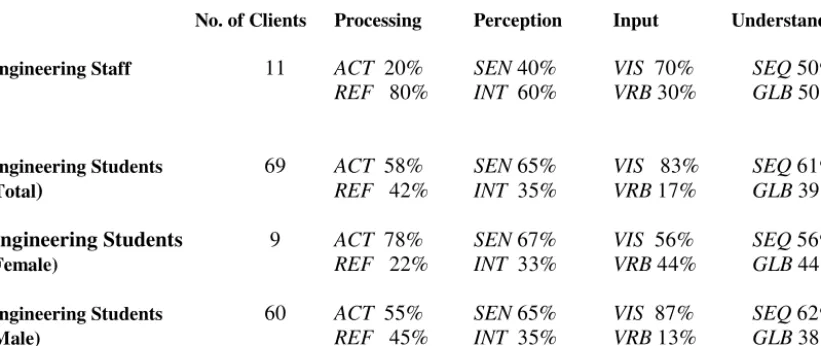
The results from Table 2, which build upon our previous studies [13] show that:
• 83% of the students are visual, yet traditionally material is presented to them verbally or in written form
• 39 % of the students are global learners, yet teaching is often narrowly focused.
Table 2. Index of Learning Style Survey Results (Soloman & Felder )
No. of Clients Processing Perception Input Understanding
Engineering Staff 11 ACT 20% SEN 40% VIS 70% SEQ 50%
REF 80% INT 60% VRB 30% GLB 50%
Engineering Students 69 ACT 58% SEN 65% VIS 83% SEQ 61%
(Total) REF 42% INT 35% VRB 17% GLB 39%
Engineering Students 9 ACT 78% SEN 67% VIS 56% SEQ 56%
(Female) REF 22% INT 33% VRB 44% GLB 44%
Engineering Students 60 ACT 55% SEN 65% VIS 87% SEQ 62%
(Male) REF 45% INT 35% VRB 13% GLB 38%
Table Key:
ACT Active REF Reflective SEN Sensory INT Intuitive VIS Visual VRB Verbal SEQ Sequential GLB Global
A potential mismatch between the teaching styles of the staff and the learning style of students is highlighted in both Table 1 and Table 2. Students whose learning styles are compatible with the teaching style adopted within a course tend to retain information better, obtain better grades and maintain a greater interest in the course [15]. Yet the diversity of learning styles in our students suggests that flexibility in teaching style is of considerable importance.
The indication that a mismatch of learning styles is greater for the female students is of particular concern and has led to us introducing various initiatives to support our student population in general, and specifically the female students.
Initiatives
Foundation Unit
A suggestion by Felder [15] is to talk to students about their learning styles and the strengths and weaknesses associated with each style. We have now incorporated a topic into our first year Foundation Unit (a general unit which the majority of students complete) to survey and discuss student learning styles. This then gives the student an awareness of issues surrounding their learning and how to get the best from their courses.
Practical Engineering
Women in Engineering Co-ordinator and Group
During the School’s first year of operation, the role of the Women-in-Engineering co-ordinator was defined. The aim is to support the relatively small numbers of female students in the School and help them build a network of relationships across all four years. The female students meet several times per semester for lunch and/or afternoon tea. Often guest speakers, female role models from industry, or other supportive guests are invited to give a seminar or informal talk. These sessions have proved to be not only enjoyable but also extremely important, informing our students about issues they may confront in industry and helping them to initiate a networking support system. In fact, currently we have only one female student in each of the 3rd and 4th years and without this group they have said
they probably would have left the course. Eventually the expectation is that this group should be run more by the students with only direction from the co-ordinator.
Mentoring
Initially we aimed to run a formal female student system with 3rd and 4th year students mentoring a
first year student. This has not occurred due to our small numbers, and the 'Women in Engineering' group has provided the mechanism for peer support. In the future as our numbers grow we may start a more formal mentoring system.
Industrial Support and Scholarships
Local industries have supported our new School of Engineering and good links have been developed. Worthy of special mention, Alcoa World Alumina, Australia’s Kwinana Refinery and the School have established a positive and co-operative relationship in recent years. This successful partnership has seen these organisations working together on projects such as:
• establishing a $120,000 Pilot Process Engineering Plant at the Rockingham Campus • providing the Day of Engineering for Excellence in Education Compact Science Students • Half Day of Engineering for Alcoa’s Future Women of Industry Scholarship recipients.
Alcoa states it is committed to supporting the local community in achieving excellence in fulfilling its potential, as well as promoting and encouraging a more diverse workforce within Alcoa’s operations. We support the Alcoa's Future Women of Industry scholarship, for year 11 and 12 students, by inviting them onto our campus for a half day exposure to the school. During this day they partake in engineering activities designed to be fun an informative. Experiments and activities range from acting out a fun algorithm to clean your teeth or serve spaghetti (it's amazing how messy this gets!), or to pumping water via solar energy.
A new initiative during 2001 is the Alcoa Engineering Scholarship program, aimed at attracting a diverse group of candidates and local students interested in a career in engineering. It consists of four $3000 scholarships for first year students, two of which are specifically targeted for women.
Computer club
Early on in the life of the School, we ran a computer club each semester, consisting of 2 hours after school for six weeks. The club was aimed at year 10 students and the schools were asked to send equal numbers of girls and boys. In reality, more boys attended but we were pleased with the numbers of girls that did participate. This has now been replaced by a web page competition again with the emphasis being for all students to participate.
MESS - The Murdoch Engineering Student Society
MESS was formed early in the life of our school and ownership given to the students. It was hoped that by having a mixed gender membership and with numbers being small, that the females would not be totally swamped by the males, which would allow for a more versatile group. However the society has become a very typical engineering group with a heavy emphasis on the 'pub crawl' culture. This year’s president is our fourth year female student who has actively responded to the challenge of leading a group that mainly consists of male students.
Future Work
Education and learning are ongoing and dynamic. As such, our teaching and learning styles and methodologies must be continually reviewed to respond to developments in technology and to the changing demands of society. To achieve this, surveying of first year learning styles is continuing and future developments will also involve surveying students at the end of their degrees to monitor any changes.
The next phase of our research is to look at issues surrounding the learning of complex software packages. In universities, as well as in other educational institutions, online computer resources are seen as essential. All our degrees, but particularly our Software Engineering degree, involve using complex software. These packages are constantly changing, being updated and replaced, with a commensurate increase in complexity.
Many professionals in industry who have to maintain state of the art skills also face similar problems to our students in learning these packages. Organisations spend billions of dollars on software training, including materials, classroom time, and employees time reading manuals. Many software packages and tools are initially self taught or assessed and they are often perceived to be complex. There is also informal learning that takes place between co-workers.
CASE, Computer Aided Software Engineering, is defined broadly:
…as tools and methods to support an engineering approach to software development at all stages of the process. By 'engineering approach' we mean a well-defined, coordinated and repeatable activity with accepted representations, design rules and standards of quality."
[17]
By looking at CASE tool software, this research aims to address learning issues that can aid our approaches to teaching software packages along with considering transferable skills users need to keep up with the dynamic and developing nature of software change. Extrapolation of our results will enable us to address the training needs of the software industry and hence aiding the uptake of these essential tools.
The CASE tool used in this research is Rational Rose [18] a professional package, which is currently gaining increased support and recognition within industry. We need to expose our students to software with similar capabilities to commercial software, as well as meeting our educational requirements. This package achieves these objectives [19], but its complexity poses the same problems for us in education as for professionals in industry.
The development of our analyser to monitor patterns of movement within the CASE tool by coding scripts embedded into Rational Rose is now well advanced. Our aim is to investigate the relationships between tool usage and learning styles thereby aiding the learning and teaching of these software packages.
Conclusion
perspectives but acknowledges that learning involves making meaning of experiences and that knowledge constructed by the learner is unique. By identifying individual student learning styles and monitoring student use of the CASE tool software, our research is addressing the following critical questions:
• How is knowledge constructed and is this process dependant upon learning style? • Are there gender differences in learning styles and does this affect the construction of
knowledge?
• Can students having an understanding of their learning styles, construct knowledge more effectively in a learning environment contrary to their individual style?
• Do software packages, and in particular CASE tool software, allow for different learners, with different learning styles, to construct the knowledge necessary to use the package?
• Does the way the teacher presents a software package impact on the student learning process?
This research is part of our development of an online learning methodology, whereby learner characteristics can be used to establish an environment to support the construction of knowledge in students. In particular, it allows for any gender differences to be identified and thereby addressed, thus enabling all out students to get the maximum benefit from their learning
experience at university and also aid them once they have started work in industry where there is less formal educational support.
Indeed our research will empower all students, whereby an awareness of their learning styles and skills will aid them in the life long learning process.
References
[1] "Review of Engineering Education: Exposure draft Report," IEAust, ACED, AATSE,
DEETYA 1996 http://www.deetya.gov.au/divisions/hed/iea/default.htm.
[2] J. Copeland and S. Lewis, "Working with Men to Change the Culture of Engineering
Education," presented at Waves of Change Conference, Gladstone, 1998
[3] D. A. Kolb, Experiential Learning Experience as the Source of Learning and
Development, Prentice-Hall, 1984
[4] J. Piaget, "The psychogenesis of knowledge and its epistemological significance," in
Language and learning, M. Piattelli-Palmerino, Ed. Cambridge, (MA): Harvard University Press, 1980, pp. 23 - 34
[5] C. I. T. Sandstrom, The Psychology of Childhood and Adolescence. London: Penguin
Books Ltd, 1966
[6] F. Heylighen, "Epistemological Constructivism," in Principia Cybernetica Web, 1997
http://pespmc1.vub.ac.be/construc.html.
[7] L. S. Vygotsky, Mind and Society: the development of higher psychological
processes. Cambridge (MA): Harvard University Press, 1978
[8] D. C. Phillips, "The Good, the Bad, and the Ugly: The Many Faces of
Constructivism," Educational Research, vol. 24, pp. 5-12, 1995
[9] B. Soloman and R. Felder, "Index of Learning Styles (ILS)," 1999
http://www2.ncsu.edu/unity/lockers/users/f/felder/public/ILSpage.html. [10] S. M. Montgomery, "Addressing Diverse Learning Styles Through the use of
Multimedia," presented at Engineering Education for the 21st Century: Proceedings of the 25th Annual Frontiers in Education Conference, 1995, pp. 3a2.13-3a2.21
http://fre.www.ecn.purdue.edu/FrE/asee/fie95.
[11] S. Burns, "There's More Than One Way to Learn," Australia Wellbeing, vol. 33, pp.
[12] R. Felder and R. L. Silverman, "Learning and teaching styles in engineering
education," Engineering Education, vol. 78, pp. 674-681, 1988
[13] L. Fowler, M. Allen, J. Armarego, and J. Mackenzie, "Learning styles and CASE tools in Software Engineering," presented at Flexible Futures in Tertiary Teaching. Proceedings of the 9th Annual Teaching Learning Forum, Perth, 2000, pp. 169-180 http://cleo.murdoch.edu.au/confs/tlf/tlf2000/fowler.html
[14] B. Z. Warren and C. C. Dziuban, "Personality, Learning-style, gender and Ethnic Characteristics of Students attending Supplementary Instruction in Spring of 1997 at
the University of Central Florida," in Annual Teaching/Learning Conference, vol.
1998. Ashland (Ky), 1997 http://reach.ucf.edu/~fctl/learning/personality.htm. [15] R. Felder, "Reaching the Second Tier: Learning and Teaching Styles in College
Science Education," Journal of College Science Teaching, vol. 23, pp. 286 - 290,
1993
[16] C. McLean, S. Lewis, J. Copeland, B. O'Neill, and S. Lantern, "Masculinity and the
culture of Engineering," Australasian Journal of Engineering Education, vol. 7, pp.
143-156, 1997
[17] G. Forte and R. J. Norman, "A Self-Assessment by the Software Engineering
Community," Communications of the ACM, vol. 35, pp. 28-32, 1992
[18] Rational Software, 2000 http://www.rational.com/.