Open Access
Research
Time and frequency domain methods for quantifying common
modulation of motor unit firing patterns
Lance J Myers*
1, Zeynep Erim
1,2and Madeleine M Lowery
1,2Address: 1Rehabilitation Institute of Chicago, Sensory Motor Performance Program, 345 East Superior St, Chicago, Illinois, 60611, USA and 2Department of Physical Medicine and Rehabilitation, Feinberg School of Medicine, Northwestern University, Chicago, Illinois, USA
Email: Lance J Myers* - [email protected]; Zeynep Erim - [email protected]; Madeleine M Lowery - [email protected]
* Corresponding author
coherencecommon drivemotor unit dischargedescending drive
Abstract
Background: In investigations of the human motor system, two approaches are generally employed toward the identification of common modulating drives from motor unit recordings. One is a frequency domain method and uses the coherence function to determine the degree of linear correlation between each frequency component of the signals. The other is a time domain method that has been developed to determine the strength of low frequency common modulations between motor unit spike trains, often referred to in the literature as 'common drive'.
Methods: The relationships between these methods are systematically explored using both mathematical and experimental procedures. A mathematical derivation is presented that shows the theoretical relationship between both time and frequency domain techniques. Multiple recordings from concurrent activities of pairs of motor units are studied and linear regressions are performed between time and frequency domain estimates (for different time domain window sizes) to assess their equivalence.
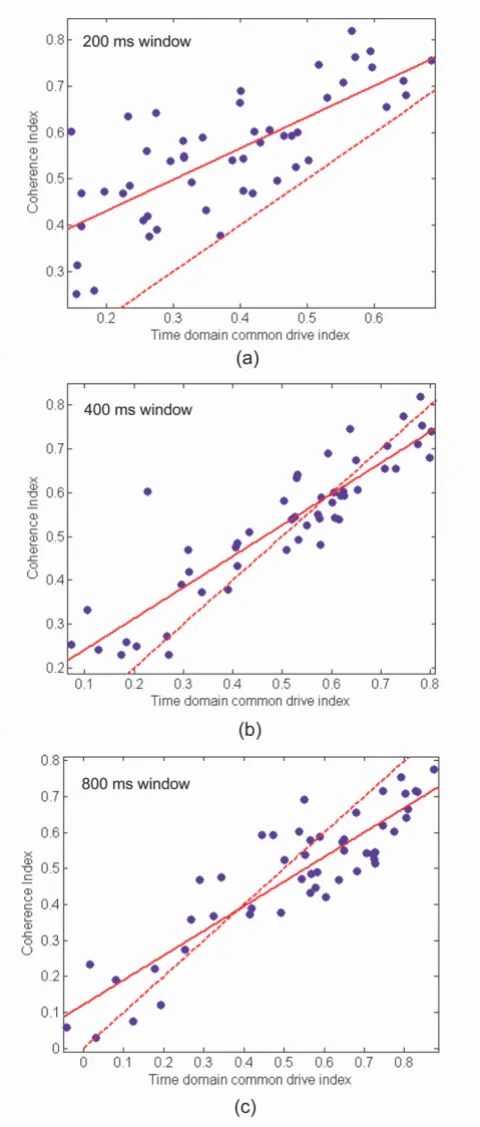
Results: Analytically, it may be demonstrated that under the theoretical condition of a narrowband point frequency, the two relations are equivalent. However practical situations deviate from this ideal condition. The correlation between the two techniques varies with time domain moving average window length and for window lengths of 200 ms, 400 ms and 800 ms, the r2 regression statistics (p < 0.05) are 0.56, 0.81 and 0.80 respectively.
Conclusions: Although theoretically equivalent and experimentally well correlated there are a number of minor discrepancies between the two techniques that are explored. The time domain technique is preferred for short data segments and is better able to quantify the strength of a broad band drive into a single index. The frequency domain measures are more encompassing, providing a complete description of all oscillatory inputs and are better suited to quantifying narrow ranges of descending input into a single index. In general the physiological question at hand should dictate which technique is best suited.
Published: 14 October 2004
Journal of NeuroEngineering and Rehabilitation 2004, 1:2 doi:10.1186/1743-0003-1-2
Received: 30 August 2004 Accepted: 14 October 2004
This article is available from: http://www.jneuroengrehab.com/content/1/1/2 © 2004 Myers et al; licensee BioMed Central Ltd.
Introduction
Common oscillations in neurophysiological activity in the human motor system have been well documented. During voluntary muscle contraction, the human central nervous system drives motor neurons at a range of frequencies which cause common modulations in the firings of these neurons. These drives are reviewed in [1] and [2] where they are summarized into four broad frequency ranges: (1) A low frequency drive at around 1–3 Hz (2) A neurogenic component of physiological tremor that occurs between 5– 12 Hz and is likely to have both spinal and supraspinal components. (3) A corticospinal drive in the beta (15–30 Hz) range (4) A corticospinal drive in the low gamma (30– 60 Hz) range, that increases in importance with stronger contractions and is called the Piper rhythm.
There are two distinct approaches toward the identifica-tion of these drives. The majority of the literature has examined common modulation to motor units using fre-quency domain methods. This methodology was first introduced by Rosenberg and colleagues [3] and applied by Farmer and colleagues [4] who used coherence analysis to identify both a significant low frequency and beta-band association between motor unit firings in the 1–12 Hz and 15–30 Hz frequency ranges respectively. Subse-quently, coherence analysis has become an established technique to study bivariate motor system measurements and a number of works have used this to investigate corti-comuscular interactions [5-8,1]; tremor [9]; aging [10]; oscillatory drive in Parkinson's disease [11,12]; dystonia [13]; stroke [14]; and cortical myoclonus [15].
A separate body of literature has focused specifically on the low frequency common drive. This drive was first identified by De Luca and colleagues [16] who demon-strated that the firing rates of concurrently active motor units (MUs) were modulated in a highly interdependent manner. They low-pass filtered the impulse trains corre-sponding to MU firing times to obtain the time-varying mean firing rates which they high-pass filtered at 0.75 Hz. They then performed a time domain cross-correlation analysis between pairs of zero-mean signals representing the fluctuations in mean firing rates. Peaks occurring near the zero lag location in the normalized cross correlations implied that those firings rates were essentially simultane-ously modulated with virtually no time delay. This phe-nomenon was termed 'common drive' to indicate a common excitation to the motor neuron pool that results in concurrent fluctuations in the firing rates of motor units from the same pool. A number of subsequent stud-ies have utilized this technique to investigate the relation-ship of this drive to handedness [17-19]; different proprioceptive conditions [20]; exercise [21]; task and dis-ease [22]; and aging [23]. These works have established this time domain method as an accepted means of
quan-tifying the common low frequency modulation of MU firings.
In a recent review [1], it was suggested that the low fre-quency common drive first identified by De Luca and col-leagues [16] using time domain methods is essentially the same low frequency drive as detected by Farmer and col-leagues [4] using frequency domain methods. In this paper we explore the relationship between the two tech-niques using mathematical and experimental approaches.
Analytic methods
Frequency domain methods: Coherence
The coherence between two zero-mean stationary random processes x1 (t) and x2 (t), at frequency f, is defined as:
where (f) is the cross spectral density and (f) and (f) are the auto spectral density functions of x1 (t) and x2 (t) respectively. The coherence function is a complex quantity and its squared magnitude provides a bounded measure of linear association between the two series, taking on a value of 1 for a perfect linear relation-ship and a value of 0 to indicate that the series are uncor-related. In practice, we are often limited to a single time-limited realization of each random process and hence it is necessary to estimate the magnitude squared coherence,
, by windowing the time series to
obtain multiple sections as follows:
where * denotes complex conjugation, N is the number of data segments employed and X1n (f) and X2n (f) are the dis-crete Fourier transforms of the nth data segments of x1 (t) and x2 (t). This estimate is biased and its probability den-sity function for non-weighted and non-overlapping win-dows has been analytically determined [24]. This may be used to derive the value of the estimated coherence, with a particular probability of occurrence, α, that would be obtained when the true value is zero. Any value exceeding this level is considered to be unlikely to be a false indica-tion of coherence with (α× 100) % confidence. This con-fidence level is given by [24,3]
Eα= 1 - (1 - α)1/(N-1) (3)
γx x
x x x x x x
f S f
S f S f
1 2
1 2
1 1 2 2
1 2 1
( )
=( )
( )
( )
/ ( )
Sx x
1 2 Sx x1 1
Sx x
2 2
Cx x f x x f
1 2 1 2
2
( )
= γ( )
ˆ ( )
*
C f
X f X f
X f X f
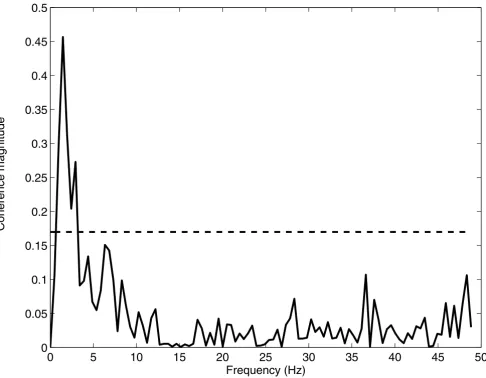
The resolution of the coherence estimate is determined from the inverse of the length of the windowed sections, i.e., for a 2 s window, the coherence resolution will be 0.5 Hz. Figure 1 depicts a typical coherence plot computed for the spike trains of two MU's and the associated 95% con-fidence level. The coherence plots reveal the bandwidth and values of significant coherence for the given resolu-tion. Results from coherence analyses are usually quanti-fied in terms of either the peak value and its frequency or the frequency range of significant coherence. In Figure 1 there is significant coherence between 0.5 and 3.5 Hz and the peak value of coherence is 0.46 and occurs at 1.5 Hz.
Time domain methods: Cross correlation
The cross correlation between two zero-mean stationary random processes x1 (t) and x2 (t) is defined as:
where E [·] is the estimation operator. Assuming ergodic-ity, for single time-limited realizations of each random process, this is determined using the integral:
where * denotes complex conjugation and τis the time lag between the signals. The Fourier transform of the cross Example of a magnitude squared coherence plot
Figure 1
Example of a magnitude squared coherence plot. Magnitude coherence between two motor unit spike trains recorded from the FDI muscle. The dashed horizontal line indicates significance at the 95% confidence level. Significant coherence occurs between 0.5 and 3.5 Hz with the peak coherence of 0.46 occurring at 1.5 Hz.
0
5
10
15
20
25
30
35
40
45
50
0
0.05
0.1
0.15
0.2
0.25
0.3
0.35
0.4
0.45
0.5
Frequency (Hz)
Coherence magnitude
Rx x E x t x t
1 2
( )
τ = [ ( )1 2( +τ)] ( )4Rx x x t x t dt
1 2( ) 1( ) 2( ) ( )5
*
correlation function, defines the cross-spectrum, (f). Cross correlation functions are unbounded measures and are typically normalized by the values of the autocorrela-tions at zero lag to bound the estimate between -1 and 1. The autocorrelation functions are the time domain equiv-alent of the auto power spectra and their value at zero lag represents the total energy in the signal. The normalized and bounded measure is known as the cross correlation coefficient, , which provides a measure of the lin-ear association between the two signals at a given time lag and is given by:
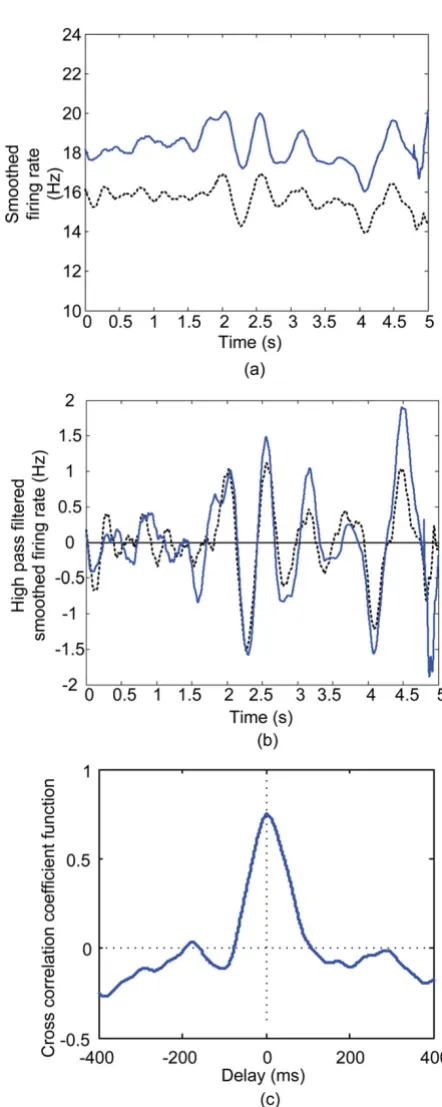
The original method employed by De Luca and colleagues [16] represents the time series as a binary pulse train with ones corresponding to the firing times of the MUs and zeros comprising the remainder of the signal. A moving average window is then used to smooth these binary sig-nals, which is analogous to filtering the time-series with a low-pass filter. These smoothed signals are depicted in fig-ure 2a. A high-pass filter is then used to remove the mean bias of the signal as 'shown in figure 2b. The filtered sig-nals are subsequently cross correlated and an index obtained from the peak value of the normalized cross cor-relation function within a specified lag window. Here we term this index the time domain common drive coefficient.
Figure 2c depicts the normalized cross correlation func-tion for the same two motor unit spike trains used in Fig-ure 1 obtained using a moving average Hanning window of 400 ms duration and high pass filtering at 0.75 Hz. The function is displayed for lags up to ± 400 ms and the peak of the signal indicated at a lag of 3.5 ms. The time domain common drive coefficient is measured as 0.75.
Relationship between cross correlation and coherence
The cross correlation coefficient is related to coherence using a similar analysis to Gardner [25] as follows:
We begin with the real and stationary signals x1 (t) and x2 (t), where x2 (t) = αx1 (t - τ0) + n (t) is a scaled and time-delayed version of x1 (t), with additive uncorrelated, zero mean noise, n (t). The cross-correlation function is given by
since the cross correlation with the noise is zero every-where. The cross spectrum is given by
Assume that the signals y1 (t) and y2 (t) result from passing the signals x1 (t) and x2 (t) respectively through a tunable narrowband bandpass filter with transfer function denoted by H (f):
where and ∆ are the center frequency and bandwidth of the ideal bandpass filter. The cross-correlation function between filtered signals y1 (t) and y2 (t) is given by:
where (f) is the cross power spectral density func-tion of y1 (t) and y2 (t).
The cross power spectrum may be written in terms of its
magnitude and phase, .
Since for stationary, real signals, the autocorrelation is real and even and hence, (f) is real, the phase of the cross spectrum is given by (equation 8):
Thus replacing (f) with |H (f)|2 (f) in equation 10 we get
since is real for real x1 (t) and x2 (t).
Similarly for the autocorrelation functions we get
and
Thus as ∆→ 0 we obtain the expression for the normal-ized cross correlation function as:
Sx x
1 2
ρx x1 2( )τ
ρx x τ τ
x x x x x x
R
R R
1 2
1 2
1 1 0 2 2 0
6
( ) ( )
( ) ( ) ( )
=
Rx x1 2( )τ =αRx x1 1(τ τ− 0) ( )7
Sx x f Sx x f e i f
1 2 1 1
0 2
8
( )=α ( ) − π τ ( )
H f( ) , f f , / ( ) = − ≤ 1 0 2 9 ∆ otherwise f
Ry y Sy y f ei f df
1 2 1 2
2 10
( )τ = ( ) π τ ( )
−∞ ∞
∫
Sy y1 2
Sx x f Sx x f e i x x f
1 2 1 2
1 2
( )= ( ) −θ ( )
Sx x
1 1
θx x1 2( )f =2π τf 0 ( )11
Sy y
1 2 Sx x1 2
R H f S f e df
S f e
y y x x i f f
x x i
1 2 1 2
0
1 2
2 2 2
0 2 12 ( ) ( ) ( ) ( ) ( ) [ ] [ τ = π τ π τ = − ∞
∫
ππ τ π τ π τ τ f f f f x x dfS f f
− − +
∫
≅ − 2 2 2 0 01 2 2 13
] /
/
( ) cos ( ) ( )
∆ ∆
∆
Ry y
1 2( )τ
Rx x Sx x f f
1 1( )τ ≅ ∆ 1 1( ) cos2π τ ( )14
Rx x Sx x f
Example of the construction of a low frequency common drive plot
Figure 2
The peak of the cross-correlation function occurs at the time delay, τ= τ0. Thus
Thus we see that the peak of the normalized cross-correla-tion funccross-correla-tion between two signals after ideally bandpass filtering to contain a single frequency, is identical to the magnitude of the coherence function of the original signals at the frequency of the filter. The phase of the coherence function is the same as the phase of the cross-spectrum and provides the time delay.
For a less ideal filter that spans several frequencies the relationship is less precise and may be derived as follows:
Let W (f) be the new filter transfer function and thus the normalized cross-correlation function is:
where f1 and f2 are the cut-off frequencies of the filter. Thus when multiple frequencies are present, this may be thought of as taking the weighted summation of the cross-correlation functions at each frequency present and nor-malizing this by the product of the weighted summations of the autocorrelations across all frequencies present. The more narrow band the filter used, the more similar the time domain correlation and frequency domain magni-tude coherence measures. As the filter encompasses a greater range of frequencies, measures from the two meth-ods will increasingly deviate.
The low frequency time domain method employed by De Luca and colleagues [16] utilized a moving Hanning win-dow as a low pass filter. The cut-off frequency of the filter is dependent on the time constant of the filter which is typically 400 ms [16,21] but values up to 0.95 s have also been used [26]. However different window lengths will modify the relationship between this time domain meas-ure and the coherence function.
The effect of varying window length may be illustrated by obtaining an expression for the filter transfer function. The equation for the Hanning window is given as:
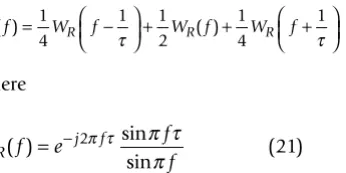
where τis the length of the window. The discrete Fourier transform of this is given as (Kay, 1988):
where
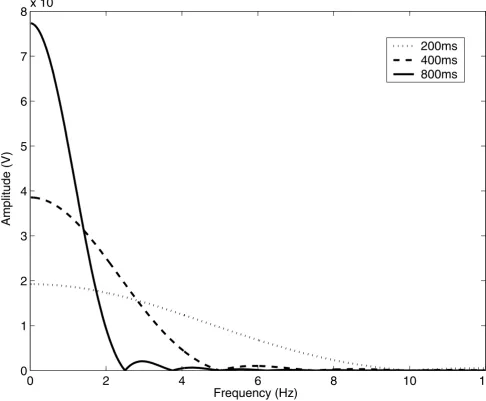
Figure 3 depicts the transfer function power spectrum (|W (f)|2) for τ= 200, 400 and 800 ms. The figure clearly dem-onstrates that as the length of the analysis window decreases, the bandwidth of the filter increases. Therefore the only information that can be ascertained with shorter windows is that the frequency of the common modulating input lies somewhere within the frequency range specified by the window. Longer windows result in a better correla-tion with coherence values at lower single frequencies (close to zero), while shorter windows lump into a single value a weighted expression of the coherence values in the frequency range which they span.
Experimental methods
In this section we demonstrate the relationship between time and frequency domain based methods to estimate the common modulating drive using empirical data. The methods are applied to data collected during isometric contractions of the First Dorsal Interosseous muscle at 20% of maximal effort. Two contractions where the activ-ities of 4 and 5 MUs were identified yielded a total of 16 pairs of coactive MUs. The periods of concurrent activity of these MU pairs ranged between 30 s to 1 minute and were further divided into pairs of non-overlapping 10 s intervals resulting in a total of 50 pairs of 10 s long spike trains. Each method was applied to these spike train pairs and the correlation between the results yielded by the two methods were investigated as discussed below.
The time domain method was used to estimate low fre-quency common drive according to the method described by De Luca and colleagues [16]. Three different time domain estimates were formed by smoothing the spike trains using Hanning windows of length 200, 400 and 800 ms respectively. These smoothed firing rate signals were then digitally high pass filtered with a low frequency cut-off of 0.75 Hz using a third order Butterworth filter to remove the mean bias discharge rates. The cross correla-tion coefficient funccorrela-tion of these high pass filtered records
lim ( )
( ) cos[ ( )]
[ ( ) ( )] / ∆→ − 0 0 1 2 1 2 1 2
1 1 2 2
2
ρy y τ π τ τ
x x
x x x x
S f f
S f S f
(( )16
ρy y τ γ
x x
x x x x
x x S f
S f S f f
1 2
1 2
1 1 2 2
1 2
0 1 2 17
( ) ( ) [ ( ) ( )]/ ( ) ( ) = = ˆ ( ) ( ) ( ) ( ) ( ) ( ) ρ τ π τ τ y y
x x i f df f
f
x x f
W f S f e
W f S f df 1 2 1 2 0 1 2 1 1 1 2 2 2 = −
∫
ff x x f fW f S f df 2 2 2 1 2 2 18
∫
∫
( ) ( ) ( ) w t t t( )= +cos ( )
< ≤ 1 2 1 2 0 0 19 π
τ elsewhereτ
W f( )= WRf− WR( )f WR f ( )
+ + + 1 4 1 1 2 1 4 1 20 τ τ
W f e f
f
R( ) j f
sin
sin ( )
= −2
21
π τ π τ
was then obtained and the peak value of this function within ± 50 ms of the zero time lag was recorded and termed the time domain common drive coefficient.
The coherence analyses were performed in a similar man-ner to the procedure of Rosenberg and colleagues [3] for point process data. The spike trains were represented as binary pulse trains with ones corresponding to the firing times of the MU's and zeros comprising the remainder of the signal. Fourier transforms of these trains were obtained for each appropriately windowed section and
then averaged according to equation (2). However where Rosenberg and colleagues [3] do not use overlapping or tapered data windows, we used overlapping, tapered Han-ning windows of 2048 ms to optimize the variance and bias of the estimate. With any non-parametric spectral estimation technique, there is a trade-off between the var-iance and both the bias and resolution of the estimation. A window size of 2048 ms, gives a frequency resolution of 0.49 Hz, which is adequate to discriminate frequencies for our purposes. However, when analyzing 10 s of data using 2048 ms non-overlapping windows, only 5 different Magnitude squared spectra of Hanning window filters
Figure 3
Magnitude squared spectra of Hanning window filters. Magnitude spectra of the transfer functions of Hanning window filters for three different time constants, τ= 200 ms (dotted line), τ= 400 ms (dashed line) and τ= 800 ms (solid line). As the time constant increases the bandwidth of the filter decreases and its magnitude increases.
0
2
4
6
8
10
12
0
1
2
3
4
5
6
7
8
x 10
−3
Frequency (Hz)
Amplitude (V)
records are available and this small number of records will increase the variance of the estimate. Furthermore rectan-gular windows introduce an estimation bias due to the effect of their sidelobes. These concerns may be reduced by using the Welch periodogram method which uses tapered windows (to reduce spectral leakage and therefore the estimation bias) and overlapping windows (to increase the total number of windows and hence reduce the variance). The minimum variance for this method is obtained using an overlap of 62.5% [27]. The frequency corresponding to the first zero-crossing of the Hanning fil-ter was obtained according to equation (20) and the peak value of the coherence in the range between 0.75 Hz and this frequency was recorded.
A linear regression between the time domain common drive coefficients and corresponding frequency domain peak coherence values was performed to determine whether a linear relationship between the two indices existed. The regression r2 values are reported at a signifi-cance level of p < 0.05.
Results and discussion
Figure 4a,4b,4c displays the regression between the low frequency time domain common drive coefficients for Hanning windows of length 200, 400 and 800 ms and peak low frequency coherence. All regressions are signifi-cant at p < 0.05 and the r2 statistics are 0.56, 0.81 and 0.80 respectively. A unitary slope line is displayed in the figure and this describes the theoretical relationship between the two indices. These results indicate that for the larger 400 ms and 800 ms windows, the time domain method is more closely correlated with the coherence estimate, with the 400 ms window yielding a marginally better fit. The data for the smaller 200 ms window exhibits a consistent bias, with the coherence estimate larger than the time domain common drive estimate, whilst the 400 ms and 800 ms windowed data are more evenly distributed around the unitary slope line, indicating less bias. There are a number of possible factors that could contribute to the observed mismatches between the two methods.
As demonstrated in Figure 2, the cross-correlation peak can occur at lags slightly different than zero. A time delay or misalignment has been shown to introduce a bias into the coherence estimate that is proportional to the delay and coherence magnitude and inversely proportional to the FFT epoch duration [24]. However for delays of the order of magnitude of ± 50 ms and FFT lengths of approx-imately 2 s, this type of bias is very small and unlikely to account for the observed differences between the time and frequency domain estimates.
The use of a short duration window in the time domain method results in the inclusion of multiple frequencies in
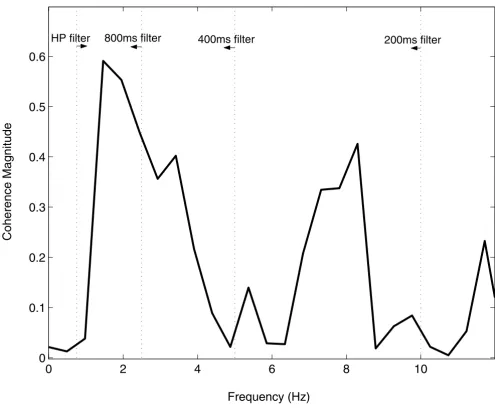
the time domain correlation estimation according to equation (18). The bandwidths of descending oscillatory drives may be variable. Thus when the descending drive occupies a narrow bandwidth and the time domain win-dow includes a greater range of frequencies than this bandwidth, this will bias the time domain estimate to be lower than the peak coherence value as is the case in figure 4a. Alternatively should the drive span a broader band-width, the time domain measure would encompass all the correlated frequencies into a single value and would thus be different than the value obtained from any single peak coherence frequency. This idea is illustrated in Figure 5 where a typical coherence plot is displayed. Superimposed on this are vertical lines representing various moving aver-age filter cut-off frequencies. The 0.75 Hz high pass cut-off frequency is also displayed. Thus from the figure we see that in this case the coherence occupies a fairly broad bandwidth from 1–5 Hz, peaking at 1.5 Hz. The cut-off frequency of the 200 ms filter is approximately 10 Hz and thus the time domain estimate will include coherence val-ues at all these frequencies which would make it signifi-cantly different from the peak coherence. The 400 ms and 800 ms windows would better correlate with the peak coherence frequencies and the 400 ms window would provide a better overall index encompassing the full band-width of the drive. However, if the middle peak at 8 Hz were stronger and actually the main peak, the wider time windows would miss it altogether. This emphasizes the importance of a priori knowledge in choosing the appro-priate time windows in the time-domain based method. Therefore in summary, the time domain measure is more effective in quantifying a range of frequencies into a single index and the peak coherence estimate is better at repre-senting the coherence at any single frequency.
Coherence estimates are typically formed from data records of around 1–5 minutes in length [4,28,29] or from pooled coherence measures of repeated trial meas-urements [30]. This increases the number of non-overlap-ping windows in the calculation, thereby reducing the variance of the coherence estimate. Non-overlapping, rec-tangular windows are traditionally preferred due to the clear relationship with significance levels. Overlapping, tapered windows will allow coherence to be estimated from shorter data segments and parametric techniques, in particular multivariate autoregressive (MAR) methods are suggested for the analysis of very short duration data seg-ments [31]. When using short records of data (<5 s), the coherence estimates are likely to be significantly biased. However, the time domain method is more robust for such short data lengths and would therefore be preferred in these situations.
Regression plots for low frequency common drive time versus frequency domain techniques
Figure 4
frequency domain coherence method simply subtracts the mean component of the signal prior to forming the esti-mate. Although similar, these two methods are not iden-tical and may further explain some of the variation between the time and frequency domain techniques. A further possibility is to employ a low order polynomial detrending technique instead of high pass filtering or sub-tracting the mean. In general, a visual examination of the smoothed firing rate signals would indicate whether this would be necessary.
It is straight forward to quantify any time delay using the time domain technique. Although this is also possible with the frequency domain technique, this delay informa-tion is incorporated in the phase of the estimate and is therefore 2πperiodic and would thus yield the same result for integer multiples of delay. For significant coherence present over a band of frequencies, Mima and colleagues [32] suggest a constant phase shift plus constant time delay regression model to compute time delays from coherence estimates. However for narrow band Magnitude squared coherence between two motor unit spike trains recorded from the FDI muscle
Figure 5
Magnitude squared coherence between two motor unit spike trains recorded from the FDI muscle. Magnitude coherence between two motor unit spike trains recorded from the FDI muscle. The vertical dotted lines from left to right represent the cut-off frequencies of the 0.75 high-pass filter, and the 800 ms, 400 ms and 200 ms moving average low-pass filters. The peak coherence occurs at 1.5 Hz.
0
2
4
6
8
10
0
0.1
0.2
0.3
0.4
0.5
0.6
Frequency (Hz)
Coherence Magnitude
descending drives, the time domain technique provides a clearer estimate of any time delay.
It should be noted that the time domain technique may be generalized to cover any arbitrary frequency. This would necessitate bandpass filtering the signals to the frequency range of interest, removing the mean trends and then evaluating the cross-correlation function. Although this requires a priori knowledge of the drive bandwidth, this method would then be able to provide a single index to quantify a particular bandwidth.
Conclusions
Two separate bodies of literature offer techniques to esti-mate band limited common oscillatory input to motor neurons. These techniques are based in either the time or in the frequency domain. Indices derived from both meas-urement techniques are well correlated with each other and in the theoretical limit, the techniques are shown to be mathematically equivalent. However, for practical pur-poses there are a number of minor discrepancies which may favour the use of one particular method for a given application.
The time domain method offers greater resolution in time (the latency of the correlations are easily revealed) at the expense of the requirement of a priori knowledge of the bandwidth of the common modulating drive. On the other hand the frequency domain technique reveals infor-mation regarding the frequency distribution of the com-mon modulating drives but it is more difficult to obtain accurate estimates of the coherence with short signal lengths as well as of the exact delay.
Time domain methods of estimation are preferred for short data segments and are well suited to quantifying the strength of a broad band drive into a single index. This proves useful in quantitative, comparitive analyses of the common behavior of MUs such as statistical tests that investigate the effects of aging or disease. Frequency domain measures tend to be more encompassing as they provide a complete description of all common oscillatory inputs. This facilitates qualitative analysis of distribution of coherence across frequencies and hence leads to a bet-ter understanding of the nature of the common inputs. They are well suited for estimation from large data seg-ments, that may be assumed to be stationary, and are bet-ter able to quantify narrow ranges of descending inputs into a single index. Thus the selection of one technique over another should be dictated by the nature of the phys-iological question to be addressed.
Acknowledgements
The authors gratefully acknowledge the financial support of the Falk Medi-cal Research Trust.
References
1. Brown P: Cortical drives to human muscle: the Piper and related rhythms.Prog Neurobiol 2000, 60:97-108.
2. Grosse P, Cassidy MJ, Brown P: EEG-EMG, MEGEMG and EMG-EMG frequency analysis: physiological principles and clinical applications.Clin Neurophysiol 2002, 113:1523-1531.
3. Rosenberg JR, Amjad AM, Breeze P, Brillinger DR, Halliday DM: The Fourier approach to the identification of functional coupling between neuronal spike trains. Prog Biophys Mol Biol 1989,
53:1-31.
4. Farmer SF, Bremner FD, Halliday DM, Rosenberg JR, Stephens JA:
The frequency content of common synaptic inputs to motoneurones studied during voluntary isometric contrac-tion in man.J Physiol 1993, 470:127-155.
5. Conway BA, Halliday DM, Farmer SF, Shahani U, Maas P, Weir AI, Rosenberg JR: Synchronization between motor cortex and spi-nal motoneurospi-nal pool during the performance of a main-tained motor task in man.J Physiol 1995, 489:917-924. 6. Salenius S, Portin K, Kajola M, Salmelin R, Hari R: Cortical control
of human motoneuron firing during isometric contraction.J Neurophysiol 1997, 77:3401-3405.
7. Halliday DM, Conway BA, Farmer SF, Rosenberg JR: Using electro-encephalography to study functional coupling between cor-tical activity and electromyograms during voluntary contractions in humans.Neurosci Lett 1998, 241:5-8.
8. Mima T, Hallett M: Corticomuscular coherence: a review.J Clin Neurophysiol 1999, 16:501-511.
9. McAuley JH, Marsden CD: Physiological and pathological trem-ors and rhythmic central motor control. Brain 2000,
123:1545-1567.
10. Semmler JG, Kornatz KW, Enoka RM: Motor-unit coherence dur-ing isometric contractions is greater in a hand muscle of older adults.J Neurophysiol 2003, 90:1346-1349.
11. Brown P, Marsden J, Defebvre L, Cassim F, Mazzone P, Oliviero A, Altibrandi MG, Di Lazzaro V, Limousin-Dowsey P, Fraix V, Odin P, Pollak P: Intermuscular coherence in Parkinson's disease: relationship to bradykinesia.Neuroreport 2001, 12:2577-2581. 12. Salenius S, Avikainen S, Kaakkola S, Hari R, Brown P: Defective
cor-tical drive to muscle in Parkinson's disease and its improve-ment with levodopa.Brain 2002, 125:491-500.
13. Farmer SF, Sheean GL, Mayston MJ, Rothwell JC, Marsden CD, Con-way BA, Halliday DM, Rosenberg JR, Stephens JA: Abnormal motor unit synchronization of antagonist muscles underlies patho-logical co-contraction in upper limb dystonia. Brain 1998,
121:801-814.
14. Mima T, Toma K, Koshy B, Hallett M: Coherence between corti-cal and muscular activities after subcorticorti-cal stroke.Stroke
2001, 32:2597-2601.
15. Grosse P, Guerrini R, Parmeggiani L, Bonanni P, Pogosyan A, Brown P: Abnormal corticomuscular and intermuscular coupling in high-frequency rhythmic myoclonus.Brain 2003, 126:326-342. 16. De Luca CJ, LeFever RS, McCue MP, Xenakis AP: Control scheme
governing concurrently active human motor units during voluntary contractions.J Physiol 1982, 329:129-142.
17. Kamen G, Greenstein SS, De Luca CJ: Lateral dominance and motor unit firing behavior.Brain Res 1992, 576:165-167. 18. Semmler JG, Nordstrom MA: Influence of handedness on motor
unit discharge properties and force tremor.Exp RBraines 1995,
104:115-125.
19. Adam A, De Luca CJ, Erim Z: Hand dominance and motor unit firing behavior.J Neurophysiol 1998, 80:1373-1382.
20. Garland SJ, Miles TS: Control of motor units in human ffexor digitorum profundus under different proprioceptive conditions.J Physiol 1997, 502:693-701.
21. Semmler JG, Nordstrom MA, Wallace CJ: Relationship between motor unit short-term synchronization and common drive in human first dorsal interosseous muscle. Brain Res 1997,
767:314-320.
22. Patten C, Kamen G: Adaptations in motor unit discharge activ-ity with force control training in young and older human adults.Eur J Appl Physiol 2000, 83:128-143.
23. Erim Z, Beg MF, Burke DT, de Luca CJ: Effects of aging on motor-unit control properties.J Neurophysiol 1999, 82:2081-2091. 24. Carter GC: Coherence and time delay estimation.Proc IEEE
Publish with BioMed Central and every scientist can read your work free of charge "BioMed Central will be the most significant development for disseminating the results of biomedical researc h in our lifetime."
Sir Paul Nurse, Cancer Research UK
Your research papers will be:
available free of charge to the entire biomedical community peer reviewed and published immediately upon acceptance cited in PubMed and archived on PubMed Central yours — you keep the copyright
Submit your manuscript here:
http://www.biomedcentral.com/info/publishing_adv.asp
BioMedcentral
25. Gardner WA: A unifying view of coherence in signal processing.Signal Processing 1992, 29:113-140.
26. De Luca CJ, Erim Z: Common drive of motor units in regula-tion of muscle force.Trends Neurosci 1994, 17:299-305. 27. Marple SL: Digital spectral analysis with applications.
Engle-wood Cliffs, NJ: Prentice Hall; 1987.
28. Kristeva-Feige R, Fritsch C, Timmer J, Lucking CH: Effects of atten-tion and precision of exerted force on beta range EEG-EMG synchronization during a maintained motor contraction task.Clin Neurophysiol 2002, 113:124-131.
29. Gross J, Tass PA, Salenius S, Hari R, Freund HJ, Schnitzler A: Cor-tico-muscular synchronization during isometric muscle con-traction in humans as revealed by magnetoencephalography.J Physiol 2000, 527:623-631. 30. Amjad AM, Halliday DM, Rosenberg JR, Conway BA: An extended
difference of coherence test for comparing and combining several independent coherence estimates: theory and appli-cation to the study of motor units and physiological tremor. J Neurosci Methods 1997, 73:69-79.
31. Cassidy MJ, Brown P: Hidden Markov based autoregressive analysis of stationary and non-stationary electrophysiologi-cal signals for functional coupling studies.J Neurosci Methods
2002, 116:35-53.
32. Mima T, Hallett M: Electroencephalographic analysis of cor-tico-muscular coherence: reference effect, volume conduc-tion and generator mechanism. Clin Neurophysiol 1999,