Dwight Grant* and Gautam Vora**
March 1999
Revised: February 11, 2001
Do not quote. Comments welcome.
*
Douglas M. Brown Professor of Finance, Anderson School of Management, University of New Mexico, Albuquerque, NM 87131-1221. Tel: 505-277-5995, fax: 505-277-7108, e-mail: [email protected]. **
Analytical Implementation of the
Ho and Lee Model for the Short Interest Rate
Abstract
Analytical Implementation of the
Ho and Lee Model for the Short Interest Rate
Ho and Lee (1986) (HL henceforth) pioneered the use of no-arbitrage computational
lattices for the evolution of the short interest rate. They were following Vasicek (1977) and Cox,
Ingersoll and Ross (1985) in giving new direction to the research in modelling interest rates.
Black, Derman and Toy (1990) (BDT henceforth) quickly followed HL with an innovative
no-arbitrage model of interest-rate evolution. Whereas HL assumed that the interest rates are
normally distributed, BDT assumed that they are log-normally distributed. These computational
lattices have become very popular because of (1) their built-in ability to price exactly a given
vector of bond-prices and (2) their resemblance to the binomial approach of Cox, Ross and
Rubinstein (1979) which made the pricing of options a much simpler process. In addition, BDT
introduced an elegant numerical, albeit search, method of implementation such that both the
correct expectations (of discounted value of bonds) and variances obtain simultaneously.
Rebonato (1998) states that “the procedure can be shown to be equivalent to determining the
change in drift required by Girsanov’s theorem if arbitrage is to be avoided. … This equivalent
measure can differ from the real world measure by a drift transformation.”
When writing about the Ho-Lee model, other researchers adopted the numerical approach
in order to extend the original lattice models of HL and BDT. (See, for example, Hull and White
(1996), Jarrow and Turnbull (JT) (1996), or Ritchken(1996).) Under many realistic
circumstances, the numerical approach results in binomial trees rather than lattices. These trees
grow exponentially and are not practical for many problems. For those problems, Monte Carlo
simulation is the preferred numerical method. The current method of calibration, namely forward
induction with a search at each date for the appropriate drift term, would be extremely difficult
efforts to find efficient ways around the problem. The results presented in this paper apply
equally well to Monte Carlo simulation thereby expanding significantly the capacity to model
realistic specifications of the evolution of interest rates.
In this paper we develop an analytical solution to the implementation of the HL model of
the short interest rate. 1 This solution obviates the need for setting up the evolution as a “goal seek” math-program subject to the constraints of conditional expectations and volatility. We
illustrate the method via three examples: (1) Time-varying volatility i.e., the volatility is fixed for
a particular maturity. This means that the volatilities for the short-rate one period hence, for the
short-rate two periods hence, for the short-rate three periods hence, and so on, are different but
fixed. The volatility structure allows the volatility of the short rate to vary across short rates but
to be constant for each maturity as time elapses. This specification yields a short-rate tree. This is
different specification than that assumed in example 3 which yields a short-rate lattice. (2) The
canonical case of constant volatility, i.e., the volatility is constant for all terms-to-maturity. This
specification yields a short-rate lattice. (3) Time-varying volatility which changes as time
elapses. This specification of volatility is taken from Jarrow and Turnbull (1996). They assume
an evolution in which the volatility of the short rate varies across short rates but is constant for
each short rate as time passes. This specification yields a short-rate lattice. In terms of difficulty
of implementation, the case of a constant-volatility is the easiest. The cases of examples 1 and 3,
involving time-varying volatilities, are more complex.
1
Kijima and Nagayama (1994) may be considered to have done something similar in their development of what they call the shift function. Their results are derived in the continuous-time setting and then implemented for the Hull and White trinomial tree. Whether their results are generalizable and applicable in a wider context is unknown. Hull and White (1990a, 1990b) explore extensions of the Vasicek model that provide an exact fit to the initial term-structure of interest rates. When the speed of mean-reversion is set to zero, the Hull-White model reduces to the HL model. Hull and White provide two implementations of their continuous-time model, viz., trinomial-tree building and explicit finite-difference method, based on a demonstration by Brennan and Schwartz (1978). In a series of subsequent articles, they expound upon the trinomial-tree method. While their model does provide elegant
I. Derivation of the Analytical Implementation Method
Ritchken (1996) notes that the Ho and Lee model of the evolution of the short interest rate
at time t, r(t), is given in continuous time as
( ) ( ) ( ) ( ) for 0,
dr t =µ t dt+σ t dz t t> (1)
where ( )µ t is the drift, ( )σ t is the instantaneous volatility of the short rate, and dz t( ) ~ N(0,1). This expression permits both the drift and volatility to be functions of time and it produces an
instantaneous short interest rate that is normally distributed.
The corresponding expression for the change in the short interest rate over the discrete time
interval ∆t, i.e., for the time period
[
t t, + ∆t]
, is( ) ( ) ( ) ( ) for 0
r t µ t t σ t z t t
∆ = ∆ + ∆ ≥ (2)
where r t
( )
and ( )σ t are the short rate and the volatility of the short rate at time t for the interval from t to t +∆t and ∆z t( )is a unit normal random variable. Without loss of generality, let ∆ =t 1and let t=0. We can write the evolution of the short rate as
( ) ( )
( ) ( ) ( )
(0) 1 0 0 0 0 .
r r r µ σ z
∆ ≡ − = + ∆ (3)
This yields, for example,
( ) ( ) ( ) ( ) ( )
1 0 0 0 0 .r =r +µ +σ ∆z
( ) ( ) ( ) ( ) ( )
( ) ( ) ( ) ( ) ( ) ( )
( )
{
( ) ( )
}
{
( ) ( ) ( ) ( )
}
2 1 1 1 1
(0) 0 0 0 1 1 1
0 0 1 0 0 1 1 .
r r z
r z z
r z z
µ σ
µ σ µ σ
µ µ σ σ
= + + ∆
= + + ∆ + + ∆
= + + + ∆ + ∆
( ) ( )
3 0{
( ) ( ) ( )
0 1 2}
{
( ) ( ) ( ) ( ) ( ) ( )
0 0 1 1 2 2 .}
r =r + µ +µ +µ + σ ∆z +σ ∆z +σ ∆z
( ) ( ) (
)
( ) (
)
( )
1(
)
1(
) (
)
1 1
1 1 1 1
0 1 1 1 .
t t
j j
r t r t t t z t
r j j z j
µ σ
µ σ
− −
= =
= − + − + − ∆ −
= +
∑
− +∑
− ∆ − (4)Expression (4) shows that the short rate is the sum of a set of non-stochastic drift terms and
a set of stochastic terms; all of the latter are normally distributed. Consequently, all short interest
rates are normally distributed (albeit with changing parametric values). For example,
( )
(
( ) ( )
2( )
( )
)
1 ~ 0 0 , 1 .
r N r +µ σ r
( )
(
( )
( )
( )
2(
( ) ( )
)
)
2 ~ 0 0 1 , 1 2 .
r N r +µ +µ σ r +r
( )
(
( ) ( ) ( )
( )
2(
( ) ( ) ( )
)
)
3 ~ 0 0 1 2 , 1 2 3 .
r N r +µ +µ +µ σ r +r +r
In general, then,
( )
( )
1(
)
2( )
1 1
~ 0 1 , .
t t
j j
r t N r µ j σ r j
−
= =
+ −
∑
∑
(5)The inputs for a Ho and Lee no-arbitrage interest rate model in discrete time are (1) a set of
known (pure) discount bond prices,
{
P( ) ( ) ( )
1 ,P 2 ,P 3 , ... ,P n( )
}
,2 and (2) the volatility (standard deviation) of future one-period short rates,{
σ( ) ( )
0 ,σ 1 , ... ,σ(
n−1)
}
.An evolution of the short rate that precludes arbitrage must satisfy the local expectations
condition that bonds of any maturity offer the same expected rate of return in a given period.
This is equivalent to the expectation of the discounted value of each bond’s terminal payment
2
being equal to its given market value.3 Let the present values, at date 0, of a bond’s terminal
payments be given by
( )
( )
1
0 exp
n
j
p n r j
−
=
= −
∑
.Therefore, the no-arbitrage conditions will be stated as
( )
( )0[ ]
(0) (0)0 0
1 f Q (1) Q r r .
P =e− ≡E p =E e− =e−
( )
{ ( ) ( )0 1}( )
{( ) ( )0 1}0 0
2 f f Q 2 Q r r .
P =e− + ≡E p =E e− +
( )
{ ( ) ( ) ( )0 1 2}( )
{( ) ( ) ( )0 1 2}0 0
3 f f f Q 3 Q r r r .
P =e− + + ≡E p =E e− + +
In general, then,
( )
1( )
0( )
0 1( )
0 0
exp exp ,
n n
Q Q
j j
P n f j E p n E r j
− − = = = − ≡ = −
∑
∑
(6)where 0
[ ]
Q
E ⋅ is the expectation at date t=0 under the equivalent martingale probability
distribution Q and f
( )
j is the one-period forward rate observed at date j.From statistics we know that if x: N
(
µ σ, 2)
, then42
2 .
x
E e e
σ µ
− + −
=
(7)
Therefore, for date t=2,
( )
{( ) ( )} ( ) ( )( ) ( ) 2( )( )
0
0 1 0 1
0 0 1 1 1 0 2 2 . Q
r r r r
Q Q
E r r
r
P E e e E e
e e σ
− + − − − + − = = = Further, 3
For example, we can illustrate that the equivalence with respect to the expected rate of return on the two-period bond from time 0 (zero) to time 1:
(1) (1)
(0) (0) (1)
2
2 2
ln (0) or
r r
r r r
E e E e
r e or P E e
( )
( )
( )
( )
( )
( )
( ) ( )
( )
( )
2 0
2 0
1
ln 2 0 1 1 or
2 1
1 ln 2 0 1 .
2
Q
Q
P r E r r
E r P r r
σ σ
= − − +
= − − +
We know that lnP
( )
2 = −f( ) ( )
0 − f 1 = −r( ) ( )
0 − f 1 . Therefore, upon substitution,( )
( )
2( )
( )
0
1
1 1 1 .
2
Q
E r = f + σ r (8)
Thus, the expectation at date 0 of the short rate at date 1 is the forward rate plus a term
determined by the variance, 1 2
( )
( )
2σ r 1 .
Further, applying the expectations operator to expression (4), we get a second expression
for the expectation of the short rate,
( )
( ) ( )
0 1 0 0 .
Q
E r =r +µ (9)
From expressions (8) and (9), we get
( )
( ) ( )
1 2( )
( )
0 1 0 1 .
2
f r r
µ = − + σ (10)
Expression (10) tells us that the drift term, (0)µ , is given by the combination of two effects: (1) (1)f −r(0) is the difference between the forward rate and the short rate, i.e., the short
rate drifts up or down towards the forward rate. (2) 1 2
( )
( )
2σ r 1 is a positive drift adjustment term (DAT) that is required to preclude arbitrage.5
Let ( )δ t denote the DAT for date t. Then,
( )
1 2( )
( )
0 1 .
2 r
δ = σ (11)
Now we can work out the details for t=3.
5
( )
{( ) ( ) ( )} ( ) {( ) ( )}( ) ( ) ( ) 2( ( ) ( ))
0
0 1 2 0 1 2
0 0
1
1 2 1 2
0 2
3
. Q
r r r r r r
Q Q
E r r r r
r
P E e e E e
e e σ
− + + − − +
− + + + −
= =
=
Further,
( )
( )
( )
( )
(
( ) ( )
)
( ) ( )
( )
( )
( )
(
( ) ( )
)
( )
( ) ( ) ( )
(
( ) ( )
)
( )
( )
2
0 0
2 2
0
2 2
0
1
ln 3 0 1 2 1 2
2
1 1
0 1 1 2 1 2 or
2 2
1 1
2 ln 3 0 1 1 2 1 .
2 2
Q Q
Q
Q
P r E r E r r r
r f r E r r r
E r P r f r r r
σ
σ σ
σ σ
= − − − + +
= − − − − + +
= − − − + + −
We know that lnP
( )
3 = −f( ) ( ) ( )
0 − f 1 − f 2 = −r( ) ( ) ( )
0 − f 1 − f 2 . Therefore, uponsubstitution,
( )
( )
2(
( ) ( )
)
2( )
( )
0
1 1
2 2 1 2 1 .
2 2
Q
E r = f + σ r +r − σ r (12)
Thus, the expectation at date 0 of the short rate at date 2 is the forward rate plus a term
determined by the variance, 1 2
(
( ) ( )
)
1 2( )
( )
2σ r 1 +r 2 −2σ r 1 .
Further, applying the expectations operator to expression (4), we get a second expression
for the expectation of the short rate,
( )
( ) ( ) ( )
0 2 0 0 1 .
Q
E r =r +µ +µ (13)
From expressions (12) and (13), we get
( )
( ) ( ) ( )
1 2(
( ) ( )
)
1 2( )
( )
1 2 0 0 1 2 1 .
2 2
f r r r r
µ = − −µ + σ + − σ
Substitute expression (10) above to get:
( )
( ) ( )
1 2(
( ) ( )
)
2( )
( )
1 2 1 1 2 1 .
2
f f r r r
µ = − + σ + −σ (14)
at date 1, i.e., the nearby forward short rate drifts up or down towards the distant forward rate.
(2) 1 2
(
( ) ( )
)
2( )
( )
2σ r 1 +r 2 −σ r 1 is a positive drift adjustment term (DAT) that is required to preclude arbitrage.
Let (1)δ denote the DAT for date 1. Then,
( )
1 2(
( ) ( )
)
2( )
( )
1 1 2 1 .
2 r r r
δ = σ + −σ (15)
If we add expressions for δ
( )
0 and δ( )
1 (expressions (11) and (15)) we get( )
( )
( )
(
( ) ( )
)
( )
( )
( ) ( )
(
)
( )
( )
1
2 2 2
0
2 2
1 1
1 1 2 1
2 2
1 1
1 2 1 .
2 2
t
t r r r r
r r r
δ σ σ σ
σ σ
=
= + + −
= + −
∑
If we add expressions for µ
( )
0 and µ( )
1 (expressions (10) and (14)) we get( ) ( )
( ) ( )
( )
( )
( ) ( )
(
( ) ( )
)
( )
( )
( ) ( )
(
( ) ( )
)
( )
( )
2 2 2
2 2
1 1
0 1 1 0 1 2 1 1 2 1
2 2
1 1
2 0 1 2 1 ,
2 2
f r r f f r r r
f r r r r
µ µ σ σ σ
σ σ
+ = − + + − + + −
= − + + −
which can be simplified to
( )
( ) ( )
( )
1 1
0 0
2 0 .
t t
t f r t
µ δ
= =
= − +
∑
∑
(16)Now we can work out the details for t=4.
( )
{( ) ( ) ( ) ( )} ( ) {( ) ( ) ( )}( ) ( ) ( ) ( ) 2( ( ) ( ) ( ))
0
0 1 2 3 0 1 2 3
0 0
1
1 2 3 1 2 3
0 2
4
. Q
r r r r r r r r
Q Q
E r r r r r r
r
P E e e E e
e e σ
− + + + − − + +
− + + + + + −
= =
=
( )
( )
( )
( )
( )
(
( ) ( ) ( )
)
( ) ( )
( )
( )
( )
(
( ) ( )
)
( )
( )
( )
( ) ( ) ( )
(
)
( )
( ) ( ) ( ) ( )
(
( ) ( ) ( )
)
(
( ) ( )
)
2
0 0 0
2 2 2
0
2
2 2
0
1
ln 4 0 1 2 3 1 2 3
2
1 1 1
0 1 1 2 1 2 r 1 3
2 2 2
1
+ 1 2 3 or
2
1 1
3 ln 4 0 1 2 1 2 3 1 2 .
2 2
Q Q Q
Q
Q
P r E r E r E r r r r
r f r f r r E r
r r r
E r P r f f r r r r r
σ
σ σ σ
σ
σ σ
= − − − − + + +
= − − − − − + + −
+ +
= − − − − + + + − +
We know that lnP
( )
4 = −f( ) ( ) ( ) ( )
0 − f 1 − f 2 − f 3 = −r( ) ( ) ( ) ( )
0 − f 1 − f 2 − f 3 .Therefore, upon substitution,
( )
( )
2(
( ) ( ) ( )
)
2(
( ) ( )
)
0
1 1
3 3 1 2 3 1 2 .
2 2
Q
E r = f + σ r +r +r − σ r +r (17)
Thus, the expectation at date 0 of the short rate at date 3 is the forward rate plus a term
determined by the variance, 1 2
(
( ) ( ) ( )
)
1 2(
( ) ( )
)
2σ r 1 +r 2 +r 3 −2σ r 1 +r 2 .
Further, applying the expectations operator to expression (4), we get a second expression
for the expectation of the short rate,
( )
( ) ( ) ( ) ( )
0 3 0 0 1 2 .
Q
E r =r +µ +µ +µ (18)
From expressions (17) and (18), we get
( )
( ) ( ) ( ) ( )
1 2(
( ) ( ) ( )
)
1 2(
( ) ( )
)
1 2( )
( )
2 3 0 0 1 1 2 3 1 2 1 .
2 2 2
f r r r r r r r
µ = − −µ −µ + σ + + + σ + − σ
Substitute expressions (10) and (14) above to get:
( )
( ) ( )
1 2(
( ) ( ) ( )
)
2(
( ) ( )
)
1 2( )
( )
2 3 2 1 2 3 1 2 1 .
2 2
f f r r r r r r
µ = − + σ + + −σ + + σ (19)
Expression (19) tells us that the drift term, (2)µ , is given by the combination of two effects: (1) (3)f − f(2) is the difference between the forward rate at date 3 and the forward rate
rate. (2) 1 2
(
( ) ( ) ( )
)
2(
( ) ( )
)
1 2( )
( )
2σ r 1 +r 2 +r 3 −σ r 1 +r 2 +2σ r 1 is a positive drift adjustment term (DAT) that is required to preclude arbitrage.
Let δ
( )
2 denote the DAT for date 2. Then,( )
1 2(
( ) ( ) ( )
)
2(
( ) ( )
)
1 2( )
( )
2 1 2 3 1 2 1 .
2 r r r r r 2 r
δ = σ + + −σ + + σ (20)
If we add expressions for δ
( )
0 , δ( )
1 and δ( )
2 (expressions (11), (15) and (20)) we get( )
(
( ) ( )
)
( )
( )
(
( ) ( ) ( )
)
( ) ( )
(
)
( )
( )
( ) ( ) ( )
(
)
(
( ) ( )
)
22 2 2
0
2 2
2 2
1 1 1
1 2 1 1 2 3
2 2 2
1
1 2 1
2
1 1
1 2 3 1 2 .
2 2
t
t r r r r r r
r r r
r r r r r
δ σ σ σ
σ σ σ σ = = + − + + + − + + = + + − +
∑
If we add expressions for µ
( )
0 , µ( )
1 and µ( )
2 (expressions (10), (14) and (19)) we get( ) ( ) ( )
( ) ( )
(
( ) ( )
)
( )
( )
( ) ( )
( ) ( ) ( )
(
)
(
( ) ( )
)
( )
( )
( ) ( )
(
( ) ( ) ( )
)
(
( ) ( )
)
2 2
2 2 2
2 2
1 1
0 1 2 2 0 1 2 1 3 2
2 2
1 1
1 2 3 1 2 1
2 2
1 1
3 0 1 2 3 1 2 ,
2 2
f r r r r f f
r r r r r r
f r r r r r r
µ µ µ σ σ
σ σ σ
σ σ
+ + = − + + − + −
+ + + − + +
= − + + + − +
which can be simplified to
( )
( ) ( )
( )
2 2
0 0
3 0 .
t t
t f r t
µ δ
= =
= − +
∑
∑
(21)The results of the first three dates can be generalized for the general case of date t.
( )
( )
2( )
2 1( )
0 1 1 1 1 1 1. 2 2 t t Q j j
E r t f t σ r j σ r j t T
−
= =
= + − ∀ < ≤ −
∑
∑
(22)( )
( ) ( )
1 2( )
( )
0 1 0 1 ,
2
f r r
µ = − + σ (23-a)
( )
( ) ( )
2 2( )
2( )
( )
1 1
1 2 1 1 ,
2 j
f f r j r
µ σ σ
=
= − + −
( )
( ) ( )
2( )
2 1( )
2 2( )
1 1 1 1
1 1
1 1 3.
2 2
t t t n
j j n j
t f t f t r j r j r j t
µ σ σ − − σ
= = = =
− = − − + − + ∀ ≥
∑
∑
∑ ∑
(23-c)In addition,
( )
2 1( )
2( )
0 1 1
1 1
1.
2 2
t t t
n j j
n r j r j t
δ σ + σ
= = =
= − ∀ ≥
∑
∑
∑
(24)( )
( ) ( )
( )
0 1
1 0 1.
t t
n n
n f t r n t
µ δ
= =
= + − + ∀ ≥
∑
∑
(25)Equations (22)–(25) give the necessary recursive relations to evolve the HL no-arbitrage
model of short interest rate. The inputs are the set of market prices of (pure) discount bonds and
a structure of volatilities for the short rates.
The above discussion is general in the sense that it applies equally well to implementation
based on the binomial models and Monte Carlo simulation. If we adopt the tree approach to
depict the evolution, we would write the evolutionary equation as
( )
(
)
(
)
(
)
(
)
(
)
(
)
1 2 1 2 with probabilitywith probability ,
r t t t t t t t t
r t
r t t t t t t t t
µ σ µ σ − ∆ + − ∆ ∆ + − ∆ ∆ = − ∆ + − ∆ ∆ − − ∆ ∆ (26)
or in the case of ∆ =t 1,
( )
( )
( )
( )
( ) (
(
)
)
12 1 21 1 1 with probability
1 1 1 with probability .
r t t t
r t
r t t t
µ σ µ σ − + − + − = − + − − − (27)
Thus, for t=1,
( ) ( ) ( ) ( )
( ) ( ) ( ) ( )
1 1 2 1 0 21 0 0 0 with probability ,
1 0 0 0 with probability ,
r r
r r
µ σ
µ σ
= + +
= + − (28)
where r tn
( )
denotes the nth node at date t.6
6
If the evolution can be depicted as a lattice, then the nth node means n up-moves. On the other hand, if the
And, for t=2,
( )
( ) ( ) ( )
( ) ( ) ( )
( ) ( )
( )
( ) ( )
( )
( )
( ) ( ) ( )
( ) ( )
13 0 2
1
2 0 2
2 1 1 1 with probability
0 0 1 0 1 ,
2 1 1 1 with probability
0 0 1 0 1 .
r r
r
r r r
r
µ σ
µ µ σ σ
µ σ
µ µ σ σ
= + + = + + + + = + − = + + + − (29-a) and
( ) ( ) ( ) ( )
( ) ( ) ( ) ( ) ( )
( ) ( ) ( )
( )
( )
( ) ( ) ( ) ( ) ( )
11 1 2
1
0 1 2
2 1 1 1 with probability
0 0 1 0 1 ,
2 1 1 1 with probability
0 0 1 0 1 .
r r
r
r r r
r
µ σ
µ µ σ σ
µ σ
µ µ σ σ
= + +
= + + − +
= + −
= + + − −
(29-b)
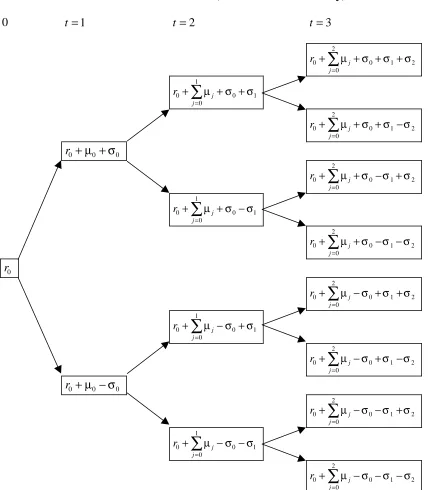
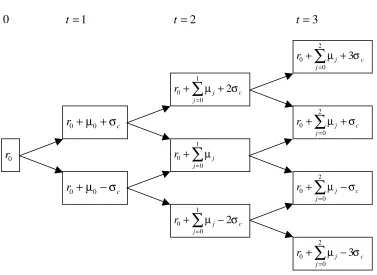
The progression to the next date should be clear. See Figure 1-A for an example of a tree
and Figure 2-A for an example of a lattice.
Substituting for
∑
µ( )
t we can develop an alternative to the above evolutionary scheme. This alternative may be preferable. From expressions (10) and (11), for t =1,( )
( ) ( ) ( )
( )
( ) ( ) ( )
1 1 2 1 0 21 1 0 0 with probability ,
1 1 0 0 with probability ,
r f
r f
δ σ
δ σ
= + +
= + − (30)
where, as before, r tn
( )
denotes the nth node at date t and f t( )
denotes the one-period forwardrate at date t.
And, for t=2,
( )
( ) ( ) ( ) ( ) ( )
( )
( ) ( ) ( ) ( ) ( )
1 3 2 1 2 22 2 0 1 0 1 with probability ,
2 2 0 1 0 1 with probability .
r f
r f
δ δ σ σ
δ δ σ σ
= + + + +
= + + + − (31-a)
and
( )
( ) ( ) ( ) ( ) ( )
( )
( ) ( ) ( ) ( ) ( )
1 1 2 1 0 22 2 0 1 0 1 with probability ,
2 2 0 1 0 1 with probability .
r f
r f
δ δ σ σ
δ δ σ σ
= + + − +
The progression to the next date should be clear. See Figure 1-A for an example of a tree
and Figure 2-A for an example of a lattice.
Depending on the data at hand and ease of computation, one or the other approach may be
preferred. This point will become clear from the illustrations given in the next section.
Under both approaches, however, we recognize from expression (24) that we need the
variances of the sums of short rates, i.e., σ2
(
r( ) ( )
1 +r 2)
, σ2(
r( ) ( ) ( )
1 +r 2 +r 3)
, and so on. For a quick reference, expression (4) is reproduced below:( ) ( )
1(
)
1(
) (
)
1 1
0 1 1 1 .
t t
j j
r t r µ j σ j z j
− −
= =
= +
∑
− +∑
− ∆ − (32)For the ease of exposition, let the (time) indexes in the parentheses be designated as a subscript.
Then,7
( )
(
)
(
)
2 2 2 2
1 0 0 0 0 0 0 0.
r r z z
σ =σ +µ + ∆σ =σ σ ∆ =σ (33-a)
(
)
(
)
(
)
(
)
(
)
(
)
(
)
2 2
1 2 0 0 0 0 0 0 1 0 0 1 1
2 2
0 0 0 0 1 1 0 0 1 1
2 2
0 0 1 1 0 0 1 1
2 2
0 1
2
2 2Cov 2 ,
4 .
r r r z r z z
z z z z z
z z z z
σ σ µ σ µ µ σ σ
σ σ σ σ σ σ σ
σ σ σ σ σ σ
σ σ + = + + ∆ + + + + ∆ + ∆ = ∆ + ∆ + ∆ = ∆ + ∆ = ∆ + ∆ + ∆ ∆ = + (33-b)
(
)
(
)
(
)
(
)
(
)
(
)
(
)
(
)
(
)
2 21 2 3 0 0 0 0 1 1 0 0 1 1 2 2
2
0 0 1 1 2 2
2 2 2
0 0 1 1 2 2
0 0 1 1 0 0 2 2
1 1 2 2
2 2 2
0 1 2
3 2
3 2
2Cov 3 , 2 2Cov 3 ,
2Cov 2 , ,
9 4 .
r r r z z z z z z
z z z
z z z
z z z z
z z
σ σ σ σ σ σ σ σ
σ σ σ σ
σ σ σ σ σ σ
σ σ σ σ
σ σ
σ σ σ
+ + = ∆ + ∆ + ∆ + ∆ + ∆ + ∆ = ∆ + ∆ + ∆ = ∆ + ∆ + ∆ + ∆ ∆ + ∆ ∆ + ∆ ∆ = + + (33-c)
Therefore, in general,
7
( )
(
)
(
)
2 2 1 1 1 1 2 2 1 1 1 1 . t t k k j k t k kr j t k z
t k
σ σ σ
σ − − = = − = = − + ∆ = − +
∑
∑
∑
(34)For example, expression (34) will yield for t =4,
(
)
2 2 2 2 2
1 2 3 4 16 0 9 1 4 2 3.
r r r r
σ + + + = σ + σ + σ +σ
Implementation of expression (34) can be made easier if we use matrix notation. Let Dt
denote a diagonal t t× matrix whose elements are 2
1 1
jj j
a =σ − ∀ ≤ −j t . Let wt denote a t -dimensional column vector whose elements are the integer values of the index t in reverse order.
Then, expression (34) can be written as
( )
2 T
1
,
t
t t t
j
r j t
σ =
= ∀
∑
w D w (35)where T denotes transposition.
For example, expression (35) will yield for t =4,
[
]
2 0
2 4
2 T 1
4 4 4 2
1 2
2 3
2 2 2 2
0 1 2 3
4
0 0 0
3
0 0 0
4 3 2 1
2
0 0 0
1
0 0 0
16 9 4 .
j j r σ σ σ σ σ
σ σ σ σ
= = = = + + +
∑
w D wII. Implementation Examples
In this section we provide three examples to demonstrate the implementation. These
examples differ in volatility structure assumed for evolution.8
The first example follows the exposition closely. The volatility of the short rate is not
constant, i.e., it differs as time changes. For example, the volatility of the short rate at any given
When we compute the evolution of the short interest rate as a binomial model, this example
produces a short-rate tree.
The second example is the canonical Ho and Lee model where the volatility of the short
rate is constant at all times. When we compute the evolution of the short interest rate as a
binomial model, the canonical example produces a short-rate lattice.
Note that the assumption of constant volatility (as in HL) is not necessary for producing a
lattice. Jarrow and Turnbull (1996, p. 456–459) assume non-constant volatility structure, employ
a search algorithm and produce a short-rate lattice. The volatility structure allows the volatility of
the short rate to vary across short rates but to be constant for each short rate as time elapses. For
example, the volatility of the short rate from date 3 to date 4 can differ from the volatility of the
short rate from date 4 to date 5 but those two different volatilities do not change as time elapses.
The effect of this non-constant volatility structure is quite different from that of the first example.
The final trees evolved in the first and third examples are quite dissimilar.
The figures show the evolution of the short interest rate as well as the satisfaction of
no-arbitrage conditions. These conditions are that the bond prices are recovered at date 0 and that
volatility of interest rates obtains at every date. In addition, the equality of one-period rates of
returns is illustrated, thereby satisfying the interpretation of no-arbitrage as equality of local
expectations. In other words, at any vertex (except those on the last date), we can calculate the
expectation of the rate of return on a two-year bond, as we can for any longer-term bonds This
expectation of the rate of return should equal the short rate evolved at that vertex. If this equality
does not obtain, then arbitrage profits are possible.
II.A. Time-Varying Volatility Structure
As demonstrated in Section I (see expressions (30)–(32)), a decline in the short rate
followed by an increase is not equal to an increase in the short rate followed by a decline. The
magnitude of the interest-rate change differs in each period. Thus, recombination of branches is
not possible. Therefore, the number of nodes in the tree increases exponentially, namely, at date t
the tree will have 2t nodes. Figure I-A shows the short-rate tree in an extensive form for four
dates.
Figure I-A goes here
---Table 1 shows the initial data, consisting of pure discount bond prices and volatility
structure, used to produce the tree shown in Figure I-B. Table 1 contains the relevant calculations
of δ
( )
t and µ( )
t as well.Figure I-B goes here
---Consider date t =2, node n=0. Here r0
( )
2 = 4.664 900%. The expectation of the valueof the two-year bond is
( )
1(
)
0.0466492 2, 4 2 $0.946741 $0.967800
$0.957271 0.954422 $0.913641.
Q
E P = + e−
= × =
The expectation of the rate of return on the two-year bond is (R t T
( )
, denotes the rate of returnat date t for the total maturity of T years):
( )
12(
)
2
$0.946741 $0.967800
2, 4 ln 4.6649%,
$0.913641
Q
E R = + =
which is the same as the short rate at the node. Thus the local expectations requirement is
II.B. Constant Volatility
The short-rate tree produced in Figure I-A and Figure I-B is unappealing for many realistic
problems because it grows exponentially. In the style of HL, if we assume that volatility is
constant, we will get a lattice. Figure II-A shows the short-rate tree in an extensive form for four
dates.
Figure II-A goes here
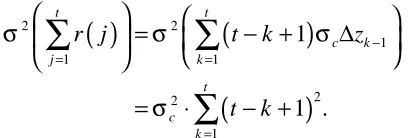
---Let the volatility structure be given as σ
( )
t =σc for all t. Then, from expression (34) willsimplify to
( )
(
)
(
)
2 2
1
1 1
2 2
1
1
1 .
t t
c k
j k
t
c k
r j t k z
t k
σ σ σ
σ
−
= =
=
= − + ∆
= ⋅ − +
∑
∑
∑
(36)
From expression (36), the variance of the sums of the short rates can be calculated as
( )
2 2
1 c.
r
σ =σ (37-a)
(
)
2 2
1 2 5 c.
r r
σ + = σ (37-b)
(
)
2 2
1 2 3 14 c.
r r r
σ + + = σ (37-c)
(
)
2 2
1 2 3 4 30 c.
r r r r
σ + + + = σ (37-d)
[image:19.612.205.413.301.370.2]Or, of course, one can use expression (35) to get the same results.
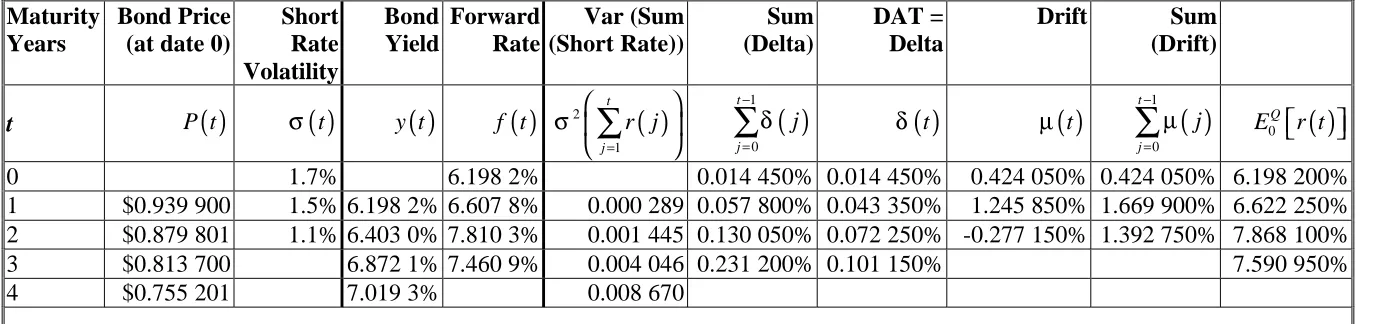
Table 2 shows the initial data, consisting of pure discount bond prices and volatility
structure, used to produce the tree show in Figure II-B. Table 2 contains the relevant calculations
of δ
( )
t and µ( )
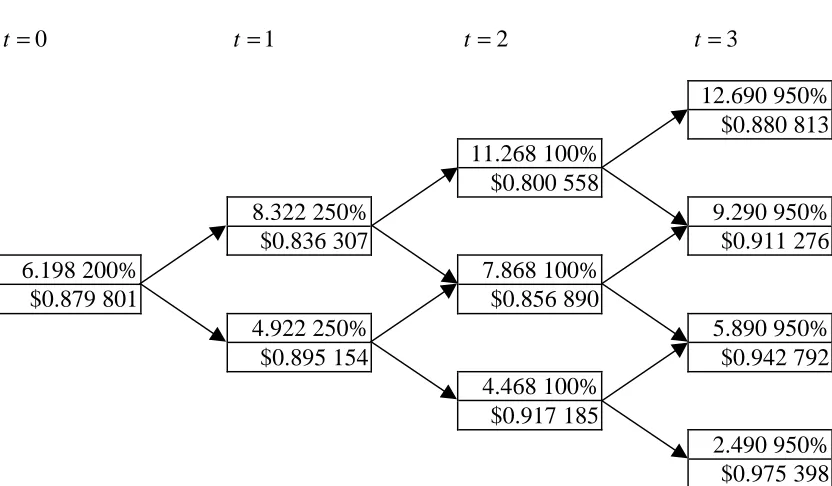
t as well.---Consider date t =2, node n=0. Because this is a lattice, nth node corresponds to n
up-moves. Here r0
( )
2 = 4.468 100%. The expectation of the value of the two-year bond is( )
1(
)
0.0446812 2, 4 2 $0.942792 $0.975398
$0.959095 0.956302 $0.917185.
Q
E P = + e−
= × =
The expectation of the rate of return on the two-year bond is
( )
12(
)
2
$0.942792 $0.975398
2, 4 ln 4.4681%,
$0.917185
Q
E R = + =
which is the same as the short rate at the node. Thus the local expectations requirement is
satisfied. This requirement holds at every node for bonds of longer terms also.
II.C. Time-Varying Volatility Structure
Jarrow and Turnbull (1996, p. 456) “explain how to construct a lattice of future short
interest rates”. Their explanation requires a numerical solution for the short interest rate one
period ahead and forward induction. We demonstrate how the method developed in this paper
can be applied to the same problem. The method, however, will need to be placed in the context
of their volatility structure and its underlying mode of evolution.9
They assume an evolution in which the volatility of the short rate varies across short rates
but is constant for each short rate as time passes. This evolution can be specified as:
( ) ( ) ( ) ( ) ( )
1 0 0 0 0 .r =r +µ +σ ∆z
( ) ( ) ( ) ( ) ( )
(
( )
)
( ) ( )
( ) ( )
( ) ( )
(
( )
)
2 1 1 1 0 1 0 0
0 0 (1) 1 0 1 .
r r z z z
r z z
µ σ σ
µ µ σ
= + + ∆ + ∆ − ∆
= + + + ∆ + ∆
( ) ( ) ( ) ( ) ( )
(
( )
( )
)
( ) ( )
(
( )
)
( ) ( )
( ) ( ) ( )
(
( )
( )
)
3 2 2 2 0 1 2 1 0 1
0 0 (1) 2 2 0 1 2 .
r r z z z z z
r z z z
µ σ σ
µ µ µ σ
= + + ∆ + ∆ + ∆ − ∆ + ∆
= + + + + ∆ + ∆ + ∆
9
( ) ( ) ( ) ( ) ( )
(
( )
( )
( )
)
( ) ( )
(
( )
( )
)
( ) ( )
( ) ( ) ( ) ( )
(
( )
( )
( )
)
4 3 3 3 0 1 2 3 1 0 1 2
0 0 (1) 2 3 3 0 1 2 3 .
r r z z z z z z z
r z z z z
µ σ σ
µ µ µ µ σ
= + + ∆ + ∆ + ∆ + ∆ − ∆ + ∆ + ∆
= + + + + + ∆ + ∆ + ∆ + ∆
In general, then,
( ) ( )
1( ) ( )
1( )
0 0
0 1 .
t t
j j
r t r µ j σ t z j
− −
= =
= +
∑
+ −∑
∆ (38)Now, we need the variance of the sums of short rates. For the ease of exposition, let the
(time) indexes in the parentheses be designated as a subscript. Then,
( )
(
)
(
)
2 2 2 2
1 0 0 0 0 0 0 0.
r r z z
σ =σ +µ + ∆σ =σ σ ∆ =σ
(
)
(
(
)
)
(
)
(
(
)
)
(
(
)
)
2 2
1 2 0 0 1 0 1
2 2
0 0 1 0 1 0 0 1 0 1
2 2
0 1 0 1
2Cov ,
2 2 .
r r z z z
z z z z z z
σ σ σ σ
σ σ σ σ σ σ
σ σ σ σ
+ = ∆ + ∆ + ∆ = ∆ + ∆ + ∆ + ∆ ∆ + ∆ = + +
(
)
(
(
)
(
)
)
(
)
(
(
)
)
(
(
)
)
(
)
(
)
(
(
)
)
(
) (
)
(
)
2 21 2 3 0 0 1 0 1 2 0 1 2
2 2 2
0 0 1 0 1 2 0 1 2
0 0 1 0 1 0 0 2 0 1 2
1 0 1 2 0 1 2
2 2 2
0 1 2 0 1 0 2 1 2
2Cov , 2Cov ,
2Cov ,
2 3 2 2 4 .
r r r z z z z z z
z z z z z z
z z z z z z z
z z z z z
σ σ σ σ σ
σ σ σ σ σ σ
σ σ σ σ
σ σ
σ σ σ σ σ σ σ σ σ
+ + = ∆ + ∆ + ∆ + ∆ + ∆ + ∆
= ∆ + ∆ + ∆ + ∆ + ∆ + ∆
+ ∆ ∆ + ∆ + ∆ ∆ + ∆ + ∆
+ ∆ + ∆ ∆ + ∆ + ∆
= + + + + +
Therefore, in general,
(
)
(
)
1 2 1
2 2
1 0 0 1
1 2 1 .
t t t t
j j j k
j j j k j
r j j
σ − σ − − σ σ
= = = = +
= + + +
∑
∑
∑ ∑
(39)For example, expression (39) will yield for t =4,
4
2 2 2 2 2
0 1 2 3 0 1 0 2 0 3
1
1 2 1 3 2 3
2 3 4 2 2 2
4 4 6 .
j j
r
σ σ σ σ σ σ σ σ σ σ σ
σ σ σ σ σ σ = = + + + + + + + + +
∑
Implementation of expression (39) can be made easier if we use matrix notation. Let Vn n×
,j k 1
∀ ≥ . Let Sm m× denote a m m× the principal submatrix of the matrix Vn n× and is formed by deleting rows and columns of Vn n× simultaneously, e.g., row 1 and column 1; deletions always
start with row 1 and column 1, thereby leaving a submatrix of southeast elements. Let en denote a n-dimensional column vector whose elements are all equal to unity. Then, expression (39) can
be written as
2 T
1 1
.
t t
j m m m m
j m
r
σ ×
= =
=
∑
∑
e V e (40)The evolutionary equation for this case is given as
( )
( ) ( ) ( )
( )
( ) ( ) ( )
1
1 2
1
0 2
1 1 0 0 with probability ,
1 1 0 0 with probability ,
r f
r f
δ σ
δ σ
= + +
= + − (41)
where, as before in the context of the lattice, r tn
( )
denotes the nth up-move in the short rate atdate t and f t
( )
denotes the one-period forward rate at date t.And, for t=2,
( )
( ) ( ) ( )
( )
( )
( ) ( ) ( )
( )
( ) ( ) ( )
( )
1
2 4
1
1 2
1
0 4
2 2 0 1 2 1 with conditional probability ,
2 2 0 1 with conditional probability ,
2 2 0 1 2 1 with conditional probability ,
r f
r f
r f
δ δ σ
δ δ
δ δ σ
= + + +
= + +
= + + −
(42)
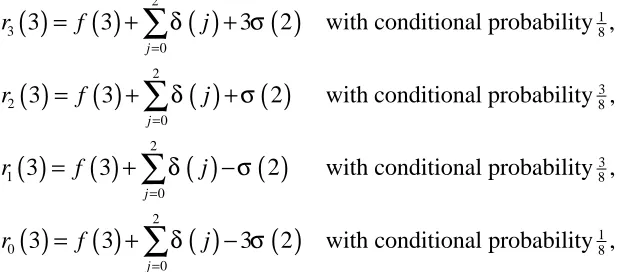
where the probabilities represent the conditional probability from date 0. The equivalent
martingale probability still remains at ½ from the relevant vertex at the previous date.
( )
( )
( )
( )
( )
( )
( ) ( )
( )
( )
( ) ( )
( )
( )
( )
( )
2
1
3 8
0
2
3
2 8
0
2
3
1 8
0
2
1
0 8
0
3 3 3 2 with conditional probability ,
3 3 2 with conditional probability ,
3 3 2 with conditional probability ,
3 3 3 2 with conditional probability ,
j
j
j
j
r f j
r f j
r f j
r f j
δ σ
δ σ
δ σ
δ σ
=
=
=
=
= + +
= + +
= + −
= + −
∑
∑
∑
∑
(43)
where the interpretation of the probability is as given for the preceding expression.
The progression to the next date should be clear. Figure III-A shows the short-rate tree in
an extensive form for four dates.
Figure III-A goes here
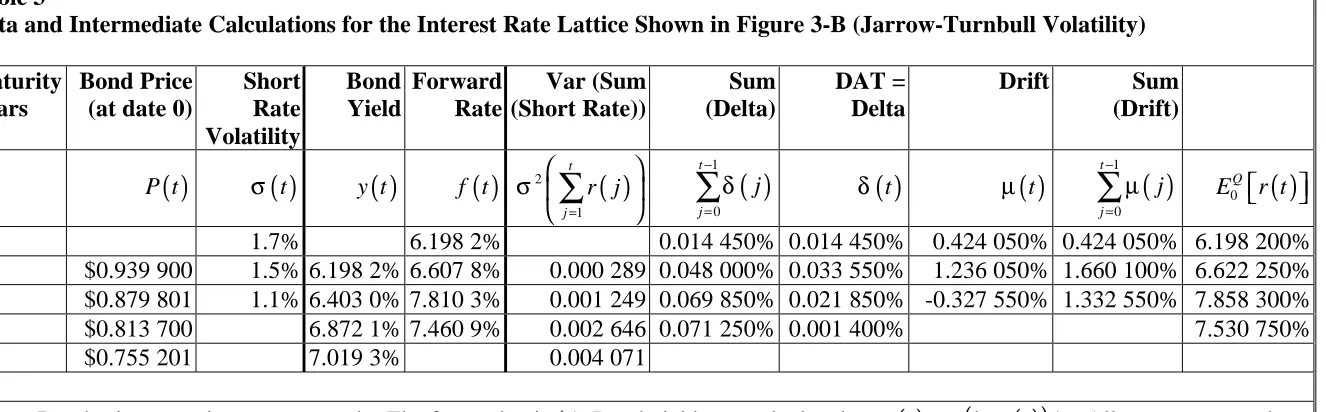
---Table 3 shows the initial data, consisting of pure discount bond prices and volatility
structure, used to produce the tree show in Figure III-B. These data are the same as used by
Jarrow and Turnbull. Table 3 contains the relevant calculations of δ
( )
t and µ( )
t as well. Figure III-B goes here---Consider date t =2, node n=0. Because this is a lattice, nth node corresponds to n
up-moves. Here r0
( )
2 = 4.858 300%. The expectation of the value of the two-year bond is( )
1(
)
0.0485832 2, 4 2 $0.937717 $0.958575
$0.948146 0.952578 $0.903183.
Q
E P = + e−
= × =
The expectation of the rate of return on the one-year bond is
( )
12(
)
2
$0.937717 $0.958575
2, 4 ln 4.8583%,
$0.903183
Q
E R = + =
which is the same as the short rate at the node. Thus the local expectations requirement is
[image:23.612.152.463.77.213.2]Conclusions
Ho and Lee’s interest-rate model retains the distinction of being the first no-arbitrage
model that can be calibrated to market data. One of the major short-comings, however, has been
the complexity of its discrete time implementation. In general, it has required numerical methods
and forward induction. In this paper we have analytically demonstrated its implementation. It is
relatively straightforward to identify recursive expressions for short rates at all (nodes and) dates.
Armed with a set of expressions, we can map out the entire evolution. It is advisable to
remember that the objective of the paper was to demonstrate the implementation of the HL
model in discrete time and not necessarily discuss the evolution of interest rates under different
specifications of the volatility function. Whether the evolution will result in a tree or a lattice will
depend on the volatility structure assumed for short rates. This implementation has an added
advantage of being scalable, such that once the longest-maturity is known we can use matrix
algebra for intermediate calculations. Lastly we reëmphasize that this method of implementation
References
Black, F., E. Derman and W. Toy, 1990, A One-Factor Model of Interest Rates and Its Application to Treasury Bond Options, Financial Analysts Journal 46, 33–39.
Boyle, P. P., 1978, Immunization Under Stochastic Models of the Interest Rate Structure,
Journal of the Institute of Actuaries 105,177–87.
Brennan, M.J. and E. S. Schwarz, 1978, Finite Difference Method and Jump Processes Arising in the Pricing of Contingent Claims, Journal of Financial and Quantitative Analysis 13, 461– 474.
Cox, J. C., J. E. Ingersoll and S.A. Ross, 1985, A Theory of the Term Structure of Interest Rates,
Econometrica 53, 385–407.
Cox, J. C., S. A. Ross, and M. Rubinstein, 1979, Option Pricing: A Simplified Approach, Journal of Financial Economics 7, 229–264.
Ho, T. S. Y. and S.-B. Lee, 1986, Term Structure Movements and Pricing Interest Rate Contingent Claims, Journal of Finance 41, 1011–1029.
Hull, J. and A. White, 1990a, Pricing Interest Rate Derivative Securities, Review of Financial Studies 3, 573–92.
Hull, J. and A. White, 1900b, Valuing Derivative Securities Using the Explicit Finite Difference Method, Journal of Financial and Quantitative Analysis 25, 87–100.
Hull, J. and A. White, 1996, Using Hull-White Interest Rate Trees.” Journal of Derivatives 3, 26–36.
Hull, J. C., 2000, Options, Futures, and Other Derivatives, Fourth Edition (Prentice-Hall, Englewood Cliffs, NJ).
Jarrow, R. and S. Turnbull, 1996, Derivative Securities (South-Western College Publishing, Cincinnati, OH).
Kijima, M. and I. Nagayama, 1994, Efficient Numerical Procedures for the Hull-White Extended Vasicek Model, Journal of Financial Engineering 3, 275–292.
Mood, A. M., F. A. Graybill and D. C. Boes, 1974, Introduction to the Theory of Statistics, Third Edition (McGraw-Hill, New York, NY).
Rebonato, R, 1998, Interest-Rate Option Models, Second Edition (Wiley & Sons, West Sussex).
Ritchken, P., 1996, Derivative Markets (HarperCollins College Publishers, New York, NY).
Table 1
Data and Intermediate Calculations for the Interest Rate Tree Shown in Figure 1-B (Non-Constant Volatility) Maturity
Years
Bond Price (at date 0)
Short Rate Volatility Bond Yield Forward Rate Var (Sum (Short Rate)) Sum (Delta) DAT = Delta Drift Sum (Drift)
t P t
( )
σ( )
t y t( )
f t( )
2( )
1 t j r j σ =
∑
( )
1 0 t j j δ − =∑
δ( )
t µ( )
t( )
1 0 t j j µ − =
∑
0( )
Q E r t
0 1.7% 6.198 2% 0.014 450% 0.014 450% 0.424 050% 0.424 050% 6.198 200%
1 $0.939 900 1.5% 6.198 2% 6.607 8% 0.000 289 0.054 600% 0.040 150% 1.242 650% 1.666 700% 6.622 250%
2 $0.879 801 1.1% 6.403 0% 7.810 3% 0.001 381 0.112 050% 0.057 450% -0.291 950% 1.374 750% 7.864 900%
3 $0.813 700 6.872 1% 7.460 9% 0.003 622 0.178 363% 0.066 312% 7.572 950%
4 $0.755 201 7.019 3% 0.007 189
Notes: Bond prices are given exogenously. The face value is $1. Bond yields are calculated as y t
( )
= −(
lnP t( )
)
/t. All rates are annual.Table 2
Data and Intermediate Calculations for the Interest Rate Lattice Shown in Figure 2-B (Constant Volatility: Canonical HL Model) Maturity
Years
Bond Price (at date 0)
Short Rate Volatility Bond Yield Forward Rate Var (Sum (Short Rate)) Sum (Delta) DAT = Delta Drift Sum (Drift)
t P t
( )
σ( )
t y t( )
f t( )
2( )
1 t j r j σ =
∑
( )
1 0 t j j δ − =∑
δ( )
t µ( )
t( )
1 0 t j j µ − =
∑
0( )
Q E r t
0 1.7% 6.198 2% 0.014 450% 0.014 450% 0.424 050% 0.424 050% 6.198 200%
1 $0.939 900 1.5% 6.198 2% 6.607 8% 0.000 289 0.057 800% 0.043 350% 1.245 850% 1.669 900% 6.622 250%
2 $0.879 801 1.1% 6.403 0% 7.810 3% 0.001 445 0.130 050% 0.072 250% -0.277 150% 1.392 750% 7.868 100%
3 $0.813 700 6.872 1% 7.460 9% 0.004 046 0.231 200% 0.101 150% 7.590 950%
4 $0.755 201 7.019 3% 0.008 670
[image:27.792.57.746.361.523.2]Table 3
Data and Intermediate Calculations for the Interest Rate Lattice Shown in Figure 3-B (Jarrow-Turnbull Volatility) Maturity
Years
Bond Price (at date 0)
Short Rate Volatility
Bond Yield
Forward Rate
Var (Sum (Short Rate))
Sum (Delta)
DAT = Delta
Drift Sum
(Drift)
t P t
( )
σ( )
t y t( )
f t( )
2( )
1
t
j r j
σ =
∑
( )
1
0
t
j j
δ −
=
∑
δ( )
t µ( )
t( )
1
0
t
j j
µ −
=
∑
0( )
Q E r t
0 1.7% 6.198 2% 0.014 450% 0.014 450% 0.424 050% 0.424 050% 6.198 200%
1 $0.939 900 1.5% 6.198 2% 6.607 8% 0.000 289 0.048 000% 0.033 550% 1.236 050% 1.660 100% 6.622 250%
2 $0.879 801 1.1% 6.403 0% 7.810 3% 0.001 249 0.069 850% 0.021 850% -0.327 550% 1.332 550% 7.858 300%
3 $0.813 700 6.872 1% 7.460 9% 0.002 646 0.071 250% 0.001 400% 7.530 750%
4 $0.755 201 7.019 3% 0.004 071
Figure I-A
Extended-Form Short Interest Rate Tree (Non-Constant Volatility)
0 t=1 t=2 t =3
2
0 0 1 2
0
j j
r µ σ σ σ
=
+
∑
+ + +1
0 0 1
0
j j
r µ σ σ
=
+
∑
+ +2
0 0 1 2
0
j j
r µ σ σ σ
=
+
∑
+ + −0 0 0
r +µ +σ
2
0 0 1 2
0
j j
r µ σ σ σ
=
+
∑
+ − +1
0 0 1
0
j j
r µ σ σ
=
+
∑
+ −2
0 0 1 2
0
j j
r µ σ σ σ
=
+
∑
+ − −0
r
2
0 0 1 2
0
j j
r µ σ σ σ
=
+
∑
− + +1
0 0 1
0
j j
r µ σ σ
=
+
∑
− +2
0 0 1 2
0
j j
r µ σ σ σ
=
+
∑
− + −0 0 0
r +µ −σ
2
0 0 1 2
0
j j
r µ σ σ σ
=
+
∑
− − +1
0 0 1
0
j j
r µ σ σ
=
+
∑
− −2
0 0 1 2
0
j j
r µ σ σ σ
=
+
∑
− − −Notes: ( )r t ≡rt is the short rate at date t, µ
( )
t ≡µt is the drift term at date t,( )
t tFigure I-B
Numerical Short Interest Rate Tree (Non-Constant Volatility)
0
t = t=1 t=2 t=3
11.872 950% $0.888 048 11.064 900%
$0.803 870
9.672 950% $0.907 802 8.322 250%
$0.836 307
8.872 950% $0.915 093 8.064 900%
$0.853 578
6.672 950% $0.935 448 6.198 200%
$0.879 801
8.472 950% $0.918 761 7.664 900%
$0.860 434
6.272 950% $0.939 197 4.922 250%
$0.895 154
5.472 450% $0.946 741 4.664 900%
$0.913 641
3.272 950% $0.967 800
Notes: The first number is the short interest rate. The second number is the
expectation of the value of a two-year bond, except at t =3 where it is one-year bond. Data: Bond prices are given as (0,1)P =$0.939 000, (0, 2)P =$0.879 801,
(0, 3) $0.813 700
P = , (0, 4)P =$0.755 201, for bonds with face value of $1; the volatility structure is given as: σ
( )
0 ≡σ0=1.7%, σ( )
1 ≡σ1 =1.5%,( )
2 2 1.1%Figure II-A
Extended-Form Short Interest Rate Lattice (Constant Volatility)
0 t=1 t=2 t=3
2 0
0 3
j c
j
r µ σ
=
+
∑
+1 0
0 2
j c
j
r µ σ
=
+
∑
+0 0 c
r +µ +σ
2 0
0
j c
j
r µ σ
=
+
∑
+0
r
1 0
0
j j
r µ
=
+
∑
0 0 c
r +µ −σ
2 0
0
j c
j
r µ σ
=
+
∑
−1 0
0 2
j c
j
r µ σ
=
+
∑
−2 0
0 3
j c
j
r µ σ
=
+
∑
−Notes: ( )r t ≡rt is the short rate at date t, µ
( )
t ≡µt is the drift term at date t,( )
t tFigure II-B
Numerical Short Interest Rate Lattice (Constant Volatility)
0
t = t=1 t=2 t=3
12.690 950% $0.880 813 11.268 100%
$0.800 558
8.322 250% 9.290 950%
$0.836 307 $0.911 276
6.198 200% 7.868 100%
$0.879 801 $0.856 890
4.922 250% 5.890 950%
$0.895 154 $0.942 792
4.468 100% $0.917 185
2.490 950% $0.975 398
Notes: The first number is the short interest rate. The second number is the
expectation of the value of a two-year bond, except at t =3 where it is one-year bond. Data: Bond prices are given as (0,1)P =$0.939 000, (0, 2)P =$0.879 801,
(0, 3) $0.813 700
P = , (0, 4)P =$0.755 201, for bonds with face value of $1; the volatility structure is given as: σ