Oligomerization of
a
-olefins by the dimeric nickel bisamido complex
[Ni{1-N(PMes
2
)-2-N(
l
-PMes
2
)C
6
H
4
-
j
3
N
,
N
0
,
P
,-
j
1
P
0
}]
2
activated by methylalumoxane
(MAO)
Felicite Majoumo-Mbe
a,c, Peter Lönnecke
a, Victoria Volkis
b, Manab Sharma
b, Moris S. Eisen
b,*,
Evamarie Hey-Hawkins
a,*a
Institut für Anorganische Chemie der Universität, Johannisallee 29, D-04103 Leipzig, Germany
b
Shulich Faculty of Chemistry, The Institute of Catalysis Science and Technology, Haifa 32000, Israel
c
University of Buea, Faculty of Science, Department of Chemistry, Inorganic Chemistry Laboratory, P.O. Box 63, Buea, Cameroon
a r t i c l e
i n f o
Article history:
Received 25 March 2008
Received in revised form 1 May 2008 Accepted 6 May 2008
Available online 10 May 2008
Keywords:
P,N ligand Nickel complex Oligomerization reaction
a-Olefins
a b s t r a c t
The reaction of Li2[1,2-{N(PMes2)}2C6H4], formed in situ fromn-BuLi and the corresponding amines, with 1 equiv. of [NiBr2(DME)] gives [Ni{1-N(PMes2)-2-N(l-PMes2)C6H4-j3N,N0,P-j1P0}]2(1). After activation by methylalumoxane (MAO),1is a highly active catalyst in the oligomerization and isomerization ofa -ole-fins such as ethene, propene, isobutene, 1-hexene and 1,5-hexadiene. For ethene oligomerization turn-over frequencies (TOFs) range from 3000 to 79015 h1, depending on the reaction conditions. The TOF for propene oligomerization reaches 1 190 730 h1. To our knowledge, catalyst1, activated by MAO, is the most active catalyst for the oligomerization of propene and outperforms the best known complexes for this reaction. In the reactions with 1-hexene, 1,5-hexadiene and isobutene dimerization and isomer-ization products were observed.
Ó2008 Elsevier B.V. All rights reserved.
Catalytic polymerization and oligomerization of
a
-olefins, espe-cially to give dimeric and trimeric products, are of special interest in industry[1]due to the use of olefin oligomers as building blocks and intermediates for specialty chemicals[1a,2]. In addition, olefin oligomerization is widely studied to gain better insight into the reaction mechanisms of the corresponding catalysts, because of the homogeneity of the reaction mixture and easier characteriza-tion of oligomeric products as compared to high molar mass poly-mers[3].Recently, different organometallic catalysts, including homoge-neous vanadium-based catalysts, zeolites, alkyl aluminum com-pounds, group IV and late transition metal catalysts, have been reported as good precursors for olefin oligomerization[2,4], with special focus on nickel catalysts[5].
The pronounced ability of Ni complexes for chain termination via ab-hydrogen elimination process is important for their suc-cessful application in the production of dimers and/or oligomers of ethene, propene and other olefins. Nickel catalysts have been found to be active in a wide spectrum of olefin transformations, including dimerization [6], oligomerization [7], polymerization
[8], and copolymerization[9]with different comonomers. Their re-duced oxophilicity and enhanced tolerance to functional groups makes them very effective in copolymerization of polar and nonpo-lar monomers to give new polymers with unusual microstructures [10].
Among the myriad of nickel precursors containing chelating acetylacetonate [11], 2-(diphenylamino)benzoate [12], pyrroli-mine [13], salen [14], Schiff base [15], salicylideneiminato [16], and many other ligands which were found to be active for the dimerization and oligomerization of ethene and propene, the fol-lowing activators are the most active: (i) catalytic systems based on a P,O chelate ligand for the production of C4–C20oligomers from ethene, which were developed by Keim et al. and later modified in the Shell Higher Olefin Process (SHOP) for the synthesis of linear oligomers of ethene[17], (ii) P,N chelate complexes of Ni reported by Braunstein et al.[18], (iii) Grubbs’ catalysts[19], and (iv) Brook-hart’s catalysts[20]. In addition, much attention has been focused on Ni catalysts supported on zeolites such as Y-zeolite, L-zeolite, mordenite, and mesoporous MCM-41 or on amorphous silica–alu-mina[21]. These systems were found to be very effective for the dimerization of ethene.
One of the industrially most important dimerization reactions is that of isobutene, as hydrogenation of the resulting dimers gives isooctane (2,2,4-trimethylpentane), which is a reference com-pound for the measurement of octane number that, by definition,
0022-328X/$ - see front matterÓ2008 Elsevier B.V. All rights reserved. doi:10.1016/j.jorganchem.2008.05.004
* Corresponding authors. Tel.: +49 341 9736151; fax: +49 341 9739319 (E. Hey-Hawkins), fax: +972 4 829 5705 (M.S. Eisen).
E-mail addresses:[email protected](M.S. Eisen),[email protected]
(E. Hey-Hawkins).
Contents lists available atScienceDirect
Journal of Organometallic Chemistry
has a research octane number (RON) and motor octane number (MON) of 100. In attempts to replace the industrially used acid cat-alysts and ion-exchange resins for the dimerization of isobutene, some inorganic catalysts such as titanium complexes [22], org-ano-f-element complexes [23], and the system AlEt3/TiCl4 [24] were studied. However, none of them has industrial future due to the low activity compared to acidic ion-exchange resins[25].
Recently, the catalytic activity of many nickel complexes in the oligomerization of ethene was reported. For example, paramag-netic complexes [NiBr2(L)] (L = cone-5,17-dibromo-11,23-bis(diphenylphosphino)-25,26,27,28-tetrapropoxycalix-4-arene or cone-5,17-bis(diphenylphosphino)-25,26,27,28-tetrapropoxycalix-4-arene) [26] activated with methylalumoxane selectively pro-duced 1-butene with turnover frequencies (TOFs) up to 106(mol C2H4) (mol Ni)1h1. Complexes with phosphinopyridine (P,N) li-gands[18a]have shown TOFs for catalytic oligomerization of eth-ene of up to 58 100 (mol C2H4) (mol Ni)1 h1and 22 800 (mol C2H4) (mol Ni)1 h1 in the presence of 6 equiv. of AlEtCl2 and 800 equiv. of methylalumoxane (MAO), respectively. The selectiv-ity was in the range of 70–85% for the C4olefins and 33–38% for 1-butene in the C4fraction. Nickel complexes with oxazoline- or pyridine–phosphonite ligands, as well as catalytic systems based on NiIIhydrazone complexes/MAO [27] induced dimerization of ethene with good catalytic activity (104–105g mol1h1) at ambi-ent pressure. Nickel complexes with aryl-substituted
a
-diimine li-gands activated by MAO and modified MAO (MMAO) are highly active in ethene oligomerization, with TOFs as high as 1.4105 (mol C2H4) (mol Ni)1h1[28].Here, we report the catalytic dimerization and oligomerization of ethene, propene, isobutene, 1-hexene, and 1,5-hexadiene by the novel nickel bisamido complex [Ni{1-N(PMes2)-2-N(
l
-PMes2)C6H4-j
3N,N0,P-j
1P0}]2 (1) activated by MAO. Complex 1 was synthesized and was characterized by various analytical tech-niques, including X-ray crystallography. This complex was found to be an active catalyst in the dimerization of ethene and propene, and, to the best of our knowledge, for the latter this catalyst exhib-its the best activity to date. The influence of the reaction conditions on the oligomerization activity and properties of the resulting di-mers and oligodi-mers are presented.1. Results and discussion
1.1. Synthesis and spectroscopic properties of the nickel bisamido complex [Ni{1-N(PMes2)-2-N(
l
-PMes2)C6H4-j
3N,N0,P-j
1P0}]2(1)The reaction of 1,2-{NH(PMes2)}2C6H4[29]with 2 equiv. ofn -BuLi in toluene at room temperature leads to the formation of the anionic ligand [1,2-{N(PMes2)}2C6H4]2, which reacts in situ with 1 equiv. of [NiBr2(DME)] to give1(Scheme. 1).
In the31P{1H} NMR spectrum of1, two doublets are observed for the two nonequivalent phosphorus atoms. The doublet at
61.8 ppm (2J
PP= 299.4 Hz), assigned to Ni–P–N (bridging mode), is shifted to lower field in comparison to the free ligand (24.9 ppm), and the second doublet at68.3 ppm (2JPP= 299.4 Hz), assigned to Ni(P–N) (chelating mode), is shifted to higher field, probably due to the effect of the small ring and the delocalization of the lone pair of electrons on nitrogen into antibonding orbitals at phosphorus, as was observed in the structures of model com-pounds of phosphanylamide anions[30]. A high-field shift was also observed for [TiCl2{N(PPh2)2}2] [31] (10 ppm), a complex with P–N in a chelating mode and Ti in an octahedral configuration, whereas the chemical shift of the free ligand is 46 ppm. Details of the1H and13C NMR spectra are given in Section3. In the IR spec-trum of1, the
m
(PN) band is observed at 908 cm1.
1.2. Molecular structure of1
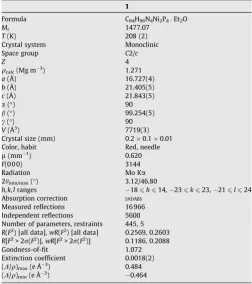
Violet crystals of1were obtained from diethyl ether/petroleum ether at 4°C. Compound 1 crystallizes in the monoclinic space group C2/c with four molecules of 1 and four noncoordinating diethyl ether molecules in the unit cell.
The molecular structure of1(Fig. 1) reveals a dimeric complex with a crystallographicC2axis located at the center of the hexagon formed by the two P–N bridges and the two Ni atoms. Compound1
exhibits unusual coordination at the Ni atoms. Each Ni atom is coordinated by two nitrogen and two phosphorus atoms. The geometry around the Ni atom is highly distorted, and consists of a five-membered chelate ring via the nitrogen atoms, a three-membered chelate ring via the P–N group, and formation of a di-mer in which the two rings are bridged by two phosphorus atoms. The five-membered rings have an envelope conformation in which the atoms N(1), C(19), C(24), and N(2) are coplanar, while the Ni atom lies 0.64(2) Å above this plane.
The N(1)–Ni(1)–N(2) bond angle of 83.6(4)° is comparable to that of 83.6(6)°observed for the chelating nitrogen donor ligands in the Ni-1,2-diiminophosphorane complex [NiCl2 {1,2-(NPPh3)2C6H4}] [32]. The sum of the bond angles [N(1)–Ni(1)– P(1) 46.0(3)°, N(1)–Ni(1)–N(2) 83.6(4)°, N(2)–Ni(1)–P(20)
108.7(3)°and P(1)–Ni(1)–P(20) 123.9(1)°] of 362.3°around the Ni
atom indicates a distorted planar geometry. The sum of bond an-gles at N(2) [C(24)–N(2)–P(2) 121.8(7)°, C(24)–N(2)–Ni 108.8(7)°, P(2)–N(2)–Ni 126.8(5)°] of 357.6°indicates trigonal-planar coordi-nation, while at N(1) [C(19)–N(1)–P(1) 132.0(8)°, C(19)–N(1)–Ni 110.8(7)°, P(1)–N(1)–Ni 77.7(4)°] the sum of 320.7° indicates a pyramidal environment due to the chelating mode of the P–N group.
The N(1)–Ni and N(2)–Ni bond lengths of 1.872(9) and 1.965(8) Å, respectively, are shorter than those observed in other chelating N-donor Ni complexes [1.996(2)–2.017(5) Å][32]. The shorter P(1)–N(1) bond length of 1.617(8) Å compared to the P(2)–N(2) bond length of 1.676(9) Å indicates double-bond charac-ter, as in the case of Ni complexes with iminophosphorane ligands
H N
N H
PMes2
PMes2
N Ni
Mes2P PMes2
N N N
Ni
PMes2
Mes2P
+ [NiBr 2 (DME)]
-2 LiBr - DME -2 n-BuH
+ 2 n-BuLi 1/2
(1)
[1.585(5)–1.618(2) Å][32]. The P(1)–Ni bond of the three-mem-bered ring is stronger than the P(2)–Ni bond of the bridging unit, as the bond length of 2.234(4) Å for the latter is larger than the 2.197(3) Å for the former. This may indicate delocalization of the nitrogen lone pair into the three-membered ring.
1.3. Oligomerization reactions promoted by complex1activated by MAO
Complex1was activated by methylalumoxane prior to the olig-omerization reaction. Only one broad signal at 58 ppm is ob-served in the31P NMR spectrum for the active species.
The oligomerizations of ethene, propene, and isobutene were carried out in a high-pressure stainless steel reactor, whereas the oligomerization reactions for 1-hexene and 1,5-hexadiene were performed in Schlenk heavy duty glass vessels. For ethene, the pressure of the reactor was kept constant at 20 atm via a solenoid pressure transducer, whereas for propene and isobutene liquid monomer was used and as soon as the pressure was slightly re-duced (1 atm) quenching was immediately performed. This pro-cedure was followed to allow a constant monomer concentration in the reaction vessel and to avoid pressure-velocity polymeriza-tion side effects.
The oligomerization data for ethene, propene, and isobutene are presented inTable 2. The reactions of oligomerization/polymeriza-tion were studied as batch condioligomerization/polymeriza-tions and performing the same process at different time intervals revealed that the viscosity of the solution increases as a function of time and as the result, most of the product was formed during the first 30 min. Reactions per-formed for long periods of time exhibited activities much lower than the expected due to diffusivity of the monomer into the active sites with almost no change in composition of products.
It can be seen fromTable 2that the catalytic activity of complex
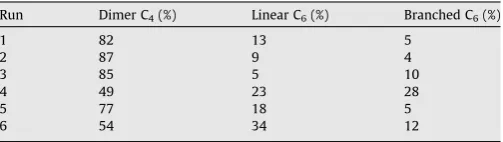
1in the oligomerization of ethene increases with increasing Al:Ni ratio. In addition, the catalyst is more active in the polar solvent methylene chloride than in toluene. However, depending on the oligomerization conditions, liquid or liquid and solid products may be obtained. The formation of both oligomers and polymers with preferential selectivity for oligomers has already been re-ported in the literature. For example, nickel(II) complexes contain-ing neutral N,N- and anionic N,O-bidentate ligands activated by MMAO produced a mixture of ethene trimers and polymers with moderate activity and very high selectivity towards the oligomer [33].Tables 3 and 4illustrate the properties of the resulting solid
and liquid ethylene oligomerization products, respectively. The polymerization products are high density polyethylenes with sim-ilar melting points of 127.0–127.5°C. Moreover, the higher the amount of MAO the higher the amount of the polymeric fraction obtained, but in all cases the amount of the oligomers is always much higher than that of the polymers. In the reaction with ethene, complex1exhibits a high activity but a low chemoselectivity as compared to previously described catalysts; it produces a mixture of dimers (where 1-butene is always the major component >77% among the dimers mixture) as well as linear (75% 1-hexene) and branched trimers (>80% 3-methyl-1-pentene) with a small preference for the linear product. The TOF exhibited for complex
1 in dichloromethane (79 015 h1) is indeed higher than those Ni1
P1 N1 N2
P2
Ni1’ P1 ’
N1’ N2’
P2’ C1
C10
C19 C24 C25
C34
C10
C1
P1 Ni1
N1
C19 C24
N2
P2
P2’
C34’
C25’ C24’
C19’ N1’
N2’
Ni1’ P1’
C1’
[image:3.595.96.507.68.231.2]C10’ C34 C25
Fig. 1.Left: Molecular structure of1(H atoms omitted for clarity; thermal ellipsoids set at 50% probability); right: only the central framework is shown for clarity. Selected bond lengths (Å) and angles (°): N(1)–P(1) 1.617(8), N(1)–Ni(1)–P(1) 46.0(3), N(2)–P(2) 1.676(9), N(2)–Ni(1)–P(20) 108.7(3), N(1)–Ni(1) 1.872(9), P(1)–N(1)–Ni(1) 77.7(4),
N(2)–Ni(1) 1.965(8), C(19)–N(1)–P(1) 132.0(8), P(1)–Ni(1) 2.197(3), C(19)–N(1)–Ni(1) 110.8(7), P(2)–Ni(10) 2.234(4), C(24)–N(2)–Ni(1) 108.8(7), P(1)–Ni(1)–P(20) 123.9(1),
P(2)–N(2)–Ni(1) 126.8(5), N(1)–Ni(1)–N(2) 83.6(4), C(24)–N(2)–P(2) 121.8(7).
Table 1
Crystal data and structure refinement for1
1
Formula C84H96N4Ni2P4Et2O
Mr 1477.07
T(K) 208 (2)
Crystal system Monoclinic Space group C2/c
Z 4
qcalc(Mg m3) 1.271
a(Å) 16.727(4)
b(Å) 21.405(5)
c(Å) 21.843(5)
a(°) 90
b(°) 99.254(5)
c(°) 90
V(Å3
) 7719(3)
Crystal size (mm) 0.20.10.01 Color, habit Red, needle
l(mm1
) 0.620
F(0 0 0) 3144
Radiation Mo Ka
2hmin/max(°) 3.12/46.80
h,k,lranges 186h614,236k623,216l624 Absorption correction SADABS
Measured reflections 16 966 Independent reflections 5600 Number of parameters, restraints 445, 5
R(F2
) [all data],wR(F2
) [all data] 0.2569, 0.2603
R[F2
> 2r(F2
)],wR[F2
> 2r(F2
)] 0.1186, 0.2088 Goodness-of-fit 1.072 Extinction coefficient 0.0018(2) (D/q)max(e Å3) 0.484
[image:3.595.310.563.313.598.2]TOFs observed for the P,N chelate nickel complexes reported in the last few years[18]. However, our TOFs are somewhat lower than those obtained using Grubbs’[19]and Brookhart’s[20]catalysts.
The oligomerization of propene, promoted by complex 1 and activated by MAO, was performed in liquid propene using a double jacket wall reactor with a mechanical stirrer (>100 RPM), an inter-nal thermocouple and the reactor vessel thermostated to the re-quested temperature. When the oligomerization reaction was carried out at room temperature, the process was found to be ex-tremely fast and exothermic. The pressure in the reactor dropped in a few minutes, and full conversion was reached. No solids or elastomeric materials were detected in any of the reactions with propene.
Among the many previously reported active nickel catalysts for the oligomerization of propene the following complexes are note-worthy: [Ni(COD)2], prepared in situ and activated by MAO, poly-merizes propene with TOFs of up to 24 800 h1 and is regioselective towards 2,3-dimethyl-1-butene (2,3-DMB) in the C6fraction (>82%)[34]. [Ni(
g
5-indenyl)2] activated by organoalu-minum cocatalysts displayed an extremely high productivity (TOF up to 169 000 h1) and a moderate regioselectivity for 2,3-DMB (66.4%) [35]. Poly-salen-type NiIIcomplexes reached TOFs of up to 221 000 h1 in the selective dimerization of propene[36]. An extremely high TOF of up to 268 000 h1and a rather high selectivity for dimers (95.6%) were achieved in the propene dimer-ization by the complex bis[N -(2,6-dimethylphenyl)-4-aminopent-3-en-2-one]nickel(II) in the presence of Et3Al2Cl3and PCy3 [37], whereas the bis(2-hydroxy-1-naphthaldehyde)nickel system exhibited TOF of up to 262 000 h1
with a moderate regioselectiv-ity for 2,3-DMB (65.6%)[38].
As can be seen fromTable 2, the nickel complex1is an extre-mely active catalyst for the oligomerization of propene. The activ-ity increases with increasing the Al:Ni ratio. Moreover, to try to control the exothermicity of the reaction without reducing the cat-alytic activity we have found that when the reaction is performed at5°C, the temperature raised to 0°C yielding the best turnover frequency of 1 190 734 h1(run 10). Comparison of this result with the most active catalyst described in the literature allows us to conclude that for the oligomerization of propene, catalyst 1has the highest activity to date. Under all studied conditions, complex
1is an order of magnitude more active than the best literature cat-alysts[20]. Interestingly, to put the result into perspective, at room temperature and at low Al:Ni ratio, the activity of complex1is comparable to those catalysts reported by Wu and Lu[35–38].
[image:4.595.31.555.85.235.2]Unexpectedly, and in contrast to the results observed for eth-ene, in propene the oligomerization activity is not affected by the solvent (Table 2, runs 9 and 10) presumably due to the large amount of liquid propene serving as a co-solvent. However, a very strong effect is observed for the regioselectivity of the products as presented inTable 5. For all the reactions linear and branched di-mers are obtained with a slight preference for the branched com-pound when the reaction is performed in toluene. In all these cases where toluene was used as the solvent at both MAO/cat ra-tios, the product distribution is very much alike. Among the linear products 1-hexene (75%) is obtained as the major isomer along with 2-hexene (cis+trans) and 3-hexene (mostly trans), which are obtained via a simple isomerization of 1-hexene, as minor products. The amount of the isomerized dimers is an indication that the speed of formation of the dimers and trimers is by far more rapid than the isomerization process. Although lower tem-peratures do not lead to the formation of higher oligomers, using methylene chloride results in the partial formation of C9–C12 olig-omers without changing the activity (Table 2, runs 8 and 9). Inter-estingly, the distribution of the products for the dimers remains almost unchanged but for the branched trimer 2,3-DMB is the ma-jor isomer (>82%). For the higher oligomers a myriad of isomers were obtained.
Table 2
Oligomerization/polymerization data for different olefins in the presence of complex1activated by MAOa
Run Substrateb
Ni:Al Time (h)
Solvent Initial temperature (°C)
Maximum temperature (°C)
Solid productd (g)
Liquid product (g)
Activity (g/mol cath)
TOF (h1
)e
1 Ethene 1:100 3 Toluene 25 25 0.02 1.78 8.4104
3001
2 Ethene 1:700 3 Toluene 25 25 0.11 4.61 2.2105 7868
3 Ethene 1:700 0.5 Toluene 25 25 0.06 0.86 2.6105
9202
4 Ethene 1:700 3 CH2Cl2 25 25 – 17.1 8.0105 28 505
5 Ethene 1:700 1 Toluene 25 25 Traces 3.53 5.0105
17 653
6 Ethene 1:700 1 CH2Cl2 25 25 – 15.8 2.2106 79 015
7 Propene 1:200 0.33 Toluene 25 50 – 25 1.1107
252 580
8 Propene 1:700 0.07 Toluene 25 80 – 25 5.0107
1 190 734
9 Propene 1:700 0.07 CH2Cl2 25 80 – 25 5.0107 1 190 734
10 Propene 1:700 0.07 Toluenec
5 0 – 25 5.0107
1 190 734 11 Isobutene,
10 ml
1:500 3 Toluene 25 25 – 3.7 1.7105
3084
12 Isobutene, 40 ml
1:500 3 Toluene 25 25 – 17.2 8.0105
14 337
a10 mg of catalyst1.
b Ethene 20 atm, propene 50 ml = 11 atm, 10 ml of solvent. c
7.6 ml of solvent.
d
Clean product without catalyst or solvent.
e
[image:4.595.301.552.318.362.2]mol of monomer/(mol of catalyst1h).
Table 3
Properties of solid products of the reaction with ethene
Run Mn Mw MWDa
1 99 000 258 000 2.60
2 122 000 330 000 2.70
3 1200 2400 2.20
a
MWD = molecular weight distribution =Mw/Mn.
Table 4
Amounts of different fractions in liquid products of ethene oligomerizationa
Run Dimer C4(%) Linear C6(%) Branched C6(%)
1 82 13 5
2 87 9 4
3 85 5 10
4 49 23 28
5 77 18 5
6 54 34 12
a
[image:4.595.302.554.415.486.2]The reaction of 1/MAO with isobutene was also studied in a high-pressure reactor at room temperature. Although the TOFs were not very high for these reactions as compared to propene, but the selectivity was remarkable, only one dimeric product (2,5-dimethyl-3-hexene) was produced (Table 2).
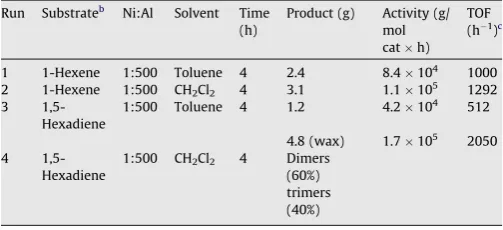
Complex1was also found to be active in the oligomerization of 1-hexene and 1,5-hexadiene (Table 6). For these olefins, the reac-tion in toluene was again slower than for ethene and propene and as compared in dichloromethane a similar behavior is obtained inducing slightly to better activities in the more polar solvent. In toluene the selectivity was exclusively for dimers for both sub-strates whereas for dichloromethane trimers were obtained for 1,5-hexadiene. For 1-hexene in both solvents, the linear 1-dode-cene was the major product (>75%) but isomerization of the double bond to different diastereomers is observed producing a myriad of products as a function of time which were difficult to separate or compare. For 1,5-hexadiene, the dimer 5-methyleneundeca-1,10-diene is obtained as the major isomeric product (>50%) but a num-ber of compounds are also observed. In dichloromethane, a mix-ture of dimers and trimers was obtained as a low melting wax. Important to note that for 1,5-hexadiene in both solvents, no cyclic oligomers were obtained.
2. Conclusions
The anionic ligand [1,2-{N(PMes2)}2C6H4]2 was produced by the reaction of 1,2-{NH(PMes2)}2C6H4 with 2 equiv. ofn-BuLi in toluene at room temperature. Treating the latter in situ with 1 equiv. of [NiBr2(DME)] resulted in the formation of precatalyst
1, which was characterized by NMR spectroscopy and X-ray diffraction.
The activation of complex1in toluene or dichloromethane by an excess of MAO results in the formation of species which are ex-tremely active in the oligomerization of ethene and propene. For ethene oligomerization high TOF numbers were obtained and for propene TOFs of up to 1.2106h1was obtained. To the best of our knowledge, catalyst1activated by MAO exhibits the largest
activity to propene oligomerization to date. In addition, the acti-vated complex1was also found to be highly effective in the dimer-ization reactions of 1-hexene, 1,5-hexadiene, and isobutene.
3. Experimental
All reactions were carried out in an atmosphere of dry nitrogen using standard Schlenk or vacuum line techniques. The solvents were purified (diethyl ether, THF, toluene: reflux over Na/benzo-phenone; petroleum ether: reflux over LiAlH4) and distilled under nitrogen. The infrared spectrum was recorded on a Perkin–Elmer System 2000 FT-IR spectrometer scanning between 400 and 4000 cm1
using KBr disks. The chemical shifts for the 1H and 13C NMR spectra are reported in parts per million (ppm) at 400.13 and 100.63 MHz, respectively, with tetramethylsilane as external standard. The chemical shifts for the31P NMR spectrum are reported in ppm at 161.97 MHz, with 85% H3PO4external stan-dard. The FAB mass spectrum was recorded on a ZAB-HSQ-VG with 3-nitrobenzyl alcohol as matrix. The elemental analyses were re-corded on a VARIO EL (Heraeus). The melting point was deter-mined in a sealed capillary and was not corrected. The 2.50 M solution of n-BuLi inn-hexane (Aldrich) was used as purchased. [NiBr2(DME)] was prepared according to the literature[39].
Crystallographic data of1are listed inTable 1. The data were collected with a Siemens CCD (SMART) diffractometer using
x
-scan rotation. Data reduction was performed withSAINT including the programSADABSfor empirical absorption correction[40]. The struc-ture was solved by heavy-atom methods and the refinement of all non-hydrogen atoms was performed withSHELX97[40]. Due to the weakly diffracting, small crystal, the quality of our experimental results are relatively poor, although they are good enough for a structural confirmation of 1. The presentation of the molecular structure in this paper was generated with ORTEP[40].3.1. [Ni{1-N(PMes2)-2-N(
l
-PMes2)C6H4-j
3N,N0,P,-j
1P0}]2(1)n-BuLi (1.1 ml, 2.23 M inn-hexane) was added dropwise to a solution of 1,2-{NH(PMes2)}2C6H4 (0.8 g, 1.24 mmol) in toluene (25 ml). The mixture was stirred for 3 h, and then added dropwise to a solution of [NiBr2(DME)] (0.38 g, 1.23 mmol) in toluene. The reaction mixture was stirred overnight, and then filtered. The sol-vent was removed, and the residue was dissolved in diethyl ether. The solution was concentrated and layered with petroleum ether. The product was obtained as violet crystals at 4°C. Yield: 0.58 g (68%), M.p.: 255–257°C.1H NMR (C
6D6, ppm): 7.39 (br, s, 2H in C6H4), 7.04 (br, s, 2H in C6H4), 6.90 (br, s, 2H, C6H4), 6.63 (s, 8H, m-H in Mes), 6.53 (s, 8H,m-H in Mes), 6.10 (br, s, 2H in C6H4), 3.57 (s, Et2O), 2.73 (s, 24H,o-CH3in Mes), 2.74 (s, 24H,o-CH3in Mes), 2.00 (s, 12H, p-CH3 in Mes), 1.92 (s, 12H, p-CH3 in Mes), 1.42 (s, Et2O). 31P NMR (C6D6, ppm): 61.8 (d, 2JPP= 299.4 Hz),
68.3 (d,2J
PP= 299.4 Hz). 13C{1H} NMR (CD2Cl2, ppm): 142.3 (d, 2J
PC= 11.2 Hz, o-C in Mes), 141.4 (s, p-C in Mes), 140.2 (d, 2
JPC= 11 Hz, o-C in Mes), 140.02 (s, p-C in Mes), 134.3 (d, 2J
PC= 11.2 Hz, C6H4), 133.6 (d, 2JPC= 19.4 Hz, C6H4), 131.6 (d, 1J
PC= 38.2 Hz, ipso-C in Mes), 131.7 (d, 1JPC= 38.0 Hz, ipso-C in Mes), 130.7 (d, 3JPC= 7.6 Hz, m-C in Mes), 130.2 (d,3JPC= 9.7 Hz, m-C in Mes), 122.2 (br, s, C6H4), 121.8 (br, s, C6H4), 120.4 (s, C6H4), 120.2 (d, 3JPC= 3.3 Hz, C6H4), 120 (s, C6H4), 119.1 (d, 3J
PC= 4.9 Hz, C6H4), 67.7 (s, Et2O), 25.5 (s, Et2O), 24.2 (d, 3J
PC= 7.8 Hz,o-CH3, in Mes), 22.6 (d,3JPC= 9.9 Hz,o-CH3in Mes), 20.9 (s, p-CH3 in Mes), 20.6 (s, p-CH3 in Mes). IR (KBr, cm1): 3022w, 2923vs, 2923vs, 1602vs, 1554m, 1493vs, 1456vs, 1401vs, 1304vs, 1261m, 1031vs, 908m, 850s, 803s, 739s, 638m, 553m, 441s. MS (FAB) [m/z, %]: 701.4 [M+/2, 77], 643.4 [M+/2-Ni, 10], 373.2 [M+/2-NiPMes
[image:5.595.42.292.86.140.2]2, 38], 269 [(Mes2P)+, 52], calc. for Table 5
Fractions in the liquid products of propene oligomerization
Run Linear C6(%) Branched C6(%) Higher oligomers
7 46 54 –
8 41 59 –
9 59 12 C9–C12(29%)
10 47 53 –
Table 6
Oligomerizationa
data for 1-hexene and 1,5-hexadiene with the complex1
Run Substrateb
Ni:Al Solvent Time (h)
Product (g) Activity (g/ mol cath)
TOF (h1
)c
1 1-Hexene 1:500 Toluene 4 2.4 8.4104
1000 2 1-Hexene 1:500 CH2Cl2 4 3.1 1.1105 1292
3 1,5-Hexadiene
1:500 Toluene 4 1.2 4.2104 512
4.8 (wax) 1.7105
2050 4
1,5-Hexadiene
1:500 CH2Cl2 4 Dimers
(60%) trimers (40%)
a 10 mg of catalyst1, RT. b
5 g of substrate.
c
[image:5.595.42.294.197.312.2]C84H96N4Ni2P4:M= 1403.00. Anal. Calc. for C84H96N4Ni2P44OEt2 (1699.49): C, 70.7; H, 8.0; N, 3.3. Found: C, 70.0; H, 9.4; N, 3.2%.
3.2. Reaction of complex1with ethene
In a glove box a high-pressure reactor (100 ml) was charged with complex 1(10 mg, 7.13103mmol), the desired amount of MAO according to the Ni:Al ratio, and 10 ml of solvent. Then the reactor was connected to a high-pressure line and filled with ethene (99.999%) at 20 atm. To maintain a constant pressure of 20 atm a solenoid valve was used. Hence, when the pressure in the reactor was reduced it was refilled constantly. After a specific amount of time, the reactor (kept at 30°C) was opened in a well-ventilated hood, the raw content was weighed, and the amount of products was calculated as the difference between the mass of raw content and the sum of the masses of the catalyst, MAO, and the solvent. The raw product was maintained at
30°C to keep the C4fraction liquid and filtered. From the result-ing liquid samples for NMR and GCMS were taken. The solid mate-rial obtained at room temperature was washed with a 1:1 mixture of methanol and HCl (10 wt% solution), filtered again, washed with acetone, and dried under vacuum.
3.3. Reaction of complex1with propene
In a glove box, a high-pressure stainless steel reactor (100 ml) was charged with complex1(10 mg, 7.13103mmol), the de-sired amount of MAO according to the Ni:Al ratio, and 10 ml of sol-vent. The reactor was connected to a high-vacuum line, and propene (50 ml, 25 g) was transferred to the reactor (propene was frozen with liquid nitrogen, and the volume measured in a heavy-duty, calibrated glass vessel). The reactor was brought to room temperature and the mixture was stirred during the reaction time. At the beginning of the reaction the pressure of propene was 10–11 atm. A quick and exothermic reaction occurred, the pressure dropped to zero, and the reactor was opened. Immediately after opening the reactor the raw content was weighed and the amount of products was calculated as the difference between the mass of the raw contents and the sum of the masses of the catalyst, MAO, and the solvent. The raw product was filtered off. From the resulting liquid, samples were taken for NMR and GCMS.
3.4. Reaction of complex1with 1-hexene and 1,5-hexadiene
These reactions were carried out in a Schlenk tube, charged in a glove box with catalyst1(10 mg, 7.13103mmol), the desired amount of MAO according to the Ni:Al ratio, and 10 ml of solvent. Then the Schlenk tube was connected to a vacuum line, and a mea-sured amount of the substrate was injected into the vessel via a gas-tight syringe. After the reaction mixture was stirred for an ade-quate amount of time, the products were separated as follows: a 1:1 mixture of methylene chloride and HCl (10 wt% in water) was added to the Schlenk tube. After neutralization of the catalytic mixture with solid NaHCO3, the content of the Schlenk tube was transferred to a separating funnel. The organic fraction was sepa-rated and dried with MgSO4. After filtration the vessel was con-nected to a flash evaporator, and methylene chloride was removed by vacuum. The resulting residue was analyzed by NMR and GCMS.
3.5. Reaction of complex1with isobutene
The reactions were carried out in a high-pressure stainless steel reactor (100 ml) charged in a glove box with complex1(10 mg, 7.13103
mmol), the desired amount of MAO according to the Ni:Al ratio, and 10 ml of solvent. Then, the reactor was connected
to a vacuum line, and a measured amount (10 ml or 40 ml) of iso-butene was transferred under vacuum to the reactor (by a similar procedure as for propene but at30°C). After the reaction was fin-ished the excess of isobutene was released in a well-ventilated hood. The products were separated similar to the procedure de-scribed for 1-hexene: a 1:1 mixture of methylene chloride and HCl (10 wt% in water) was added to the Schlenk tube. After neu-tralization of the catalytic mixture, the contents of the Schlenk tube were transferred to a separating funnel. The organic fraction was separated and dried with MgSO4. After filtration the mixture was analyzed by NMR and GCMS.
4. Supplementary material
CCDC 652339 contains the supplementary crystallographic data for this paper. These data can be obtained free of charge from The Cambridge Crystallographic Data Centre viawww.ccdc.cam.ac.uk/ data_request/cif.
References
[1] (a) C. Janiak, Coord. Chem. Rev. 250 (2006) 66;
(b) F. Calderazzo, M. Catellani, G.P. Chiusoli, Met.-Catal. Ind. Org. Proc. (2006) 163.
[2] J. Skupinska, Chem. Rev. 91 (1991) 613.
[3] C. Janiak, F. Blank, Macromol. Symp. 236 (2006) 14.
[4] (a) W. Kaminsky, M. Arndt-Rosenau, Applied Homogeneous Catalysis with Organometallic Compounds, 2nd ed., vol. 1, 2002, p. 213.;
(b) W. Kaminsky, M. Arndt, Appl. Homogeneous Catal. Organomet. Compd. 1 (1996) 220;
(c) C.T. O’Connor, M. Kojima, Catal. Today 6 (1990) 329;
(d) O.T. Onsager, J.E. Johansen, Chem. Met.-Carbon Bond 3 (1985) 205; (e) R. Pearce, Catal. Chem. Proc. (1981) 194.
[5] (a) R. Brull, W.H. Meyer, H.G. Raubenheimer, S. Afr. J. Chem. 51 (1998) 73; (b) B. Bogdanovic, Adv. Organomet. Chem. 17 (1979) 105;
(c) E. Nelkenbaum, M. Kapon, M.S. Eisen, J. Organomet. Chem. 690 (2005) 3154;
(d) E. Nelkenbaum, M. Kapon, M.S. Eisen, J. Organomet. Chem. 690 (2005) 2297; (e) E. Nelkenbaum, M. Kapon, M.S. Eisen, Organometallics 24 (2005) 2645. [6] (a) M. Peuckert, W. Keim, Organometallics 2 (1983) 594;
(b) G. Wilke, Angew. Chem., Int. Ed. 27 (1988) 185;
(c) M. Mitkova, K. Kurtev, S.S. Zlotskii, D.L. Rakhmankulov, Izv. Vysshikh Uch. Zav. Khim. i Khim. Tekhnol. 35 (1992) 27;
(d) D. Zhu, J. Lu, Sch. Chem. Eng. 19 (1990) 735;
(e) V.S. Tkach, F.K. Shmidt, T.N. Sergeeva, N.D. Malakhova, Neftekhimia 15 (1975) 703;
(f) P. Muthukumaru, M. Ravindranathan, S. Sivaram, Chem. Rev. 86 (1986) 353. [7] (a) Ch. Sui-Seng, A. Castonguay, Y. Chen, D. Gareau, L.F. Groux, D. Zargarian,
Top. Catal. 37 (2006) 81;
(b) F. Spiezer, P. Braunstein, L. Saussine, Acc. Chem. Res. 38 (2005) 784; (c) K. Nomura, Recent Res. Dev. Pure Appl. Chem. 2 (1998) 473.
[8] (a) S.D. Ittel, L.K. Johnson, M. Brookhart, Chem. Rev. 100 (2000) 1169. and references therein;
(b) S. Mecking, Coord. Chem. Rev. 203 (2000) 325; (c) S. Mecking, Angew. Chem., Int. Ed. 40 (2001) 534; (d) V.C. Gibson, S.K. Spitzmesser, Chem. Rev. 103 (2003) 283;
(e) B. Rieger, L.S. Baugh, S. Kacker, S. Striegler (Eds.), Late Transition Metal Polymerization Catalysis, Wiley-VCH, Weinheim, Germany, 2003;
(f) M.C.B. Dolinsky, Whei O. Lin, M.L. Dias, J. Mol. Catal. A 258 (2006) 267. [9] (a) H. Zou, F.M. Zhu, Q. Wu, J.Y. Al, S.A. Lin, J. Polym. Sci. A: Polym. Chem. 43
(2005) 1325;
(b) X. Wang, S. Liu, G.-X. Jin, Organometallics 23 (2004) 6002;
(c) X. Tang, Y. Cui, W.-H. Sun, Z. Miao, S. Yan, Polym. Int. 53 (2004) 2155; (d) M.E. Bluhm, C. Folli, O. Walter, M. Döring, J. Mol. Catal. A 229 (2005) 177; (e) J. Du, L.-J. Li, Y. Li, Inorg. Chem. Commun. 8 (2005) 246;
(f) Y. Chen, G. Wu, G.C. Bazan, Angew. Chem., Int. Ed. 44 (2005) 1108; (g) F. Speiser, P. Braunstein, L. Saussine, R. Welter, Organometallics 23 (2004) 2613;
(h) F. Speiser, P. Braunstein, Inorg. Chem. 43 (2004) 4234;
(i) H.Y. Kwon, S.Y. Lee, B.Y. Lee, D.M. Shin, Y.K. Chung, J. Chem. Soc., Dalton Trans. (2004) 921;
(j) Q.-X. Zhang, S.-Q. Lin, Z.-Y. Wu, H.-H. Wang, Gaodeng Xuexiao Huaxue Xuebao 25 (2004) 2166;
(k) J.N.L. Dennett, A.L. Gillon, K. Heslop, D.J. Hyett, J.S. Fleming, C.E. Lloyd-Jones, A.G. Orpen, P.G. Pringle, D.F. Wass, J.N. Scutt, R.H. Weatherhead, Organometallics 23 (2004) 6077;
(l) C. Mueller, L.J. Ackerman, J.N.H. Reek, P.C.J. Kamer, P.W.N.M. van Leeuwen, J. Am. Chem. Soc. 126 (2004) 14960;
(n) E. Kogut, A. Zeller, T.H. Warren, T. Strassner, J. Am. Chem. Soc. 126 (2004) 11984;
(o) J. Heinicke, M. Koehler, N. Peulecke, W. Keim, P.G. Jones, Z. Anorg. Allg. Chem. 630 (2004) 1181;
(p) W. Zhao, Y. Qian, J. Huang, J. Duan, J. Organomet. Chem. 689 (2004) 2614; (q) H. Suzuki, S. Matsumura, Y. Satoh, K. Sogoh, H. Yasuda, React. Funct. Polym. 59 (2004) 253.
[10] L.S. Boffa, B.M. Novak, Chem. Rev. 100 (2000) 1479. and references therein. [11] (a) M. Arndt, M. Gosmann, Polym. Bull. 41 (1998) 433;
(b) C.-T. Zhao, M.R. Ribeiro, M.F. Portela, S. Pereira, T. Nunes, Eur. Polym. J. 37 (2001) 45.
[12] B.Y. Lee, Y.H. Kim, H.J. Shin, C.H. Lee, Organometallics 21 (2002) 3481. [13] Y.-S. Li, Y.-R. Li, X.-F. Li, J. Organomet. Chem. 667 (2003) 185. [14] S. Borkar, P.K. Saxena, Polym. Bull. 44 (2000) 167.
[15] D. Zhang, G.-X. Jin, L.-H. Weng, F. Wang, Organometallics 23 (2004) 3270. [16] H. Yang, W.-H. Sun, F. Chang, Y. Li, Appl. Catal. A: General 252 (2003) 261. [17] W. Keim, F.H. Kowalt, R. Goddard, C. Kruger, Angew. Chem., Int. Ed. Engl. 17
(1978) 466.
[18] (a) F. Speiser, P. Braunstein, L. Saussine, Organometallics 23 (2004) 2625; (b) F. Speiser, P. Braunstein, L. Saussine, R. Welter, Organometallics 23 (2004) 2613;
(c) F. Speiser, P. Braunstein, L. Saussine, R. Welter, Inorg. Chem. 43 (2004) 1649; (d) Q.-Z. Yang, A. Kermagoret, M. Agostinho, O. Siri, P. Braunstein, Organometallics 25 (2006) 5518.
[19] (a) C. Wang, S. Friedrich, T.R. Younkin, R.T. Li, R.H. Grubbs, D.A. Bansleben, M.W. Day, Organometallics 17 (1998) 3149;
(b) T.R. Younkin, E.F. Conner, J.I. Henderson, S.K. Friedrich, R.H. Grubbs, D.A. Bansleben, Science 287 (2000) 460;
(c) E.F. Connor, T.R. Younkin, J.I. Henderson, S. Hwang, R.H. Grubbs, W.P. Roberts, J.J. Litzau, J. Polym. Sci., Part A: Polym. Chem. 40 (2002) 2842; (d) E.F. Connor, T.R. Younkin, J.I. Henderson, A.W. Waltman, R.H. Grubbs, Chem. Commun. 22 (2003) 72.
[20] (a) L.K. Johnson, C.M. Killian, M. Brookhart, J. Am. Chem. Soc. 117 (1995) 6414; (b) M.S. Brookhart, L.K. Johnson, C.M. Killian, S.D. Arthur, J. Feldmann, E.F. McCord, S.J. Mchain, K.A. Kreutzev, M.A. Bennett, E.B. Coughlin, S.D. Ittel, A. Parthasarathy, D.J. Tempel, WO Patent Application to Du Pont, 9623010, April 3, 1995.;
(c) L.K. Johnson, S. Mecking, M. Brookhart, J. Am. Chem. Soc. 118 (1996) 267; (d) C.M. Killian, D.J. Tempel, L.K. Johnson, M. Brookhart, J. Am. Chem. Soc. 118 (1996) 11664;
(e) S. Mecking, L.K. Johnson, L. Wang, M. Brookhart, J. Am. Chem. Soc. 120 (1998) 888;
(f) S.A. Svejda, M. Brookhart, Organometallics 18 (1999) 65.
[21] E. Angelescu, M. Che, M. Andruh, R. Zavoianu, G. Costentin, C. Mirica, P. Dumitru, Oct. J. Mol. Catal. A 219 (2004) 13.
[22] F. Barsan, Diss. Abstr. Int. B58 (1998) 4787.
[23] T.J. Marks, R.L. Burwell, Energy Res. Abstr. (1986) 11 (Abstr. No. 30195). [24] N.N. Korneev, S.K. Goryunovich, I.F. Leshcheva, Plasticheskie Massy 10 (1968)
3.
[25] Y.-J. Huang, Y.-M. Sun, F.-L. Chang, A.Y.C. Hung, C.-T. Wang, J. Environ. Sci. Health, Part A A38 (2003) 2661.
[26] M. Lejeune, D. Semeril, C. Jeunesse, D. Matt, F. Peruch, P.J. Lutz, L. Ricard, Chem. Eur. J. 10 (2004) 5354.
[27] L. Chen, J. Hou, W.-H. Sun, Appl. Catal. A: General 246 (2003) 11. [28] S.A. Svejda, M. Brookhart, Organometallics 18 (1999) 65. [29] (a) F. Majoumo, PhD Thesis, Leipzig University, 2004.;
(b) F. Majoumo-Mbe, O. Kühl, P. Lönnecke, I. Silaghi-Dumitrescu, E. Hey-Hawkins, Dalton Trans. (2008),doi:10.1039/b720004h.
[30] G. Trinquier, M.T. Ashby, Inorg. Chem. 33 (1994) 1306.
[31] O. Kühl, T. Koch, F.B. Somoza, P.C. Junk, E. Hey-Hawkins, D. Plat, M.S. Eisen, J. Organomet. Chem. 604 (2000) 116.
[32] M. Sauthier, F. Leca, K. Bernardo-Gusmao, L.F.T. Queiroz, ; L. Toupet, R. Reau, New J. Chem. 26 (2002) 630.
[33] M.P. Batten, A.J. Canty, K.J. Cavell, Th. Rüther, B.W. Skelton, A.H. White, Inorg. Chim. Acta 359 (2006) 1710.
[34] C. Carlini, M. Marchionna, A.M.R. Galletti, G. Sbrana, J. Mol. Catal. A 169 (2001) 19.
[35] S.-Z. Wu, S.-W. Lu, Chin. J. Chem. 21 (2003) 372. [36] S.-Z. Wu, S.-W. Lu, J. Mol. Catal. A 197 (2003) 51. [37] S.-Z. Wu, S.-W. Lu, Appl. Catal. A: General 246 (2003) 295. [38] S.-Z. Wu, S.-W. Lu, Appl. Catal. A: General 198 (2003) 29.
[39] R.B. King, Organometallic Synthesis, vol. I, Academic Press, New York, 1965.
[40] (a) SMART: Area-Detector Software Package, Siemens Industrial Automation, Inc., Madison, WI, 1993.;
(b)SAINT: Area-Detector Integration Software, Version 6.01, Siemens Industrial Automation, Inc., Madison, WI, 1999.;
(c)SADABS: G.M. Sheldrick,SADABS, Program for Scaling and Correction of Area-detector Data, Göttingen, 1997.;
(d)SHELX97 [includesSHELXS97,SHELXL97]: G.M. Sheldrick,SHELX97, Programs for Crystal Structure Analysis (Release 97-2), University of Göttingen, Germany, 1997.;
(e) DIRDIF 99: P.T. Beurskens, G. Beurskens, R. de Gelder, S. Garcia-Granda, R.O. Gould, R. Israel, J.M.M. Smits, Crystallography Laboratory, University of Nijmegen, The Netherlands, 1999;