Iranian journal of educational Sociology
(Interdisciplinary Journal of Education)Available online at: http://www.iase-idje.ir/ Volume 2, Number 2, July2019
Developing a Growth Pattern of General Managers of Iranian
Provinces of Education
Hoda Amiri1,Ahmad Akbari2,Toraj Sadeghi2, Moslem Cherabin2 1. PhD Student of Management Studies, Neyshabour Branch, Islamic Azad University, Khorasan Razavi, Iran.
2. Assistant Professor, Department of Educational Management, Neyshabour Branch, Islamic Azad University, Khorasan Razavi, Iran
Article history:
Received date: 2 January 2019 Review date: 24 March 2019 Accepted date: 28 March 2019
Abstract
Purpose: The purpose of this study was to identify early growth indices of general managers in order to present the growth pattern of general managers of Iranian provinces in the academic year of 2017-2018. Methodology: To this end, the qualitative research approach and data arising theory (systematic design) have been the criterion for action in this study. The statistical population consisted of all heads of education provinces of Iran. Purposive sampling continued until the researcher saturated theoretically using a semi-structured interview with 14 sample members.
Findings: The results showed 16 main categories that were modeled as a paradigm model including: causal conditions, focal categories, growth strategies, contextual factors, intervening factors and outcomes, using the results of theoretical and background studies Research and analysis of the content of interviews conducted, early indicators of modality development The whole thigh has been identified and included in three stages of open coding, axial coding, and selective coding of general manager maturity model in five main categories of causal conditions, pivotal phenomenon, general manager maturity strategies, intermediary conditions, and managerial maturity outcomes.
Conclusion: The professional development of principals leads to the implications that at the community level in the form of education and training of students, the formation of interaction with education and personal growth, growth, performance, communication, thinking and management and decision making, decision making. Finds and manages. Keywords:
General Managers Growth, Foundation Data Theory, Ministry of Education
Please cite this article as: Amiri H, Akbari A, Sadeghi T, Cherabin M. (2019). Developing a Growth Pattern of General Managers of Iranian Provinces of Education. Iranian journal of educational Sociology. 2(2):131-141.
corresponding author: [email protected]
1. Introduction
Today, education is considered one of the largest and most complex social organizations in any country due to the necessity of social change, and it has an inextricable link with social, cultural and economic development and has gradually evolved from a simple elementary state to a complex one. The fruit of education has been to transform talented people into healthy, nurturing, balanced, and growing individuals, and to meet the needs of the human resources of society in diverse cultural, social, and economic sectors. It is important to note that in the present age, all global governments, from small to large, powerful and incapacitated and industrialized to developing, regard the education of their people as essential tasks for universal, universal, and even compulsory They incorporate heavy commitments into their constitutions and allocate a large percentage of GDP to the country's current and development budget (Ebrahimi Moghaddam and Durrani, 1977).
On the other hand, due to the expansion of human sciences and experiences and the development of technology and industrial developments, the tendency for education organizations has become universal. To the extent that one of the most important indicators of the growth of any society is the extent of the range of tasks that education has undertaken. Today the structure of education is a process that has a profound impact on other social institutions, including politics, culture and economics. The degree to which a country's success is culturally, economically, and politically measured is based on its success in establishing an efficient education system. This importance stems from the fact that a dynamic and efficient education system will lead to the development of decent people in a society; therefore, Plato believes that "it is not superior to and above technical education" and that The nurture, body and soul of man reach the highest level of perfection (Hussein & Al-Abri, 2015).
It is easy to see that the present era is distinct from the past with the rapid development of science, culture and technology. In the new global economy, individuals need special skills that are directly influenced by leadership and educational management in schools to be guaranteed and fit for personal and social life, and that the role of active managers in education is of particular importance. These individuals are the king of the sonnet of existence (Hayat et al., 2015). Creative and thoughtful leaders who, in a complex, challenging and changing environment, have led schools to meet the needs of the present and future community have a significant impact on student learning and the quality of curriculum. While this is a key role for managers, special attention must be paid to these people. One of the things that must be done to these managers is to create the conditions that managers need to grow and be able to properly handle the responsibilities they are given over time. In this direction and before any action, the development of education managers must be properly explained (Rezaeian et al., 2014). The purpose of this study is to identify the concept of development, its prerequisites and consequences, along with the underlying and confounding conditions, and to define the necessary strategies, using the data theory approach. On the other hand, management is not a superficial task. In this world full of vacuuming, frustration, and confusion, people have to look at the status quo, they have to look at the vast landscape. The development of management is so important that we must abandon short, simple, fleeting courses or longer camps. We don't need to talk about management issues in class, we need to correct them. In the superficial world, there is a need for a problem, and in a world full of pressure, there is a need for thinking. For broad-based organizations, the third generation is not discontinuous management training but the continuous development of organization and management (Mintzberg, 2004, 28).
Managerial scholars believe that: The development of management is the key to the country's development. As many executives in successful companies around the world say, you become a manager. Everything follows. Today, the key to the success of advanced societies is the development and progress of those societies, and the development and progress are attributed to the growth of the managers of that organization and institution. Therefore, as the country's largest executive, the Education Organization is one of the organizations that are on the fast track to change and must adapt to this fast-paced growth.
Organizations will continue in the 21st century. To know how to improve management capabilities to continually improve their performance. According to DC Markville and TJ Roberts, management improvement should be achieved by developing an improvement training program in the following areas. The first is the presentation of management knowledge, which emphasizes what managers need to be reasonably aware of. The second area relates to on-the-job skills, including training that enhances managers' practical skills. The third area is that the manager, in addition to having the practical knowledge and skills, must have the necessary capabilities in the organization. Today, improving the quality of management in education, like other areas such as industry, health, is needed, and management improvement plans address problems such as lack of some supervisory skills, poor performance, evaluation, lack of dynamics, and ability to cope with changes and adaptations. The new one is formed (Qasimzadeh, 2014, p. 154). Burnsadt (1994) examined the activities of the last three decades of the twentieth century and concluded that managers are the future issue of the life of science. If school principals have the desired level of growth and development, then it can be expected to make good use of other educational resources and to continually improve quality in the various activities and missions of the educational system. In fact, the basis of organizational development is the development of human resources. The sustainability of any organization depends on the knowledge and skills of that organization (Cardeno & Young, 2013). On the other hand, there are principals that make the school effective, so empowering the principals is crucial to the advancement of the profession and the advancement of the goals of education, and it requires purposeful planning. Given the growing challenges of today's world, it is important to pay more attention to the growth and development of education (Qasemzadeh, 2014, p. 155). Growth is the result of people's learning process and learning is the result of new knowledge. Knowledge is acquired through education, research and practice. The importance of this issue is that the development of managers has become a requirement for professional growth. Therefore, a comprehensive and flexible model of academic activities is needed that encompasses both the personal and professional sectors and the community of managers who Help in the search for ways of success for students and their professional development (Sahin, 2013).
Managing schools in today's world is not just about managing, organizing, supervising, and ordering at school. Rather, today's educational leaders in schools must possess the individual characteristics and professional skills needed to meet the growing needs of students. Therefore, there is an urgent need to prepare, refine and develop managers and educational leaders at different levels. The development of continuous, job-related activity managers and in order to be more effective in achieving defined school goals whose activities are planned beyond a single course in a school year (Nasiri Valeh Bani, Ghanbari & Sarcahani, 2016: 2). With a systematic look at the current education in Iran, it can be acknowledged that the problems of this organization are numerous. On the one hand, managers in Iran are still elected without professional and scientific standards and managed by a teacher; on the other hand, there are no consistent professional standards for their professional development and development, and experts believe that the criteria for selecting and appointing managers and approving them The Higher Education Council relies more on the personal views and experiences of experts and council members than on research data and comparative studies (Ahmadi et al., 1977). In the meantime, abandoning the development of managers in the hope of accidental and low-yield processes is a mistake, and the challenge of intelligently managing and managing this process (developing managers) is a matter of human dignity. The usual approaches in this regard, although widespread and growing in scale, are due to attention to one dimension (knowledge and knowledge) and neglect of other dimensions (skills, personality traits required of managers, attitudes and insights, managerial abilities, the professional credibility and philosophical mindset required of managers has been plagued by a lack of effectiveness. Managers need to develop skills, ability development, personality development, and philosophical mindset to best serve their managerial roles (Kimber, 2013). It is natural that capacity development of each of these dimensions requires different approaches (direct, in-work and social). In other words, it can be asserted that managers are a set of people who are developed in terms of skills, abilities,
personality and philosophical mentality. Obviously, multidimensional developed managers are better able to fulfill their managerial roles, resulting in the organizational effectiveness (goal acquisition and satisfaction of individuals) that is ultimately desirable for any organization (Ikrami et al., 2011, p. 4).
Therefore, the purpose of this study was to design a model of development and management development in the Iranian Education Organization. In this regard, this study aims to introduce a suitable model for the development and development of managers by determining the factors affecting the growth of general managers of the provinces of Iran. It is worth mentioning that some research has been done in Iran in the field of growth. The rendering to develop the pattern of growth has largely been based on a combination of external patterns that have not been localized. In this research, by studying the patterns that have been presented in other societies, this research seeks to provide a model for the development of managers from their aspects of participation. On the other hand, researches in Iran show that the activities aimed at the development of managers are scattered and are not satisfied by the relevant stakeholders.The main purpose of the present study is to develop a model of growth of general managers of Iranian provinces using the data theory. The aims of the present study are as follows:1-Identifying the dimensions and components of the growth of general managers in education2-Identifying the factors affecting the growth of general managers in education3- Identify the positive and negative consequences of the growth of general managers in education4- Identify the strategies and strategies needed to achieve the growth of general managers in education5- Identify the underlying and interfering factors affecting the growth of general managers in education.
2. Methodology
The present study seeks to develop the development of education managers, in terms of methodology: qualitative; research orientation: fundamental; research method: qualitative; research philosophy: interpretive; research strategy: data theory; research approach: inductive. Exploratory; Research Time horizon: Single-Cross-sectional and Data Collection Method: Semi-structured interview. Due to the abstract nature of the concept of 'growth', qualitative research is needed to explain the new angles of this structure. In this regard, the present study, by adopting the methodology of Foundation Data Theory, as a qualitative methodology, has investigated the development of managers 'attitudes, in order to identify new dimensions of this concept, regarding managers' developmental phenomenon. The present study also analyzes the growth of managers and interviewees that they may not be aware of. In other words, this research did not seek to present the voices of the participants, but rather to create patterns that they may not be aware of. In this study, general education managers of Iran who served in the current academic year (1976-1979) with at least managerial experience in general administration were considered as the study population. Subsequently, semi-structured interviews were conducted with the 14 heads of education provinces on the basis of sampling in the data base methodology, until reaching theoretical saturation. In this study, the researcher made a sampling of the study population based on indicators that reflect the rich information of these managers in the field of study. These criteria are: Interviewers 'executive ability; Interviewees' educational background; Interviewees and ... In general, in this study, sample members were selected based on their knowledge and knowledge of the subject of the research. In other words, individuals were selected as exemplars who were information-rich and could provide useful information in the subject area chosen and provide richer data for study purposes. At first, the names were identified by coordinating with the provincial governors' office. Individual interviews were conducted after agreement and timing was obtained. Another group of participants was education experts. Thus, the assumptions formed during the study and the communication between the concepts became clearer. Targeted sampling continued until data saturation. The sampling was done in a purposive and theoretical way. The sample size in this approach was determined during the work and the sampling was continued until data saturation, meaning that the researcher concluded that the new data was duplication of previous data and other new conceptual information that needed new code or code expansion. And the existing floors, it was not achieved. In the study, from the seventeenth interview, the researcher
saturated the data; however, interviews were continued for up to 14 individuals to ensure adequate data collection. All interviews were recorded and after each interview the transcript was implemented and analyzed line by line.
As stated earlier, the main data collection tool in this study was semi-structured interviews. In these interviews, the interviewees will be provided with information about the interview in advance. Interviews were mainly conducted around the following seven axes, but where necessary, the researcher posed additional and additional questions for further information. Semi-structured interviews were used to guide the conversation. Immediately after the completion of each interview, coding was implemented. Before each interview, coordination was required. The duration of the interview varied. Semi-structured interviews were conducted so that general managers were asked to communicate after introducing themselves and the initial referendum and demographic research purpose and information. Purposeful questions were then used to guide the study to gain participants' experiences. Interviews were recorded after prior coordination with the participant. This process continued until the last interview and saturation. Data were collected through semi-structured interviews (based on research questions and interviews) with research participants. Because in the fundamental data theory approach, the type of data is of the primary data type and can be collected, interviewed, and collected.
3. Findings
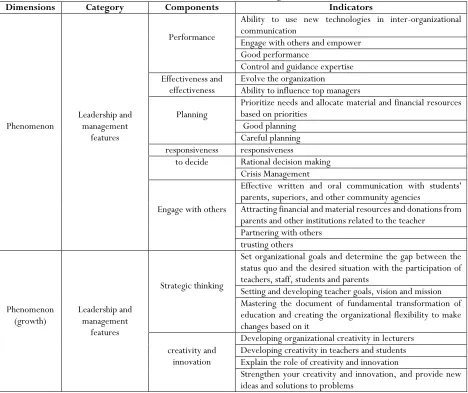
Table 1. Results of coding
Dimensions Category Components Indicators
Phenomenon Leadership and management features
Performance
Ability to use new technologies in inter-organizational communication
Engage with others and empower Good performance
Control and guidance expertise Effectiveness and
effectiveness Evolve the organization Ability to influence top managers
Planning
Prioritize needs and allocate material and financial resources based on priorities
Good planning Careful planning responsiveness responsiveness
to decide Rational decision making Crisis Management
Engage with others
Effective written and oral communication with students' parents, superiors, and other community agencies
Attracting financial and material resources and donations from parents and other institutions related to the teacher
Partnering with others trusting others
Phenomenon
(growth) Leadership and management features
Strategic thinking
Set organizational goals and determine the gap between the status quo and the desired situation with the participation of teachers, staff, students and parents
Setting and developing teacher goals, vision and mission Mastering the document of fundamental transformation of education and creating the organizational flexibility to make changes based on it
creativity and innovation
Developing organizational creativity in lecturers Developing creativity in teachers and students Explain the role of creativity and innovation
Strengthen your creativity and innovation, and provide new ideas and solutions to problems
team work Team building ability and team leadership
Team Building and Creating Working Teams in Teacher Conflict
Management Mastering negotiation techniques and resolving organizational conflicts
Individual characteristics
Continuous improvement
Developing learning for managers, staff and all stakeholders Continuous quality upgrades
Comprehensive continuous improvement
Providing growth and maturity of the organization by the manager himself and increasing motivation among other employees.
Individual dynamics Proportional dynamics with growth Motivating yourself and others and paying attention to being creative in yourself and others
Knowledge and skills
Accumulate their knowledge and skills
Mastery of the seven ICDL technologies and skills Applying new technologies
make smart
Ability to use mobile phones, laptops, tablets and other technologies
Education in education management
Attend in-service specialized courses and obtain relevant certifications
Continuous promotion of specialized knowledge and familiarity with new theories of educational management Graduate and Ph.D. experience
Phenomenon (growth)
Leadership and
management features Understanding of education issues
Understanding the status quo
Understanding teacher morale, understanding child development psychology and ...
Understanding the school and its issues Aristocracy in the field of business
Thinking Risk taking Reaching the transcendent stage of thinking and transcending action
Individual
characteristics Years of service
Experienced managers
Valuable experiences in the field of education management Attended all organizational positions from school to executive Understanding teachers' morals, understanding the psychology of child development and ... problems and problems
Ethical features Good morality and good manners Coldness and mastery of anger Honesty and honesty
Psychological features
Empathy and sympathy for students and staff Flexibility in speech and behavior
Creativity
Having the motivation for personal and career advancement
Consequences Society
Education and training of students
Teacher professional development and student success Improving the teaching process (learning)
Increasing efficiency and educational quality
Educational development and promotion of educational practices
Adaptation of educational processes to goals Better educating the next generation
Improving and creating conditions for student learning success
Promoting educational practices Dynamics of the educational process
Consequences Society Engage with education Interaction of Families with Education Interaction of organizations with education
Public Satisfaction Community Satisfaction with Education Outputs cultural issues The role of students in shaping community culture
Organizational
Efficiency
Coordination and functions shared between staff and managers
Promotion of employees in their posts and in the organization Development of the organization
Guarantee efficiency and effectiveness Increase Productivity
Human Resources Development
Redirect resources and elements, and reduce costs Optimal management of resources and costs Increase efficiency
Organization Development
Comprehensive development of the organization
Participation of organizations and institutions with education Development of the organization
Make smarter use of the opportunities and capabilities facing the organization
Rule of Law Meritocracy Law Transparency Organizational
Structure Reform the organizational structure Decentralization
Organizational performance
Aligning intra- and inter-organizational factors in the training process and achieving its goals
Develop individual and organizational creativity
Turning threats into opportunities, discovering opportunities Fulfillment of organizational goals
Protecting translators' security, identifying issues and training crises and ways to deal with them, anticipating emerging challenges, developing research culture, and so on.
Organization staff
Using each other's experiences Organizational Trust
Motivation
The development of staff and teachers and subordinates Knowledge Sharing
Human Resources Development
Participate in interagency meetings and workshops Subsystem Performance (Teachers and Staff) Management system
in organization Cohesion and coherence at senior, middle, executive levels Cost Reduce organization costs Optimal management of resources and costs
Outcomes Personal
communicate
Continuous and appropriate communication between school, family and community
The power of communication and public relations with all members
Ability to communicate with all active and effective individuals and institutions
organizational
commitment organizational commitment Community
presence Community presence Spontaneity Self-arousal
Individual
growth Personal and Personal Development Growth Growth
Performance
Managers efficiency
Fulfillment of goals set by the organization Better performance in different jobs
Better organization and organization of resources How to use power and power
Supporting new ways and believing in new techniques Transforming Threats into Opportunities, Opportunities, Opportunities, Community Satisfaction, and Education
More efficiency
Clever use of the opportunities and capabilities facing the organization
Correct explanation of individual performance
Outcomes Personal
Power of decision making
and management
Conscious use of research findings in decision making and decision making
Managers accountability for actions Removes the barriers of mental traits
Managers' attention to transformative and service-oriented theory
Intellectual independence and freedom of thought A clear vision of the future.
Conscious use of research findings in decision making and decision making,
Concentration, failure in plans, plans and activities; early relocation of managers
Weak educational management
Regular and continuous supervision of the manager in order to evaluate the performance of the staff and increase the efficiency and quality of training
Getting the right statistics and making the right decisions Effective leadership activities such as change leadership and human resource management
Predicting, Designing and Implementing a Strategic Plan with the Participation of Councils (Participatory Management)
Planning, organizing, commanding and monitoring performance evaluation
Trying to reach ideals
Outcomes Personal
The power of thinking
Transitioning from the mental to the new processes and structures
Good thinking and good thinking
Continuous learning
Having a positive attitude to lifelong learning Continuous and continuous learning Up-to-date information
Learn from exposure to new content Membership in the learning organization
Strategies
Organizational factor
strategic Management
Futurology
Extracurricular Interactions with Families
Inter-organizational Interactions with National Media Inter-organizational interactions with educational organizations and institutions
Paying attention to the fundamental change in education - reviewing human resource management practices Paying attention to the document of fundamental change in education - attitude change (participatory management, change management, administrative procedures)
Paying attention to the fundamental document of education - strengthening the monitoring and evaluation system
Meta Organizational
factor Rule of Law Proper implementation of the rules
Personal factor Self-knowledge Recognize the strengths and weaknesses of the manager Accept the criticism of others
Strategies Personal factor
Specialized
recognition Recognize the strengths and weaknesses of the manager and the organization itself Know the necessary professional specialties
Knowing the environment
Understanding the social and cultural space Understanding the potential of the environment Comprehensive understanding of society
Understanding the problems of the field through research
Attention to native needs and norms
Pragmatism
Thinking room formation Define operational plans
Accurate planning to prioritize the needs of the organization
Making enforceable and rational decisions
Gain management
knowledge
Quality is part of the intrinsic activities, the main mission of the education system
Get the latest science and technology achievements Learn new ways of managing and executing A scientific look at management
Exploiting managerial theories
4. Conclusion
The main purpose of this study was to present a model of professional development of general managers of education. For this purpose, from the methodological point of view of Strauss and Corbin's (1998) systematic data theory approach, a paradigmatic model of research was developed based on open, axial and selective or selective three-step coding. This model suggests that the main phenomenon of the present study is affected by three variables, some of which are related to the individual and the other two are related to inside and outside the organization. According to this model, people who have confidence, public awareness, study, higher education and lifelong learning, fairness and honesty, a positive attitude to lifelong learning, motivation, and social maturity, also have creativity and innovation The community, parents, teachers, and colleagues have a better relationship, and can benefit from higher levels of professional thinking, using systematic thinking, managerial knowledge, delegating authority, and ethical characteristics. Organizations where outsourcing, learning organizations, management information systems and administrative systems, human resources management, financial resources, organizational culture, and the internal environment of the organization can help improve the professional development of managers. In the meantime, factors such as environmental, political and economic factors, technology, history, geography, and the overall functioning of the government system and upstream documents are also important. Some of these strategic factors may have some advantages and disadvantages. Influence and change the level of development of individuals, including strategic management, and the rule of law, in organization and society, and self-knowledge, specialized and environmental cognition, pragmatism, and management knowledge acquisition. It should be noted, however, that some of the confounding factors included technology, organizational procedures, organizational and social infrastructures, use of the latest findings and research and new managerial and educational approaches, as well as job motivation.
These strategies are also influenced by contextual factors such as social discipline, population composition (demographic characteristics), social relationships, level of public education, climate issues, growth rate, unemployment rate, inflation, economic fluctuations, efforts to achieve productivity in organizations, Values, habits and other cultural categories, and community thinking are about doing the right thing. All of these factors lead to the development of a phenomenon called professional development that means effectiveness, planning, accountability, decision making, interacting with others. Strategic thinking, conflict management and teamwork, creativity and innovation, continuous improvement, and Individual dynamics, service history, and understanding of education issues are ethical and psychological characteristics.
This professional development has implications for the education and training of students at the community level, the formation of interaction with education, cultural issues and public satisfaction; at the organizational level in terms of productivity, cost and development of the organization, management system in the organization, Functioning and Organizational Structure and Rule of Law - At the individual level, it leads to organizational commitment, community presence, spontaneity, personal growth, growth, performance, communication, thinking and decision making and management, decision making and management. This study was conducted in the time period of 1396 and the first half of 1977, which is a cross-sectional study; it also included only the general manager of education at the national level, which is one of the main constraints of the research based on the high occupation of these individuals. And many of them were inaccessible, as well as lack of time to collaborate with the researcher.
Another point is that in this study, based on the approved research design, only the qualitative model was satisfied and the presented model was not quantitatively measured. As with any other study, the results of this study have some limitations that require caution in applying the results to further research that examines the relationships between variables more closely. One of the issues that adds to the credibility of the interview is the location of the interview. Given that managers were at their workplace and making phone calls, given this situation some of them could not easily talk about their experiences and attitudes. Although the interviewees were provided with as much information as possible about the nature of the research, and the
researcher was obliged to comply with the confidentiality mentioned in the form of interview, some interviewees were reluctant to record their voices during the interview. They did not show an interview. It would appear that if the full text of the interview was also written and coded, the results would be more accurate or at least documented.
One of the methods used to increase the reliability of the data is the use of participant reviews, so that the written text of the interview along with coding and initial analysis should be provided to the participants to ensure that the researcher is correct in his or her perceptions. Some of the interviewees did not cooperate in this regard, despite the researcher's pursuits. Qualitative interviews should usually be conducted in three layers, and each interviewee should be interviewed three times in such a way that "in the first case only his / her life history and background are examined; in the second case questions about the details of his / her experiences are raised." And in the Third Referral or Interview, which is the deepest layer of qualitative interviews, questions are asked about understanding the meaning of the interviewee's experiences from his / her own perspective (Miller & Salkind, 2002; and Sidman, 2005). There were certain people who would reach out to them and interview them only once It took a long time and some difficulties, so each of them was only interviewed once. In fact, during an interview session that lasted an average of an hour and a half, questions were asked about all three layers in the qualitative interviews. Certainly if there were such opportunities to interview three times per person, it would also result in richer results.
References
Ahmadi S, Hasani M, Mousavi M. (2018). Institutional Separation and Inequality in Iranian Education (Case Study: Theoretical High Schools of Urmia) Applied Sociology. 29 (2):190-169.
Cardno C, Youngs H. (2013). Leadership Development for Experienced New Zealand Principals Perceptions of Effectiveness. Educational Management Administration & Leadership. 41(3):256-271.
Da'i H, Farahi M M, Homayouni M H. (2009). The Role of Employee Development in Improving Their Mutual Trust in Managers. Management Transformation Research Paper. 1: 309- .
Ebrahimi Moghaddam N, Dorani P. (2018). Telegraphic Analysis of Social Skills in the Document of Fundamental Education Change. Organizational Culture Management. 48 (16):304-283.
Ghasemzadeh Alishahi A, Abbaspour A, Kazemzadeh Batalali M. (2014). Investigating the Relationship between Growth of Senior Managers and Headquarters of the Ministry of Education with Organizational Effectiveness in the Iranian Education System, Journal of Organizational Education Management. 3(2):153-176.
Hayat A A, Abdollahi B, Zeinabadi H, Arasteh H. (2015). A qualitative study of the needs and methods of professional development of school principals. Journal of Teaching and Learning Studies. 7 (2):64-43.
Hussin S. (2015). Professional Development Needs of School Principals in the Context of Educational Reform. International Journal of Educational Administration and Policy Studies. 7(4): 90-97.
Hussin S, Al Abri S. (2015). Professional Development Needs of School Principals in the Context of Educational Reform. International Journal of Educational Administration and Policy Studies. 7(4): 90-97.
Ekrami M, Rajabzadeh S. (2011). Developing Components of Managers' Measurement Scale. Journal of Management and Development Process. 24(3):49-69.
Kimber R. (2013). Improving Teacher Quality National Partnership variation–Principal Professional Development Program. Nasiri Valeh Bani F, Ghanbari S, Sarchani Z. (2016). Exploring the Growth of School Principals, A Data Foundation Theory.
7(28): 261- .
Rezaian A, Ganjali A, Meridian H. (2014). Faculty Development in Universities; Case Study: Faculty Members of Imam Sadegh University, Culture in Islamic University. 4(4): 241- .
Sahin I. (2013). The Principals of Primary Schools Ideas on Their School Development Strategies and Practices. Educational Sciences: Theory and Practice. 13(1):242-250.
Strauss E, Karbin J. (2012). Fundamentals of Qualitative Research: Techniques and Processes of Generating a Theory. (Translated by A. Afshar). Tehran: Straw.