Investigating the Impact of Growth of Petroleum
Products Consumption on Economic Development
with a Systematic Dynamics Approach in
Developing Countries
Hossein-Ali Fakher1 Seyed Ahmad Goldansaz2
Received: 2015/03/10 Accepted: 2016/01/05
Abstract
n addition to labor force and capital, energy plays a significant role in the production of commodities and services. Energy is the driving force of production activities. Therefore, it is an essential ingredient of growth and development. Results obtained from this paper show that the growth of oil products consumption has a positive effect on economic development via two channels: Firstly, increase of oil products consumption results in an increase of the profit of firms’ consumption, and subsequently, increase of firms’ motivation leads to more application of advanced equipment and high technologies and, ultimately, enhancement of development. Secondly, increase of oil products consumption leads to an increase in the employment of labor force, and subsequently, an increase of capital and investing equipment; this will ultimately be followed by the improvement of development. At last, this development turns into a factor for the higher usage of oil products aiming at higher production and profits. Also, in this paper, we present four hypotheses about the relationship between energy consumption and economic growth, including: Growth Hypothesis, Conservation Hypothesis, Feedback Hypothesis, and Null Hypothesis. The results show that Conservation Hypothesis and Null Hypothesis are rejected, but Growth Hypothesis and Feedback Hypothesis are accepted for Iran and the countries which have a significant dependence on energy.
Key Words: Oil Products Consumption, Economic Development, Systematic Dynamics Method
JEL Classification: C61, O10, O12,Q48
1. Ph.D. student at Department of energy economy, Faculty of Environment and Energy, Science and Research branch, Islamic Azad University, Tehran, Iran (Corresponding Author) Email Address: [email protected], Tel: +98 11- 54224711, +98 9113966841
2. Ph.D. student at Department of energy economy, Faculty of Environment and Energy, Science and Research branch, Islamic Azad University, Tehran, Iran. Email Address: [email protected] , Tel: +98 9131572212
1.
Introduction
Development is a flow which is accompanied by various reorganizations and reorientations of the total economic- social system. In addition to the improvement of production and revenue rate, development also includes basic transformations in the institutional, social and demonstrative structures as well as the general view points of people. All in all, it can be said that economic development consists of economic growth along with fundamental changes in the economy and the increase of productive capacities, including physical, human, and social capacities (Furuoka, 2016). Development planning is accomplished with the aim to equip national facilities and resources for the purpose of much more growth of the required commodity and services production. Therefore, more production is accompanied by more extensive and compressed exploitation from all resources whether human resources or physical capital and natural resources, because when the rate of economic growth rises tangibly, an increasing pressure is inflicted on the resources. As a result, demand for specialized human force rises and, subsequently, requirement of capital and capital equipment increases and more raw materials and energy are consumed. Synchronized with the growth and development of machine application in the productive processes, consumption of a variety of energy carriers was increased, and usage of other carriers was limited; at the same time, demand for oil consumption rose with the discovery of oil in 1861. Statistics show that energy consumption of the OECD (2000) member countries representing the worlds developed countries has grown on average, about %4.6 annually from 1869 to 1930. This era is counted as the golden age of industrial development of the developed countries. After the aforementioned era, namely in the 1930s the developed world passed a decade accompanied by an unprecedented stagnation. Subsequently, growth of energy consumption decreased due to the drop of the production level following World War II, industry began its fast growth and, thus, energy consumption grew in the industrial countries during the 1950s and 60s. Therefore, there exists a close relationship between oil consumption, oil products, and economic growth, and fossil fuels will be still the supplier of the main part of energy consumption in the world.
these countries is greatly affected by their development level, and pursuant to it, since each country, according to its own available resources, supplies its energy requirements from the cheapest and the most accessible available resources. These countries only use a little amount of nuclear energy, while they require a high level of it. So, in the initial steps of development, usage of fossil fuels finds is more desirable (Khalatbari, 1994). A study of the trend of energy consumption growth in the process of the economic development of developing countries shows that despite continuous growth of per capita energy consumption in these countries, the rate of energy-intensiveness of production in the process of industrialization has a rising trend first, then after it reaches a specified level of development, it adopts a downward movement. Generally, regarding the developing countries, it can be said that decrease of energy consumption growth is not predicted at least in the near future. Totally, energy-intensiveness (energy consumption) in the developing countries is higher than the developed countries.
This paper is structured as follows:
After the introduction, Section 2 presents the review of literature; Section 3 illustrates the theoretical backgrounds; Section 4 provides the empirical results and finally, Section 5 presents the conclusion and recommendations.
2.
Review of literature
Until the late 1970s, the relationship between energy consumption and economic growth was not clear. Over time, economists and analyzers have studied the relationship between energy consumption and economic growth. In this part, we investigate the researches that have been done regarding the relationship between energy consumption such as petroleum products and economic growth. Several studies have been done about energy consumption and its effect on the economy. The results obtained from these studies are as follows:
Arman and Zare (2005) studied the relation between energy consumption and economic growth in Iran during 1967-2002. The results showed a unilateral relation between oil productions consumption and the economic growth.
Abrishami and Mostafaee (2002) investigated the relation between economic growth and common oil products consumption during 1959-1999 by using the error vector correction model. They also revealed that there is not a significant relation during a short-term period from oil products usage to local gross production; however, it can be proved that a positive significant relation exists in the long-term.
economic growth in Iran. The obtained results showed that gas consumption has a positive and meaningful effect on economic growth.
Kashmari et al. (2007) investigated the eminence relation between energy consumption, employment and local gross production during 1971-2005, and the results showed a significant relationship between these mentioned variables.
Najjarzade and Abbasmohseni (2004) have studied the relationship between energy carriers consumption and growth of economic parts in Iran. The results demonstrated that there is a bidirectional causal relationship between petroleum products consumption and growth of economic parts.
Sadr et al. (2012) investigated the relationship between energy consumption and economic growth in oil exporting countries. The results showed that even for these countries which energy consumption has an effect on economic growth, the effect is very low.
Shahbazi et al. (2012) studied the impact of petroleum products consumption on economic growth in the country provinces. To do this, they used panel and season data for the period of 2001-2006 in the province level. The results show that gasoline and gas oil consumption has positive and significant effect on economic growth. Elasticity of production towards gasoline and gas oil was sequence 0.22 and 0.19. Results have also shown that the government construction expenses and the population of provinces have positive and significant effects on economic growth. According to the results, limiting the consumption of petroleum products can lead to slow economic growth in the country provinces.
Fallahi and Montazeri (2010) studied the relationship between petroleum products consumption and economic growth in Iran. They used a nonlinear regression model smooth transition in order to investigate the relationship between petroleum products consumption and economic growth in Iran. The results showed that there is a negative relationship between economic growth and oil consumption.
Mehrgan et al. (2001) investigated the impact of the growth of petroleum products prices on employment in the transportation using the autoregressive distributed lag model (ARDL). The results obtained from their study indicated that the impact of increasing petroleum products prices has a negative effect on employment.
Granger causality relationship from economic growth to natural gas consumption in the short-term and long-term.
Najjarzadeh and Mohseni (2004) have studied the causality relationship between energy carriers’ consumption and growth of economic parts during 1970-2002 in Iran. The results obtained from their study demonstrated that there is a two-way Granger causality relationship between energy carriers’ consumption and growth of economic parts in Iran.
Li Zhang-wei and Zheng Xun-gang (2012) have investigated the relationship of energy consumption and economic growth in China. The results showed that there exists a unidirectional causality from energy consumption to gross domestic product, and that energy consumption can observably promote the development of economy.
Lee et al. (2005) have studied the relationship between energy consumption, gross domestic product, and economic growth in Taiwan. These results indicate that with consideration of structural breaks, there is a one-sided causal relationship between oil consumption and gross domestic product.
Cheng (1995) has investigated the relationship between energy consumption and growth of gross national product with the approach of multivariable model. The results obtained from his study showed that energy consumption and capital don’ have any effect on the gross national product, and neither does gross national product have any effect on energy consumption and capital.
Tsani (2009) has investigated the causality relationship between the level of energy consumption and economic growth in Greece during 1960-2006. He used the Toda and Yamamoto method in his paper.
Apergis and James (2010) have studied the relationship between renewable energy consumption and economic growth in selected OECD countries during 1985-2005. The results suggested that there is a long-term equilibrium relationship between gross domestic product, renewable energy consumption, real gross fixed capital and labor in which the coefficient is positive and significant. The results of Granger causality relationship showed that there is a bidirectional causality relationship in both the short-term and the long-short-term.
electricity consumption. Finally, for the G6 countries panel, the estimations showed a negative sign effect. This situation indicates that the increase of electricity consumption will reduce gross domestic product in advanced industrial countries.
As it was mentioned earlier, energy especially in the form of oil and its products can be a motor power in any production activities; therefore, it acquires a special status in economic growth and development so that these resources could be regarded as effective factors in economic growth and development.
3.
Theoretical backgrounds
Theoretically, the choice of appropriate energy policy depends on the causality relationship between energy consumption and economic growth. Ozturk and Acaravci (2010) present four hypotheses about the relationship between energy consumption and economic growth: first, according to the first hypothesis, which is titled “Null Hypothesis”, there is no causal relationship between these variables. In other words, energy is a factor in economic growth which can be considered neutral. If not, expansionary and contractionary or expansionary policy related to energy consumption can affect economic growth inversely. Proponents of this view emphasize the role of substitution and technical progress. Belloumi (2009) believes that the reason of being neutral of energy effect is that the cost of energy is dispensable and does not seem to have a significant impact on economic growth. Also, it is argued that the likely impact of energy consumption on economic growth depends on economic growth and the structure of the country. The structure of production of the economic growth, on the other hand, shifts to the service sector which does greatly depend on energy.
on each other. Therefore, the hypotheses that have studied the relationship between energy consumption and economic growth can be divided into four categories, including: Growth Hypothesis, Conservation Hypothesis, Feedback Hypothesis and Null Hypothesis. According to the growth hypotheses, the energy consumption affects economic growth as a crucial component in the factors of production, labor, and capital, directly and indirectly. According to these hypotheses, policy related to the limitation of energy consumption has not undesirable effect on economic growth. According to conservation hypotheses, the policy, designed to reduce energy consumption, cannot have a negative impact on economic growth. It is for this reason that these hypotheses emphasize the existence of a one-way causal relationship from economic growth to energy consumption. In contrast, feedbacks hypotheses emphasize the existence of a two-way causal relationship from economic growth to energy consumption and indicate that energy consumption and economic growth have mutual influence each other at the same time. Finally, according to null hypotheses, energy consumption has zero or minimal impact on economic growth. Therefore, proponents of these hypotheses believe that the policy of conservation hypotheses has not negative effects on economic growth. In fact, null hypotheses emphasize the lack of any causal relationship between energy consumption and economic growth. It should be noted that growth hypotheses are associated with countries which depends on energy significantly. Therefore, the policies that are designed to increase energy consumption will stimulate economic growth in these countries. In addition, conservation hypotheses associated with the countries that have lower dependence on energy (Nondo et al., 2010, p. 5).
growth. In terms of ecological economics, technological advances and other physical factors cannot replace the essential role of energy in their production process. They consider energy as the primary resource of value, because other factors of production such as labor and capital will not have any efficiency without energy. Proponents of this theory support “Energy-led Growth Hypothesis” and therefore, pointed out that any energy supply shocks have a negative effect on economic growth. Consequently, they oppose the limitative policies of energy consumption (Binh, 2011).
According to the aforementioned theories, energy can have a key role in the production of goods and services as an important factor of production and, in addition, it can play an important role in economic growth besides the two inputs of labor and capital. Thus, production can be considered as a function of inputs of labor, capital and energy:
, ,
Q f K L E (1)
In the above relation Q is gross domestic production; K is capital input; L is labor and E is energy. Also, it is assumed that there is direct relationship between the amounts of these inputs and output levels mathematically, so we have:
0, 0, 0
Q Q Q
K L E (2)
E can be covered by energy carriers including petroleum products, gas, electricity, coal and so on. On the other hand, energy consumption is the inverse function of its price and energy price changes have important effects on energy consumption and consequently, on the gross domestic production (Ghazvinian, 2007).
Energy has an important role in economic growth and development. Hence, energy plays a significant role in increasing the productivity levels of production factors and living standards, so economists emphasize the existence of a close relationship between energy consumption and economic growth and development (Adnan Hye and Riaz, 2008, p. 45).
According to the macroeconomic literature, analysis of the relationship between energy consumption and economic growth through the production function, supply and demand curves, and aggregate demand is possible for the whole economy. Energy is considered as an important factor in the production function and its increase leads to shift in the above production function. Then, the aggregate supply curve (AS) is moved to the right, and assuming the vertical aggregate demand curve (AD), the balance of production and income increases (Behboodi et al., 2009).
economic growth was ignored. According to the neoclassical production function, economic growth is a function of labor, capital, and technology, in which the role of energy as an essential input in the production is not taken into account. In this function, the total productivity factor is used to show the role of technology in economic growth (total productivity factor is the part of economic growth which is explained by labor and capital variables). However, today, energy is considered as an input in order to produce the necessary factor. The oil crisis of the 1970s persuaded economists to propound energy as a production factor besides labor and capital. One study that has been carried out by the IEA1 indicates that for the period of 1981-2000, energy has played a more important role than the other variables in the economic growth of developing countries (Erbaykal, 2008, p. 172).
The economists who are proponents of the biophysical model of growth have emphasized the prominent role of energy in economic growth more than other economists. In the biophysical model of growth, economic growth is strongly influenced by energy, in a way that the intensity of this influence depends on the economy's dependence on energy consumption. These economists believe that labor and capital are intermediate factors, and in order to use these factors, energy is necessary. Therefore, energy is the most important factor of economic growth (Tsani, 2009).
4.
Empirical results
4.1. Data and Method
Systems theory was proposed in the 1940s by the biologist Ludwig von Bertalanffy and furthered by Ross Ashby. Systematic Dynamics is propounded in order to identify and explain the behavior of Nonlinear complex systems and how they interact with each other. Forrester (1946) believed that we can-not only use quantitative methods to analyze all the issues because some issues cannot be quantified and their relationship is nonlinear. But Systematic Dynamics, with its focus on feedback processes and causal relationships, is able to understand and explain the relationship between different systems. In this method, it is assumed that the behavior of the system is determined based on the interconnected network of feedback loops. Astrmn (2000) believes that the structure of the system leads to its behavior. Therefore, in case the system behavior recognized, it can be controlled and programmed. He uses cause and effect diagrams and feedback system in order to describe the system components. Accordingly, any causal relationship can positively or negatively affect the system. A positive relationship means that
with an increase in the cause, the effect becomes much more than what has already increased. If the cause decreases, the effect will decrease less than what decreased. For example, economic growth will increase energy consumption and energy consumption will have a positive effect on economic growth. This form of communication is increasing. A feedback process is necessary to create a balance in the system. Feedback analysis compares the current situation with the desired objective, and the system performance is reformed permanently. For example, the relationship between energy consumption, economic growth and the level of contamination must be an equilibrium relation because in case of the lack of an equilibrium relation between these two variables, energy consumption increases infinitely with a tendency to greater economic growth. This cycle will continue up to infinity. In reality, not only will this situation never happen but also the equilibrium factor will change this situation.
The system theory that is propounded by Ludwig Brtalanfy was considered in all areas briefly, including education systems. According to systematic perspective, all the phenomena that somehow interact within themselves and with other phenomena are called systems (Bertalanffy, 1988). In other words; system refers to a set of elements and components which are intended to achieve a particular purpose and have useful connections with each other.
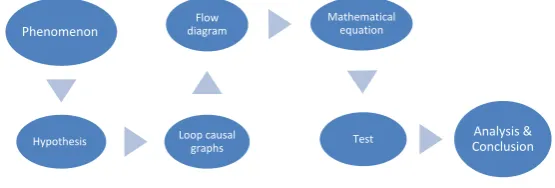
The process of system theory is presented briefly as follows:
Fig. 1. The process of system theory Source: Results of Vensim model
According to the process of system theory that is described in Figure 1, the loop causal graphs can be explained: The total loop is drawn as overviews of the variables with which all manufacturing firms are associated are studied.
In Figure 2, two main loops, namely a self-reinforcing loop (R) and a balancing loop (B) have been shown:
Phenomenon
Hypothesis Loop causal graphs
Flow diagram
Mathematical equation
Test Analysis &
Fig. 2. The total loop variables Source: Research results
The balancing loop shows that the consumption of petroleum products creates an increase in demand that leads to an increase in their prices. An increase in the prices of these products will reduce corporate profits. With the increase of corporate profits the incentives for firms to raise capital and capital equipment are created. Equipping manufacturing firms resulted in employing advanced machines and eventually led to the increase of development. Finally, the development will be a factor to use more petroleum products in order to generate more:
Fig. 3. The relationship between the consumption of petroleum products and production
Source: Research results
Figure 4 demonstrates that an increase in the consumption of petroleum products leads to an increase in production. The increase in production is the
development
capital and capital equipment price of oil product
skilled labor force manufac turing
firms profits
human resources product
consumption of oil product
+
+
+
+ + +
+
-+
R B
development
capital and capital equipment
manufacturing firms profits price of oil products
consumption of oil products
+
-+
+
B
factor of employing more labor; in other words, the increase of human resources. An increase in the labor force leads to the increase of specialists in the firms. Skilled labor force requires new capital and capital equipment. Hence, the increase of capital and capital equipment will lead to an increase of development and will create a force for development in order to raise the consumption of petroleum products:
Fig. 4. The balancing loop
Source: Research results
5.
Conclusion and Recommendations
As we demonstrated in this paper, energy, especially in the form of oil products, is the propellant of every manufacturing activity. Therefore, it has a special role in economic growth and development, so greatly that these resources are the most effective factors in economic growth and development. Therefore, this issue has been dealt with in this paper. The summary of this paper’s results is as follows:
The oil products consumption growth has a positive effect on the economic development through two channels:
Firstly, an increase in oil products consumption growth will increase the firm’s profits, and as a consequence, will increase the firm’s incentives, leading to more usage of advanced equipment and, finally, the rise of development.
Secondly, an increase in oil products consumption growth through the rise of production leads to an increase in the usage of labor force and, as a consequence, an increase in the capital and capital equipment and, finally, the rise of development.
Finally, this development would be the factor for the use of petroleum products in order to have more production and profits.
development
capital and capital equipment
skilled labor force
human resources product
consumption of oil product
+
+
+
+ + +
Therefore, considering that Iran has vast oil resources, it is suggested that the government prepare the necessary and proper backgrounds for raising manufacturing firms' incentives in the direction of manufacturing activities through making available new equipment and technologies. We presented four hypotheses about the relationship between energy consumption and economic growth including: Growth Hypothesis, Conservation Hypothesis, Feedback Hypothesis, and Null Hypothesis. The results show that Conservation Hypothesis and Null Hypothesis are rejected, but Growth Hypothesis and Feedback Hypothesis are accepted for Iran and the countries which depend significantly on energy.
References
1.Abrishami, H. & Mostafayi, A. (2002). The relation between economic growth and common oil products consumption during 1959-1999 through
using error vector correction model. Quarterly knowledge and
development. 14, 11-46, In Persian.
2.Adnan Hye, Q.M. and S. Riaz (2008). “Causality between Energy
Consumption and Economic Growth: The Case of Pakistan”, The Lahore
Journal of Economics, vol. 13 (2 ), pp. 45-58.
3.Al-mulali, U. & Gholipour Fereidouni, H. (2014). Electricity consumption from renewable and non-renewable sources and economic growth: Evidence from Latin American countries, 30, 290-298.
4.Apergis,N. & James E.P. (2010). Renewable energy consumption and
economic growth: Evidence from a panel of OECD countries. Energy
Policy, 38 (1): 656–660.
5.Arman, S.A. & Zare, R. (2005), investigation of granger causality relationship between energy consumption and economic growth in Iran during the years 1967-2002. Iranian Journal of Economic Research, No 24, PP. 115-142.
6.Asgharpoor, H., Davood, B. & Hasani Sdrabadi, M.H. (2007).
Investigating natural gas consumption and economic growth in Iran, 19, 105-122, In Persian.
7.Behboodi, D., Asgharpoor, H. & Ghazvinian, M.H. (2009). Energy
Consumption and Economic Growth in Iran. Journal of Economic
Research, No 3, PP. 53-84, In Persian.
8.Belke, A., C. Dreger and F.D. Haan (2010), “Energy Consumption and Economic Growth –New Insights into the Cointegration Relationship”,
RuhrEconomicPapers, pp. 1-22.
9.Belloumi, M. (2009). Energy consumption and GDP in Tunisia:
10.Cowan, W. (2014). The nexus of electricity consumption, economic growth and CO2 emissions in the BRICS countries, 66, 359368.
11.Cheng, B.S. (1995). An investigation of cointegration and causality
between energy consumption and economic growth. The journal of
energy and development, 21 (1), 73-84.
12.Erbaykal, E. (2008). Disaggregate Energy Consumption and Economic
Growth: Evidence From Turkey. International Research Journal of
Finance and Economics, vol. 20, pp. 173-180.
13.Fallahi, F. & Montazeri, J. (2010). The relationship between Petroleum
Products Consumption and Economic Growth, Iranian Journal of
Economic Research, No 44, PP. 111-113, In Persian.
14.Furuoka, Fumitaka. (2016). Natural gas consumption and economic
development in China and Japan: An empirical examination of the Asian context, Renewable and Sustainable Energy Reviews, Vol. 56, Pages 100–115.
15.International Energy Agency, Energy Balances of OECD Countries
2000.
16.Javan, A. (1999). Evolution of Energy in the Twentieth Century, Energy
Economic Journal. Tehran, In Persian.
17.Khalatbari, F. (1994). The Basis of Oil Economy (1st ed). Scientific and
Cultural Publications, In Persian.
18.Kashmari, A., Emad Slam, H. & Sadrabadi, M.H. (2007). The eminence
relation between energy consumption, employment, and local gross production during 1971-2005, 24, 31-58, In Persian.
19.Lee, Ch., & Chang Ch. (2005). Structural breaks, energy consumption, and economic growth revisited: Evidence from Taiwan, 27, 857-872. 20.Narayan P.K., & Narayan S., & P. S. (2010). Does electricity
consumption panel granger causes GDP? A new global evidence.
Applied Energy, 87(10): 3294– 3298.
21.Nasreen, S. & Anwar, S. (2014). Causal relationship between trade openness, economic growth and energy consumption: A panel data analysis of Asian countries, 69, 82-91.
22.Mehrgan, N., Haghani, M. & Abdolahi, S. (2011). The Impact of the Growth of Petroleum Products Price on Employment in the Transportation. Transportation Research Journal, No 3, 277-288, In Persian.
23.Najjarzade, R & Abasmohseni, A. (2004). The relationship between energy carriers’ consumption and growth of economic parts in Iran, 2, 61-80, In Persian.
and Economic Growth: Evidence from COMESA Countries”, RESEARCH PAPER, pp. 1-20.
25.Narayan P.K., & Narayan S., & P. S. (2010). Does electricity consumption panel granger cause GDP? A new global evidence. Applied Energy, 87(10): 3294–3298.
26.Park, Sun-Young. (2014). the dynamics of oil consumption and
economic growth in Malaysia, 66, 218-223.
27.Ozturk, Ilhan and Acaravci, Ali. (2010).The causal relationship between
energy consumption and GDP in Albania, Bulgaria, Hungary and Romania: Evidence from ADRL bound testing approach, Applied Energy, 87, 1938–1943.
28.Sadr, M.H, S., Gudarzi Farahani,Y. & sharifi, H. (2012). Consideration of the relationship between energy consumption and economic growth in oil exporting countries, 62, 52 – 58, In Persian.
29.eyed Aziz, A. & Zare, R. (2005). The relation between energy consumption and economic growth in Iran during 1967-2002, 24, 117-143, In Persian.
30.Shahbazi, K., Asgahrpoor, H. & Moharramzadeh, K. (2012). The Impact
of Petroleum Products Consumption on Economic Growth. Quarterly
Journal of Economic Modelling, No 1, PP. 25-44, In Persian.
31.Stulz, R. (1999). Globalization, corpor ate finance and the cost of capital.
Journal of Applied Corporate Finance, 12(3):8-25.
32.Tsani, S. Z. (2010). Energy consumption and economic growth: A
causality analysis for Greece. Energy Economics, 32 (3): 582–590. 33.Tsani, Stela Z. (2009). Energy Consumption and Economic Growth: A
Causality Analysis for Greece. Energy Economics, pp. 1-9.
34.Yoo, S.H., & Ku, S.J.(2009). Causal relationship between nuclear energy
consumption and economic growth: A multi-country analysis. Energy
Policy, 37 (5): 1905-1913.
35.Zamani, M. (2007). Energy consumption and economic activity in Iran.
Energy Economics, 29(6): 1135-1140.
36.Zhang-wei, L & Xun-gang, Zh. (2012). Study on Relationship of Energy