28
3D Scene and Object Classification Based on
Information Complexity of Depth Data
A. Norouzzadeh
a, H. D. Taghirad
a, *a
Industrial Control Center of Excellence (ICCE), Advanced Robotics and Automated Systems (ARAS), Faculty of Electrical Engineering, K. N. Toosi University of Technology, Tehran, Iran, P. O. Box 16315-1355
A R T I C L E I N F O A B S T R A C T
Article history:
Received: April 20, 2015. Received in revised form: August 10, 2015.
Accepted: September 02, 2015.
Keywords:
SLAM
Loop Closure Detection Information Theory Kolmogorov Complexity
In this paper the problem of 3D scene and object classification from depth data is addressed. In contrast to high-dimensional feature-based representation, the depth data is described in a low dimensional space. In order to remedy the curse of dimensionality problem, the depth data is described by a sparse model over a learned dictionary. Exploiting the algorithmic information theory, a new definition for the Kolmogorov complexity is presented based on the Earth Mover’s Distance (EMD). Finally the classification of 3D scenes and objects is accomplished by means of a normalized complexity distance, where its applicability in practice is proved by some experiments on publicly available datasets. Also, the experimental results are compared to some state-of-the-art 3D object classification methods. Furthermore, it has been shown that the proposed method outperforms FAB-Map 2.0 in detecting loop closures, in the sense of the precision and recall.
1. Introduction
The two problems of 3D scene and object classification have received a great amount of attention from computer vision and robotic communities. The visual scene or object detection is performed using feature-based representation of camera images. Distinctive properties extracted from images, such as shape, color and textures are employed in visual detection. As the world is 3D in nature, the depth information should be used in the object detection algorithms. The 3D scans are made available as the observation of sensors such as stereo camera, Lidar or Microsoft Kinect.
Various descriptors are presented for representation of colour, shape and depth information in the context of 3D scene or object recognition. A shape descriptor is presented in [1], where an ensemble of angle, area and distance shape functions is employed in construction of
* Corresponding address: K. N. Toosi University of Technology, Tehran, Iran,
Tel.: +98 2188469084; E-mail address: [email protected].
an object descriptor. The depth information is used in [2] in order to construct a depth kernel descriptor where models the size, 3D shape and depth edges in a single framework. Another shape descriptor is expressed in [3] for classification of 3D objects observed by a Kinect camera using a database of 3D models. Detection of similar places is known as loop closure detection in the Simultaneous Localization and Mapping (SLAM) problem. Conventional feature-based representations are usually employed for loop closure detection, such as training a classifier from extracted features [4] or using Bayesian filtering for loop detection from bag of visual words [5].
29
such that it works in a low-dimensional space, based on range image data without training or derivation of distinctive characteristics from all 3D scans.
The paper is organized as follows. The next section briefly reviews some related works. Some preliminaries about sparse modeling of images based on a parametric dictionary and algorithmic information theory, are provided in section 2. Section 3 is devoted to the description of the proposed approach. Finally, section 4 is dedicated to the experimental results, which is followed by the concluding remarks.
2. Preliminaries
In order to efficiently classify 3D scenes or objects, a similarity measure for low-dimensional representation of rage image observations is necessary. Two theories are employed in the process of definition of this similarity measure in a low dimensional space. The first is the sparse representation of data based on a learned dictionary and the second is the information theory. The sparse modeling of 2D images, generates a low-dimensional representation of a natural 2D image, which is unique in an over-complete dictionary [7]. This approach achieves a very compact and efficient representation of salient features of a natural image. Here we apply this method to achieve a sparse representation for each range image as a linear combination of dictionary elements called atoms. In order to accomplish the object classification task, a proper similarity measure is required.
A normalized distance measure is developed in algorithmic information theory [8], which compares
general objects based on the complexity of their representations. In the following sections, the sparse modeling of images and normalized distance measure are presented in more detail. Based on these theories, the proposed object classification method is elaborated in section 3.
2.1. Sparse Modeling
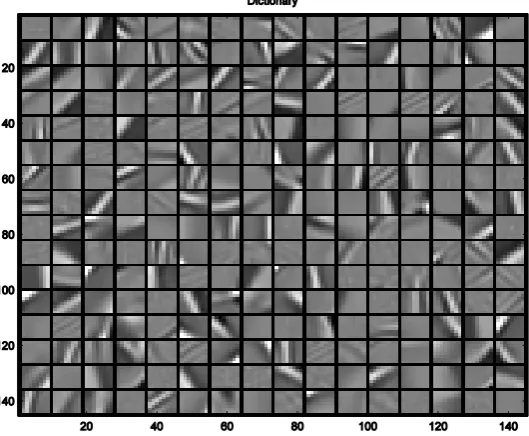
The representation of 2D images as a sparse model based on a learned dictionary has received great amount of attention from image processing community [7]. Sparse and compact representation of an image using few atoms of an over-complete dictionary and also the flexibility of dictionary design, are some benefits of sparse modeling of images. A parametric mother function is employed for generation of dictionary atoms with a combination of 2D transformations such as translation, rotation and non-uniform scaling applied. Finally an iterative matching pursuit algorithm, [9] represents the input image approximately. The decomposition of image is expressed by a linear combination of most correlating atoms. Therefore, the only limitation to design such dictionary is spanning of whole Hilbert space of input images, while the generating function should be able to capture input image structure and salient features [7]. Some dictionary atoms are depicted in Fig. 1 indicating atoms of a leaned dictionary from a camera image.
In conventional dictionary learning methods, a set of vectors 𝑥𝑖∈ ℛ𝑛 are employed and the following cost
function is minimized in order to construct the dictionary 𝐷 as:
30
𝑓𝑛(𝐷) = 1
𝑛∑ 𝑙(𝑥𝑖, 𝐷) 𝑛
𝑖=1
(1)
where 𝑙(𝒙, 𝐷) is a loss function and represents the quality of dictionary 𝐷 in representing the vector 𝒙. Following the work of [10], 𝑙(𝒙, 𝐷) is defined as
𝑙(𝒙, 𝐷) = min 𝛼
1
2∥ 𝒙 − 𝐷𝛼 ∥22+ 𝜆 ∥ 𝛼 ∥1 (2)
where 𝜆 is a regularization parameter. The optimization is accomplished over the two variables 𝐷 and 𝛼. Since this optimization problem is not convex, the optimization is performed in two stages by keeping one variable fixed and optimizing over the other one, which results in a convex optimization problem.
Even though the sparse approximation of images from an over-complete dictionary is an NP-hard problem [11], greedy algorithms find sub-optimal but yet efficient solutions, iteratively. One of the widely used greedy algorithms is the matching pursuit [9], in which, at every iteration the best matching atom is found by full dictionary searching. The matching pursuit converges exponentially, however, it cannot find the sparsest solution [7]. Therefore, the Orthogonal Matching Pursuit (OMP) algorithm [11] is used in this paper which solves the problem of finding optimal sparse solution [12], [13].
The OMP algorithm, initially assigns the input image 𝐼𝑠 to the residual 𝑅0.
𝐼𝑠= 𝑅0 (3)
Then iteratively at the 𝑖th step, OMP seeks the best matching atom 𝑔𝛾𝑖 by finding the atom which possess
maximum correlation with the residual 𝑅𝑖−1. 𝛾𝑖= arg max𝛾 | < 𝑅𝑖−1, 𝑔𝛾
> | (4)
In this relation the defined inner product in Hilbert space ℋ is denoted by the operator <. , . >. The contribution of the selected atom is removed from the residual by orthogonal projection of 𝑅𝑖−1 on to the span of selected atoms {𝑔𝛾𝑖}, where
𝑅𝑖= (𝐼 − 𝑃𝑖)𝑅𝑖−1 (5)
represents the orthogonal projection of 𝑠𝑝𝑎𝑛{𝑔𝛾𝑖} by 𝑃𝑖. After 𝑁 iterations, the input image 𝐼𝑠 is expressed by
a linear combination of the selected atoms.
𝐼𝑠= ∑ < 𝑅𝑖, 𝑔𝛾𝑖> 𝑔𝛾𝑖+ 𝑅𝑁 𝑁−1
𝑖=0
(6)
It is observed that the approximation error decays exponentially and the algorithm is terminated after 𝑁 steps to represent the input image as a sparse model or until the norm of the residual becomes lower than a specified threshold. After 𝑁 iterations, the OMP algorithm represents the input image approximately as a linear combination of most correlating atoms. The
approximate linear expansion of input image 𝐼𝑠
expressed by
𝐼𝑠 ≈ ∑ < 𝑅𝑖, 𝑔𝛾𝑖> 𝑔𝛾𝑖+ 𝑅𝑁 𝑁−1
𝑖=0
= ∑ 𝜉𝑖𝑔𝛾𝑖 𝑁−1
𝑖=0
(7)
which is an efficient unique image representation in a low dimensional space which has application in image and video coding [14], and image transformation estimation [15]. The approximate spare model captures the salient geometrical features of input image with few atoms of a parametric dictionary.
The extracted sparse models of range images shall be compared for finding similar objects which is the main purpose of this paper. The next section is dedicated to the Kolmogorov complexity and Normalized Compression Distance. These theories are used in development of complexity based representation of range images and are discussed in section 3.
2.2. Algorithmic Information theory
The algorithmic version of information theory, estimates the information by lossless data compression which is successfully employed for content-based image retrieval [16] and feature extraction [17]. In contrast to the Shannon approach that assumes the objects are made by a known random source and represent entropy as average information, the algorithmic information theory represents objects as a symbol strings and defines the complexity in analogy to entropy. In algorithmic information theory, a string sequence 𝑋 is expressed as the required input to a universal computer 𝑈 which prints 𝑋 on its output and stops. Also the complexity 𝐾(𝑋) is defined as the minimal length of any input for fixed 𝑈 which prints 𝑋 to the output. It has been shown that the dependency of 𝐾(𝑋) to 𝑈 is weak and can be ignored when 𝐾(𝑋) is sufficiently large [18]. The conditional Kolmogorov complexity is shown by 𝐾(𝑋|𝑌) and defined as the length of a shortest program to generate 𝑋 given 𝑌 as its input.
31
𝑁𝐶𝐷(𝑋, 𝑌) =𝐶(𝑋𝑌) − min {𝐶(𝑋), 𝐶(𝑌)}
𝑚𝑎𝑥 {𝐶(𝑋), 𝐶(𝑌)}
(8)
where 𝐶(𝑋𝑌) is the length of compressed file containing the concatenation of 𝑋 and 𝑌. The 𝑁𝐶𝐷 is a metric with 𝑁𝐶𝐷(𝑋, 𝑋) = 0 for similar sequences and 𝑁𝐶𝐷(𝑋, 𝑌) ≤ 1 for all pairs (𝑋, 𝑌). When 𝑋 and 𝑌 are similar and share a great amount of information, their concatenation is compressed much more than the situation of comparing two dissimilar string sequences. Therefore, the 𝑁𝐶𝐷 value gets close to zero. In contrast, the concatenation of two different string sequences can be compressed so much, resulting in a 𝑁𝐶𝐷 value near to one. In order to compute 𝑁𝐶𝐷, any compression algorithm such as gzip, bzip2 or PPM can be used. The next section presents the proposed method which is constructed from complexity based representation of range images. The object classification is accomplished by comparing these representations using 𝑁𝐶𝐷.
3. Proposed System
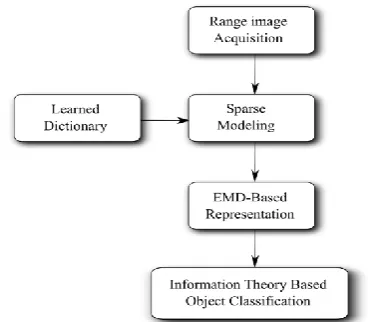
In this section a similarity measurement approach is developed for 3D scene or object classification from range images. As it is shown in the flowchart given in Fig. 2, range images are acquired as input sensor observations. Then, a sparse model for each range image is constructed iteratively, from a learned dictionary using orthogonal matching pursuit algorithm (OMP). The dictionary is learned offline, containing learned patches known as atoms. The result of this step is the sparse model of the acquired range image, composed of a linear combination of atoms. This representation has a lower dimension in relation to conventional methods such as feature-based representations.
In order to use the 𝑁𝐶𝐷 as a normalized similarity measure, a representation is constructed from the range image sparse model, involving its structure complexity. The Kolmogorov complexity of this representation is proportional to the number of atoms used in sparse model and their geometrical structure. Employing the complexity based representation, the sensor observations are compared according to their complexity. In what follows, different parts of the proposed method are explained in more details.
3.1. Earth Mover’s Distance
The EMD originally has been used for image retrieval [22] and is well designed for comparison of signatures. The EMD describes the distance between two distributions as the minimum cost of transforming one distribution to another by solving the well-known transportation problem. Considering each distribution as a pile of earth, the EMD is equal to the minimum required amount of work to fill holes by moving earth.
Figure 2: The overall processing units of the proposed scene/object classification approach.
Consider two signatures as
𝑃 = {(𝑝1, 𝑤𝑝1), … , (𝑝𝑚, 𝑤𝑝𝑚)} (9) 𝑄 = {(𝑞1, 𝑤𝑝1), … , (𝑞𝑚, 𝑤𝑞𝑚)} (10) where 𝑝𝑖 and 𝑞𝑖 are the cluster representative while 𝑤𝑝𝑖 and 𝑤𝑞𝑖 indicate the width of each cluster.
Furthermore, the cost matrix 𝐶 = [𝑐𝑖𝑗] is defined as the
cost of moving a unit of mass from the 𝑖th cluster of 𝑃 to the 𝑗th cluster of 𝑄. Then the EMD seeks the minimum flow 𝐹 = [𝑓𝑖𝑗] which minimizes the following cost function
𝑊𝑂𝑅𝐾(𝑃, 𝑄, 𝐹) = ∑ ∑ 𝑐𝑖𝑗𝑓𝑖𝑗 𝑛
𝑗=1 𝑚
𝑖=1
(11)
subject to the following constraints 𝑓𝑖𝑗 ≥ 0 1 ≤ 𝑖 ≤ 𝑚, 1 ≤ 𝑗
≤ 𝑛 (12)
∑ 𝑓𝑖𝑗 ≤ 𝑤𝑝𝑖 𝑛
𝑗=1
1 ≤ 𝑖 ≤ 𝑚
(13)
∑ 𝑓𝑖𝑗 ≤ 𝑤𝑞𝑖 𝑚
𝑗=1
1 ≤ 𝑗 ≤ 𝑛 (14)
∑ ∑ 𝑓𝑖𝑗 𝑛
𝑗=1 𝑚
𝑖=1
= min (∑ 𝑤𝑝𝑖 𝑚
𝑖=1
, ∑ 𝑤𝑞𝑖 𝑛
𝑗=1 )
(15)
After finding the optimal flow, the EMD is computed as the required work normalized by the total flow
𝐸𝑀𝐷(𝑃, 𝑄) = 𝑊(𝑃, 𝑄, 𝐹) ∑𝑚𝑖=1∑𝑛𝑗=1𝑓𝑖𝑗
32
3.2. Complexity Based Representation of SparseModel
The normalized compression distance (𝑁𝐶𝐷) is a universal metric for comparison of general object descriptions such as music and genome data [20]. Unfortunately, the application of 𝑁𝐶𝐷 in image similarity measurement is not satisfactory [21], where it has been shown experimentally that 𝑁𝐶𝐷 cannot be universally applied to the images. In order to remedy this problem, we propose to use the EMD as Kolmogorov complexity of each sparse model. Estimating the Kolmogorov complexity of a model using a compression algorithm has some drawbacks such as sensitivity to repeated patterns and mapping of many representations to a fixed value in the complexity space. In other words, since a compression based complexity estimator is not a one to one mapping function, some problems arise in practice. The EMD has been widely used for distance measurement of histograms and feature descriptors. Since the EMD is not a normalized metric, we present a new definition for the Kolmogorov complexity based on the EMD in order to employ the 𝑁𝐶𝐷 as a normalized
similarity measure. As mentioned before, the conditional Kolmogorov complexity 𝐾(𝑋|𝑌) is defined as the minimum length of a program that generates 𝑌 having 𝑋 in hand. Assuming that the signatures 𝑃 and 𝑄 are derived from 𝑋 and 𝑌 respectively, the conditional Kolmogorov complexity can be defined as
𝐾(𝑋|𝑌) = 𝐸𝑀𝐷(𝑃, 𝑄) (17) In this paper we substitute the signatures of 𝑃 and 𝑄 by the sparse model of range images. Each model is expressed as a linear combination of learned dictionary atoms and the signature of each range image is equal to the set of atom coefficients.
Also the complexity of 𝑋 and 𝑌 can be computed separately as
𝐾(𝑋) = 𝐸𝑀𝐷(𝑃, {0}) (18) where {0} represents an empty signature with all cluster center and widths equal to zero.
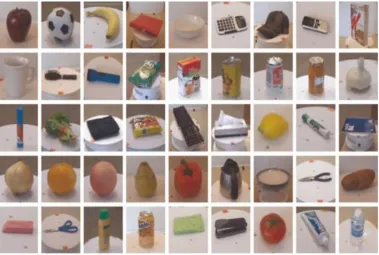
Figure 3: Various objects of the dataset
Finally, having the Kolmogorov complexity of each sparse model computed, the 𝑁𝐶𝐷 as a normalized similarity measurement metric can be efficiently applied in order to perform classification task. The next section presents the experimental results of both 3D scene and object classification using the proposed approach.
4. Experimental Results
4.1. Object Classification
33
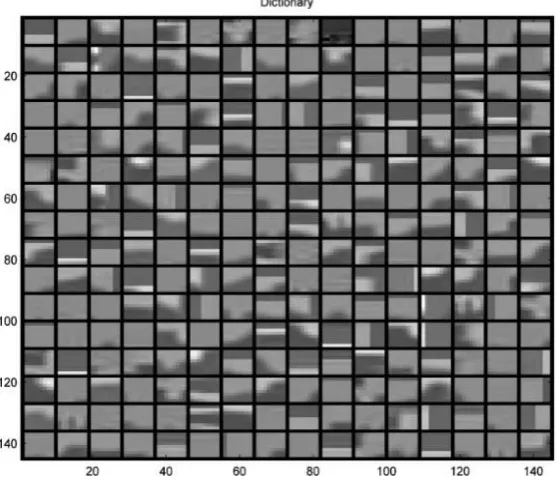
presented in [23]. In the first experiment a dataset of 300 objects from 51 different categories is used [24], which some of them are shown in Fig. 3. The parameters of the proposed system are shown in Table 1. A dictionary of 256 atoms is learned from some range images offline, which is shown in Fig. 4. Also, the range image of each object is resized to 96 × 96 and the corresponding sparse model is generated by OMP algorithm. In the category detection experiment, one object is randomly excluded from the dataset and used as the test object. The similarity of the test object is computed with other objects and its category is detected.
Table 1: Proposed system parameters
Parameter Value
Number of dictionary atoms 256 Number of sparse model atoms 20 Range image resolution 96 × 96
Figure 4: Leaned dictionary from range images of some dataset objects
The result of 20 experiments is reported in Table 2. As it can be seen, the proposed method has a competing performance with the kernel descriptor based classification methods [2], where the pixel attributes are represented by match kernels. In the instance detection experiment, the leave-sequence-out approach is followed, where the system is trained on the object range images captured from angels of 30°and 60° and is tested on views got from the angel of 45°. As it can be seen in Table 2, the proposed method has good accuracy in relation to the kernel descriptor based methods. In addition, it can be concluded that using depth information for classification of objects is not sufficient especially in the case of instance recognition.
4.2. Loop Closure Detection
34
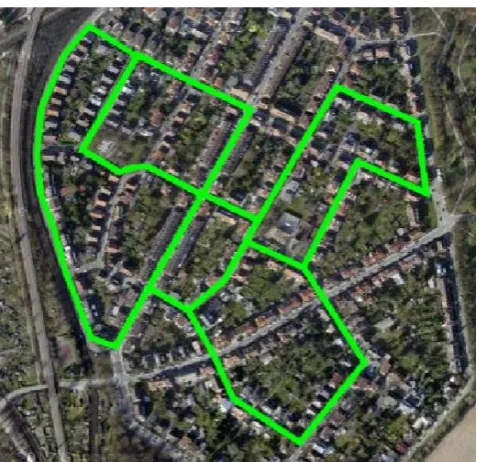
Figure 5: The KITTI Sequence (00) dataset. The travelled path is indicated by green lines
The output of both FAB-MAP 2.0 and the proposed method is a difference matrix indicating the pairwise similarity of depth images. A similarity threshold is used to accept or reject each loop closure candidate. The precision is the number of true detected loops divided by the total number of reported loops. The recall is achieved by dividing the number of true detected loops by the total number of actual loops. The precision-recall curves are generated by varying the similarity threshold.
Table 2. Experimental results of object classification
Method Category Detection Instance Detection
Proposed method 78.2% 52.4%
GradKDES 72.8% 40.1%
LBPKDES 72.1% 33.5%
SpinKDES 60.2% 33.1%
SizeKDES 56.3% 25.2%
The precision-recall curve of the proposed method and the FAB-MAP 2.0 algorithm, are shown in Fig. 6. As it can be seen, the proposed method has higher precision-recall performance in relation to the FAB-MAP 2.0 algorithm. While the proposed method has achieved accuracy of 100% with the recall rate of 62%, the FAB-MAP 2.0 algorithm provides accuracy of 25% at the same recall rate. This means that the FAB-MAP 2.0 algorithm has reported so many false loop closures which causes instability of the SLAM algorithm and inconsistency of the environment map. Therefore, according to the experimental results in a dynamic urban environment, it can be concluded that the proposed method outperforms the FAB-MAP 2.0 algorithm which makes it suitable for SLAM application.
Figure 6: The precision-recall curve of KITTI Sequence (00).
5. Conclusions
35
References[1] W. Wohlkinger, M. Vincze, Ensemble of shape functions for 3D object classification, in Robotics and Biomimetics (ROBIO), 2011 IEEE International Conference on. IEEE, (2011), 2987–2992.
[2] L. Bo, X. Ren, D. Fox, Depth kernel descriptors for object recognition, in Intelligent Robots and Systems (IROS), 2011 IEEE/RSJ International Conference on. IEEE, (2011), 821– 826.
[3] W. Wohlkinger, M. Vincze, Shape-based depth image to 3D model matching and classification with inter-view similarity, in Intelligent Robots and Systems (IROS), 2011 IEEE/RSJ International Conference on. IEEE, (2011), 4865– 4870.
[4] M. Cummins, P. Newman, Appearance-only SLAM at large scale with FAB-MAP 2.0, The International Journal of Robotics Research, Vol. 30(9), (2011), 1100–1123.
[5] K. Granstrom, T. Schon, J. Nieto, F. Ramos, Learning to close loops from range data, The International Journal of Robotics Research, (2011).
[6] M. Radovanovi´c, A. Nanopoulos, M. Ivanovi´c, Hubs in space: Popular nearest neighbors in high-dimensional data, The Journal of Machine Learning Research, Vol. 9999, (2010), 2487–2531.
[7] R. Figueras i Ventura, P. Vandergheynst, P. Frossard, Low-rate and flexible image coding with redundant representations, Image Processing, IEEE Transactions on, Vol. 15(3), (2006), 726–739.
[8] T. Cover and J. Thomas, Elements of information theory. Wiley-Interscience, (2006).
[9] S. Mallat and Z. Zhang, Matching pursuits with time-frequency dictionaries, Signal Processing, IEEE Transactions on, Vol. 41(12), (1993), 3397–3415.
[10] J. Mairal, F. Bach, J. Ponce, G. Sapiro, Online dictionary learning for sparse coding, in Proceedings of the 26th Annual International Conference on Machine Learning. ACM, (2009), 689–696.
[11] G. Davis, S. Mallat, M. Avellaneda, Adaptive greedy approximations, Constructive approximation, Vol. 13(1), (1997), 57–98.
[12] E. Livshitz, On the optimality of the orthogonal greedy algorithm for -coherent dictionaries, Journal of Approximation Theory, Vol. 164(5), (2012), 668–681.
[13] M. Davenport, M. Wakin, Analysis of orthogonal matching pursuit using the restricted isometry property, Information Theory, IEEE Transactions on, Vol. 56(9), (2010), 4395–4401.
[14] A. Rahmoune, P. Vandergheynst, P. Frossard, Sparse approximation using m-term pursuit and application in image and video coding, Image Processing, IEEE Transactions on, Vol. 21(4), (2012), 1950 –1962.
[15] E. Kokiopoulou, D. Kressner, P. Frossard, Optimal image alignment with random projections of manifolds: Algorithm and geometric analysis, Image Processing, IEEE Transactions on, Vol. 20(6), (2011),1543 –1557.
[16] D. Cerra, M. Datcu, A fast compression-based similarity measure with applications to content-based image retrieval, Journal of Visual Communication and Image Representation, (2011).
[17] H. Peng, F. Long, and C. Ding, “Feature selection based on mutual information criteria of dependency, max-relevance, and min-redundancy,” Pattern Analysis and Machine Intelligence, IEEE Transactions on, Vol. 27(8), (2005), 1226–1238.
[18] M. Li, P. Vitanyi, An introduction to Kolmogorov complexity and its applications. Springer-Verlag New York Inc, (2008).
[19] M. Li, X. Chen, X. Li, B. Ma, and P. Vit´anyi, The similarity metric, Information Theory, IEEE Transactions on, Vol. 50(12), (2004), 3250–3264.
[20] R. Cilibrasi, P. Vitanyi, Clustering by compression, Information Theory, IEEE Transactions on, Vol. 51(4), (2005), 1523 – 1545.
[21]P. V´azquez, J. Marco, Using normalized compression distance for image similarity measurement: an experimental study, The Visual Computer, (2011), 1-22.
[22] Y. Rubner, C. Tomasi, L. Guibas, The earth mover’s distance as a metric for image retrieval, International Journal of Computer Vision, Vol. 40(2), (2000), 99–121.
[23] K. Lai, L. Bo, X. Ren, D. Fox, RGB-D Object Recognition: Features, Algorithms, and a Large Scale Benchmark, in Consumer Depth Cameras for Computer Vision. (2013), 167–192.
[24] K. Lai, L. Bo, X. Ren, D. Fox, A large-scale hierarchical multi-view RGB-D object dataset, in Robotics and Automation (ICRA), 2011 IEEE International Conference on. IEEE, (2011), 1817–1824.
[25] A. Geiger, P. Lenz, R. Urtasun, Are we ready for autonomous driving? The kitti vision benchmark suite, in Computer Vision and Pattern Recognition (CVPR), Providence, (2012), USA.
Biography
Alireza Norouzzadeh Ravari has received his B.Sc. and M.Sc. degrees in electrical engineering from Shahid Bahonar University of Kerman, and K. N. Toosi Univ. of Technology, respectively. He is currently a Ph.D. student in electrical engineering and a member of the Advanced Robotics and Automated System (ARAS) at K.N. Toosi University of Technology, Tehran, Iran. His research interests include machine vision, mobile robotics and information theory.