Journal of Caring Sciences 2019; 8 (4): 207-211 doi:10.15171/jcs.2019.029
http:// journals.tbzmed.ac.ir/ JCS
© 2019 The Author(s). This work is published by Journal of Caring Sciences as an open access article distributed under the terms of the Original Article
Effect of Self-Management Program on Self-efficacy and
Medication Adherence in Patients with Mechanical Heart Valve:
a Randomized Clinical Trial
Leila Javan
1, Anoshirvan kazemnejad
2, Mahin Nomali
1, Masoumeh Zakerimoghadam
1*1Department of Critical Care Nursing, School of Nursing and Midwifery, Tehran University of Medical Sciences, Tehran, Iran 2Department of Biostatistics, Faculty of Medical Sciences, Tarbiat Modares University, Tehran, Iran
ARTICLE INFO ABSTRACT
Article type: Original article Article History:
Received: 6 Oct. 2017 Accepted: 22 Oct. 2018 ePublished: 1 Dec. 2019
Introduction: Patients with mechanical heart valve need anticoagulant therapy to prevent thrombotic events. The treatment interacts with some foods and drugs. The aim was to evaluate the effect of self- management program on self-efficacy and medication adherence in patients with mechanical heart valve.
Methods: This was a randomized controlled trial. eighty eligible patients, with the ability to read and speak in Farsi, aged between 15 to 60, were included in the study from the cardiac surgery clinic in Imam Khomeini hospital affiliated to Tehran University of Medical Sciences (Tehran, Iran) and randomly allocated to intervention and control groups. The participants had no history of psychiatric disorders, had undergone valve replacement surgery at least one year before the study, and were being treated with Warfarin. The intervention was a combination of 2 one- hour self-management education via small groups with 3 to 5 members, self-self-management educational booklets, and weekly call follow- ups for 8 weeks about 10- 15 minutes. The control group received no intervention. Self- efficacy was the primary outcome and medication adherence, Prothrombin Time (PT), and International Normalized Ratio (INR) were secondary outcomes. Data were analyzed using SPSS13.
Results:Although the mean of self-efficacy and medication adherence, PT, and INR values were not different between the two groups at baseline, they improved significantly following the program. Conclusion: Self-management program had a positive effect on self-efficacy and medication adherence of patients with mechanical heart valve.
Keywords:
Heart valves, Self care, Self efficacy, Medication Adherence
*Corresponding Author: PhD in Nursing. Email: [email protected]
Citation: Javan L, kazemnejad K, Nomali M, Zakerimoghadam M. Effect of self- management program on self-efficacy and medication adherence in patients with mechanical heart valve: a randomized controlled trial. J Caring Sci 2019; 8 (4): 207-11. doi:10.15171/jcs.2019.029
Introduction
Valvular heart disease (VHD) is prevalent in developed
and developing countries with etiology of degenerative1
and rheumatic valvular disease by Staphylococci (Group
A).1,2 In the United States, VHD accounts for 10% to 20%3
and in Iran, it comprised 7.2% of all cardiac surgeries.4
From reported complications, thrombosis,
thrombo-embolism, and anticoagulant- related complications
account for 75% of all complications5 which usually occur
six months after surgery and necessitates the post
operation follow- ups5 Moreover, they are the leading
causes of morbidity and mortality6 imposing a
psychological burden and a negative effect on the quality of life.5
Although the long term durability is the main advantage of mechanical heart valves, there is need for Vitamin K antagonists (VKAs) with inherent risk of
thromboembolism and bleeding events in contrast.7
Warfarin and other VKAs interact with some foods and drugs, which makes the management of oral anticoagulant therapy challenging for both patients and
health care providers.8 Therefore, the management of oral
anticoagulant therapy is a key issue among patients with
mechanical heart valve7 and the therapy should be
individualized by focusing on patient education and
monitoring9 in order to reduce the risk of bleeding and
Thromboembolism events.9,10 One of the strategies is self-
management program that empowers patients to monitor
and adjust treatment at home.11 Previous studies have
shown that self- management program improves the INR
control, quality of life,12 self-efficacy,13 medication
adherence, and adjustment of treatment14 and leads to
lower risk of all- cause mortality rate,15,16 and
thromboembolism and major bleeding.15
Although most patients with a mechanical heart valve
may benefit from self-management program,7 Iranian
patients with mechanical heart valve have a permanent fear and concern about INR fluctuation, its regulation,
and correct use of VKAs during their treatment.17 On the
other hand, insufficient support can make life difficult for
them.18 Thus, because the self-management program
appears at least better than the routine care,11 and there is
crucial need for further randomized controlled trials to assess the efficacy of self-management program in order
to consider it as the standard care,15 and in view of lack of
this program in our health care setting so as to overcome the patients` fear and concerns and improve clinical outcomes, the aim of this study was to evaluate the effect of self- management program on self-efficacy and medication adherence of patients with mechanical heart valves.
Materials and methods
Javanet al.,
130/1225/93/d), and IRCT code IRCT201406154443N13.
With Helsinki ethical principles for human research considered during the study period.
The participants were patients aged between 15 to 60 years, who had undergone valve replacement surgery at least one year before the study and were being treated with Warfarin, with the ability to read and speak Farsi, no history of psychiatric disorders. The patients who experienced the drug side effects during the study period, were discharged before completing the two- educational sessions, did not answer the phone calls during the call follow- ups, or were not willing to continue the study were all excluded from the study. Therefore, 80 eligible patients with mechanical heart valves were included in the study from the cardiac surgery clinic in Imam Khomeini hospital affiliated to TUMS in 2014.
In this trial, the intervention consisted of self-management education, and weekly call follow- ups for 8 continuous weeks, each lasting from 10 to 15 minutes. In order to provide self-management education, the patients were divided into groups of 5 to 7 members and received 2 one-hour self-management education sessions at 2 to 3-day intervals. Self-management education and booklets were about the nature of the disease, medication management, drugs’ side effects, and actions needed to be taken to prevent drug side effects, food and drug interactions, having Warfarin card, prevention of actions that lead to complications, physical activity and stress and anxiety reduction methods. The content validity of the educational booklet was evaluated by three nursing and midwifery faculty members of TUMS. While the patients in the control group received no intervention. The outcomes of this trial were self-efficacy as a
primary outcome, and medication adherence,
prothrombin time (PT) and international normalized ratio (INR) were the secondary outcomes. In order to including 31 items with five- point Likert from extremely high to extremely low, with the higher scores indicating
the higher self-efficacy behavior.19,20 The questionnaire
was translated into Farsi by forward- backwards translation method and its content validity was approved evaluate the patient`s self-efficacy, a researcher- constructed self-efficacy questionnaire was used by 10 faculty members in the school of nursing and midwifery affiliated to TUMS. It had an acceptable reliability coefficient, too (Cronbach's alpha= 0.82). The patients were asked to complete the questionnaire themselves at baseline and at the end of the study. Medication adherence was another study outcome which was
evaluated by a medication adherence questionnaire21,22
consisting of 22 items with five- point Likert from always to never, where the higher scores were considered as higher medication adherence. 10 nursing and midwifery faculty members approved the content validity and
Cronbach's alpha was 0.85. The medication adherence questionnaire was completed by patient`s self- report at baseline and at the end of the study. In addition, PT and INR were measured by BIOLABO kit (France) with therapeutic range of INR between 2 and 3.5 at baseline and at the end of the study.
Demographic and clinical variables including age, sex, education level, job, income, insurance, smoking, family history of cardiovascular diseases (CVDs), consumption of other medications, and post-operation duration were among the study variables which were recorded at baseline for each patients based on their self-report and clinical records.
The collected data were analyzed using SPSS (version 13.0, Chicago, IL, USA). We described demographic and clinical data by descriptive statistics such as frequency, partial frequency percentage, the mean and standard deviation Mean (SD). In order to compare the means between the intervention and control groups, independent- samples t- test and chi- squared test were used to compare the frequency between the two groups. The significance level of statistical tests was less than 0.05.
Results
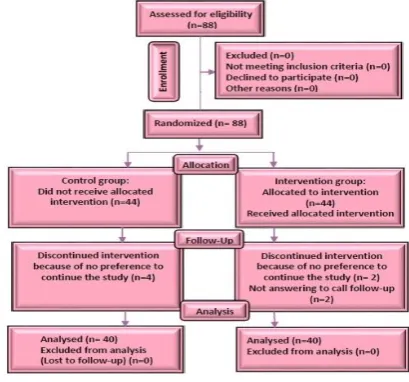
In this trial, 88 eligible patients were recruited during the enrolment phase and data related to 80 patients were analyzed. The total attrition rate was 10% as it was expected a priori. The most common causes of exclusion from the study were “not answering the call- follow- ups” and “no willingness to continue the study” during the follow- up period. The study process from the enrollment to analysis has been shown in CONSORT 2010 flow diagram (Figure 1).
Figure 1. Flowchart of study
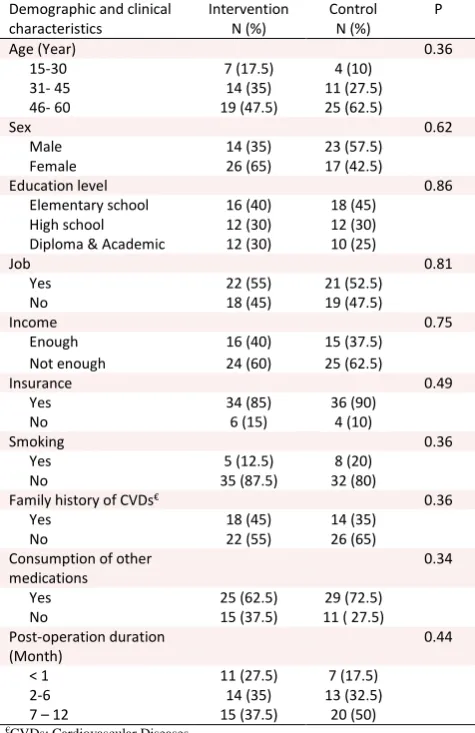
Table 1 shows the demographic and clinical characteristics of the patients in the intervention and control groups. According to this table, no Significant difference for clinical and demographic data were found between the two groups at baseline (P>0.05) (Table 1). Comparison of the mean and standard deviation of the
Table 1. Demographic and clinical characteristics of patients in the intervention and control groups (n=40)
Demographic and clinical characteristics
Intervention N (%)
Control N (%)
P
Age (Year) 0.36
15-30 7 (17.5) 4 (10)
31- 45 14 (35) 11 (27.5)
46- 60 19 (47.5) 25 (62.5)
Sex 0.62
Male 14 (35) 23 (57.5)
Female 26 (65) 17 (42.5)
Education level 0.86
Elementary school 16 (40) 18 (45) High school 12 (30) 12 (30) Diploma & Academic 12 (30) 10 (25)
Job 0.81
Yes 22 (55) 21 (52.5)
No 18 (45) 19 (47.5)
Income 0.75
Enough 16 (40) 15 (37.5) Not enough 24 (60) 25 (62.5)
Insurance 0.49
Yes 34 (85) 36 (90)
No 6 (15) 4 (10)
Smoking 0.36
Yes 5 (12.5) 8 (20)
No 35 (87.5) 32 (80)
Family history of CVDs€ 0.36
Yes 18 (45) 14 (35)
No 22 (55) 26 (65)
Consumption of other medications
0.34
Yes 25 (62.5) 29 (72.5)
No 15 (37.5) 11 ( 27.5)
Post-operation duration (Month)
0.44
< 1 11 (27.5) 7 (17.5)
2-6 14 (35) 13 (32.5)
7 – 12 15 (37.5) 20 (50)
€CVDs: Cardiovascular Diseases
Compared with the control group following the program (P<0.05).
Table 2. Comparison of mean and standard deviation of
study outcomes between the intervention and control group (n=40)
Study outcomes
Intervention Mean(SD)
Control Mean(SD)
P
Self-efficacy
Before 93.22(12.05) 96.22(14.99) 0.327 After 118.20(12.94) 100.40(16.01) 0.0001 Medication
adherence
Before 60.02(6.26) 79.60(9.04) 0.813 After 94.97(8.55) 80.80(10.21) 0.0001 PT (Second)
Before 17.78(2.91) 18.21(3.45) 0.530 After 19.94(3.31) 17.56(4.11) 0.008 INR
Before 1.89( 0.49) 1.95(0.62) 0.640 After 2.29(0.67) 1.94(0.45) 0.019
Discussion
In this trial, the effect of self-management program on self-efficacy and medication adherence of patients with mechanical heart valve was evaluated. According to the
result of the present study, the patients` self-efficacy improved significantly following the intervention. Previous studies assessed the effect of the intervention on self- efficacy among patients with multiple sclerosis, care
following the intervention, too.13,19,23,24 In contrast, in
Elzen et al., study, although the mean of self-efficacy score increased following the intervention, this difference was not statistically significant which may be due to the
aged study population and different disease conditions.25
Reduce the health care costs.26 the positive effect of
self-management program on patients` medication adherence has been shown in our study which was consistent with previous studies where the mean of medication adherence was significantly higher in the intervention group in comparison to the control group.22,27
Education about anticoagulant self-management can result in the patients’ satisfaction, quality of life improvement, anticoagulation control, and reduction in
thromboembolic events and mortality.28-30 in the present
study, the mean of PT and INR were significantly higher in the intervention group in comparison to the control group. In Jeon and Park study in 2015, PT and INR were maintained in the therapeutic range, following the intervention among patients with cardiac valve
replacement.13 In addition, educational intervention plays
a key role in controlling INR and its maintenance in
normal range31 In contrast, Sedri et al., indicated that PT
and INR were not significantly different between the two groups of intervention ( interactive and non- interactive
short message service) and control22 which may be due to
the type of intervention and follow- up duration. Conduction of this research project in a tertiary referral hospital that covers all patients with different health care behaviors was the strength of this study. The main limitation of this study was the presence of patients in educational sessions in order to receive the intervention that made patients discontinue the program. Thus, it is recommended the self-management program be provided through internet or by mobile health applications to improve patients` involvement in their care.
Conclusion
Self-management program had a positive effect on self-efficacy and medication adherence of the patients with mechanical heart valves. Therefore, this intervention can be applied by nurses as a part of the discharge plan in order to reduce the outcomes of patients with mechanical heart valve and improve their self-efficacy and medication adherence.
Acknowledgments
This article was extracted from the MS thesis of Ms. Leila Javan for the field of critical care nursing at Tehran university of medical sciences (Tehran, Iran) .The authors thank IRB and Research Ethics Committee (REC) of
Javanet al.,
Ethical issues
None to be declared.
Conflict of interest
The authors declare no conflict of interest in this study.
References
1. Iung B, Vahanian A. Epidemiology of valvular heart
disease in the adult. Nat Rev Cardiol 2011; 8 (3): 162-72. doi: 10.1038/nrcardio.2010.202
2. Shahin Imani M, Asghar Ramezani M, Saeid Hosseini M,
Babak Nasiri M, Abbasnezhad M. A multi-center study of the pathologies of valvular heart diseases: 5 year analysis of more than 3400 patients in Iran. Journal of Cardiovascular and Thoracic Research 2010; 2 (2): 21-7.(Persian)
3. Maganti K, Rigolin VH, Sarano ME, Bonow RO. Valvular
heart disease: diagnosis and management. Mayo Clin Proc 2010; 85 (5): 483-500. doi: 10.4065/mcp.2009.0706
4. Karimi A, Ahmadi S, Davoodi S, Marzban M, Movahedi
N, Abbasi K, et al. First database report on cardiothoracic surgery in Tehran Heart Center. Iran J Public Health 2008 ; 37 (2) :1-8.
5. Kulik A, Rubens FD, Wells PS, Kearon C, Mesana TG, van
Berkom J, et al. Early postoperative anticoagulation after mechanical valve replacement: a systematic review. Ann Thorac Surg 2006; 81 (2): 770-81. doi: 10.1016/ j. athoracsur. 2005.07.023
6. Groves P. Surgery of valve disease: late results and late
complications. Heart 2001; 86 (6): 715-21. doi: 10.1136 /heart.86.6.715
7. Christensen TD, Larsen TB. Dabigatran versus warfarin in
patients with mechanical heart valves: comment. J Thromb Haemost 2014; 12 (3): 424-5. doi: 10.1111/jth.12497
8. Leiria TL, Lopes RD, Williams JB, Katz JN, Kalil RAK,
Alexander JH. Antithrombotic therapies in patients with prosthetic heart valves: guidelines translated for the clinician. J Thromb Thrombolysis 2011; 31 (4): 514-22. doi: 10.1007/s11239-011-0574-9.
9. Snipelisky D, Kusumoto F. Current strategies to minimize
the bleeding risk of warfarin. J Blood Med 2013; 4: 89-99.
10.Kaneko T, Aranki SF. Anticoagulation for Prosthetic
Valves. Thrombosis 2013; 2013: 4. doi: 10.1155 /2013 /346752
11.Christensen TD, Johnsen SP, Hjortdal VE, Hasenkam JM.
Self-management of oral anticoagulant therapy: a systematic review and meta-analysis. Int J Cardiol 2007; 118 (1): 54-61. doi: 10.1016/j.ijcard.2006.06.018
12.Hamad MAS, van Eekelen E, van Agt T, van Straten AH.
Self-management program improves anticoagulation
control and quality of life: a prospective randomized study. Eur J Cardiothorac Surg 2009; 35(2): 265-9. doi. 10.1016/j.ejcts.2008.10.020
13.Jeon HR, Park JS.Development and application of a
self-management program based on Prothrombin INR monitoring for Patients with cardiac valve replacement. J Korean Acad Nurs 2015; 45 (4): 554-64. doi: 10.4040 /jkan.2015.45.4.554
14.Pozzi M, Mitchell J, Henaine AM, Hanna N, Safi O,
Henaine R. International normalized ratio self-testing and self-management: improving patient outcomes. Vascular Health and Risk Management 2016; 12: 387-92. doi: 10.2147/VHRM.S85031
15.Christensen TD, Skjøth F, Nielsen PB, Maegaard M, Grove
EL, Larsen TB. Self-management of anticoagulant therapy in mechanical heart valve patients: a matched cohort study. Ann Thorac Surg 2016; 101 (4): 1494-9. doi: 10.1016 /j.athoracsur.2015.09.084
16.Christensen TD, Skjoth F, Nielsen PB, Maegaard M, Grove
EL, Larsen TB. Self-Management of Anticoagulant Therapy in Mechanical Heart Valve Patients: A Matched Cohort Study. Ann Thorac Med 2016; 101 (4): 1494-9. doi.org/10.1016
17.Taghadosi M, Memarian R, Ahmadi F. Experiences of
warfarin use among cardiac valve-replaced patients in Iran. Iranian Journal Of Critical Care Nursing 2014; 6 (4): 207-16. (Persian)
18.Taghadosi M, Memarian R, Ahmadi F. The Experiences of
“Difficult Life” in Heart Valve Replaced Patients. Iran Red Crescent Med J 2014; 16 (8). doi : 10.5812/ircmj.19147
19.Kaveh Savadkooh O, Zakerimoghadam M, Gheyasvandian
S, Kazemnejad A. Effect of self-management program on
self-efficacy in hypertensive patients. Journal of
Mazandaran University of Medical Sciences 2012; 22 (92): 19-28. (Persian)
20.Sol BG, van der Graaf Y, van der Bijl JJ, Goessens NB,
Visseren FL. Self-efficacy in patients with clinical manifestations of vascular diseases. Patient Educ Couns 2006; 61 (3): 443-8. doi: 10.1016/j.pec.2005.05.011
21.Lambert TJ, Kane J, Kissling W, Parellada E. CERP–
Centres of Excellence in Relapse Prevention. An international educational programme to enhance relapse prevention in schizophrenia. Schizophrenia Research 2010; 117 (2-3): 295-6. doi: 10.1016/j.schres.2010.02.494
22.Sedri N, Asadi Noughabi A, Zolfaghari M, Haghani H,
Tavan A. Comparison of the effect of two types of short message service (interactive and non-interactive) on anticoagulant adherence of patients with prosthetic heart valves. Journal of Nursing Education 2014; 2(4): 1-11. (Persian)
23.Kafami F, Mohammadi F, Norouzi K, Rahgozar M. The
effect of self-management program on the health status of
multiple sclerosis patients. Journal of Research
Development In Nursing & Midwifery 2012 ; 9 (1) 24 -33. (Persian)
24.Bodenheimer T, Lorig K, Holman H, Grumbach K. Patient
self-management of chronic disease in primary care. Jama 2002; 288 (19): 2469-75. doi: 10.1001/jama.288.19.2469
25.Elzen H, Slaets JP, Snijders TA, Steverink N. Evaluation of
the chronic disease self-management program (CDSMP) among chronically ill older people in the Netherlands. Soc Sci Med 2007; 64 (9): 1832-41. doi: 10.1016/j. socscimed. 2007.02.008
26.Cutler DM, Everett W. Thinking outside the pillbox—
medication adherence as a priority for health care reform. N Engl J Med 2010; 362 (17): 1553-5. doi: 10.1056 /NEJMp1002305.
27.Baljani E, Rahimi Zh, Heidari Sh, Azimpour A. The effect
of self management interventions on medication adherence and life style in cardiovascular patients. Journal of Hamadan Nursing and Midwifery Faculty 2012; 20 (3): 58-68. (Persian)
28.Levi M. Self-management of anticoagulation. Expert Rev
Cardiovasc Ther 2008; 6 (7): 979-85. doi: 10.1586 /14779072.6.7.979
program for patients receiving oral anticoagulation: a randomized controlled trial. Working Group for the Study of Patient Self-Management of Oral Anticoagulation. JAMA 1999; 281 (2): 145-50. doi: 10.1001/jama.281.2.145
30.Garcia-Alamino JM, Ward AM, Alonso-Coello P, Perera
R, Bankhead C, Fitzmaurice D, et al. Self-monitoring and
self-management of oral anticoagulation. Cochrane Database Syst Rev 2010; 128 (1): 246. doi: 10.1590/S1516 -31802010000400015
31.Khan TI, Kamali F, Kesteven P, Avery P, Wynne H. The
value of education and self‐monitoring in the management