1Department of Mechanical Engineering, Indian Institute of Technology Kharagpur
2Department of Computer Science & Engineering, Indian Institute of Information Technology Dharwad 3GATE Aerospace Forum Educational Services, Delhi-110059
Abstract: The computing power of smartphones has not received considerable attention in the mainstream education system. Most of the education-oriented smartphone applications (apps) are limited to general purpose services like Massive Open Online Courses (MOOCs), language learning, and calculators (performing basic mathematical calculations). Greater potential of smartphones lies in educators and researchers developing their customized apps for learners in highly specific domains. In line with this, we present Fluid Dynamics, a highly accurate Android application for measuring flow properties in compressible flows. This app can determine properties across the stationary normal and oblique shock, moving normal shock and across Prandtl−Meyer expansion fan. This app can also measure isentropic flows, Fanno flows, and Rayleigh flows. The functionality of this app is also extended to calculate properties in the atmosphere by assuming the International Standard Atmosphere (ISA) relations and also flows across the Pitot tube. Such measurements are complicated and time-consuming since the relations are implicit and hence require the use of numerical methods, which give rise to repetitive calculations. The app is an efficient semi-implicit solver for gas dynamics formulations and uses underlying numerical methods for the computations in a graphical user interface (GUI), thereby easing and quickening the learning of concerned users. The app is designed for the Android operating system, the most ubiquitous and capable surveillance platform, and its calculations are based on JAVA based code methodology. In order to check its accuracy, the app’s results are validated against the existing data given in the literature.
Keywords: Fluid dynamics Android app, compressible flows, isentropic flows, Android app for gas dynamics.
Nomenclature
∗ At sonic condition
A Area at cross-section [m2]
A∗ Throat area at choked condition in
convergent-divergent (CD) nozzle [m2]
D Hydraulic diameter [m]
F Fanning friction factor
L∗ Required duct length [m]
M Mach number
P Static pressure [Pa]
Po Stagnation pressure [Pa]
R Local gas constant [J kg−1 K−1]
T Static temperature [K]
To Stagnation temperature [K]
U flow speed [m/s]
∗Corresponding author, email: [email protected],
†S.S. and A.G. are combined first authors. October 26, 2019
γ Heat capacity ratio
µ Mach angle [degree]
ν Prandlt-Meyer function [degree]
ρ Static density [kg/m3]
ρo Stagnation density [kg/m3]
θ Deflection Angle [degree]
cp Specific heat at constant pressure
[JK−1mol−1]
s Entropy [JK−1]
subscript−1 Denotes upstream values
subscript−2 Denotes downstream values
subscript−n Denotes normal component
1
Introduction
In 2013, the engineering director of Ames research center, Pete Klupar, was thinking aloud in a speech; why the smartphones, which had faster processors and better sensors than many satellites were so cheap in comparison. The talk ignited the mind of Chris Boshuizen, a fellow researcher. By September 2013, Chris and his team at NASA launched three coffee-cup-size PhoneSats in orbit to beam back information. Interestingly, these devices were the ordinary Nexus phones with Android operating system (OS). NASA now has tiny satellites with smartphone brains. These phones wrap increasingly powerful technology in decreasingly smaller packages. No wonder, these small personal portable computers [1–4] are now killing desktops and laptops in terms of speed, cost, and convenience. 2.71 billion smartphone users [5] in the world generate more than half of the Internet’s traffic [6]. 46% of these users report not being able to imagine their life without a phone [7]. Instead, the number of smartphones in the world is growing approximately five times faster than the world’s population [8].
The dominant use of smartphones in the world seems restricted to general-purpose applications (apps) like Facebook, WhatsApp, YouTube, etc. However, digital trends now show a significant impact of smartphones on the educational system as well. The Apple iTunes store alone has more than 65,200 educational apps. Collectively, there are more than 500,000 educational apps developed to date. The most popular of these are Amazon Kindle (online book store), Coursera (provides Massive Open Online Courses), Duolingo (language learning app) and Photomath (all about math and equation solving). These apps enable millennial teachers to reach millions of digital learners. Hence, mobile learning is overhauling the traditional classroom setting of “chalk and talk” learning. Unlike traditional classrooms, mobile learning is available 24× 7 at any place and pace. It is interactive, portable, and fun. Further, these apps enable immediate feedback, collaborative setting, and personalized learning.
Although mLearning apps have come a long way, most of them are designed not by the domain experts, rather by the software developers possessing advanced programming knowledge. This results in most of such apps being generic and lacking customization according to the subject of interest. This limits the diversity of experiences educators can provide to digital learners. It would be useful if educators could create their own apps as per their requirements; comprising tests, interactive maps, mobile features (e.g., GPS), etc. However, most educators lack the necessary skills required for developing such apps. This remains a significant gap between mobile technologies and their incorporation in education.
• Isentropic relations
• Prandtl- Meyer expansion fan relation
• Normal shock properties
• Oblique shock properties
• Fanno flow relations
• Rayleigh flow relations
• International Standard Atmosphere (ISA) relations
• Moving normal shock relations
• Pitot tube relations
2. validation of the app’s output with the data available in the literature.
1.1
Related Applications
There are several apps related to fluid mechanics in GoogleP layT M repository (https://play. google.com). Some of these apps are listed below for the reader’s reference.
1. Fluid Flow Navier-Stokes - This app allows simulation of fluid flow based on Navier-Stokes equations. It allows the user to create fluids, simulate solar explosions and move a ball in a wind tunnel.
2. Liquid Simulation - It is an interactive simulation of the 2D incompressible viscous fluid model.
3. Hydraulic Calculator. This app calculates the pressure drop in the design of liquid, gas, and two-phase fluid pipelines taking into account the inline fittings.
4. Liquid Flow Calculation - It calculates flow rate through a pipe.
5. Open Flow - This app allows the user to calculate a channel’s hydraulic properties such as flow capacity, flow width, flow depth, channel slope, Froude number, etc.
development environment (IDE) in developing this app. The app is portable and can run on any platform bearing the Android Operating system, e.g., a tablet or a smartphone.
The remaining paper is organized as follows. Section 2 presents the GUI design of the app with a number of snapshots. Section 3 provides an overview of gas dynamics formulations used for calculating the compressible flows in this app, along with corresponding schematic diagrams. The numerical methods for solving these formulations are reported in Section 4. Section 5 shows the validation of the calculated app results with the reference data available in the literature. The paper is concluded in Section 6.
2
Fluid Dynamics’ User Interface (UI) Design
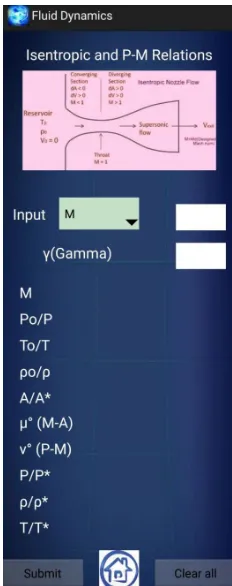
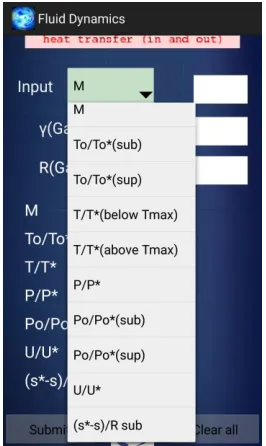
Figures 1 to 3 correspond to the user interface design of the app. After registration, the user is presented with a screen, as shown in Figure 1.
Figure 1: Snapshot of the screen showing the available formulations.
Figure 2: Snapshot of the screen after select-ing the desired formulation (“isentropic and PM relations” in this case).
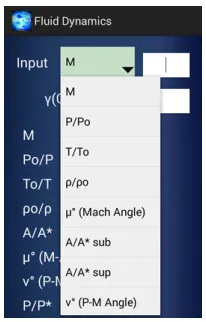
(a) Snapshot of possible inputs for “isentropic & PM relations”.
(b) Snapshot when input M=5 and γ = 1.5 are selected.
(c) Snapshot showing the out-put corresponding to Figure 3b
Figure 3: Series of snapshots depicting complete representation (from showing wide range of possible inputs to obtaining output data of “isentropic and PM relations”) for input M=5 and
γ = 1.5.
button (as shown in Figure 2), outputs as shown in Figures 3b and 3c respectively are presented to her . The user interface layout of the app is explained with the help of a flow chart in Figure 4.
3
Compressible Flows
In this section, we present an overview of gas dynamics formulations for pressure, temperature, and density ratios as a function of Mach number M, specific heat constant ratio γ, and local gas constantR(Please refer [10] for the derivations of these formulations). We solve these formulations in this app using JAVA based code programming for Android platform.
3.1
Isentropic Relations
Typically isentropic flows occur when the changes in the flow variables are small and gradual, leading to a reversible flow. A schematic diagram of the isentropic flow through a nozzle is shown in Figure 5. Equations (1) to (5) represent the isentropic relations between stagnation and static properties. Po P = ρo ρ !γ
= To
T
!γ/γ−1
(1)
To
T = 1 + γ−1
2 M
2 !
(2)
Po
P = 1 + γ−1
2 M
2 !γ−γ1
(3)
ρo
ρ = 1 + γ−1
2 M
2 !γ−11
(4) A A∗ !2 = 1 M2 " 2
γ+ 1 1 +
γ−1
2 M
2
!#((γγ−+1)1)
. (5)
These relations are derived using the energy conservation principle. As stated earlier, Figure 3a represents the user interface of the app. Here, the user can provide possible inputs for the isentropic and PM relations based on equations (1) to (5). For sonic condition, i.e., when M=1,
To
T = To
T∗,
Po
P = Po
P∗,
ρo
ρ = ρo
ρ∗. (6)
3.2
Prandtl
−
Meyer Expansion Fan Relation
In the expansion process of supersonic flows, a finite change in the flow direction generates Prandtl− Meyer central expansion fan. Across the expansion fan, the flow diverts away from itself. This is an isentropic process. This expansion fan consists of an infinite number of Mach lines. Equations (7) and (8) show the first Mach line and the last Mach line for the initial flow direction and the final flow direction respectively. This has been shown in Figure 6.
µ1(M) = sin-1
1
M1
Figure 5: Schematic diagram representing ideal flow through convergent-divergent noz-zle at choked condition.
Figure 6: Schematic diagram representing expansion fan with the first and last Mach angle µ1 and µ2 respectively.
µ2(M) = sin-1
1
M2
(8)
Equation (9) gives “Prandtl−Meyer function” which determines the angle through which a sonic flow must turn to reach the Mach numberM. Equation (10) shows the relation between the Mach numbers before and after the turn; and turn angle (θ).
ν(M) =
r
γ + 1
γ−1tan
-1 r
γ−1
γ+ 1(M
2−1)−tan-1√M2−1 (9)
θ =ν(M2)−ν(M1). (10)
If a supersonic flow is turned abruptly and the flow area decreases resulting in an irreversible flow, the isentropic relations are no longer valid. In this case, the flow is governed by the normal or oblique shock relations as discussed in the next section. Across a shock wave; the static pressure, temperature, and gas density increases almost instantaneously. However, there is a loss of total pressure associated with a shock wave.
3.3
Normal Shock Relations
A normal shock occurs in front of a blunt object if the flow is supersonic and turned by a large amount, and the shock cannot remain attached to the body. Normal shock is perpendicular to the direction of flow, as shown in Figure 7. Across the normal shock, the flow changes from supersonic to subsonic conditions. Equations (11) to (17) are derived by considering the conservation of mass, momentum, and energy for a compressible fluid as given in references [10, 11].
M22 = 1 + [(γ−1)/2]M
2 1
γM2
1 −(γ−1)/2
(11)
ρ2
ρ1
= U1
U2
= (γ+ 1)M
2 1
2 + (γ−1)M2 1
P2
P1
= 1 + 2γ
γ+ 1(M
2
1 −1) (13)
T2
T1
= P2
P1 !
ρ1
ρ2 !
(14)
s2−s1 =cpln
T2
T1
−RlnP2
P1
(15)
P02
P01
=e−(s2−s1)/R (16)
P02
P1
= P02
P2
P2
P1
. (17)
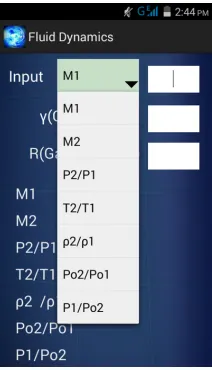
These equations are specialized for a one-dimensional flow assuming no heat exchange. Supersonic inlets and shock tubes are two examples where normal shocks generally occur. Figure 8 shows the user interface layout for the inputs and outputs for “normal shock relations”.
Figure 7: Normal shock perpendicular to the di-rection of upstream and downstream flow.
Figure 8: Possible inputs in Android app for “normal shock relations”.
3.4
Oblique Shock Relations
Figure 9: Supersonic flow past a two dimen-sional wedge generating oblique shock at an angle β (90◦> β > µ).
.
Figure 10: Flow direction with respect to upper half surface of fixed wedge.
Figure 11: Normal and tangential components of inclined flow across oblique shock.
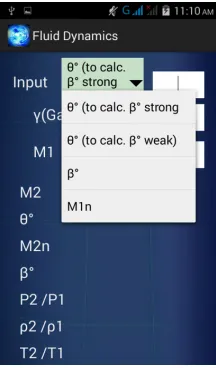
Figure 12: Possible inputs in Android app for “oblique shock relations”.
interface layout of the app is shown in Figure 12. It shows the possible inputs and outputs for the flow properties across the oblique shock based on equations (18) to (25).
Mn,1 =M1sinβ (18)
Mn,2 =M2 sin(β−θ) (19)
Mn,22 = 1 + [(γ−1)/2]M
2
n,1
γM2
n,1−(γ−1)/2
(20)
ρ2
ρ1
= (γ+ 1)M
2
n,1
2 + (γ−1)M2
n,1
(21)
P2
P1
= 1 + 2γ
γ+ 1(M
2
T2
T1
= P2
P1
ρ1
ρ2
(23)
tanθ= 2 cotβ M
2 1 sin
2β−1
M2
1(γ+ cos 2β) + 2
(24)
P02
P01
= P02
P2
P1
P01
P2
P1
. (25)
The app also calculates the shock wave-expansion fan interaction over the two dimensional dia-mond wedge inclined at an angleα(see Figure 13). The schematics of oblique shock and expansion fan over the diamond wedge are shown in Figure 14. We can see that the oblique shock waves are generated through the convergence angles θ1 and θ2 due to compression. On the other hand, the
expansion fans are generated through divergence angle β due to expansion. After passing through the expansion fans, flow further needs to pass through two more oblique shocks to align itself and to satisfy the flow properties in the back atmosphere. Given the flow upstream Mach number
M1, wedge angle θ, and inclination angleα; we calculate pressure, temperature and density ratios
across the diamond wedge.
For solving this problem analytically, we use a) equations (18) to (24) for calculating the flow properties across the shocks and b) equations (1) to (10) for calculating the flow properties across the expansion fan. Computing this problem mentally using pen-paper calculations is a tedious process which is prone to errors. Further, most of the standard university textbooks have limited examples which are insufficient to validate all analytical results corresponding to a wide set of problems and their inputs. In contrast, while solving this problem through Android app for the upper half of the wedge, we just need to enter known corresponding upstream Mach number M1
for oblique shock “a” at the leading edge. The app calculates downstream Mach number M2 for
this shock “a” which also acts as upstream Mach number for expansion fan “b”. With the help of isentropic relations as discussed above, the app provides downstream Mach numberM3 for this
expansion fan “b”, which also acts as an upstream Mach number for oblique shock “c”. Similarly, the Android app can be used to calculate Mach numbers M4 and M5 for the lower half of the
wedge. This procedure provides us Mach numbers at all flow conditions. Further, required data such as pressure ratio, temperature ratio, density ratio, etc. can be calculated as per the user requirement from app calculation. The app solves such complex problems quickly and provides robust solutions over a wide range of given inputs.
3.5
Fanno Flow Relations
Figure 13: Two dimensional diamond wedge problem inclined at an angle α.
Figure 14: Flow passing through four oblique shocks and two expansions waves.
Figure 15: Adiabatic flow through a constant area duct with frictional effect.
Figure 16: Supersonic flow through a constant area duct with frictional effect.
duct with a frictional effect where Fanno flow conditions are applicable. Equations (26) to (31) are derived and solved to describe Fanno flow relations with respect to the values at the choking location [10].
U U∗ =
ρ∗
ρ =M(γ+ 1)
1/2 "
2 1 + γ−1
2 M
2
!#−1/2
(26)
T
T∗ = (γ+ 1)
"
2 1 + γ−1
2 M
2 !#−1
(27)
P P∗ =
1
M(γ+ 1)
1/2 "
2 1 + γ−1
2 M
2
!#−1/2
(28) Po P∗ o = 1 M "
2 1 + γ−1
2 M
2
!#2(γγ−+11)
(γ+ 1)
−(γ+1)
2(γ−1) (29)
s−s∗
R =−ln
1
M
""
2 1 + γ−1
2 M
2
!#2(γγ−+11)
(γ+ 1)
−(γ+1) 2(γ−1)
#
(30)
4F L∗ D =
1−M2 γM2 +
γ+ 1 2γ ln
(γ+ 1)M2
2 1 + γ−21M2
To calculate the Fanno flow relations, the user interface layout of the app is shown in Figure 17. It shows all possible inputs and outputs for the flow properties calculated using equations (26) to (31) in the Fanno flow.
Figure 17: Possible inputs in Android app for “Fanno flow relations”.
Figure 18: Possible inputs in Android app for “Rayleigh flow relations”.
3.6
Rayleigh Flow Relations
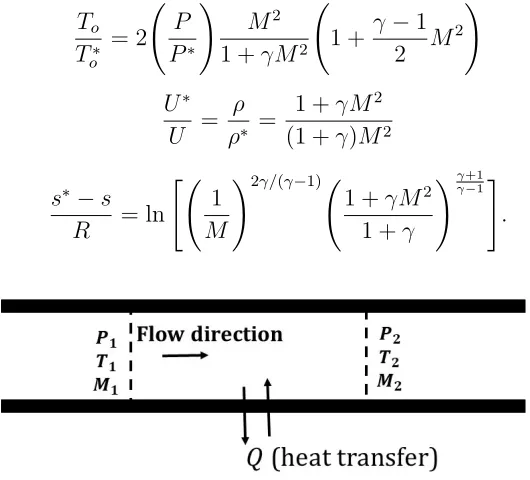
Rayleigh Flow refers to a non-adiabatic frictionless flow through a constant area duct where the effect of heat addition or rejection is considered, and no mass is added within the duct (see Figure 19). The resulting decrease in stagnation pressure (because of heat addition) is known as the Rayleigh effect. Heat addition leads to an increase in subsonic Mach number and decrease in supersonic Mach number such that these flow approach to Mach 1. Conversely, heat rejection decreases a subsonic Mach number and increases a supersonic Mach number along the duct. In reference [10], equations (32) to (37) are derived and solved to describe Rayleigh flow property ratios with respect to the values at the choking location. To calculate the Rayleigh flow relations, the user interface layout of the app is shown in Figure 18. It shows all possible inputs and outputs for the flow properties calculated using equations (32) to (37) in the Rayleigh flow.
P P∗ =
1 +γ
1 +γM2 (32)
Po
P∗ o
= 1 +γ
1 +γM2 "
2 1 + γ−1
2 M
2 !#γ−γ1
(γ+ 1)γ−−γ1 (33)
T T∗ =M
2 P
P∗
!2
Figure 19: Non-Adiabatic frictionless flow through a constant area duct with heat transfer.
3.7
International Standard Atmosphere (ISA) Relations
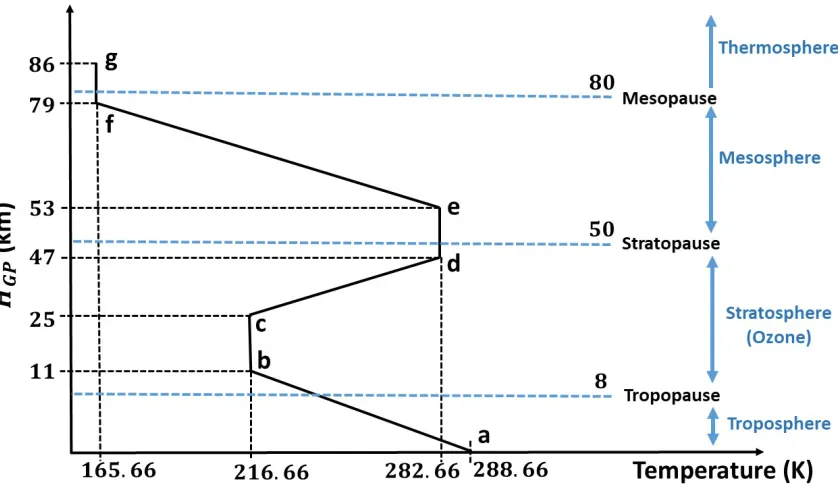
The earth’s atmosphere is a dynamically changing system. To model it, U.S. Air Force provided standard atmosphere relations in 1959. International Standard Atmosphere (ISA) is a static at-mospheric model of how the pressure P, temperature T, and densityρ of the Earth’s atmosphere change over a wide range of altitudes. The model comprises a number of standard definitions for the altitudes. The geometric altitude HG is the standard height above the mean sea level. The geopotential altitude HGP is calculated from a mathematical model that adjusts the altitude to include the variation of gravity with height. Figure 20 shows temperature distribution with respect to geopotential altitude. The relations applicable in various regimes of this atmospheric model are given by equations (38) to (45).
HGP =
R R+HG
!
HG (38)
g =go
R R+HG
!2
. (39)
For gradient layers,
T −Tb
HGP −Hb
= dT
dHGP
=a (40)
P Pb
= T
Tb
!−go/aR
Figure 20: Temperature distribution in standard atmosphere.
ρ ρb
= T
Tb
!−[(go/aR)+1]
(42)
T =Tb+a(HGP −Hb). (43)
For isothermal layers,
P Pb
=e(−go/RT)(HGP−Hb) (44)
ρ ρb
=e(−go/RT)(HGP−Hb). (45)
Table 1 corresponds to standard lapse rate and base values of temperature, pressure and density at different atmospheric regimes.
Range HGP (in km) a (in K/km) TB (in Kelvin) PB (in Pascals) ρB (in kg/m3)
a−b <11 -6.5 288.16 1.013×10⁵ 1.225
b−c 11-25 0 216.66 22700 0.3648
c−d 25-47 3 216.66 2527.3 0.0406
d−e 47-53 0 282.66 125.58 0.0015
e−f 53-79 -4.5 282.66 61.493 0.000758
f −g 79-86 0 165.66 1.2437 0.000022
Figure 21: Possible inputs in Android app for “International Standard Atmosphere (ISA) relations”.
Figure 22: Possible inputs in Android app for “moving normal shock relations”.
3.8
Moving Normal Shock Relations
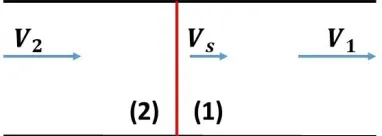
The app is able to calculate flow across moving normal shock waves which are generated in the shock-tube or by an explosion. We show the schematic diagram of moving normal shock in sta-tionary frame of reference in Figure 23. In this figure, the shock is moving with the velocity Vs.
V1 and V2 represent the upstream and the downstream flow velocity across moving normal shock
respectively. For the moving normal shock, we assumeU1 =Vs−V1 andU2 =Vs−V2. Substituting
these values in equation (12), we get
Figure 23: Moving normal shock (red) in sta-tionary coordinate system.
Figure 24: Moving normal shock (red) in moving coordinate system.
ρ2
ρ1
= Vs−V1
Vs−V2
= (γ+ 1)M
2 1
2 + (γ−1)M2 1
Both V1 and V2 are known parameters. Vs is the unknown shock velocity. We show the schematic diagram of moving normal shock in moving frame of reference with the shock in Figure 24. Given the upstream Mach number M1, temperature T1, and velocities V1 and V2, we calculate shock
speedVsfrom equation (46). Further, Equations (13), (14) and (46) are used to calculate pressure, temperature and density ratios across moving normal shock respectively. To calculate the flow properties across moving shock normal shock wave, the user interface layout for all possible inputs and outputs of the app is shown in Figure 22.
3.9
Pitot Tube Relations
A Pitot tube is a fluid flow measuring device, used to measure the airspeed of an aircraft. It consists of a tube pointing directly to the fluid flow. The moving fluid comes to a rest since there is no outlet for a continuous flow. The pressure corresponding to the stationary flow is called stagnation pressure of the fluid, also known as the Pitot pressure of the tube. The pressure corresponding to the flowing flow is called the static pressure of the flow. If the aircraft is flying at subsonic speed, we use isentropic flow condition across the Pitot tube. On the other hand, if the aircraft flies with a supersonic speed, then a normal shock stands in front of the tip of the Pitot tube. In this case, the procedure to calculate the airspeed becomes different giving rise to Rayleigh Pitot tube formulation. Both the formulations are described as follows. For subsonic flow, we use isentropic relations (see Figure 25), i.e., equation (3), and get
Figure 25: Subsonic flow : Pitot pressure is the free stream total pressure Po,1.
Figure 26: Supersonic flow : Pitot pressure is the total pressure behind a normal shock
Po,2.
P01
P1
= 1 + γ−1
2 M
2 1
!γ−γ1
=⇒ M12 =
2
γ−1
"
Po,1
P1 !γ−γ1
−1
#
(47)
U12 =
2a21 γ−1
"
Po,1
P1 !γ−γ1
−1
#
. (48)
For supersonic flow, where a normal shock occurs in front of the tip as shown in Figure 26, the Pitot tube measures the total pressure downstream of the shock and the downstream static pressure. Therefore, in order to get the upstream Mach number, we re-write the Pitot tube measurements in terms of the upstream flow variables as
Po,2
P = Po,2
P P2
(a) Snapshot after the selection of “Pitot tube” relations.
(b) Snapshot after the selection of “incompressible flow”.
(c) Snapshot after the selection of “compressible flow”.
Figure 27: Series of snapshots depicting complete representation for Pitot tube formulations for both compressible flow and incompressible flow.
4
Implementation of Numerical Methods
In this section, we discuss the numerical methods which we have implemented in this app to solve the semi-implicit formulations presented in the previous section. As an example we show the procedure to calculate the solution of equation (5) using Newton-Raphson method and equation (24) using Bisection method respectively within the app. These methods are further extended to calculate the solution for other implicit formulations in the “Fluid Dynamics” Android application.
4.1
Newton-Raphson Method
(5) is A A∗ !2 = 1 M2 " 2
γ+ 1 1 +
γ−1
2 M
2
!#((γγ−+1)1)
The above equation can be re-written as
f(M) =
"
2
γ+ 1 1 +
γ−1
2 M
2
!#2((γγ−+1)1)
−M A
A∗
!
= 0. (51)
For finding the roots of the functionf(M) of equation (51), the algorithm starts with an initial guess Mold and applies Newton-Raphson approach as
Mnew=Mold−
f(Mold) df
dM(Mold)
. (52)
For solving above equation (52), the algorithm calculates derivative of equation (51) as
df
dM(M) = A A∗ −
2
γ+ 1
!2(γγ−+11)
(γ−1)M 1 + γ−1
2 M
2
!2((γγ−+1)1)−1
. (53)
Using the initial guess Mold in equations (52) and (53), we get Mnew in the first step. As the procedure is having an iterative algorithm, we assign Mnew to Mold in the next step and repeat the above procedure which gives a better approximation for Mnew. The same process is repeated til convergence, i.e., til |Mnew−Mold| ≤10−6.
For finding the supersonic solution for equation (51), the initial guess is taken as M = 5, since this is the maximum possible supersonic Mach number. For finding the subsonic solution for equation (51), the initial guess is taken as M = 0.999, since this is the possible critical Mach number for subsonic solution. The selection of (A/A∗)sup and (A/A∗)sub in Figure 3a leads to supersonic and subsonic solutions respectively.
For any given problem, where A/A∗=5.5 and γ = 1.4 are known inputs, M = 3.2755 and
M = 0.1059 are displayed as supersonic and subsonic solutions respectively.
4.2
Bisection Method
Equation (24) represents the relation betweenθ,β and M. It is solved using the Bisection method which gives two solutions for solving wave (shock) angle. The higher and the lower values corre-spond to the strong and the weak shock solutions respectively. Therefore, two different inputs, “θ(to calculate β strong)” and “θ(to calculate β weak)” are provided as shown in Figure 12. De-pending on the input selected by the user, corresponding outputs are displayed.
Given the inputs; upstream Mach number M1, specific heat constant ratio γ and deflection angle
θ, app algorithm outputs wave(shock) angle β. Considering equation (24),
tanθ= 2 cotβ M
2
1 sin2β−1
M2
1(γ+ cos 2β) + 2
f(β) = tanθ−2 cotβ M
2
1 sin2β−1
If f(βs) is sufficiently small as per tolerance 10−6, i.e. |f(βs)| ≤ 10−6 then it is returned as the solution. If not, then we check whether
sign(f(βs)) == sign(f(β1)). (56)
If the above condition is true then we replace β1 with βs otherwise β2 is replaced with βs. The next iteration continues by taking mid point of the new range. The iterations continue till the required tolerance of 10−6 is achieved.
The number of iterations (N) required to converge to the root within this tolerance is given as
N =
ln β2−β1
10−6
!
ln 2 (57)
5
Results and Comparisons
In this section, we compare the results of the Android app with the data in references [14–16]. The results from the Android app and references are plotted as “App. Data” and “Ref. data” respectively. However, as stated earlier, γ varies from 1 to 1.67, and local gas constant R can also be chosen as per flow problem which ensures a wide range of variables for the app. Therefore, for the validation purpose, we useγ = 1.4 andR = 287 and compare the results against the literature. As discussed in Section 2, equations (1) to (37) are used to make these comparisons where Mach number is taken as input, and the corresponding outputs are plotted.
5.1
Isentropic Flows and Prandtl
−
Meyer Expansion Fan
In Figure 28, Mach number is plotted against To/T, Po/P and ρo/ρ using equations (2) to (4). Similarly, in Figure 29, Mach number is plotted against A/A∗ using equation (5). We find that the results obtained from the app are in very good agreement with the results given in the literature [14–16]. This validates that the implementations of the isentropic flows relations and the Prandtl− Meyer expansion fan relations in the app are correct. Also these results from the app are obtained in a fraction of second which shows that the algorithms written in the app are highly efficient.
5.2
Normal Shock Properties
In Figure 30, upstream Mach number M1 is plotted against downstream Mach number M2, and
temperature ratio T2/T1 using equations (11) and (14) respectively. Similarly, in Figure 31,
0 0.5 1 1.5 2
Mach number (M)
1 2 3 4 5 6 7 8 Isentropic properties Ref. T o /T App. T
o /T Ref.
o / App.
o / Ref. Po /P
App. P o /P
Figure 28: Isentropic relations for Mach number ranging from subsonic to super-sonic values.
0 0.5 1 1.5 2
Mach number (M)
0 5 10 15 20 25 30 A /A* Ref. data App. data
Figure 29: Geometric area to throat area ratio when flow is choked at throat for convergent-divergent nozzle.
total pressure ratio Po2/Po1 using equations (12), (13) and (16) respectively. We again find that
the results obtained from the app are in very good agreement with the results given in the liter-ature [14–16] which validates that the implementations of the normal shock relations in the app are correct. Also these results from the app are obtained in a fraction of second which shows that the algorithms written for the normal shock relations in the app are highly efficient.
1 2 3 4 5
Upstream Mach number (M
1) 0 1 2 3 4 5 6
Normal shock properties
Ref. M 2 App. M 2 Ref. T
2 / T1 App. T
2 / T1
Figure 30: Relation between upstream and downstream Mach numbers and temperature ratio for normal shock.
1 2 3 4 5
Upstream Mach number (M
1) 0 5 10 15 20 25 30
Normal shock properties
Ref. 2 / 1 App.
2 / 1 Ref. P
2 /P1 App. P
2 /P1 Ref. P
o2 /Po1 App. Po2 /Po1
Figure 31: Relation between upstream and downstream flow properties of pres-sure and density ratio for normal shock.
5.3
Oblique Shock Relations
In Figure 32, shock wave angle β is plotted against deflection angleθ for upstream Mach number
0 20 40 60 80 100 0
10 20
Figure 32: θ, β and Mach relation for oblique shock.
0 2 4 6
Mach number (M)
0 10 20
P /P
* , P
Figure 33: Static pressure ratios, to-tal pressure ratios and Mach number at sonic condition for Fanno flow.
5.4
Fanno Flow Relations
In Figure 33, Mach numberM is plotted against static pressure ratioP/P∗and stagnation pressure ratio Po/Po∗ at sonic condition using equations (28) and (29) respectively. In Figure 34, Mach number M is plotted against velocity ratio U/U∗ and temperature ratio T /T∗ at sonic condition using equations (26) and (27) respectively. Similarly, in Figure 35, Mach number M is plotted against Fanno parameter 4F L∗/D using equation (31). We find that the results obtained from
0 2 4 6
Mach number (M)
0 0.5 1 1.5 2 2.5
T /T
* , U /U
*
Ref. T /T* App. T /T* Ref. U /U* App. U /U*
Figure 34: Static temperature ratios, velocity ratios and Mach number at sonic condition for Fanno flow.
0 2 4 6
Mach number (M)
0 500 1000 1500 2000
4fl
* /D
Ref. 4fl* /D App. 4fl* /D
0 1 2 3 4 5 6 10-3
10-2 10-1 100 101 102 103
Figure 35: Fanno parameter and Mach number at sonic condition for Fanno flow.
that the implementations of the Fanno flow relations in the app are correct. Also these results from the app are obtained in a fraction of second which shows that the algorithms written for the Fanno flow relations in the app are highly efficient.
5.5
Rayleigh Flow Relations
In Figure 36, Mach number M is plotted against static pressure ratio P/P∗, static temperature ratio T /T∗ and stagnation temperature ratio To/To∗ at sonic condition using equation (32), (34) and (35) respectively. In Figure 37, Mach number M is plotted against stagnation pressure ratio
Po/Po∗ and velocity ratio U/U∗ at sonic condition using equation (33) and (36) respectively.
0 2 4 6
Mach number (M)
0 0.5 1 1.5 2 2.5 T /T
* , T
o
/
T o
* , P /P
*
Ref. T /T* App. T /T* Ref. T
o /To *
App. T o /To
*
Ref. P /P* App. P /P*
Figure 36: Correlation between static temperature ratios, total temperature ratios, static pressure ratios with Mach number at sonic condition for Rayleigh flow.
0 2 4 6
Mach number (M)
0 10 20 30 40 P o / P o
* , U /U
*
Ref. P o /Po
*
App. P o /Po
*
Ref. U /U* App. U /U*
Figure 37: Correlation between
to-tal pressure ratios, velocity ratios with Mach number at sonic condition for Rayleigh flow
We find that the results obtained from the app are in very good agreement with the results given in the literature [14–16] which validates that the implementations of the Rayleigh flow relations in the app are correct. Also these results from the app are obtained in a fraction of second which shows that the algorithms written for the Rayleigh flow relations in the app are highly efficient.
As shown above in all cases, the comparison between App data and Ref data (Figures 28 to 37) shows that “Fluid Dynamics” is accurate with an absolute error of 10−6; when Mach number,
γ = 1.4 and local gas constant R = 287 are taken as input. However, any possible combination of inputs produces results with similar accuracy in a fraction of seconds.
6
Conclusion
Author Contributions
A.G. conceived the idea of designing such a highly specific application for solving compressible flow formulation on the Android platform. S.S. and A.G. contributed to all phases of the project, from the design of the architectural framework of the Android application, to the implementation of the numerical methods and validation of the application results with benchmark. S.S., Y.G., and A.G. contributed significantly to the preparation of the submitted manuscript preceded by a number of brainstorming sessions.
Conflicts of Interest
There are no conflicts to declare.
Acknowledgements
Many thanks to ‘GATE Aerospace Forum Educational Services’ for their financial support. We also thank Komal Mehta for proof reading some part of the validation work.
References
[1] Mr Jared Rayleigh Wilson and Kurt C Gramoll. Viscous fluid dynamics app for mobile devices using a remote high per-formance cluster. age, 26:1, 2015.
[2] Kristine Dery, Darl Kolb, and Judith MacCormick. Working with connective flow: how
smartphone use is evolving in practice. European Journal of Information Systems, 23(5):558– 570, 2014.
[3] Vlad Oncescu, Dakota O’Dell, and David Erickson. Smartphone based health accessory for colorimetric detection of biomarkers in sweat and saliva. Lab on a Chip, 13(16):3232–3238, 2013.
[4] Chucri A Kardous and Peter B Shaw. Evaluation of smartphone sound measurement appli-cations. The Journal of the Acoustical Society of America, 135(4):EL186–EL192, 2014.
[6] Janine Morley, Kelly Widdicks, and Mike Hazas. Digitalisation, energy and data demand: The impact of internet traffic on overall and peak electricity consumption. Energy Research & Social Science, 38:128–137, 2018.
[7] L Saad. Nearly half of smartphone users can’t imagine life without it. gallup, 2015.
[8] Zachary Davies Boren. There are officially more mobile devices than people in the world. The Independent, 7, 2014.
[9] J Anderson. Research in supersonic flight and the breaking of the sound barrier. Retrieved September, 30:2009, 2001.
[10] SM Yahya. Fundamentals of compressible flow: SI units with aircraft and rocket propulsion. New Age International, 2003.
[11] Ashish Garg. Aerodynamics. GATE Aerospace Forum Educational Services, 2015.
[12] Edward M Greitzer, Choon Sooi Tan, and Martin B Graf. Internal flow: concepts and appli-cations, volume 3. Cambridge University Press, 2007.
[13] Shivam Singhal and Ashish Garg. Fluid dynamics: An android application. http://
gateaerospaceforum.com/download.php, December 2014.
[14] John David Anderson Jr. Fundamentals of aerodynamics. Tata McGraw-Hill Education, 2010.
[15] Genick Bar-Meir. Gas dynamics tables. Potto Project, 2007.