Tanaffos (2008) 7(3), 47-52
©2008 NRITLD, National Research Institute of Tuberculosis and Lung Disease, Iran
A New Sampler and Analysis Method for BTEX in
Ambient Air
Mansour R. Azari, Mohammad Reza Massoudi Nejad, Saeed Motesadi
School of Public Health, Shahid Beheshti University of Medical Sciences, TEHRAN –IRAN.
ABSTRACT
Background: Benzene, toluene, ethylbenzene and xylene (BTEX) compounds are components of motor vehicle fuel. BTEX
are released from exhausts of vehicles and also evaporation from the fuel tank, carburetor and crank case of engines. BTEX
are dangerous chemicals that participate in photochemical reactions and produce secondary air pollutants such as ozone,
peroxyacethyl nitrate, free radicals and nitrogen oxides. BTEX in ambient air of metropolitan areas has been the subject of
concern in many studies through elaborate "Environmental Protection Agency" (EPA) method. Level of BTEX in the ambient
air of major Iranian cities, has not been measured in concentration range of part per billion (ppbv) due to the inadequate
sensitivity of available gas chromatography systems. The aim of this study was to improve the sensitivity of gas
chromatography by using a special sampler and thermal desorber (Micro-Packed Injector).
Materials and Methods: Our sampler consisted of a 5-centimeter stainless steel tube one millimeter in diameter packed with
carbopacked B heat-conditioned samplers utilized for sampling atmospheric BTEX. It was subsequently injected to a
custom-made thermal desorber (225°C) which was assembled onto the injection port of a gas chromatography device for analysis.
Results: BTEX standard atmospheres were analyzed with a gas chromatograph flame ionization detector (GC-FID) with
linear range detection of 27.5-275ppb, 23.1-223.6ppb, 20-320-ppb, and 20-320ppb respectively.
Conclusion: The Micro-Packed Injector (MPI) installed on ordinary GC-FID improved linear range detection of BTEX from
previous ppm detection to ppb range. (Tanaffos 2008; 7(3): 47-52)
Key words: Micro-Packed Injector, Benzene, toluene, ethylbenzene and xylene (BTEX), Ambient Air, EPA
INTRODUCTION
Benzene, toluene, ethylbenzene and xylene (BTEX) are volatile organic compounds. Due to their toxicity and ambient air concentrations, they are regarded as significant air pollutants (1). In Canada, BTEX
Correspondence to: Azari M
Address: School of Public Health
Shahid Beheshti University of Medical Sciences
Email address: [email protected]
Received: 26 August 2007
Accepted: 26 June 2008
these compounds in motor vehicles (4,5). According to toxicological studies, all BTEX compounds are neurotoxins and irritants; however, "International Agency for Research on Cancer" (IARC) considers benzene and ethylbenzene as confirmed and probable carcinogens respectively (6-12).
Environmental concentrations of BTEX in the ambient air of major cities of the world have been studied using the EPA analytical method (13,14). A Japanese study group studied benzene concentration in the ambient air of Tehran and reported a concentration in the range of 15-187 ppb (15). Despite the sensitivity and specificity of the EPA method, the prescribed procedure requires elaborate sampling and double stage thermal desorption, gas chromatography and a mass detector (13). In Iran the only device for analyzing volatile organic compounds is ordinary gas chromatography, which can only analyze BTEX according to "Occupational Safety and Health Administration" (OSHA's method No.12) (16). OSHA's method does not require elaborate sampling and thermal desorption and is quite simple requiring sampling with activated charcoal and subsequent chemical desorption with 1ml carbon disulfide and subsequent injection of 1µl of extraction solvent into the GC-FID and has a detection target of 1ppm.
There are several articles suggesting a method for analysis of volatile organic compounds simpler than EPA's method (solid phase micro-extraction/gas chromatography/mass detection) (17). Another study suggested even a simpler method for sampling and analysis of volatile organic compounds such as pentane, by sampling with a micro-packed injector, and direct injection of samplers into GC injection port with subsequent thermal extraction (18).
Due to the unavailability of EPA's method in Iran and the need for detection capability for analysis of
BTEX in the ppb range, the aim of this study was to develop and validate the micro-packed injector method for analysis of BTEX in ambient air.
MATERIALS AND METHODS
Benzene, toluene, ethylbenzene and xylene (Ortho, Para and Meta with 99%+ HPLC grade) were purchased from Sigma-Alderich (Milwaukee, WI). Ultra pure air (hydrocarbon free air) was obtained from Air Products Co. (Long Beach Calif.).
Materials: Air sampling Tedlar bags (1, 5 and 10L) were used for standard preparation (SKC Co.). Two inch steel tubes (1 mm diameter) were made from stainless steel and luer-lock syringes (5, and 10ml) were also obtained from Hamilton Co. (Los Vegas, Nevada).
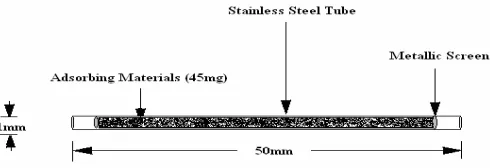
Selection of Adsorbing Materials for Micro Packed Injector: Carbopack B which is compromised from Carbotrap B/Carbosieve S3 and is capable of adsorbing C6-C12 (19) was purchased from Suppelco Co.(Milwaukee, Ohio). Five centimeter tubes were filled with adsorbing materials under strong suction vacuum. Both ends of the needle were closed with a piece of fiber glass or steel screen with the support of a piece of 1mm diameter tube with a finer gauge (Figure 1). Sampling tubes were heat conditioned at 225°C in an oven overnight prior to usage. Generally, all constructed sampling tubes were kept in an oven (225°C) when they were not in use.
Preparation of Standard Atmosphere: Stock standards of benzene, toluene, ethylbenzene and xylene(para, ortho and meta) were prepared by injecting a known volume of pure liquid (BTEX) into a fixed volume of the hydrocarbon-free air (HCFA) in cleaned Tedlar bags washed five times with HCFA (20). The volume of HCFA in the bags was measured according to the flow of air by a clean flow meter and time of flow. After heating and ruffling stock bags containing (BTEX), they were used for preparation of standard atmospheres. Standards were prepared by diluting stock standard gases with HCFA. Concentration range of mixed standards was 27.5-275ppb, 23.1-223.6ppb, 20-320-ppb, 20-320ppb and 20-320 ppb for benzene, toluene, ethylbenzene, xylene(m,p) and xylene(o) respectively. To all standard atmospheres in Tedlar bags (containing 10L of HCFA) 2ml of pentane with a density of 1.252µg/ml was added as an internal standard.
Sampling from the bags containing BTEX standard atmospheres with MPI sampler: Break through volume of the micro-packed injector sampler (Figure 1) was examined by serial connection of two MPI samplers (21). In this study the volume of sampling was limited to 10 liters and Tedlar bags containing standards were sampled at a flow of 50 ml/min.
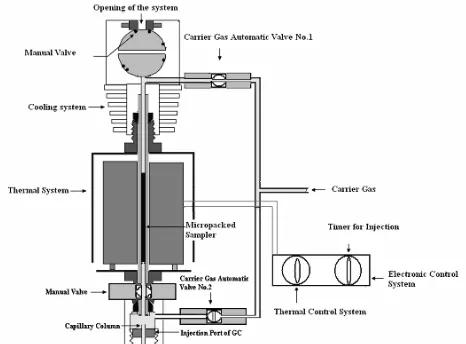
Extraction of BTEX in standard atmospheres from MPI sampler: MPI samplers were injected into the custom made thermal desorber (Figure 2) and were heated at 225°C for 5 minutes and washed by flow of carrier gas with direct injection in a gas chromatography device with injection time of 10 seconds into the capillary column of GC.
Analytical Instrument Parameters: Non-polar capillary column (Polydimethylsiloxane) with a length of 25 meters was chosen for separation of BTEX compounds (22). Shimatzu-17A gas
chromatograph equipped with flame ionization detector was employed for experimental analysis in this study. Capillary column flow of pure N2 carrier gas was set at 2.0 ml/min. Oven temperature was initially programmed at 65°C for 4.5 minutes and temperature was increased at the rate of 30°C/min to 150°C and held constant for 2 minutes in order to cleanse the column from residual BTEX compounds. Flow of hydrogen gas, air, carrier gas and FID temperature was optimized for analysis of BTEX.
Determination of Hydrocarbon Elution Times: Separate standard atmospheres of benzene, toluene, ethylbenzene, xylene(m,p), xylene(o), pentane and mixed standards were prepared as described and were injected directly into the gas chromatography device and retention time of each analyte was obtained and peaks of mixed standards were identified according to their retention times.
Figure 2. Custom made thermal desorbing device for thermal extraction of MPI sampler.
RESULTS
linear range, precision, and limits of detections are presented in Table 1. Linear range of benzene, toluene, ethylbenzene, xylene(m,p) and xylene(o) standards were in the ranges of 27-270ppb, 23-230ppb, 20-23-230ppb, 20-230ppb and 20-230 ppb, respectively.
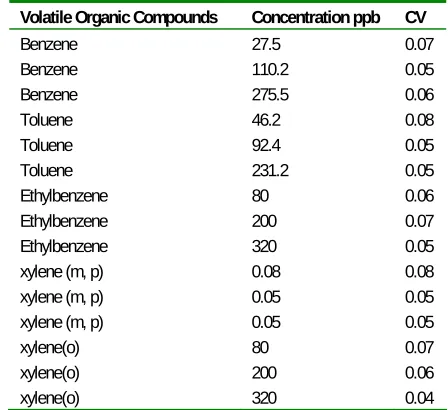
Analytical Precision and Limit of Detection. Coefficient of variation of measurements of benzene, toluene, ethylbenzene, xylene(m, p) and xylene(o) through extraction by MPI is shown in Table-1. Maximum CV for the measurement of benzene, toluene, ethylbenzene, xylene(m, p) and xylene(o) at room temperature was less than 7%. The detection limit of benzene was 5ppb and detection limit for toluene, ethylbenzene, xylene(m, p) and xylene(o) was 3ppb. Limits of detection were calculated from lowest concentrations of standards that produced peaks area 3 times more than background peaks.
Figure 3. Representative chromatogram of BTEX
Table 1. Linear range, precision and limits of detection
BTEX Standards Linear concentration
Range (ppb) r2
Regression formula
Benzene 27.5-275 0.998 1.288X-0.0709
Toluene 23.1-231 0.995 1.322X-0.1001
Ethylbenzene 20-320 0.995 1.509-0.2449
Xylene (m,p) 20-320 0.989 1.492X-0.2318
Xylene(o) 20-320 0.996 1.534X-0.3614
b-Precision coefficient of variation (CV) of BTEX standards analysis
Volatile Organic Compounds Concentration ppb CV
Benzene 27.5 0.07
Benzene 110.2 0.05
Benzene 275.5 0.06
Toluene 46.2 0.08
Toluene 92.4 0.05
Toluene 231.2 0.05
Ethylbenzene 80 0.06
Ethylbenzene 200 0.07
Ethylbenzene 320 0.05
xylene (m, p) 0.08 0.08
xylene (m, p) 0.05 0.05
xylene (m, p) 0.05 0.05
xylene(o) 80 0.07
xylene(o) 200 0.06
xylene(o) 320 0.04
DISCUSSION
BTEX are volatile compounds and prominent toxic air pollutants which have been studied in many metropolitan cities (7-9). Measurement of BTEX air pollutants have been addressed by the Iranian Department of Environment; however, the analytical technology for detection of ppb concentration range has not been available so far.
its detection is remarkable and reported to be less than 1ppb (17). In Iran the only applicable method is the OSHA's method, which can not be applied for environmental analysis. Therefore, a method by Azari et al.(18) was improvised and modified for environmental detection of BTEX in this study. According to the results obtained for the Micro-Packed Injector system coupled with GC-FID, the linear range for analysis of BTEX is in the range of environmental detection (20-320ppb). The validity of the proposed set-up comprising a micro-packed injector coupled with GC-FID was superior to OSHA's method in terms of percentage of recovery and close to analytical set-up of double-stage thermal desorber coupled to GC (14). Reproducibility of the proposed method is also comparable to other methods (13 and 16). Sensitivity of the new set-up (micro-packed injector coupled with GC-FID) is far better than OSHA's method with a detection limit of 5 ppb for benzene and 3 ppb for toluene, ethylbenzene and xylene isomers; however, the new method presented in this study, does not match the EPA's sensitivity (16).
The cost of analysis of BTEX in the USA by EPA's and OSHA's methods is about 400 and 80 dollars respectively (23). Application of MPI in third world countries can upgrade the performance of ordinary GC for environmental and occupational analysis in ppb range concentrations, specially because OSHA has reduced permissible exposure limit of benzene to 100ppb (24). The new method of analysis can also reduce the cost of analysis of BTEX by heat reactivating samplers up to 20 samplings and also by not requiring carbon disulfide for desorption of sampled BTEX and independent-sorbent tube sampler for each sampling .
REFERENCES
1. Field R. A., Goldstone M. E., Lester J. N., and Perry R. The sources and behavior of tropospheric anthropogenic volatile hydrocarbons. Atmos Environ 1992; 26A: 2983-96.
2. Sevigney J (2002). Human health Risk Assessment at
gasoline contaminated sites. AIHA Symposium.
3. Rappenglück B, Oyola P, Olaeta I, Peter Fabian. The
Evolution of Photochemical Smog in the Metropolitan Area of Santiago de Chile. Journal of Applied Meteorology 1998; 39(3): 275-90.
4. Ching-Chang L, et al. Exposure assessment on organic
volatile compounds (VOCs) for Tollway station workers via
direct and indirect approaches. Journal of Occupational Health 2002; 44: 294- 300.
5. Wallace L. Major sources of exposure to benzene and other volatile organic chemicals. Risk Anal 1990; 10: 59- 64. 6. ATSDR. (1992). Toxicological Profile for Toluene. Agency
for Toxic Substances and Disease Registry, U.S. Public
Health Service, U.S. Department of Health and Human Services, Atlanta, GA.
7. Dean BJ. Recent findings on the genetic toxicology of
benzene, toluene, xylenes and phenols. Mutat Res 1985; 154 (3): 153- 81.
8. Hayes RB, Yin SN, Dosemeci M, Li GL, Wacholder S,
Travis LB, et al. Benzene and the dose-related incidence of hematologic neoplasms in China. Chinese Academy of Preventive Medicine--National Cancer Institute Benzene Study Group. J Natl Cancer Inst 1997; 89 (14): 1065- 71.
9. Lynge E, Andersen A, Nilsson R, Barlow L, Pukkala E,
Nordlinder R, et al. Risk of cancer and exposure to gasoline vapors. Am J Epidemiol 1997; 145 (5): 449- 58.
10.Rinsky RA, Young RJ, Smith AB. Leukemia in benzene
workers. Am J Ind Med 1981; 2 (3): 217- 45.
11.IARC (1987). Benzene. In: Overall Evaluations of
Carcinogenicity: an updating of selected IARC. Monographs on the Evaluation of Carcinogenic Volumes 1 to 42. 12.Sorahan T, Kinlen LJ, Doll R. Cancer risks in a historical UK
13.US EPA Compendium Method TO-14A, 1997. Determination of volatile organic compounds (VOCs) in ambient air using specially prepared canisters with subsequent analysis by gas chromatography.
14.Tilson Air Quality (2000). Final report on the air quality monitoring program. Volume I. Summary of ambient air quality monitoring program Manitoba Conservation August 10.
15.Japan International Cooperation Agency (1997). The study on an integrated master plan for air pollution control in the greater Tehran area (final report). Japan Weather Association. Unicom International Corporation, 63-4.
16.OSHA (1990). Analytical Method of Manual. Department of labor, Occupational Safety and Health Administration Directorate for Technical. Evaluation Branch, Salt Lake City OSHA Analytical Laboratories, 12-1 -12-21.
17.Tumbiolo S, Gal JF, Maria PC, Zerbinati O. Determination of benzene, toluene, ethylbenzene and xylenes in air by solid phase micro-extraction/gas chromatography/mass spectrometry. Anal Bioanal Chem 2004; 380 (5-6): 824- 30.
18.Azari M, Que Hee Sh. Development of a New Method for Sampling and Analysis of Biomarker of Lipid Peroxidation in Exhaled Breath. Tanaffos 2002; 1(4): 51-59.
19.Sigma-Aldrich.com/Supelco(2002). The Reporter. Volume 20.2 . SUPELCO ● Supelco Park, 595 North Harrison Road, Bellefonte, PA 16823-0048.
20.SKC. Operating instructions, Sample bags 231 Series.
Technical service department, www.skc inc.com.
21.Wang J-L, Chen Lin Y-H and Tsai. Retention volumes of adsorbing materials. Journal of chromatography A 2000; 896: 31-9.
22.SGE. Characteristics of SGE GC Stationary phases of
Capillary Column. WWW.SGE.COM
23.Health Science Associates. Analysis fee schedule. AIHA accredited Industrial hygiene laboratory. AIHA Accreditation No.:172 NVLAP Accreditation No.: 101384. www.healthscience.com.
24.OSHA (1988). Permissible Exposure Limit OF Benzene