Please cite this article as: A. Sarlak, H. Saeedmonir, C. Gheyratmand, Numerical and Experimental Studying of Soil-structure Interaction in Structures Resting on Loose Soil Using Laminar Shear Box, International Journal of Engineering (IJE), TRANSACTIONS B: Applications Vol. 30, No. 11, (November 2017) 1654-1663
International Journal of Engineering
J o u r n a l H o m e p a g e : w w w . i j e . i rNumerical and Experimental Study of Soil-structure Interaction in Structures Resting
on Loose Soil Using Laminar Shear Box
A. Sarlak, H. Saeedmonir*, C. Gheyratmand
Department of Civil Engineering, Faculty of Engineering, Urmia University, Urmia, Iran
P A P E R I N F O
Paper history: Received 10 July 2017
Received in revised form 02 September 2017 Accepted 08 September 2017
Keywords:
Soil-structure Interaction Nonlinear Dynamic Analysis Shaking Table Tests Laminar Shear Box
A B S T R A C T
In the present work, the effect of Soil-Structure Interaction (SSI) in low frequency structures resting on loose soil, through numerical modelling and shaking table tests have been studied. In theoretical studies two types of models namely fixed base and flexible base structure were subjected to three selected earthquake records. Nonlinear dynamic analysis was employed for all of the numerical models. Geometrical and material nonlinearities were considered in all models and finite element method was used for soil modelling. To verify the outputs of the numerical modelling, shaking table tests were carried out. For experimental tests, scaled form of the main structure according to scaling laws, and laminar shear box as a container of the soil, was built. By comparison between the numerical modelling and the shaking table tests results, good agreement was observed. Therefore, the numerical modelling approach was validated. In next step by implementing this approach, comparison between the fixed base and the flexible base results was carried out. In this study, it was demonstrated that considering the SSI effects on structures resting on loose soils increases the lower story drifts. Besides if the structure is located in sites which is susceptible to experience strong earthquakes, this increase is dominant. Therefore negelecting SSI effects leads to unsafe design of the structure.
doi: 10.5829/ije.2017.30.11b.05
1. INTRODUCTION1
1. 1. Soil Structure Interaction Investigating the SSI phenomenon is one of the challenging problems in dynamic analysis of structures. Considering fixed base, which is the custom and simplified assumption in analyzing the structures, is not always true. This assumption may impose many uncertainties in the numerical modelling of the structures. There are several methods for modelling semi-infinite soil media, known as Winkler beam method, Lumped parameter method and finite element method (FEM). In Winkler method the soil media is replaced by a system of independent, closely spaced and linear elastic springs. In Lumped parameter method the soil media is substituted with three transitional and three rotational springs which are attached to the foundation. To consider soil damping in any of these six degrees of freedom, dashpots can be
*Corresponding Author’s Email: [email protected] (H. Saeedmonir)
added. For Lumped parameter method, Wolf [1]
developed simple and applicable cone model
average or secant of shear modulus and damping ratio is used and in the next analysis these values are varied. This process continues until the values are consistent with the level of the strain induced in the soil [5]. In fully nonlinear method, by integrating the equation of motion in small time steps, nonlinear stress-strain can be used. Nonlinear inelastic stress-strain relationship of soil can be followed in a set of incrementally linear steps through using cyclic stress-strain models such as hyperbolic model, modified hyperbolic model, etc. [5]. Hosseini and Pajouh [6], showed the superiority of the fully nonlinear method over the equivalent-linear method. They applied a comparative study between equivalent-linear and fully nonlinear method, to estimate the dynamic site responses for 4 different sites. The results showed that for each of the sites, the amplitude of acceleration response spectra obtained in nonlinear method is smaller than linear one and the equivalent linear analysis estimates maximum acceleration larger than the observed records.
During the past decades many researchers inspected the SSI effects on structural responses. Gazetas and Maylonakis [7] stated that considering SSI effects will reduce the stiffness and the natural frequency of the soil-structure system, therefore the responses will be different from fixed base state. Dutta et al. [8] studied seismic SSI effects in buildings. They applied cone model to consider supporting soil effects, and equivalent linear method for analyzing the structures. Dutta et al. [8] showed that considering SSI effects will increase the seismic base shear of the low-rise buildings. However, for mid-rise and high-rise buildings the amount of this change is relatively lesser. Azarbakht and Ashtiany [9] applied nonlinear static analysis for 3-story braced building, for both fixed and flexible base states. They compared the outputs with static analysis results. They showed that ignoring SSI effects in linear static analysis of braced or high-frequency buildings, will result in conservative design of foundations in these structures. Tavakoli et al. [10], using cone model for considering supporting soil effects and equivalent linear method for analyzing the structure showed that, as the soil under the structure gets softer, the necessity of considering SSI effects becomes more important. They also showed that the SSI could be neglected for regular flexible buildings resting on rock or stiff soils.
1. 2. Shaking Table Tests In order to verify the results of the numerical simulation, experimental modelling is usually implemented. Shaking table is a device for producing any kind of dynamic loadings in laboratory. The considered structure in the laboratory could be subjected to the variety of loadings such as harmonic, time history, etc. These loadings could be continued under controlled circumstances until desired capacity of the structure is achieved. For experimental
study of SSI phenomenon, soil region under the structure which is the semi-infinite media, must be limited. This limited volume is filled in a container and the container is placed on the shaking table. There are three kinds of containers known as: rigid container, flexible container and laminar container or laminar shear box. Rigid containers are the simplest one, in which the walls of the container are absolutely rigid. Yan and Byrne [11] for studying bearing capacity of footings on sandy soils applied some numerical simulations along with the series of model footing tests in laboratory. Their container was a rigid container and had a cylindrical shape. To predict the load-settlement response of the footings, they applied linear FEM analysis in their numerical modellings. By confining soil in a rigid container, the rigid walls will affect the dynamic response of the soil, therefore free-field condition at the boundaries cannot be simulated [12]. The main drawback of the rigid containers is associated with the reflection of the earthquake energy inside the finite volume of the container [13]. Flexible container is made of several frames which are mounted on each other, through using rubber between successive frames, the frames can have relative movements. Meymand [14] used a cylindrical flexible container in his shaking table tests for studying the nonlinear soil-pile-structure interaction in soft clay. Lu et al. [15] studied seismic behavior of a 12-story building considering SSI. They applied numerical simulation along with a series of shaking table tests. The building was a 12-story reinforced concrete frame structure. They used FEM for modelling soil media and equivalent linear method for analyzing soil-structure system. The flexible container was used to verify the numerical outputs. The results of their study showed that FEM modelling is suitable for dynamic SSI problems. Tabatabaiefar and Mansoury [16] studied the SSI phenomenon in tall buildings. They applied FEM for modelling soil-structure system and fully nonlinear method for analysis. They used a flexible container to verify the numerical results. In designing flexible container, since the containers and the soils stiffness must be matched together, the rubber layers thickness must be carefully selected. This is a restrictive feature of the flexible container, because in a certain level of excitations due to the high deformation of the soil mass, the soil stiffness will be reduced and it couldn’t be matched to the stiffness of the container any more [17].
bidirectional LSB for dynamic analyses on loose sandy soil. Applying equivalent linear method in numerical modelling, and by comparison between the test results and numerical results, Jafarzadeh [13] showed that the need for using the LSB increased by decreasing the soil density. Guoxing et al. [19] used the LSB for empirical study of damage mechanism for an embedded structure. The desired structure was 3-story subway station embedded in a soft soil experiencing strong ground motion. They also applied numerical simulation in which, FEM for modelling soil-structure system was chosen and fully nonlinear analysis was carried out. By comparison between test results and numerical outputs it was concluded that the adopted numerical simulation method, was satisfactory. The main aspects of previous studies are as follow:
Fully nonlinear analysis method for seismic studies of SSI effects on structures was rarely implemented.
Finite element modelling of supporting soil was often not used.
SSI effects in soft soils were more dominant. The LSB for empirical study of seismic SSI effects
is the best choice.
The aim of this paper is to study numerically and experimentally the SSI effects in a low frequency, 8- story building, resting on a loose soil. Numerical simulations of two types of models namely, fixed base and flexible base structure are carried out. FEM for modelling soil media and fully nonlinear method, for analyzing the soil-structure system, have been adopted. For all models, nonlinear dynamic analysis considering geometrical and material nonlinearities is implemented. For experimental tests LSB is applied. Scaled form of the structure (model structure) according to scaling laws is built. The framework of this paper is as follows:
In the first part of this paper the design process of casting the model strcuture and the LSB, is elaborated. In the second part, the numerical simulation results are verified with the shaking table tests results. In the last part, a comparison between seismic responses of fixed base and flexible base structures in numerical modelling is carried out.
2. MATERIALS AND METHODS
2. 1. Scaling Laws The main structure (called prototype structure) is an 8-story steel frame building with 2263-ton mass and 0.243 (Hz) frequency. This sturcture is rested on a loose sandy soil with shear wave velocity equal to 100 m/s. The soil beneath the prototype structure is Firoozkouh sand (No.161). For empirical study of SSI phenomenon, scaling laws must be considered. According to the scaling laws there are relations between structural characteristics of the
prototype structure and that of the model structure. Rocha [20] was the first one who inspected scaling laws in soil mechanic problems. He stated that a linear relationship for both stress and strain, between model and prototype must be considered. Moncarz and Krawinkler [21] showed that the necessary condition for experimental modelling of the dynamic SSI is as Equation (1):
(𝑉𝑠)𝑝
(𝑉𝑠)𝑚= √𝜆 (1)
in which subscription p and 𝑚 denote prototype and model, respectively and 𝜆 is geometrical scaling factor. The above well-known expression is called “Cauchy condition”. Iai [22] extracted a set of relations for soil-structure system. He showed that in these systems the following equation must be satisfied:
𝜆𝜀=
𝜆
((𝑉𝑠)𝑝
(𝑉𝑠)𝑚)
2 (2)
in which 𝜆𝜀= 𝜀𝑝
𝜀𝑚 . Meymand [14] showed that holding
both Cauchy condition and 𝜆𝜀 = 1 are sufficient
condition satisfying scaling laws in dynamic soil-structure interaction systems. He added that the density of the model and the prototype structure must be identical and the natural frequency of the prototype should be scaled. Therefore, in this paper, Meymand relations are adopted and will be used. Meymand relations are shown in Table 1:
2. 2. Dimensions of the LSB The main factor in determining dimension of the LSB is the capacity of the shaking table. The shaking table of Urmia university has single degree of freedom and its platform has rectangular shape with 3 m × 2 m dimensions. Its payload capacity is 2200 kg. The functional frequency of the shaking table is 0.1 to 10 (Hz). The LSB dimensions depends on the dimension of the finite soil media in numerical modelling and also the scale factor. In this study FEM modelling has been applied and as a result, extracted dimensions of this modelling were used for obtaining scaling factor and dimensions of the LSB. An important factor in FEM modelling of soil-structure systems is dimensions of the soil media. Rayhani and Nagger [23] inspected the effects of soil media dimensions on soil responses and structural behaviors.
TABLE 1. Meymand scaling law relations [14]
Mass density 1 Acceleration 1 Length 𝝀
Force 𝜆3 Shear wave velocity
𝜆1⁄2 Stress 𝜆
Stiffness 𝜆2 Time
𝜆1⁄2 Strain 1
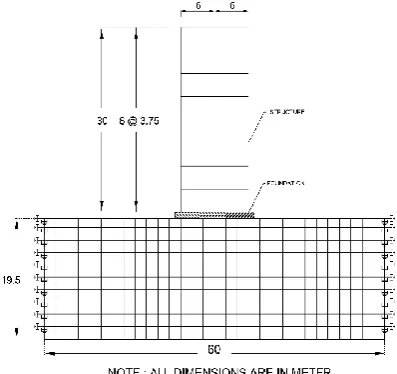
They studied soils with various range of shear wave velocities. Their study included numerical modelling along with the series of centrifuge shaking table tests. They applied a fully nonlinear analysis method for analyzing the soil-structure system. The numerical results were verified with the test results and a good agreement was observed. Therefore, the numerical modelling approach was validated. By implementing this approach for modelling soil-structure systems with different soil media sizes, and for soils with various shear wave velocities (especially those in which, Vs < 180 m/s) they concluded that the minimum dimensions of the soil media in earthquake direction must be 5 times of width of the structure. They also showed that increasing this value will not affect the results significantly. They recommended 30 meters as the maximum depth of the finite soil media. In the current study, the result of the work done by Rayhani and Nagger [23] is applied. Therefore, 60 meters as the dimension of the soil media in earthquake direction and 19.5 meters for soil depth has been adopted in FEM model. To sum up previous discussion, the model shown in Figure 1 is the adopted finite element model of the prototype soil-structure system.
2. 3. Scaled soil-structure System Scaling factor (𝜆) for this study was selected 30, thus according to Figure 1 soil mass dimensions of the prototype structure become 2 m × 1 m × 0.65 m. Considering 1500 kg/m3 as a density of dry sand, the mass of the soil will be 1950 kg. Since maximum payload of the shaking table is 2200 kg, decreasing the scale factor is not possible and also by increasing the scale factor the accuracy of the output results will be decreased. Therefore, it could be inferred that the selected scaling factor is the best choice.
Figure 1. Finite element model of the prototype structure
2. 4. Cast of LSB The desired LSB was made of aluminum, by this selection the mass of the LSB would be decreased which resulted in decreasing the ratio of container to soil mass. Outer dimensions of the container were 2.04 m × 1.04 m × 0.66 m and the container was made of 15 rigid rectangular frames. Two type of profiles were used to build frames, profile (1) and profile (2). Two wood plates with dimensions 2 m × 1.25 m × 0.02 m were placed on the shaking table. This plates were attached to the shaking table via 20, 14 mm diameter screws. First frame which was made of profile (2), was a fixed frame. This frame was attached to the wooden plate through 36, 2 mm diameter screws. As it can be noticed in Figure 2 there are 4 guiding columns, closely spaced around the container. Those which are parallel to the rectangle length, are somehow bigger.
Their function is transferring weight of each frame to the shaking table. This is done using system of linear bearing and hollow rods. There are 4 linear bearings attached to the guiding columns on each frame level. This system allows frames to move freely and also there is a 4 mm gap between each two successive frames, so that frames could have relative movements without any friction. The function of other guiding columns is to prevent excessive displacement of the container during the vibration of the shaking table.
2. 5. Test Preparation A model structure consists of a soil-structure model and LSB which must be located on the shaking table. According to the scaling laws, the density of the model soil and the prototype soil must be identical [14]. Therefore, the applied soil in the tests is the same as the prototype soil and it is Firoozkouh sand (No.161). Before pouring soil inside the LSB a latex sheet is placed inside the LSB to prevent soil from exiting through the layers during the tests. The container was filled with the sand and the model structure was placed on top of the sand and in the center of the LSB. According to the dimensions of the prototype structure and the scaling factor (𝜆 = 30), the dimension of the 8-story model structure was 1 m × 0.4 m × 0.4 m. Using Meymand scaling law relations, the frequency and the mass of the desired model structure is obtained. Equation (3) exists between the frequency of the model and the prototype structure:
𝑓𝑚
𝑓𝑝= √𝜆
(3)
Therefore, having 0.243 (Hz) as the frequency of prototype structure, the frequency of the model structure is obtained:
𝑓𝑚= √𝜆 𝑓𝑝 ⇒𝑓𝑚= √30 (0.243) = 1.33 (𝐻𝑧)
Again using Meymand scaling law relations, the densities of the model structure and porotype structure are identical:
𝜌𝑚= 𝜌𝑝 (4)
According to the mass and the dimensions of the prototype structure we have:
𝜌𝑚=
2263000 𝑘𝑔
(30)(12)(12)𝑚3= 523.84
𝑘𝑔
𝑚3
⁄
As a result, the mass of the model structure is obtained as follows:
𝜌𝑚= 𝜌𝑝= 523.84 ⇒ 523.84 =
𝑚𝑚 𝑚𝑣
𝑚𝑚= 83.8
Therefore, the desired and qualified model structure must have following characteristics:
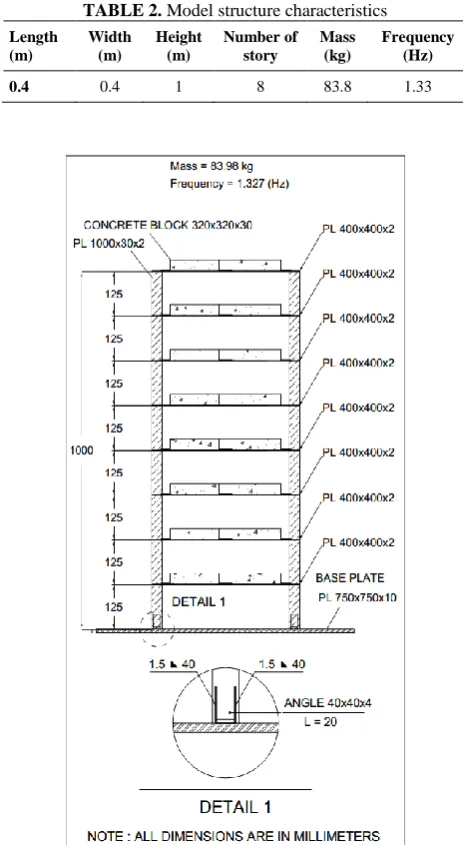
2. 6. Cast of the Model Structure The desired model structure is made of steel; by implementing many cycles of trial and error of modelling the structure in
ETABS software, the model structure showed in Figure 3 satisfied the requirements listed in Table 2.
As it can be seen, a lumped mass equal to 7.750 kg is mounted on each story level. Applying these additional masses will assist reaching the desired mass and frequency in the model structure. According to Figure 3 and the dimensions, the mass of the columns and the floors will be 0.471 and 2.512 kg, respectively. Therefore, the total mass of the model structure is as follows:
4 (0.471) + 8 (2.512) + 8 (7.750) = 83.98 kg
There is a base plate with 0.75 m × 0.75 m dimensions, which has not any effect on seismic mass and frequency of the structure.
TABLE 2. Model structure characteristics
Length (m)
Width (m)
Height (m)
Number of story
Mass (kg)
Frequency (Hz)
0.4 0.4 1 8 83.8 1.33
Through modelling this model structure in ETABS software, it was observed that the frequency of this model structure is equal to 1.327 (Hz) which is quite acceptable.
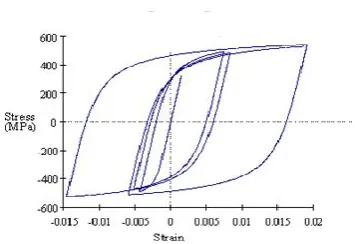
2. 7. Numerical Simulation Numerical model consists of soil-structure system which was modelled in FLAC2D software. Fully nonlinear method has been employed for analyzing the soil-structure system. Both geometrical and material nonlinearities have been considered. For considering material nonlinearities in structural members,cyclic stress-strain curve of steel as shown in Figure 4 was applied. For routine engineering design, using an approximate representation of cyclic energy dissipation is mandatory. In FLAC2D, the choice is between Rayleigh damping and hysteretic damping. Through using hysteretic damping algorithm, strain-dependent modules and damping function are incorporated directly into the FLAC2D. Modulus degradation curves, imply a nonlinear stress/strain curve [24]. In Figure 5 hysteresis stress-strain relationship for a soil are given. For applying fully nonlinear method, the actual path of the hysteresis loop is needed. By applying hysteretic damping algorithm, the actual degradation in value of the shear modulus and the damping ratio can be considered. Masing rule is implemented in the formulation of the hysteretic damping algorithm in FLAC2D [24]. In the present study, the model presented by Hardin and Drenvich [25] is applied for considering hysteretic damping. This model is shown in Equation (5):
G G𝑚𝑎𝑥 =
1 1+ 𝛾
𝛾𝑟𝑒𝑓
(5)
In which 𝛾 is cycle shear strain. Hardin and Drenvich model and corresponding 𝛾𝑟𝑒𝑓 are defined in FLAC2D.
The value of the 𝛾𝑟𝑒𝑓 for sandy soils, has been
considered 0.06 in FLAC2D. By implementing Hardin and Drenvich model and the corresponding 𝛾𝑟𝑒𝑓 value,
the program will produce the desired modulus degradation curve.
Figure 4. Steel stress-strain curve
Figure 5. Soil stress-strain curve
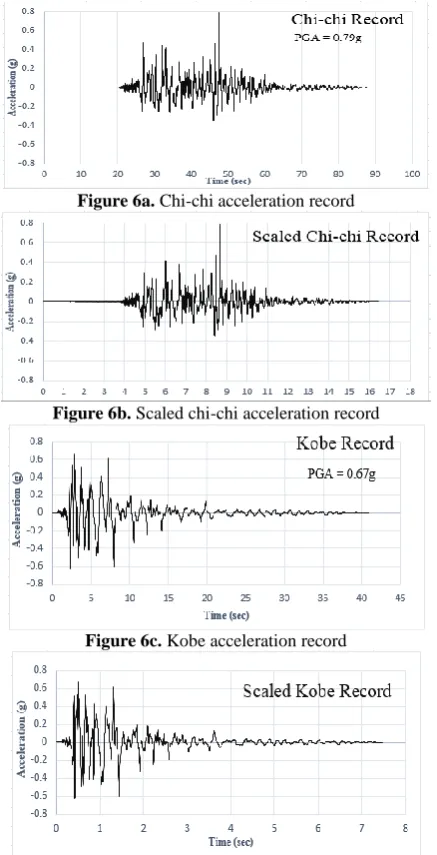
As it was mentioned earlier, to prevent reflection of the earthquake wave back into the finite soil media, viscous boundaries are implemented. The Lysmer and Kuhlemeyer [26] dashpots in normal and tangential direction of the vertical boundaries of the soil media are applied as viscous boundaries. In order to apply the nonlinear time history analysis, 3 selected earthquake records have been chosen. 4 factors are involved in selection of the earthquake records, which are: magnitude, significant time duration, PGA and near and far fault earthquakes. All of the selected earthquake records must have magnitude greater than 6.5. The magnitude of Chi-chi, Kobe and Loma prieta earthquake records are 7.62, 6.9 and 6.93, respectively. The significant time duration of all of the selected records must be greater or equal to 10 seconds. As it can be noticed in Table 4, this condition is satisfied for the selected records. The PGA of three selected records are different values in which, the differences between these values are notable. Therefore, the PGA of these records could be classified in three levels of maximum, average and minimum. At least one of the selected records must be from a near fault earthquake and one must be from far fault earthquakes. Chi-chi record is near fault earthquake and Kobe and Loma prieta records are far fault earthquakes. The characteristics of the selected records are summarized in Table 4.
2. 8. Tests In order to verify numerical modelling results, shaking table tests were applied. During these tests, experimental model consisting of the LSB and soil–structure system, totally were located on the shaking table and subjected to the selected earthquake records.
TABLE 4. Selected earthquake records characteristics
Name Country Depth
(km) PGA (g)
Significant Duration (s)
Chi-chi Taiwan 8 0.79 28.55
Kobe Japan 17 0.67 10
In order to obtain displacement of the top level of the model structure, during the tests, a LVDT was used and it was attached to the tip of the model structure. Figure 7 shows the overall soil-structure system on the shaking table which is ready for testing. For applying the earthquake records scaling laws must be considered. According to Table 1, in a particular record, the value of the acceleration will not be changed and just the time duration will be affected. Adopting 𝜆1/2 as a relation
between time in the model and the prototype, therefore time steps of Chi-chi and Loma prieta earthquake records which were 0.005 (s) will change to 0.000912 (s) and the time step of Kobe earthquake which were 0.01 (s) will change to 0.001825 (s). Original and scaled records are shown in Figures 6a to 6f.
Figure 6a. Chi-chi acceleration record
Figure 6b. Scaled chi-chi acceleration record
Figure 6c. Kobe acceleration record
Figure 6d. Scaled Kobe acceleration record
Figure 6e. Loma prieta acceleration record
Figure 6f. Scaled Loma prieta acceleration record
Each test was repeated for three times, the average of the obtained values from LVDT was considered as the top level displacement of the model. The results of the shaking table tests for three selected earthquake records, and also the results of the numerical modelling for both states of the fixed base and the flexible base are shown in Figure 8. As it could be noticed, there is a good agreement between numerical results with the shaking table test results and maximum error of 4.8% was observed which is acceptable. Thus the adopted numerical modelling and analyzing approach for the soil-structure system in this study is quite reliable and it could be used for evaluating the behavior of the structure in both states of the fixed base and the flexible base.
3. RESULTS AND DISCUSSION
The results of the numerical modelling of 8-story steel frame structure, resting on a loose soil for both states of the fixed base and the flexible base are exhibited. These models were subjected to Chi-chi, Kobe and Loma prieta earthquakes. Figure 9 shows that considering the flexible base in comparison with the fixed base will result in decreasing base shear of the structure.
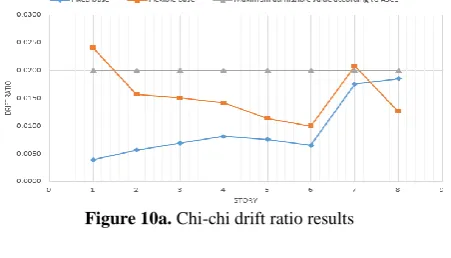
This degradation is 11.6, 19.8 and 19% for Chi-chi, Kobe and Loma prieta earthquake respectively. Thus it could be noticed that shear base degradation for Chi-chi earthquake, which has greater PGA and longer significant time duration, was lesser. In Figures 10a to 10c story drifts and also maximum admissible of this value according to ASCE [27], has been depicted. According to ASCE, the maximum story drift ratio is restricted to 0.02. As it can be noticed ignoring SSI effects has significance influence on story drifts values. The remarkable point in these figures is about differences between the story drift values in bottom story levels. For Chi-chi earthquake, the ratio of the flexible base story drift to the fixed base, for 3 bottom stories is 6.14, 2.77 and 2.17, respectively. For Kobe earthquake this portion for 2 bottom stories is 1.96 and 1.13, respectively. For Loma prieta earthquake the value of this portion for first bottom story is 1.98. Since performance of the steel moment-frame structures is closely related to the story drift (FEMA-350 [28]), thus it is clear that neglecting SSI effects will impose many uncertainties to structural analysis and will lead to incorrect design of the structure. In a similar study done by Tababtabaiefar et al. [29], the difference between story drift values for fixed and flexible base structure in lower stories, was observed. A prototype structure in Tababtabaiefar et al. [29] work was a 15-story steel frame structure with 953-ton mass and 0.384 (Hz) frequency. This structure was resting on a clayey soil with shear wave velocity equal to 200 m/s. The structure was subjected to 4 selected earthquake records which were: Kobe, Northridge, El Centro and Hachinohe. The PGA of these earthquake records are: 0.833 (g), 0.843 (g), 0.349 (g) and 0.23 (g), respectively. The ratios of the flexible base story drift to the fixed base for stories 3, 5, 7 are exhibited in Table 5. As it can be noticed in Table 5, increase in story drift in lower stories is obvious. The PGA of Chi-chi earthquake in this study is close to the PGA of Kobe and Northridge earthquake in Tababtabaiefar et al. [29] work, but it is obvious that increase in story drift ratio in flexible base state, in this study is greater. PGA of Loma prieta earthquake in this study is also close to PGA of El Centro earthquake in Tababtabaiefar et al. [29] work. Again it can be noticed (at least for first story) that increase in story drift ratio in flexible base state, in this study is greater. This could be due to the fact that the 8-story structure (this study) in comparison with the 15-story structure (Tababtabaiefar et al. [29]) which is heavier and also has lower frequency, is resting on looser soil. Therefore, it can be concluded that the destructive effects of SSI for heavy and low frequency structures resting on loose soils are dominant. In Figure 8, increasing the top level displacement of the structure due to considering SSI is observed. This amplification is about 94.7, 64.5 and 81.2% for Chi-chi, Kobe and Loma prieta earthquake,
respectively. Again it is clear that destructive seismic effects in Chi-chi earthquake is dominant. A notable point here is the differences between Kobe and Loma prieta. In that, although having greater PGA, the amplification in the top level displacement of Kobe is lesser than Loma prieta, which originates from the differences in significant time duration.
Figure 8. Top level displacement, the results of numerical
modelling and shaking table tests
Figure 9. Base shear outputs of numerical modelling for the
Fixed base and the Flexible base modells
Figure 10a. Chi-chi drift ratio results
Figure 10c. Loma prieta drift ratio results
TABLE 5. Flexible to fixed base story drift for lower stories
[29]
Story Kobe Northridge Elcentro Hachinohe
3 1.25 1.61 1.43 1.4
5 1.07 1.26 2.5 1.33
7 1.11 1.5 2.47 1.2
4. CONCLUSION
In this paper, the effects of the SSI on seismic responses of the low frequency structures, resting on loose soil were investigated. Numerical simulation, by applying fully nonlinear analysis method and FEM in FLAC2D was carried out. A LSB was built in order to apply a series of shaking table tests to verify the outputs of the numerical modelling. From designing point of view considering the SSI effects has two results. The first result is decreasing the base shear of the structure which is advantageous and the second result is increasing the displacements of the structure which is regarded as a defect. Through this study it was demonstrated that for structures resting on loose soils and susceptible to experience strong ground motions like Chi-chi earthquake, the positive aspect of the SSI is lesser and the negative aspect is more. In this study it was shown that ignoring the SSI effects may significantly affect the story drifts of the structure. It was demonstrated that considering SSI effects for low frequency structures, resting on loose soils, increases the lower story drifts. Besides if the structure is located in sites which are susceptible to experience strong ground motion, like Chi-chi earthquake, this increase in lower story drifts is more dominant.Since the story drifts are used in design of the structures in performance based design, thus relying on the story drifts obtained from fixed base analysis, will lead to incorrect and unsafe design of the structure. Therefore, considering SSI effects for structures resting on loose soils and prone to experience strong earthquakes is avoidable.
5. REFRENCES
1. Wolf, J.P., "Simple physical models for foundation dynamics", Developments in Geotechnical Engineering, Vol. 83, (1998), 1-70.
2. Dutta, S.C. and Roy, R., "A critical review on idealization and modeling for interaction among soil–foundation–structure system", Computers & Structures, Vol. 80, No. 20, (2002), 1579-1594.
3. Roesset, J.M. and Ettouney, M.M., "Transmitting boundaries: A comparison", International Journal for Numerical and Analytical Methods in Geomechanics, Vol. 1, No. 2, (1977), 151-176.
4. Kocak, S. and Mengi, Y., "A simple soil–structure interaction model", Applied Mathematical Modelling, Vol. 24, No. 8, (2000), 607-635.
5. Kramer, S.L., "Geotechnical earthquake engineering prentice hall", New York, (1996).
6. Hosseini, S.M.M.M. and Pajouh, M.A., "Comparative study on the equivalent linear and the fully nonlinear site response analysis approaches", Arabian Journal of Geosciences, Vol. 5, No. 4, (2012), 587-597.
7. Gazetas, G. and Mylonakis, G., "Seismic soil-structure interaction: New evidence and emerging issues", (1998), 1119-1174..
8. Dutta, S.C., Bhattacharya, K. and Roy, R., "Response of low-rise buildings under seismic ground excitation incorporating soil–structure interaction", Soil Dynamics and Earthquake Engineering, Vol. 24, No. 12, (2004), 893-914.
9. Azarbakht, A. and Ashtiany, M.G., "Influence of the soil‐ structure interaction on the design of steel‐braced building foundation", in Aip Conference Proceedings, AIP. Vol. 1020, (2008), 595-601.
10. Tavakoli, H., Naeej, M. and Salari, A., "Response of rc structures subjected to near-fault and far-fault earthquake motions considering soil-structure interaction", International Journal of Civil and Structural Engineering, Vol. 1, No. 4, (2011), 881-896.
11. Yan, L. and Byrne, P.M., "Application of hydraulic gradient similitude method to small-scale footing tests on sand", Canadian Geotechnical Journal, Vol. 26, No. 2, (1989), 246-259.
12. Fishman, K., Mander, J. and Richards, R., "Laboratory study of seismic free-field response of sand", Soil Dynamics and Earthquake Engineering, Vol. 14, No. 1, (1995), 33-43. 13. Jafarzadeh, B., "Design and evaluation concepts of laminar shear
box for 1g shaking table tests", in Proceedings of the 13th world conference on earthquake engineering, Vancouver, paper. (2004).
14. Meymand, P.J., "Shaking table scale model tests of nonlinear soil-pile-superstructure interaction in soft clay, University of California, Berkeley, Vol. 1, (1998).
15. Lu, X.-l., Li, P.-z., Chen, Y.-q. and Chen, B., "Shaking table model testing on dynamic soil-structure interaction system", in Proc., 13th World Conf. on Earthquake Eng., (2004).
16. Tabatabaiefar, H.R. and Mansoury, B., "Detail design, building and commissioning of tall building structural models for experimental shaking table tests", The Structural Design of Tall and Special Buildings, Vol. 25, No. 8, (2016), 357-374.
17. Dietz, M. and Muir Wood, D., "Shaking table evaluation of dynamic soil properties", in Proceedings of 4th international conference on earthquake geotechnical engineering., (2007).
sandy deposit with structure", in Proceedings of the Tenth World Conference on Earthquake Engineering., (1992), 1897-1903.
19. Guoxing, C., Su, C., Xi, Z., Xiuli, D., Chengzhi, Q. and Zhihua, W., "Shaking-table tests and numerical simulations on a subway structure in soft soil", Soil Dynamics and Earthquake Engineering, Vol. 76, (2015), 13-28.
20. Rocha, M., "The possibility of solving soil mechanics problems by the use of models, Laboratório Nacional De Engenharia Civil., (1958).
21. Moncarz, P.D. and Krawinkler, H., "Theory and application of experimental model analysis in earthquake engineering, Stanford University, Vol. 50, (1981).
22. Iai, S., "Similitude for shaking table tests on soil-structure-fluid model in 1g gravitational field", Soils and Foundations, Vol. 29, No. 1, (1989), 105-118.
23. Rayhani, M. and El Naggar, M.H., "Numerical modeling of seismic response of rigid foundation on soft soil", International Journal of Geomechanics, Vol. 8, No. 6, (2008), 336-346.
24. Itasca Consulting Group, “FLAC2D: Fast Lagrangian Analysis of Continua, version 6.0, User’s manual”, Minneapolis, (2008). 25. Hardin, B.O. and Drnevich, V.P., "Shear modulus and damping
in soils: Design equations and curves", Journal of Soil Mechanics & Foundations Division, Vol. 98, No. sm7, (1972). 667-672.
26. Lysmer, J. and Kuhlemeyer, R.L., "Finite dynamic model for infinite media", Journal of the Engineering Mechanics Division, Vol. 95, No. 4, (1969), 859-878.
27. ASCE/SEI 7-10, ASCE standard., "Minimum Design Loads for Buildings and other Structures", American Society of Civil Engineers, (2006).
28. F.E.M.A., Recommended seismic design criteria for new steel moment frame buildings. 2000, FEMA-350, SAC Joint Venture Washington, DC.
29. Tabatabaiefar, S.H.R., Fatahi, B. and Samali, B., "Numerical and experimental investigations on seismic response of building frames under influence of soil-structure interaction", Advances in Structural Engineering, Vol. 17, No. 1, (2014), 109-130.
Numerical and Experimental Study of Soil-structure Interaction in Structures Resting
on Loose Soil Using Laminar Shear Box
A. Sarlak, H. Saeedmonir, C. Gheyratmand
Department of Civil Engineering, Faculty of Engineering, Urmia University, Urmia, Iran
P A P E R I N F O
Paper history: Received 10 July 2017
Received in revised form 02 September 2017 Accepted 08 September 2017
Keywords:
Soil-structure Interaction Nonlinear Dynamic Analysis Shaking Table Tests Laminar Shear Box
ديكچ ه نیارد شهوژپ رثا شنکردنا کاخ هزاسو یارب هزاس ،نییاپ یشاعترا سناکرف اب ییاه هک یوررب کاخ تسس رارق ،دنراد هب تروص کیروئت و دروم یهاگشیامزآ یسررب رارق هتفرگ تسا . لدم یاه یددع لماش ود هتسد یم دنشاب : هزاس اب رتسب بلص و هزاس اب فاطعنارتسب ،ریذپ هک یگمه تحت هس دروکر هلزلز بختنم رارق دنتفرگ . لیلحت یکمانید ریغ یطخ یوررب یمامت لدم یاه یددع تروص .تفریذپ لدم یمامت رد یطخ ریغ راتفر اه
.دش روظنم داوم یطخریغ راتفر و یسدنه هب روظنم یزاسلدم کاخ زا شور ازجا دودحم هدافتسا دیدرگ . هب روظنم جیاتن ییامزآ یتسار یزاسلدم ،یددع تاشیامزآ زیم هزرل ماجنا دش . ،یهاگشیامزآ لدم هزاس رب ساسا نیناوق مکاح رب سایقم یدنب هتخاس دش . هبعج یشرب هیلا یا یارب ندرکروظنم کاخ رد یاهلدم یهاگشیامزآ زیم
هتخاس ،هزرل دش . هسیاقم جیاتن یزاسلدم یاه یددع و تست یاه یهاگشیامزآ دیوم قابطنا لوبق لباق اهنآ یم دشاب . هلحرم رد .دش هتخانش ربتعم هتفرراک هب یددع یزاسلدم شور هجیتن رد
هرهب اب دعب قم ،یددع یزاسلدم تهج شور نیا زا یریگ هسیا نیب لدم یاه کیروئت ود هزاس( هزاس هتسد یاه اب رتسب بلص و هزاس یاه اب رتسب فاطعنا .تفریذپ تروص )ریذپ رد نیا قیقحت ناشن هداد دش هک شنکردنا رثا ندرک روظنم هجیتن رد
هزاس یارب هزاس و کاخ یم شبازفا یناتحت تاقبط تفیرد ،دنراد رارق تسس کاخ یور هک ییاه
.دبای دروم رد شیازفا نیا
هزاس دعتسم ،رتسب کاخ ندوب تسس رب هولاع هک ییاه هبرجت
هلزلز یاه یم زین دیدش هزادنا هب ،دنشاب
هدیدان هک تسا یا
رثا نتفرگ شنکردنا کاخ و ریغ یحارط هب رجنم هزاس یم هزاس نمیا
.ددرگ
![TABLE 1. Meymand scaling law relations [14]](https://thumb-us.123doks.com/thumbv2/123dok_us/204067.2014689/3.595.309.543.675.746/table-meymand-scaling-law-relations.webp)