A b s t r a c t. The objective of this paper is to present a method for determining diurnal distribution of the intensity of effective non rainfall water flux. It was found that the application of TDR technique for the determination of diurnal dynamics of effective non rainfall water flux requires temperature correction of sensed volumetric moisture contents. Without temperature correction the error of estimated non rainfall water flux can be as much as 26%. In addition, the effect of temperature changes on the soil surface was determined in 0.5, 1, 2, 3, 4, and 5 hours periods. It was found that the intensity of effective non rainfall water flux was determined to the greatest extent by the rate of temperature drop during the period of 3 h preceding the non rainfall water flux determination. The agreement of non rainfall water flux calculated with the method proposed and that obtained by the collector was better for dew than for hoarfrost periods.
K e y w o r d s: TDR technique, effective non rainfall water flux, impermeable barrier
INTRODUCTION
Knowledge of the physical processes that affect the ef-ficiency of water infiltration into the surface horizon of soil is important in the formulation of input data for mathe-matical models describing the movement of water (Jacobset al., 2002; Reinhard and Reinhard, 2005). Knowledge of the run of processes of that type is important, as water is a source of nutrients for animals and plants (Kidron, 2005; Kolevet al., 2012). In such considerations one should take into account the role of dew, hoarfrost, condenzation of water vapour contained in the soil air, and adsorption of water
from the atmosphere. In regions with arid climate the effect of those processes on the water balance of the top horizon of soil may be greater than that of atmospheric precipitation (Agam and Berliner, 2006). As an example, the contribution of dew and hoarfrost in the annual water balance of the sur-face horizon of soil in a semi-desert area situated in Nevada, USA, amounts to 31 mm year-1(Maleket al., 1999). With regard to the phenomena considered here, the contemporary methods for the determination of the diurnal dynamics of the intensity of water infiltration can be classified in four groups: methods consisting in measurements with the use of dew and hoarfrost collectors, lysimetric methods, models em-ploying empirical mathematical formulae, and phenomeno-logical models.
The first group includesegthe Duvdevani dew gauge, the Cloth Plate Method and the Hiltner Dew Balance. The Duvdevani dew gauge is one of the first devices for the measurement of the dew balance (Duvdevani, 1947). The measured volume of dew deposit should be treated as an estimate and it cannot be compared with absolute values. The Cloth Plate Method is also a method in which the mea-surement is taken manually. The apparatus is equipped with a glass plate with dimensions of 10 x 10 x 0.2 cm, to the centre of which highly absorbing synthetic fabrics are at-tached, with dimensions of 6 x 6 cm (Kidron, 1998). In their study, Zangvil and Druian (1980) applied the Hiltner Dew Balance for dew measurement. In this case, the measure-ment consists in weighing an artificial condenzation plate Int. Agrophys., 2014, 28, 23-37
doi: 10.2478/intag-2013-0024
TDR technique for estimating the intensity of effective non rainfall
Grzegorz Janik
1, Wojciech Skierucha
2, Marek B³aœ
3, Mieczys³aw Sobik
3, Ma³gorzata Albert
1,
Micha³ Dubicki
1, and Anna Zawada
11
Institute of Environmental Protection and Development, Wroc³aw University of Environmental and Life Sciences, Pl. Grunwaldzki 24, 50-363 Wroc³aw, Poland
2
Institute of Agrophysics, Polish Academy of Sciences, Doœwiadczalna 4, 20-290 Lublin, Poland
3
Department of Earth and Environmental Sciences, University of Wroc³aw, Kosiby 8, 51-621 Wroc³aw, Poland Received March 19, 2013; accepted November 26, 2013
© 2014 Institute of Agrophysics, Polish Academy of Sciences *Corresponding author e-mail: [email protected]
A A
suspended on a beam 2 cm above the ground. The short-coming of that simple and easy to use device is the fact that the energy balance of the condenzation plate is different from the balance of the soil surface. This is due to the difference between the specific heat of the material of the plate and the specific heat of the soil material. Therefore the values measured can also be treated as a certain indicator (Agam and Berliner, 2006). The second group of methods comprises measurements made with the use of lysimeters of very high accuracy. They were appliedegin a study con-ducted in Greece, under semi-arid conditions, for quantita-tive determination of water vapour adsorption by soil (Kosmaset al., 1998). The results obtained indicate that the diurnal changes in volumetric moisture are the greatest in the top horizon of the soil (0-5 cm) and are subject to variation in an analogous manner to the diurnal variation of the relative humidity of the air. A similar experiment was conducted in 1997, also in Greece, in the locality of Spata (Kosmaset al., 2001). In that case, due to significant diurnal variations of temperature (the amplitude was as much as 24.3°C), a temperature correction was applied to the rea-dings taken by means of a TDR apparatus (as in the study by Yamanakaet al., 2007). In studies conducted in the Negev Desert (Jacobset al., 1999; 2002) it was demonstrated that the diurnal dew balance was from 0.1 to 0.2 mm, and its effect was limited only to 2, 3 cm layers of soil. In another study conducted also in the Negev Desert it was demon-strated that for dew measurement the minimum depth of micro-lysimeters should exceed the depth at which the diurnal temperature of the soil is constant (Bryœ and Bryœ, 2010; Ninari and Berliner, 2002). The micro-lysimeters designed by Heusinkveld et al. (2005) and applied by Kasekeet al.(2011) are fully automated (LCM) and sup-plied with solar energy. Studies conducted in the winter period in Stellenbosch, South Africa, involved the use of an aluminium Tedea-Huntleigh 1004 loadcell. It was demon-strated that the diurnal adsorption of water vapour (average of 2.369 mm) had a three-fold larger contribution to the supply of the surface horizon of soil than the dew yield (mean of 0.785 mm).
The third group of methods comprises mathematical formulae, in which the difficulty of finding effective solutions results from the necessity of determining a large number of input data (Agam and Berliner, 2006; Li, 2002; Richards, 2002). A study by Kosmaset al.(1998) presented an empiri-cal formula in which the input data included the adsorption of water vapour (mm), soil moisture tension (kPa), mini-mum daily relative humidity (%), and the daily amplitude of relative humidity.
The fourth group includes phenomenological modelsie such in which the phenomenon of non-rainfall is described by means of mathematical relations between physical va-lues. Due to the complexity of the phenomenon of the forma-tion of dew and water vapour condenzaforma-tion, the use of such
models is difficult. As in the case of the empirical models, it is necessary to introduce a lot of input data characterising the soil medium, information on the changing atmospheric conditions, and to determine the status of the soil water. As an example, in a comprehensive mathematical model described in a paper by Katataet al. (2007), the input data include the soil temperature (K),the thermal conductivity (W m-1K-1), the latent heat of vaporization (J kg-1),the phase changes of soil water (kg m-2s-1),the volumetric soil water content (m3m-3), the soil water diffusivity (m2s-1),the unsaturated hydraulic conductivity (m s-1),the density of liquid water (kg m-3),the diffusion coefficient of water vapour (m2s-1),and the den-sity of water vapour (kg m-3). At present, both of those ap-proaches – the empirical and the phenomenological – are criticized (Agam and Berliner, 2006).
Summing up the review of the four groups of methods used so far for the determination of effective non rainfall water flux (ER) it should be concluded that each of them is burdened with shortcomings. In the methods involving the use of collectors the energy balance of the condenzation pla-tes differs from the balance of the soil surface. In lysimetric tests the structure of the soil is disturbed, and there appear interferences caused by the boundary effect. There is also a risk of appearance of interference between phenomena (water from an overgrown monolith can be transmitted by the plants to the atmosphere and at the same time dew can be deposited on the soil surface, supplying its top horizon with moisture). Also, we do not know the answer to the question what part of the water remains on the surface of the soil or plants and what part actually supplies the surface horizon of the soil (Ermich, 1958). In lysimetric experiments it is difficult to ascertain whether the surface horizon of the soil has been supplied with water from dew deposition on the soil surface or as a result of water vapour condenzation. Methods employing empirical mathematical formulae, and phenomenological models, require numerous input data.
The objective of the present study was to propose a me-thod which is free of the above shortcomings and permits the determination of the diurnal distribution of the intensity of effective non rainfall water flux. Effective non rainfall water flux is understood as the volume of water which actually supplies the surface horizon of soil, in the form of dew, hoar-frost, deposition of fog, condenzation of water vapour from the soil air, and adsorption of water from the atmosphere. The only input parameters required for the proposed method will be the moisture content and temperature of the soil surface horizon.
MATERIALS AND METHODS
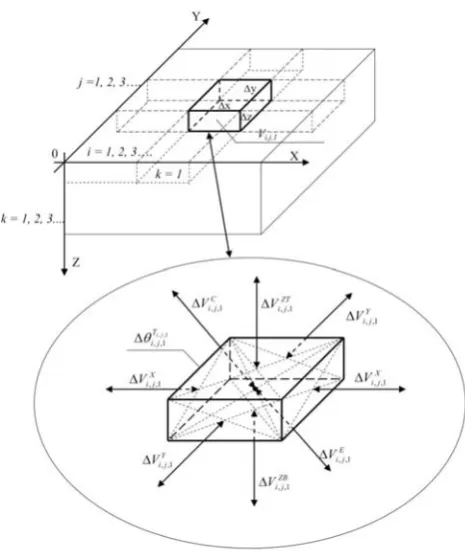
moisture content ofDqDi j, ,Vi j1, ,1 and a temperature change of the measured medium (Skierucha, 2009). This can be written as:
DqTDRi j
, ,1=D D
D T
qi jVi j qi ji j , , , , , , , , 1 1 1 1
+ , (1)
where:DqTDRi j, ,1– change of the reading from the TDR gauge, DqDi j, ,Vi j, ,
1 1
– actual change of volumetric moisture,DqTi j, ,i j, ,11– change of reading caused by temperature change (DTi j, ,1).
Changes ofDqDi j, ,Vi j1, ,1are caused by water flow through the side walls of spaceVi j V V
i j X
i j Y
, ,1(D , ,1;D , ,1)and also through the upper and lower surfaces ( ; )
, , , ,
DV DV
i j ZB
i j ZT
1 1 .
A change ofDqDi j, ,Vi j1, ,1can be caused also by draining water from plant roots ( )
, , DV
i j E
1 . In addition, due to the cooling of the soil air, water vapour condenzation may appear on the surface of soil pores, which can also cause an increase in the volume of soil water content (DV
i j C
, ,1). Change ofD
D
qi j, ,Vi j, , 1
1
results from an error introduced by the instrument itselfieits short- or long-term thermal drift, non-linearity of the delay system, inaccuracy of determination in time of the extremes on the reflectogram. Ultimately we can write, in confor-mance with Fig. 1, that changes ofDqTDRi j, ,1are the function of the following values:
DqTDRi j D D D D
i j X i j Y i j ZB i j ZT
f V V V V
, ,1= ( , ,1; , ,1; , ,1; , ,1;DVi j, , ; E
1
DVi jC, ,1;Dqi jT, ,i j, ,11), (2) where: symbols as in Fig. 1.
Let us assumeDV DV
i j X
i j Y
, ,1, , ,1, andDVi j ZB
, ,1to be zero. This can be achieved with the application of an impermeable barrier on the side walls and on the lower surface. If in space Vi j, ,1 there are no plant roots and no irrigation system,
DV
i j E
, ,1= 0. Let us assume additionally that there is a known function describing the effect of the temperature of the me-dium and of the environment on TDR readings. Such a func-tion can be developed on the basis of a field experiment. After introducing a temperature correction, we obtain the corrected volumetric moisture content (qTDR Si j, ,1, ), and that – in relation with the assumptions introduced earlier – depends only on DV
i j Z T
, , ,
1 and DVi j C
, ,1. Therefore we can finally write that:
DqTDR Si j D D i j
ZT i j
C
f V V
, , ,
, , , ,
( ; )
1 = 1 1 , (3)
where: symbols as in Eq. (2). Change ofDV
i j ZT
, ,1 can be caused by atmospheric pre-cipitation, evaporation or infiltration of water from the soil surface that originated from dew or hoarfrost deposition on the soil surface. It can be written that:
DV DV N DV P DV E
i j ZT i j ZT i j ZT i j ZT r
, ,1= , ,1( )+ , ,1( )+ , ,1( ), (4) where:DV N
i j ZT
, ,1( )– volume change of water inVi j, ,1space resulting from atmospheric precipitation, DV P
i j ZT
, ,1( ) – change in the volume of water in spaceVi j, ,1 due to evaporation,DV E
i j
ZT r
, ,1( )– change in the volume of water in spaceVi j, ,1due to the infiltration of water from the soil Fig. 1.Causes of changes in readings of TDR gauge during
measu-rements of volumetric moisture of soil,DV DV i j
X
i j Y
, ,1, , ,1– change of water volume in spaceVi j, ,1caused by flow in the direction of axis0X (0Y),DV
i j ZB
, ,1(DVi j ZT
, ,1) – change of water volume in space Vi j, ,1caused by flow in the direction of axis0Z, through the lower (upper) surface, DV
i j E
, ,1 – change of water volume caused by irrigation or by water uptake by plant roots,DV
i j C
surface that originated from the deposition of dew or hoarfrost. Taking into account the adopted assumptions, on the basis of Eqs (3) and (4) we can write that:
DqTDR Si j D D
i j ZT
i j ZT
f V N V P
, , ,
, , , ,
( ( ); ( );
1 = 1 1
DVi jZT, ,1(Er);DVi jC, ,1), (5) where: symbols as in Eqs (3) and (4).
In Eq. (5), for a period with no rain, whenDVi jC, ,1> 0 andDVi jZT, ,1(Er)>0 (when air moisture content is high), thenDVi jZT, ,1( )P »0. Therefore we can finally write that:
DqTDR Si j D D i j
C
i j
ZT r
f V V E
, , ,
, , , ,
( ; ( ))
1 = 1 1 . (6)
The sum of componentsDVi jC, ,1andDVi jZT, ,1(Er) consti-tutes the volume of water that will actually supply the surface horizon of the soil. That water is formed through the deposition of dew or hoarfrost, and also through the condenzation of water vapour from soil and atmospheric air. The sum of those components will be denoted with the symbolDVi jR, ,1and the intensity of that supply referenced to area, expressed in mm h-1, will be denoted with the symbol ER. Further on the valueERwill be referred to as the intensity of effective non rainfall water flux. It can be calculated from Eq. (7):
E V
P t
R
i j TDR S t k
i j
TDR S t p i j =((q , ,1, ) -(q , ,1, ) ) , ,1
D , (7)
where:ER– intensity of effective non rainfall water flux; (qTDR Si j
, , ,
)
1 – corrected reading from the TDR gauge at the initial moment (tp), (at the final moment (tk));P– upper surface of volumeVi j k, , ,P= D Dx y(Fig. 1),Dt= -tk tp.
To demonstrate the applicability of the TDR technique for the determination of the intensity of effective non rainfall water flux (ER) a field experiment was conducted in Wroc³aw, Lower Silesia, in the area of the meteorological observatory of the Department of Climatology and Atmosphere Protection, University of Wroc³aw, during the period from 20th October to 16th December, 2011.
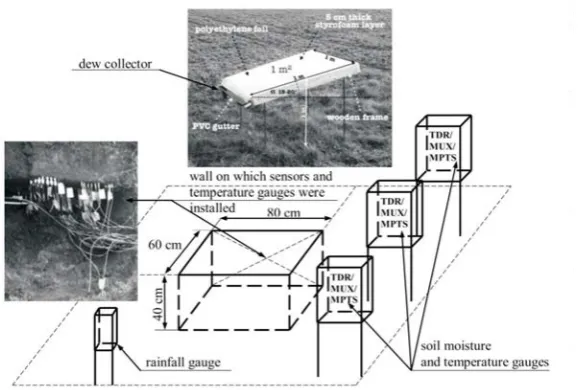
A schematic presentation of the experiment is given in Fig. 2. The particle size distribution of the mineral parts of the soil material forming the surface horizon corresponded, acc. to PTG classification of 2008, to sandy loam (gp). It was assayed with the method of laser diffraction at the Labora-tory of Applied Optical Measurement Techniques, Bohdan Dobrzañski Institute of Agrophysics PAS, Lublin, Poland. The measurements were made using a Mastersizer 2000 apparatus with Hydro G attachment (Sochanet al., 2012). The parameters recorded included the intensity of atmospheric precipitation and the temperature at the soil surface. The deposited dew/hoarfrost was collected by means of insulated plain radiative condensers (B³aœet al., 2002; Nilsson, 1996; Muselliet al., 2002; Beysenset al., 2003). The condensing surface of 1 m2was covered with polyethylene film and 5 cm thick insulating layer made of styrofoam. It was placed at the height of about 1 m above the ground. The inclination angle of the surface was 15-20. The condenser was inclined towards the west in order to mini-mize the warming effect of direct solar radiation after sun-rise. The condenser was cleaned up with deionized water, around sunset, just before the potential start of a new dew formation episode. In the profile of the surface horizon of the soil also the volumetric moisture was recorded (sensors FP/mts and LP/ms) and the temperature (sensors LP/T). The sensors were made at the Institute of Agrophysics PAS, Lublin (Poland) (online: Soil water status measurement devices, 2008).
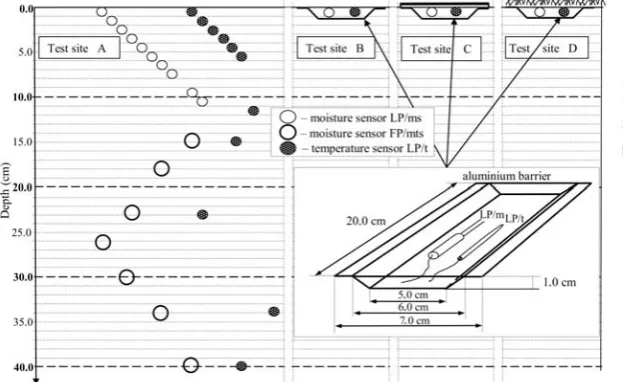
The particular test sites in the experiment were denoted with symbols A, B, C and D (Fig. 3). At site A, beneath the surface of the ground, moisture and temperature sensors were installed at intervals from 1 to 10 cm down to the depth of 40 cm. At sites B, C and D measurements were made only in the top 1 centimetre layers which were separated from the underlying soil profile be means of an aluminium barrier. The length of the LP/ms sensor needle is 5.3 cm and the distance between the metal rods is 0.6 cm. It was found (Janiket al., 2011) that for soils of low water content the LP/ms sensor sphere of influence is an elliptic cylinder with the radiuses of 0.3 cm and 0.4 cm and the height of 11.2 cm. In the experiment presented in the paper, the height of the soil layer was 1 cm. Consequently, the distance between the sen-sor axis and the border of the soil-aluminium barrier is bigger and it is equal to 0.5 cm. As a result, the LP/ms sensor sphere of influence is enclosed completely in the tested soil volume. The preparation of the measurement site was as follows. The vertical surface was exposed, which enabled to push the aluminium barrier without destroying the soil profile in the middle of the barrier. Then, the needles of the sensor were pressed in so as not to destroy the soil structure. Finally, the vertical barriers were installed and covered with the soil.
Site C was insulated additionally with a top barrier. Sites A, B and C were situated on a fallow, and D on a grass-covered area. The purpose of the measurements at site B was the determination of the intensity of effective non rainfall water flux on a fallow, and at site D – on a lawn. The results obtained at that site were burdened with an error resulting from the fact thatDVi jE, ,1¹0. The measurements at site C
were aimed at the determination of the temperature cor-rection for object No. 1 to permit the determination of the corrected value of volumetric moisture (qTDR Si j, ,1, ). The
re-sults of measurements at site A were compared with the
results of measurements at site B to determine the effect of the use of the barrier. At the final stage of analysis of data from that object, tests of the goodness of fit were performed for the values ofERobtained from the measurements at sites A, B and D with the data measured with a dew collector. The following measures were applied: maximum absolute dif-ference (R|max|) (Eq. (8)), mean values of absolute diffe-rences (SWB) (Eq. (9)) and the root mean square of the differences (R.M.S) (Eq. (10)). Additionally, the maximum differencePmax(Eq. (11)) and the minimum differencePmin (Eq. (12)) were applied. Definitions of selected measures for a constant number of days (H = const) are as follows:
R E E
h h
R
K h R
max=max
{
A,B,D, - ,}
, (8)S
H E E
WB A B D h
R
K h R
h
= å
-=
1
1 , , , , H
, (9)
(
)
R M S
H E h E
R
K h R
h
. . = å , - ,
=
1 2
1 A,B,D H
, (10)
P E E
h h
R
K h R
max=max
{
A,B,D, - ,}
, (11)P E E
h h
R
K h R
min=min
{
A,B,D, - ,}
, (12)where:EA,B,DR – intensity of effective non rainfall water flux
calculated on the basis of measurements at test sites A, B, D; EKR – intensity of effective non rainfall water flux calculated
on the basis of measurements made with a dew collector; Rmax – maximum absolute difference;R.M.S– root mean square; Pmax – maximum difference; Pmin – minimum
RESULTS
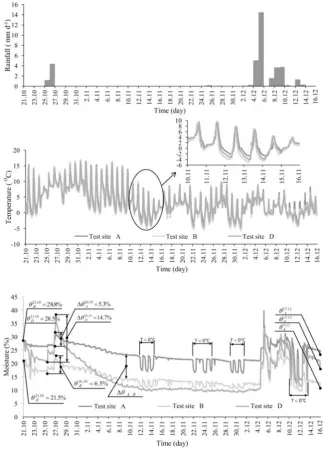
The intensity of atmospheric precipitation, the dyna-mics of temperature and moisture in the top 1 centimetre layer of soil at test sites A, B and D is presented in Fig. 4. The initial values of volumetric moisture content on 21.10.2011 at 000were varied. At test sites A and D they wereqA21.10= 28.8% and qD21.10=28.5%, respectively, while at site B qB21.10
= 21.5%. Their range is 7.3%. At the final moment, on 15.12.2011 at 2400, it was even strongerR15.12=12.3%. The moisture increments from rainfall also varied. For example,
in the case of 0.1 and 4.3 mm day-1precipitation that oc-curred on the 25th and 26th October, 2011, respectively, the following moisture increments were recorded: at test site A: DqA25.10
=31.7-26.4=5.3%, at site B:DqB25.10=23.2-16.7= 6.5%, at site D:DqD25.10=38.2-23.6=14.7%. Amplitudes caused by a more intensive rainfall, with a maximum of 14 mm day-1, that occurred on 5th December, 2011, were as follows: DqA5.12
= 39.8-20.5=19.3%, DqB5.12= 32.4-13=19.4% and DqD5.12
=32.3-10.3=22%, respectively. These moisture incre-ments were calculated on the basis of moisture contents
Fig. 4.Intensity of rainfall in object and dynamics of volumetric moisture and temperature in 1 cm layer of soil and at test sites A, B and D, in the period from 21.10 to 15.11.2011,qA21.10;qB21.10;qD21.10;q15.12A ;q15.12B ;q15.12D – values of moisture on 21.10 and 15.12DqA26.10; DqB26.10;Dq
D
26.10– moisture increments caused by rainfall on 25 and 26.10.2011,Dq
measured at each test site simultaneously. Variations in the soil moisture contents and amplitudes due to the rainfall are justified and result from spatial variation of the soil physical properties. This applies to points situated at small distance from each other. This should always be kept in mind when conducting studies using TDR gauges (Janik, 2008; Obalum at al., 2013). At the sites on the fallow (A and B) moisture content changes were similar. The moisture content at test site A was higher than that at site B, throughout the study period (DqA,B»9%). Different course of moisture content changes was observed at the grass covered site (D). In this site a transpiration effect was observable (assumption of relation 7 is not fulfilled). The observed moisture changes were influenced by, among other things, atmospheric
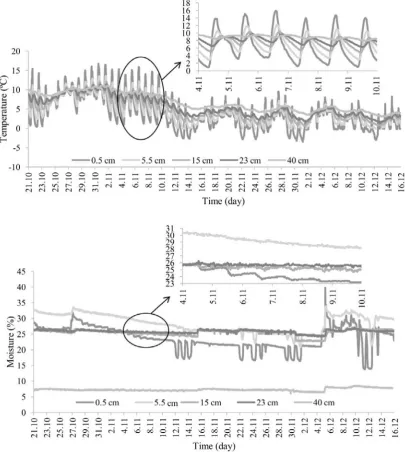
precipitation that occurred on 25th and 26th October, 2011, and from 2nd to 14th December, 2011, as well as the drop of temperature below 0°C in the top 1 centimetre of soil,ieout of the normal operation range of the TDR gauge. Such periods appeared from 12th to 14th November, 24th to 25th November, 29th November to 1st December, and 10th to 13th December, 2011. In those periods effective non rainfall water flux was not determined. Figure 5 presents the tem-perature and moisture content dynamics at site A at selected soil depths. Diurnal variations in temperature were observed even at the depth of 40 cm, though their value was only 0.6°C. However, diurnal variations in moisture contents were observed only to 5mm soil depth.
Estimation of the intensity of effective non rainfall water flux with one hour time step requires high accuracy of volumetric moisture content measurement. The expected dose of deposited water in that period (estimated on the basis of the references cited herein) may be as low as 0.02 mm h-1. This means that the moisture increment in the 1 centimetre layer of soil will be only 0.2% (2 x 10⁻³m3m-3). Better ac-curacy of measurement with the TDR apparatus can be obtai-ned by introducing a temperature correction (Skierucha, 2009). Such a correction was determined on the basis of a field experiment, using temperature and moisture measu-rements taken at test site C in the period from 2nd to 5th November, 2011 (Fig. 6). Since test site C was constructed in such a way as to preclude water flow through any of the walls of spaceVi j, ,1, any change of moisture readings taken with the TDR gauge can only be due to oscillations in soil tempe-rature. Therefore the diurnal course of volumetric moisture contents at site C is different from those at test sites A, B and D.
The course of actual volumetric water content and tem-perature at site C is presented in Fig. 6. Despite the lack of wa-ter flux through any wall of spaceVi j, ,1a diurnal variation of moisture content is observed in the readings from the TDR gauge. As an example, on 2nd November, 2011, the diurnal amplitude of moisture readings was 0.8% percentage points: (DqC2 11. =qC2 11.max-qC2 11.min =18 6 17 8. - . =0 8. %),
while the diurnal amplitude of temperature was 15.5°C (DTC2 11. =TC2 11.max-TC2 11.min=17 4. - =19. 15 5. oC).
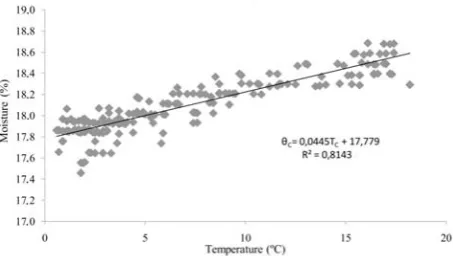
Ultimately, the relation of temperature and TDR gauge readings was developed for the range of 0.5°C<T1C <18.8°C, as presented in Fig. 7. The slope of the line appro-ximating moisture readings as a function of temperature has the value of only 0.045, so the effect of temperature on volumetric moisture readings is slight (temperature increase from 1 to 18°C causes moisture increase by about 1%). However, considering the accuracy of the readings, it was taken into account in further calculations ofER. It should be noted that the readings of TDR are correct when the soil temperature is equal to the temperature at which the full calibration of the sensors was made prior to the experiment (18°C). For majority of soils the value of coefficient d dTq -1is negative (Skierucha, 2009). Only for soils with a content of the clay fraction the value ofd dTq -1is positive (Skierucha, 2009). In the object studied the percentage share of the clay fraction was 26.83%.
It should be also explained that after the calibration in the temperature of 18°C theDqmeasurement uncertainty was 1-2% (Toppet al., 1980). However, when the sensor was placed permanently in the soil monolith, the Dqwas constant. Therefore, when calculating the soil moisture differences for the subsequent time instants, the influence of the errorDqis zeroed.
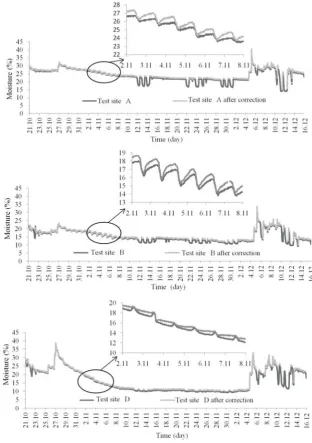
Figure 8 presents the changes in moisture in the top layer of soil, with the temperature correction, versus the moisture without the correction. Introducing the empirically
elaborated temperature correction caused hardly any change of the measured moisture content. As an example, on 3rd November, 2011, at site B the maximum moisture without the correction was aqB3 11. max= 17.6%, and with the correc-tion only 0.9% higher. However, the correccorrec-tion increased the diurnal amplitude of moisture for each test site. For example, on 3rd November, 2011, at site B the amplitude wasqB3 11. =1.9% (17.6-15.7=1.9%) for readings without the cor-rection, and for readings with the correction it wasDqB3 11. ,s= 2.4% (18.3-15.9=2.4%). Since the calibration temperature is higher than the temperature at which the measurements were taken, the true moisture is higher than the measured value. The biggest differences between moisture values with and without the temperature correction were observed in the morning hours, when the soil temperature is the lowest. This can be seen in Fig. 8, presenting the results from test site B. As follows from the above, if the temperature correction were not applied then the value ofER, calculated on the basis of measurements with the TDR gauge, would be under-estimated by 26%. The diurnal dynamics of effective non rainfall water flux (ER) was ultimately determined on the Fig. 6.Dynamics of moisture and temperature in the period from 2nd to 5th November, 2011, qCmin2 11. (qCmax2 11. ) – maximum (minimum) value of moisture at test site C on 2.11;TCmin2 11. (TCmax2 11. ) – maximum (minimum) value of temperature at test site C on 2.11.
Fig. 7. Temperature correction for volumetric moisture for 0.5°C<TC< 18.8°C,qC– volumetric moisture at test site C,TC–
basis of the corrected values of moisture. For the calcula-tions (Eq. (7)), the minimum moisture from the preceding
day was adopted as the initial moisture (qTDR S t pi j, ,1, ) , while
the final moisture (qTDR S tki j, ,1, ) was the maximum moisture
value on the current day. The results of calculations of the value ofERfor periods in which no rainfalls were observed and soil temperatures were higher than 0.5°C are presented in Fig. 9. The values calculated for the particular test sites and for the dew collector have different runs. The lines marked with symbolsEAR andEBR represent calculations for data from sites with no vegetation. The lines are parallel, which indicates similar temporal variation of the intensity of
effective non rainfall water flux. The values of the intensity at the site isolated from the soil monolith (test site B) are higher than those at site A. This should be attributed to the fact that the water from effective non rainfall, that penetrated through the surface into the top layer of the soil, did not supply the lower horizons. It should be kept in mind that the lack of the barrier at test site A results in DVi jZB, ,1¹0;DVi jX, ,1¹0;DVi jY, ,1¹0, thus the adopted as-sumptions (see ‘Material and Methods’) are not fulfilled. Analysing the shape of lineEKR formed as a result of the observations obtained from the dew collector one can conclude that variations on the consecutive days are greater than in linesEAR andEBR. The difference in the shape of line
EKR in relation to linesEARandEBR should be attributed to the different atmospheric conditions in the vicinity of the dew collector and on the soil surface. However, the courses of linesE1RAandE1RBare predominantly similar to the course of lineEKR. The intensity of effective non rainfall water flux for the grass cover test site (EDR) is approximately constant: 0 mm day-1. This means that when the soil is covered with grass the water from effective non rainfall does not supply the top layer of the soil or that supply is balanced by evapotranspiration.
Figure 9 presents also periods in which dew or hoarfrost were observed on the collector. The first to be analysed were those time intervals in which dew was observed, then the periods when hoarfrost was observed on the collector. The estimation of the goodness of fit of the data obtained on the basis of measurements taken at test sites A, B and D with the data from the dew collector was performed with two
me-thods. The first consisted in the analysis of values calculated on the basis of relations 7 to 11, and the second in the analysis of the regression lines. Table 1 presents the values of the fit of the data for the period when dew was observed on the collector, and separately for the periods with hoar-frost. On the days with dew the values ofSWBandR.M.S.are the lowest for test site B, and the highest for site D. This indicates that when the intensity of effective non rainfall water flux is estimated only on the basis of TDR measure-ments, with simultaneous isolation of the top layer of the bare soil, the results of the valueERare the closest to the values ofERmeasured on the collector. Analysis of data PmaxandPminshows that the maximum differences between the values calculated on the basis of TDR measurements in relation to the values calculated from the collector data are significant – even for test site B (Pmaxat site B for dew is 0.081 mm day-1). Analysing the values of the measures of goodness of fit for the periods when hoarfrost appeared on the collector we can find that, as in the case of periods with Fig. 9.Diurnal intensity of effective non rainfall water flux calculated on the basis of TDR measurements and data from dew collector, EAR;EBR;EDR– diurnal intensity of effective non rainfall water flux at test sites A, B and D;EKR– diurnal amount of deposit recorded on the collector.
Test site
Rmax R.M.S Pmax Pmin SWB
(mm day-1) for a period with dew on the collector
A 0.149 0.065 0.031 -0.149 0.044
B 0.082 0.044 0.081 -0.055 0.037
D 0.234 0.096 0.005 -0.234 0.065
for a period with hoarfrost on the collector
A 0.194 0.088 0.029 -0.194 0.081
B 0.102 0.054 0.100 -0.102 0.050
D 0.272 0.129 0.026 -0.272 0.119
dew, the values ofSWBandR.M.S.are the lowest for test site B and the highest for site D. The only difference is that 13 out of the 15 measures calculated assume higher values in the case of hoarfrost. This indicates that for periods with hoarfrost the goodness of fit of calculated values of ER obtained on the basis of TDR measurements with values obtained on the basis of data from the collector is lower.
Figure 10 presents the regression lines plotted on the basis of points generated from the comparison of values of ERcalculated on the basis of TDR measurements at test sites A, B and D (EAR,EBR,EDR) with values obtained on the basis of measurements made with the dew collector. Also in this case the analyses were made separately for periods with dew and those with hoarfrost. The slopes of the regression lines assume values from -0.0563 (EDR – for hoarfrost) to 1.4224 (EBR)for dew. The value closest to 1,iethe best fit of the results obtained from the TDR measurements with those from measurements with the dew collector, was obtained at test site B. The results for dew, obtained from TDR measurements, are higher than those from the collector (the slope of the regression line isaB>1), and those for hoarfrost are lower (aB<1). For test site A (without grass and the impermeable barrier) the slopes of the regression line as-sume lower values, at 0.1611 for dew and 0.290 for hoar-frost, respectively. This supports the fact that results ob-tained on the basis of TDR measurements without an imper-meable barrier are poorly correlated with results obtained
from the dew collector. In the case when the soil is covered with grass the slope values areaD= 0.028 for dew and aD= -0.0563 for hoarfrost. This indicates a lack of correlation. The mean diurnal intensity of non rainfall for 9 days on which dew was observed isEKR ave, = 0.086 mm day-1(on the collector), and at site B it is higher by 0.027 mm day-1and amounts toEBR ave, = 0.114 mm day-1. On 8 out of 10 days EBR>EKR. This comparison indicates (assuming that the values ofEKR represent real deposition of dew to the ground) that 76% of water in the top layer of the soil originates from dew and 24% from the condenzation of water vapour contained in the soil air and atmospheric air. Whereas, in the period with hoarfrost EKR ave, = 0.104 mm day-1 (on the collector), and at site B it is lower by 0.016 mm day-1and amounts toEKR ave, = 0.0880 mm day-1. At the same time, on 11 out of 15 daysEBR<EKR. In this case one can state that 100% of water in the top layer of the soil comes from the hoarfrost. This is due to the fact that the frozen thin layer of the soil creates a membrane blocking the adsorption of water vapour from the soil air.
Figure 11a presents the diurnal variability of effective non rainfall water flux calculated for a selected 6-day period in which dew was observed on the collector. The value ofER was calculated from Eq. (7), using moisture measurements from individual sensors installed at test sites A, B and D. The
Fig. 10.Relations between effective non rainfall water flux calculated on the basis of TDR measurements for the periods with: a – dew, b – hoarfrost at test sites A, B and D (EAR;EBR;EDR) and measured on the collectorEKR.
a
calculations were made with a time step ofDt= 0.5 h. The values obtained were expressed in mm h-1. The maximum values ofEAR andEBR appear in the period between 1500and 1800 hours. On each of the days analyzed there appear periods in which the values ofEBR are considerably higher than those ofEAR. This supports the fact that changes in the volume of water at site B are caused solely by effective non rainfall water flux (the water does not supply the lower layers of soil). Values ofEDR – at the test site covered with grass – assume negative values throughout the period of the experiment. This means that at site D the phenomenon of top layer of soil being supplied by effective non rainfall water flux does not appear, in spite of dew deposit being observed on the collector. Non rainfall is deposited on grass blades and then evaporates to the atmosphere, or water uptake by grass roots balances or exceeds the supply from the non rainfall. In the study presented here this problem has not been solved. The irregularities of lines EAR, EBRand EDR result from the fact that a change in moisture reading by 0.1% causes a change in the value ofERby 0.01 mm h-1. The shapes of linesEAR,EBRandEDR plotted for a period with hoarfrost observed on the collector are similar to those of the lines presented in Fig. 11b. The only difference is that the values of ERmax are lower than those calculated for the period with dew (the membrane effect).
Figure 12a presents the changes in the values of ER calculated separately for each test site, and averaged for the period with dew. It can be seen from the Figure that the process of supply of the top layer of the soil at test site B starts already at 1400. Then its intensity increases, reaching its maximum EBR,maxave = 0.027 mm h-1 at 1630. In the subsequent period a decrease is observed in the value of EB,Rave. However, it is not as dynamic as the initial growth. The value ofE1B,R avegets zeroed at 2330. The shape of line EaveR ,Ais similar. However, the process of supply of the top layer of soil starts later that at site B – ie at 1500. The maximum,EA,Rmaxave= 0.011 mm h-1, is over two-fold lower thanEB,Rmaxave and it is attained 0.5 h later,ieat 1700. From 1700there is a slow decrease, and the value of 0 mm day-1is reached at 2330. At test site D the values ofEA aveR,maxare nega-tive throughout the day. Figure 12b presents the course of the values ofERcalculated separately for each test site and averaged for the period with hoarfrost. The character of the runs of values for the periods with dew and with hoarfrost is similar, the difference consisting in that the averaged values ofERfor hoarfrost are lower than the corresponding ave-rages calculated for the periods with dew.
Fig. 11.Diurnal variation of the intensity of effective non rainfall water flux calculated on the basis of TDR measurements, for the periods with: a – dew, b – hoarfrost,EAR;EBR;EDR – diurnal intensity of effective non rainfall water flux calculated on the basis of measurements from individual sensors separately for each test site.
a
Fig. 12.Mean diurnal variation of the intensity of effective non rainfall water flux calculated on the basis of TDR measurements, for the periods with: a – dew, b – hoarfrost,EAR;EBR;EDR– diurnal intensity of effective non rainfall water flux calculated on the basis of measurements from individual sensors separately for each test site.
a
b
Fig. 13.Relation of the intensity of effective non rainfall water flux at test site B (EBR) with the rate of temperature drop (VDT) on the soil
Figure 13 presents the relation between the intensity of effective non rainfall water flux and the rate of changes of temperature on the soil surface. That rate is denoted asVDT and it was determined for different intervalsDti(Dti= 0.5, 1, 2, 3, 4, 5 h). IfVDT<0°C h-1there is a drop of temperature. The intensity of effective non rainfall water flux (EBR) was determined within hourly intervals. Linear relationsEBR = VDT+ bwere developed from the periodsDti.The highest value of the coefficient of correlation was obtained whenDti =3h(RA2=0.6484). This means that the rate of temperature drop on the soil surface during the period of 3 h preceding the determination of the value ofERhas the strongest effect on the intensity of effective non rainfall water flux.
CONCLUSIONS
1. The advantage of the presented method for the deter-mination of the diurnal distribution of effective non rainfall water flux is that the only input parameters required for the application of the method, and ones easy to measure, are the moisture of the top layer of the soil and its temperature. The measurements were conducted on samples with undisturbed structure, under thermal conditions equivalent to the natural conditions.
2. The application of the TDR technique for the determi-nation of the diurnal dynamics of the intensity of effective non rainfall water flux requires the application of a tem-perature correction during the determination of volumetric moisture. The lack of such a correction may cause that the value ofthe intensity of effective non rainfall water fluxwill be estimated with an error of up to 26%.
3. The method, applied in conjunction with measure-ments on a dew and hoarfrost collector, permits to determine what part of effective non rainfall water flux is due to the condenzation of water vapour from the soil air and atmos-pheric air, and what part originates from dew or hoarfrost.
4. The agreement between the values ofthe intensity of effective non rainfall water flux calculated with the method proposed and the values obtained from the collector is better for periods with dew than for periods with hoarfrost. The relevantroot mean square values equal 0.044 and 0.054 mm day-1, respectively.
5. It was found that when hoarfrost appears on the soil surface a membrane forms, rendering the adsorption of water vapour from the soil air impossible.
REFERENCES
Agam N. and Berliner P.R., 2006.Dew formation and water va-por adsorption in semi-arid environments. A review. J. Arid Environ., 65, 572-590.
Beysens D., Milimouk I., Nikolayev V., Muselli M., and Marcillat J., 2003. Using radiative cooling to condense atmospheric vapor: a study to improve water yield. J. Hydrol., 276, 1-11.
B³aœ M., Sobik M., Quiel F., and Netzel P., 2002.Temporal and spatial variations of fog in the Western Sudety Mts. Poland. Atmospheric Res., 64, 19-28.
Bryœ K. and Bryœ T., 2010. Reconstruction of the 217-year (1791-2007) Wroc³aw air temperature and precipitation series. Bulletin of Geography (Physical Geography Series). Wyd. Nauk. UMK Toruñ, 3, 121-171.
Duvdevani S., 1947. An optical method of dew estimation. Quarterly J. Royal Meteorol. Soc., 73, 282-296.
Ermich K., 1958.An attempt at determination of the share of so-called horizontal precipitation in water cycle in nature (in Polish). Wiadomoœci Botaniczne, II(IV), 219-236.
Heusinkveld B.G., Berkowicz S.M., Jacobs A.F.G., Holtslag A.A.M., and Hillen W.C.A.M., 2005.An automated microlysimeter to study dew formation and evaporation in arid and semiarid regions. J. Hydrometeorol., 7, 825-832.
Jacobs A.F.G., Heusinkveld B.G., and Berkowicz S.M., 1999.
Dew deposition and drying in a desert system: a simple simulation model. J. Arid Environ., 42, 211-222.
Jacobs A.F.G., Heusinkveld B.G., and Berkowicz S.M., 2002.
A simple model for potential dewfall in an arid region. Atmospheric Res., 64, 285-295.
Janik G., 2008.Spatial variability of soil moisture as information on variability of selected physical properties of soil. Int. Agrophysics, 22, 35-43.
Janik G., Szpila M., S³owiñska J., Brej G., Turkiewicz M., Skierucha W., and Pastuszka T., 2011.Method for the determination of the sensitivity zone of TDR probe. Acta Agrophysica, 183, 269-286.
Kaseke F.K., Mills A.J., Brown R., Esler K.J., Henschel R., and Seely M.K., 2011. A method for direct assessment of the ‘non rainfall’ atmospheric water cycle: input and evapora-tion from the soil. Pure Appl. Geophys., 169(5-6), 847-857.
Katata G., Nagai H., Ueda H., Agam N., and Berliner P.R., 2007.
Development of a land surface model including evaporation and adsorption processes in the soil for the land-air exchange in arid regions. J. Hydrometeor., 8, 1307-1324.
Kidron G.J., 1998.A simple weighing method for dew and fog measurements. Weather, 53, 428-433.
Kidron G.J., 2005. Angle and aspect dependent dew and fog precipitation in the Negev desert. J. Hydrol., 301, 66-74.
Kolev N., Levi A., Milenova L., Nenov M., Haarbrink R., and Shutko A., 2012.Energy budget elements estimation of the agricultural field by aircraft remote sensing and land surface observations. Comptesrendusde l'Acade'miebulgare des Sci., 65(7), 991-996.
Kosmas C., Danalatos N.G., Poesen J., and van Wesemael B., 1998.The effect of water vapour adsorption on soil moisture content under Mediterranean climatic conditions. Agric. Water Manag., 36, 157-168.
Kosmas C., Marathianou M., Gerontidis St., Detsi V., Tsara M., and Poesen J., 2001. Parameters affecting water vapor adsorption by the soil under semi-arid climatic conditions. Agric. Water Manag., 48, 61-78.
Li X.J., 2002. Effects of gravel and sand mulches on dew deposition in the semiarid region of China. J. Hydrol., 260, 151-160.
Muselli M., Beysens D., Marcillat J., Milimouk I., Nilsson T., and Louche A., 2002.Dew water collector for potable water in Ajaccio (Corsica Island, France). Atmospheric Res., 64, 297-312.
Nilsson T., 1996.Initial experiments on dew collection in Sweden and Tanzania. Solar Energy Materials Solar Cells, 40, 23-32.
Ninari N. and Berliner P.R., 2002.The role of dew in the water and heat balance of bare loess soil in the NegevDesert: quantifying the actual dew deposition on the soil surface. Atmospheric Res., 64, 323-334.
Obalum S., Oppong J., Igwe C., Watanabe J., and Obi M., 2013.
Spatial variability of uncultivated soils in derived savanna. Int. Agrophys., 27, 57-67.
Reinhard T. and Reinhard A., 2005. Choice of time step in calculation of water moisture by means of a mathematical model simulating drip irrigation (in Polish). Zesz. Nauk., Univ. Agric. Wroc³aw, 520, 95-105.
Richards K., 2002. Hardware scale modelling of summertime patterns of urban dew and surface moisture in Vancouver, BC, Canada. Atmospheric Res., 64, 313-321.
Skierucha W., 2009.Temperature dependence of time domain reflectometry - measured soil dielectric permittivity. J. Plant Nutrition Soil Sci., 172, 186-193.
Sochan A., Bieganowski A., Ry¿ak M., Dobrowolski R., and Bartmiñski P., 2012.Comparison of soil texture determi-ned by two dispersion units of Mastersizer 2000. Int. Agrophys., 26, 99-102.
Soil water status measurement devices, IA PAS, Lublin,2008.
http://www.easytest.pl/downloads/ET_Brochure%202008.pdf
Topp G.C., Davis J.L., and Annan A.P., 1980.Electromagnetic determination of soil-water content – measurements in coaxial transmission-lines. Water Resour. Res., 16(3), 574-582.
Yamanaka T., Kaihotsu I., Oyunbaatar D., and Ganbold T., 2007.
Summertime soil hydrological cycle and surface energy ba-lance on the Mongolian steppe. J. Arid Environ., 69, 65-79.