International Journal of Engineering
J o u r n a l H o m e p a g e : w w w . i j e . i rImproved Frog Leaping Algorithm Using Cellular Learning Automata
S. Ranjkesh*
Islamic Azad University, Roudsar-Amlash Branch, Iran
P A P E R I N F O
Paper history:
Received 08 January 2013
Received in revised form 12 June 2013 Accepted 20 June 2013
Keywords:
Frog Leaping Algorithm Optimization
Cellular Learning Automata
A B S T R A C T
In this paper, a new algorithm which is the result of combination of cellular learning automata (CLA) and shuffled frog leap algorithm (SFLA) is proposed for optimizationof functions in continuous, static environments. In the frog leaping algorithm, every frog represents a feasible solution within the problem space. In the proposed algorithm, each memeplex of frogs is placed in a cell of CLA. Learning automata in each cell acts as the brain of memeplex and will determine the strategy of motion and search.The proposed algorithm along with the standard SFLA and two global and local versions of particle swarm optimization algorithm have been tested in 30-dimensional space on five standard merit functions. Experimental results show that the proposed algorithm has a performance of the introduced algorithm is due to the control of search behavior of frogs during the optimization process.
doi: 10.5829/idosi.ije.2014.27.01a.01
1. INTRODUCTION1
Optimization is considered as one of the most important problems in engineering and mathematics. Great importance and application of optimization have caused many scientists to engage in research in various areas. Optimization is a problem that all people deal with in their daily lives. When the parameters and constraints of optimization problems are small in number, they can be easily solved; however if the constraints and parameters increase, these problems will be very difficult to solve in the way that they become NP-hard problems.Collective intelligence algorithms are one of the most popular methods to solve these problems. All these algorithms are based on meta-heuristic methods, the most famous of which are: particle swarm optimization algorithm [1], bee colony optimization algorithm [2], frog leaping algorithm [3], ant colony optimization algorithm [4] and artificial fish batch algorithm [5]. Shuffled frog leap algorithm (SFLA) was presented by Eusuff and Lansey [3]. [6]
This algorithm which is derived from the particle swarm optimization algorithm and memetic algorithmscan simulates the behavior of frogs in the wetlands to find food. In this algorithm, the advantages
* Corresponding Author Email:[email protected](S. Ranjkesh)
of memetic algorithms, which are based on genetics and social behaviors of particles in PSO are used.
experimental results and the final section deals with conclusions.
2. SHUFFLED FROG LEAPING ALGORITHM (SFLA)
Frog leap algorithm was presented by Eusuff and Lansey in 2003 [3]. This algorithm works on the basis of the probability rules, random search and population. The process of running this algorithm is derived from the behavior of frogs in wetlands to find food. In optimization problems, the situations with more merits have more food, and aim to find more food. Thus, frogs try to get more food with the implementation of the SFLA. At the beginning of the implementation of the SFLA, there is a population of frogs that are randomly distributed within the problem space.
In the SFLA, every frog represents a feasible solution within the problem space. After positioning the frogs, the value of their merit is measured. Position of ith frog in the D-dimensional space is equal to xi= (xi ,1, xi, 2, …, xi, D); and the amount of food available in the position of the frog, which is value of its merit is equal to f (xi). Like other collective intelligence algorithms, the SFLA also works in an iterative manner, which the following steps are performed at any iteration:
a. Members of the population are first sorted according to their merit value (the best frog is placed in index
“1”).
b. Frogs are divided into m groups, which are called memeplexes. Each memeplex includes n frogs. The population is divided as follows: first frog will be given to the first memeplex, second frog to second memeplex, and mth frog to mth memeplex. Then, (m+1)th frog is given to 1th memeplex; and similarly the classification process continues until nth frog is placed in each memeplex.
c. After frogs are classified in m memeplexes, each memeplex will repeat the following process itr times. In each memeplex, position of the best and the worst frogs are found in terms of merit levels, which are equal to Xb and Xw, respectively. Then, a candidate position is obtained using the following equations:
(
Xb XW)
RandD = . - (1)
max min
, D D D
D X
XW¢ = W+ £ £ (2)
where in "(1)" and "(2)", rand is a function generating random number (with uniform distribution over the interval [0, 1]), and is equal to the length of displacement step: its value in each dimension of the problem should be in the range of [Dmin, Dmax]. After the
position is obtained, its value of merit will be measured. If the value of merit is better than the previous position, Xw will move to its new position, and otherwise "(1)"
and "(2)" are performed again, except that the position of the best frog among all memeplexes (i.e. Xg) is used
instead of the position of Xb. After this step, if the merit
value of the position obtained by from "(2)" is not better than the previous position of Xw, then this frog will be initialized; i.e. its new position within the problem space is determined randomly. After step 3 is performed by all memeplexes for itr times, the termination condition of the algorithm is measured. If this condition is not met, all the frogs will be placed again in a group (shuffling) regardless of the memeplex to which it belongs and they perform steps 1 to 3.
3. CELLULAR LEARNING AUTOMATA (CLA)
CLA is a mathematical model for systems with simple components, so that the behavior of each component based on its neighbors' behavior and past experiences is determined and corrected. Basic components of this model, through interaction with each other show a complex behavior, thus, it can be used in the modeling of many problems. This model was first introduced by Meybodi and colleagues [7, 8, 9]. Finally, Sheybani and Meybodi [10] analyzed mathematical model. In order to find local optimum, they have investigated the convergence behavior of the important theorems concerning the convergence ability of the model .
The CLA consists of a single or multiple learning automata in each cell which is equipped with state of the cell revealed. The law will determine whether the action chosen by the automation in a cell should be rewarded or a full stop is required. Reward or punishment causes CLA to update the structure of a purpose to be determined. The main idea of CLA, which is a random subset of cellular automata is learning automata for computation of the state transition probability of stochastic cellular automata.
4. THE PROPOSED ALGORITHM
In this section, a new combined method is proposed based on the SFLA and CLA, in which each of the existing memeplexes in the SFLA algorithm is placed in a cell of CLA. Each cell is equipped with a learning automaton which becomes the brain of the memeplex in the cell.
of global search to find the best peak. However, when the frogs move in search of the best frog of group, the group will be gathered around the best position found by the algorithm and the local search is increased around it.
On the other hand, the random motion of failed frogs within the problem space causes the escape from local optimum and thus increases the ability of global search.With three actions listed, the SFLA algorithm tries to do global search and local search at acceptable level. But, it does not strengthen or weaken one or both of the abilities depending on the conditions within the problem space.
For example, the conditions of the problem may be in a such way that a strong local search is needed to achieve better results, while some frogs look for the best frog of their memeplex and typically conduct a global search. In fact, a part of the potential of the algorithm is lost in such a case. To fix this problem and improve the results of the algorithm, LA in each cell acts as a decision maker for the memeplex in the same cell and will determine the types of motion of frogs in it according to the conditions of memeplex and its type of group within the problem space.
The performance trend of LA in each cell is as follows: in the proposed algorithm, there is an LA in each cell which contains two actions.
The first action is to follow the best frog of each memeplex by the worst frog of the memeplex, and if failed, to perform a random motion within the problem space. The second action is to follow the best frog of each memeplex by the worst frog, and if failed, to perform a random motion within the problem space. In fact, with the first action, it is tried to make better the ability of global search for algorithm; and with the second behavior of the algorithm, it tries to improve its ability of local search. In any iteration of the algorithm, this automaton will determine how frogs may act. For each frog that intends to move within the problem space (i.e. the worst frog of the memeplex), the automata chooses an action based on its probability vector, and then, does this action. LA in each cell performs the action of learning and decision making under the local rule governing CLA. In the proposed algorithm, the local rule governing CLA determines whether the action selected by LA in each cell should be rewarded or fined. In the proposed algorithm, there are m cells (equal to the number of memeplexes); and the neighborhood in CLA is in line with periodic boundary so that successive memeplexes can be located in the neighboring cells.There is the same LA in all cells (i.e. they have the same actions and parameters, and all are updated together); CLA is of homogeneous type.
At any iteration of the proposed algorithm, each LA acts independently of LA in other cells and selects an action based on its probability vector, and then implements it. After the action selected by LA in all
cells was implemented, the LA of each cell can evaluate the action done according to local rule, and encourages or punishes its action based on the result of evaluation. The local rule governing CLA is as follows:
a. If a memeplex manages to find a better position in an iteration of its implementation (i.e. position of the best frog of the improved memeplex) and the merit of its best frog is higher in amount than the merit of the best frog in its two neighboring memeplexes, then the selected action will be rewarded.
b. If a memeplex have had a progress that is at least higher in amount than the progress of one of its neighboring memeplexes, then the selected action will be encouraged (the amount of progress of a memeplex, i.e. the difference in the merit value of the frog before and after implementation of the action chosen by the automata, which should be a negative number in minimization problems).
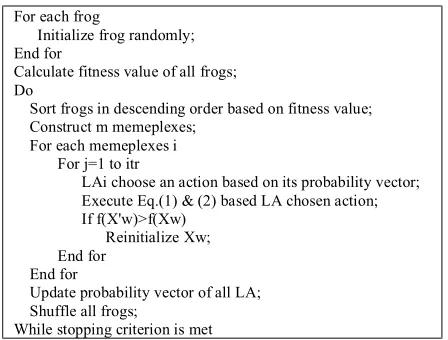
c. If a memeplex has conditions other than the two above conditions (a and b), then the selected action will be punished (i.e. it has no progress or a progress less than that of its neighboring memeplexes). Pseudo code of the proposed algorithm is shown in Figure 1.
For each frog
Initialize frog randomly; End for
Calculate fitness value of all frogs; Do
Sort frogs in descending order based on fitness value; Construct m memeplexes;
For each memeplexes i For j=1 to itr
LAi choose an action based on its probability vector; Execute Eq.(1) & (2) based LA chosen action; If f(X'w)>f(Xw)
Reinitialize Xw; End for
End for
Update probability vector of all LA; Shuffle all frogs;
While stopping criterion is met
Figure 1. Pseudo code of the proposed algorithm.
5. RESULTS OF EXPERIMENTS
local version of the algorithm [12]. Parameters of the two PSO algorithms are determined based on their references.
In the SFLA algorithm and the proposed algorithm, the number of memeplexes is considered equal to 10, and frog population size is considered equal to 30.
Length of D can be at most equal to 0.1 times the length of the problem space in each dimension.
In addition, the value of itr parameter is considered equal to 10 ("itr" is iteration) .
The values listed for the parameters of the two algorithms (SFLA and the proposed algorithm) were determined on the basis of several experiments conducted in different areas. Structure of the learning automata used in the proposed algorithm varies; environment has been considered to be of P type;
(
n)
T[
( ) ( ) ( )
n n pn]
p +1 = a ,b , learning algorithm is used; values “a” and “b” are equal.( “a” is Reward parameter and “b” is Punish parameter in each LA); and algorithm is of LARP type. In the proposed algorithm, the coefficients of rewards and punishs (“a” and “b” for learning automata) are considered equal to 0.01. Experiments are repeated 50 times, and 200,000 fitness evaluations are continued each time.
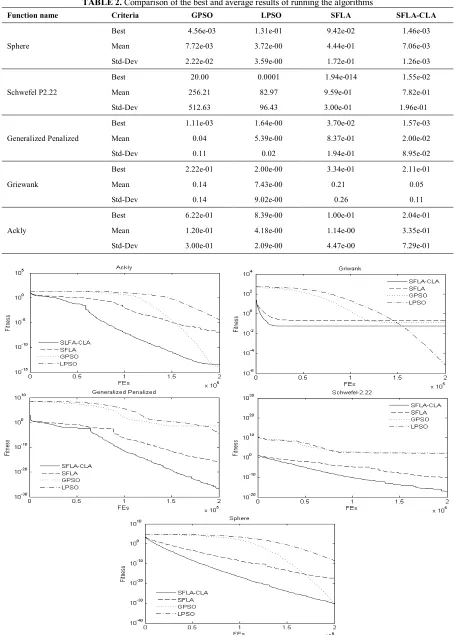
The average results, the best results and their standard deviations are given in Table 2 in 30-dimensional space. As is shown in Table 2, the results
of the proposed algorithm are better than the SFLA standard algorithm in all cases.
The improved performance of the proposed algorithm is due to the control of search behavior of frogs during the optimization process. Indeed, with the help of LAs in CLA cells, each memeplex can do a local search or global search according to the position of frogs within the problem space and the progress of the optimization process. The main task of the CLA, in fact, is to create a balance between capabilities of local and global search and use them in time.
According to the results of algorithms, the proposed algorithm did not get the best results only in two Griewangk and Ackley functions.
The result obtained in the Ackley function is almost equal to the GPSO algorithm; and the difference in results is minimal.
However, the results obtained in Griewangk function have considerable difference with the results obtained from the LPSO algorithm. Performance degradation of the proposed algorithm in this function is due to the specific form of space of problem in this function, in which it is very hard to escape the local optimum.
Since very strong global search is carried out due to the type of the loop neighborhood of the particles, the LPSO algorithm can be removed from the local optimum of this function. The average figure of merit function in algorithm run 50 times on the test functions are shown In Figure 2.
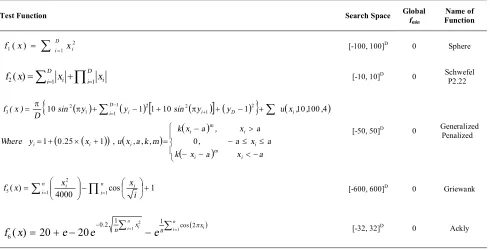
TABLE 1. Five benchmark function used in this paper
Name of Function Global fmin Search Space Test Function Sphere 0
[-100, 100]D
å
== D
i xi
x
f 1 2
1( )
Schwefel P2.22 0
[-10, 10]D
å
= +Õ
== Di xi Di xi
x f
1 1
2( )
Generalized Penalized 0
[-50, 50]D
( ) ( )
[
( )]
( ){
}
( )( )
( ) ( ) ( )
( ) x a
a x a a x a x k , , a x k m , k , a , x u , x . y Where , , , x u y y sin y y sin D ) x ( f i i i m i m i i i i i D D
i i i
-< £ £ -> ï î ï í ì -= + ´ + = + -+ p + -+ p p
=
å
=- +å
0 1 25 0 1 4 100 10 1 10 1 1
10 1 2
1 1 2 2 1 2 3 Griewank 0
[-600, 600]D 1 cos 4000 ) ( 1 1 2
5 ÷+
ø ö ç è æ -÷÷ ø ö çç è æ
=
å
=Õ
n=i i n i i i x x x f Ackly 0
[-32, 32]D
( ) å -å -+ = - = = n i i n
i xi n x
n e
e e x
f 1 1
2 1 cos2
1 2 . 0
6( ) 20 20
p
TABLE 2. Comparison of the best and average results of running the algorithms
SFLA-CLA SFLA
LPSO GPSO
Criteria Function name
1.46e-03 9.42e-02
1.31e-01 4.56e-03
Best
Sphere Mean 7.72e-03 3.72e-00 4.44e-01 7.06e-03
1.26e-03 1.72e-01
3.59e-00 2.22e-02
Std-Dev
1.55e-02 1.94e-014
0.0001 20.00
Best
Schwefel P2.22 Mean 256.21 82.97 9.59e-01 7.82e-01
1.96e-01 3.00e-01
96.43 512.63
Std-Dev
1.57e-03 3.70e-02
1.64e-00 1.11e-03
Best
Generalized Penalized Mean 0.04 5.39e-00 8.37e-01 2.00e-02
8.95e-02 1.94e-01
0.02 0.11
Std-Dev
2.11e-01 3.34e-01
2.00e-00 2.22e-01
Best
Griewank Mean 0.14 7.43e-00 0.21 0.05
0.11 0.26
9.02e-00 0.14
Std-Dev
2.04e-01 1.00e-01
8.39e-00 6.22e-01
Best
Ackly Mean 1.20e-01 4.18e-00 1.14e-00 3.35e-01
7.29e-01 4.47e-00
2.09e-00 3.00e-01
Std-Dev
6. CONCLUSION
In this paper, a new combined algorithm was proposed based on the frog leap algorithm and cellular learning automata. In the proposed algorithm, learning automata in each cell acts as the brain of memeplexes in the cells.The main task of the cellular learning automata used in the proposed algorithm is to create a balance between global and local search capabilities and control them. Performance of the proposed algorithm was compared to the shuffled frog leap algorithms and two global and local versions of particle swarm optimization algorithm on five known benchmark functions. In all, results showed that the performance of the proposed algorithm is better than the other algorithms tested (especially standard SFLA).
7. REFERENCES
1. Kennedy, J. and Eberhart, R., "Particle swarm optimization",
IEEE International Conference on Neural Networks, Vol. 4, (1995), 1942-1948.
2. Karaboga, D. and Akay, B., "A comparative study of artificial bee colony algorithm", Applied Mathematics and Computation, Vol. 214, No. 1, (2009), 108-132.
3. Eusuff, M. M. and Lansey, K. E., "Optimization of water distribution network design using the shuffled frog leaping algorithm", Journal of Water Resources Planning and Management, Vol. 129, No. 3, (2003), 210-225.
4. Dorigo, M. and Birattari, M., "Ant colony optimization", in Encyclopedia of machine learning, Springer, (2010), 36-39. 5. Li, L. X., Shao, Z. J. and Qian, J. X., "An optimizing method
based on autonomous animate: Fish swarm algorithm", in System Engineering Theory and Practice. Vol. 11, (2002), 32-38.
6. Elbeltagi, E., Hegazy, T. and Grierson, D., "A modified shuffled frog-leaping optimization algorithm: Applications to project management", Structure and Infrastructure Engineering, Vol. 3, No. 1, (2007), 53-60.
7. Meybodi, M., Beigy, H. and Taherkhani, M., "Cellular learning automata and its applications", Sharif Journal of Science and Technology, Vol. 19, No. 25, (2003), 54-77.
8. Beigy, H. and Meybodi, M. R., "A mathematical framework for cellular learning automata", Advances in Complex Systems, Vol. 7, No. 03 n 04, (2004), 295-319.
9. Navid, A. H. F. and Aghababa, A. B., "Cellular learning automata and its applications", (2013).
10. Sheybani, M. and Meybodi, M., "Pso-la: A new model for optimization", in Proceedings of 12th annual CSI computer conference of Iran., (2007), 1162-1169.
11. Shi, Y. and Eberhart, R., "A modified particle swarm optimizer", in Evolutionary Computation Proceedings, World Congress on Computational Intelligence., IEEE. (1998), 69-73.
12. Kennedy, J. and Mendes, R., "Population structure and particle swarm performance", in Evolutionary Computation, CEC'02. Proceedings of the 2002 Congress on, IEEE. Vol. 2, (2002), 1671-1676. .
Improved Frog Leaping Algorithm Using Cellular Learning Automata
S. Ranjkesh
Islamic Azad University, Roudsar-Amlash Branch, Iran
P A P E R I N F O
Paper history:
Received 08 January 2013
Received in revised form 12 June 2013 Accepted 20 June 2013
Keywords:
Frog Leaping Algorithm Optimization
Cellular Learning Automata
هﺪﯿﮑﭼ
ﻪﻏﺎﺑرﻮﻗﺶﻬﺟﻢﺘﯾرﻮﮕﻟاوﯽﻟﻮﻠﺳﺮﯿﮔدﺎﯾيﺎﺗﺎﻣﻮﺗاﺐﯿﮐﺮﺗزاﻪﮐﺪﯾﺪﺟﻢﺘﯾرﻮﮕﻟاﮏﯾﻪﻟﺎﻘﻣﻦﯾارد ﺎﻫ
)
SFLA
(
ﯽﻣﻞﺻﺎﺣ
-ﻪﻨﯿﻬﺑياﺮﺑ،دﻮﺷ ﻂﯿﺤﻣرديزﺎﺳ
ﯽﻣدﺎﻬﻨﺸﯿﭘ،ﺎﺘﺴﯾاوﻪﺘﺳﻮﯿﭘيﺎﻫ ددﺮﮔ
. ﺎـﻫﻪﻏﺎﺑرﻮﻗزاﺲﮑﻠﭙﻤﻣﺮﻫيدﺎﻬﻨﺸﯿﭘﻢﺘﯾرﻮﮕﻟارد
رد ﺪﻧﺮﯿﮔﯽﻣراﺮﻗﯽﻟﻮﻠﺳﺮﯿﮔدﺎﯾيﺎﺗﺎﻣﻮﺗازالﻮﻠﺳﮏﯾ
.
ﺲﮑﻠﭙﻤﻣﺮﮑﻔﺘﻣﺰﻐﻣناﻮﻨﻋﻪﺑلﻮﻠﺳﺮﻫرددﻮﺟﻮﻣﺮﯿﮔدﺎﯾيﺎﺗﺎﻣﻮﺗا
ﯽﻣﻦﯿﯿﻌﺗارﻮﺠﺘﺴﺟوﺖﮐﺮﺣيﮋﺗاﺮﺘﺳاوﺪﻨﮐﯽﻣﻞﻤﻋ ﺪﻨﮐ
.
هاﺮﻤﻫﻪﺑيدﺎﻬﻨﺸﯿﭘﻢﺘﯾرﻮﮕﻟا SFLA
ﮥﺨـﺴﻧودودراﺪﻧﺎﺘـﺳا
دتارذﮥﺘﺳديزﺎﺳﻪﻨﯿﻬﺑﻢﺘﯾرﻮﮕﻟاﯽﻠﺤﻣويﺮﺳاﺮﺳ يﺎﻀﻓر
30
هﺪﺷﺶﯾﺎﻣزآدراﺪﻧﺎﺘﺳاﯽﮕﺘﺴﯾﺎﺷﻊﺑﺎﺗﺞﻨﭘيورﺮﺑيﺪﻌﺑ
ﺪﻧا
.
ﯽﻣنﺎﺸﻧتﺎﺸﯾﺎﻣزآﺞﯾﺎﺘﻧ ﺖﺳارادرﻮﺧﺮﺑﯽﺒﺳﺎﻨﻣرﺎﯿﺴﺑﯽﯾارﺎﮐزايدﺎﻬﻨﺸﯿﭘﻢﺘﯾرﻮﮕﻟاﻪﮐﺪﻨﻫد
.