ISSN: 0976-3031
Research Article
SCIENTOMETRIC ANALYSIS OF INDIAN RESEARCH PERFORMANCE IN
ENGINEERING ON THE BASIS OF WOS DATABASE
Shambulinga B. Jali
1and Bagalkoti V. T*
21
Greenwood High International School Bannerghatta Branch, Bengaluru
2
Library & Information Officer, School of Engineering and Technology, CMR University, Bengaluru
DOI: http://dx.doi.org/10.24327/ijrsr.2019.1009.3957
ARTICLE INFO ABSTRACT
This study aimed to explore the Indian engineering research output by using document retrieval from Web of Science database. Document type, language, source title, authorship, countries and affiliation centres and citation count were evaluated for 71484 documents. as reflected in Web of Science (WOS) database for the period 2006 to 2016. It also provides a comparative evaluation and performance of different types of scientometric indicators, such as number of publications, number of citations and collaboration from India. The Indian engineering research has increased exponentially over the last decade.
INTRODUCTION
Scientometrics also known as ‘science of science’ is a novel and popular statistical discipline investigating all aspects of scientific literature, it is a popular statistical discipline providing data relevant to publication patterns and trends in a certain academic field. The present study aims to perform a holistic analysis of Indian engineering research. Scientometric researches provide more comprehensive assessment and examine characteristics of the authors, countries and organisations producing academic documents in the literature (Senel, (2019). Although the number of bibliometric and scientometric studies has been rising in the last decades, there has been no recent scientometric analysis of publications published in military medicine literature. This Scientometric profile is significant because it gives an insight into the research and development of a particular country, institution and scientist. Scientometrics points out the stronger and weaker areas of research and helps researchers to contribute more.
METHODS AND MATERIALS
The data retrieved from Web of Science citation database of the Science Citation Index Expanded (SCI-EXPANDED) which is an international indexing and abstracting database (https://isiknowledge.com/) The data has been ectracted during
the period of 2006 to 2016. 7.1484 articles published in engineering. The data have been filtered using the Advanced Search tool with the following syntax:
SU = (Engineering) AND CU = (India)
where SU is the Subject Area; CU is the Country; AND is the Boolean operator.
The specific objectives
To examine the growth of Indian engineering during the period 2006 – 2016
To identify the document type of the publications in Indian engineering.
To examise the Language wise distribution of records in the Indian Engineering.
To identify the organisations conducting the research in Indian engineering.
To identify and analyse the research contribution in the subject field of engineering.
To identify the top source titles those, carry the research productions in engineering.
To identify the top prolific authors in the Indian Engineering Research.
To identify the top 25 collobrative coutries.
Available Online at http://www.recentscientific.com
International Journal of
Recent Scientific
Research
International Journal of Recent Scientific Research
Vol. 10, Issue, 09(C), pp. 34717-34721, September, 2019
Copyright © Shambulinga B. Jali and Bagalkoti V. T, 2019, this is an open-access article distributed under the terms of the Creative Commons Attribution License, which permits unrestricted use, distribution and reproduction in any medium, provided the original work is properly cited.
DOI: 10.24327/IJRSR CODEN: IJRSFP (USA)
Article History: Received 06thJune, 2019
Received in revised form 14th July, 2019 Accepted 23rd August, 2019
Published online 28th September, 2019
Key Words:
RESULTS AND DISCUSSION
Year wise growth rate of publications
This section provides the results after application of scientometric tools to analyze the outcome. Table 1 indicates the year-wise productivity of engineering research in India. The output of global research of Indian engineering has increased from 3,728 (2006) to 10,776 (2016).
Table 1 Year wise growth rate of publications
Publication
Years Records Citations
Average citations
per paper H-index
% of 71484 2006 3728 84742 22.73 107 5.22 2007 4347 91238 20.99 106 6.08 2008 4991 96153 19.27 110 6.98 2009 5444 104312 19.16 108 7.62 2010 5602 89495 15.98 91 7.84 2011 5913 88171 14.91 89 8.27 2012 6187 79269 12.81 76 8.66 2013 7295 77926 10.68 69 10.21 2014 7952 68959 8.67 64 11.12 2015 9249 55174 5.97 52 12.94 2016 10776 NA NA NA 15.07
71484 835439 11.69
It could be clearly observed from the table 1 the research output of India and average citations per papers of India. India has produced 71484 papers, and received 835439 citations with 11.69 an average citations per paper during the period 2006-2016. In the year of 2006 were produced with 3,728 articles (84,742 citations) and average citations per paper is 22.73 and h-index is 107, in 2007 India produced 4,347 papers in the field of engineering and received 91238 citations with an average of 20.98 and his h-index is 106, in the year of 2008 published 4991 publication, 96153 citations with h – Index is 110, The table show that India has contributed total number of publications on engnieering as per Web of Science database 2006 – 2016. Highest publications (10776) were published in 2016 and lowest publications (3728) were published in the year of 2006.
Distribution of publications based on document types
The analysis shows the distribution of publications based document types, Indian engineering publications are published in different forms such as Research article, Reviews, Conference Proceedings papers Editorials Materials, Book Review, Book Chapter, News Item, Letter etc and the same is shown in Table 2.
Table 2 Distribution of publications based on document types
Document Types Records %
Article 66738 93.36 Proceedings paper 2251 3.15 Review 1139 1.59 Editorial material 895 1.25 Correction 245 0.34 Letter 122 0.17 Retracted publication 27 0.04 Meeting abstract 24 0.03 Biographical item 15 0.02 Book review 13 0.02 Book chapter 7 0.01 News item 5 0.01 Retraction 2 0.00 Reprint 1 0.00
Total 71484 100%
Table 2 show that maximum number of papers are published in the form of articles i.e. 66738 (93.36%) are published in journals. This followed by Conference proceeding papers 2251 (3.15%) are published, Reviews 1139 (1.59%) are published, Editorials 895 (1.25%) are published, Correction 245 (0.34%) are published, Letters 122 (0.17%) are published, Retracted publications 27 (0.04%) are published. It could be noted that only 1 (0.00%) publication is available in Reprint.
Language based distribution of publications
Language is significant medium to disseminate the scientific productivity in any subject area. Therefore, researcher tried to know the language in which author preferred to publish. Study.
Table 3 Language based publications
Languages Records Percentage
English 71455 99.959 Croatian 13 0.018 German 5 0.007 Japanese 4 0.006 Spanish 3 0.004 Korean 2 0.003 Estonian 1 0.001 Polish 1 0.001 Portuguese 1 0.001 Total 71484 100%
The table 3 deals the distribution of articles language-wise, the researchers of Indian engineering research are published the articles in different languages; English, Chinese, Japanese, German, Welsh, French, Estonian and Danish. It is observed from the data that, the maximum of publicatioins i.e. 99.96% are published in English, 0.018 % of the articles in Croatian language and very less of articles are published in other languages.
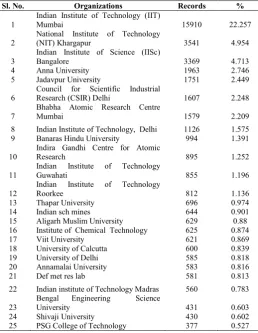
Research output of major Research Institutions and Universities in India
Table 4 Research output of major Research Institutions and Universities in India
Sl. No. Organizations Records %
1
Indian Institute of Technology (IIT)
Mumbai 15910 22.257
2
National Institute of Technology
(NIT) Khargapur 3541 4.954
3
Indian Institute of Science (IISc)
Bangalore 3369 4.713 4 Anna University 1963 2.746 5 Jadavpur University 1751 2.449
6
Council for Scientific Industrial
Research (CSIR) Delhi 1607 2.248
7
Bhabha Atomic Research Centre
Mumbai 1579 2.209 8 Indian Institute of Technology, Delhi 1126 1.575 9 Banaras Hindu University 994 1.391
10
Indira Gandhi Centre for Atomic
Research 895 1.252
11
Indian Institute of Technology
Guwahati 855 1.196
12
Indian Institute of Technology
Roorkee 812 1.136 13 Thapar University 696 0.974 14 Indian sch mines 644 0.901 15 Aligarh Muslim University 629 0.88 16 Institute of Chemical Technology 625 0.874 17 Viit University 621 0.869 18 University of Calcutta 600 0.839 19 University of Delhi 585 0.818 20 Annamalai University 583 0.816 21 Def met res lab 581 0.813 22 Indian institute of Technology Madras 560 0.783
23
Bengal Engineering Science
University 431 0.603 24 Shivaji University 430 0.602 25 PSG College of Technology 377 0.527 Sources wise distribution of Indian Engineering Research in India during 2005 – 2016
The data collected for the sudy indicate that from the 71484 publications of the source from various journal sources in the field of Indian engineering over the 10 years period.
Table 5 Source wise distribution of the Indian Engineering Research out put
Sl. No. Source Titles Records %
1 Journal of alloys and compounds 2451 3.429 2 Industrial engineering chemistry research 1441 2.016 3 Journal of materials science materials in
electronics 1356 1.897 4 Journal of hazardous materials 1071 1.498 5 Journal of scientific industrial research 1040 1.455 6 Materials science and engineering a structural
materials properties microstructure and processing
1034 1.446
7 Transactions of the Indian institute of metals 926 1.295 8 International journal of advanced
manufacturing technology 904 1.265 9 Desalination and water treatment 857 1.199 10 International journal of electrical power
energy systems 726 1.016 11 International journal of heat and mass transfer 708 0.99 12 Chemical engineering journal 694 0.971 13 Microwave and optical technology letters 693 0.969 14 Materials and manufacturing processes 680 0.951 15 Indian journal of chemical technology 600 0.839 16 Sadhana academy proceedings in engineering
sciences 554 0.775 17 Metallurgical and materials transactions a physical metallurgy and materials science 534 0.747 18 Desalination 474 0.663
19 Materials science in semiconductor processing 463 0.648 20 Journal of chemical and engineering data 455 0.637 21 Separation science and technology 455 0.637 22 IETE journal of research 431 0.603 23 Expert systems with applications 426 0.596 24 IEEE transactions on electron devices 404 0.565 25 Indian journal of engineering and materials
sciences 389 0.544
Table 5 showes that the total Indian publications ourput in Engineering research 93.36 % appeared in Journals. The top 25 most productive journals accounted for the ten years. Based on the publications the Journal of alloys and compounds from (Netherlands) published the highest publications i.e. 2,451 (3.429% ) articles, followed by Industrial Engineering Chemistry Research (United Stats) published 1441 (2.016%, ) articles , Journal of Matirials Science Matirials in Electronics (Netherlands) published 1356 1.897%, articles Journal of Hazardous Matirials (Netherlands) published 1071 (1.498%), articles Journal of Scientific Industrial Research (India) published 1040 (1.455%) articles, Materials science and engineering a structural materials properties microstructure and processing (Netherlands) published 1034 (1.446%), Transactions of the indian institute of metals (India) published 926 (1.295%), International journal of advanced manufacturing technology (Germany)published904 (1.265%), Desalination and water treatment (United States) published 857 (1.199%), etc. during 2005 – 2016.
Subject-Wise distribution of Indian engineering research
Table 6 Subject-Wise distribution of Indian engineering research
Sl. No. Research areas Records %
1 Materials science 14717 20.588 2 Metallurgy metallurgical engineering 9125 12.765 3 Chemistry 7231 10.116 4 Physics 5966 8.346 5 Computer science 4496 6.29 6 Environmental sciences ecology 4084 5.713 7 Mechanics 3790 5.302 8 Thermodynamics 3382 4.731 9 Science technology other topics 3275 4.581 10 Telecommunications 3230 4.518 11 Water resources 3150 4.407 12 Energy fuels 2799 3.916 13 Automation control systems 1939 2.712 14 Instruments instrumentation 1852 2.591 15 Optics 1704 2.384 16 Operations research management science 1376 1.925 17 Construction building technology 1272 1.779 18 Biotechnology applied microbiology 1232 1.723 19 Mathematics 1221 1.708 20 Geology 919 1.286 21 Polymer science 888 1.242 22 Acoustics 679 0.95 23 Imaging science photographic technology 636 0.89 24 Mining mineral processing 490 0.685
International Collaboration
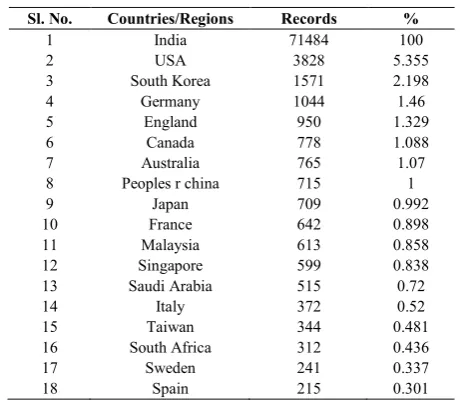
Table 7 shows the top 25 global collaborative linkages of India during 2005-2016. The largest number of collaborative publications (71484) of India in engineering, followed by USA contributed 3828 papers with 5,355% of total output, South Korea produced 1,571 (2,198%) papers, Germany produced 1044 papers, England published 950 (1,329%) articles, Canada contributes778 (1.088%) papers, Australia published 765 (1.07%) papers and People R China has contributed 715 (1%) papers, Japan produced 709 (0.992%) publications, France contributed 642 (0.898%) papers, Malaysia produced 613 (0.858%) papers, Singapur published 599 (0.838%) papers, Saudi Arebia produced 515 (0.72%) papers, Italy published 372 (0.52%) papers, Taiwan published 344 (0.481%) papaers, South Africa published 312 (0.436%) papers, Sweedan published 241 (0.337%) papers, Spain produced 215 (0.301%) papers, Netherlands published 199 (0.278%) papers, Portugal published 193 (0.27%) papers and etc,.
Table 7 Top 25 collobrative countries
Sl. No. Countries/Regions Records %
1 India 71484 100 2 USA 3828 5.355 3 South Korea 1571 2.198 4 Germany 1044 1.46 5 England 950 1.329 6 Canada 778 1.088 7 Australia 765 1.07 8 Peoples r china 715 1 9 Japan 709 0.992 10 France 642 0.898 11 Malaysia 613 0.858 12 Singapore 599 0.838 13 Saudi Arabia 515 0.72 14 Italy 372 0.52 15 Taiwan 344 0.481 16 South Africa 312 0.436 17 Sweden 241 0.337 18 Spain 215 0.301
19 Iran 204 0.285 20 Netherlands 199 0.278 21 Portugal 193 0.27 22 Switzerland 163 0.228 23 Scotland 148 0.207 24 Turkey 137 0.192 25 Brazil 136 0.19
Most prolific authors in Indian Engineering research
The table 7 dipicts the highly prolific authors of indian engineering research. Kumar, A, is on top rank with 1,027 articles (1.437%) followed by Kumar, S. published 1,001 papers, Das S. published 541 papers (0.757%), Kumar P 504 papers (0.705%), Singh, B. produced 479 papers (0.67%), Singh S. published 477 articles (0.667%), Kumar V published 421 (0.589%) papers, Ghosh S published 407 (0.569) papers, Singh AK published 397 (0.555) papers, Singh R published 384 (0.537%) papers, Chakraborthy S published (.0537%) papers, Kumar M published 336 (0.47%) papers, Sharma A published 322 (0.45%) papers, Roy S published 301 (0.421%) papers Singh A published 298 (0.417%) papers, Kumar N published 286 (0.4%) papers, Singh SK published 264 (0.369%) papers, Gupta A published 257 (0.36%) papers, Sanker S published 244 (0.341%) papers, Das SK published 241 (0.337%) papers, Banerjee S & Singh K published 239 (0.334%) papers and Ghosh A published 238 (0.333%) papers (Table – 7).
Table 7 Most prolific authors in Indian Engineering research
Sl. No Authors Records %
1 Kumar A 1027 1.437 2 Kumar R 1001 1.4 3 Kumar R 746 1.044 4 Das S 541 0.757 5 Kumar p 504 0.705 6 Singh b 479 0.67 7 Singh S 477 0.667 8 Kumar V 421 0.589 9 Ghosh S 407 0.569 10 Singh AK 397 0.555 11 Singh R 384 0.537 12 Chakraborty S 340 0.476 13 Kumar M 336 0.47 14 Sharma A 322 0.45 15 Sharma S 315 0.441 16 Roy S 301 0.421 17 Singh A 298 0.417 18 Kumar N 286 0.4 19 Singh SK 264 0.369 20 Gupta A 257 0.36 21 Sarkar S 244 0.341 22 Das SK 241 0.337 23 Banerjee S 239 0.334 24 Singh K 239 0.334 25 Ghosh A 238 0.333
CONCLUSION
majority of articles published in the form of research articles and the articles written by multiple authors.
There is a need to publish research in high impact or internationally acclaimed journals to get attention and wider visibility. There is a need of increasing and establishing scientific collaborations. Research productivity and citation rankings have become major indicators of the scientific worth of country as well as R&D institutions to determine a large extent the career of individual scientist.
References
1. Bhattacharya, S., Shilpa, & Bhati, M. (2012). China and
India: The two new players in the nanotechnology race.
Scientometrics, 93(1), 59-87. Retrieved from
http://link.springer.com/10.1007/s11192-012-06517.
2. Chaman Sab, M., Dharani Kumar, P., & Biradar, B. S. (2017). Assessment of Chemical Science Research output Using Scientometric Indicators. Asian Journal of Chemistry and Pharmaceutical Sciences, 2(2), 10 -15. 3. Chaman Sab, M., Dharani Kumar, P., & Biradar, B. S.
(2017). Scientometric Dimensions of Chemical engineering research in india with reference to web of science citation database. Review Of Research, 6(4), 1-8. Retrieved from www.lsrj.in
4. Elango, B., & Rajendran, P. (2015). Global tribology
research output (1998 2012): A macro level
scientometric study. Journal of Information Science
Theory and Practice, 3(4), 35-48.
5. Gupta, B. M., Kshitij, A., & Verma, C. (2011). Mapping
of Indian computer science research output, 1999-2008.
Scientometrics, 86(2), 261-283.
6. Gupta, B.M., & Gupta, P. (2004). Analysis of India’s S&T research capabilities and international collaborative strength, particularly in context of India-German collaboration, New Delhi: DFG India.
7. Hadagali, G. S., & Anandhalli, G. (2015). Modeling the
growth of neurology literature. Journal of Information
Science Theory and Practice, 3(3), 45-63.
8. Hosamani, M. S. C., & Bagalkoti, V. T. (2014).
Scientometric Analysis of Indian Engineering Literature
during 1999-2013. International Journal of Scientific &
Engineering Research, 5(5).
9. Kim, M. J. (2002). Citation patterns of Korean physicists and mechanical engineers: Difference by type of publication source and type of authorship. Scientometrics, 55(3), 421 – 436.
10. Liu, F., Lin, A., Wang, H., Peng, Y., & Hong, S. (2016).
Global research trends of geographical information system from 1961 to 2010: A bibliometric analysis.
Scientometrics, 106(2), 751-768.
11. Nobre, G. C., & Tavares, E. (2017). Scientific literature
analysis on big data and internet of things applications
on circular economy: A bibliometric study.
Scientometrics,111(1),463-492.
12. Ravichandra Rao, I. K., & Suma, M. P. (1999). A
quantitative study of Indian engineering literature.
Scientometrics, 46(3), 605-619.
13. Sangam, S. L., Keshava, & Agadi, A. B. (2010). Growth
pattern of marine engineering literature. Information
Studies, 16(2), 113-120.
14. Schoepflin, U., & Glanzel, W. (2001). Two decades of “Scientometrics”. An interdisciplinary field represented by its leading journal. Scientometrics, 50(2), 301-312.
15. Singhal, K., Banshal, S. K., Uddin, A., & Singh, V. K.
(2015). A Scientometric analysis of computer science
research in India. In 2015 Eighth International
Conference on Contemporary Computing (IC3) (pp.
177-182).
16. Zou, Y., & Laubichler, M. D. (2017). Measuring the
contributionsofChinesescholarstotheresearchfieldof
systems Biology from 2005 to 2013. Scientometrics,
110(3),1615-1631.
How to cite this article:
Shambulinga B. Jali and Bagalkoti V. T.2019, Scientometric Analysis of Indian Research Performance in Engineering on The Basis of WOS Database. Int J Recent Sci Res. 10(09), pp.34717-34721. DOI: http://dx.doi.org/10.24327/ijrsr.2019.1009.3957