
International Doctorate School in Information and Communication Technologies
Department of
Information Engineering and Computer Science
University of Trento, Italy
Cooperative Push/Pull Protocols
for Live Peer-Assisted Streaming
Alessandro Russo
Advisor:
Prof. Renato Lo Cigno
University of Trento, Italy
Video streaming is rapidly becoming one of the key services of the Internet. Most streaming is today “on demand” and delivered via unicast delivery; how-ever, many applications require delivery to many end-users and the lack of ubiquitous IP multicast remains a weakness of the Internet.
Given this scenario, the peer-to-peer (P2P) or peer-assisted communica-tions is an appealing solution, especially in light of its intrinsic scalability and its extremely low initial investment requirements. However, the design of efficient, robust, and performing P2P streaming systems remains a high challenge, in particular when real-time (hard or soft) constraints are part of the service quality, as in TV distribution or conferencing.
This thesis deals with P2P live streaming, concentrating on unstructured, swarm-based systems. The protocols explored and proposed are based in gen-eral on mixed Push/Pull phases, i.e., the behavior of peers alternates between offering content to other peers and seeking the content from other peers.
ticast techniques (based on a modified version of the Protocol Independent Multicast –PIM– adapted to wireless environments) with active Pull recov-ery of missing data, with a peer-assisted approach. This protocol, called
PullCast, enables end-users to pull missed data packets via unicast
com-munications while they receive video packet in multicast via push, exhibiting interesting results in terms of chunks diffusion delay and fraction of end-users served.
Finally, the GRAPES library is introduced to provide a set of open-source components conceived as basic building blocks for developing new P2P stream-ing applications which have in mind the intelligent usage of network resources as well as the Quality of Experience of final users. GRAPES is the core li-brary behind PeerStreamer, an open source P2P media streaming framework developed under the NAPA-WINE European research project, and currently supported by the EIT ICT Labs.
Keywords: Peer-to-Peer, Content Distribution, Multicast, Live Streaming,
The works presented in this thesis was supported by the European Com-mission through the NAPA-WINE Project (www.napa-wine.eu), ICT Call 1 FP7-ICT-2007-1, 1.5 Networked Media, Grant Agreement no.: 214412.
This doctoral thesis would not have been possible without the help and support of the kind people around me, and this page is here to thank them all. First, I would like to express my sincere gratitude to my advisor, Prof. Renato Lo Cigno for being an excellent advisor and an outstanding person. His vision, knowledge, and advice have been a source of inspiration for me during my doctoral program, but also for the Master’s degree. I would also like to thank him for the countless coffees and interesting discussions.
I would like to express my deep appreciation to Prof. Izhak Rubin who allowed me to visit him at the University of California, Los Angeles. You have been an excellent guide who enriched my knowledge with your exceptional insights into engineering.
I am deeply indebted to my committee members Prof. Marco Mellia and Prof. Pascal Felber for their time and effort in reviewing this work, providing invaluable suggestions.
A special thanks also goes to Csaba, Danilo, Roberta, Gianluca, and all the members of my group for their helpful support in these years.
e dolori del dottorato. Grazie a Christian, Nicola S., Andrea, Nicola M., Igor, Luca, Thomas, Edoardo, Chiara, Mattia, Nicola P., Valentina, Stefano S., Paolo, Stefano B., Gabriela, Yuri e Sasha.
Desidero ringraziare inoltre tutti gli amici siculi. Compagni di granite la domenica mattina. Anche se mi sono allontanto da casa la nostra amicizia non ne ha risentito. Mi siete stati sempre vicini e ritengo di essere molto fortunato ad avervi come amici. Grazie Pippo, Alfio, Salvo, Ivan e Giuseppe. Un ringraziamento speciale va alla mia famiglia che da sempre mi accom-pagna e mi sostiene con tanto affetto e calore. Grazie a Rita, Alfio, Barbara, Vera, Orazio ed Antonio. Un grazie anche ai nipotini Daenerys e Sebastiano che allieteranno l’estate 2013.
Indubbiamente un ruolo fondamentale in questi anni è stato svolto da mia moglie Angela. Grazie per avermi sempre ascoltato ed incoraggiato ad andare avanti. Grazie per aver appoggiato tutte le mie scelte, anche quando sapevi che avremmo sofferto (sei mesi), sei stata fondamentale per me. Scusami per quelle volte che ti ho trascurato a causa del lavoro (sai con chi prendertela). Grazie Amore Mio.
Abstract v
Acknowledgments ix
Table of Contents xiii
List of Table xvii
List of Figures xix
1 Introduction 1
1.1 Content Distribution . . . 1
1.1.1 Video Streaming Multicasting . . . 3
1.1.2 IP Multicast . . . 5
1.1.3 Client-Server Architecture . . . 7
1.1.4 Content Delivery Networks . . . 8
1.1.5 Peer-to-Peer Technology . . . 10
1.2 Motivation of the Thesis . . . 11
1.3 Structure of the Thesis and Contributions . . . 13
1.3.1 Hybrid Push/Pull Protocols in P2P Networks . . . 14
1.3.2 Cooperative Multicasting in Wireless Mesh Networks . 15 1.3.3 The GRAPES library . . . 16
2.1 P2P Live Streaming . . . 21
2.1.1 Principles . . . 22
2.1.2 Overlay Topology . . . 23
2.1.3 P2P Streaming Architecture . . . 26
2.1.4 Requirements and Trade-off . . . 29
2.2 State-of-the-Art Solutions . . . 30
2.2.1 Tree-based P2P Streaming Systems . . . 31
2.2.2 Mesh-based P2P Streaming Systems . . . 33
2.2.3 Hybrid P2P Streaming Systems . . . 35
2.2.4 The NAPA-WINE Architecture . . . 36
3 Understanding P2P Push/Pull Protocols 39 3.1 Introduction . . . 39
3.2 Interleave Protocols . . . 42
3.2.1 A Cycle-based Model . . . 43
3.2.2 A Realistic Model . . . 44
3.3 Numerical Results . . . 46
3.3.1 The PeerSim Environment . . . 47
3.3.2 Parameters under Study and Settings . . . 49
3.3.3 Fundamental Cycle-Based Properties . . . 51
3.3.4 Evaluating a Realistic Model . . . 56
3.4 Remarks . . . 57
3.5 Enhancing the Push/Pull Protocols . . . 59
3.6 Performance Metrics . . . 60
3.7 Experimental Results . . . 61
3.8 Lesson Learned . . . 62
3.9 The Importance of Network-Aware Protocols . . . 63
3.12 Experimental Setup . . . 70
3.13 Results . . . 73
3.13.1 The Role of Push and Pull . . . 74
3.13.2 Impact of Choice and Parallel Signaling . . . 75
3.13.3 Impact of Upload Bandwidth . . . 76
3.14 Conclusion . . . 78
4 Cooperative Wireless Mesh Multicasting 81 4.1 Introduction . . . 81
4.2 Enabling PIM-DM over WMNs . . . 85
4.3 Wireless-PIM-DM Performance Metrics . . . 89
4.4 Wireless Model and Experimental setup . . . 92
4.5 Results on Wireless-PIM-DM Protocol . . . 95
4.6 Discussion . . . 101
4.7 Peer-Assisted Wireless Multicasting . . . 101
4.8 Related Works . . . 103
4.9 System Overview . . . 104
4.10 PullCast Design . . . 106
4.11 PullCast: Performance Metrics . . . 111
4.12 Simulation Model and Methodology . . . 112
4.12.1 Scenario . . . 113
4.12.2 Channel and Radio Model . . . 114
4.12.3 Mobility Model . . . 115
4.13 Simulation Results . . . 115
4.13.1 Impact of Mobility. . . 118
4.13.2 Extending to Single Channel Meshes . . . 119
5.1 Introduction . . . 125
5.2 Requirements . . . 127
5.3 Design and Structure . . . 129
5.3.1 Peer Sampling . . . 130
5.3.2 Signalling and Chunk Trading . . . 131
5.3.3 The Chunk Buffer . . . 133
5.3.4 Scheduling . . . 134
5.3.5 Other Modules . . . 135
5.4 Usage and Early Experiences . . . 136
5.5 Conclusion . . . 140
6 Conclusion and Perspectives 141
Papers Published 145
Bibliography 147
3.1 Parameters used for exploring Interleave protocols. . . 49
3.2 Simulation parameters values. . . 61
3.3 Parameters used for evaluating delay-awareness. . . 73
4.1 Parameters used for Wireless-PIM-DM experiments. . . 93
4.2 Parameters used for exploring the PullCast protocol. . . . 115
1.1 Mobile traffic forecast (Cisco VNI 2013). . . 2
1.2 On-demand video streaming. . . 4
1.3 Live video streaming service. . . 4
1.4 IP Multicast over a source-based tree topology. . . 7
1.5 The client-server architecture. . . 8
1.6 A content delivery network infrastructure. . . 9
1.7 The peer-to-peer architecture. . . 10
2.1 From video content to chunks. . . 22
2.2 The overlay network layer. . . 23
2.3 Tree-based overlay network. . . 24
2.4 Mesh-based overlay network. . . 25
2.5 The NAPA-WINE architecture. . . 27
3.1 CDF of the overall download time with |K| = 1000 nodes: Asymmetric contact list. . . 52
3.2 CDF of the overall download time with |K| = 1000 nodes: Symmetric contact list. . . 53
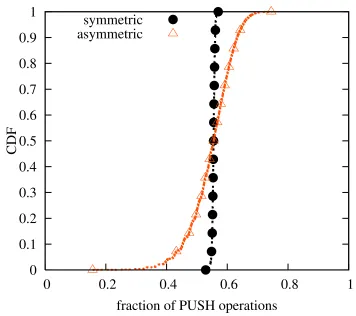
3.3 CDF of the maximum delay: Symmetric contact list, k = 16. 54 3.4 CDF of the Push operations: Symmetric contact list, k = 16, |K| = 1000, |C| = 104. . . 55
= 5 10 . . . 58 3.7 Maximum value of the maximum delay: Symmetric contact
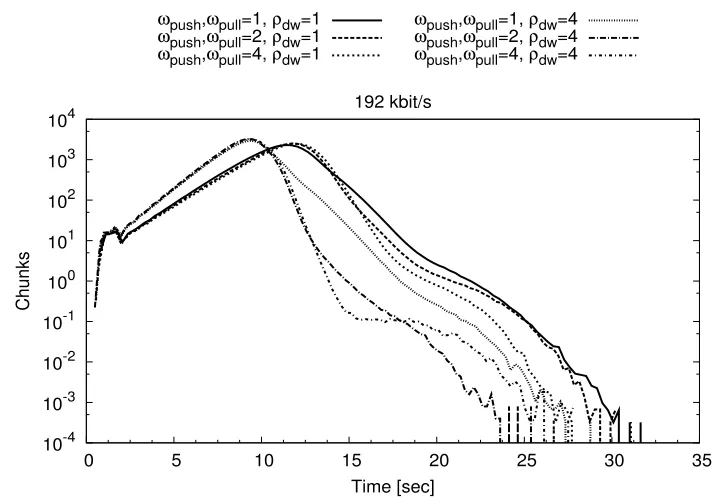
list, k = 16. . . 59 3.8 δmax and δ90 for different uploads: |K|= 1000, |N | = 16. . . . 62 3.9 Chunk diffusion delay histogram: |K| = 1000 and BU P =
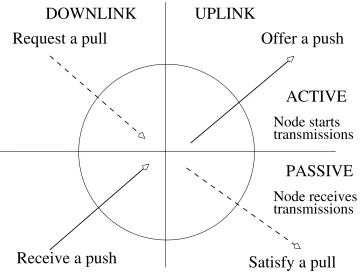
192 kbit/s. . . 63 3.10 Example of push (left) and pull (right) communications. . . . 65 3.11 Active and passive states for a peer in Push/Pull protocols . . 66 3.12 A 3-regular topology with eight nodes, the shaded area is the
neighborhood of the black node. . . 71 3.13 Histogram of chunk diffusion delay for Push and Pull
mecha-nism, for BU P = {1.9,2.4,2.9,3.4}, and RTT [10÷250]ms. . 74 3.14 Histogram of chunk diffusion delay among all peers varying
ω, α: BU P=1.9, and RTT [10÷250] ms. . . 75 3.15 95th-percentile chunk diffusion delay for different BU P and RTT. 77 3.16 Histogram of chunk diffusion delay for RTT [10÷500] ms and
BU P = {2.3,2.5,3.0}. . . 78
3.17 CDF of the δ(p), BU P = {2.3,2.5,3.0}, and RTT [10÷500] ms. 79
4.1 Matching WEIs to routers and IP subnets for single physical
interface. . . 88 4.2 Overview of the scenario. . . 94 4.3 Average convergence time τc for static and roaming clients. . . 95 4.4 Average traffic at PIM-routers with static PIM-clients. . . 96 4.5 Average traffic at PIM-routers with roaming PIM-clients. . . . 97 4.6 Fraction of chunks received, missed, and replicas: static clients. 98 4.7 Fraction of chunks received, missed, and replicas: roaming
the 95% of chunks vs. the distance between PIM-routers. . . . 100 4.9 Abstract representation of the system where PullCast
op-erates. . . 104 4.10 End users with Qthr ≥ 95% (Top) and Average Channel Load
¯
η (Bottom) for different BC and RN, with ST ASSRC = 7. . . 116
4.11 End users with Qthr ≥ 95% (Top) and Average Channel Load ¯
η (Bottom) for different BC and RN, with ST ASSRC = 0. . . 117
4.12 Fraction of chunks received for different values of IP and RN:
ST ASSRC = 0 and BC = 18Mbit/s. . . 118 4.13 Average chunks diffusion delay varying IP and RN:
ST ASSRC = 0 and BC = 18Mbit/s. . . 119
4.14 End users havingQthr=95% with roaming stations for different
BC and RN: IP = [0.90:1.00]. . . 120
4.15 End users having Qthr = 95% (Top) and Average Channel Load (Bottom) in a chain topology for different BC, RN, and
IP intervals. . . 121
4.16 End users having Qthr=95% with roaming stations in chain
Introduction
1.1
Content Distribution
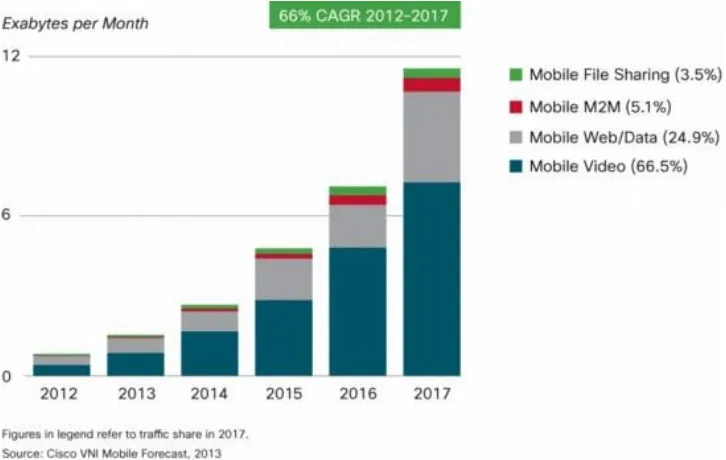
In the last decade the Internet has experienced a tremendous growth of data, especially multimedia contents. According to Cisco VNI (Visual Networking Index), video streaming is dominating mobile communications, exceeding 51% of total traffic by the end of 2012,1 accounting for over two-thirds of total mobile data traffic by the end of 2017, as reported in Fig. 1.1. Thus, video and TV services are fast becoming an important part of users’ lives, resulting in a significant grown of bandwidth used for delivering video contents.
Broadband penetration is increasing dramatically; Telecommunication companies are deploying miles of optical fibers to improve the last-mile telecommunications from neighborhood (FTTN) to fiber-to-the-home (FTTH), offering more and more bandwidth to fiber-to-the-home and business networks; On the wireless side, the fourth generation of mobile communi-cation (4G) offers high speed broadband Internet access, guaranteeing high mobility communications through the Long-Term Evolution (LTE), and the future LTE-Advanced.
1
Figure 1.1: Mobile traffic forecast (Cisco VNI 2013).
TV broadcasters, independent producers, and the end-users themselves are willing to offer their video contents to the Internet community which represents a potential market that makes video streaming more attracting than ever.
Video streaming is a typical multicast application which involves a large number of participants that are willing to receive the same stream of packets. Content providers can rely on the client-server architecture to stream their video contents. Although this architecture is simple to manage and to update, however, it is very expensive to maintain and is not suitable for serving large population of users, which is a fundamental requirement in video streaming systems.
The peer-to-peer (P2P) paradigm promises to solve the content distribu-tion problem through a flexible applicadistribu-tion-level distribudistribu-tion, following the epidemic-style dissemination mechanisms where the stream is divided into small parts, called chunks, and exchanged among peers in a distributed fash-ion, without additional costs. The P2P technology has become increasingly popular to stream video contents, as shown by the success of several com-mercial systems such as PPLive2, PPStream3, UUSee4, and SopCast5.
Given this scenario, the big challenge is to design an efficient and reliable peer-to-peer content distribution system which enables users to enjoy their video contents anytime and anywhere.
1.1.1 Video Streaming Multicasting
Media streaming refers to a process of delivering multimedia content, such as video streaming, to a group of users called participants. The content is streamed regarding timing and quality constraints, and the main problem regards an efficient distribution process that satisfies the corresponding con-straints and application requirements.
Basically, video streaming contents can be classified in two groups: on-demand and live. In on-on-demand video streaming, called Video on-Demand (VoD), contents are pre-recorded and stored in one or more servers, and their size is fixed and well known, making VoD similar to file transfer: the content can be partially buffered or completely downloaded before being watched, and timeliness constraints are not critical. Thus, the content can be played and paused by users, as well as rewound or fast-forwarded: users can navigate the content. For instance, users can download the episodes of their favorite TV Series at anytime, and watch them in the evening or during the weekend,
2
www.pptv.com 3
www.ppstream.com 4
www.uusee.com 5
Figure 1.2: On-demand video streaming.
whenever they want. Netflix and Hulu are two companies that offer Video on-Demand both ad-supported and at monthly price.
In live video streaming, as represented in Fig. 1.3, the content to stream is generated during the execution of the corresponding event (e.g., football match), making the content available at a certain time for all the users, for instance when the football match starts, and cannot be fast-forwarded.
Therefore, the size and the number of video packets that will be sent to participants are not known a priori, making the video distribution more challenging than in Video on-Demand. These characteristics emphasize the timeliness constraints of live streaming, affecting the quality experienced by customers: users are willing to watch the football match without interrup-tions, enjoying a sharp and clean live stream. Perhaps, they can wait a handful of seconds to establish the stream, buffering a few seconds, then, they are very demanding on its quality.
Live video streaming are delay sensitive services, reflecting the “play while downloading” model. The contents must be delivered within a limited delay, otherwise can be discarded, resulting in a wasting of time and resources. The source node can stream the content at different data rates and video formats, resulting in several channels, related either to the network resources or to the devices available at participants. For instance, TV broadcaster might distribute the same channel on regular and the High Definition (HD) quality, and the latter requires more resources.
Thus, there is a trade-off between the target video quality and the amount of resources employed.
1.1.2 IP Multicast
IP Multicast [80] provides a scalable point-to-multipoint delivery service for those applications that involve groups of users. IP Multicast delivers traf-fic from a source host towards multiple receivers, consuming less network resources than any other solution.
In particular, users announce their interest to join a multicast session to routers by subscribing to the corresponding multicast group address through the Internet Group Management Protocol (IGMPv3) [21]. After a router re-ceives a membership subscription, it joins the corresponding multicast group address, being part of the multicast overlay. Then, it receives the data pack-ets associated to the multicast group address, and it will forward such data packets towards the users interested in that multicast group. The multicast routing protocols enable only a subset of multicast routers to forward the multicast traffic towards the hosts or other routers, resulting in an overlay topology, usually a spanning tree, on top of the physical network.
Multicast routing protocols can be classified in two categories: source-based and core-source-based. In source-source-based multicast routing protocol, the source of the multicast session is the root of the multicast tree. Core-based multicast protocols construct a shared multicast tree for each multicast group, having a rendezvous point as the root of the tree. The multicast tree is shared among all the source nodes of the same group. Each source-node sends the multicast data to the core node that forwards such data to the shared tree.
There are several multicast routing protocol, they include Protocol In-dependent Multicast Sparse Mode SM) [34], PIM Dense Mode (PIM-DM) [14], Distance Vector Multicast Routing Protocol (DVMRP) [102], Multicast Open Shortest Path First (MOSPF) [75], Border Gateway Multicast Protocol (BGMP) [59], Core-Based Trees (CBT) [15], and many other protocols.
Figure 1.4: IP Multicast over a source-based tree topology.
However, IP Multicast suffers of several issues [33], they include assigning permanent and temporal multicast address, multicast data integrity mech-anism, multicast access control, security and protection on multicast routes and sessions, group management, and sender authorization. In addition, sev-eral Internet Service Provides (ISPs) used to disable multicast in their core routers, or filter multicast traffic, or their backbone routers are too old to support multicast. Therefore, the IP Multicast service suffers of several issues and it is not yet available on the Internet.
1.1.3 Client-Server Architecture
The client-sever paradigm is the most common centralized computing archi-tecture where servers and clients are connected through IP unicast connec-tions, as depicted in Fig. 1.5.
Figure 1.5: The client-server architecture.
Content providers might distribute their video contents through the client-server architecture, mainly because it is easy to set up and simple to maintain and to update. However, in order to guarantee the service availability and reliability, they have to reserve a noteworthy collection of resources from hardware resources to human resources, resulting in a significant investment of money.
In addition, the client-server architecture provides the access to only a limited number of clients, until the server’s resources are saturated, limiting significantly the number of clients that will access to the video streaming service. Thus, the client-server model might be expensive to maintain and does not scale with the number of clients, being available to only a subset of clients, that is in contrast to the actual objectives of content providers.
1.1.4 Content Delivery Networks
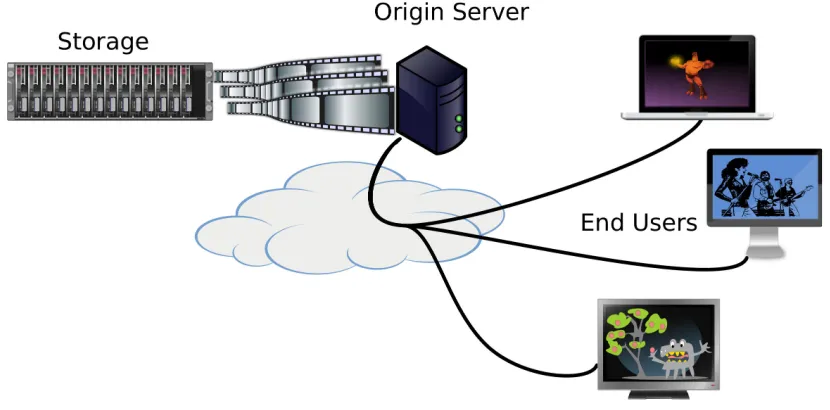
A Content Delivery Network, such as Akamai, Weebo6, and CoralCDN7, consists of a collection of network and storage resources spanning the Inter-net. The origin server pushes the content over several servers that are placed strategically at the network edges, offering a transparent and efficient deliv-ery to the clients, reducing significantly the latency at the end-users. This
6
www.weebo.it 7
Figure 1.6: A content delivery network infrastructure.
architecture allows to distribute the burn of the clients traffic over several servers, reducing the load at the origin server and the network congestion, as well. Thus, CDNs overcome the limits of the client-server model by providing more servers, multiplying the amount of available resources, increasing the number of clients served [58].
Several content providers, such as USAToday8 and New York Post9, moved their Web sites to CDNs, obtaining fast, reliable, and scalable content deliv-ery. Nowadays, video content providers and TV broadcasters, such as RAI10, BBC11, and CBC12, leverage on CDNs to provide their contents, for instance full-length shows, movies, and TV series.
Although the CDN technology employs more resources than the client-server architecture, however, such resources are limited and might be insuf-ficient to sustain the video streaming service, in terms of number of partici-pants, number of video channels, and video quality data stream. In addition, small content provides, such as local TV broadcasters and radios, or
indepen-8
www.usatoday.com 9
www.nypost.com 10
www.rai.tv 11
www.bbc.com 12
Figure 1.7: The peer-to-peer architecture.
dent filmmakers, cannot benefit of CDNs advantages because of their cost, that is not affordable for such small-medium content providers.
1.1.5 Peer-to-Peer Technology
The basic philosophy behind the peer-to-peer paradigm is to promote co-operation among end-users exploiting their resources: end-users behave as client and server at the same time, they are completely equivalent, namely peers. In particular, peers not only download data from the network, but become active entities of the distribution process by employing their band-width resources to upload the downloaded data to other peers, resulting in a significant load reduction at the origin server, as depicted in Fig. 1.7; Hence, the P2P paradigm addresses the resources bottleneck by employing the peers’ ones.
The peer-to-peer technology owes its popularity to file sharing which aims to disseminate data files on the Internet in a distributed fashion. Today, emule13 and BitTorrent14 are the most used file sharing applications.
Ac-13
www.emule-project.net 14
tually, the P2P technology is employed in several services, including search engines (e.g., Faroo15), Voice over IP (e.g., Skype16), and other applications, representing a noteworthy part [86, 55] of the global Internet traffic.
Recently, P2P video streaming has emerged as a promising solution for Internet video distribution, as testified by the growing success of commer-cial streaming systems such as UUSee, PPLive, SopCast, and many others. Basically, P2P video streaming is characterized by one source node which transforms video flows into data packets that are injected into the P2P net-work. Then, peers establish several connections among them to exchange such data packets as well as additional information that can be helpful to improve the streaming experience.
1.2
Motivation of the Thesis
TV-like video streaming is a typical multicast application because involves a large number of participants that are willing to receive the same stream of video packets.
The actual content delivery can be realized in several ways. IP Multicast is the network solution which allows to deliver the same stream of packets to multiple receivers. Multicast packets are replicated by the network routers, without adding any additional load to the source node, using the least net-work resources needed. Unfortunately, the Internet Service Provides (ISPs) used to filter multicast traffic or to disable multicast protocols in Internet routers, making IP multicast unfeasible to distribute multicast traffic (e.g., video content) on the global Internet.
15
www.faroo.com 16
The client-server paradigm is suitable to manage several permanent con-nections, emulating the IP Multicast through multiple IP unicast connections from the server to each client. However, when the population of clients in-creases, the number of IP unicast connections grows dramatically, and the server can either reduce the amount of resources (e.g., bandwidth) dedicated to each unicast connection (i.e., user), or reject clients connections, resulting in a quality degradation or a denial of service, respectively. The incapacity to scale with the number of clients and the limited amount of available resource at the server, make the client-server architecture unsuitable for delivering live streaming content to millions of end-users at any time.
The Content Delivery Networks (CDNs) overcome such limitations by deploying high speed array of servers, actually providing more resources than the client-server model, enabling the system to sustain more clients. However, content providers have to paying a fee for each GB delivered, which can be expensive for small-medium content providers.
In recent years, the Peer-to-Peer technology has emerged as a promising solution for Internet video distribution. This technology i) leverages the resources available at the end-users, revealing great potential to scale and ii) does not require any additional support from Internet routers and network infrastructure, resulting in a cost-effective and easy to deploy solution.
Given this scenario, the big challenge is to design an efficient and reli-able mesh-based P2P streaming system, shedding an insightful light on the diffusion schemes and network parameters employed in video distribution, enabling end-users to experience their video contents anytime and anywhere.
1.3
Structure of the Thesis and Contributions
As outlined discussing the motivation, this thesis deals with protocols and scheduling strategies for unstructured P2P streaming systems, with particu-lar attention and reference to particu-large-scale, real-time applications like TV.
Chapter 2 reviews the state-of-the-art in peer-to-peer application-level multicast systems, describing what has been proposed so far in the literature to tackle the research problem described in Section 1.2.
Chapter 3 presents our research work, introducing a new class of hybrid protocols that alternates data dissemination via push with missed data re-covery via pull, this contribution is summarized in Section 1.3.1.
Chapter 4 points out the issues that prevent the Protocol Independent Multicast protocol family to work on Wireless Mesh Networks, proposing a solution to tackle such issues and evaluating the Wireless-PIM protocol. Then, the hybrid protocols are applied to video multicast session in Wireless Mesh Networks, where the push is performed via standard multicast delivery, while the pull is used to recover missed data packets in a P2P fashion. This work is reviewed in Section 1.3.2.
Finally, concluding remarks and insights about future possible research directions are provided in Chapter 6.
1.3.1 Hybrid Push/Pull Protocols in P2P Networks
This section focuses on a new class of protocols that combines push and pull diffusion schemes, called hybrid Push/Pull protocols. The class is known as mesh-based swarming Push/Pull systems or interleave protocols;
The first contribution examines both synchronous and asynchronous mod-els, exploring the impact of protocols parameters, such as overlay connectivity type, peers bandwidth, and active neighborhood size, trying to identify the efficiency of such simple protocols under several scenarios, gaining insight to design the next protocol generation with performance and efficiency in mind. The result of our study shows that hybrid protocols can work with-out having additional information on the other peers, being suitable for high churn scenario, because a piece negotiation occurs before the actual transfer. Moreover, the overlay connectivity type (i.e., asymmetric or symmetric) has no influence when the neighborhood degree is greater than 12 peers. Fur-thermore, it is shown that the round-trip-time delay (RTT) is an important parameter to take into account for delay sensitive systems, and can be em-ployed in peer selection algorithms to promote communication among closest neighbors, leading to a reduction of the chunks diffusion delay.
(i.e., file-based communications) as well as high-bandwidth delay sensitive media streaming, such as live video streaming and IPTV.
1.3.2 Cooperative Multicasting in Wireless Mesh Networks
The second contribution is divided in two parts. The first part analyzes the problem of extending the Internet multicast protocols to wireless mesh networks, in view of the third contribution. In particular, it focuses on the standard Protocol Independent Multicast (PIM) protocols family. Such a protocols family has been dismissed as non practical, or non feasible, assum-ing its straightforward application on wireless networks.
This contribution shows that the PIM standard based implementations improperly interact when employed across wireless mesh networks and iden-tifies the issues that prevent the PIM protocols to work on such networks.
It proposes a solution which do not require the actual modifications of the standard, but require only minor modifications of the underlying protocol implementation, yielding to the Wireless-PIM-DM protocol version.
Then, an evaluation study is addressed through the Wireless-PIM-DM protocol implementation in a network modeled by using the ns-3 simulator program. Such a study investigates on the performance of a wireless mesh network with full static mesh nodes that serve a multicast session to either static or roaming users.
The performance results show that the Wireless-PIM-DM protocol works properly and efficiently across wireless mesh networks, and this protocol scales with the number of clients. In addition, a multicast video stream-ing session is run on PIM, showstream-ing that PIM achieves effective throughput and packet delay performance behavior.
Push/Pull protocols previously explored in the Internet scenario to wireless mesh networks.
In particular, end-users receive the multicast data packets in push; Then, such users build their local neighborhood through hello messages, or any gos-siping protocol, retrieving missed chunks via pull through unicast messages to 1-hop neighbors, exploiting spatial diversity and higher unicast data rates. The key idea is to complement the standard multicast delivery protocol (i.e., push), by enabling a peer-to-peer mechanism to recover (i.e., pull) a small fraction of missed data packets from nodes’ neighborhood.
The results show a significant increase of the fraction of peers reaching the target quality, that is 95% of chunks, showing also a rather low chunks diffusion delay.
Finally,PullCasthas been evaluated in highly structured mesh network, where the chunks recovery is limited to the equivalent of an 802.11 BSS, and in more complex scenarios, where the mesh nodes offer connectivity to clients in a seamless network using a single radio channel, showing that PullCast improves the system performances in both scenarios.
1.3.3 GRAPES: A Generic Library for P2P Streaming
The last contribution presents the GRAPES library. GRAPES (Generic Resource-Aware P2P Environment for Streaming) is an open-source library that provides basic functionalities for building P2P streaming applications. GRAPES aims at providing a working codebase that can be easily modified to experiment with and to integrate novel ideas, addressing the problem of rewriting the whole application for any solution to test.
Currently, GRAPES is the core library of PeerStreamer17, an Open Source P2P Media Streaming Framework. Indeed, PeerStreamer is today one of the
17
most diffused Open Source systems for P2P TV and streaming applications and its use by researchers and practitioners is increasing steadily.
1.4
Topics Outside the Scope of the Thesis
There are important issues related to content distribution that are outside the scope of the thesis:
Overlay Discovery and Management. One of the main assumptions in P2P
systems is that peers can easily get in touch with all the other peers involved in the same video streaming session. Indeed, such systems employ several mechanisms to discover the overlay network topology. For instance, gossip-ing protocols [48, 100] can be used to complement the overlay management protocol, discovering peers belonging to the same streaming session. Then, the overlay management protocol selects a subset of nodes to populate and update the neighborhood set to communicate with.
Cooperation and Incentives. The P2P paradigm works on the premise that
BitTorrent-like distributions and has been revised for video streaming appli-cations [87].
Content Integrity and Pollution. The P2P paradigm assumes the peers
hon-esty, however, it cannot guarantee such trustfulness. Peers may intentionally pollute the content by introducing errors or distributing modified data, yield-ing in a waste of time and resources to distribute wrong data packets [32]. A simple mechanism to avoid content pollution is to diffuse chunks digi-tally signed by the source node, allowing peers to decrypt the chunks signa-ture, discarding wrong packets. In addition, peers may banish that malicious neighbors that have injected or sent polluted data, diffusing their identities in the system.
Network Coding. Network coding allows intermediate nodes to encode data
packets in order to perform error correction, exploiting cooperation among nodes: a client should receive enough linearly independent combinations of packets to reconstruct the original content,[25]. For instance, wireless links (e.g., WiFi) suffer from packet loss due to signal attenuation and interference, and network coding can be employed to address such a problem over lossy networks.
Security and Privacy. P2P systems are vulnerable to attack by malicious
peers, guaranteeing that their information (e.g., peer’s history) are properly collected, used, and maintained.
Wireless Physical Layer. Live streaming over wireless networks has more
State-of-the-Art
2.1
P2P Live Streaming
Peer-to-peer networks are emerging as cooperative solution to provide scalable, reliable, flexible, and cheap to deploy multicast service at the application-level. P2P systems designed for live video streaming are very different than those designed for file sharing; Despite of file sharing systems, where the content is open after being downloaded, in live video streaming sy-stems the content is play while downloading, introducing more requirements and constraints, where the main bottleneck is the uplink bandwidth. Such systems aim to deliver each piece of content within its deadline, through a clever resource management, avoiding content blackout, in order to provide high quality of experience to users.
2.1.1 Principles
A peer-to-peer network consists of a group of nodes that communicate and cooperate among them to achieve a common interest, e.g., video streaming service. Such nodes are logically connected among them through virtual links, implementing a network abstraction over the underlying physical topology, namely overlay network. Hence, each peer maintains a list of peers that form its neighborhood: the overlay manager module is in charge of populating and updating such a list of neighbors. Therefore, peers establishes commu-nications with their neighbors, exchanging video packets and information.
Figure 2.1: From video content to chunks.
Despite of peers, several entities can be involved in the P2P network. For instance, file sharing systems employ dedicated servers to provide the indexing services used to search files. Therefore, some services, critical or not, might be provided or supported through dedicated servers, which are easier to manage and update, while the data exchange is realized directly between peers. Such systems that include external entity, for instance servers, are called hybrid P2P systems, while pure P2P systems consists of only regular peers, without any external entities.
swarm-ing paradigm: the video stream is divided in piece of data of a limited size, called chunks. Hence, such nodes are called source nodes because they are the actual entry point of the media stream into the network. The source node encapsulates one or more chunks in IP packets that will be sent towards the P2P network, as depicted in Fig. 2.1. Afterwards, whenever a new chunk is generated, this fresh content is received by a few peers that will redistribute such information towards the other peers.
2.1.2 Overlay Topology
In a P2P network peers are logically connected among them. Such virtual connections are related to the underlying physical topology, resulting in an overlay network, as depicted in Fig. 2.2.
Layer Network
Overlay
IP Layer
Figure 2.2: The overlay network layer.
Structured Systems
In structured systems, the overlay management protocol entails a fundamen-tal role, aim at building the tree structure multicast overlay, as shown in Fig. 2.3. The video source node is the root of the tree and peers establish parent-child relationships among them: each peer has exactly one parent node, while internal nodes become k degree parents, connecting to at most
k children;
Figure 2.3: Tree-based overlay network.
Unstructured Systems
In unstructured systems peers are connected between them in a mesh topol-ogy, establishing neighborhood relationships, as show in Fig. 2.4. Such con-nections can be either symmetric or asymmetric, resulting in a directed or undirected graph, respectively. Mesh topologies are more resilient to peers departures than tree-based systems, because a peer departure results in an edge removed in the graph that can be replaced by adding another peer (i.e., edge) in the corresponding neighborhood.
Figure 2.4: Mesh-based overlay network.
A comparative study between tree-based and mesh-based performance reveals [71] that swarm-like distribution in mesh-based overlay exhibits a su-perior performance. First, swarm-like distribution reduce the impact of low bandwidth peers. In case of tree-based overlay, the descendant peers of low bandwidth parents experience content bottleneck, affecting the correspond-ing sub-tree. Opposite is the case of mesh-based systems, where peers can fetch the video packets from alternatives paths, obtaining such packets from their neighboring nodes. In addition, mesh-based systems are more resilient to network dynamics than tree-based ones which require to re-organize the whole distribution overlay.
2.1.3 P2P Streaming Architecture
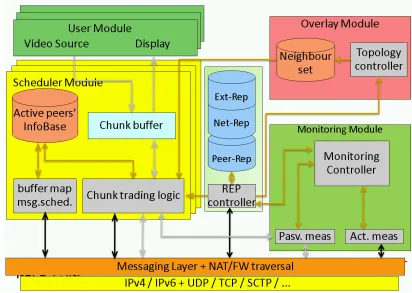
In a live streaming session, peers run the same P2P system, which consists of several modules. The NAPA-WINE project has defined an high-level system architecture [18], that include the user, the scheduler, the overlay, the mon-itoring, the information repository, and the messaging layer module. This architecture is shown in Fig. 2.5.
The relevance of each module is related to the overlay topology employed. For instance, in tree-based systems the overlay manager is the core module because it is in charge of establishing and maintaining the content distri-bution tree; In mesh-based systems the content distridistri-bution engine is the scheduler module. Thus, such modules interact among them, defining peers behavior and interactions, applying rules and algorithms to the content dis-tribution.
User Module This module is in charge of receiving the video stream from
Figure 2.5: The NAPA-WINE architecture.
Furthermore, the user modules might provide information about the streaming quality experienced by the users.
Monitoring Module P2P systems often fail to notice the importance of the
underlying network conditions, the dynamic countermeasure made by ISPs to tackle such traffic, and the possibility to combine such network measurements to design a network-aware systems.
Overlay Module The main task of this module to create and maintain the
peer Neighborhood, which populates this set with a large number neighbors, guaranteeing resilience and flexibility to overlay dynamics and session switch. Moreover, each streaming session has its corresponding overlay network; Thus, whenever the peer switches from one streaming session to another one, this module has to rebuild the local peer Neighborhood for the new streaming session.
Repository Management Information are very helpful to perform wise
op-erations. This module stores information and statistics about peers status, environments, and resources in a centralized database.
Such information can be used by several entities. For instance, peers can enhance their neighborhood, or improve the session switching mechanism, network providers can tune the resources allocated to the P2P network, and content providers can evaluate the impact of their contents.
Scheduler Module The scheduler is the core of the distribution process in
mesh-based systems. It interacts with the other entities of the system, inte-grating the information gathered from the other peers, with network param-eters and measurements, as well as the information provided by the overlay manager, and the current peer state.
Furthermore, the order of executing such algorithms provide another clas-sification, based on whether the chunk is selected before the peer, or vice versa, stressing the diffusion more on the chunks or on the peers, respec-tively.
2.1.4 Requirements and Trade-off
This section describes the main requirements of P2P live streaming systems and the corresponding trade-offs.
Startup and Buffering Delay. P2P systems usually underestimate the
start-up phase. Whenever a peer join the networks, the overlay-discovery operation is done, collecting information about other peers. Then, the peer receives data packets from the P2P network, establishing connections to exchange such packets, and, after a short time, the playout at the peer starts. Thus, the peer experiences i) the join and overlay-discovery delay, becoming part of the P2P network and ii) the buffering delay, collecting enough chunks to play the video. Some resources can be dedicated to minimize such delays, increasing the quality perceived by users. Similar observations can be applied for channel switching.
Scalability. P2P systems are supposed to scale with the number of
Overlay Management and Reliability. P2P systems employ several
proto-cols, such as gossiping protoproto-cols, discovering a partial view of the overlay network topology. Such protocols can be employed to identify changes in the network topology. In particular, peers can leave the network at any time, in graceful or ungraceful (e.g., failure) ways. The dynamics of the network, characterized by peers that continuously join and leave the network is called churn. Whenever a peer leaves the network, it brings its resources and the received content away from the network, possibly leaving obsolete informa-tion about its actual presence into the network. Thus, P2P system has to address the churn problem, limiting its impact on the overall system, possi-bly promoting connections among stable peers, limiting the effects of network dynamics on video quality experienced by users.
Quality of Experience. Quality of Experience (QoE) describes the quality
of multimedia and video services. The most common metrics [20, 68] used to estimate the QoE are the chunk delivery delays, the playback rate, the fraction of chunks received, as well as the peak signal-to-noise (PSNR) ratio. The latter measures the distortion between the received video image and the original one. However, QoE is influenced by additional factors [103], such as the users quality expectation and users attention.
2.2
State-of-the-Art Solutions
are aggressive in consuming peers resources, especially bandwidth. Hence, several techniques can be employed in content distribution systems, leverag-ing either on the network topology and the information exchanged between peers, to optimize the resources utilization (e.g., bandwidth).
The following sections surveyed the state-of-the-art of P2P streaming sy-stems that have been proposed in the literature as follows. Section 2.2.1 reviews the tree-based systems while Section 2.2.2, instead, describes mesh-based ones, and Section 2.2.3 discusses the combination of tree-based and mesh-based systems, namely hybrid systems. Finally, Section 2.2.4 presents the NAPA-WINE architecture.
2.2.1 Tree-based P2P Streaming Systems
DONeT [111] (Data-Driven Overlay Network) organizes nodes in a dynamic tree, depending on data availability. DONeT consists of the membership manager, to preserve a partial knowledge of the overlay network and ex-changing buffer map among peers, the partnership manager, to maintain collaboration with other active nodes, and the scheduler, to schedule data transmissions towards suitable suppliers. Although such an adaptive behav-ior, i.e., nodes selects best partners, leads to nodes clustering, which depends on their buffer maps, it may lead to unbalanced-tree that affects end-to-end delay while the buffer map exchange increases the overhead in the network.
CoolStreaming is the commercial implementation of DONet. In [110] the authors presents an empirical study on CoolStreaming, investigating on users’ behavior, their correlation, and the perceived video quality; Next, the authors redesigned [105] the system, introducing a pull-push mechanism, adopting sub-streams, multi-source, and multi path delivery, to reduce the content diffusion delay, and introducing multiple servers to boost join procedure.
net-work access. In addition, they collect and analyze real traces of live event, in-vestigating on several system parameters, such as the packet block size, num-ber of sub-streams, peers uplink capacity, partner set size, and start-up time. ZIGZAG [92] is a single source tree-based protocol, which guarantees a bal-anced tree. ZIGZAG employs an administrative module to separate the main-tenance and the data layer. Thus, whenever a parent left the data delivery tree, the administrative part recoveries such a departure, handling ungraceful node failure, at a price of protocol complexity and signaling overhead.
PROMISE [39] is a video streaming implementation on top of the P2P application-level service CollectCast [40]. CollectCast gathers information of the underlying network topology, such as bandwidth variation, end-to-end delay, and peers failure. In PROMISE a session is established whenever a peer requests a content: first the receiver performs a look-up request to the underlying network that provides a collection of peers that can supply the requested content. Then, it constructs the topology and fills active and standby set, connecting active candidates to the receiver that establishes parallel connections towards all such active senders, using the standby set as a backup.
SplitStream [25] is a multi-tree system that splits content in several stripes, e.g., k stripes, delivering each stripe on a separate tree. Peers join as many tree as there are stripes they wish to receive. SplitStream uses the multi-tree topology to exploit leaves’ bandwidth: each node is an internal node only in one tree, being a leaf in the others. SplitStream employs MDC where each stripe is a description and a parent node failure implies the loss of at most one description. However, such a protocol is built on top of a tree structure, suffering of all the issues related to tree topology: maintenance, reliability, node failure detection, and recovery.
of traffic which overload the queried server. When a flash crowd occurs, the bandwidth is the main bottleneck, and when the server provides dynamic web pages, the CPU becomes another bottleneck. The same authors proposed a revised version of CoopNet [98] for distributing media content among peers. The original architecture has been converted in an hybrid-P2P system where the server provides contents to peers and maintains also a list of peers served and contents provided to them. When the server is going to be overloaded by peers requests, it redirects such peers to those that have already received the corresponding content before: Such a mechanism produces a set of tree rooted at the source, where peers forward contents to the others, using Multiple Description Coding (MDC) schemes to reduce the churning effects.
ChunkySpread [99] is a multi-tree system which leverages on frequent signaling messages to dynamically changing parents node, in order to fulfill load balancing and reducing latency delay. Furthermore, it provides a loop detection mechanism based on bloom filters.
2.2.2 Mesh-based P2P Streaming Systems
amount of data, (v) signaling messages does not suffer any queuing delay and is processed immediately. In addition, the source server corresponds to the bootstrap node, thus, churn phases may overwhelmed the source, increasing the pull response time.
So far, several mesh-based systems which combines scheduling policies and overlay management protocols have been proposed in the literature [67, 69, 73, 36].
In [29] authors investigate on the performance improvements achieved by exploiting information on peers’ upload bandwidth in the overlay topology construction, as well as the peer selection, leading to a reduction of the the chunk distribution delay.
A new chunks trading scheme based on the offer-select messages has been proposed in [24]. Actually, the offer-select mechanism is a three-phase proto-col: i) each peer advertises the chunks it possesses through an offer message towards neighboring nodes, ii) the latter reply with a select message which contains the subset of chunks they are willing to receive, and iii) finally, the original peer collects a sequence of selected chunks in their outbound queue, which are sent and Ack-ed, and before the transmission queue empties, a new offer-select cycle is started. The combination of dynamic chunks trad-ing and transmission queue enable nodes to utiliztrad-ing the upload bandwidth efficiently, improving the overall system performance in terms of delay and lost video packets.
Another comparative study [66] focuses on both simple and sophisticated algorithms, evaluating five different protocols on the source rate, the band-width usage, buffering techniques, and other metrics. They start from a simple random pull protocol which avoids wasting transmission due to chunk duplicates, introducing a pull-token mechanism to publish bandwidth avail-ability, so peers may reply either pulling a sequence of pieces or notifying that they have the same chunks. The authors compare simple and complex sched-ulers, showing that streaming quality is not scheduling-dependent in presence of low streaming rate and are wide playback delays; On the other side, by increasing the streaming rate, the delay constraints become too strict, and the intelligence of the scheduler is fundamental. Finally, they also observe that systems which guarantee high streaming rate with low delay are too complex and need some particular conditions (e.g., full-mesh overlay), and the source’s bandwidth is crucial in such systems because increases chunks diffusion noteworthy as well as rich peers (e.g., good heterogeneity) that have more bandwidth than the others.
Pulse [79] uses a pull technique and builds a general mesh topology with a complex neighborhood structure for each node, trying to favor a distribution of nodes such that more endowed nodes are closer to the source and help an efficient distribution.
2.2.3 Hybrid P2P Streaming Systems
a peer successfully receives a packet belonging to a given sub-stream via pull, it sends a sub-stream subscription, asking the target peer to directly push the chunks of that sub-stream. The pull mechanism is used when a packet expected in push is not received within its deadline. This protocol builds a push-tree for each sub-stream, with all the problems related to the tree structure, thus, nodes departures may cause starvation and pull overhead to recover from such failures.
In Prime [70] participants form a randomly connected and directed mesh where each peer has multiple parents and child peers. The parents are assigned randomly and incoming and outgoing connections of each peer have different path in order to reduce the probability of a shared bottleneck among them. Receivers “drive” the distribution, which means that also in Prime the basic mechanism is pulling information from other nodes. This system produces a significant amount of traffic due for reporting periodically new chunks received, and during churn phases the bootstrapping node may be overwhelmed.
2.2.4 The NAPA-WINE Architecture
The NAPA-WINE1 (Network Aware Peer-to-peer Application over WIse NEtwork) project proposes an innovative architecture [18] for High Qual-ity P2P live streaming applications [63] over unstructured networks. Such an architecture promotes cooperation between the application level and the underlying network layer to offer high quality streaming service to users, limiting the impact of the P2P application on the underlying network. This solution introduces the monitoring module to collect real time information on the network conditions and users’ video experience. Such information are helpful to improve the actual content distribution, and can be used locally by each peer, to reconfigure the scheduling policies, to modify the overlay
1
topology, or by the source node to tune the content distribution. In addi-tion, such information can be stored in a shared repository that can be used by the network providers (i.e., ISPs) to improve the P2P distribution. In-deed, the NAPA-WINE project did not limit its work to only propose such an architecture, it actually implements PeerStreamer:2 an open source P2P media streaming framework.
2
Understanding Hybrid P2P Push/Pull
Protocols
3.1
Introduction
The rise of Peer-to-Peer (P2P) communication paradigm seems to be the next big thing in Internet services. After the initial phase, where legal con-cerns about illegal exchanged content hampered the diffusion, the key idea of sharing resources to improve the common benefit of users is gaining momen-tum, and service providers are modifying their business plans and strategies to ride the rising tide.
Traditional approaches for peer-to-peer streaming systems propose streaming on either structured or unstructured overlays. The former are characterized by parent/children relationships over a tree-structure, where the information flow [25] through the multicast tree, pushed from parents to children. On the other side, in unstructured overlays peers are organized in mesh topology where they either push [79, 70] to or pull [109] information from their neighbors, depending on the diffusion scheme and the algorithms employed. Among these systems, those based on swarm-like distribution of the chunks over unstructured overlays are the most successful, (see for in-stance commercial applications like PPlive, SopCast, UUsee, TVAnts, etc., or scientific literature [93, 70]). Early performance works [23,22,17,19] pro-pose new semi-analytic techniques to explore fundamental properties of the topology used by P2P overlays as well as the protocols used to build them. Indeed, some recent works [71, 20, 29] use the push scheme in unstructured overlays, that have superior performance than structured ones, hinting to the fact that the structure of the overlay and the information distribution process are not necessarily coupled.
Two recent works [69,85] proposed a system called Interleave where nodes are synchronized and alternate regularly push and pull phases where push is used to disseminate fresh content to target nodes while pull is used to retrieve missing information. The proposal is appealing because of good asymptotic performances, and because it reduces almost to zero the need for signaling. However, all the analysis is based on asymptotic assumptions and synchronized, cycle-based operation.
Interleave was designed mainly for P2P file transfer. The analysis of the scheme made in [85] was done considering that all the nodes in the network are homogeneous and synchronized, i.e. the download time of a single piece is the same for all nodes and the time is slotted. Authors of [85] found that the file dissemination time of Interleave is within a constant factor of the optimal performance of a fully centralized system. A major concern is whether the good performance of Interleave is due to synchronization and bandwidth homogeneity or not. Also, while [85] speculates that Interleave may be used for live streaming, it does not further investigate this issue.
In this work, we translate the synchronous scheme into a fully distributed asynchronous protocol, where nodes in the network behave independently, without any coordination, actually introducing a new class of asynchronous push-pull protocols for live video streaming systems. Thus, we compare syn-chronous and asynsyn-chronous models, and evaluate the impact of protocols parameters, such as the dimension of the active neighborhood, and the influ-ence of topologies, such as symmetric or asymmetric topologies, identifying the efficiency of such very simple protocols in different scenarios, gaining in-sight to design the next protocol generation with performance and efficiency in mind. Then, we focus on understanding the interactions between push and pull phases, we explore the importance of parallel download and possi-ble choice on chunks to either push or pull. Finally, we investigate on the impact of upload bandwidth, the role of push and pull diffusion schemes, and the importance of network parameters, in particular, the round-trip-time, evaluating a peers selection algorithm that promote communications between closest neighbors.
Interleave, which is a combination of pull and push and it does not maintain information about the pieces owned by nodes, can already provide such a good performance. The notation used in this chapter is reported in TableA.1. The remaining part of this chapter is organized as follows. Section 3.2 describes the fundamental workout of push/pull protocols, both in a simpli-fied, cycle-based model and in a more realistic, entirely distributed system. Section 3.3 discusses numerical results and fundamental system parameters. Section 3.4 provides some observations on fundamental study of push/pull protocols. Section 3.5introduces the chunks negotiation mechanism and par-allel transmission. Section 3.6describes the performance metrics. The results are discussed in Section 3.7. Section 3.8 reports several comments on the protocol. Finally, Section 3.9 describes a delay-aware protocol to promotes communications among closest peers. The evaluation metrics are reported in Section 3.11 while the experimental setup is described in Section 3.12, and Section 3.13 presents the obtained results. Section 3.14 presents the conclusions and describes future directions.
3.2
Interleave Protocols
We consider a system with a single source, where the content is partitioned into pieces that can be exchanged independently. Pieces are generated at a constant rate Bs, which can be the streaming rate or simply a service rate for a file transfer. Each piece has a sequence number that reflects the order of creation by the source. Each node alternates between pull and push mode, and has a finite size neighborhood N defined by its contact list of size
|N |; the neighborhood of peer Kj is defined as the set of peers that can be contacted actively by peer Kj, i.e., Kj can contact peers only in its contact list, but can be contacted by peers that are outside its contact list.1
1
Inpush mode, a peerKk randomly selects a neighbor and a piece to push; if the neighbor does not have the piece and has available download bandwidth,
Kk uploads the piece, otherwise the push is aborted.
Inpull mode, a peer Kk randomly selects a neighbor and a piece and sends a pull request to that neighbor. If the neighbor has the requested piece and it is currently not uploading to any other node, it accepts the request, otherwise it refuses it.
The piece selection policy represents a delicate part of the design, espe-cially for streaming systems, where each piece should be received within a maximum delay. A random piece selection may work for file distribution, but not for live streaming. Also, ‘intelligent’ selection procedures, like rarest-first and similar, cannot be implemented without state signaling between peers, thus cannot be implemented in a basic push/pull protocol without state. We adopt the same piece selection policy proposed in Interleave [85]:
• In push mode, the node pushes the piece with the highest sequence number among the pieces received via a push from one of its neighbors.
• In pull mode, the node asks for the piece with the lowest sequence num-ber it does not possess. This policy aims to fill the holes within the sequence of pieces.
Interesting features to be explored in the future, include simple choice-based selection policies and strategies to maintain the system without state, thus highly dynamic and resistant to churn.
3.2.1 A Cycle-based Model
The basic scheme described above was initially proposed considering a simplified environment, where all the nodes have the same upload link
bandwidth and unlimited download link bandwidth. It is also assumed that the time to upload a single piece is much bigger than the latency for the exchange of a single (application level) message. Additionally it is supposed that the nodes are synchronized and the time slotted. In even slots all the nodes are in push mode; in odd slots all the nodes are in pull mode.
If the node is in push (pull) mode and the request is accepted by the selected neighbor, the piece is pushed (pulled). At the end of the slot the node switches mode. If the request is refused by the selected neighbor, the slot is entirely wasted, and the node waits until the end of the slot before switching mode (and sending a new request).
The source pushes a new piece in every even slot, and it replies to pull in odd slots. This means that the streaming rate is equal to one piece every two cycles and the required upload bandwidth is 2Bs.
This cycle-based model was employed in [85] to find theoretical bounds for the distribution process, and we use it for comparison reasons. In a realistic scenario, upload link bandwidths are heterogeneous, downlink capacity is not infinite, and imposing synchronization may be impractical (if at all possible), thus a better model is required to understand fundamental properties.
3.2.2 A Realistic Model
The time spent in pull or push mode depends on the success of the requests and on the availability of the bandwidth (both, the neighbors’ and the node’s bandwidth); thus each push or pull interval is not fixed and the nodes, even in a homogeneous case, will be desynchronized.
We stress that this implementation is entirely decentralized and the infor-mation exchange among peers is kept to a minimal level: Keep-alive messages for the contact list management and push/pull queries and answers. Addi-tionally, the goal of this work is not building a new system (not yet at least!), but to gain insight into fundamental parameters like the contact list size, the efficiency of the distribution system (i.e., the ratio between the available bandwidth in upload/download and the streaming or transfer rate). Algo-rithms 1 and 2 summarize the basic operations of a single node related to
sending out requests; Algorithms 3 summarizes the basic operations related to replying to requests. We do not report the pseudo-code for building and maintaining the contact list for the sake of brevity.
Algorithm 1 Interleave: Sending Out Requests in PULLstate.
1: Input: maxP ullAttempts
2: while (pullAttempt < maxP ullAttempts) do
3: n = Select a neighbor//Select a neighbor to Pull
4: c = Select the lowest piece not owned//Select a chunk to recover
5: SendPull(n,c) //Pull chunk c to node n
6: Wait for reply: Run Pull timeout GoToTimeoutExpired
7: if (reply==AcceptP ull) then
8: if (has download bandwidth available) then
9: SendReady(n,c) message
10: Wait for receiving piece: Run timeout GoToTimeoutExpired
11: StartPullingPiece
12: break//exit from the loop cycle
13: else
14: SendBusy(n) message//Node’s downlink is saturated
15: end if
16: end if
17: TimeoutExpired:
18: pullAttempt++ 19: end while
20: status = PUSH
21: pullAttempt= 0 //Reset attempts for the next cycle
3.3
Numerical Results
We have implemented both the cycle-based and the more realistic, asyn-chronous and distributed model in a simulation environment, to explore some fundamental parameters.
The cycle-based implementation works in the same ideal hypotheses of the theoretical analysis in [85] as summarized in Section 3.2.1.
Algorithm 2 Interleave: Sending Out Requests in PUSH state.
1: Input: maxP ushAttempts
2: while (pushAttempt < maxP ushAttempts) do
3: n = Select a neighbor//Select a neighbor to Push
4: c = Select the highest piece owned //Select a chunk to transmit
5: SendPush(n,c) message //Push chunk c to node n
6: Wait for reply: Run Push timeout GoTo TimeoutExpired
7: if (reply==AcceptP ush)then
8: if (has upload bandwidth available)then
9: SendReady(n,c) message
10: StartPushingPiece
11: break//exit from thewhile cycle
12: else
13: SendBusy(n) message//Node’s uplink is saturated
14: end if 15: end if
16: TimeoutExpired:
17: pushAttempt++
18: end while
19: status = PULL
20: pushAttempt= 0 //Reset attempts for the next cycle
not implemented since is would slow down simulation and make the results so complex as to make their interpretation almost impossible.
3.3.1 The PeerSim Environment
PeerSim is a Java based simulator that consists of many configurable compo-nents: It has two types of engines,cycle-based and event-based, and different modules that manage the overlay building process and the transport charac-teristics. In the cycle-based engine, all nodes are synchronized, making it a perfect tool for the implementation of the simple cycle-based model. In each cycle each node is activated sequentially and executes a protocol: There is no concurrency among nodes nor competition for resources. In the event-based
indepen-Algorithm 3 Interleave: Replying to Requests.
1: if (message == PULL)then
2: if (has piecec && has upload bandwidth available)then
3: SendAcceptPull(n,c) message
4: Wait for reply: Run Reply timeout GoTo TimeoutExpired
5: if (reply == READY) then
6: StartPieceUploading
7: end if
8: else
9: SendRefusePull(n,c) message
10: end if
11: end if
12: if (message == PUSH) then
13: if (pieceID missing && has download bandwidth available)then
14: SendAcceptPush(n,c) message
15: Wait for reply: Run Reply timeout GoTo TimeoutExpired
16: if (reply == READY) then
17: StartPieceDownload
18: else
19: SendRefusePush(n,c) message
20: end if
21: end if 22: end if
23: TimeoutExpired:
dent instances of the same class). They can add events in the event list of the simulator, so nodes can compete for resources.
Parameter Value
BU P 128, 256, 512 kbit/s
|K| 102
, 5·102 , 103
|C| 103
, 5·103 , 104
Table 3.1: Parameters used for exploring Interleave protocols.
The simulator contains a transport layer for sending messages from a source to a destination: The layer adds a delay uniformly distributed be-tween a minimum and a maximum value an it can also drop messages with a probability p.
For a detailed description of PeerSim simulator the interested reader is referred to [74]. The software modules developed in this chapter are available at the author’s home page or on request.
3.3.2 Parameters under Study and Settings
The theoretical analysis of the basic Interleave scheme in [85] is done con-sidering a directed random graph with degree |K|= k. Each peer selects its ownk neighbors independently from any other peers and without constraints. Each peer has a contact list of exactly k neighbors, and the probability of being in the contact list of other nodes is binomially distributed with mean
k. We refer to this overlay as asymmetric.
We also define and test another overlay model, where the edges are not directed: In this case we use a constant-degree graph with degreek. Build



![Figure 3.13: Histogram of chunk diffusion delay for Push and Pull mechanism, for BUP ={1.9, 2.4, 2.9, 3.4}, and RTT [10 ÷ 250]ms.](https://thumb-us.123doks.com/thumbv2/123dok_us/577544.2056997/96.595.108.459.138.381/figure-histogram-chunk-diusion-delay-push-pull-mechanism.webp)
