AP
®Physics C: Mechanics
2008 Free-Response Questions
The College Board: Connecting Students to College Success
The College Board is a not-for-profit membership association whose mission is to connect students to college success and opportunity. Founded in 1900, the association is composed of more than 5,000 schools, colleges, universities, and other
educational organizations. Each year, the College Board serves seven million students and their parents, 23,000 high schools, and 3,500 colleges through major programs and services in college admissions, guidance, assessment, financial aid, enrollment, and teaching and learning. Among its best-known programs are the SAT®, the PSAT/NMSQT®, and the Advanced Placement Program® (AP®). The College Board is committed to the principles of excellence and equity, and that commitment is embodied in all of its programs, services, activities, and concerns.
© 2008 The College Board. All rights reserved. College Board, Advanced Placement Program, AP, AP Central, SAT, and the acorn logo are registered trademarks of the College Board. PSAT/NMSQT is a registered trademark of the College Board and National Merit Scholarship Corporation.
Permission to use copyrighted College Board materials may be requested online at: www.collegeboard.com/inquiry/cbpermit.html.
Visit the College Board on the Web: www.collegeboard.com.
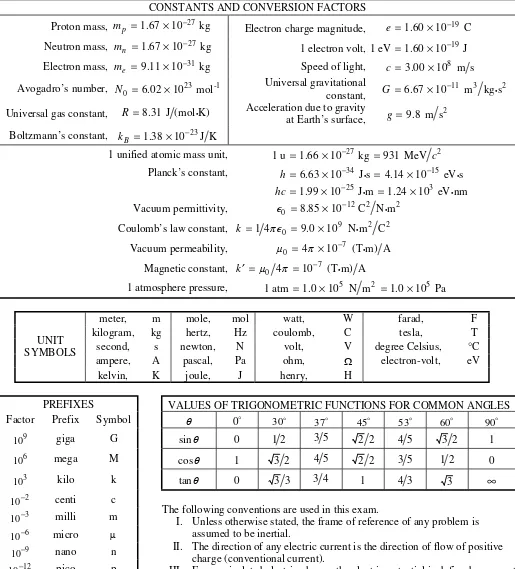
TABLE OF INFORMATION FOR 2008 and 2009
CONSTANTS AND CONVERSION FACTORS
Proton mass, mp 1.671027 kg Electron charge magnitude, e 1.601019 C
Neutron mass, mn 1.671027 kg 1 electron volt, 1 eV 1.601019 J
Electron mass, me 9.111031 kg Speed of light, c 3.0010 m s8
Avogadro’s number, N0 6.0210 mol23 -1 Universal gravitationalconstant, G 6.671011 m3 kg s< 2
Universal gas constant, R 8.31 J (mol K)< Acceleration due to gravity
at Earth’s surface,
2
9.8 m s
g
Boltzmann’s constant, kB 1.381023J K
1 unified atomic mass unit, 1 u 1.661027 kg 931 MeV c2
Planck’s constant, h 6.631034 J s 4.141015 eV s
< <
25 3
1.99 10 J m 1.24 10 eV nm
hc < <
Vacuum permittivity, ⑀0 8.851012C2 N m< 2
Coulomb’s law constant, k 1 4p⑀0 9.010 N m9 < 2 C2
Vacuum permeability, m0 4p 107 (T m) A
<
Magnetic constant, k m0 4p 107 (T m) A<
1 atmosphere pressure, 1 atm 1.010 N m5 2 1.010 Pa5
meter, m mole, mol watt, W farad, F kilogram, kg hertz, Hz coulomb, C tesla, T
second, s newton, N volt, V degree Celsius, C
ampere, A pascal, Pa ohm, W electron-volt, eV UNIT
SYMBOLS
kelvin, K joule, J henry, H
PREFIXES VALUES OF TRIGONOMETRIC FUNCTIONS FOR COMMON ANGLES Factor Prefix Symbol q 0D 30D 37D 45D 53D 60D 90D
9
10 giga G sinq 0 1 2 3 5 2 2 4 5 3 2 1
6
10 mega M cosq 1 3 2 4 5 2 2 3 5 1 2 0
3
10 kilo k tanq 0 3 3 3 4 1 4 3 3
2
10 centi c 3
10 milli m 6
10 micro m 9
10 nano n 12
10 pico p
The following conventions are used in this exam.
I. Unless otherwise stated, the frame of reference of any problem is assumed to be inertial.
II. The direction of any electric current is the direction of flow of positive charge (conventional current).
ADVANCED PLACEMENT PHYSICS C EQUATIONS FOR 2008 and 2009
MECHANICS ELECTRICITY AND MAGNETISM
0 at u u 2 0 0 1 2
x x u t at
2 2
0 2a x x0
u u
net m
ÇF F a
d dt p F dt D
Ô
J F p
m
p v
fric
F mN
W
Ô
Fdr2
1 2
K mu
dW P
dt
P F vⴢ
g U mgh D 2 2 c a r r u w r F t net I
Ç t t a
2 2
I
Ô
r dm Çmrcm Çm Çm
r r
r
u w
I
L r p w
2
1 2
K Iw
a = acceleration
F = force
f = frequency
h = height
I = rotational inertia
J = impulse
K = kinetic energy
k = spring constant
A = length
L = angular momentum
m = mass
N = normal force
P = power
p = momentum
r = radius or distance
r = position vector
T = period
t = time
U = potential energy
u = velocity or speed
W = work done on a system
x = position
m= coefficient of friction
q = angle
t = torque
w= angular speed
a = angular acceleration
s k
F x 2 1 2 s U kx 2 1 T f p w 2 s m T k p 2 p T g p A 1 2 2 ˆ G Gm m r F r 2 1 2 0 1 4 q q F r p⑀ q F E 0 Q d
Ô
E Av
⑀ dV E dr 0 1 4 i i i q V rp⑀
Ç
1 2 0 1 4 E q q U qV r p⑀ Q C V 0A C d k⑀ p i i
C
Ç
C1 1
s i i
C
Ç
CdQ I dt 2 1 1 2 2 c
U QV CV
R A rA r E J d
I Neu A
V IR
i i
s
R
Ç
R1 1
i i
p
R
Ç
RA = area
B = magnetic field
C = capacitance
d = distance
E = electric field
e
= emfF = force
I = current
J = current density
L = inductance
A = length
n = number of loops of wire
per unit length
N = number of charge carriers
per unit volume
P = power
Q = charge
q = point charge
R = resistance
r = distance
t = time
U = potential or stored energy
V= electric potential
u = velocity or speed
r = resistivity
m
f = magnetic flux
k = dielectric constant
0
d m I
Ô
Bv
ᐉ 0 3 4 I d d r m p r B ᐉI d
Ô
F ᐉ B
0 s
B m nI
m d
f
Ô
B AADVANCED PLACEMENT PHYSICS C EQUATIONS FOR 2008 and 2009
GEOMETRY AND TRIGONOMETRY CALCULUS
Rectangle A bh Triangle 1 2 A bh Circle
A pr2
C 2pr
Parallelepiped V Awh
Cylinder
V pr2A
S 2prA 2pr2
Sphere
4 3 3
V pr
S 4pr2
Right Triangle
a2 b2 c2
sin a c q cos b c q tan a b q
A = area
C = circumference
V = volume
S = surface area
b = base
h = height
A = length
w = width
r = radius
c a
b
90q
q
d f d f du
dx du dx
1 n n d x nx dx x x d e e dx
1n 1d x
dx x
sin cosd
x x
dx
cos sind x x dx 1 1 , 1 1 n n
x dx x n
n
Ô
x x
e dx e
Ô
ln dx x xÔ
cosx dx sinx
Ô
2008 AP
®PHYSICS C: MECHANICS FREE-RESPONSE QUESTIONS
PHYSICS C: MECHANICS
SECTION IITime — 45 minutes 3 Questions
Directions: Answer all three questions. The suggested time is about 15 minutes for answering each of the questions, which are worth 15 points each. The parts within a question may not have equal weight. Show all your work in the pink booklet in the spaces provided after each part, NOT in this green insert.
Mech. 1.
A skier of mass M is skiing down a frictionless hill that makes an angle θ with the horizontal, as shown in the diagram. The skier starts from rest at time t = 0 and is subject to a velocity-dependent drag force due to air resistance of the form F bυ, where υ is the velocity of the skier and b is a positive constant. Express all algebraic answers in terms of M b, , θ, and fundamental constants.
(a) On the dot below that represents the skier, draw a free-body diagram indicating and labeling all of the forces that act on the skier while the skier descends the hill.
(b) Write a differential equation that can be used to solve for the velocity of the skier as a function of time. (c) Determine an expression for the terminal velocity uT of the skier.
2008 AP
®PHYSICS C: MECHANICS FREE-RESPONSE QUESTIONS
© 2008 The College Board. All rights reserved.
Visit apcentral.collegeboard.com (for AP professionals) and www.collegeboard.com/apstudents (for students and parents).
GO ON TO THE NEXT PAGE.
2008 AP
®PHYSICS C: MECHANICS FREE-RESPONSE QUESTIONS
Mech. 2.
The horizontal uniform rod shown above has length 0.60 m and mass 2.0 kg. The left end of the rod is attached to a vertical support by a frictionless hinge that allows the rod to swing up or down. The right end of the rod is supported by a cord that makes an angle of 30 with the rod. A spring scale of negligible mass measures the tension in the cord. A 0.50 kg block is also attached to the right end of the rod.
(a) On the diagram below, draw and label vectors to represent all the forces acting on the rod. Show each force vector originating at its point of application.
(b) Calculate the reading on the spring scale.
(c) The rotational inertia of a rod about its center is 1 2
12ML , where M is the mass of the rod and L is its length. Calculate the rotational inertia of the rod-block system about the hinge.
2008 AP
®PHYSICS C: MECHANICS FREE-RESPONSE QUESTIONS
© 2008 The College Board. All rights reserved.
Visit apcentral.collegeboard.com (for AP professionals) and www.collegeboard.com/apstudents (for students and parents).
GO ON TO THE NEXT PAGE.
Mech. 3.
In an experiment to determine the spring constant of an elastic cord of length 0.60 m, a student hangs the cord from a rod as represented above and then attaches a variety of weights to the cord. For each weight, the student allows the weight to hang in equilibrium and then measures the entire length of the cord. The data are recorded in the table below:
Weight (N) 0 10 15 20 25 Length (m) 0.60 0.97 1.24 1.37 1.64
(a) Use the data to plot a graph of weight versus length on the axes below. Sketch a best-fit straight line through the data.
2008 AP
®PHYSICS C: MECHANICS FREE-RESPONSE QUESTIONS
The student now attaches an object of unknown mass m to the cord and holds the object adjacent to the point at which the top of the cord is tied to the rod, as represented above. When the object is released from rest, it falls 1.5 m before stopping and turning around. Assume that air resistance is negligible.
(c) Calculate the value of the unknown mass m of the object.
(d) i. Calculate how far down the object has fallen at the moment it attains its maximum speed. ii. Explain why this is the point at which the object has its maximum speed.
iii. Calculate the maximum speed of the object.