
2014 Mech FR
9
0
0
Full text
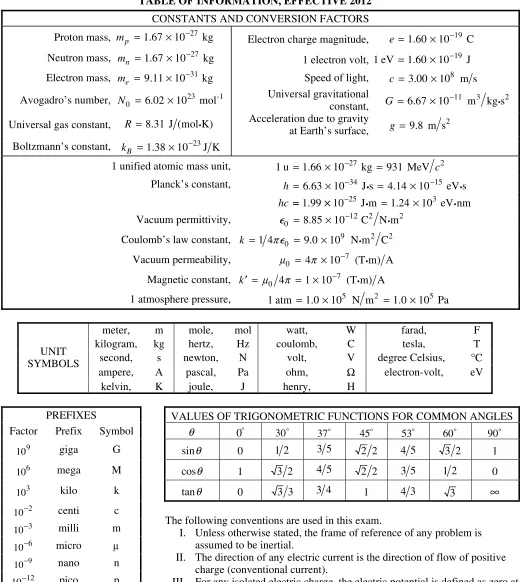
(2) TABLE OF INFORMATION, EFFECTIVE 2012 CONSTANTS AND CONVERSION FACTORS Proton mass, m p = 1.67 ¥ 10 -27 kg Neutron mass, mn = 1.67 ¥ 10 -27 kg. 1 electron volt, 1 eV = 1.60 ¥ 10 -19 J. Electron mass, me = 9.11 ¥ 10 -31 kg. c = 3.00 ¥ 108 m s. Speed of light, Universal gravitational constant, Acceleration due to gravity at Earth’s surface,. Avogadro’s number, N 0 = 6.02 ¥ 1023 mol-1. R = 8.31 J (mol iK). Universal gas constant,. e = 1.60 ¥ 10 -19 C. Electron charge magnitude,. G = 6.67 ¥ 10 -11 m 3 kgis2. g = 9.8 m s2. Boltzmann’s constant, k B = 1.38 ¥ 10 -23 J K. 1 u = 1.66 ¥ 10 -27 kg = 931 MeV c 2. 1 unified atomic mass unit,. h = 6.63 ¥ 10 -34 J is = 4.14 ¥ 10 -15 eV is. Planck’s constant,. hc = 1.99 ¥ 10 -25 J im = 1.24 ¥ 103 eV i nm. ⑀0 = 8.85 ¥ 10 -12 C2 N im 2. Vacuum permittivity,. Coulomb’s law constant, k = 1 4 p⑀ 0 = 9.0 ¥ 109 N im 2 C2. m0 = 4 p ¥ 10 -7 (T im) A. Vacuum permeability,. Magnetic constant, k ¢ = m0 4 p = 1 ¥ 10 -7 (T i m) A. 1 atm = 1.0 ¥ 105 N m 2 = 1.0 ¥ 105 Pa. 1 atmosphere pressure,. UNIT SYMBOLS. meter, kilogram, second, ampere, kelvin,. PREFIXES Factor Prefix Symbol. m kg s A K. mole, hertz, newton, pascal, joule,. mol Hz N Pa J. watt, coulomb, volt, ohm, henry,. W C V W H. farad, tesla, degree Celsius, electron-volt,. F T ∞C eV. VALUES OF TRIGONOMETRIC FUNCTIONS FOR COMMON ANGLES q 30 0 37 45 53 60 90. 10 9. giga. G. sin q. 0. 12. 35. 2 2. 45. 3 2. 1. 106. mega. M. cos q. 1. 3 2. 45. 2 2. 35. 12. 0. 103. kilo. k. tan q. 0. 3 3. 34. 1. 43. 3. •. -2. centi. c. 10 -3. milli. m. 10 -6. micro. m. 10 -9. nano. n. 10 -12. pico. p. 10. The following conventions are used in this exam. I. Unless otherwise stated, the frame of reference of any problem is assumed to be inertial. II. The direction of any electric current is the direction of flow of positive charge (conventional current). III. For any isolated electric charge, the electric potential is defined as zero at an infinite distance from the charge.. -2-.
(3) ADVANCED PLACEMENT PHYSICS C EQUATIONS, EFFECTIVE 2012 MECHANICS. u = u0 + at. x = x0 + u0 t +. 1 2 at 2. u 2 = u0 2 + 2a ( x - x0 ).  F = Fnet = ma dp dt. F=. J = Ú F dt = Dp. p = mv F fric £ m N W =. Ú Fidr. K =. 1 2 mu 2. P=. dW dt. P = Fiv DUg = mgh. ac =. u2 = w2 r r. Ú r dm =  mr 2. 2. rcm =  mr  m u = rw. x = xmax cos( wt + f). 2p 1 = T = f w. m k. 1 2 Iw 2. Tp = 2p FG = -. w = w0 + at 1 2 at 2. UG. F =. 1 q1q2 4 p⑀0 r 2. E=. F q. Q. Ú E i d A = ⑀0. UE. Gm1m2 r2. Gm1m2 =r. rˆ. q.  rii. 1 4 p⑀0. V =. i. 1 q1q2 = qV = 4 p⑀0 r. C =. Q V. C =. k ⑀0 A d.  Ci. Cp =. i. 1 1 = Cs C i i. dQ I = dt 1 1 QV = CV 2 2 2. A B C d E. = = = = = e= F = I = J = L = = n =. N = P Q q R r t U. = = = = = = = V= u = r=. area magnetic field capacitance distance electric field emf force current current density inductance length number of loops of wire per unit length number of charge carriers per unit volume power charge point charge resistance distance time potential or stored energy electric potential velocity or speed resistivity. fm = magnetic flux. k = dielectric constant. Ú B i d ᐉ = m0 I dB =. r R= A. F=. E = rJ. m0 I d ᐉ ¥ r 4p r3. Ú I dᐉ ¥ B. I = Neud A. Bs = m0 nI. V = IR. fm = Ú B i d A. Rs =. g. dV dr. E =-. Uc =. 1 2 kx 2. Ts = 2 p. L = r ¥ p = Iw. q = q0 + w0 t +. acceleration force frequency height rotational inertia impulse kinetic energy spring constant length angular momentum mass normal force power momentum radius or distance position vector period time potential energy velocity or speed work done on a system position coefficient of friction angle torque angular speed angular acceleration phase angle. Us =.  t = t net = I a. K =. = = = = = = = = = L = m= N = P = p = r = r = T = t = U= u = W= x = m= q = t = w= a= f =. Fs = - k x. t=r¥F. I =. a F f h I J K k. ELECTRICITY AND MAGNETISM.  Ri. 1 = Rp. i. 1. ÂR i. i. P = IV. FM = qv ¥ B. -3-. Ú Eidᐉ = -. e. =. e. = -L. UL =. dI dt. 1 2 LI 2. d fm dt.
(4) ADVANCED PLACEMENT PHYSICS C EQUATIONS, EFFECTIVE 2012 GEOMETRY AND TRIGONOMETRY Rectangle A = bh Triangle. A=. 1 bh 2. Circle. A = pr2. C = 2p r Rectangular Solid V = wh Cylinder. A= C= V= S = b = h = = w= r =. CALCULUS. df d f du = dx du dx. area circumference volume surface area base height length width radius. d n ( x ) = nxn -1 dx d x (e ) = e x dx d ( ln x ) = 1 dx x d (sin x ) = cos x dx d (cos x ) = - sin x dx. V = pr2. Úx. S = 2p r + 2p r 2. Úe. Sphere. V =. 4 3 pr 3. Ú. a 2 + b2 = c2 a c b c. tan q =. a b. x. dx = e x. dx = ln x x. Ú sin x dx = - cos x. Right Triangle. cos q =. dx =. Ú cos x dx = sin x. S = 4p r 2. sin q =. 1 x n + 1 , n π -1 n +1. n. c. a 90°. q b. -4-.
(5) 2014 AP® PHYSICS C: MECHANICS FREE-RESPONSE QUESTIONS PHYSICS C: MECHANICS SECTION II Time— 45 minutes 3 Questions Directions: Answer all three questions. The suggested time is about 15 minutes for answering each of the questions, which are worth 15 points each. The parts within a question may not have equal weight. Show all your work in this booklet in the spaces provided after each part.. Mech. 1. In an experiment, a student wishes to use a spring to accelerate a cart along a horizontal, level track. The spring is attached to the left end of the track, as shown in the figure above, and produces a nonlinear restoring force of magnitude Fs = As 2 + Bs, where s is the distance the spring is compressed, in meters. A measuring tape, marked in centimeters, is attached to the side of the track. The student places five photogates on the track at the locations shown. (a) Derive an expression for the potential energy U as a function of the compression s. Express your answer in terms of A, B, s, and fundamental constants, as appropriate.. © 2014 The College Board. Visit the College Board on the Web: www.collegeboard.org.. GO ON TO THE NEXT PAGE. -5-.
(6) 2014 AP® PHYSICS C: MECHANICS FREE-RESPONSE QUESTIONS In a preliminary experiment, the student pushes the cart of mass 0.30 kg into the spring, compressing the spring 0.040 m. For this spring, A = 200 N m 2 and B = 150 N m. The cart is released from rest. Assume friction and air resistance are negligible only during the short time interval when the spring is accelerating the cart. (b) Calculate the following: i. The speed of the cart immediately after it loses contact with the spring ii. The impulse given to the cart by the spring In a second experiment, the student collects data using the photogates. Each photogate measures the speed of the cart as it passes through the gate. The student calculates a spring compression that should give the cart a speed of 0.320 m s after the cart loses contact with the spring. The student runs the experiment by pushing the cart into the spring, compressing the spring the calculated distance, and releasing the cart. The speeds are measured with a precision of ± 0.002 m s . The positions are measured with a precision of ± 0.005 m. Photogate. 1. 2. 3. 4. 5. Cart speed (m/s). 0.412. 0.407. 0.399. 0.374. 0.338. Photogate position (m). 0.20. 0.40. 0.60. 0.80. 1.00. (c) On the axes below, plot the data points for the speed u of the cart as a function of position x. Clearly scale and label all axes, as appropriate.. (d) i. Compare the speed of the cart measured by photogate 1 to the predicted value of the speed of the cart just after it loses contact with the spring. List a physical source of error that could account for the difference. ii. From the measured speed values of the cart as it rolls down the track, give a physical explanation for any trend you observe.. © 2014 The College Board. Visit the College Board on the Web: www.collegeboard.org.. GO ON TO THE NEXT PAGE. -6-.
(7) 2014 AP® PHYSICS C: MECHANICS FREE-RESPONSE QUESTIONS. Mech. 2. A small block of mass m starts from rest at the top of a frictionless ramp, which is at a height h above a horizontal tabletop, as shown in the side view above. The block slides down the smooth ramp and reaches point P with a speed u0 . After the block reaches point P at the bottom of the ramp, it slides on the tabletop guided by a circular vertical wall with radius R, as shown in the top view. The tabletop has negligible friction, and the coefficient of kinetic friction between the block and the circular wall is m . (a) Derive an expression for the height of the ramp h. Express your answer in terms of u0 , m, and fundamental constants, as appropriate. A short time after passing point P, the block is in contact with the wall and moves with a speed of u . (b) i. Is the vertical component of the net force on the block upward, downward, or zero? ____ Upward. ____ Downward. ____ Zero. Justify your answer. ii. On the figure below, draw an arrow starting on the block to indicate the direction of the horizontal component of the net force on the moving block when it is at the position shown.. Justify your answer. Express your answers to the following in terms of u0 , u , m, R, m , and fundamental constants, as appropriate. (c) Determine an expression for the magnitude of the normal force N exerted on the block by the circular wall as a function of u . (d) Derive an expression for the magnitude of the tangential acceleration of the block at the instant the block has attained a speed of u . (e) Derive an expression for u (t ) , the speed of the block as a function of time t after passing point P on the track.. © 2014 The College Board. Visit the College Board on the Web: www.collegeboard.org.. GO ON TO THE NEXT PAGE. -7-.
(8) 2014 AP® PHYSICS C: MECHANICS FREE-RESPONSE QUESTIONS. Mech. 3. A large circular disk of mass m and radius R is initially stationary on a horizontal icy surface. A person of mass m 2 stands on the edge of the disk. Without slipping on the disk, the person throws a large stone of mass m 20 horizontally at initial speed u0 from a height h above the ice in a radial direction, as shown in the figures above. The coefficient of friction between the disk and the ice is m . All velocities are measured relative to the ground. The time it takes to throw the stone is negligible. Express all algebraic answers in terms of m, R, u0 , h, m , and fundamental constants, as appropriate. (a) Derive an expression for the length of time it will take the stone to strike the ice. (b) Assuming that the disk is free to slide on the ice, derive an expression for the speed of the disk and person immediately after the stone is thrown. (c) Derive an expression for the time it will take the disk to stop sliding.. © 2014 The College Board. Visit the College Board on the Web: www.collegeboard.org.. GO ON TO THE NEXT PAGE. -8-.
(9) 2014 AP® PHYSICS C: MECHANICS FREE-RESPONSE QUESTIONS. The person now stands on a similar disk of mass m and radius R that has a fixed pole through its center so that it can only rotate on the ice. The person throws the same stone horizontally in a tangential direction at initial speed u0 , as shown in the figure above. The rotational inertia of the disk is mR 2 2 . (d) Derive an expression for the angular speed w of the disk immediately after the stone is thrown. (e) The person now stands on the disk at rest R 2 from the center of the disk. The person now throws the stone horizontally with a speed u0 in the same direction as in part (d). Is the angular speed of the disk immediately after throwing the stone from this new position greater than, less than, or equal to the angular speed found in part (d) ? ____ Greater than. ____ Less than. ____ Equal to. Justify your answer.. STOP END OF EXAM. © 2014 The College Board. Visit the College Board on the Web: www.collegeboard.org.. -9-.
(10)
Figure
Related documents
Six of the 10 national parks are located in Manhattan: African Burial Ground National Monument, General Grant National Memo- rial, Hamilton Grange National Memorial,
Pripravci na bazi oksamila u nasadu raj č ice mogu se primijeniti u dozi 10-20 l/ha, i to nakon presa đ ivanja kroz sustav navodnjavanja, ali samo jednom godišnje, ili 10-14
time t seconds s distance D meters m velocity acceleration momentum energy power force charge current potential difference resistance frequency wavelength.. Use
The paper is organised as follows: §2 introduces the algebraic blueprint to build moment semantics and the notion of jump-closure of an algebra of observ- ables; preferential
and major thickness ≤ 1,0 % ASTM C485 Planarit Warpage ASTM C499 Dimensioni Dimensions ASTM C499 Spessore Tickness ASTM C502 Parallelismo dei lati. Wedging SPESSORE THICKNESS
In contrast, the combined administration of naloxone + propranolol produced no such decrease in retention; mean freezing behavior in the naloxone + propranolol condition did not
I think the biggest advantages with using IPTV over the other distribution methods is that with IPTV you will be able to decide your self what information you want to be provided
MHN ACO Clinical Integration Workgroup MHN Management Council MHN CEO MHN ACO President Mercy Des Moines President Mercy North Iowa President Mercy Sioux City President Mercy
