GOKARAJU RANGARAJU INSTITUTE OF ENGINEERING AND TECHNOLOGY DEPARTMENT OF MANAGEMENT STUDIES
MBA III SEMESTER
STRATEGIC MANAGEMENT MANUAL-3 (for private circulation only)
Chapter 3: Evaluating a Company’s External Environment 1. Learning Objectives
a. To gain command of the basic concepts and analytical tools widely used to diagnose a company’s industry and competitive conditions.
b. To become adept in recognizing the factors that cause competition in an industry to be fierce, more or less normal, or relatively weak.
c. To learn how to determine whether an industry’s outlook presents a company with sufficiently attractive opportunities for growth and profitability.
d. To understand why in-depth evaluation of specific industry and competitive conditions is a prerequisite to crafting a strategy well matched to a company’s situation.
2. Roadmap
a. The Strategically Relevant Components of a Company’s External Environment b. Thinking Strategically About a Company’s Industry and Competitive
Environment
Question 1: What Are the Industry’s Dominant Economic Features? Question 2: How Strong Are Competitive Forces?
Question 3: What Forces Are Driving Industry Change and What Impacts Will They Have?
Question 4: What Market Positions Do Rivals Occupy—Who Is Strongly Positioned and Who Is Not?
Question 5: What Strategic Moves Are Rivals Likely to Make Next?
Question 6: What Are the Key Factors for Future Competitive Success?
Question 7: Does the Outlook for the Industry Offer the Company a Good Opportunity to Earn Attractive Profits?
3. Understanding the Factors that Determine a Company’s Situation a. Diagnosing a company’s situation has two facets
i. Assessing the company’s external or macro-environment 1. Industry and competitive conditions
2. Forces acting to reshape this environment
2. Competencies, capabilities, resource strengths and weaknesses, and competitiveness
Figure 3.2: The Components of a Company’s Macro-environment
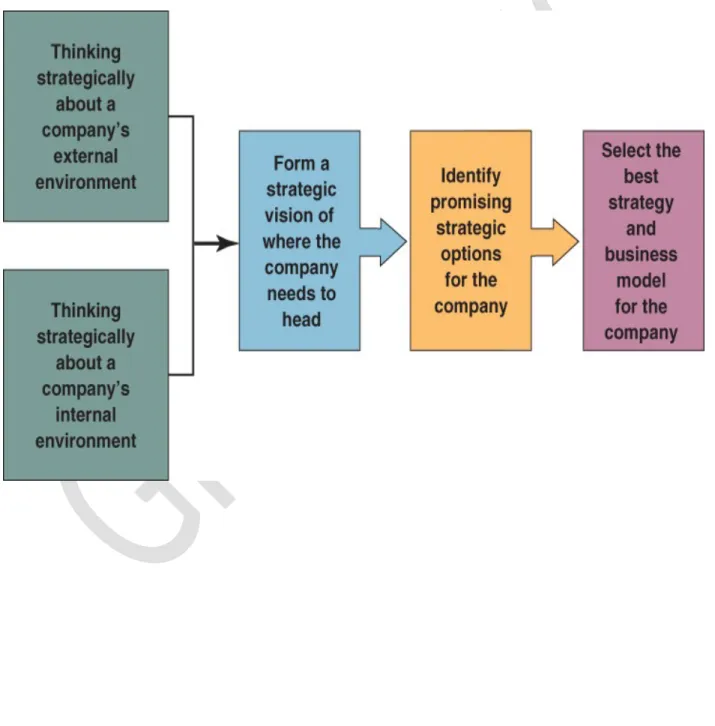
6. Thinking Strategically About a Company’s Macro-environment
A company’s macro-environment includes all relevant factors and influences outside its boundaries
Diagnosing a company’s external situation involves assessing strategically important factors that have a bearingon the decisions a company’s makes about its
o Direction o Objectives o Strategy
o Business model
o Adapt a company’s direction and strategy as needed
7. Key Questions Regarding the Industry and Competitive Environment
8. Question 1: What are the Industry’s Dominant Economic Traits? Market size and growth rate
Number of rivals
Scope of competitive rivalry Buyer needs and requirements Degree of product differentiation Product innovation
Supply/demand conditions Pace of technological change Vertical integration
Economies of scale
Learning and experience curve effects
9. Table 3.1: What to Consider in Identifying an Industry’s Dominant Economic Features
Economic Feature Questions to Answer
Market size and
growth rate How big is the industry and how fast is it growing?What does the industry’s position in the product life cycle (early development, rapid growth and takeoff, early maturity and slowing growth, saturation and stagnation, decline) reveal about the industry’s growth prospects?
Number of rivals Is the industry fragmented into many small companies or concentrated and dominated by a few large companies?
Is the industry consolidating to a smaller number consolidating to a smaller number of competitors?
Scope of
competitive rivalry Is the geographic area over which most companies competelocal, regional, national multinational, or global? Is having a presence in foreign markets becoming more
important to a company’s long-term competitive success?
Number of buyers Is market demand fragmented among many buyers?
Do some buyers have bargaining power because they purchase in large volume?
Degree of product
differentiation Are the products of rivals becoming more differentiated or lessdifferentiated? Are the products of rivals becoming increasingly similar and
causing heightened price competition?
Product innovation Is the industry characterized by rapid product innovation and short product life cycles?
How important is R&D and product innovation?
Are there opportunities to overtake key rivals by being first-to-market with next-generation products?
Demand-supply
conditions Is a surplus of capacity pushing prices and profit marginsdown? Is the industry overcrowded with competitors?
Pace of
technological change
What role does advancing technology play in this industry? Are ongoing upgrades of facilities/equipment essential because
of rapidly advancing production process technologies?
Do most industry members have or need strong technological capabilities? Why?
Vertical integration Do most competitors operate in only one stage of the industry (parts and components production, manufacturing and assembly, distribution, retailing), or do some competitors operate in multiple stages?
Is there any cost or competitive advantage or disadvantage associated with being fully or partially integrated?
Do companies with large-scale operations have an important cost advantage over small-scale firms?
Learning/
experience curve effects
Are certain industry activities characterized by strong learning and experience effects (“learning by doing”) such that unit costs decline as company’s experience in performing the activity builds?
Do any companies have significant cost advantages because of their learning/experience in performing particular activities?
10. Learning/Experience Effects
Learning/experience effects exist when a company’s unit costs decline as its cumulative production volume increases because of
o Accumulating production know-how o Growing mastery of the technology
The bigger the learning or experience curve effect, the bigger the cost advantage of the firm with the largest cumulative production volume
11. Question 2: How Strong Are Competitive Forces? Objectives are to identify
o Main sources of competitive forces o Strength of these forces
Key analytical tool
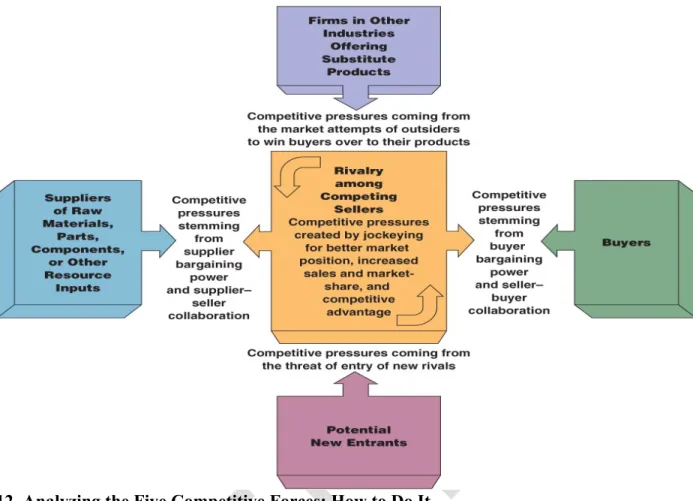
12. Analyzing the Five Competitive Forces: How to Do It
Step 1: Identify the specific competitive pressures associated with each of the five forces Step 2: Evaluate the strength of each competitive force – fierce, strong, moderate to normal, or weak?
Step 3: Determine whether the collective strength of the five competitive forces is conducive to earning attractive profits
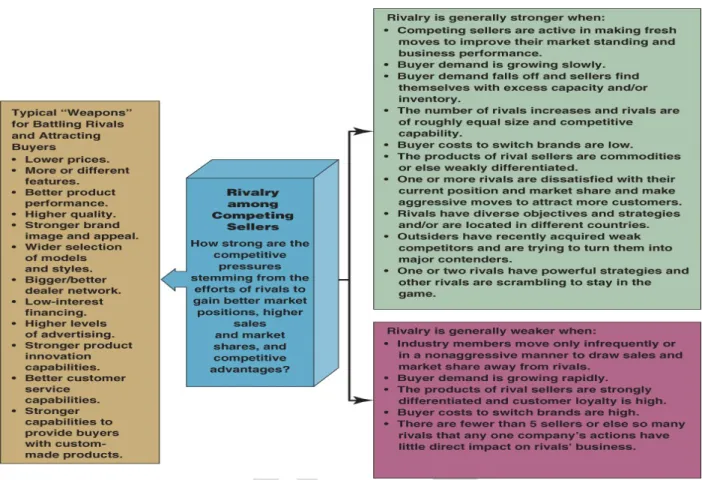
13. Competitive Pressures Among Rival Sellers Usually the strongest of the five forces Key factor in determining strength of rivalry
o How aggressively are rivals using various weapons of competition to improve their market positions and performance?
Competitive rivalry is a combative contest involving o Offensive actions
o Defensive countermoves
14. Competitive Pressures Associated With Potential Entry Seriousness of threat depends on
o Size of pool of entry candidates and available resources o Barriers to entry
o Reaction of existing firms
Evaluating threat of entry involves assessing
o How formidable entry barriers are for each type of potential entrant and o Attractiveness of growth and profit prospects
15. Common Barriers to Entry Sizable economies of scale
Cost and resource disadvantages independent of size Brand preferences and customer loyalty
Capital requirements and/or other specialized resource requirements Access to distribution channels
Regulatory policies
Tariffs and international trade restrictions
Ability of industry incumbents to launch vigorous initiatives to block a newcomer’s entry 16. Competitive Pressures from Substitute Products
Concept: Substitutes matter when customers are attracted to the products of firms in other industries
Examples: Sugar vs. artificial sweeteners; Eyeglasses and contact lens vs. laser surgery; Newspapers vs. TV vs. Internet
17. How to Tell Whether Substitute Products Are a Strong Force Whether substitutes are readily available and attractively priced Whether buyers view substitutes as being comparable or better How much it costs end users to switch to substitutes
18. Competitive Pressures From Suppliers and Supplier-Seller Collaboration
Whether supplier-seller relationships represent a weak or strong competitive force depends on
o Whether suppliers can exercise sufficient bargaining leverage to influence terms of supply in their favor
19. Competitive Pressures: Collaboration Between Sellers and Suppliers Industry members often forge strategic partnerships with select suppliers to
o Reduce inventory and logistics costs
o Speed availability of next-generation components o Enhance quality of parts being supplied
o Squeeze out cost savings for both parties
Competitive advantage potential may accrue to those industry members (sellers) doing the best job of managing supply-chain relationships
20. Competitive Pressures From Buyers and Seller-Buyer Collaboration
Whether the relationships between industry members and buyers represent a weak or strong competitive force depends on
o Whether buyers have sufficient bargaining leverage to influence terms of sale in their favor
o Extent and competitive importance of strategic partnerships between certain industry members and the buyers
21. Competitive Pressures: Collaboration Between Sellers and Buyers
Partnerships between industry members and some/many of their customers can impact competitive pressures
Collaboration may result in mutual benefits regarding o Just-in-time deliveries
o Order processing
o Electronic invoice payments o Data sharing
Competitive advantage may accrue to those industry members doing the best job of partnering with their customers
22. Strategic Implications of the Five Competitive Forces
Competitive environment is unattractive from the standpoint of earning good profits when
o Rivalry is vigorous
o Entry barriers are low and entry is likely o Competition from substitutes is strong
o Suppliers and customers have considerable bargaining power 23. Strategic Implications of the Five Competitive Forces
Competitive environment is ideal from a profit-making standpoint when Rivalry is moderate
Suppliers and customers are in a weak bargaining position
24. Coping With the Five Competitive Forces Objective is to craft a strategy to
o Insulate firm from competitive pressures
o Initiate actions to produce sustainable competitive advantage
o Allow firm to be the industry’s “mover and shaker” with the “most powerful” strategy that defines the business model for the industry
Question 3: What Forces Are Driving Industry Change and What Impacts Will They Have?
Industries change because forces are driving industry participants to alter their actions Driving forces are the major underlying causes of changing industry and competitive
conditions
Where do driving forces originate? o Outer ring of macroenvironment o Inner ring of macroenvironment 25. Analyzing Driving Forces: Three Key Steps
STEP 1: Identify forces likely to exert greatest influence over next 1 - 3 years o Usually no more than 3 - 4 factors qualify as real drivers of change STEP 2: Assess impact
o Are driving forces acting to cause market demand for product to increase or decrease?
o Are driving forces acting to make competition more or less intense? o Will driving forces lead to higher or lower industry profitability?
STEP 3: Determine what strategy changes are needed to prepare for impacts of driving forces
26. Question 4: What Market Positions Do Rivals Occupy?
One technique to reveal different competitive positions of industry rivals is strategic group mapping
A strategic group is a cluster of firms in an industry with similar competitive approaches and market positions
27. Strategic Group Mapping
Firms in same strategic group have two or more competitive characteristics in common o Have comparable product line breadth
o Sell in same price/quality range o Emphasize same distribution channels
o Use same product attributes to appeal to similar types of buyers o Use identical technological approaches
o Offer buyers similar services o Cover same geographic areas
28. Procedure for Constructing a Strategic Group Map
STEP 1: Identify competitive characteristics that differentiate firms in an industry from one another
STEP 2: Plot firms on a two-variable map using pairs of these differentiating characteristics
Example: Strategic Group Map of Selected Automobile Manufacturers
29. Guidelines: Strategic Group Maps
Variables selected as axes should not be highly correlated
Variables chosen as axes should expose big differences in how rivals compete Variables do not have to be either quantitative or continuous
Drawing sizes of circles proportional to combined sales of firms in each strategic group allows map to reflect relative sizes of each strategic group
If more than two good competitive variables can be used, several maps can be drawn 30. Interpreting Strategic Group Maps
The closer strategic groups are on the map, the stronger the cross-group competitive rivalry tends to be
Not all positions on the map are equally attractive
o Driving forces and competitive pressures often favor some strategic groups and hurt others
o Profit potential of different strategic groups varies due to strengths and weaknesses in each group’s market position
31. Question 5: What Strategic Moves Are Rivals Likely to Make Next? A firm’s best strategic moves are affected by
o Current strategies of competitors o Future actions of competitors
Profiling key rivals involves gathering competitive intelligence about o Current strategies
o Resource strengths and weaknesses
o Efforts being made to improve their situation o Thinking and leadership styles of top executives 32. Competitor Analysis
Sizing up strategies and competitive strengths and weaknesses of rivals involves assessing
o Which rival has the best strategy? Which rivals appear to have weak strategies? o Which firms are poised to gain market share, and which ones seen destined to lose
ground?
o Which rivals are likely to rank among the industry leaders five years from now? Do any up-and-coming rivals have strategies and the resources to overtake the current industry leader?
33. Things to Consider in Predicting Moves of Rivals
Which rivals need to increase their unit sales and market share? What strategies are rivals most likely to pursue?
Which rivals have a strong incentive, along with resources, to make major strategic changes?
Which rivals are good candidates to be acquired? Which rivals have the resources to acquire others?
Which rivals are likely to enter new geographic markets?
Which rivals are likely to expand their product offerings and enter new product segments?
34. Question 6: What Are the Key Factors for Competitive Success?
Key Success Factors (KSFs) are competitive factors and attributes that affect every industry member’s ability to be competitively and financially successful
KSFs are those particular attributes that are so important that they spell the difference between
o Profit and loss
o Competitive success or failure KSFs can relate to
o Specific strategy elements o Product attributes
o Resources o Competencies
o Competitive capabilities o Market achievements
35. Identifying Industry Key Success Factors
The answers to 3 questions often help pinpoint an industry’s KSFs
o On what basis do customers choose between competing brands of sellers?
o What resources and competitive capabilities does a company need to have to be competitively successful?
o What shortcomings are likely to place a company at a significant competitive disadvantage?
Table 3.3: Common Types of Industry Key Success Factors
36. Question 7: Does the Outlook for the Industry Offer an Attractive Opportunity?
Involves assessing whether the industry and competitive environment presents a company with an attractive or unattractive opportunity for earning good profits
Factors to consider:
o Industry growth potential
o Whether competitive forces are growing stronger/weaker
o Whether driving forces will favorable/unfavorably impact industry profitability o Degree of risk and uncertainty in industry’s future
o Whether the industry confronts severe problems o Firm’s competitive position in industry vis-à-vis rivals
o Firm’s potential to capitalize on industry opportunities or the vulnerabilities of weaker rivals
o Whether a firm has sufficient competitive strength to defend against unattractive industry factors
37. Factors to Consider in Assessing Industry Attractiveness As a general proposition
o If an industry’s overall profit prospects are above average, the industry environment is basically attractive
o If an industry’s overall profit prospects are below average, the industry environment is basically unattractive
However
o Conclusions about attractiveness have to be drawn from the perspective of a particular company
38. Factors to Consider in Assessing Industry Attractiveness
An industry is unlikely to be equally attractive or unattractive to all industry members o Industry environments attractive to strong competitors may be unattractive to
weak competitors
A favorably positioned company may survey an industry environment and see opportunities that weak competitors have little or no ability to capture o Industry environments attractive to insiders may be unattractive to potential
entrants
o Under certain circumstances, a firm uniquely well-situated in an otherwise unattractive industry can still earn good profits by taking sales and market share away from weaker competitors
39. Core Concept: Assessing Industry Attractiveness reasonable, logical and objective.
The degree to which an industry is attractive or unattractive is not the same for all industry participants or potential entrants.