PhD Dissertation
Doctoral Thesis
DISI - University of Trento Universidad Cat´olica “Nuestra Se˜nora de la Asunci´on”
“...And suddenly the memory revealed itself”
The role of IT in supporting social reminiscence
Cristhian Daniel Parra Trepowski
Advisor:
Prof. Vincenzo D’Andrea University of Trento
Co-Advisors:
Prof. Luca Cernuzzi Prof. Fabio Casati
Universidad Cat´olica “Nuestra Se˜nora de la Asunci´on” University of Trento
Abstract
Every human being is familiar to the experience of reminiscence: recalling and revisiting our past mem-ories. We reminisce to create our identities. We reminisce to maintain our relationships. We reminisce to review our lives. And we also reminiscetogether. This dissertation develops around the topic of how IT stimulates reminiscence, motivated by its proven benefits in people’s well-being and its prevalence across all stages of life. The focus is set on older adults, with the overall goal of fostering intergen-erational social interactions (that is, interactions between older adults and younger generations). This thesis is motivated by the current interest on active ageing as an emergent way of life, with better and more opportunities for health, participation and security. As the world ageing population continues to increase and the average life expectancy of people increasing every year, there is a growing need for understanding the ageing phenomena, and particularly, for designing human centered information tech-nologies (IT) that enhance opportunities of social participation as people age. Within this scenario, this dissertation addresses the following research questions using a participatory approach to research and design: (i) what is the role of IT in enabling a more happy and active ageing?; (ii) in doing so, how can IT stimulate intergenerational social interactions?, and (iii) can IT-supported social reminiscence facilitate these interactions and make of them an enjoyable experience?. To answer these questions, we leverage upon a participatory action research approach to gain an understanding of the topic, moving later to the participatory design of IT for social reminiscence and finally, evaluating how IT supports the practice of social reminiscence in a face-to-face intergenerational context. The contributions of this dissertation can be summarized as follows:
• Knowledge: an understanding of what role IT can play in supporting, stimulating and
accompa-nying active ageing and social interactions through the practice of reminiscence.
• Model: a conceptual model of the different stages of IT-supported social reminiscence sessions,
and an extended model of the design spaces for intergenerational engagement.
• System:an exemplary socio-technical system that fits the aforementioned roles, including a
knowl-edge base and algorithms to support contextual stimulation of reminiscence, using multimedia resources that are publicly available on the web.
• Evaluation: quantitative and qualitative results obtained from observing the use of our system in
a real intergenerational context.
Acknowledgments
A Ph.D. is a journey about life as much as it is about science. You learn the beauty of the scientific method and do your best to extend human knowledge in that one exciting area of your dissertation topic. But there is also another side to all of it. The part that nobody tells you about because it is just different for everyone. In those baffling moments when you are lost, when you do not know what you are doing or where you are going or why,
there you get to faceyourself. And then you discover your true strengths and yourmost dreadful inner foes. You
fight yourself, and so many times lose the battle. But, in the long run, you survive to discover that the journey was truly worthy. You look back and see the paths you have walked, and realize that everything gave something back to you, even those things you worked hard to do but ultimately failed. A Ph.D. is a journey of self-discovery and,
paraphrasing Carl Sagan, ahumbling and character-building experience. And my journey would not have been
possible without the help of so many great people.
Thanks to my advisorVincenzo D’Andrea, you helped me find my way when I was completely lost and I would
not have gotten this far without your invaluable mentoring and always positive stimulation. ToLuca Cernuzzi, for
acting as my mentor from the other side of the sea and for helping me find my confidence back when it looked like
this was not for me. ToFabio Casati, you opened the doors of this opportunity and pushed me always to bring out
my best, even when I was not able to fully appreciate it. ToFlorian Daniel, your excellent and detailed conceptual
help shaped much of this dissertation. ToMaurizio Marchese, for being an active part of the early days of my
work and for giving me the chance of doing one of the things I loved the most: to teach. ToDavid Hakkenfor
agreeing to revise this dissertation and participate on the final exam, apart from all the insights you have shared with me in your visits to our group. Thanks also to the Department of Information Engineering and Computer Science, and to the ICT Doctorate School of the University of Trento, for the financial support of my work. And thanks to so many other colleagues who worked with me and teach me so much during these years.
Un grazie mille gigantesco alCSA Kaleidoscopio, nella persona diJury CocuzzieRoberto Casagranda, per
aprire le porte del centro quando ero un perfetto sconosciuto e avermi permesso di entrare in contatto con la meravigliosa comunit`a di persone che ho avuto la possibilit`a di incontrare l`ı. Il vostro ruolo in questa tesi `e centrale e nulla sarebbe stato possibile se non ci fosse la vostra fiducia e la vostra partecipazione attiva in tutte l’attivit`a che abbiamo organizzato insieme. Lavorare con tutti voi `e stata la parte pi`u gratificante di questo dottorato. Grazie a
Giulia Giacomin,Maria GarbarieValeria Galdinoper avere aiutato a me e a Vincenzo a costruire e mantenere
attive tutte l’iniziative che abbiamo realizzato con il CSA. Voi pure siete una parte centrale di questo lavoro. E grazie mille a tutti i volontari che hanno dato una mano in una o pi`u di queste attivit`a.
Gracias a mi familia en Trento,La Fiebre Trentina. Nada se extra˜na tanto como la familia y los amigos cuando
se est´a lejos del hogar, pero ustedes, con todo el cari˜no y el apoyo que me han dado, se convirtieron en mi segunda familia en este segundo hogar que es Trento. Gracias por el aguante!. Gracias a los amigos de siempre, que me ofrecieron su abrazo fuerte y su est´ımulo en cada uno de mis regresos a Paraguay. Y por supuesto, a mi familia
en Paraguay,Ygnacio y Aurora,Cynthia y Rafa,Oscar y Lourdes,Don Julio,Raquel y Cristhian,Pathy y
Alonso, y todos los peques; ustedes fueron siempre mi fortaleza, mi ejemplo y mi sost´en. Estar lejos de ustedes ha sido la parte m´as dura de estos a˜nos pero nunca, ni siquiera un instante, los sent´ı lejos. Gracias de verdad, y a trav´es de ustedes, gracias a la familia grande. Esta tesis es de todos ustedes.
Y finalmente, el agradecimiento m´as importante quisiera dedicarlo a mi esposa,Marijo. Fuiste la mejor compa˜nera
que pude haber jam´as anhelado en este viaje. Dejaste todo y diste un enorme salto de FE al venir conmigo. No solo fuiste mi mejor amiga y mi inspiraci´on, sino que aportaste directamente a esta tesis ayud´andome en tantas cosas. Desde ayudarme a preparar los talleres de Kaleidoscopio hasta organizar mis datos. Te merec´es la co-autor´ıa de esta tesis. Gracias por cuidar tan cari˜nosamente de mi. Desde que viniste mi tesis empez´o a salir bien.
List of publications
[1] F. Chiumeo, O. A. Kashyta, C. Parra, G. Armellin, and C. Matteoti. Allena Vita Coach: stratification (clustering), observation , stimulation (fosterage, persuasiveness, support)”. InEGPRN Meeting Malta, 2013.
[2] F. Chiumeo, C. Matteotti, C. Parra, and S. Girardi. Allena Vita Coach: modello innovativo di gestione del paziente a domicilio. In Abstract. 2◦ conferenza nazionale sulle cure domiciliari:
Home Care e Distretti, L’assistenza e cura integrata (integrated home care) nei distretti italiani. Tra tecnologie (high tech) e competenze relazionali (high touch) un distretto High-teach che cres, pages 71–72, Roma, 2013.
[3] V. D’Andrea, C. Matteotti, and C. Parra. D2.3.1 Studio di un servizio per telemedicina e benessere. Technical report, Centro Ricerche GPI, 2013.
[4] M. Dianti, C. Parra, F. Casati, and A. D. Angelli. What’s Up : Fostering Intergenerational Social Interactions. International Reports on Socio-Informatics (IRSI). Special Issue on Designing for Inter/Generational Communities, 9(1):22–27, 2012.
[5] T. Macchia, C. Parra, and M. Salgado. [Under Review] Asymmetries of knowledge and culture in participatory design. InParticipatory Design Conference 2014, 2014.
[6] C. Parra, V. D. Andrea, and F. Casati. Participatory Design of a Digital Reminiscence Application. InDemo paper at CHITALY 2013, pages 10–13, Trento, Italy, 2013.
[7] C. Parra, V. D. Andrea, and G. Giacomin. Enabling Community Participation of Senior Citizens through Participatory Design and ICT. InCIRN 2012 Community Informatics Conference: ’Ideals meet Reality’, 2012.
[8] C. Parra, L. Cernuzzi, V. D’Andrea, and F. Casati. Reminiscens: tecnolog´ıa para el recuerdo y la interacci´on social del adulto mayor. InIberdiscap 2013, pages 3–6, Santo Domingo, Rep´ublica Dominicana, 2013.
[9] C. Parra, C. Matteotti, V. D’Andrea, A. Kashytsa, D. Martintoni, and T. Peng. AllenaVita: mo-tivating lifestyle improvement in a telemedicine scenario. Demo Paper. In Ninth International Conference on Persuasive Technology, 2014.
[11] T. Peng, C.-H. Chi, A. Chiasera, G. Armellin, M. Ronchetti, C. Matteotti, C. Parra, A. O. Kashytsa, and G. Bonadiman. Business Process Assignment and Execution in Mobile Environments. In
Contents
Abstract iii
Dedication v
Acknowledgements vii
List of Publications x
Table of Contents xiv
List of Figures xix
List of Tables xxii
1 Introduction 1
1.1 Research Questions and Problems . . . 3
1.2 Dissertation organization . . . 4
1.3 Research Acknowledgements . . . 5
2 Review on IT for Active Ageing 7 2.1 Theoretical Background . . . 8
2.1.1 What’s Ageing? . . . 8
2.1.2 What’s Active Ageing? . . . 9
2.1.3 Determinants of Active Ageing . . . 10
2.2 IT and Active Ageing . . . 13
2.2.1 Objectives of IT for elderly . . . 13
2.2.2 Evaluation Framework . . . 16
2.2.3 IT for Prevention . . . 17
2.2.4 IT for Compensation . . . 22
2.2.5 IT for Care Support . . . 26
2.2.6 IT for Enhancement . . . 30
2.3 Challenges of Software Design for Elderly . . . 36
2.4 Summary and Outlook . . . 37
2.5 Exploratory work: AllenaVita . . . 39
2.5.2 Proposed Solution: the lifecoach . . . 40
2.5.3 Participatory Design with SERMEDA . . . 43
2.5.4 Lessons Learned . . . 43
3 Review on IT for Socializing 51 3.1 Theoretical Background . . . 51
3.1.1 What makes us happy? . . . 52
3.1.2 Social relationships and happiness . . . 53
3.1.3 Social inclusion of Older Adults . . . 54
3.2 IT and Socializing . . . 56
3.3 Exploratory work: What’s Up . . . 57
3.3.1 The prototype: What’s Up Intergenerational Communication . . . 58
3.3.2 Prototype Evaluation: Think Aloud Study . . . 59
3.3.3 Lessons Learned . . . 59
3.4 Exploratory work: Global EngAge . . . 61
3.4.1 Motivating Scenario . . . 62
3.4.2 EngAge prototype . . . 62
3.4.3 EngAge Service Model and Platform . . . 62
3.4.4 Lessons Learned . . . 65
4 Review on IT for Reminiscence 67 4.1 Theoretical Background . . . 67
4.1.1 What is Reminiscence? . . . 68
4.1.2 Reminiscence research and practice . . . 68
4.1.3 Reminiscence and Ageing . . . 72
4.1.4 The benefits of reminiscence . . . 73
4.1.5 Summary . . . 74
4.2 IT for Reminiscence . . . 74
4.2.1 IT for stimulating reminiscence . . . 75
4.2.2 IT for storytelling . . . 77
4.2.3 IT for preservation of memories . . . 78
4.3 Exploratory work: Reminiscens . . . 80
5 Methodology and research plan 81 5.1 Epistemological positioning: Participatory Action Research . . . 81
5.2 Research plan . . . 84
5.3 Research activities and Methods . . . 85
5.3.1 Activities and methods for exploration . . . 85
5.3.2 Activities and methods for design . . . 88
5.3.3 Activities and methods for evaluation . . . 90
5.4 Summary . . . 91
6 Designing IT for Social Reminiscence 93 6.1 Research Activity: Exploratory Workshops . . . 93
6.1.1 Observations in Brentonico Visits . . . 94
6.2 Research Activity: The Laboratory of Technology . . . 95
6.2.1 Research Questions . . . 95
6.2.2 Program and Development of the Laboratory . . . 96
6.2.3 Participation and Collected Information . . . 98
6.2.4 Analysis and Discussion . . . 99
6.2.5 Key takeaways: the choice for a participatory approach . . . 104
6.3 Research and Design Activity: PD Workshops . . . 105
6.3.1 Research Questions . . . 106
6.3.2 The workshops . . . 106
6.3.3 Insights and Evolution of Reminiscens . . . 110
6.3.4 Reflections about the PD process . . . 113
6.3.5 Key takeaways: insights for design and the importance of socializing . . . 116
6.4 Summary of Insights from Research Activities . . . 117
7 The Reminiscens System 121 7.1 Reminiscens Platform . . . 121
7.1.1 The Knowledge Base . . . 123
7.1.2 The Personal Knowledge Base . . . 127
7.2 Reminiscens User Interfaces . . . 128
7.2.1 Key Features . . . 133
7.2.2 Limitations . . . 133
8 Field Studies 135 8.1 Revisiting Research Questions . . . 135
8.2 Short study: the public reminiscence display . . . 136
8.2.1 Goals of the study . . . 137
8.2.2 Method . . . 137
8.2.3 Results and Discussion . . . 138
8.3 Longitudinal study: intergenerational social reminiscence . . . 143
8.3.1 Goals of the Study . . . 143
8.3.2 Methods . . . 144
8.3.3 Results: participants and sessions . . . 150
8.3.4 Results: qualitative analysis . . . 152
8.3.5 Results: quantitative analysis . . . 166
8.3.6 Discussion . . . 176
9 Conclusion and Future Work 181 9.1 Lessons Learned . . . 181
9.1.1 IT for Active Ageing and Socializing . . . 181
9.1.2 IT for social reminiscence . . . 182
9.1.3 Contributions . . . 186
9.2 Limitations . . . 187
9.3 Future Work . . . 188
A.2 Collaboration in academia . . . 191
B Related/Co-supervised Bachelor/Master projects 195 C What’s Up think aloud study evaluation questionnaire 199 D PD Workshop Observation guides and materials 203 D.1 First PD Workshop (June 12th, 2012) . . . 203
D.1.1 Activity 1: What’s Up Focus Group . . . 203
D.1.2 Activity 2: Active Lifestyle Focus Group . . . 203
D.1.3 Activity 3: Brainstorming Session . . . 204
D.1.4 First Part (15min) . . . 204
D.1.5 Guide for pure observers . . . 205
D.2 Second PD Workshop (November 20th, 2012) . . . 208
D.3 Third PD Workshop (December 11th, 2012) . . . 217
D.4 Fourth PD Workshop (February 25th, 2012) . . . 222
E Social Disengagement Index Questionnaire and Procedure 229
F Reminiscence Bootstrap Questionnaire 233
G Final questionnaire after the study 235
H Participant Diaries and Mood Questionnaire 239
I Long Study of Reminiscens: Ethical Committee Request 243
List of Figures
2.1 Ageing and Active Ageing phenomena simple representation . . . 13
2.2 Gerontechnology Goals . . . 14
2.3 ICT for Active Ageing: evaluation framework. . . 15
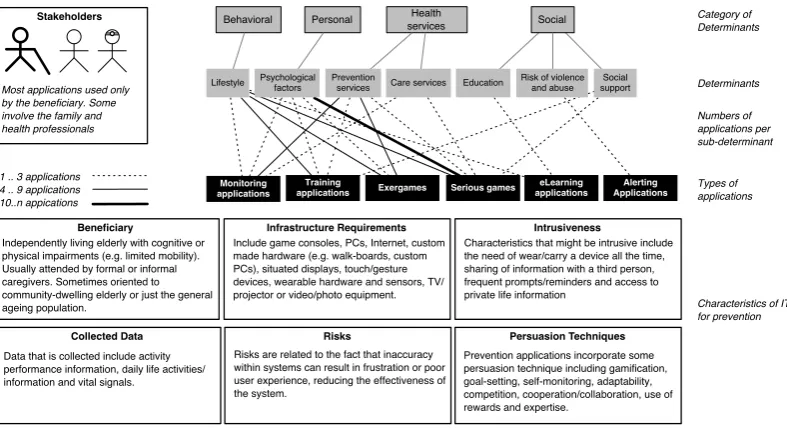
2.4 Typical characteristics of IT solutions for Prevention . . . 22
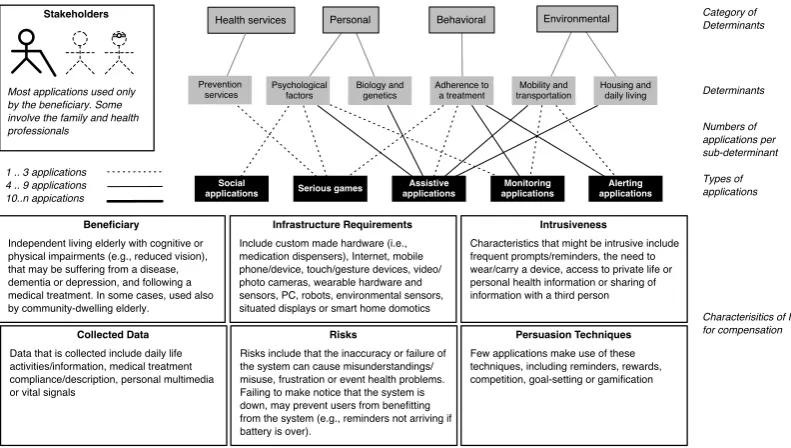
2.5 Typical characteristics of IT solutions for Compensation . . . 27
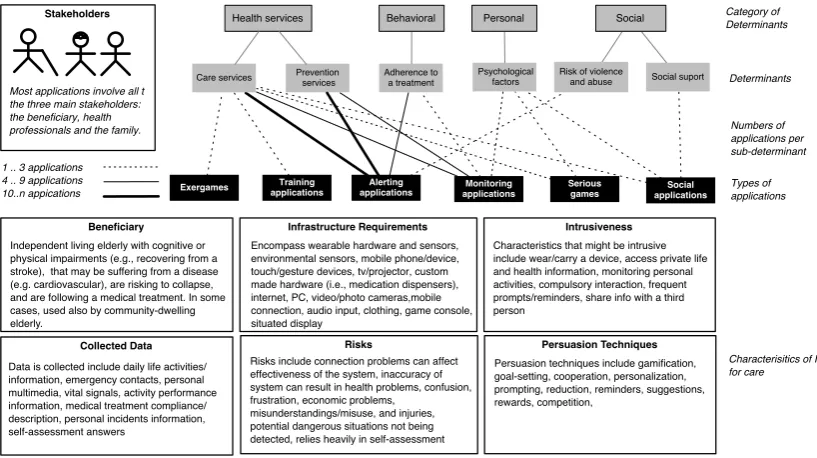
2.6 Typical characteristics of IT solutions for Care . . . 31
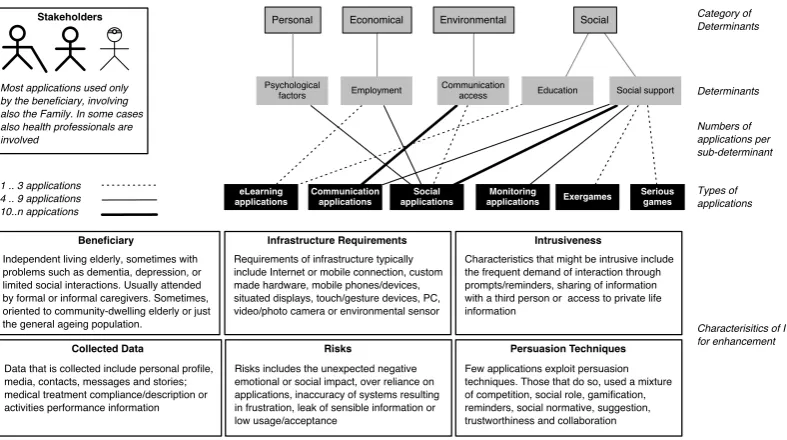
2.7 Typical characteristics of IT solutions for Enhancement . . . 36
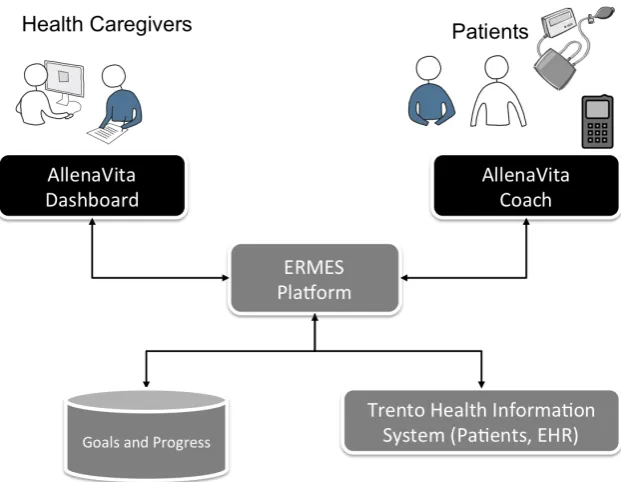
2.8 The ERMES Project Platform, with AllenaVita as Front-end . . . 41
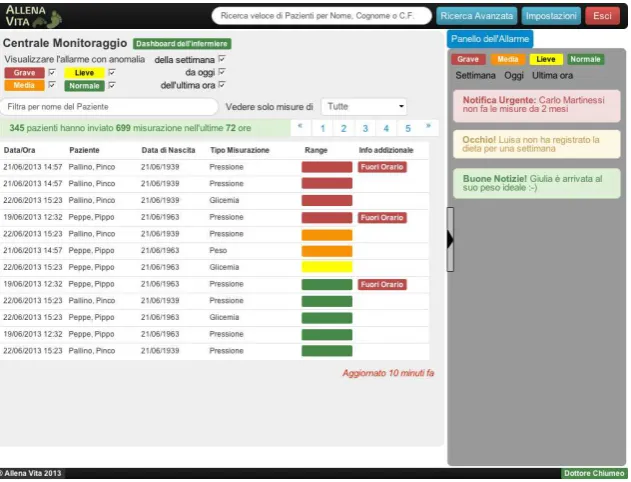
2.9 AllenaVita Dashboard. The home screen, with the upcoming list of health parameters values from patients, ordered by their level of alert . . . 42
2.10 AllenaVita Dashboard. Risk Assessment screen, where doctors and nurse classify pa-tients according to their risk for developing a cardiovascular disease, and monitor their evolution . . . 43
2.11 AllenaVita Dashboard. Goals and Activities screen, where doctors can set lifestyle goals and activities to suggest to patients based so as to achieve the goals . . . 44
2.12 AllenaVita Dashboard.Progress monitoring screen, where doctors can track the progress of patients in achieving their lifestyle goals . . . 45
2.13 AllenaVita Dashboard. Feedback screen, where doctors can send direct feedback to patients . . . 46
2.14 AllenaVita Coach. (a) theallenatore (trainer) approachwith the list of daily activities to follow, rendered as reminders in the main screen of the application; (b) blood pressure registration first step, the user can choose to do it manually or to obtain the measurement from an enabled measurement device; (c) blood pressure registration while the measure-ment is being taken . . . 47
2.15 AllenaVita Coach.(a) blood pressure registration finalized; (b) blood pressure registra-tion final addiregistra-tional details before sending the informaregistra-tion . . . 47
2.17 AllenaVita Coach.Progress screens. (a) progress on the physical activities category; (b) progress on the nutrition category, progress is shown for one goal at a time; (c) progress on the nutrition category, in this case for the second goal on nutrition; (d) progress on the category of reducing smoke; (e) the history of blood pressure measurements; (f) details
of single blood pressure measurements. . . 49
2.18 AllenaVita Coach.Feedback Screens. (a) list of the most recent messages received from caregivers, including the list of caregivers following the user; (b) list of all the messages received from caregivers. . . 50
3.1 The U-Bend of Life: happiness as we grow old (as found by Stone et al. [340]). The “WBL Ladder” in the vertical scale of the chart represents average levels of self-reported subjective well-being by people in different age groups represented in the horizontal scale 53 3.2 Social distance and happiness in a social network . . . 54
3.3 What’s Up’s one way communication . . . 58
3.4 What’s Up Interfaces for the Think Aloud Study . . . 58
3.5 Ease of use and comfort of the application . . . 60
3.6 Users ranking What’s Up interfaces according to their preferences . . . 60
3.7 Preference of interface levels by age group in ascending order . . . 61
3.8 EngAge Community Dashboard. The basic prototype allow senior centers to register future activities and later start the video-conference when the activity is ongoing . . . 63
3.9 EngAge Connect. The basic prototype allow users to see a list of up to 6 ongoing activities to which they can enter by one click. The user can also request for new list suggested activities if the previous list was not of interest. . . 63
3.10 EngAge Video-Conference.A google hangout with and embedded hangout application that has the EngAge controls . . . 64
3.11 The EngAge prototype architecture . . . 64
4.1 Heuristic model of reminiscence (as proposed by Webster in the field of social gerontol-ogy [368]) . . . 70
4.2 The reminiscence Bump.An approximated representation of the lifespan retrieval curve 73 4.3 Simple stages-based model of reminiscence design spaces . . . 75
4.4 Technology Heirlooms prototypes as proposed by [54] . . . 80
5.1 Research Plan.The plan of the research of this dissertation. . . 84
5.2 Summary of research activities and outcomes for each phase of this project . . . 92
6.1 Age distribution of participants of the First Laboratory of Technologies . . . 99
6.2 Home Screen of the Kaleidoscopio Blog . . . 100
6.3 Blog use Intention of the participants . . . 101
6.4 Laboratory disposition of participants according to expertise . . . 104
6.5 PD Workshops.Participants of the first workshop, brainstorming around the first paper prototype of Reminiscens . . . 107
6.6 PD Workshops. Participants of the second workshop create posters to represent stories they shared in a first moment . . . 108
6.8 PD Workshops.Collaborative digitalization of posters with and without assistance using glogster . . . 109 6.9 PD Workshops.Posters created by participants in the first workshop, showing their use
of visual triggers . . . 111 6.10 PD Workshops. Analysis of posters with notes about how visual cues were made of
both visual triggers of memory and cultural references . . . 112 6.11 PD Workshops. Evolution of the design of Reminiscens. (a) First paper prototype
focused on visualization through a timeline; (b) Second version focused on stimulation through questions and related information (c) Third version with the main screen focused on stimulating reminiscence with contextual cues; (d) Final version, with both contextual triggers in the form of media and question plus a timeline . . . 114 6.12 PD Workshops. Final prototype features. (a) Contextual questions as a starting point
for storytelling. (b) Drag and Drop life story editor with voice recording support and a collaboration button; (c) Digitizing physical memories with the tablet’s camera (d) Digitizing physical memories with automatic cropping of images. . . 115 6.13 The “Kaleidoscopio Group” after finishing one of the Reminiscens PD workshops . . . . 119
7.1 The Reminiscens system.Architectural overview of Reminiscens’ platform . . . 122 7.2 The Reminiscens system.The simple conceptual model of personal life stories . . . 128 7.3 The Reminiscens system.Main screen of Reminiscens’ UI. . . 129 7.4 The Reminiscens system.The timeline, divided in decades, as part of Reminiscens’ UI. 129 7.5 The Reminiscens system.The main screen, with the context displaying a resource from
the ‘Song’ category in the form of a youtube embedded video. . . 130 7.6 The Reminiscens system. A story opened in detail view (similar view for contextual
multimedia). . . 131 7.7 The Reminiscens system.The timeline, menu and (highlighted) one of the life questions
related to that decade. . . 131 7.8 The Reminiscens system. The story editor, featuring the possibility of adding pictures
taken with the Tablet (i.e., for digitalizing physical pictures) and record audio account of stories (audio storytelling). . . 132
8.1 Settings of the reminiscence public display. (a) Reminiscence public display call to action; (b) The reminiscence public display at the Kaleidoscopio CSA; (c) A regular day at the Kaleidoscopio CSA. The public display at right. . . 139 8.2 Reminiscence public display.Origin of shared pictures. . . 140 8.3 Reminiscence public display. Members of the CSA Community interacting with the
reminiscence public display . . . 142 8.4 Reminiscence longitudinal study.Visual timeline of the longitudinal study about
rem-iniscence supported by IT. . . 151 8.5 Reminiscence longitudinal study.Participants and sessions. . . 153 8.6 Reminiscence longitudinal study. Extended model of reminiscence stages where IT
8.7 Reminiscence longitudinal study. (a) a narrator showing what she has added to the system during the week to a listener; (b) and (c) parts of diaries with lists of events to be shared during the sessions. . . 155 8.8 Reminiscence longitudinal study.Listeners focused on listening the stories carefully. . 157 8.9 Reminiscence longitudinal study. Listeners acting as scribes, digitalizing stories in
parallel while narrators tell them. . . 157 8.10 Reminiscence longitudinal study.Listeners focused on either letting narrators take the
lead in writing the stories or teaching (or at least showing) them how to use the tablet. . . 158 8.11 Reminiscence longitudinal study.Listeners focused on either letting narrators take the
lead in writing the stories or teaching (or at least showing) them how to use the tablet. . . 158 8.12 Reminiscence longitudinal study. (a) (c) Non-collaborative preservation vs. (b) (d)
Collaborative preservation of stories. . . 161 8.13 Reminiscence longitudinal study. Collaboration in family. Social reminiscence
ses-sions in family context motivated not only participants, but the rest of the family to join the collaboration in telling family stories. . . 162 8.14 Reminiscence longitudinal study.Some examples of the settings of the social
reminis-cence sessions. . . 164 8.15 Reminiscence longitudinal study. Additional examples of the settings of the social
reminiscence sessions. . . 165 8.16 Reminiscence longitudinal study.Percentage of stories created, editions made, pictures
uploaded, questions answered and contextual multimedia watched using the web version ofReminiscens, outside of the sessions. . . 168 8.17 Reminiscence longitudinal study.Average of content inserted in the system per week. . 168 8.18 Reminiscence longitudinal study.Total content inserted in the system per week. . . 169 8.19 Reminiscence longitudinal study. Evolution of self-reported mood after sessions (in a
scale that goes from 8 to 40). . . 170 8.20 Reminiscence longitudinal study.ANOVA post-hoc results of comparing the difference
in means of the MS variable (contextual multimedia watched in detail during the session) for different versions of Reminiscens. On the left, a plot of the means of MS per group. On the right, the mean differences of MS for each pair of groups. . . 171 8.21 Reminiscence longitudinal study.ANOVA post-hoc results of comparing the difference
in means of the QS variable (questions answered during session) for different versions of Reminiscens. On the left, a plot of the means of QS per group. On the right, the mean differences of MS for each pair of groups. . . 171 8.22 Reminiscence longitudinal study.ANOVA post-hoc results of comparing the difference
in means of the SS variable (stories created during session) for different versions of Reminiscens. On the left, a plot of the means of SS per group. On the right, the mean differences of MS for each pair of groups. . . 172 8.23 Reminiscence longitudinal study.ANOVA post-hoc results of comparing the difference
in means of the PS variable (number of pictures added during the session) for different versions of Reminiscens. On the left, a plot of the means of PS per group. On the right, the mean differences of MS for each pair of groups. . . 173 8.24 Reminiscence longitudinal study.ANOVA post-hoc results of comparing the difference
8.25 Reminiscence longitudinal study.ANOVA post-hoc results of comparing the difference in means of the MSN variable (narrators’ mood after the session) for different versions of Reminiscens. On the left, a plot of the means of MSN per group. On the right, the mean differences of MS for each pair of groups. . . 174 8.26 Reminiscence longitudinal study.ANOVA post-hoc results of comparing the difference
in means of the ST variable (qualitative level of storytelling) for different versions of Reminiscens. On the left, a plot of the means of ST per group. On the right, the mean differences of MS for each pair of groups. . . 174
List of Tables
2.1 Active Ageing Health Services determinants . . . 11
2.2 Active Ageing Behavioral determinants . . . 11
2.3 Active Ageing Personal determinants . . . 11
2.4 Active Ageing Environmental determinants . . . 12
2.5 Active Ageing Social determinants . . . 12
2.6 Active Ageing Economical determinants . . . 12
3.1 Participants of the Think Aloud small study using What’s Up . . . 59
4.1 Types of reminiscence in literature . . . 69
4.2 Reminiscence Functions as presented in theReminiscence Functions Scale(RFS) [365][366] 71 7.1 Reminiscens Knowledge Base.Summary of collected multimedia resources by category. 124 7.2 Reminiscens Knowledge Base. Summary of collected multimedia resources by their source. . . 124
7.3 Reminiscens Knowledge Base.Summary of collected multimedia resources by decade. 125 8.1 Reminiscence public display.Origin of shared pictures vs type of memory contained in the picture (personal, community or public) . . . 140
8.2 Reminiscence public display.Origin of shared pictures vs age of the memory contained in the picture (very recent, recent, or past) . . . 140
8.3 Reminiscence public display. The four most common themes of the pictures shared through the display . . . 141
8.4 Reminiscence longitudinal study.Different conditions of the study based on Reminis-cens’ features. . . 147
8.5 Reminiscence longitudinal study.Narrators and listeners age statistics. . . 150
8.6 Reminiscence longitudinal study.Summary of age differences in groups. . . 150
8.7 Reminiscence longitudinal study.Sessions by version ofReminiscensthat was used. . . 167
8.8 Reminiscence longitudinal study.Content generated in sessions, throughReminiscence. 167 8.9 Reminiscence longitudinal study.Activated contextual multimedia triggers by category 175 8.10 Reminiscence longitudinal study.Activated contextual questions by category . . . 175
8.11 Reminiscence longitudinal study.Activated contextual questions by life chapter . . . . 175
1
Introduction
It happens to all of us. We are walking down the street while a sudden smell, or a simple sound, or a person passing by spontaneously triggers our memory and make us remember something in our past. Sometimes is a positive and lovely memory, that we treasure and that draws a smile in our face. Some-times is a tough memory that we might not enjoy to remember, but that helps us to reflect and learn about ourselves. This act of recalling and revisiting our past experiences is what is calledreminiscence. It is an experience that we are all familiar with, and one that is common to all ages and cultures. Reminiscing helps us to create our identities and maintain our relationships [171], to increase our life satisfaction and to lower or prevent depression [368], among many other benefits. Its practice is also used frequently with therapeutic purposes [363] and, as a human experience, it is typically spontaneous and unstructured in nature [105], sometimes private and some others very much social [368]. Reminiscence’s cross-generational prevalence, as a human experience, and the fact that some of its forms gain importance as we grow old (i.e., life review [96]), led us to explore how information and communication technologies (IT) can support reminiscence as the mean to an end, with the end being that of enabling a more happy
andactive ageing (AA).
During the last two decades that brought us the Internet and the boom of IT, our world has undergone a major cultural shift around one of the most important topics of our times:the challenges of ageing. All around the world, and especially in developed countries, the old “needs-approach” to ageing, thinking of elderly as the people who just need care due to their limitations, has been left behind and replaced by a more positive “rights-approach” [373] that emphasizes the fact that life does not end at that imaginary and fuzzy line between young and older adults, and there can still be lot to it beyond the natural limitations that are imposed by age.
to seize. In this context, IT has a role to play and it can be not only to improve care, prevention and compensation of age related limitations, but also to create new opportunities for health, security and participation as we naturally grow older [356]. In other words, the premise upon which this dissertation is built states that IT can, and will, play an enabling role in allowing people to achieve a more AA.
Of course, AA is a challenge with many sides. When older adults lose their ability to move within their environments without needing assistance they are less likely to remain active in the community. Health is also naturally challenged by ageing with older adults facing higher rates of morbidity, mortality, health care utilization and costs, which can all result in a poorer quality of life [167, 168, 176]. Research in this domain has led to a call for a greater focus on prevention of age-associated, physical function decline and disabilities [169, 140], which along with the improvement of healthcare services and solutions that com-pensate for physical and cognitive decline, are the most common ways in which technology addresses age-related challenges.
While the focus on prevention and health care is indeed key for enabling participation, another fun-damental aspect, however, has to do with the social context: how to increase, sustain or enable social interactions as we age, beyond the natural limitations that come with age. Social relationships are a key element of healthy and happy lives [222] and they are challenged as we grow older due to several factors like the reduction of our social networks or the physical limitations that prevent people from engaging with others as often as they would prefer. This is where this dissertation steps in: what can technology bring to the social dimension of active ageing?. How can IT help older adults to achieve the goals of an active ageing, maintaining, and enriching, their social interactions with family, friends and peers?.
These are, of course, overly broad questions to address, which require an interdisciplinary approach where IT and engineering traditional methods are not enough. Hence, in the search for an answer to these questions, this dissertation has leveraged upon a participatory action research approach [285] in order to provide first an understanding of what roles IT already plays and what the needs of older adults are with respect to technology and social interactions, while at the same time enabling them to achieve the goals of AA through active participation in their communities. This participatory exploration, combined with a deep literature research, eventually resulted in a broad range of experiences of social interactions where technology can play a positive role: from substantially improving remote communication with the family for increasing social connectedness, briefly passing by enabling real time remote participation in social events, and finally getting to facilitating face-to-face intergenerational conversation through storytelling. Each of these experiences have been explored pragmatically in this research project, by designing, implementing and evaluating prototypes to support them. But, each is also an entire research and design space on its own. With the goal of deepening our learning and providing a more substantive contribution to the state of the art, the focus was finally set in one of such experiences: face-to-face, intergenerational, social interactions through the practice ofsocial reminiscence (i.e., when memories are shared for conversation or teaching lessons learned from past experiences [368]).
model of the different stages of IT-supported social reminiscence that represent the design spaces for (or roles played by) IT in supporting social reminiscence; an exemplary socio-technical system that fits these roles, including an algorithm for suggesting contextual triggers of reminiscence; and, an analysis of the use of this system in a real intergenerational, conversational context, including a discussion of the future avenues for research and design of IT-supported intergenerational social interactions.
In the very end, the final goal of this dissertation is to trigger the involuntary but exquisite human emotion described by Proust’s famousMadeleine[290], for the benefit of a better, happier and more active ageing.
...No sooner had the warm liquid mixed with the crumbs touched my palate than a shudder ran through me and I stopped, intent upon the extraordinary thing that was happening to me. An exquisite pleasure had invaded my senses, something isolated, detached, with no suggestion of its origin. And at once the vicissitudes of life had become indifferent to me, its disasters innocuous, its brevity illusory this new sensation having had on me the effect which love has of filling me with a precious essence; Whence did it come? What did it mean? How could I seize and apprehend it?. And suddenly the memory revealed itself. The taste was that of the little piece of madeleine which on Sunday mornings at Combray, when I went to say good morning to her in her bedroom, my aunt Lonie used to give me, dipping it first in her own cup of tea or tisane. (M. Proust)
1.1
Research Questions and Problems
This research project starts from the premise that social interactions are a fundamental aspect of well-being, and this relevance holds (perhaps even stronger) as we age. Given this premise, which is later grounded in literature, the dissertation revolves around the role of IT in enabling social interactions and well-being as we age. The research is then driven by the following general research questions (GRQs):
• GRQ1.1. IT and Active Ageing: can IT play a role in enabling a moreactive ageing, i.e., the improvement of opportunities for health, security and participation as we age?
• GRQ1.2.IT and Active Ageing:how does IT play this role?.
• GRQ2.1. IT and Socializing: can IT enhance (i.e., increase, sustain, improve) social interactions for older adults?
• GRQ2.2. IT and Socializing: how does IT enhance (i.e., increase, sustain, improve) social inter-actions as we age?.
These general questions are answered by two means: through scientific literature review and exploratory works that included both research and design of IT aimed at enabling AA and social interactions (see chapters 2 and 3). The work undertaken for answering this first group of questions led the project to a shift of focus towards a more specific human experience: the practice of reminiscence (i.e., revisiting our past memories) as a way for enabling intergenerational social interactions in a face-to-face conversational context. Given the potential of reminiscence as a practice to improve subjective well-being and its cross-generational prevalence, the goal became to stimulate and facilitate this practice and, by using reminiscence as a vehicle, to also stimulate social interactions. This focus is expressed in the following refined research questions (RQs):
• RQ1.2 IT to stimulate reminiscence: how can IT (which technology, which designs, which in-teractions, what content) stimulate the practice of reminiscence in a social and intergenerational context?
• RQ2.1. IT to stimulate social interactions: can IT-supported reminiscence systems facilitate in-creased and sustained intergenerational social interactions?
• RQ2.2. IT to stimulate social interactions: how can IT-supported reminiscence systems facilitate increased and sustained intergenerational social interactions?
• RQ2.3. IT to stimulate social interactions:is IT-supported social reminiscence enjoyable?
These questions are answered through both (i) a literature review on the topic of reminiscence, covering its conceptual background and its research from the IT perspective (see chapter 4); and (ii) a participa-tory action research approach intertwined with an interaction, engineering (participaparticipa-tory-driven) design process that led to a socio-technical system we callReminiscens, which was used as a technology probe for a more concrete study and evaluation of IT-supported social reminiscence for enabling social inter-generational interactions. We set (ii) as the core of this research project.
1.2
Dissertation organization
The present dissertation starts by introducing the motivations, research questions and problems it is aimed to resolve. To this introductory part follows a review of the core concepts and the state of the art (with a focus on information technologies) that are used to frame the research project within a conceptual framework and present the exploratory works that led to and motivated the work.
This conceptual framework has three layers, that goes from the very general domain ofactive ageing, passes by the intermediate level ofsocializing(as one fundamental aspect of AA) and finally delves into the practice of reminiscence(as one specific way of enabling socializing). Each domain is explored in detail in a different chapter that offers both the theoretical overview and a detailed review of IT for that domain.
Also in this first part, we describe exploratory works (sections 2.5, 3.3 and 3.4), which are not central and can, thereby, be skipped while reading this dissertation. They are included in the dissertation because they contributed to the process that led to our final (and core) research questions. In summary, the first part of the dissertation includes the following chapters:
• Chapter 1 (Introduction)introduces the motivation of this dissertation, the research questions it aims to answer and the problems it seeks to solve.
• Chapter 2 (Review on IT for Active Ageing)presents a thorough review of the ageing problem domain and its solution domain from an IT perspective, using the concept of active ageing as the integrating framework. It also presents a small exploratory design work (AllenaVita) undertaken as a part of a local research project in the area of healthcare informatics from the Province of Trento, Italy.
(EngAge) focused on remote synchronous real-time social interaction.
• Chapter 4 (Review on IT for Reminiscence)presents a review on the theory behind the practice of reminiscence and an overview of IT for supporting, stimulating or facilitating this practice, which this dissertation empathizes as a way for bridging and stimulating intergenerational social interactions in a conversational, face-to-face context.
The second part of the dissertation describes the methods and tools we used for answering our research questions, the way in which these methods have been applied in the research project, the description and insights of the design process that has driven the research from its early stages and a technical overview of the proof-of-concept that resulted from this process:Reminiscens. In summary, the second part includes the following chapters:
• Chapter 5 (Methodology and research plan)describes the methodological approaches used for this project and the resulting research plan that applies them. Each approach is introduced by a small overview of literature that defines it.
• Chapter 6 (Designing IT for Social Reminiscence)describes the design process that has driven the research project from its beginning, describing in detail each of research and design activity undertaken during this process, along with the insights results and insights obtained from them.
• Chapter 7 (The Reminiscens System)focuses on the technical contributions of this dissertation, as they are expressed in the resulting Reminiscensplatform and application, explaining how the different insights obtained during the previous exploratory and design experiences are connected to the technical decisions we made during implementation.
The most important part of the dissertation follows in the third part, with the description of the final field studies we have conducted, their results and the discussion around these results together with the conclusions and future research and design spaces that can be addressed. The third part includes the following chapters:
• Chapter 8 (Field Studies)describes in detail the two main field studies of this research project, designed to answer the last two research questions presented in section 1.1, including the results, analysis, and discussion of results.
• Chapter 9 (Conclusion and Future work)extends the discussion of results and their implications for the future, presenting a the lessons we have learned with this research, the limitations of our work and the future research directions opened by this dissertation.
1.3
Research Acknowledgements
This dissertation would not have been possible without the extended and participatory action collabora-tion with theElderly Services Center “Contrada Larga”, managed by the social Cooperative Kalei-doscopio of Trento in Italy1, with both its staff and its wonderful community of active seniors.
In the same way, the project has been entirely developed within and supported by (in so many differ-ent ways) theLifeparticipationresearch team2, which is a foundational part of theSocial Informatics
research group at the University of Trento, Italy.
1Centro Servizi Anziani “Contrada Larga” gestito dalla Cooperativa Sociale Kaleidoscopio:http://kaleidoscopio.
coop/index.php/ita/I-nostri-servizi/Centro-Servizi-Anziani
Finally, parts of this project had been conducted under the scope of the following research projects, funded by the Province of Trento:
• Project“ANCHISE portale RSA”(2012-2013 ), developed by theUniversity of Trentoin collab-oration withHIT s.r.l.andRSA Brentonico.
2
Review on IT for Active Ageing
“Running is my life. I will keep running to inspire the masses” says Fauja Singh in a recent interview after announcing his retirement from running marathons1. The surprising aspect of his statement is not so much the intention to quit running competitions but rather his age: Fauja is 102 years old and known as the oldest marathon runner of the world2.
What Fauja is teaching us is that life does not end after retirement and that the right exercise, diet, determination and opportunities have the power to keep or even improve quality of life also when facing the burdens of age. Fauja is not only an extraordinary sportsman, he is also representative of a more general phenomenon of today’s ageing society (admittedly, an exceptional one): increasingly, people do not just live longer and generally healthier, but they also keep practicing physical activities (e.g., dancing, hiking or swimming), reading to stay informed or writing themselves to inform others, engage in social relationships (also over long distances), or travelling, even in advanced age. That is, older adults are increasingly active and want to take part of society and to contribute to it. Active Ageing (AA) is a concept that encompasses this phenomenon, fostering a physically, mentally and socially active lifestyle as a person ages. It is a complex, multi-faceted problem that involves a variety of different actors, such as policy makers, doctors, care givers, family members, friends and, of course, older adults.
Information and communication technologies (IT) increasingly play the role ofenablers and facilitators of AAas we grow older. In this chapter, a theoretical overview of the ageing phenomena and its active version is presented, followed by a review on how IT enables AA, serving both as answers to our first set of general research questions (see section 1.1). This review has also been submitted for publication as a survey on IT for AA [277]. The chapter is finalized by presenting one of the exploratory works developed within this research project, and that can be categorized as yet another example of IT for AA.
Active Ageingforms thebig picturethat motivates this dissertation. This big picture is zoomed in the following chapter to one specific aspect of AA: itsSocial Dimension. Finally, a last zoom in is done to get to the actual core of the dissertation, centered around one of many experiences that can enable
intergen-1http://news.discovery.com/human/life/101-year-old-marathoner-retire-130124.htm
erational social interactions (as the means for enabling AA):Social Reminiscence, understood as the act of revisiting the past memories and sharing them for the purpose of conversation in an intergenerational context.
2.1
Theoretical Background
2.1.1 What’s Ageing?
Ageing is a process we all undergo from the moment of our birth. At the beginning, ageing means growing, getting stronger, and differentiating ourselves while we build our identities, gain experience and knowledge. Around the age of 20, our physical, sensory, and cognitive capabilities peak and stabilize until we reach our 50s/60s. While our life experiences and our knowledge (and perhaps our wisdom) will continue to grow, our capabilities start to decline depending on factors like our genetics, lifestyle, and social environment. The exact reason of this decline is not yet entirely understood. Some theories speak of a natural and programmed process that takes place in our bodies, while others explain decline as the result of damage accumulated over time [160]. Independently of the reasons that determine decline, ageing unavoidably affects functioning as a complex interaction of genetics, chemistry, physiology, and behavior/lifestyle [238].
Ageing often comes with augmented risk of adverse health conditions that may affect physical function-ing. Some of the most common age-related health problems are mobility related. Sometimes the changes in physical capabilities come as a result of diseases. Non-communicable chronic diseases increase in most societies [203] and negatively effect on physical functioning. Examples of non-communicable diseases are diabetes, cancer, and hypertension. Most of the health problems in old age are chronic non-communicable diseases [373], which require constant monitoring and care. Although research has shown that many of these conditions have their origins in early childhood, it is well known that behav-ioral factors; e.g., tobacco or alcohol consumption, a sedentary lifestyle, etc. considerably increase the risk of developing or aggravating non-communicable diseases.
Independently of health, there are three macro-areas of manifestations of age that group different phe-nomena that affect quality of life and that allow us to structure our analysis: physical capacity, i.e., the capacity to perform physical activities; sensory capacity, i.e., the capacity to capture and interpret information; and cognitive capacity, i.e., the capacity to process, reason on, and produce information. Common cardiovascular, neuromuscular, physiological, sensorimotor, and cognitive changes associated with ageing are summarized in the literature [99, 219, 249].
2.1.2 What’s Active Ageing?
Ideas around AA have taken many different names and forms within the field of Gerontology. In the mid 1990s, one of the first attempts to sum up these ideas into a term was the definition ofsuccessful ageingas having a “low probability of disease and disease related disability, high cognitive and physical functional capacity, and active engagement with life” [303]. Terms such as healthy or productive ageing and ageing well followed later in the same line of describing desirable ideals about the ageing process [234]. According to Tesch-Roemer [347], these definitions represented an idealization of ageing and were not inclusive enough. The Organization for Economic Co-operation and Development (OECD) defined AA as “the capacity of people to lead productive lives in society and economy” [263], focusing the concept on the occupational dimension. The WHO popularized AA by publishing a policy framework for enabling AA. WHOs definition emphasized opportunities within the process of ageing with AA being the “process of optimizing opportunities for health, participation and security in order to enhance quality of life as people age” [373].
This focus on opportunities represented a shift in how the concept was understood and the definitions that followed took the same approach, differing only on which aspects or dimensions of quality of life were emphasized other than health, security and participation. Along with the emphasis on opportunities, the point of view of these definitions was almost always that of policy makers trying to enable AA through society’s institutions.
The United Nations through its Economic Commissions for Europe (UNECE), for example, emphasize that the promotion ofsocial integrationandactive involvementin community are the key elements of AA [353] whileautonomy,self-determinationandchoicesare the core dimensions according to [234]. The Institute for Prospective Technological Studies of the European Union (IPTS) emphasize the need for policies aroundindependenceandautonomy[233] definingAA policiesas those that “enable people, as they grow older, to lead independent lives (socially and economically), making their own choices about how to shape their lives in all its spheres”.
In 2012 the European Union (EU) promoted the European Year for Active Ageing 3 updating the definition of AA to “growing old in goodhealthand as afull member of society, feeling more fulfilled in our jobs, moreindependent in our daily lives and more involved as citizens”. The EU takes then a more lifestyle oriented definition, which is summarized in a particularly inspiring phrase from their website: “No matter how old we are, we can still play our part in society and enjoy a better quality of life”.Employment,ParticipationandIndependenceare the key dimensions in this definition.
Other definitions of AA use phrases such as “engaged in life”, “live life as fully as possible”4or “having as much as possible of independence, autonomy andsocial inclusion” [108]. One of the latest term definitions says that AA is a “processthat leads to both objective and subjective quality of life in old age in the domains ofhealth,social integration, andparticipation” [347].
In summary, the general idea is that it does not matter how old you are, there will still be a role to play in society to enjoy a better quality of life. Whether we define it from a policy-making perspective or from a lifestyle point of view, AA improves wellbeing in the dimensions of health, participation, security, employment, independence, autonomy and integration. All these dimensions can be argued to be included within those proposed by the WHO, leading to the definition we used in this dissertation, where we put together both policy makers and the lifestyle perspectives.
3http://europa.eu/ey2012/
Definition 1 Active ageing (AA)is having a physically, mentally and socially active lifestyle as we age, with optimized opportunities of quality of life in the domains of health, participation, and security.
“Health is a state of complete physical, mental, and social well-being and not merely the absence of
disease or infirmity” [374]. Participationis the ability of a person to engage in socio-economic and cultural activities, making a productive contribution to society as they age (e.g. attending cultural ac-tivities, volunteering, being part of local communities, interacting with family and friends). Securityis having adequate protection and care when assistance is required while maintaining as much as possible of autonomy and independence (e.g. receiving quick response to emergencies such as falling, or having the possibility to make our own choices). Altogether, these are the threemain aspects of AAand they influence each other in multiple ways [250, 359]. Health is often seen as a precondition for participation and security, however, it is also well know that more social participation can improve health, while at the same time security can enhance people’s opportunities for participation [347].
2.1.3 Determinants of Active Ageing
How well both individuals and populations age is determined by a set of enabling factors (and the inter-play between them) called thedeterminants of AA, each affecting one or more of the three main aspects of AA presented before.
Definition 2 Determinants of AAare influences that surround individuals and which the process of AA depends on.
Based on the report by the WHO [373] and other inputs from the literature cited in the previous section, there are 17 determinants that are key for enabling AA, organized in six main categories. Building upon WHO’s definitions, each of these categories is explained in the following paragraphs, along with a description of each specific determinant included in them.
Health services(Table 2.1) are public or private health services to which a person has access, including
health promotion, disease prevention, curative and mental health services. Part of this is the equitable access to primary healthcare and long-term care by informal caregivers and/or healthcare professionals.
Behavioural determinants (Table 2.2) are the behaviours a person regularly follows. Behaviours like
healthy nutrition, active participation in ones own care, not smoking nor using alcohol and engaging in regular physical activity can all have a positive impact on AA.
Personal determinants(Table 2.3) are the set of characteristics of a person’s biology, genetic and
phys-ical limitations, including psychologphys-ical factors like ones own intelligence, cognitive capacity, self-efficacy and self-esteem.
Environmental determinants (Table 2.4) are the conditions of a person’s physical surroundings which
can help people age better. Transportation means, safe housing, clean water, air and safe food are all environmental determinants of AA.
Social determinants(Table 2.5) are the conditions that define a person’s social environment, including
how much support a person receives from its social networks, how many opportunities for education and lifelong learning the person has access to and how much risk of violence and abuse the person is subjected to.
protec-Table 2.1: Active Ageing Health Services determinants
Determinant Description
Cure services Health services that provide attention and recovery treatment when an emergency is triggered (either because of a disease or an accident) or when the person endures a chronic health condition or disease that de-mands constant treatment. For example, a cure service can help to avoid long term loss of capabilities, helping people to stay active faster and for longer.
Care services Availability and quality of healthcare and long-term care for elderly in the place they live. For example, a constant and good care can ease the burden of age related limitations, helping people to feel good and facilitating their participation in social or personal activities.
Prevention services Health services to prevent potential physical or cognitive losses. For ex-ample, vaccinating older adults against influenza prevents them from be-ing affected by this disease and related complications, potentially allevi-ating also the economic cost of treatments.
Table 2.2: Active Ageing Behavioral determinants
Determinant Description
Adherence to a treatment Level of compliance of a person in following medication and treatment. For example, if a person adheres correctly to a prescribed treatment, his or her health conditions will improve faster or the burden of diseases gets reduced.
Lifestyle The individuals’ way of living manifested in activities, attitudes and in-terests. For example, participation in regular, moderate physical activity can delay functional decline.
Table 2.3: Active Ageing Personal determinants
Determinant Description
Psychological factors Everything that makes to a person’s psychology like its cognitive capac-ity, motivation, efficacy and esteem. For example, a good self-esteem will make it easier for people to adopt healthy lifestyles.
Biological and Genetic factors A person’s intrinsic biological characteristics and inherited health con-ditions and limitations, including also its inherited or acquired physical limitations. For example, physical conditions like constant tremors of the hands can reduce the type of activities a person can engage in.
tion) services.
Table 2.4: Active Ageing Environmental determinants
Determinant Description
Mobility and Transportation Opportunities for, and quality of, mobility and transportation systems ex-isting in the environment. For example, a good public transportation sys-tem can facilitate people to stay in touch visiting friends and family. Age-friendly infrastructure Availability of infrastructure that it is accommodating to disabilities that
may appear as we grow old. For example, ramps for accessing building. Communication access Infrastructure for communication and availability of communication
means. This determinant has a role in supporting elders’ social relation-ships, for example, keeping them in touch with relatives and friends living abroad.
Housing and daily living How supportive is a person’s housing environment to facilitate perfor-mance of daily chores and activities. For example, the availability of ramps or wheelchair stairs lifts can be key in facilitating the life of people with physical impairments, allowing them to maintain independence. Quality of water, air and food The quality and availability of air, food and water in the environment. For
example, clean water is fundamental for those who have a fragile health (i.e. people with chronic illnesses and compromised immune systems) can reduce the type of activities a person can engage in.
Table 2.5: Active Ageing Social determinants
Determinant Description
Risk of violence and abuse Level of insecurity in the social environment. For example, older people who are frail live alone may feel particularly vulnerable to crimes and such as theft, and hence limit their participation in social activities. Education Quality and availability of education opportunities in the social
environ-ment. For example, low levels of education can result in difficulties for finding jobs as we become older workers.
Social support Quality and availability of support and social interactions in a person’s social network. For example, supportive social connections and intimate relations are vital sources of emotional strength.
Table 2.6: Active Ageing Economical determinants
Determinant Description
Income Level of income perceived by individuals. For example, better income can guarantee access to better, healthier diet.
Employment Opportunities and quality for employment, volunteerism or leisure time activities. For example, access to employment through volunteerism in old age can help people to feel useful for contributing meaningful in so-ciety.
!∀#∃ %&∋
Happ inness
Experience and W isdom
Capabilities
!∀#∃ %(∋
Hap pinn
ess
Experience a nd Wisdo
m
Capabilities
Figure 2.1: Ageing and Active Ageing phenomena simple representation
Summarizing this section, literature on ageing is often focused on the declining aspects of the ageing phenomena. AA pushes this perspective towards a more positive view that takes into account all aspects of growing older (not only those that decline) and emphasize improvement of opportunities as we age. As a general model, albeit only for representation purposes, we prefer to think of ageing as a process during which we gain in some aspects while losing in some others. Active ageing is about optimizing gains and minimizing loses. Figure 2.1a is an abstraction of this idea, where life is represented by several curves that change over time. Things like experience and wisdom can be represented as S-Shaped learning curves [118], slow at the beginning and getting to plateau towards the end. Happiness seems to follow a U-Shaped evolution [340], increasing in elderly years. And finally, our capabilities (physical, sensory and cognitive) get to a peak and then start to decline. Enabling AA is about getting from Figure 2.1a to Figure 2.1b, slowing decline as much as possible and increasing life experiences, wisdom and, ultimately, happiness.
2.2
IT and Active Ageing
IT can help to maintain health and independence increase participation and enhance security as we grow old. This section explains the four approaches by which IT enable AA and provides a systematic review of existing systems for this purpose.
2.2.1 Objectives of IT for elderly
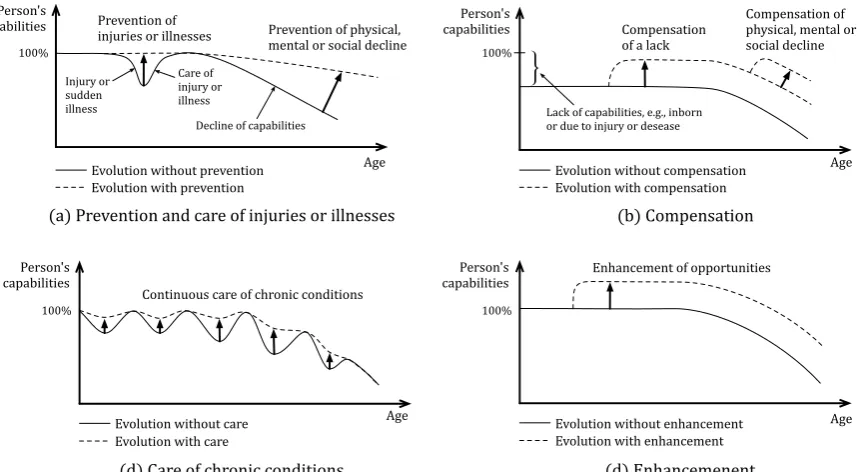
The four approaches in which IT can enable AA come from the literature of Gerontechnology, an in-terdisciplinary field devoted to “the study and design of technology and environments for independent living and quality of life of older adults”5. These four approaches are summarized asGerontechnology goals[177]. Figure 2.2 shows our representation of each of these approaches in terms of how they pos-itively impact some aspects of our life. In each figure, the dashed curve represents how would our life course be by following these approaches. A definition of each goal follows the figure.
• Prevention. Is the first and foremost goal of Gerontechnology. Successful prevention can make
the other three goals redundant. In addition to enabling AA, prevention implementation success
!∀#∃%&∋(&)∗+∗&∗&, %&∋(&)∗+∗&,∃−.∃−//−0,1&2,2∗3 %4−51,2−&∃62,∋−1,∃∗&∋(&)∗+∗&, %4−51,2−&∃62,∋∃∗&∋(&)∗+∗&, 7889 :∗03−&;3∃ )(/(<252,2∗3 =>∗ ?−&,2&1−13∃)(0∗∃−.∃)∋0−&2)∃)−&∀2,2−&3 !∀#∃?(0∗∃−.∃)∋0−&2)∃)−&∀2,2−&3 %4−51,2−&∃62,∋−1,∃)(0∗ %4−51,2−&∃62,∋∃)(0∗ :∗03−&;3∃ )(/(<252,2∗3 =>∗ 7889 ?−+/∗&3(,2−&∃ −.∃(∃5()≅ ?−+/∗&3(,2−&∃−.∃ /∋Α32)(5Β∃+∗&,(5∃−0∃ 3−)2(5∃∀∗)52&∗ !<#∃?−+/∗&3(,2−& %4−51,2−&∃62,∋−1,∃)−+/∗&3(,2−& %4−51,2−&∃62,∋∃)−+/∗&3(,2−& :∗03−&;3∃ )(/(<252,2∗3 =>∗ Χ()≅∃−.∃)(/(<252,2∗3Β∃∗∆>∆Β∃2&<−0&∃ −0∃∀1∗∃,−∃2&Ε10Α∃−0∃∀∗3∗(3∗ 7889
}
:0∗4∗&,2−&∃−.∃ 2&Ε102∗3∃−0∃255&∗33∗3 :0∗4∗&,2−&∃−.∃/∋Α32)(5Β∃ +∗&,(5∃−0∃3−)2(5∃∀∗)52&∗ %4−51,2−&∃62,∋−1,∃/0∗4∗&,2−& %4−51,2−&∃62,∋∃/0∗4∗&,2−& !(#∃:0∗4∗&,2−&∃(&∀∃)(0∗∃−.∃2&Ε102∗3∃−0∃255&∗33∗3 :∗03−&;3∃ )(/(<252,2∗3 =>∗ Φ&Ε10Α∃−0∃ 31∀∀∗&∃ 255&∗33 Γ∗)52&∗∃−.∃)(/(<252,2∗3 7889 ?(0∗∃−.∃ 2&Ε10Α∃−0∃ 255&∗33Figure 2.2: Gerontechnology Goals
may also lead to economics savings that can be redirected to other societal needs [177]. As we age, prevention helps us to avoid injuries and slow down physical, mental and social decline (Figure 2.2a). Using a machine to stay fit and keep walking, following a physical training plan using videos on YouTube, improving our nutrition with a tool that helps us log and monitor what we eat or stimulating our brain with computer games are examples of IT enabling AA through prevention.
• Compensation. When an impairment or disability can no longer be prevented or cured,
compensa-tioncomes into place to either reduce the impact of the declined capability, or to partially and arti-ficially replace a not available capability (inborn or due to injuries or illnesses; Figure 2.2b). Com-pensation is applied either on the environmental or on the personal level [177]. (Geron)technology can be used for these purposes, making up for impairments that people face as they age.
• Care. When we cannot prevent nor compensate a problem, and/or we need assistance to recover
from an incident or to reduce the impact of a chronic condition,careis needed (Figures 2.2a and 2.2c). (Geron)technology for care acts to facilitate the work of the caregivers. The caregiver can either be a formal caregiver (e.g., nurse, physician) or an informal caregiver (e.g., family member, friend).
• Enhancement. (Geron)technology can help to create new opportunities and extent existing
1 .. 3 applications 4 .. 9 applications 10..n appications Health Active Ageing Participation Security Determinants Sub-determinants Types of applications Application goals Active Ageing dimensions
Numbers of applications per sub-determinant
Care Compensation Prevention Enhancement
IT for Active Ageing
Health services Behavioral
Personal Economical Environmental Social
Cure services Biology and
genetics
Quality of water, air and food Mobility and transportation Housing and daily living Age-friendly infrastructure
Risk of violence and abuse Income
Adherence to a treatment
Care services Prevention services Communication
access Education Social support Employment Lifestyle Psychological factors Alerting applications Exergames Serious games Communication applications Social applications eLearning applications Assistive Training applications Monitoring applications
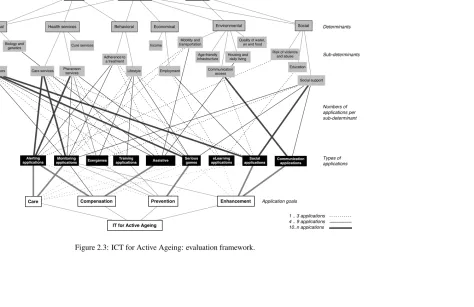
Figure 2.3: ICT for Active Ageing: evaluation framework.
2.2.2 Evaluation Framework
To understand how IT can aid AA, that is, which IT solutionsmay help address which of theproblems
of AA, part of this dissertation focused on developing a conceptual evaluation framework that brings together the two perspectives introduced above. The structure of the framework is illustrated in Figure 2.3: On the top, we find our definition of AA, with its three majordimensions(health, participation, security). In order to understand how IT may modulate these dimensions, the framework shows which
determinant categories (and their specific determinants) can be used as levers. From the bottom, the solution space is structured first into the fourgoals(or also application domains) technology may pursue, in order to make life better; then, the framework shows what types of applicationsmay serve which of these goals.
The types of applications are a bottom-up result of our analysis that stem from a careful clustering of all considered applications into groups of applications serving similar purposes; clusters were considered only for groups with at least three members. Applications of the same type share common features, such as monitoring physical activities, gaming, alerting about medication, and similar. Given the versatility of applications and the different uses one may make of them, one application may fit into one or more different types. However, in order to assign each application to exactly one type of application when multiple options were available, we opted for the type in which most the features of the application were focused. For example, alerting applications generally include the features ofmonitoring applications
(e.g., tracking some metric of measure), in that they add additional functionality to their features (e.g., rules that fire if a measure exceeds a given threshold and notify a caregiver or family member). Thetypes
of applicationswe have identified in this analysis follow along with a proper definition:
• Monitoring applications are systems that keep track of the state of something or someone (e.g.,
activity sensors like wearable step counters or pedometers).
• Alerting applicationsare systems that notify about the occurrence of an event (e.g., medication
reminders).
• Assistive applications are systems that help users in the realization of an activity by suggesting
how to perform the activity (e.g., interactive mobility guides).
• Training applicationsare systems that guide someone to improve a particular skill over a period
of time (e.g., nutritional virtual coaches).
• Exergamesare serious games that have physical exercise as a primary purpose (e.g., Nintendo