Available Online At www.ijpret.com
INTERNATIONAL JOURNAL OF PURE AND
APPLIED RESEARCH IN ENGINEERING AND
TECHNOLOGY
A PATH FOR HORIZING YOUR INNOVATIVE WORK
OBJECT RECOGNITION USING GABOR FEATURE AND CLASSIFIER
KARAN S BELSARE1, NILESH L GADEKAR2, ANUP V KALASKAR3
1. Master of Engineering ,Electronics Department, Fr.C.R.C.E College Mumbai University.
2. Master of Engineering ,Electronics Department, Fr.C.R.C.E College Mumbai University.
3. Assistant Prof. IBSS College Amravati University.
Accepted Date:
27/02/2013
Publish Date:
01/04/2013
Keywords
Gabor Feature,
Support Vector Machine,
Object Recognition
Corresponding Author Mr. Karan S Belsare
Abstract
Available Online At www.ijpret.com
INTRODUCTION
Feature extraction and classifier learning
are essential to the performance of an
object recognition system. Discriminative
features and robust classifiers are always
desirable to pattern recognition
applications. However, discriminative
features like Gabor features, either require
computationally expensive feature
extraction process, or have large feature
dimension [1]. This paper tries to propose a
framework to design efficient and robust
object recognition system. Due to it’s
biological similarity to human vision system,
Gabor features have been widely used in
object recognition applications like
fingerprint recognition [2] and character
recognition [3]. Etc. Liu et al. [7] vectorize
the Gabor responses and then apply down
sampling by a factor of 64 to reduce the
computation cost of the following subspace
training. Their Gabor-based enhanced
Fisher linear discriminate model
outperforms Gabor PCA and Gabor fisher
faces. A more detailed survey on Gabor
wavelet based face recognition methods
can be found in [1]. While subspace
methods like PCA and LDA could be applied
for dimension reduction [7, 8], they do not
improve the efficiency of feature extraction
process. Some works in the literature have
tried to tackle this problem by (1)
downsampling the images [9], (2)
considering the Gabor responses over a
reduced number of points [6], or (3)
downsampling the convolution results [7,
8]. Strategies (2) and (3) have also been
applied together [10]. To make SVM
applicable to Gabor features, Qin and He
[10] reduced the size by including only the
convolution reults over 87 manually marked
landmarks. Furthermore, our works [11]
have also shown that facial landmarks like
eyes, nose and mouth might not be the
optimal locations to extract Gabor features
for face recognition. In this paper, we
propose a general object recognition
framework based on SVM and optimized
Gabor features.
2 GABOR WAVELETS AND FEATURE
EXTRACTION
In the spatial domain, the 2D Gabor
wavelet is a Gaussian kernel modulated by
Available Online At www.ijpret.com
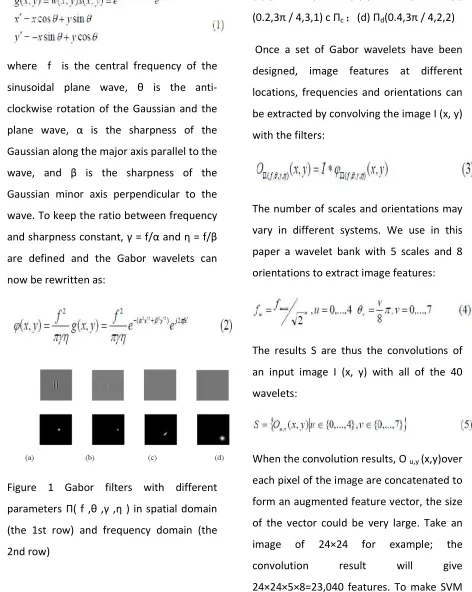
where f is the central frequency of the
sinusoidal plane wave, θ is the
anti-clockwise rotation of the Gaussian and the
plane wave, α is the sharpness of the
Gaussian along the major axis parallel to the
wave, and β is the sharpness of the
Gaussian minor axis perpendicular to the
wave. To keep the ratio between frequency
and sharpness constant, γ = f/α and η = f/β
are defined and the Gabor wavelets can
now be rewritten as:
Figure 1 Gabor filters with different
parameters Π( f ,θ ,γ ,η ) in spatial domain
(the 1st row) and frequency domain (the
2nd row)
(a) (0.1,0,1,1) a Πa ; (b) (0.3,0,6,3) b Πb;(c)
(0.2,3π / 4,3,1) c Πc ;(d) Πd(0.4,3π / 4,2,2)
Once a set of Gabor wavelets have been
designed, image features at different
locations, frequencies and orientations can
be extracted by convolving the image I (x, y)
with the filters:
The number of scales and orientations may
vary in different systems. We use in this
paper a wavelet bank with 5 scales and 8
orientations to extract image features:
The results S are thus the convolutions of
an input image I (x, y) with all of the 40
wavelets:
When the convolution results, O u,y (x,y)over
each pixel of the image are concatenated to
form an augmented feature vector, the size
of the vector could be very large. Take an
image of 24×24 for example; the
convolution result will give
Available Online At www.ijpret.com
applicable to such a large feature vector, a
boosting based feature selection process is
used to choose the most useful features,
which are then given as input to SVM to
learn an efficient and robust object
recognition system.
3 THE OG-SVM CLASSIFIER
To make the SVM classifier both efficient
and accurate, we propose to use optimized
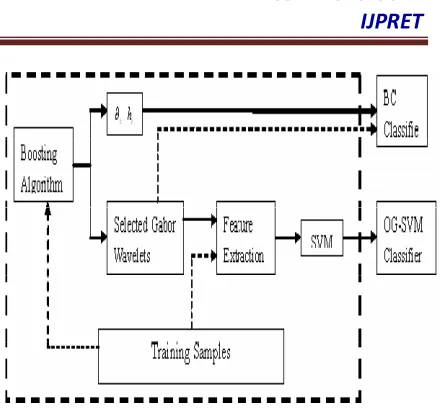
Gabor features for classification. As shown in
Fig.2, the system starts with the Gabor
feature extraction, as described in section 2.
The extracted Gabor features and associated
class labels for all of the training samples are
then fed into the boosting algorithm to
eliminate those non-discriminative features,
which are not significant for classification.
However, the OG-SVM classifier achieved
further improvement on classification
accuracy, with similar efficiency.
Figure 2 Learning process of the proposed
OG-SVM classifier
3.1Optimized Gabor Features Identification
Boosting algorithm is adopted in this paper
to select optimized Gabor features for
recognition purpose. The essence of
boosting algorithms is to select a number of
‘weak’ classifiers, which are then linearly
combined into a single strong classifier. The
algorithm operates as follows: for a
two-class problem, m labeled training samples
are given as ( xi , yi ), i = 1,2,..,m , where yi
={−1,1} is the class label associated with
sample xi € RN. A large number of weak
classifiers h :RN→{−1,1} can be generated to
form a weak classifier pool for training.
Such selected Gabor features should be
robust for object recognition, as intra- and
Available Online At www.ijpret.com
the major difficulties in object
recognition.Upon completion of T boosting
iterations, T weak classifiers are selected to
form the final strong classifier. The resulting
strong classifier
H(x)=sign∑ αh (x)--- (6)
called BC in this paper, is a weighted linear
combination of all the selected weak
classifiers, with each weak classifier using
certain Gabor feature for decision. At the
same time, T most significant Gabor
features for object recognition can also be
identified.
3.2 Support Vector Machine
Once the optimized features are selected,
they can be used train SVMs. Based on an
observed feature x∈RN , SVM is basically a
linear hyperplane classifier f (x) = (w, x) + b
aimed at solving the two class problem .
The classifier can separate the data from
two classes very well when the data is
linearly separable. Since there might be a
number of such linear classifiers available,
SVM chooses the one with the maximal
margin, which is defined as the width that
the boundary could be increased by before
hitting a data point. The linear classifier f (x)
with maximized margin can be found using
quadratic problem (QP) optimization
techniques as below:
F( x)= sign∑ ∝ y.
. (x , x) + b --- 7
where xk€RNare the support vectors
learned by SVM.
3.2 Recognition
As shown in Fig.2, once the boosting
iterations and the SVM learning process are
completed, two classifiers, i.e. BC and
OG-SVM, are created using the T selected
Gabor features. Though trained to
discriminate intra-object and extra-object
spaces, they could also be used for
multi-class object recognition as follows: given a
gallery { q j } of m known objects and a
probe p to be identified, both classifiers will
first compute the Gabor feature differences
{x j =[d1…dt…dT ]} between the probe and
each of the gallery images, and then
calculate an intra-object confidence score
Available Online At www.ijpret.com
the probe is then identified as object j that
gives the maximum confidence score δj .
4 EXPERIMENTAL RESULTS
4.1 Face and Non-face Classification
We first apply the proposed
framework to solve a two-class object
recognition task, i.e. face and non-face
classification problem. A face image set is
used to test performance of the proposed
classifier. The face image set is provided by
Carbonetto and contains 4916 images with
faces and 7872 images without faces. Figure
3 shows some example face and non-face
images.
Fig 3 Image from face image set
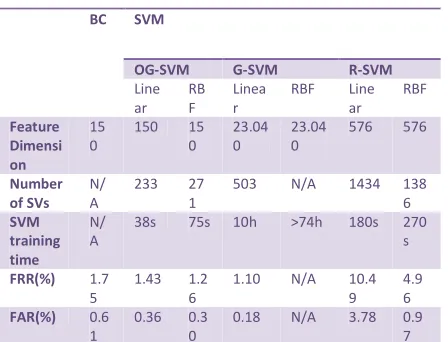
Table 1. Classification Result On Test Set
150 optimized Gabor features are selected
using boosting algorithm, which are then
used by BC, or SVM for classification. The
performance of OG-SVM has been shown in
Table 1, together with SVM trained using
the whole set of Gabor features with
dimension 23,040 (G-SVM), using the raw
pixels with dimension 24×24=576 (R-SVM)
and the BC. For R-SVM, the pixel values of
each sample are concatenated to a feature
vector to train SVM. A Pentium 4 1.8 GHz
PC and the SVM-Light package are used in
our experiments. Compared with classifiers
using Gabor features, R-SVM achieves the
highest FAR and FRR, which suggests that
Gabor filters are good choice to extract
features for classification. It also takes
about 10 hours to train G-SVM with linear
kernel. The results also suggest that the
dimension of features shall be taken into
consideration when designing practical SVM
classifiers. Since SVM is specially suited for
classification, OG-SVM achieves lower FAR
and FRR than BC. Both methods use the
same 150 Gabor features selected by
BC SVM
OG-SVM G-SVM R-SVM
Line ar RB F Linea r
RBF Line ar RBF Feature Dimensi on 15 0
150 15 0
23.04 0
23.04 0
576 576
Number of SVs
N/ A
233 27 1
503 N/A 1434 138 6 SVM training time N/ A
38s 75s 10h >74h 180s 270 s
FRR(%) 1.7 5
1.43 1.2 6
1.10 N/A 10.4 9
4.9 6
FAR(%) 0.6 1
0.36 0.3 0
Available Online At www.ijpret.com
boosting algorithm. The training of OG-SVM
with RBF kernel takes less than 2 minutes.
Only 150 convolution operations with one
variable filter are necessary to extract the
selected Gabor features, which also makes
OG_SVM highly memory and computational
efficient.
4.2 Recognition Performance
The classifiers are then applied to the test
set (200 images, 1 image per person) for
face recognition and their performances are
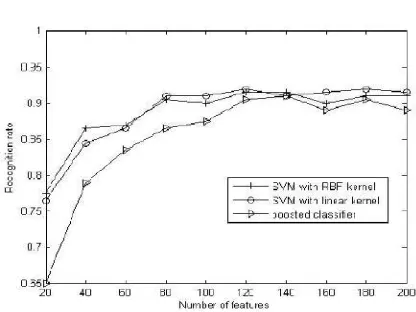
shown in Figure 4. Similarly, OG-SVM
achieves higher recognition rate than BC
when different number of features are
used. The highest identification accuracy of
92% is achieved by OG-SVM with linear
kernel when 120 Gabor features are used.
The results also suggest that the difference
of OG-SVM using RBF kernel and linear
kernel is quite small, when the features
selected by boosting algorithm are
considered.
Fig 4 Identification Performance of OG-SVM
and BC
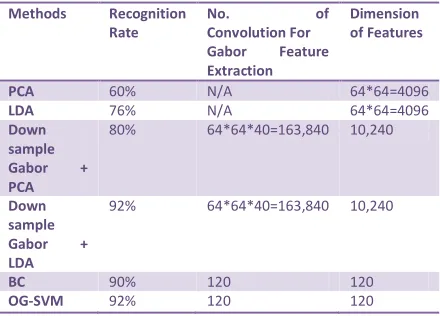
To show the efficiency and accuracy of the
proposed method, we also compare its
performance with other Gabor feature
based approaches in Table 2. The PCA and
LDA methods, details of Downs maple
Gabor + PCA and Down sample Gabor + LDA
can be found in [8]. In the implementation,
down sampling with rate 16 was used to
reduce the dimension of extracted Gabor
features before they are input to PCA, or
LDA for further processing. The table shows
that the proposed OG-SVM achieved similar
accuracy with Downs maple Gabor + LDA,
but with much fewer feature dimension and
much less feature extraction costs. In our
experiments, while it takes 100ms to train
the OG-SVM classifier, the system can
Available Online At www.ijpret.com
Table 2 Accuracy and efficiency of OG-SVM
Methods Recognition Rate
No. of Convolution For Gabor Feature Extraction
Dimension of Features
PCA 60% N/A 64*64=4096
LDA 76% N/A 64*64=4096
Down sample Gabor + PCA
80% 64*64*40=163,840 10,240
Down sample Gabor + LDA
92% 64*64*40=163,840 10,240
BC 90% 120 120
OG-SVM 92% 120 120
5. Conclusions
We have proposed in this paper a SVM and
Gabor feature based framework for object
recognition. While optimized Gabor
wavelets are applied at selected object
landmarks for feature extraction, SVM is
used for classification. A boosting based
learning process has been used to reduce
the feature dimension and make the Gabor
feature extraction process substantially
more efficient. An efficient and robust
classifier, OG-SVM is then trained. The
proposed object recognition framework has
been successfully applied to solve two
object recognition tasks,i.e. face/non-face
classification and face recognition. The
results clearly show the advantages of the
proposed system over other approaches.
When applied to face recognition, the
two-class based OG-SVM has been shown to
beat several multi-class based algorithms
like PCA, LDA and Down sample Gabor +
PCA. By combining optimized Gabor
features with SVM, our method not only
substantially reduces computation and
memory cost of the feature extraction
process, but also achieves very accurate
recognition performance.
6. References
1. Shen L and Bai L. A review on Gabor
wavelets for face recognition. Pattern
Analysis and Applications, 2006(9): 273-292.
2. Lee C J and Wang S D. Fingerprint
feature extraction using Gabor filters.
Electronics Letters, 1999(35): 288-290.
3. Wang X, Ding X, Liu C. Gabor filter-based
feature extraction for character recognition
Pattern Recognition, 2005(38): 369-379.
4. Phillips P J, Moon H, Rizvi S A, and Rauss
P J. The FERET evaluation methodology for
face-recognition algorithms, IEEE
Transactions on Pattern Analysis and
Available Online At www.ijpret.com
5. Chung K C, Kee S C, and Kim S R, Face
recognition using principal component
analysis of Gabor filter responses.
International Workshop on Recognition,
Analysis, and Tracking of Faces and
Gestures in Real-Time Systems Corfu,
Greece, 1999: 53-57.
6. Liu C J and Wechsler H. Gabor feature
based classification using the enhanced
Fisher linear discriminate model for face
recognition. IEEE Transactions on Image
Processing, 2002(11): 467-476.
7. Shen L, Bai L, and Fairhurst M. Gabor
wavelets and General Discriminate Analysis
for face identification and verification.
Image and Vision Computing, 2007(25):
553-563.
8. Zhang W, Shan S, Gao W, Chang Y Z, Cao
B, and Yang P. Information fusion in face
identification in Proceedings of the 17th
International Conference on Pattern
Recognition, 2004 (3): 950-953.
9. Qin J and He Z S. A SVM face recognition
method based on Gabor-featured key
points. In Proceedings of the 4th
International Conference on Machine
Learning and Cybernetics. 2005(8):
5144-5149.3
10.Cristianini N and Shawe-Taylor J. An
introduction to Support Vector Machines
and Other Kernel-based Learning Methods.
Cambridge University Press, 2000.
11.Burges C J C. A tutorial on support
vector machines for pattern recognition,
Data Mining and Knowledge Discovery,