6127 STANDARDIZATION OF HERBAL COMPOUNDS
Rajani Kontu*1, Uma Maheshwar Rao Vattikuti2, Sandhya Rani.M3
1, 2Teegala Ram Reddy College of Pharmacy, #4-202, Meerpet, Saroornagar (M), Hyderabad,
Telangana State-500097
3Center for Pharmaceutical sciences, IST, Kukatpally, JNTU-Hyderabad, Telangana-500085
*Corresponding author E-mail:[email protected]
ARTICLE INFO ABSTRACT
Key Words
Traditional medicine, Standardization, Quality, Evaluation
Herbs were been used by the healers as “TRADITIONAL SYSTEM OF MEDICINE” since prehistoric civilization intended for treating ailments applied for both humans as well as animals. A large part of growing countries rely on conventional practices of herbal medicines to meet up their health concerned needs. A variety of traditional systems followed in China, Japan along with India like Traditional Chinese medicine, Japanese traditional medicine and Indian traditional medicine. Just before 18th century Indian traditional system was proficient under Ayurveda, Siddha, Unani and homeopathy. According to western way of life the use of synthetic medicines was likely to acquire more side effects with less therapeutic frequency. To get rid of these problem Now-a-day’s herbal drugs has an extensive adequacy by majority of the people due to their therapeutic activity for several ailments. In order to meet the quality parameters, the herbal drugs are to be standardized. The progression of standardization includes right from its cultivation, collection of herbs until out into the market. The herbal compounds were evaluated and standardized as per regulatory guidelines of WHO with established standards for evaluation or standardization of herbal compounds that mainly focus on botanical, physicochemical, pharmacological and toxicological parameters. This review article says that herbal remedies account for a major contribute for the global market which have to approve internationally predictable guiding principles of their quality, safety, and purity.
INTRODUCTION
Herbal drugs follow ethnopharmacology which was defined as scientific study of
materials obtained from plants usually
fragmented parts, entire plant, algae, fungi, and lichen by using traditional medicine systems like Chinese traditional medicine, Japanese
traditional medicine, Indian traditional
medicine etc . Discovery of new drug from medicinal plants was increasingly used against
modern medicines like Allopathy(1). The use of
traditional medicine was habitually practiced as a vital part of their culture in different developing countries. People from western countries were more likely to be believed that
the use of herbal drugs keep their lives healthier
(2). Herbal drugs containing single chemical
constituent or in multiple combinations were used as medicinal products, dietary supplements and cosmetics. These herbal formulations can be easily bought over the counter at pharmacy stores or health food shops. Herbal medicines originated firstly in the Asian countries before spreading to the West and today they were being seen as therapeutic agents for several chronic diseases. Herbal medicinal products in the form of dietary supplements were taken to promote one’s health and wellness. However, it was incorrect to ingest them without a
An Elsevier Indexed Journal ISSN-2230-7346
6128
prescription as some can lead to health problems of a different sort, some may interfere with other drugs or some may not be very
effective. Standardization of dietary
supplements was very important for evaluating the drug quality based on the strength of their active principles. Examples of different parts of plants used as herbal medicine was discussed in the table (1)
STANDARDIZATION
Means adjusting the herbal drugs preparation to a define content of a constituent or a multiple constituents with known therapeutic activity respectively by adding excipients or by mixing herbal drugs or herbal drug preparation.
Standardization of Crude Drug and Formulated Drug:
Standardization was performed mainly for crude drug and formulated crude drug with their procedures was different from each other. The following are the methods to be followed for the procedure for standardization includes:
Standardization of the crude drugs was comparison of obtained crude drug with that of the reference standard (authenticated drug).The collected test crude drug was to be accepted from herbal drug markets, and then Substitution and adulteration process should be carried out for test crude drug. Whereas for reference standard process of botanical and chemical characterization should be done, followed by specifications and limits in their documentation. For the
test crude drug after knowing the
adulterated compound it has to be
undergoing botanical and chemical
characterization unlike the reference
standard.
Standardization of formulated drug, the formulated test crude drug undergoes comparative study of classical and modern literature of information followed by location of marketed samples, study of manufacturing process and their methods and standardization done according to established Good manufacturing practices. Selection of test protocols, analysis of
marketed samples and laboratory
preparations were done for standardization
of formulated standard references. Then the performance of the evaluation methods was compared and related quality parameters were selected and documented. At last the final quality control standards were given by statutory body after the examination of
both crude drugs and their formulation (3).
Standardized herbal extracts and their types:
The herbal extracts which undergo for standardization process includes the active constituent and the marker extract was described in the figure 1.
Figure No. 1: Types of Constituents that undergo standardization
NEED FOR STANDARDIZATION
Larger number of people were moving towards use of herbal medicines in today’s times, due to severe prone of side effects with that of modern medicine which became noticed every day. It was the complete responsibility of the regulatory authorities to assure the availability of pure, safe, potent and effective herbal
medicines to the consumer. Various established
quality standards were laid down in
formularies, pharmacopoeias or manufacturing operation which was to be followed.
Herbal drugs or products, whether they have their origin from different alternative systems of
medicines, need to follow standardized
procedures in their manufacture.
Standardization of herbal crude drugs was defined as a process of setting specific standards and their limits that carry the quality, safety, efficacy and strength of the formulated
herbal product(2). So, need for standardization
should be done right from cultivation of medicinal plants, collection, harvesting, storage,
drying and application in to clinical
6129
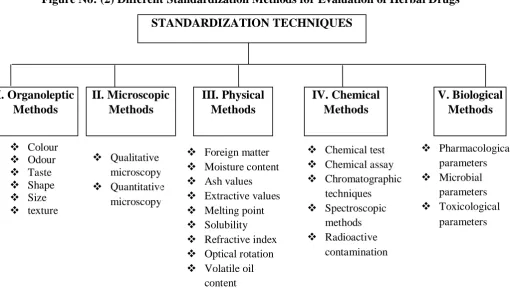
Colour
Odour
Taste
Shape
Size
texture
Qualitative microscopy
Quantitative microscopy
Foreign matter
Moisture content
Ash values
Extractive values
Melting point
Solubility
Refractive index
Optical rotation
Volatile oil content
Chemical test
Chemical assay
Chromatographic techniques
Spectroscopic methods
Radioactive contamination
Pharmacological parameters
Microbial parameters
Toxicological parameters STANDARDIZATION TECHNIQUES
I. Organoleptic Methods
II. Microscopic Methods
III. Physical Methods
IV. Chemical Methods
V. Biological Methods Table No: (1) LIST OF VARIOUS HERBS USED AS MEDICINES (3)
Sl. No
Biological
Name Family Common Name Part Used
Chemical
Constituent Used to Treat
1 Embilica
officinalis
Euphorbiaceae Amla Fruit Vitamin-c Scurvy, laxative,
hyper acidity 2 Terminalia
arjuna
Combretaceae Arjun Dried bark Glycoside:
arjunone
Mild diuretic, ischaemic heart diseases
3 Aloe
barbadensis
Liliaceace Aloe Dried juice of
the leaves
Barbaloin, glycosides
Cosmetics, laxative
4 Saraca indica Leguminosae Asoka Dried stem bark epicatechin Astringent, uterine
disorders 5 Brassica
nigra
Cruciferae Mustard Dried ripe seeds Glycerides of
oleic,linoleic, linolinic acids
Emetic
6 Papaver
somnifereum
Papaveraceae Opium Latex obtained
from unripe capsule
morphine Analgesic, hypnotic,
narcotic
7 Pinus
palustris
Pinaceae Turpentine oil
from long-leaf pine
resin Alpha- pinene, Mild antiseptic,
counter-irritant Beta- pinene
8 Theobroma
cacao
Sterculiaceae Cacao seeds xanthines Nervous system
stimulant
9 Curcuma
longa
Zingiberaceae Turmeric Dried rhizomes Curcuminoids:
curcumin
Anti- inflammatory, carminative 10 Catharanthus
roseus
Apocynaceae Vinca Whole plant vincristine Anti-neoplastic,
treatment for hodgkins disease
6130
drugs account for a major share of the global market and hence it is necessary to adopt internationally recognized guidelines for their quality control. Some of the drawbacks
concerned in standardization procedures
were(3).
Identification of botanical source
Adulteration
Climatic conditions
Harvesting
Drying & storage
STANDARDIZATION OF HERBAL COMPOUNDS - METHODS AND PROCESS
As per World Health Organization (WHO), standardization defines as a process of evaluation of crude drug to authenticate its identity, determination of quality and purity, detection of nature of adulterants’ by various parameters
The given figure (2) explains the contents which give an idea about the scope of work involved(3,6).
I. Organoleptic /Macroscopic Methods:
Also known as Macroscopic evaluation which refers to evaluation of crude drug through sensory characters (4, 6) discussed in the table (2).
Table No. 2: List of crude drugs with their Organoleptic characters
Colour Brown Colour Cinnchona
Odour Aromatic Umbelliferous Fruits
Taste Pungent Capsicum
Shape Disc Shaped Nux Vomica
Size Long- 10-30cm Digitalis
Wide- 4-10 Cm
Texture Fractured
Structure Cascara Bark
II. Microscopic Methods:
This method is used to find out the qualitative and quantitative histological characters of crude drug through transverse section (T.S) or longitudinal section (L.S) by using different staining reagents(4, 6).
i) Qualitative microscopy: It determines xylem, phloem, stomata, trichomes etc.
Eg: Anomocytic (ranunculaceous) stomata – Foxglove, Anisocytic (cruciferous) stomata
– Belladonna. Covering trichomes
(uniseriate) – Digitalis, Glandular trichomes (uni cellular glandular trichomes) – Vasaka.
ii) Quantitative microscopy: It includes palisade ratio, stomatal number, stomatal index, vein islet number, vein termination number.
a) Palisade ratio: Defined as average number of palisade cells underneath each epidermal cell.
Eg: Cassia angustifollia – 5.5- 10 (upper), 4.0-7.4 (lower)
b) Vein islet number: Defined as number of vein-islets per square millimeter of the leaf surface between midrib to margin.
Eg: Azadirachta indica – 10 to 18 c) Vein termination number: Defined as
number of vein let termination per square millimeter of leaf surface midway from midrib to margin.
Eg: Atropa belladonna – 6.3-10.3 d) Stomatal number: Defined as average
number of stomata per square millimeter of leaf epidermis.
Eg: Bacopa monniera – 65-128 (upper), 90-145 (lower)
e) Stomatal index: Defined as percentage which the number of stomata forms to the total number of epidermal cells. calculated by given formula:
Eg: Bacopa monniera - 12.9-17.8 (upper), 12.4-16.4 (lower)
6131 III. Physical Methods:
Physical methods includes the following parameters like
Ash Values indicates the measure of total ash with removal of all carbons produced after entire incineration of the drug compound heated
at a temperature of about 450oC. This total ash
usually consists of inorganic salts which also include physiological and non- physiological ash. Ash values are helpful in determining the quality and purity of an herbal compound. Different types of ash values are total ash, water
soluble ash, and acid insoluble ash.
Foreign Matter in herbal drugs was seen during the cultivation& collection of medicinal plants. It refers to presence of part of a medicinal herb along with other foreign matters like animal excreta, moulds, insects sometimes it also includes mineral admixtures like stones, sand, dust which reduce the quality and purity of the medicinal to be obtained was discussed in the below table (3)(7,8).
Table 3: Limits for Ash value and Foreign Organic matter
Sl.
No Drug
Total ash
Acid insoluble
ash
Foreign organic matter
1 Ashwagandha 7% ≤1.2% ≤2%
2 Ergot ≤5% - -
3 Rauwolfia
roots ≤8% ≤2% -
Extractives were the extracts of the exhausting crude material. To find out the evaluation of herbal crude drug, to identify the nature of active phytochemical constituents and their solubility criteria these extractive values were used .to obtain extractive values by water-soluble or ether-water-soluble extraction Soxhlet extractor is used. Different type of solvents was used for extraction process and their limits were
mentioned in the below table (4) (8, 6, 1)
Table 4: Types of Extraction and their limits
Types of Extraction
Herbal
drug Extractive values
Water- soluble
extractive Glycyrrhiza
Not less than 20.0%w/w Alcohol – soluble
extractive Asafoetida
Not less than 50.0%w/w Ether – soluble
extractive Nutmeg
Not less than 25.0%w/w
Volatile oil content was used to find out the volume of volatile oil present in the crude drug by distillation process. For the type of hydro distillation, specially designed apparatus called Clavenger’s apparatus was used. The separation of volatile oil from the crude drug with the help of Clavanger’s will take 4-5hours of heating due to boiling point elevation is created in it. The quality of an volatile (essential) oil containing drug is expressed in terms of percentage of oil present in the evaluating crude drug.
Eg: Fennel – 4.0%v/w (7,8).
Moisture content set down for the process of drying at the time of harvesting and cleaning the crude drugs due to the growth of microbes.
The significance of drying helps in
preservation, fixing to enzymatic or hydrolytic reactions that alter the chemical composition and decrease the weight of the drug. Lower the moisture content greater will be the stability, purity of the drug. It is determined by loss of drying, Azeotropic distillation method by Deane Stark Apparatus and Karl Fischer method (8).
Bitterness value was used to determine the measure of bitter taste of a therapeutically active crude drug. As per WHO bitterness property of the medicinal crude plant material can be found out by comparing concentration of threshold bitterness of crude extract with that of the diluted solutions of quinine hydrochloride(1 gm of quinine hydrochloride in 2000ml of water)(9).
Swelling Index or Swelling Factor refers to quantify the volume of mucilage up on dilution produced by 1gram of plant material. Swelling factor was mainly observed in the families of Plantago ovate, P.psylium etc. Its determination was known by adding water or swelling agent to the tested crude drug. Sometimes pectin and hemi-cellulose can also be predicted. By using glass-stopper measuring cylinder, the tested crude drug was shaken repeatedly for 1hour then the volume in milli liters of swelling factor can be determined(9,8).
6132
extracts can be determined by this parameter. Foaming index can be calculated by the formula:
Foaming index
Where A = volume in ml of diluted decoction Solubility helps in determining the nature of solvent used to soluble the crude drug for the process of evaluation. For example alkaloidal free salts soluble in water, bases in organic solvents, fixed oils & fats in ether, chloroform. Refractive index defines as When a ray of sodium light pass from one medium to the another medium of different densities bends at its original path, thus the ratio of velocity of light in vacuum to its velocity in the substance is said to be refractive index.
Eg: Mustard oil – 1.4758 to 1.4798.
Optical rotation Crude drugs either in solid state or liquid state which are optically active posses a property of rotating the plane of polarized light. This is measured by Polarimeter using sodium lamp as a light at temperature of 25°C.
Eg: Peppermint oil: -18° to -33°.
IV. Chemical Methods:
This method was evaluated for the chemical nature of the active constituent with the help of chemical tests, chemical assays, spectroscopic
methods and chromatographic techniques.
i) Chemical test helps in Detection of specific groups of the active constituent in the crude extract. It is the easier and the fastest
method to be studied for the analyses of the particular active compound. The chemical tests can be performed by both qualitative and quantitative methods.
Qualitative methods: The organic constituents are the pharmaceutically important groups of the medicinal plants that include carbohydrates, alkaloids, tannins, glycosides, flavanoids etc. To detect the organic active moiety in crude drug special chemical tests are performed depending upon the colour reactions when treated with certain chemical reagents and some of the examples were given in the table 5
Table 5: Organic Constituents and their qualitative tests for Herbal Drugs
Sl. No
Organic Constituents Containing Drugs
Specific Chemical
Tests
Results
1 Alkaloids - Cinchona, Vasaka
Dragandroffs test
Yellow/Orange precipitate 2 Glycosides -
Digitalis, Senna
Molisch test Violet ring formed at junction of two layers
3 Steroids- Dioscorea
Lieberman buchard test
Green colour
4 Tannins - Myrobalan
Ferric chloride test
Dark blue colour
5 Flavanoids - Citrus
Shinoda test Pink colour
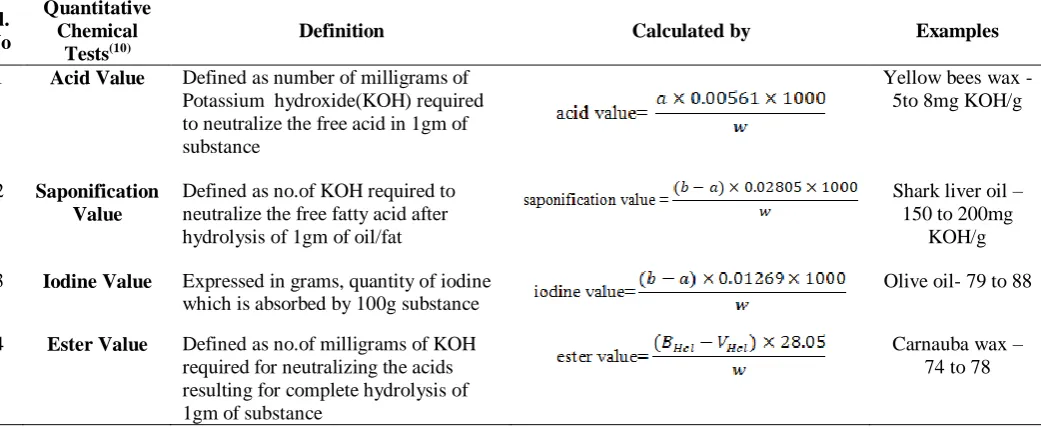
Quantitative Chemical tests: Applied for non cellular products such as fixed oils, Volatile oils, Waxes (Table 6).
Table 6: Definition of Quantitative Chemical tests and their examples
Sl. No
Quantitative Chemical
Tests(10)
Definition Calculated by Examples
1 Acid Value Defined as number of milligrams of
Potassium hydroxide(KOH) required to neutralize the free acid in 1gm of substance
Yellow bees wax -5to 8mg KOH/g
2 Saponification
Value
Defined as no.of KOH required to neutralize the free fatty acid after hydrolysis of 1gm of oil/fat
Shark liver oil – 150 to 200mg
KOH/g
3 Iodine Value Expressed in grams, quantity of iodine
which is absorbed by 100g substance
Olive oil- 79 to 88
4 Ester Value Defined as no.of milligrams of KOH
required for neutralizing the acids resulting for complete hydrolysis of 1gm of substance
6133 ii) Chemical assays:
For evaluating the specific group of constituent present in a crude drug it can be assayed by titrimetric and gravimetric methods, in some cases it can also be assayed by colorimetric technique. For example alkaloidal content can be assayed by titrimetric method present in a alkaloidal drugs i.e., Quinine from cinchona can be assayed by titrimetric method like acid-base titration. Pure form of drug can be obtained by these chemical assays.
iii) Spectroscopic methods:
The spectroscopical analysis of a drug to be evaluated can helps in determining the capacity of absorbed vibrations at specific wavelengths and structural determination. So the spectral data can be given by various techniques employed in pharmaceutical analysis includes Ultra-violet, Infra-red, Nuclear Magnetic Resonance (NMR), Mass spectroscopy etc.
iv) Chromatographic Techniques:
It represents a group of methods for separating molecular mixtures that depend on differential affinities of solute between two immiscible phases i.e. Mobile phase and a Stationary phase. The mobile phase will be in liquids or gaseous state where as stationary phase will be coated as thin layer on an inert supporting material present in porous or finely divided liquid state. The mobile phase runs over the stationary phase for separation of mixtures into individual
components. Various instrumental
chromatographic techniques includes Thin
Layer Chromatography (TLC), High
Performance Thin Layer Chromatography (HPTLC), Gas Liquid Chromatography
(GLC), High Performance Liquid
Chromatography (HPLC), Gel Permeation Chromatography (Gel filtration).
v) Radioactive Contamination is the radio nuclides present in the environment leads to the nuclear accidents. This contamination is due to radio-isotopes deposited in soil and in surroundings.for example the sample
called Peperomia pellucida contains 238 U,
234 U, 232 Th, 226 Ra, 210 Pb radio-nuclides. As
per WHO there are no certain limits given
to measure radioactive contamination (14).
V. Biological Methods:
i) Pharmacological Methods:
To demonstrate pharmacological effects,
observations done on animal models. Protocols for the assessment of biological efficacy and their activities have discussed below:
Anti – Ulcer Activity: Various factors responsible for increase in acidity due to diet, alcohol & stress. Herbal drugs showing anti-ulcerogenic activity are Liquorice, Atropine and Hyoscine, Carica papaya. For example aqueous extract of Carica papaya was administered at a dose of 50 and 100mg/kg orally in rats against ethanol induced gastric ulcers. This extract protects the gastric mucosa against ethanol effects and helps in reduction of volume of gastric juice and gastric acidity. Sometimes, this activity can be assessed by ulcer index where the number and size of ulcerative lesions are considered.
Anti – Diabetic Activity: Diabetic mellitus is a disorder caused by increase blood glucose of intake food. For hypoglycemic activity number of plant extracts like Cinnamomum, Allium sativum, Cassiaauriculata, Aloe barbadensis, Glycerrhiza glabra were been used from traditional medicines. If there is an increase hepatic metabolism and increase insulin release, aqueous homogenate of garlic (10ml/kg/day) is administered orally to sucrose fed rabbits (10gm/kg/day in water for 2 months) due to S-allyl cystein sulfoxide (SACS), the precursor of allicin and garlic oil of Allium sativum helps in
control lipid peroxidation better than
Glibenclamide and insulin. After
administration, it leads to increase hepatic glycogen, free amino acid content, decrease fasting blood glucose have been seen in in- vitro conditions (11).
6134
of adrenergic neurons, thus leaving
catecholamine’s to be destroyed by intra neuronal monoamine oxidase.Thus reserpine helps in depletion of catecholamine’s by its sympatholytic &anti hypertensive activity. Reserpine lowers blood pressure by decrease cardiac output, peripheral vascular resistance, hear rate & rennin secretion.Daily oral dose of reserpine 0.25mg and 0.05mg when given along with diuretic,when whole root is used adult dose of 50 to 200mg/day is administered once daily(12).
ii) Micro Biological Parameters:
Heavy metals comprise of Arsenic, Lead, and
Cadmium etc were abundantly found in nature.
When medicinal plants contaminated with these heavy metals, cause environmental pollutions and severe toxicity. As per Ayurvedic pharmacopeia of India (API) it was given some limits mentioned table (7) (13).
Table 7: Limits for Heavy metals
Sl. No Heavy Metal Contents Permissible Limits
1 Lead 10ppm
2 Arsenic 3ppm
3 Cadmium 0.3ppm
4 Mercury 1ppm
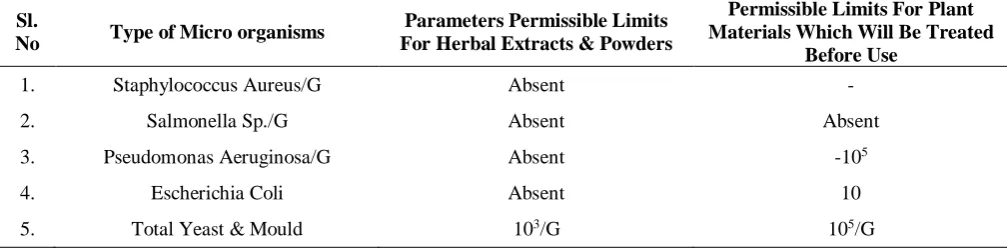
Microbial Contamination refers to the presence of several micro organisms like bacteria, fungi, yeast, and moulds etc. Due to the growth of the viable micro organisms it may contaminate the crude drug and affect the quality, purity and safety of the formulated herbal drugs. The following are permissible
limits given by API (12) was described in the
table (8).
Haemolytic property, medicinal plants belonging to families like Caryophyllaceae, Primulaceae, Araliaceae, and Dioscoreaceae contains Saponins.
It has a ability of causing haemolysis in the blood, saponins changes the erythrocytic cell membrane by diffusion of haemoglobin in the
surrounding atmosphere of the blood.
Haemolytic property can be determined by
comparison of reference solution(about 10milli
gram of saponins in pH 7.4 phosphate buffer, diluted upto 100ml of volumetric flask) which has a haemolytic property 1000 units per gram
Pesticide Residue refers to the presence of any foreign matter along with the microbial growth during collection, storage & marketing. It can be detached by spraying pesticides that may causes toxic effects. To retain the problem with pesticides, pest control procedures and limits
have been given by WHO and API (13) table (9).
Table. 9 Permissible limits for the substances used as pesticides
Sl. No Substance Limits
1. Chlorpyrifos-methyl 0.1mg/kg
2. Fenitrothion 0.51mg/kg
3. Parathion 0.51mg/kg
Aflatoxins are the toxic compounds found in
fungal species like Aspergillus and
Pencillium.These aflatoxin producing fungi in herbal compounds are very dangerous for handling and also for administration. The myotoxic compounds of Aspergillus species have the capability to produce different aflatoxins like B1, B2, G1 and G2.As per
Ayurvedic pharmacopeia (12) the following
limits were discussed in table (10)
Table 10: Permissible limits for Aflatoxins
Aflatoxin Permissible Limit
B1 < 2 ppb
B1+B2+G1+G2 < 5 ppb
Table 8: Type of micro organisms and their permissible limits for herbal extracts and powders and plant materials.
Sl.
No Type of Micro organisms
Parameters Permissible Limits For Herbal Extracts & Powders
Permissible Limits For Plant Materials Which Will Be Treated
Before Use
1. Staphylococcus Aureus/G Absent -
2. Salmonella Sp./G Absent Absent
3. Pseudomonas Aeruginosa/G Absent -105
4. Escherichia Coli Absent 10
6135 CONCLUSION
In the Current scenario were health related ailments are treated with allopathic system of medicines, since it is giving the faster relief but the side effects are more prone to produce complication also. At present the approach of the mordent medicine is mostly changing towards the alternative medicine (traditional medicines) such as Ayurveda, Siddha, Unani and homeopathy, were these medicines are used to cure the health related issues in long terms and with fewer side effects. Hence there is a huge require for the herbal medicines and to meet the demand enhanced technology needed for the isolation of active chemical constituents from the medicinal plants to get effective quality of the product. So standard protocols should be adopted for the standardization and validation of these herbal drugs right from cultivation, pre and post harvesting, time of collection and storage given by WHO, Ayurvedic pharmacopeia of India.
REFERENCES
1. William Charles Evans, University of Nottingham, UK, Trease and Evans Pharmacognosy, 15th edition, published by Elsevier, 2005; pg.no:125
2. Kunle, Oluyemisi Folashade, Egharevba, Henry Omoregie and Ahmadu, Peter Ochogu, Standardization of herbal medicines - A review,
International Journal of Biodiversity and
Conservation, Vol. 4(3), pp. 101-112, March
2012.
3. S S Agrawal and M Paridhavi, Herbal drug
Technology, 2nd edition, Universities Press,
2012, pg.no:654.
4. Swapnil G. Patil, Anita S.Wagh, Ramesh et al, Standard Tools for Evaluation of Herbal Drugs: An Overview, The Pharma Innovation –
Journal, Vol. 2 No. 9 2013, ISSN :2277-7695.
5. Anupam Kr Sachan,Garima Vishnoi,Roopak kumar,Need of standardization of herbal medicines in modern era, International Journal
of phytomedicine, 8 (2016)300-307
6. Dr. C.K.Kokate, Pharmacognosy, 42nd Edition, Nirali Prakashan, September 2008, pg.no:6.2-6.22.
7. Dr.Vinod Rangari, Pharmacognosy & Phytochemistry part-I. Career publications, 1st edition, March 2002, pg.no:89.
8. Dr.Pulok K.Mukherjee, Quality Control Of Herbal Drugs: An Approach To Evaluation Of Botanicals, Bussiness Horizonpharmaceutical Publishers, New Delhi, India,pg.no: 184-220. 9. Nilakshi Pradan, Jyoti Gavali, Nitin Wagmare,
WHO (World Health Organization) Guidelines for Standardization of Herbal Drugs,
International Ayurvedic Medical journal,
ISSN:23205091, volume 3, August 2015. 10. U.Satyanarayana, U.Chakrapani, Biochemistry,
Elsevier, June 2002.
11. https://www.pharmatutor.org/articles/review-anti-diabetic-activity-herbal-drugs
12. https://jamanetwork.com/journals/jamainternal medicine/fullarticle/210378.
13. The Ayurvedic Pharmacopeia of India Part - I Volume - IX, first edition, Government of India Ministry of Ayush 2016: Pharmacopoeia Commission for Indian Medicine & Homoeopathy, Ghaziabad.
14. Fabio V.Sussa, Sandra R.Damatto, Marcos M.Alencar, Barbar Natural Radioactivity Determination in Samples of Peperomia
pellucida commonly used as Medicinal Herb,
International nuclear atlantic conference-INAC
2011, Belo horizonte,MG, Brazil, October
24-28, 2011.