Available Online at www.ijpret.com 184
INTERNATIONAL JOURNAL OF PURE AND
APPLIED RESEARCH IN ENGINEERING AND
TECHNOLOGY
A PATH FOR HORIZING YOUR INNOVATIVE WORK
DESIGN, ANALYSIS AND OPTIMIZATION OF PISTON OF 180CC ENGINE USING CAE
TOOLS
NIKHIL D. RAUT, SHEIKH NAIM SHEIKH YUSUF
Student, Department of Mechanical Engineering, Babasaheb Naik College Of Engineering, Pusad - 445204 (India).
Accepted Date: 05/03/2015; Published Date: 01/05/2015
\
Abstract: The stress distribution of two different aluminium alloys (i.e A2618 and Al – GHY1250) piston by using CAE Tools is described in this paper. The specifications used for the study of these pistons belong to four stroke single cylinder engine of Bajaj Pulsar 180cc motorcycle. This paper includes analytical design of two different aluminium alloy pistons and parametric models of Pistons are modelled using PTC Creo Parametric 2.0 software and analysis of that model is carried out by using ANSYS 14.5 Software. The results predict the maximum stress and critical region on the different aluminium alloy pistons using CAE Tools. It is important to locate the critical area of concentrated stress for appropriate modifications. The best aluminium alloy material is selected based on parameters like Von misses Stress and strain, Deformation, Factor of safety and weight reduction for two wheeler piston were done in ANSYS 14.5 software.
Keywords: Innovations, Theoratical Analysis, Finite Element Analysis, Experimental
Corresponding Author: MR. NIKHIL D. RAUT
Access Online On:
www.ijpret.com
How to Cite This Article:
Available Online at www.ijpret.com 185
INTRODUCTION
A piston is a component of reciprocating IC-engines. It is the moving component that is contained by a cylinder and is made gas-tight by piston rings. In an engine, its purpose is to transfer force from expanding gas in the cylinder to the crankshaft via a piston rod and/or connecting rod. As an important part in an engine, piston endures the cyclic gas pressure and the inertial forces at work, and this working condition may cause the fatigue damage of piston, such as piston side wear, piston head/crown cracks and so on. The investigations indicate that the greatest stress appears on the upper end of the piston and stress concentration is one of the mainly reason for fatigue failure.
In designing a piston for an engine, the following points should be taken into consideration:
It should have enormous strength to withstand the high pressure.
It should have minimum weight to withstand the inertia forces.
It should form effective oil sealing in the cylinder.
It should provide sufficient bearing area to prevent undue wear.
It should have high speed reciprocation without noise.
It should be of sufficient rigid construction to withstand mechanical distortions.
It should have sufficient support for the piston pin.
A. ENGINE SPECIFICATIONS
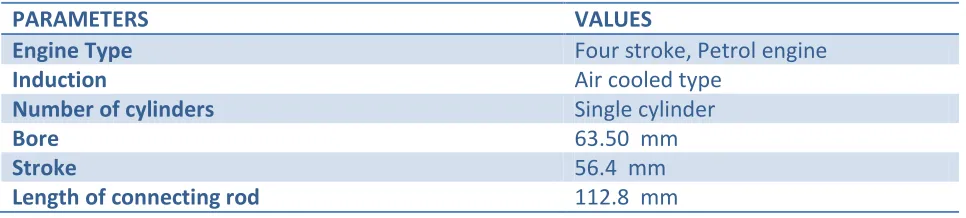
The engine used for this work is a single cylinder four stroke air cooled type Bajaj Pulsar 180cc petrol engine. The engine specifications are given in Table 1.1
Table 1.1 Engine Specifications.
PARAMETERS VALUES
Engine Type Four stroke, Petrol engine
Induction Air cooled type
Number of cylinders Single cylinder
Bore 63.50 mm
Stroke 56.4 mm
Available Online at www.ijpret.com 186
Displacement volume 178.6 cm3
Compression ratio 9.5+/-0.5 : 1
Maximum power 11.77 KW at 8500 rpm
Maximum Torque 14.72 Nm at 6500 rpm
Number of revolutions/cycle 2
B. PROPERTIES OF MATERIALS
The materials chosen for this work are A2618 and Al-GHY1250 for an internal combustion engine piston. The mechanical properties of A2618 and Al-GHY1250 aluminum alloys are listed in the following table 1.2
Table 1.2 Mechanical Properties.
Sr. No. PARAMETERS A2618 Al-GHY1250
1 Young’s Modulus (GPa) 73.7 83
2 Ultimate Tensile Strength (MPa) 480 1250
3 Possion’s Ratio 0.33 0.3
4 Density(Kg/m3) 2767.99 2880
Methodology
Analytical design of piston using specification of Bajaj Pulsar 180cc.
Creation of 3D models of piston using PTC Creo Parametric 2.0 and then imported in ANSYS
14.5
Mesh of 3D models using ANSYS 14.5
Analysis of pistons using static stress analysis method.
Comparative performance of two aluminium alloy pistons under static stress analysis method.
Select the best aluminium alloy.
Analytical Design
Let,
Available Online at www.ijpret.com 187 η = mechanical efficiency = 0.8
n = number of working stroke per minute = N/2 (for four stroke engine)
N = engine speed (rpm)
L = length of stroke (mm)A = cross-section area of cylinder (mm2)
r = crank radius (mm)
lc = length of connecting rod (mm)
a = acceleration of the reciprocating part (m/s2)
mp = mass of the piston (Kg)
V = volume of the piston (mm3)
th = thickness of piston head (mm)
D = cylinder bore (mm)
Pmax = maximum gas pressure or explosion pressure (MPa)
σt = allowable tensile strength (MPa)
σut = ultimate tensile strength (MPa)
F.O.S = Factor of Safety = 2.25
K = thermal conductivity (W/m K)
Tc = temperature at the centre of the piston head (K)
Te = temperature at the edge of the piston head (K)
HCV = Higher Calorific Value of fuel (KJ/Kg) = 47000 KJ/Kg
BP = brake power of the engine per cylinder (KW)
m = mass of fuel used per brake power per second (Kg/KW s)
C = ratio of heat absorbed by the piston to the total heat developed in the cylinder = 5% or 0.05
Available Online at www.ijpret.com 188 Pw = allowable radial pressure on cylinder wall (N/mm2) = 0.025 MPa
σp = permissible tensile strength for ring material (N/mm2) = 1110 N/mm2
h = axial thickness of piston ring (mm)
h1 = width of top lands (mm)
h2 = width of ring lands (mm)
t1 = thickness of piston barrel at the top end (mm)
t2 = thickness of piston barrel at the open end (mm)
ls = length of skirt (mm)
μ = coefficient of friction (0.01)
l1 = length of piston pin in the bush of the small end of the connecting rod (mm)
do = outer diameter of piston pin (mm)
Mechanical efficiency of the engine (η) = 80 %.
η =
B.P.=
=
= 10.019KW
I.P = =
= 12.524 KW
I.P = P x A x L x
I.P = P x x D2 x L x
12.524 x 1000 = P x x (0.0635)2 x (0.0564) x
Available Online at www.ijpret.com 189 Maximum Pressure Pmax=10xP
=10x1.294
=12.94 MPa
ANALYTICAL DESIGN FOR A2618 ALLOY PISTON.
Analytical design for A2618 alloy piston is as follows:
Thickness of the Piston Head: th = 6.771 mm.
Piston Rings: b = 1.658 mm and h = 1.16 mm.
Width of Top Land: h1 = 6.771 mm
Ring Lands: h2 = 0.87 mm
Thickness of piston barrel at the Top end: t1 = 8.463 mm
Open end: t2 = 2.115 mm.
Length of the skirt: ls = 38.1 mm
Length of piston pin in the connecting
rod bushing: l1 = 28.575 mm
Piston pin diameter: do = 17.78 mm
The centre of piston pin should be 0.02D to 0.04D above the centre of skirt.
ANALYTICAL DESIGN FOR AL-GHY1250 ALLOY PISTON.
Analytical design for Al-GHY1250 alloy piston is as follows:
Thickness of the Piston Head: th = 4.196 mm.
Piston Rings: b = 1.658 mm and h = 1.16 mm.
Width of Top Land: h1 = 4.196 mm
Ring Lands: h2 = 0.87 mm
Available Online at www.ijpret.com 190 Open end: t2 = 2.115 mm.
Length of the skirt: ls = 38.1 mm
Length of piston pin in the connecting
rod bushing: l1 = 28.575 mm
Piston pin diameter: do = 17.78 mm
The centre of piston pin should be 0.02D to 0.04D above the centre of skirt.
RESULT AND DISCUSSION
A. A2618 alloy piston
Fig1- Von-misses Stress
Fig2-Total Deformation
Available Online at www.ijpret.com 191
Fig-3 Von -Misses Stress
Fig-4 Total deformation
Sr.No. PARAMETERS A2618 Al-GHY1250
1 Von-Misses Stress 202.42 MPa 416.73 MPa
2 Total Deformation 0.24804 mm 0.1704 mm
3 Mass 0.2402 kg 0.196 kg
4 Safety Factor 2.4 2.9
From the value of stress and deformation for both materials, we can say that Al-GHY1250 materials are capable of bearing more stress. It is mainly due to following reasons:-
The addition of Yttrium (atomic No.39) gives high strength and temperature stability.
Available Online at www.ijpret.com 192
CONCLUSION
After analyzing the two different alloy pistons of Pulsar 180cc by using CAE Tool, Following conclusion can be drawn :-
About 18% mass reduction is possible with Al-GHY1250 Alloy.
Safety factor increased by 17% at same working condition.
Then from this we can conclude that Al-GHY1250 alloy piston is better than conventional alloy piston.
REFERENCES
1. E. Ramjee and K. Vijaya Kumar Reddy, “Performance analysis of a 4-stroke SI engine using CNG as an alternative fuel”, Indian Journal of Science and Technology, Vol. 4, No. 7, July 2011.
2. Dallwoo Kim, Akemi Ito et. al., “Friction characteristics of steel pistons for diesel engines”, Journal of Materials Research and Technology, June 2012.
3. V. B. Bhandari, “Design of Machine Elements”, 3rd Edition, McGraw Hill.
4. Technical Data, Advanced Materials Technology, Bickenbach, Germany, [email protected].
5. F. S. Silva, “Fatigue on engine pistons – A Compendium of case studies”, Department of Mechanical Engineering, University of Minho, Portugal, Engineering Failure Analysis 13 (2006) 480– 492.
6. Shigley, Mechanical Engineering Design, 9th edition, McGraw-Hill Publication.
7. R.S. Khurmi, Machine Design, S. Chand Publication.
8. P. S. Shenoy and A. Fatemi, “Dynamic Analysis of Loads and Stresses in Connecting Rods”, Journal of Mechanical Engineering Science, 2006, Vol. 220, No. 5.