Sree Giri Prasad. B*
Teegala Krishna Reddy College of Pharmacy, Hyderabad, Telangana, India. E -mail: [email protected]
[email protected] Address for correspondence
Sree Giri Prasad. B*et al. / JGTPS / 5(4)-(2014) 2154 - 2166
FORMULATION AND EVALUATION OF CLOPIDOGREL BISULFATE
IMMEDIATE RELEASE TABLETS
INTRODUCTION
Many patients especially children and elderly have difficulty in swallowing tablets and capsules and consequently unable to take medicine as prescribed. Almost 50% of the population is affected by such problem, resulting in the high incidence of non compliance and ineffective therapy. Most pharmaceutical forms for oral administration are formulated for direct ingestion, or for chewing, or for prior dispersion and/or dissolution in water; some of them are absorbed in the mouth (sublingual or buccal tablets).
To obviate the problems associated with conventional dosage forms, orally immediate release tablets have been developed, which combine hardness, dosage uniformity, stability and other parameters, with extremely easy administration, since no water is required for swallowing the tablets and they are thus suitable for geriatric, pediatric and traveling patients. Pharmaceutical products designed for oral delivery and currently available on the prescription and over-the-counter markets are mostly the immediate release type, which are designed for immediate release of drug for rapid absorption. Disintegrating agents are substances routinely included in tablet formulations and in some hard shell capsule formulations to promote moisture penetration and dispersion of the matrix of the dosage form in dissolution fluids. Superdisintegrants improve disintegrant efficiency resulting in decreased use levels when compared to traditional disintegrants.
Mechanism of Disintegrants
This investigation is undertaken with an aim to develop pharmaceutically equivalent, stable, cost effective and quality improved formulation of Clopidogrel bisulphate immediate release tablets. The task of developing immediate release tablet is accomplished by using a suitable diluents and super-disintegrants. Faster disintegration of the tablet administrated orally minimizes absorption time and improves its bioavailability in less time. Immediate Release tablet of Anti plate drug is formulated using direct compression using super disintegrant Croscarmellose Sodium and Crospovidone. The current study involves preparation and evaluation of Clopidogrel bisulphate tablets, comparison of dissolution rate of optimized formulation with innovator’s product and estimation of similarity and difference factors. The formulations were further evaluated for pre & post compression parameters and in-vitro dissolution studies. The study reveals that the formulation F8 is found to be the optimized formulation with 99% drug release in 30 minutes in comparison with other super disintegrants. The kinetics study shows that the fast dissolving tablet formulation followed First order kinetic model explaining the diffusion controlled release mechanism. The similarity and dissimilarity factor obtained for Clopidogrel bisulphate was found to be within the standards. The formulation F8 exhibited similar release profile as that of innovators product at each time point. Hence, F8 was considered as the best formulation.
Key words: Clopidogrel Bisulfate, PEG6000, Immediate Release Tablets, Direct Compression
ABSTRACT
Sree Giri Prasad. B
*1,
Gupta VRM
3,
Devanna N
4,
Rama Devi. M
2,
Tamilselvan A
1,
Siva Subramanian. N
21Teegala Krishna Reddy College of Pharmacy, Hyderabad, Telangana,
India.
2. Smt. Sarojini Ramulamma College of Pharmacy, Seshadrinagar,
Mahabubnagar, Telangana.
3. Pulla Reddy Institute of Pharmacy, Annaram, Jinnaram,
Medak, Telangana.
4. Jawaharlal NehruTechnological
University, Anantapur, Andhra Pradesh.
Journal of Global Trends in Pharmaceutical Sciences
Journal home page: www.jgtps.com
ISSN: 2230-7346
2) Capillary action and high swellability 3) Chemical reaction
The most popular disintegrants are corn starch, soluble starch etc. which have been well dried and powdered. Starches have great affinity for water and swell when moistened thus facilitating the rupture of the tablet matrix, its disintegration action in tablets is due to capillary action. Spherical shape of starch increases the porosity of tablet thus promoting capillary action.
Significance of the Immediate Release tablet:
1. Ease of swallowing: Dysphasic population constitute 35% of the general population, since this disorder is associated with a number of medical conditions such as Stroke, Parkinson’s disease, AIDS, Head and Neck Radiation Therapy and other neurological disorders. 2. Accurate dose: The immediate/fast dissolve
dosage forms have the added advantages of convenience and accurate dosing as compared to liquids.
3. Rapid drug therapy intervention is possible. The investigation was concerned with design and characterization of oral immediate release tablets of Clopidogrel Bisulfate, in order to improve efficacy and better patient compliance. Immediate release drug delivery system are based on single or multiple-unit reservoir or matrix system, which are designed to provide immediate drug levels in short period of time. Immediate release drug delivery is desirable for drugs having long biological half life, high bioavailability, lower clearance and lower elimination half life. But main criterion for immediate release dosage form is poor solubility of the drug and need the immediate action of drug to treat unwanted defect or disease1,2To enhance dissolution and
hence bioavailability of any drug from immediate release tablets, disintegration is one of the important parameter. In the present investigation, we tried to judge the efficiency of drug release by comparing various parameters such as disintegration time and dissolution of tablets. The objective of the development programme was to develop a tablet which was robust, stable, and an acceptable formulation when compared to reference original product thereby fulfilling the requirement of essential similarity to the marketed product3.
Advantages of Immediate Release Tablets: Economical and cost effective.
Quick onset of action.
Suitable for industrial production.
Improved stability and bioavailability.
Provides some advantages of liquid dosage forms.
Adaptable and amendable to existing processing and packaging machinery.
Unique product differentiation
Disadvantages of Immediate Release Tablets:
Rapid drug therapy intervention is not
possible. Sometimes may require more frequency of administration. Dose dumping may occur. Reduced potential for accurate dose adjustment.
Clopidogrel bisulphate, methyl
(+)-(S)-_-(2-chlorophenyl)-6,7 dihydrothieno[3,2-c]
dihydrothieno[3,2] pyridine5(4H)-acetate sulfate (1:1), is a potent oral antiplatelet agent often used in the treatment of coronary artery disease, peripheral vascular disease and cerebrovascular disease. Clopidogrel is an inhibitor of platelet activation and aggregation through the irreversible binding of its active metabolite to the P2Y12 class of ADP receptors on platelets. The blockade of this receptor inhibits platelet aggregation by blocking activation of the glycoprotein IIb/IIIa pathway. Platelet inhibition can be demonstrated 2 h after a single dose of oral Clopidogrel, but the onset of action is slow, so that a loading-dose of 300-mg followed by 75 mg once daily) The active metabolite has an elimination half-life of about six hours and acts by forming a disulfide bridge with the platelet ADP receptor4-6.
MATERIALS AND METHODS:
Clopidogrel Bisulphate was obtained from MSN Pharmachem pvt.ltd, MCC PH 101 from Mingtai Chemicals,Starch & Brilliant Blue were obtained fromColorconAsia Pvt Ltd,Mannitol was obtained from RoquetteFreres, HPMC from Dow Chemical Company & SLS,Mg Stearate were taken from Cognis (Germany), CCS, Colloidal silicon dioxide from Signet Chemicals and lastly Lactose Monohydrate was taken from DOMO Friesland Compina.
CHARACTERIZATION OF IMMEDIATE RELEASE TABLETS:
Pre compression parameters7-14:
Solubility Studies: The solubility of the drug sample was carried out in different solvents (Methanol, Purified water, 0.1N HCl, Acetate buffer pH4.5 and Phosphate buffer pH6.8) according to the United States Pharmacopoeia. Solubility can be determined by saturating the drug with different solvents used in Solubility studies in a vial. Then vial was tightly closed, agitated at constant temperature for 24hrs in Rotary Mechanical Shaker. The amount of drug in solution is determined periodically by filtering samples through whatsman filter paper and assayed by using U.V – Visible Spectrophotometer at 249 nm. The results are then compared with those given in the United States Pharmacopoeia.
Drug – Excipient Compatibility Studies7-14:
for related substances. In the present study, the potassium bromide disc (pellet) method was employed. Fourier-transform infrared (FTIR) spectra of the Drug and polymer were obtained on Alpha Brooker FTIR (Tokyo, Japan). The spectra were scanned over the wave number range of 4000 to 400 cm-1.
Micromeritic Properties Evaluation of blends7-14:
Prior to the compression of both granules into tablets, the granules were evaluated for properties like Angle of repose, Bulk Density, Tapped density, Carr’s index and Hausner’s ratio.
Angle of Repose7-14:
A funnel was fixed at a particular height on a burette stand. A graph paper was placed below the funnel on the table. The powdered drug was passed through the funnel until is formed a pile. The radius of the pile was noted down. Angle of repose of the powder material was calculated using the formula;
Angle of Repose = tan-1H/r
Where, ‘H’ is the height of the pile, and ‘r’ is the radius of the pile.
Bulk Density7-14:
It is ratio of mass of powder and its bulk volume determined by measuring the volume of known mass of the powder sample that has been passed through the screen into graduating cylinder. Bulk density was determined according to USP method I. The powder sample under test was screened through sieve no.18 and 10g of pure drug was weighed accurately and filled in a 100ml graduated cylinder and the powder was levelled and unsettled volume (VO) was noted. Bulk density was calculated
in g/ml by a formula:
Db= M/ VO
Where M= mass of the powder VO= Unsettled apparent volume
Tapped Density7-14:
Tapped density was determined by USP method II. The powder sample under test was screened through sieve no.18 and 10g of pure drug was weighed accurately and filled in a 100ml graduated cylinder of tap density tester (Electrolab ETD 1020). The tapping of the cylinder was carried out using tapped density tester at a normal rate of 250 drops per minute for 500 times initially and the initial tapped volume (Va) was noted. Tapping was preceded further for 750 times and volume was noted. The difference between two tapping volumes was calculated. Tapping was continued for additional 1250 tap if the difference is more than 2%. This was continued in increments of 1250 taps until difference between volumes of subsequent tapping was less than 2%. This volume was noted as, the final tapped volume (VO). The tapped density was calculated in
g/ml by a formula:
Db= M/ VO
Where M= mass of the powder,VO= Final tapped
volume
Compressibility Index and Hausner’s Ratio7-14:
Compressibility index and Hausner’s ratio are measures of the porosity of a powder to be compressed and provide relative importance of inter-particulate interactions. The free flowing powder has less inter-particulate interactions and bulk, tapped density difference is close when compared to poorer flowing materials. Carr’s index i.e., %compressibility indicates the flow property and packing ability of the tablet. It was determined by measuring both bulk and tapped density of the powder. Compressibility index was calculated by the following equation:
CI (%) = [(Dt-Db)/Dt] × 100 Where, Dt= tapped density Db = bulk density
Hausner’s ratio was calculated using the formula Hausner’s ratio= Dt / Db
Dt = tapped density Db = bulk density
Preparation of Immediate Release Tablets by Direct Compression Method7-14: Step – I: Sifting: All raw materials are weighed according to formula and sifted through the Sieve #30
Step – II: Preblending and Final Blending:
Preblending: All sifted materials except Cutina HRPH are placed in octagonal blender and blended for 15min.
Final blending: All sifted materials, Cutina HRPH loaded into the octagonal blender and blended for 5min. Samples were taken from at least three places from the blender and the samples were sent to QC for in process analysis. After the QC approval the samples were subjected to tablet making.
Step – III: Tablet Making: The tablets were prepared by direct Compression method using 9mm flat punches &compression is done by using rotary CADMACH punching machine, a 20 station rotary compression machine.
Step - IV: Film Coating: Tablets were coated with the coating solution of Opadry II pink.
Postcompressional parameters: Thickness7-14:
Thickness was determined for twenty pre-weighed tablets of each batch using a digital Vernier scale (Mitutoyo-Digi) and the average thickness was determined in mm.
Hardness7-14:
Friability7-14:
This test is performed to evaluate the ability of a tablet to withstand abrasion in packing, handling and transporting purpose. Twenty sample tablets were rotated at 25 RPM for 4 minutes by a USP-type Roche friabilator, then reweighed after removal of fines and the percentage weight loss was calculated according to the following formula. The tablets were found to pass the friability test, if the percentage weight loss was found to be less than 1%. % Friability= (W0-W)/W0 ×100
Where W0=initial weight of twenty tablets W= weight of 20 tablets after 100 revolutions
Disintegrating Time7-14:
The disintegration test is carried out in an apparatus (Electro lab, Mumbai) containing a basket rack assembly with six glass tubes of 7.75 cm in length and mm in diameter, the bottom of which consists of a #10 mesh sieve. The basket is raised and lowered 28-32 times per minute in a medium of 900 ml which is maintained at 37±2 °C. Six tablets were placed in each of the tubes and the time required for complete passage of tablet fragments through the mesh (#10) was considered as the disintegration time of the tablet. The disintegration
time that patients can experience for oral
disintegrating tablets ranges from 5 to 30 sec.
Dissolution Study7-14:
Dissolution study was carried out by using USP Type II dissolution apparatus. The dissolution was carried out in pH 2 buffer solution as dissolution medium. 5ml sample where collected at 10, 20, 30 and 45 minutes time intervals and after proper dilution they were analyzed at 249 nm against the blank pH 7.2 buffer solutions using an Elico UV Double beam Spectrophotometer.
Difference and Similarity Factor:
Results obtained from the dissolution profile were fitted into equations (1) and (2) to determine the difference and similarity factors of the various batches compared to standard. Difference and similarity factors are model independent approach used to estimate the dissimilarity factor (f1) and similarity factor (f2) to compare the dissolution profile of optimized formulation (F8) with innovator
product. The difference between the reference and test curve at each time point and is a measurement of the relative error between two curves. The FDA
suggested that two dissolution profiles were
declared similar if f2 value between 50 – 100 and f1 was 0 – 15. The results are given in table-7.
f1= {[Σ t=1n |Rt-Tt|] /[Σt=1n Rt]} ×100 -- Equation (1)
f2 = 50 + log {[1+ (1/n) Σt=1* n (Rt-Tt) 2]-0.5 *100
---Equation (2) Where,
f1 = difference factor f2 = similarity factor n =
time points
Rt = cumulative percentage dissolved at time t
for the reference
Tt = cumulative percentage dissolved at time t
for the test.
Drug Release Kinetics:
The cumulative percentage release of drug was
plotted against time. Correlation Coefficient and
Slope was calculated. As a model-dependent
approach, the dissolution data was fitted to (two)
popular release models such as zero, first-order. The
order of drug release from tablets was described by
using zero order release kinetics or first order
release kinetics.
Zero Order Kinetics:
The equation for zero order release is
Q
t= Q
0+ K
0 tWhere,
Q
0= initial amount of drug
Q
t= cumulative amount of drug release at time
K
0 =zero order release constant
t = time in hours
It describes the systems where the drug release rate is independent of its concentration of the dissolved substance.
A graph is plotted between the time taken on x-axis and the cumulative percentage of drug release on y-axis and it gives a straight line.
First Order Kinetics:
The first order release equation is
Log Q
t= Log Q
0+ Kt /2.303
Where
Q
0= initial amount of drug
Q
t= cumulative amount of drug release at time
K = first order release constant
t = time in hours
Stability Studies of the Tablet Formulations:
The optimized Immediate release tablets were subjected to stability studies(as per ICH guide lines) at 25°C ± 2°C / 60% ± 5% RH and 40°C ± 2°C / 75% ± 5% RH. The products were evaluated for their physical characteristics, drug content, and In-vitro drug release profiles over a period of three months by storing the samples in stability chamber.
RESULTS AND DISCUSSION:
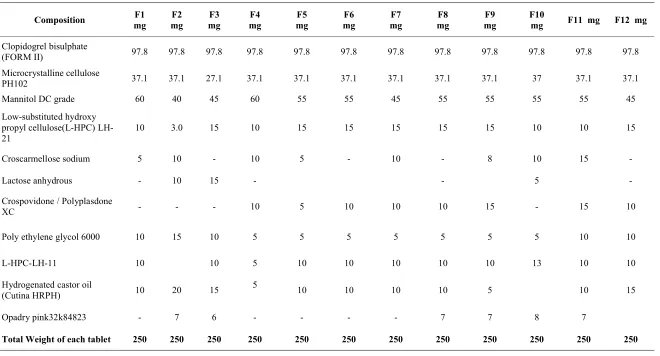
Immediate release tablets of Clopidogrel Bisulfate were prepared by direct compression method using Croscarmellose, Crospovidone as super disintegrants in different concentration. Twelve formulations were prepared. The powder blends o f t w e l v e f o r m u l a t i o n s F1 t o
F1 2 w e r e evaluated for Angle of Repose, Bulk
Density, Tapped Density, Carr’s Index and
Precompressional parameters of powder blend. The results indicate that the blend has good flow property. Later the tablets were subjected to post compressional parameters.
Solubility:
Solubility can be determined by placing the drug in a vial along with the solvent. The tightly closed vial was then agitated at constant temperature and the amount of drug in solution was determined periodically by assay of filtrate sample of the supernatant. Solubility of drug substance was performed in purified water, 0.1N HCl, Acetate buffer pH 4.5, Acetate buffer pH 6.8, Phosphate buffer pH 7.4 and Methanol. The results were given in the Table-3.
Angle of Repose: Table-4 shows there was change in angle of repose from F1 to F12. Angle of repose
increased from 25.51 to 37.12.
Bulk Density: Bulk Density of all formulations was shown in the table-4. The mean densities of all formulations from F1to F12are found to be in the range
from 0.512 to 0.694g/c.c.
Tapped Density: The mean tapped density of powders is found to be in the range from 0.625 to 0.834g/c.c. And the results are shown in table-4.
Carr’s Index & Hausner’s Ratio: The results of Carr’s index, Hausner’s ratio are showed in table-4 from the values it shows that the formulations F1, F3, F4, F5 and F9 are passable and remaining formulations had good flow properties.
Post Compressional Parameters:
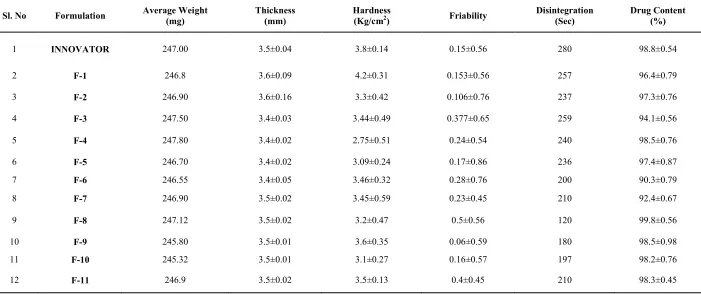
Thickness: As shown in Table-2, thicknesses of all tablet formulations are ranged from 3.43 to 3.63mm, and tablets with less thickness may attribute to less density of powder blends.
Hardness: Table-2 shows hardness of all formulations. The hardness of all formulations F1to F12managed from
2.75 ± 0.51 to 4.2 ± 0.31kg/cm2 with good mechanical
strength. The hardness of the tablets might have been increased in an account of the increase in contact area among powder particles.
Weight Variation Test:As shown in the table-2, Weight Variation test of all tablets ranged from 246.5 to 247.80 mg. So, they were within limits of I.P.
Friability: Table-2 shows friability of all formulations. The results indicates that the friability of formulations was between 0.10 ± 0.76 to 0.50 ± 0.56 which is considered that, the formulations are physically stable to mechanical shocks during handling.
Disintegration: Table-2 shows results of disintegration test of all tablet formulations. All tablets disintegrated rapidly as per USP disintegration test. The disintegration time was dependent on the concentration and type of disintegrant used. And as the disintegration is rapid they are considered suitable for immediate release tablets. So crospovidone (polyplasdone) are used. Their porous particles enable them to rapidly absorb liquids into tablets. Tablets of F8 formulation was found to be
disintegrated within 2 minutes.
Drug-Excipient Compatibility Studies by FTIR Analysis:
I.R study of the tablet formulations was also performed before and after the stability test period. Figures - 1 to 10 shows the IR spectra of Clopidogrel Bisulfate with various excipients. IR spectrum of Clopidogrel Bisulfate shows all functional group peaks. Results demonstrated that IR Spectrum of formulations showed all peaks corresponding to drug Clopidogrel Bisulfate, which attributes drug was stable before and stability study.
Difference and Similarity Factors of Immediate Release Tablets:
The cumulative percent release of the Clopidogrel Bisulfate from immediate release tablets and from Innovator (Marketed Product) were fitted into the equations (1) & (2) respectively to calculate difference and Similarity factors. The difference factor (f1) is
proportional to the average difference between two dissolution profiles, where as similarity factor (f2) is
inversely proportional to the average squared difference between two profiles; with emphasis on the larger difference the two profiles. The similarity factor (f2)
measures the closeness between two profiles. The similarity is a logarithmic reciprocal square root transformation of the sum of squared error and is a measurement of the similarity in the percent dissolution between the two curves. This model independent method is most suitable for dissolution profile comparison when three to four or more dissolution time points are available. Conventionally, a test batch is considered similar to that of a reference batch if the f2value of the two profiles is
between 50 and 100. Also, a difference factor between 0 and 15 ensures minor difference between two products. The results obtained for difference and similarity factors are shown in table-7. All formulations fell within the specified range for difference factor (52 – 68) and similarity factor of acceptable range (7 – 13). Thus show minor difference in terms of release of active ingredient with the reference drug. The dissolution of the test and the reference samples were subjected to the same conditions hence adequate comparison can be made.
Release Kinetics of Clopidogrel Bisulfate:
The dissolution data of the various formulations of tablets were fitted into the various kinetic models and their regression values used to assess the best fit. The higher the R2 value (i.e the more linear the graph), the
better the fit of the dissolution profile to that kinetic model. Various release kinetics models were applied to determine the release of the drug and to evaluate the best fit model. The best fit with higher correlation (r2=0.989)
was found with the First Order Drug Release Kinetics.
Stability Studies:
Sree Giri Prasad. B
*. B et al, JGTPS, 2014, Vol. 5(4): 2154 - 2166
Table 1: Formulation DevelopmentComposition mgF1 mgF2 mgF3 mgF4 mgF5 mgF6 mgF7 mgF8 mgF9 F10mg F11 mg F12 mg
Clopidogrel bisulphate
(FORM II) 97.8 97.8 97.8 97.8 97.8 97.8 97.8 97.8 97.8 97.8 97.8 97.8
Microcrystalline cellulose
PH102 37.1 37.1 27.1 37.1 37.1 37.1 37.1 37.1 37.1 37 37.1 37.1
Mannitol DC grade 60 40 45 60 55 55 45 55 55 55 55 45
Low-substituted hydroxy propyl cellulose(L-HPC) LH-21
10 3.0 15 10 15 15 15 15 15 10 10 15
Croscarmellose sodium 5 10 - 10 5 - 10 - 8 10 15
-Lactose anhydrous - 10 15 - - 5
-Crospovidone / Polyplasdone
XC - - - 10 5 10 10 10 15 - 15 10
Poly ethylene glycol 6000 10 15 10 5 5 5 5 5 5 5 10 10
L-HPC-LH-11 10 10 5 10 10 10 10 10 13 10 10
Hydrogenated castor oil
(Cutina HRPH) 10 20 15 5 10 10 10 10 5 10 15
Opadry pink32k84823 - 7 6 - - - - 7 7 8 7
Table - 2: Post – Compressional Parameters of Tablets
Sl. No Formulation Average Weight(mg) Thickness(mm) Hardness(Kg/cm2) Friability Disintegration(Sec) Drug Content(%)
1 INNOVATOR 247.00 3.5±0.04 3.8±0.14 0.15±0.56 280 98.8±0.54
2 F-1 246.8 3.6±0.09 4.2±0.31 0.153±0.56 257 96.4±0.79
3 F-2 246.90 3.6±0.16 3.3±0.42 0.106±0.76 237 97.3±0.76
4 F-3 247.50 3.4±0.03 3.44±0.49 0.377±0.65 259 94.1±0.56
5 F-4 247.80 3.4±0.02 2.75±0.51 0.24±0.54 240 98.5±0.76
6 F-5 246.70 3.4±0.02 3.09±0.24 0.17±0.86 236 97.4±0.87
7 F-6 246.55 3.4±0.05 3.46±0.32 0.28±0.76 200 90.3±0.79
8 F-7 246.90 3.5±0.02 3.45±0.59 0.23±0.45 210 92.4±0.67
9 F-8 247.12 3.5±0.02 3.2±0.47 0.5±0.56 120 99.8±0.56
10 F-9 245.80 3.5±0.01 3.6±0.35 0.06±0.59 180 98.5±0.98
11 F-10 245.32 3.5±0.01 3.1±0.27 0.16±0.57 197 98.2±0.76
Sree Giri Prasad. B
*. B et al, JGTPS, 2014, Vol. 5(4): 2154 - 2166
Figure -1: FTIR spectra of Clopidogrel bisulfate standard Figure-2-: FTIR spectra of Clopidogrel bisulfate + Crospovidone
Figure-3: FTIR spectra of Clopidogrel bisulfate+ hydrogenated castor oil Figure-4: FTIR spectra of Clopidogrel bisulfate + Mannitol
0 20 40 60 80 100 120
0 10 15 20 30
P
er
ce
nt
ag
e
dr
ug
r
el
ea
se
(%
)
Time(min)
F8 INNOVATOR
Figure-7: FTIR spectra of Clopidogrel bisulfate +LH 21 Figure-8-: FTIR spectra of Clopidogrel bisulfate + Opadry Pink
Figure-9-: FTIR spectra of placebo Figure-10-: FTIR spectra of F8 formulation
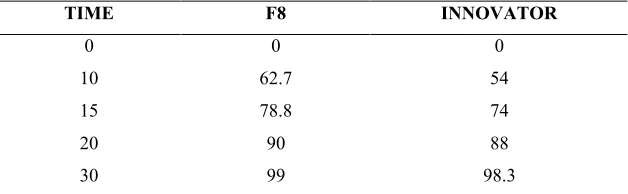
Figure-11: Comparison of In vitro % drug release in HCl buffer pH 2.0 Figure-12: In vitro% drug release of optimized formulation in HCl buffer pH 2.0
Table – 3: Solubility study data of Clopidogrel Bisulfate in water and in various Buffers.
Table-4: Micromeritic Properties of Powder Blend
Sl.
No Formulation Code
Angle of Repose
(ø) Bulk Density
Tapped
Density Compressibility Index Hausner’s Ratio
1 F-1 38.23 0.596 0.785 24.07 1.31
2 F-2 25.51 0.581 0.714 18.60 1.22
3 F-3 37.12 0.654 0.802 18.45 1.22
4 F-4 36.34 0.694 0.834 16.67 1.20
5 F-5 42.13 0.480 0.625 23.07 1.30
6 F-6 29.23 0.519 0.732 29.09 1.44
7 F-7 26.48 0.583 0.745 21.74 1.27
8 F-8 28.81 0.582 0.714 18.60 1.22
9 F-9 35.13 0.510 0.641 20.40 1.25
10 F-10 25.31 0.500 0.735 32.02 1.47
11 F-11 25.65 0.535 0.756 19.80 1.47
12 F-12 26.79 0.514 0.654 20.45 1.23
Table-5: IN VITRODRUG RELEASE OF OPTIMISED BATCH
Sl .NO TIME (mins) F8
1 0 0
2 10 62.7
3 15 78.8
4 20 90
5 30 99
Table-6: Comparison of F8 formulation with the Innovator
Solvents mg/ml Criteria
Purified water 520.6 Freely soluble
0.1N HCl 715.2 Freely soluble
Acetate Buffer pH 4.5 15.6 Sparingly soluble
Acetate Buffer pH 6.8 12.9 Sparingly soluble
Phosphate Buffer pH 7.4 202.1 Freely soluble
Methanol 89.2 Freely soluble
TIME F8 INNOVATOR
0 0 0
10 62.7 54
15 78.8 74
20 90 88
Table -7: Difference and Similarity Factors of Clopidogrel Bisulfate Tablets
Table-8: STABILITY STUDIES CONDITIONS
Sl. No Assay(%w/w) Initial 40
0C & 75% RH
0 Day 1 month 2month 3month
1 Optimized Formulation (F8) 100.3 99.8 99.5 99.6
2. Innovator 100 99.8 99.6 99.6
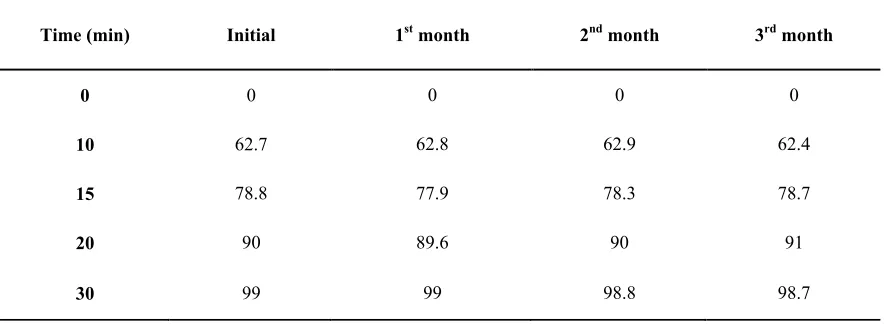
Table-9: Invitro Dissolution of Optimized Formulation after Stability Studies
Time (min) Initial 1stmonth 2ndmonth 3rdmonth
0 0 0 0 0
10 62.7 62.8 62.9 62.4
15 78.8 77.9 78.3 78.7
20 90 89.6 90 91
30 99 99 98.8 98.7
S.NO FORMULATION DIFFERENCE FACTOR(f1) SIMILARITY FACTOR(f2)
1 F-1 11 58
2 F-2 10 61
3 F-3 12 54
4 F-4 10 56
5 F-5 9 66
6 F-6 8 58
7 F-7 6 57
8 F-8 10 65
9 F-9 8 64
10 F-10 6 57
11 F-11 9 56
12 F-12 10 54
CONCLUSION
The present study was undertaken to develop Clopidogrel bisulphate immediate tablets of 250mg, comparable to the innovators product (Plavix–Sanfoi Aventis). Based on the results, suitable excipients were selected for formulation development. Various formulations of Clopidogrel Bisulfate were prepared by using direct compression method. The powder blend were subject to various physical characteristics tests such as bulk density, tapped density, Hausner’s ratio, compressibility Index, and core tablets were evaluated for weight variation, hardness, thickness, disintegration time, Invitro dissolution test and Stability test and results were found within specifications. As Clopidogrel Bisulfate possess stability problem, core tablets were coated with coating suspension (Opadry Pink) and were evaluated for disintegration time, Drug Content and Invitro release studies. The Optimized formulation was compared with innovator product (plavix) and release from optimized formulation was found to be similar with innovator product. Compared with the reference product of plavix the in-vitro dissolution profile of F8was similar to that of
reference product. The optimized batch tablets were packed in HDPE containers and performed stability studies at 40ºc/75% RH. Stability samples were evaluated initially and after three months. All the results were found to be satisfactory. Hence, the designed and developed formulation of Clopidogrel was stable. Clopidogrel Bisulphate immediate release tablets developed in the present work was found to be pharmaceutically equivalent to innovators product.
REFERENCES
1. Jigar A Patel, Jitendra S. Patel, Arjun Sony, Hemangi J Patel. Formulation and Evalution of Immediate Release Tablet of Azithromycin by
Dry Granulation Method Using
Superdintegrants. American Journal of Pharm. Tech. Research. 2011; 1(4): 211-218.
2. R. Natarajan, Rohit Vaishnani and NN. Rajendran. Formulation and Evaluation of Immediate Release Tablets of Paroxetine HCl Using Different Superdisintegrants. International Journal of Research in Pharmaceutical and Biomedical Sciences. 2011; 2(3):1095 - 1099. 3. Arivozhi Mohan, M., Identification and
characterization of a principal oxidation impurity in Clopidogrel drug substance and drug product, Journal of Pharmaceutical and Biomedical Analysis, (2008), 183–189.
4. Hardik Jain, Vimal Arora, Jitendra Gupta and Anil Bhandari Formula Optimization of Immediate Release Tablet of Clopidogrel Bisulphate Free From Surface Irregularities IJPSR, 2011; Vol. 2(12): 3243-3246.
5. K. Rama Koteswara Rao, K. Rajya Lakshmi, Design, development and evaluation of Clopidogrel bisulfate floating tablets, International Journal of Pharmaceutical Investigation January 2014 Vol 4 Issue 1, 19-26.
6. Sanjeeva Yarkala1, Sivakumar A and Sameer G. Navalgund, Physico-chemical Studies on Stability of Clopidogrel Tablet Formulations, International Journal of Pharma and Bio Sciences, 2012 Oct; 3(4): (P) 433 – 439.
7. Gibson, Pharmaceutical preformulation and formulation.HIS Health group, Englewood, 2001.
8. J.Wells,Pharmaceutical preformulation Ellis Horwood limited,1988.
9. L.J Ravin and G.W Radebaugh “Preformulation” chapter 75 in Remington’s pharmaceutical. 10. D.J.W Grant and T.Higuchi,solubility behavior
of organic compounds,John Willey and sons,Inc,1990.
11. S.Yalkowsky,solubility and solubilization in
aqeous media,American chemical
society,Washington D.C 1999.
12. British Pharmacopeia,London; the stationary office 2000.
13. Pharmacopeia.India,the drug controller of publications,1996.
14. United states pharmacopeia,/National
formulary(USP 25/NF 20).
15. Choo KS. Siong TE. Development of a HPLC method for the simultaneous several B vitamins and Ascorbic acid.Mal J Nutr 1996;2;49-65.
16. Nagaraja P, Vasantha RA, Yathirajan HS. Spectrophotometric determination of folic acid in pharmaceutical preparation by coupling reaction with immino-di-benzine or 3-amino
phenol or sodium
molybdate-pyrocatechol.Anal Bio chem. 2002:307(2); 316-321.
17. Minister of Health & Family Welfare. Indian Pharmacopoeia. Delhi: The Controller of Publications; 1996.)
18. Alfred Martin. Physical Pharmacy, 4th ed. Philadelphia: Lippincott Willams & Wilkins; 1993.)
19. Zhao N, Augsburger LL. Functionality comparison of 3 classes of superdisintegrants in promoting aspirin dissolution. AAPS PharmSciTech 2005; 6(4): Article 79.
20. Shishu, V.R.Kapoor,K.Preet,Indian J Pharm Edu Res,2009,43,2,150-155
21. C.M. Setty,D.V.K Prasad,V.R.M
Gupta,B.SA,Indian J Pharm Sci,2008,70,180-185.
22. Shirs and S.Suresh,P.V. Swamy D. N Kumar,Int J of Pharma sci ,2008,17,6,791-95 23. Sweetmann SC, editor. Martindale-The
Complete Drug Reference. 33rded. London:
Pharmaceutical press; 2002.
24. Joshi V.Excipient choise in solid dosage forms.Drug Delivery Technology 2002;2;36-40 25. Rowe RC, Sheskey PJ, Owen SC. Handbook of
pharmaceutical Excipients.5th
26. Herbert AL,Leon L,Pharmaceutical dosage forms-Tablets 2ndedition;New York:vol 1,2,3 Marcel dekker;1989
27. Arora V, Advance in direct compression technologies,Pharma times ,2007;39 (2),26,27 28. GreavesFC, J,Novel approaches to the
preparation of low dose oral solid dosage forms Pharma Tech 1995,61-64.
29. Hariharan M, Gupta VK,A Novel compression coated solid dosage form Pharma Tech 2001,14-19.
30. Well J, Aulton ME. The science of dosage form design–preformulation in pharmaceutics. International student edition ;1998
31. Tousey MD. The granulation process
101.Pharma Tech 2002,8-13.
How to cite this article:
Sree Giri Prasad. B*, Gupta VRM, Devanna N, Rama Devi. M, Tamilselvan A, Siva Subramanian.N Formulation and evaluation of clopidogrel bisulfate Immediate release tablets5(4): 2154-2166. (2014)