Vol. 9, No. 1, 2015, 107-117
ISSN: 2279-087X (P), 2279-0888(online) Published on 20 January 2015
www.researchmathsci.org
107
Reverse order Triangular, Trapezoidal and Pentagonal
Fuzzy Numbers
T.Pathinathan1 and K.Ponnivalavan2
Departmentof Mathematics, Loyola College, Chennai –600034,India.
1
Email: [email protected]; 2Email: [email protected] Received 27 December 2014; accepted 6 January 2015
Abstract. In this paper we define reverse order triangular fuzzy number and reverse order pentagonal fuzzy number with the help of triangular fuzzy number. We also define reverse order trapezoidal fuzzy number with the help of trapezoidal fuzzy number. we include basic arithmetic operations like addition, subtraction for reverse order triangular fuzzy number and reverse order trapezoidal fuzzy number. We have also verified with examples for the above mentioned operations.
Keywords: Fuzzy numbers,triangular fuzzy number, reverse order triangular fuzzy
number, reverse order trapezoidal fuzzy number, reverse order pentagonal fuzzy number, fuzzy operations
AMS Mathematics Subject Classification (2010): 94Dxx
1. Introduction
Zadeh introduced fuzzy set theory in 1965. Different types of fuzzy sets [3] are defined in order to clear the vagueness of the existing problems. A fuzzy number [9], is a quantity whose values are imprecise, rather than exact as in the case with single-valued function. The concept of fuzzy numbers is the generalization of the concept of real numbers. D.Dubois and H.Prade has defined fuzzy number as a fuzzy subset of the real line [5,12]. So far fuzzy numbers like triangular fuzzy numbers [4], trapezoidal fuzzy numbers [2,10], Pentagonal fuzzy numbers [11], Hexagonal, Octagonal , pyramid fuzzy numbers and Diamond fuzzy number [14] have been introduced with its membership functions. These numbers have got many applications [7] like non-linear equations, risk analysis and reliability. Many operations [8,1,6] were done using fuzzy numbers.
In the case, of triangular fuzzy number, the membership function characterizing a fuzzy number has one maximum on the supporting interval but in the case of trapezoidal fuzzy number, the requirement of one maximum has been relaxed allowing a flat segment at level α = 1.
108
variable which is either positive or negative. Then correspondingly only values, x ≥ 0 or x ≤ 0 are to be considered.When the supporting interval considered is unbounded we get Bell shaped fuzzy numbers.
In this paper, we introduce reverse order triangular fuzzy number (rotfn)with its membership functions, reverse order trapezoidal fuzzy number and reverse order pentagonal fuzzy number with its membership functions. Section one is the introduction and section two presents the basic definitions of fuzzy numbers; section three presents reverse order triangular fuzzy number and its arithmetic operations; section four presents reverse order trapezoidal fuzzy number and its arithmetic operations, and finally section five presents reverse order pentagonal fuzzy number.
2. Preliminaries and notations
Definition 2.1.(Fuzzy set): A fuzzy set is characterized by a membership function
mapping the elements of a domain, space or universe of discourse X to the unit interval [0, 1]. A fuzzy set
A
ɶ
in a universe of discourse X is defined as the following set of pairs:A
A
=
{( x ,
µ
( x ); x
∈
X }
ɶɶ
Here
µ
A:X →[0,1]ɶ
is a mapping called the degree of membership function of the
fuzzy set
A
ɶ
andµ
ɶA( x )
is called the membership value of
x
∈
X
in the fuzzy setA
ɶ
. These membership grades are often represented by real numbers ranging from [0,1]. Definition 2.2. (Fuzzy Number): A Fuzzy numberA
ɶ
is a fuzzy set on the real line R,must satisfy the following conditions. (i)
(
)
o A
x
µ
∼
is piecewise continous
(ii) There exist atleast one xo∈Rwith
µ
A(x0)=1ɶ
(iii)
A
ɶ
must be normal and convexDefinition 2.3. (Triangular Fuzzy Number): Triangular Fuzzy Number is defined as
A
ɶ
={a,b,c}, where all a, b, c are real numbers and its membership function is given below.
( ) ( ) ( ) ( )
0
( )
A
x a
for a x b b a
c x
for b x c c b
otherwise
x
µ
−
≤ ≤
−
−
≤ ≤
−
=
ɶDefinition 2.4. (Trapezoidal Fuzzy Number): A fuzzy set
A
ɶ
= (a, b, c, d) is said to109 0 ( ) ( ) 1 ( ) ( ) 0
( )
Afor x a x a
for a x b b a
for b x c d x
for c x d d c
for x d
x
µ
< − ≤ ≤ − ≤ ≤ − ≤ ≤ − > =
ɶDefinition: 2.5. (Pentagonal Fuzzy Number): A Pentagonal Fuzzy Number (PFN) of a
fuzzy set
A
ɶ
is defined asA
∼P= {a, b, c, d, e}, and its membership function is given by,0 , ( ) ( ) ( ) ( ) 1 ( ) ( ) ( ) ( ) 0
( )
APfo r x a
x a
fo r a x b
b a
x b
fo r b x c
c b
x c
d x
fo r c x d
d c
e x
fo r d x e
e d
fo r x e
x
µ
< − ≤ ≤ − − ≤ ≤ − = − ≤ ≤ − − ≤ ≤ − > =
ɶDefinition: 2.6 (Diamond Fuzzy Number) A Diamond Fuzzy Number (DFN) of a fuzzy
set
A
ɶ
is defined asA
∼
D= {a, b, c, (αb βb)}, and its membership function is given by,0 ,
( )
( )
( )
( )
- b a s e
( ) ( ) ( ) ( ) 1 0
( )
bb
D
f o r x a
x a
f o r a x b
b a
c x
f o r b x c
c b
a x
f o r a x b
a b
x c
f o r b x c
b c
x
o t h e r w i s e
A
x
α110
where αb is the base of the triangle a βbc and also for the reverse order reflection of the above triangle, namely abc.
3. Reverse order Triangular fuzzy number
Definition 3.1. (Reverse order triangular fuzzy number). A fuzzy set
A
ɶ
is defined ast
A
ɶ
= {-a,0,b} is said to be reverse order triangular fuzzy number(RoTFN) if itsmembership function is given by
t
1 for x a
1
x for a x 0 a
1
x for 0 x b b
1 for x b
A
µ
( x )
≤ −
−
− ≤ ≤
≤ ≤
≥
=
∼
α
a
− b
1
0
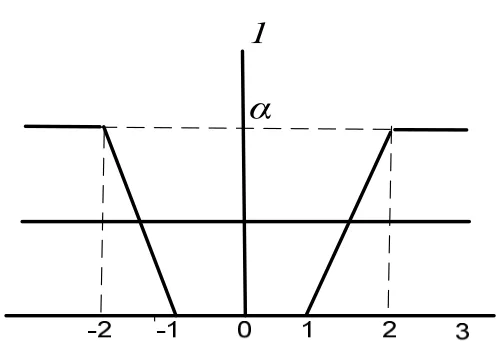
Figure 1: Graphical representation of reverse order triangular fuzzy number (RoTFN).
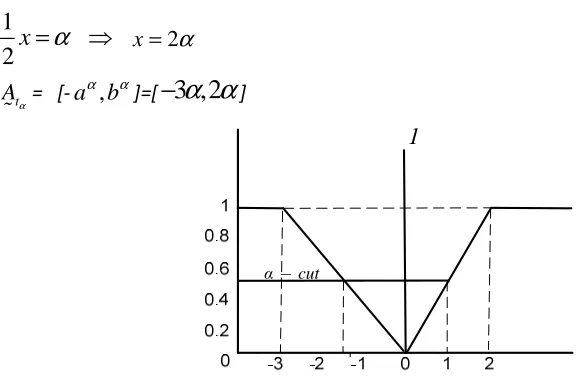
Example: An reverse order triangular fuzzy number,
µ
Atɶ = (-3,0,2) and its membership is given as,
t
1 for x 3
1
x for 3 x 0 3
1
x for 0 x 2 2
1 for x 2
A
µ
( x )
≤ −
−
− ≤ ≤
≤ ≤
≥
=
∼α
- Cut of reverse order triangular fuzzy number1
3
x
α
111
1
2
x
=
α
⇒
x=2αt Aα
ɶ = [-a b, α α
]=[
−
3 ,2
α α
]1
α−cut
Figure 2: Graphical representation of
α
- Cut of reverse order triangular fuzzy number(RoTFN).When (
α
=0.5), we get A0.5= [-1.5,1], Also when (α
=0),0 t A =
ɶ
[0 0
, a b
− ] = [-3,2].
3.2 Conditions on reverse order triangular fuzzy number. An reverse order triangular Fuzzy Number At
ɶ should satisfy the following conditions;
(i)
t
A µ ( x )
ɶ
is a continuous function in the interval [1,0]
(ii)
t
A µ ( x )
ɶ
is strictly decreasing and continuous function on [-a, 0] (iii)
t
A µ ( x )
ɶ
is strictly increasing and continuous function on [0,b]
3.3. Arithmetic operations on reverse order triangular fuzzy number (ROTFN)
3.3.1. Addition of two reverse order triangular fuzzy numbers
t 1 1 t 2 2
A , B
If
= (-a ,0,b ) and = (-a ,0,b );
ɶ ɶ are two reverse order fuzzy numbers then,
t+ t 1 2 1 2
A B
= ( a
−
−a , b + b )
ɶ ɶ .
For example;
,
( 2,0,1);
( 3,0,2);
t t
If A
= −
B
= −
∼ ∼ .Then, A
ɶ
t+ɶ
Bt= −( 5,0,3 )3.3.2. Subraction of two reverse order triangular fuzzy numbers
1 1 2 2
,
(
, 0,)
( ,0, );
t t
A B
If
=
a
b and
=
a
b
ɶ ɶ are two reverse order fuzzy numbers then,
1 2 1 2
(
,
)
t t
112 For example;
,
If
A
t= −
( 4,0,2 ); B
t= −
( 3,0,1 )
ɶ
ɶ
then,A
ɶ
t−
B
ɶ
t= −
( 1,0,1)
3.3.3 Perfect reverse order triangular fuzzy number
A perfect reverse order triangular fuzzy number(PROTFN) is definsd as
A
Ptɶ
=( a,o,a )
−
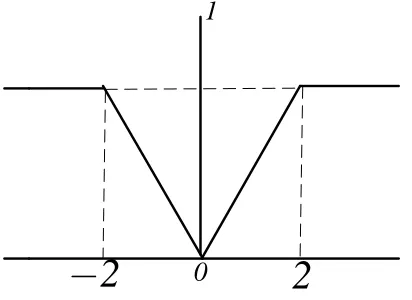
, Where the numerical value of -a and a both are equal. In other words Perfect Reverse order triangular fuzzy number(PROTFN) preserves symmetry. For example;t
P
A = −( 2,0,2 )
ɶ
2
−
2
1
0
Figure 3: Graphical representation of perfect reverse order triangular fuzzy number
(PRoTFN).
4. Reverse order Trapezoidal fuzzy number.
Definition: 4.1. (Reverse order trapezoidal fuzzy number). A fuzzy set
A
ɶ
is defined astr
A
ɶ
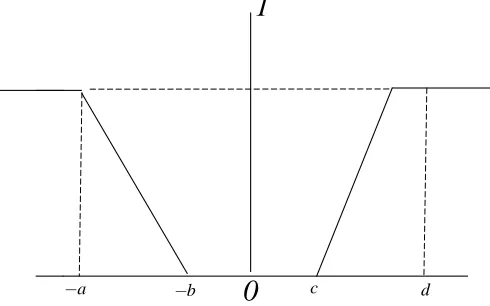
= {-a,-b,c,d}is said to be reverse order trapezoidal fuzzy number(ROTRFN) if itsmembership function is given by
tr
1 for x a
1( x b )
for a x b a b
0 for b x c
1( x c )
for c x d d c
1 for x d
A
µ
( x )
≤ −
− +
− ≤ ≤ −
−
− ≤ ≤
−
≤ ≤
−
≥
113
b
− c
1
0
a
− d
Figure 4: Graphical representation of reverse order trapezoidal fuzzy number (RoTRFN).
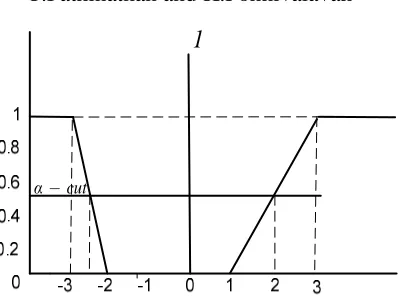
Example: An reverse order trapezoidal fuzzy number,
µ
Atrɶ = (-3,-2 ,1,3,) and its
membership is given as,
tr
1
for x
3
1( x
2 )
for
3
x
2
3
2
0
for
2
x
1
1( x
1 )
for 1
x
3
3
1
1
for x
3
A
µ
( x )
≤ −
−
+
− ≤ ≤ −
−
− ≤ ≤
−
≤ ≤
−
≥
=
∼
α
- Cut of reverse order trapezoidal fuzzy number1(
2)
2
3 2
x
x
α
α
−
+ =
⇒
= − −
−
,1( 1)
2 1
3 1 x
x
α
α
− = ⇒ = +
−
tr Aα
ɶ =[
− −
α
2,2
α
+
1
]When (
α
=0.5), we get A0.5= [-2.5,2],Also when (
α
=0),0 t A =
114
1
α−cut
Figure 5: Graphical representation of
α
- Cut of reverse order trapezoidal fuzzy number (RoTRFN).4.2. Conditions on reverse order trapezoidal fuzzy number.
An reverse order trapezoidal Fuzzy Number Atr
ɶ should satisfy the following conditions;
(i)
tr
A µ ( x )
ɶ
is a continuous function in the interval [1,0]
(ii)
tr
A µ ( x )
ɶ
is strictly decreasing and continuous function on [-a,-b] (iii)
tr
A µ ( x )
ɶ
is strictly increasing and continuous function on [c,d]
4.3. Arithmetic operations on reverse order trapezoidal fuzzy number (ROTRFN) 4.3.1. Addition of two reverse order trapezoidal fuzzy numbers
t 1 1 1 1 t 2 2 2, 2
A , B
If r
= (
− −
a
,
b
, ,c d) and
r= (-a , b
−
,c d,);
ɶ ɶ are two reverse order trapezoidal
fuzzy numbers then, Atr+Btr
= ( a
−
1−a , b
2−
1−b
2,c1+c2,d
1+
d
2)
ɶ ɶ .
For example;
,
( 4, 2,1,2);
( 3, 1,2,3);
tr tr
If A
= − −
B
= − −
∼ ∼ .
tr tr
Then, A +B = − −( 7, 3,3,5 ).
ɶ
ɶ
4.3.2. Subraction of two reverse order trapezoidal fuzzy numbers 1 1 1 1 Bt 2 2 2, 2
,
(
,
, ,) and
r= (-a , b
, ,);
tr
A c d c d
If
=− −
a
b
−
ɶ
ɶ are two reverse order
trapezoidal fuzzy numbers then,
2
1 2 1 2, 1 2, 1
(
,
)
tr tr
A −B
= −
a
−d−
b
−c c +b d +a ɶ ɶ.
For example;
,
If
A
tr= − −
( 4, 1,3,4 ); B
tr= − −
( 3, 2,2,3 )
ɶ
ɶ
then,Atr −Btr= − −
( 7, 3,5,7)
115
4.3.3. Perfect reverse order trapezoidal fuzzy number
A perfect reverse order trapezoidal fuzzy number(PRTRFN) is definsd as
A
Ptrɶ
=( a, b,b,a )
− −
, Where the numerical value of -a and a both are equal. In other words Perfect Reverse order trapezoidal fuzzy number(PRoTRFN) preserves symmetry. For example;tr
P
A = − −( 2, 1,1,2 )
ɶ
α
1
Figure 6: Graphical representation of perfect reverse order trapezoidal fuzzy number
(PRoTRFN).
5. Reverse order Pentagonal fuzzy number.
Definition 5.1. (Reverse order Pentagonal fuzzy number). A fuzzy set
A
ɶ
is defined asP
A
ɶ
= {-a,-b,0,c,d}is said to be reverse order Pentagonal fuzzy number(ROPFN) if itsmembership function is given by
P
1 for x a
1
x for a x b
a 1
x for b x 0 b
1
x for 0 x c c
1
x for c x d d
1 for x d
A
µ
( x )
≤ −
−
− ≤ ≤ −
−
− ≤ ≤
≤ ≤
≤ ≤
≥
116
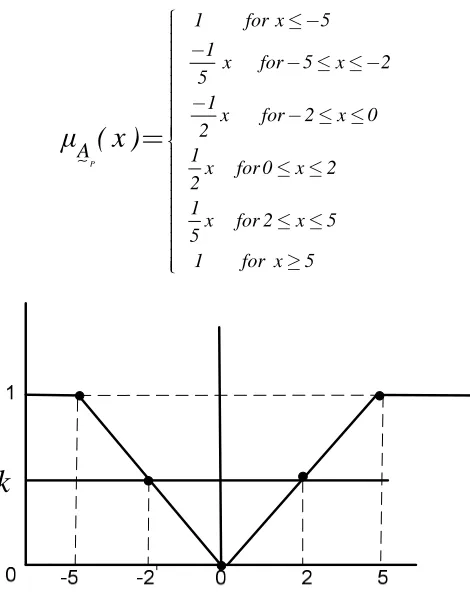
k
Figure 7: Graphical representation of reverse order pentagonal fuzzy number (RoPFN).
Example: A perfect reverse order pentagonal fuzzy number,
µ
APɶ = (-5,-2 ,0,2,5,) and its membership is given as,
P
1 for x 5
1
x for 5 x 2
5 1
x for 2 x 0
2 1
x for 0 x 2
2 1
x for 2 x 5
5
1 for x 5
A
µ
( x )
≤ −
−
− ≤ ≤ −
−
− ≤ ≤
≤ ≤
≤ ≤
≥
=
∼
k
Figure 8: Graphical representation of perfect reverse order pentagonal fuzzy number
117
6. Conclusion
The concept of fuzzy numbers and their utility aspects have been studied by researchers in recent times. Categorization of fuzzy numbers and their related properties have initiated new notions and approaches. In this paper, the Reverse Order Triangular Fuzzy Number and Reverse Order Trapezoidal Fuzzy Number has been introduced with arithmetic operations. Using a few examples,we have explained the relevant arithmetic operations. Also we defined Reverse Order Pentagonal Fuzzy Number. We observe that fuzzy number concepts could be applied to many real life problem.
REFERENCES
1. A.Bansal, Some non linear arithmetic operations on triangular fuzzy number (m,α,β), Advances in Fuzzy Mathematics, 5 (2010) 147-156.
2. C.Wu, G.Wang, Convergence of sequences of fuzzy numbers and fixed point theorems for inceasing fuzzy mappings and application, Fuzzy Sets and Systems, 130 (2002) 383–390.
3. Barnabas Bede, Mathematics of fuzzy sets and fuzzy logic, Springer Publications, 295, (1992) 51-78.
4. D.Dinagar and K.Latha, Some types of Type-2 Triangular Fuzzy Matrices, International Journal of Pure and Applied Mathematics, 82(1) (2013) 21-32.
5. D.Dubois and H.Prade, Operations on fuzzy numbers, International Journal of Systems Science, 9(6) (1978) 613-626.
6. P.Dutta and A.A.Tazid, Fuzzy arithmetic with and without α-cut method; a comparative study, International Journal of latest trends in Computing, 3 (2011) 528- 534.
7. K.H.Lee, First course on Fuzzy Theory and Applications, Springer, 2005.
8. M.Hanss,Applied Fuzzy Arithmetic: An Introduction with Engineering Applications,
Springer, 2005.
9. G.J.Klir and B.Yuan, Fuzzy Sets and Fuzzy logic, Prentice Hall of India Private Limited, 2005.
10. C.Parvathi and C.Malathi, Arithmetic operations on symmetric trapezoidal intuitionistic fuzzy numbers, International Journal of Soft Computing and Engineering, 2 (2012) 268-273.
11. T.Pathinathan and K.Ponnivalavan, Pentagonal fuzzy numbers, International Journal of Computing Algorithm, 3 (2014) 1003-1005.
12. B.Abhinav, Trapezoidal fuzzy numbers (a,b,c,d); arithmetic behavior, International Journal of Physical and Mathematical Sciences, 2, (2011) 39-44.
13. G.Bojadziev and M.Bojadzier, Fuzzy sets and fuzzy logic applications, World Scientific Publications, 5 (1995) 29-59.(Advances in Fuzzy systems)