40
INTERNATIONAL JOURNAL OF ADVANCES IN ENGINEERING RESEARCH
IMPLEMENTATION OF ROBOTIC OPERATING SYSTEM
IN MOBILE ROBOTIC PLATFORM
M. Harikrishnan, B. Vikas Reddy, Sai Preetham Sata, P. Sateesh Kumar Reddy
ABSTRACT
The paper describes implementation of mobile robots programming process with Robot Operating System (ROS). ROS provides different tools for data analysis, facilities of multiple robots and their sensors, teleoperation devices interaction thereby targeting engineering education. An example with the multiagent interaction between agent-evader and agent-pursuer were taken as the basic navigational task. The computed behavior of the virtual agents were successfully transferred to the quadcopters, Lego Mindstorms NXT based and Robotino robots. Diverse experimental tests were conducted using the algorithms on virtual agents and robotic platforms.
Keywords: Robotic Operating System, robotics, remote control.
INTRODUCTION
41
INTERNATIONAL JOURNAL OF ADVANCES IN ENGINEERING RESEARCH
developing tools to the students. Commonly used Matlab and Simulink allow making researches and controlling robots only having proper described mathematical model. And there are only few robots with the free spread models. Though every robot can be described and programmed with common programming languages such as C/C++ or Python, but it’s not comfortable to learn and use different languages for every part of the complex project or the new model of the robot. Meanwhile there are diversity of the robots should be studied during the robotics course for good preparation. And ROS (Robot Operating System) looks like the best solution for this problem.
TELEOPERATION INTERFACE GATEWAY FOR ROS
One of the common tasks during the Robotics course is developing the robotic system with the remote control. There are some robots under ROS should be provided with the remote control via the Internet. Control of robots will be independently exercised from various places. It is necessary to provide high level of safety, flexibility and performance. There is a solution for this very task proposed and described earlier in our papers and similar papers. There is a complex task, which allows students to study almost all the main parts of the ROS environment. Let us present more or less detailed example explanation.
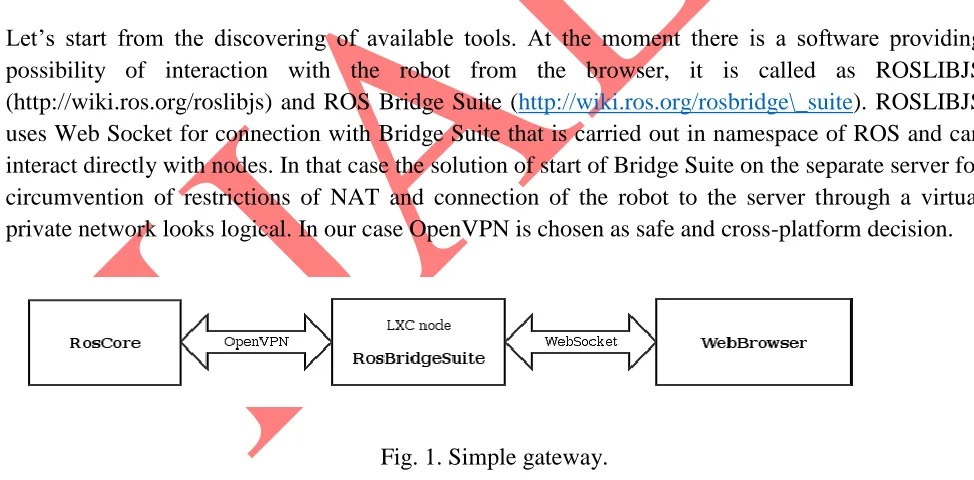
Let’s start from the discovering of available tools. At the moment there is a software providing possibility of interaction with the robot from the browser, it is called as ROSLIBJS (http://wiki.ros.org/roslibjs) and ROS Bridge Suite (http://wiki.ros.org/rosbridge\_suite). ROSLIBJS uses Web Socket for connection with Bridge Suite that is carried out in namespace of ROS and can interact directly with nodes. In that case the solution of start of Bridge Suite on the separate server for circumvention of restrictions of NAT and connection of the robot to the server through a virtual private network looks logical. In our case OpenVPN is chosen as safe and cross-platform decision.
Fig. 1. Simple gateway.
42
INTERNATIONAL JOURNAL OF ADVANCES IN ENGINEERING RESEARCH
overhead. The approach described above can be expanded for independent control of a set of robots to start with several LXC-containers. However there are also some difficulties:
� Automatic service of containers (creation, start, stop)
� Traffic routing from the robot to the container and from the container to a web browser � Authorization system for access to Bridge Suite from the robot and a web browser
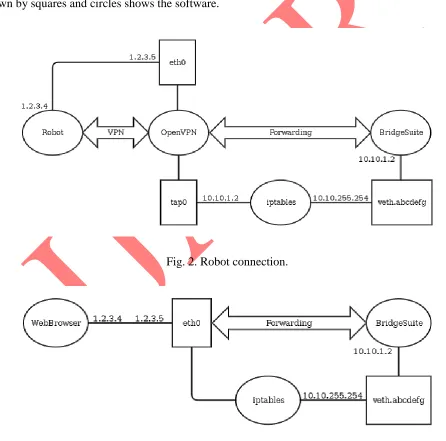
Transits of packets both from the specific robot to the container and from the container to a web browser are presented in fig. 2 and fig. 3. Thin lines present data streams; network interfaces are drawn by squares and circles shows the software.
Fig. 2. Robot connection.
43
INTERNATIONAL JOURNAL OF ADVANCES IN ENGINEERING RESEARCH
DEVELOPING OF MOBILE ROBOTS MULTIAGENT SYSTEM WITH ROS
An interest to the developing of multiagent systems significantly increases last decades. There are a lot of researches and papers on this topic with the different proposed approaches and algorithms. Developing of such kind of a system is one of the important complex tasks, which allows students to study simultaneously methods of modern control theory, mathematical modelling, system identification and programming languages. Let us present our approach to this task solving with the theoretical description and practical implementation. Mobile robots is a class of devices appropriate for problems solving which require the presence of operation unit and sensing system in the difficult to access areas. In everyday life the main reason of this situations appearance is technogenic accident and catastrophe, elemental calamity (fast acquisition, search and delivery of assistance is requires), celestial bodies surface research, the hard labor in explosive atmosphere or different dangerous areas. So the tasks of trajectory searching and following in uncertain environment have a big practical validity. Complex decision of that task allows finding the optimal trajectory for all machines in formed circumstances. This task may be solved in distributed manner with duty of few robots, which called agents and has ability to work together with some problems simultaneously. We based our research on the previous works such as [6]. Leader-follower formation control is applied as the basis for multiple wheeled robots and unmanned aerial vehicles (UAVs). This approach’s difference is in a simple way of algorithms description. It makes easier understanding by the students and easier realization. But at same time it allows adding different optimization criterions. The control objective for the follower UAV is to track its leader at a desired- separation, angle of incidence, and a bearing by using an auxiliary velocity control.
We propose the realization in ROS to the students right after the theoretical description of the system. Let us describe one of the tasks. We kindly advise to use the Haskell language for realization as the most convenient for this kind of tasks with a lot of advantages. Let us not to provide you with example cause it takes 30 rows of code. But it is the minimal available amount for this problem solving. So, the global planner in Haskell was written without transformation it into the node. Describing the desirable behavior we have the next scenario:
� Leader agent starts moving on the fixed distance from the follower. Leader moves until it meets the obstacle.
� Leader sends the command about stop to the follower and starts turning. � Leader moves fixed time after the turn while saving path points.
� Then it sends saved trajectory to the global planner. Global planner optimizes it according to the algorithm and then follower agent receives optimized trajectory.
44
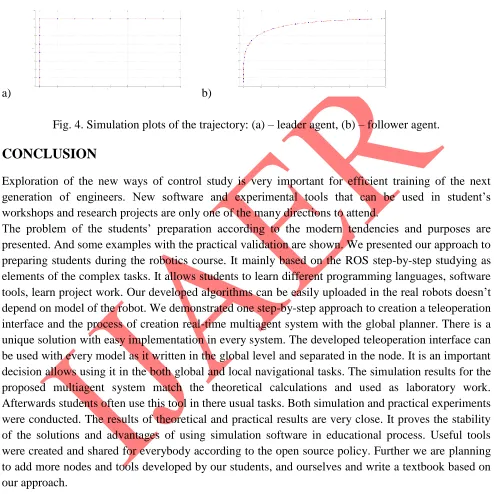
INTERNATIONAL JOURNAL OF ADVANCES IN ENGINEERING RESEARCH The simple case of simulation plots illustrated in fig. 4.
a) b)
Fig. 4. Simulation plots of the trajectory: (a) – leader agent, (b) – follower agent.
CONCLUSION
Exploration of the new ways of control study is very important for efficient training of the next generation of engineers. New software and experimental tools that can be used in student’s workshops and research projects are only one of the many directions to attend.
The problem of the students’ preparation according to the modern tendencies and purposes are presented. And some examples with the practical validation are shown. We presented our approach to preparing students during the robotics course. It mainly based on the ROS step-by-step studying as elements of the complex tasks. It allows students to learn different programming languages, software tools, learn project work. Our developed algorithms can be easily uploaded in the real robots doesn’t depend on model of the robot. We demonstrated one step-by-step approach to creation a teleoperation interface and the process of creation real-time multiagent system with the global planner. There is a unique solution with easy implementation in every system. The developed teleoperation interface can be used with every model as it written in the global level and separated in the node. It is an important decision allows using it in the both global and local navigational tasks. The simulation results for the proposed multiagent system match the theoretical calculations and used as laboratory work. Afterwards students often use this tool in there usual tasks. Both simulation and practical experiments were conducted. The results of theoretical and practical results are very close. It proves the stability of the solutions and advantages of using simulation software in educational process. Useful tools were created and shared for everybody according to the open source policy. Further we are planning to add more nodes and tools developed by our students, and ourselves and write a textbook based on our approach.
REFERENCES
[1] Bobtsov, A.A., Kolyubin, S.A., Pyrkin, A.A., Borgul, A.S., Zimenko, K.A., Evgeniy, R.Y.
Mechatronic and robotic setups for modern control theory workshops, (2012) IFAC Proceedings
45
INTERNATIONAL JOURNAL OF ADVANCES IN ENGINEERING RESEARCH
[2] Ruiz, E., Acuña, R., Certad, N., Terrones, A., Cabrera, M.E. Development of a control platform
for the mobile robot Roomba using ROS and a Kinect sensor, (2013) Proceedings - 2013 IEEE Latin
American Robotics Symposium, LARS 2013, art. no. 6693270, pp. 55-60.
[3] Bayar, V., Akar, B., Yayan, U., Yavuz, H.S., Yazici, A. Fuzzy logic based design classical
behaviors for mobile robots in ROS middleware,
(2014) INISTA 2014 - IEEE International Symposium on Innovations in Intelligent Systems and
Applications, Proceedings, art. no. 6873613, pp. 162-169.
[4] Mendonça, R., Santana, P., Marques, F., Lourenço, A., Silva, J., Barata, J. Kelpie: A ROS-based
multi-robot simulator for water surface and aerial vehicles, (2013) Proceedings - 2013 IEEE
International Conference on Systems, Man, and Cybernetics, SMC 2013, art. no. 6722374, pp.
3645-3650.
[5] Hold-Geoffroy, Y., Gardner, M.-A., Gagné, C., Latulippe, M., Giguére, P. Ros4mat: A matlab
programming interface for remote operations of ROS-based robotic devices in an educational
context, (2013) Proceedings - 2013 International Conference on Computer and Robot Vision, CRV
2013, art. no. 6569209, pp. 242-248.
[6] Bobtsov, A.A., Borgul, A.S. Multiagent aerial vehicles system for ecological monitoring, (2013)
Proceedings of the 2013 IEEE 7th International Conference on Intelligent Data Acquisition and
Advanced Computing Systems, IDAACS 2013, 2, art. no. 6663037, pp. 807-809.
[7] I. G. Chernorutsky Methods of decision making. Saint-Petersburg, BHV – Petersburg, 2005, 416
p.
[8] Pinho, T., Moreira, A.P., Boaventura-Cunha, J. Framework using ROS and SimTwo simulator for
realistic test of mobile robot controllers (2015) Lecture Notes in Electrical Engineering, 321 LNEE,