UDC 613.281: 547.562.34
DOI: 10.21668/health.risk/2016.3.08
METHODOLOGY FOR DETERMINING POLYBROMINATED
DIPHENYL ETHERS IN FISH AND FISH PRODUCTS
BY GAS-LIQUID CHROMATOGRAPHY
Timofeeva O.N., Grinkevich I.S., Shulyakovskaya O.V.
Scientific practical center of hygiene, 8, Academicheskaya str., Minsk, 220012, Belarus
The target of the present study is to develop the methodology for determining polybrominated diphenyl ethers (PBDEs) in fish and fish products for the control of impurities content in foodstuff and environmental objects in general. We analyzed chromatog-raphy conditions (temperature conditions, effect of speed and split ratio of the gas-carrier flow using HP-1 capillary columns, DB-5, HP-50+, DB-1) and the extract purification methods, lipids-destructive and non-destructive, at determination of PBDEs. We suggested the method for determining 2,2,4,4-tetrabromodiphenyl ether (BDE-47), 2,2,4,4,5-pentabromodiphenyl ether (BDE-99) and decabromodiphenyl ether (BDE-209) in fish and fish products by gas chromatography with electron-capture detector. The method is based on PBDEs extraction of the sample with hexane-acetone (3:1), extract purification with concentrated sulfuric acid (phase ratio hexane-sulfuric acid: 5:1). The second purification step is done by using solid-phase extraction with cartridges “SiOH-H2SO4/SA” and hexane as an eluent. Gas-chromatographic analysis for BDE-47 and BDE-99 determination is carried out with a low-polar capillary column DB-5 (30m x 0.25mm x 0.25mm) when setting the column temperature. In determining BDE-209, a non-polar capillary column DB-1 (15 m x 0.25 mm x 0.1 m) is used during programming the column temperature.
Estimation of BDE-47 and BDE-99 content is done under the internal standard (2,2, 3,4,4-pentabromodiphenyl ether (BDE-85)), BDE-209 by absolute calibration. In determining BDE-209 we use calibration matrix. The concentration range of calibration solutions for determining BDE-47 and BDE-99: 0.005-0.05 g/cm3, BDE-209: 0.05-0.3 g/cm3. The methodology allows measurement of BDE-47 and BDE-99 in the range of 0.0002-0.05 mg/kg of the product concerned; BDE-209 in the range of 0.002-0.3 mg/kg. The metrological profile of the method is rated.
Keywords: polybrominated diphenyl ethers, 2,2,4,4-tetrabromodiphenyl ether, 2,2,4,4,5-pentabromodiphenyl ether,
decabromodiphenyl ether, fish, fish products, gas-liquid chromatography, electron-capture detector.
Introduction. The particular attention being actually paid to polybrominated diphenyl ethers (PBDEs) is due to their wide industrial application as flame retardants, resistance to environment, bio-accumulative potential, high toxicity and carcino-genic effect to humans.
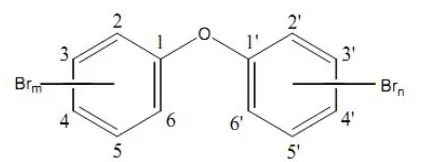
Polybrominated diphenyl ethers are a class of dicyclic aromatic ethers where the hydrogen atoms of the first and second benzene rings are substituted by bromine atoms. Bromine atoms per molecule are: n + m = 2 ÷ 10 (Figure 1). There are 209 congeners of PBDEs. Depending on the number of bromine atoms per molecule, there are 10 PBDEs homology groups classified: mono-, di-, tri-, tetra-, penta-, hexa-, hepta-, octa-, nona- and decabromobiphenyls. The said homology groups are 3, 12, 24, 42, 46, 42, 24, 12, 3 and 1 isomers,
respectively.
Fig. 1. General structure of polybrominated diphenyl ethers
PBDEs are structurally the analogues of such resistant organic pollutants, as polychlorinated bi-phenyls (PCBs) and dioxins, and show the similar chemical properties.
Due to their low reactivity and hydrophobic nature, they are fairly stable under ambient
condi-__________________________
Timofeeva O.N., Grinkevich I.S., Shulyakovskaya O.V., 2016
Timofeeva Ol'ga Nikolaevna – leading chemist of Laboratory of Food Chemistry (e-mail: [email protected]; tel.: +7 (375) 284-13-80).
Grinkevich Irina Sergeevna – chemist of Laboratory of Food Chemistry (e-mail: [email protected]; tel.: +7 (375) 284-13-80).
tions. Thus, PBDEs may be in the form of air-suspended particles, which are then deposited with dust, polluting soil, or washed off with precipitation falling into water. PBDEs are poorly soluble in wa-ter, wherefore no high concentrations of them were found.
PBDEs are lipophilic compounds with bio-accumulative potential. In human blood, adipose tissue and breast milk, fish and bird eggs we found 2,4,4-tribromdifenil ether (BDE-28), 2,2,4,4-tetrabromodiphenyl ether (BDE-47), 2,2,4,4,5-pentabromodiphenyl ether (BDE-99), 2,2,4,4,6-pentabromodiphenyl ether (BDE-100), 2,2,4,4,5,5-hexabromodiphenyl ether (BDE-153), 2,2,4,4,5,6-hexabromodiphenyl ether (BDE-154) [8,16]. The content of PBDEs in human tissues and biota is rap-idly increasing.
Under natural conditions and in living organ-isms there takes place a transformation of PBDEs (biodegradation, photo-degradation) towards conge-ners with a fewer bromine atoms contents. So, de-spite the fact that all PBDEs congeners are present in marketable compounds, including decabromodiphe-nyl ether (BDE-209), BDE-47, BDE-99, BDE-100 are more commonly found in natural objects [8,16].
The main route for PBDEs admission to human body is from food, especially high fat-contents food, such as fatty fish. It’s reported on the contents of PBDEs in vegetables, meat (pork, beef), vegetable oils, marine fish and sea-fish, shellfish, eggs: to 569.3 pg/g. Most PBDEs contaminated product is fish liver oil, used as dietary supplement: up to 2,100 pg / g. There are also data on freshwater fish contamination [8, 16]. In cereals, fruits and roots no PBDEs were detected. Lower bromated congeners (tetra-, penta-) can be contained in the air, and penetrate into human body as a result of inhalation.
The study of scientific literature sources showed that determination of PBDEs is often carried out by gas-liquid chromatography (GLC), using a capillary column with non-polar (100% methyl-polysilicone) and low polarity liquid phases (5% phenyl-dimethyl-polysilicone, 5%-phenyl-(aryl)-95%-methyl-polysilicone).
Detection at PBDEs determining by GLC can be performed using mass spectrometry (MS, MS-MS) or electron-capture detectors (ECD) [2,3,6,10,13]. ECD is used to determine relatively high PBDEs concentrations that can be applied for the purpose of PBDE monitoring.
Gas chromatographic determination of PBDEs has a number of difficulties. PBDEs have low volatil-ity, and their gas-chromatographic determination re-quires high temperatures. However, high-bromated
PBDEs congeners, such as BDE-209, may be thus unstable, so the authors [2,10] recommend using short columns to reduce thermal effect time on the sample. Furthermore, due to the presence of various halogenated contaminants in the environment, at chromatography PBDEs may elute together with or-gano-chlorine pesticides (OCPs), polychlorinated biphenyls (PCBs) or other PBDE-congeners. Thus, such critical pairs, for example, are PCB 194 and BDE-120, PCB-180 and BDE-47, PCB-194 and BDE-120. The aforementioned problems in some cases can be avoided by choosing an optimal temper-ature regime of the column and gas-carrier velocity [3,8]. Fractionating a sample by column chromatog-raphy or by SPE (solid-phase extraction) with isolat-ing individual fractions of PBDEs, OCPs and PCBs before chromatography also allows you to solve the problem of co-eluting contaminants [2,10,12,14].
For PBDEs extraction polar solvents can be used; they include chloroform, acetone, dichloro-methane or combinations of non-polar and polar or low-polarity solvents (hexane-acetone (1:1, 3:1), hexane-dichloromethane (9:1), hexalnethylene-acetone (3:1), dichloromethane-hexane (25:75), ether-hexane, petroleum ether-diethyl ether). Tra-ditional fat extraction solvents may be used to ex-tract PBDEs: chloroform-methanol (2:1) or chloro-form-ethanol (2:1) [10,16].
PBDEs extraction by Soxhlet is efficient, since sample is in contact with a hot solvent (hex-ane, dichloromethane, solvents mixtures) [2,9,10,12]. However, these extraction methods require significant volumes of solvent and time (6 – 24 hours).
Accelerated solvent extraction (ASE), extrac-tion under pressure (PLE) are also in use [7,10,11]. For extraction of PBDEs, the authors [6,14,15] recommend PLE extraction at temperatures of 60 – 150° C and under pressure of 7 – 14 MPa.
The authors [2] proposed an accelerated ex-traction technique under exposure of microwave radiation (MAE). This extraction technique re-quires small amounts of solvent, can be automated, but is expensive.
Solid-phase extraction technique (SPE) may be used for PBDEs extraction. The method allows reducing solvents consumption for extraction and sample preparation time, combining the extraction and extract purification steps [6]. The authors [4] use SPE cartridges with neutral filler (silica-gel) for simultaneous extraction of PBDEs and purifica-tion of extracts from fish.
trans-fer from multi-component food matrix into the sol-vent. The most complete extraction of analytes, for example, with hexane-acetone compound, leads to the almost complete extraction of lipids from the sample. In the case of oily fish the extracted quanti-ty from a 5g sample can amount to 0.5. So in deter-mining PBDEs much attention is paid to extract pu-rification.
Methods applicable for extract purification can be divided into lipids-destructive and non-destructive. Purifying PBDEs extract with lipids destruction may be done by extract treatment with concentrated sulfuric acid or ethanol alcali liquor [3, 9,13]. For non-destructive treatment of lipids we use neutral adsorbents: silica-gel, florisil, aluminum oxide [3.7]. The authors [4,11,12] apply multilayer adsorption columns with several adsorbents simul-taneously. It is also practicable to combine lipids-destructive and non-lipids-destructive methods using a mixture of silica-gel and sulfuric acid [2,4].
In the works [2, 12] extract purification is suggested using gel permeation chromatography (GPC) with the column containing polystyrol-divinylbenzene based filler, and an extra purifica-tion may be effected using a florisil or silica-gel. Solid- phase extraction (SPE) can be done using cartridges filled with neutral (silica-gel, florisil) adsorbent, adsorbent modified with chemically-bonded functional groups, layered combined phas-es [4,13]. At extract treatment, the above methods can be also combined [2,4,9,12].
The growing interest in PBDEs effect on the environment resulted in the need for analytical methods for their quantification in a wide range of natural objects, including food which is the main route of PBDEs entry into human body. Despite the global distribution and the trend of PBDEs in-crease in human tissues and biota, in the Republic of Belarus, PBDEs-content is not regulated, and there are no formal methods of their determination in the environmental objects in place. Develop-ment of hygienic standards and methods of meas-urement to determine PBDEs will allow monitor-ing the level of environment contamination.
Target and objectives. The target is to de-velop the methodology for determining PBDEs in fish and fish products. For this purpose, it was nec-essary to meet the following objectives: to set op-timum conditions for chromatography, to develop extraction conditions, to study different treatment methods in order to choose the appropriate ones, to develop the methodology for PBDEs determining and set its metrological profile.
Materials and methods. We studied the con-ditions of chromatography and extract purification methods for determining BDE-47, BDE-99 and BDE-209 in fish and fish products.
Chromatographic conditions were studied us-ing standard hexane solutions of BDE-47, BDE-99 in concentrations: 0.0001; 0.001; 0.01; 0.05; 0.1; 0.5 g/cm3; BDE-209 in concentration of 0.001; 0.01; 0.1; 0.5 g /cm3 in hexane; OCPs mixture (of hexachlorocyclohexane isomers (HCH), DDT and its metabolites DDE and DDD, aldrin, heptachlor) and PCBs (a mixture of PCB 28, 52, 101, 138, 153, 180, 209) in concentration of 0.1 g/cm3 in hexane.
When studying PBDEs chromatography conditions, we used quartz capillary columns of different polarity and length: non-polar HP-1 (100%-dimethyl-polysiloxane) 30 m long; low-polar DB-5 (5%-phenyl-methyl-polysiloxane) 30 m long; of medium polarity + HP-50 (50%-phenyl-methyl-polysiloxane) 30 m long; non-polar DB-1 (100%-dimethyl-polysiloxane) 15 m long.
Extracts purifying conditions were studied on fish and fish products samples (puree for baby food of fish, fresh-frozen hake, fresh mackerel). Segre-gating fat from fish and fish products was done with hexane-acetone compound (1:1). The sample weight was 5g. After solvents extraction on a rota-ry evaporator, the resulting oil was weighed and used to study conditions of purification. The segre-gated fat quantity of one sample made 0.2 - 0.5g.
For samples treatment we used concentrated sulfuric acid in accordance with GOST 4204-77; florisil and silica-gel adsorbents by “Macherey-Nagel” (0.063-0.200 mm); cartridges for SPE by “Chromabond”, SiOH, Florisil®, NH2, CN, OH; SiOH-H2SO4/SA, SA/SiOH, NAN by “Macherey-Nagel” production of 3 and 6 cm3 containing 500 – 1000 mg of adsorbent.
Analysis was performed on a gas chromato-graph "Chromatec Crystal 5000.2", equipped with ECD. As a gas-carrier, hydrogen was used.
Results and discussion. We studied tempera-ture conditions of chromatography, effect of speed and fission rate of the gas-carrier flow on PBDEs determination using the above-mentioned capillary columns.
optimal temperature values for the detector stated at 300°C, for the evaporator: 260 – 270° C. We studied the fission rate of gas-carrier flow in evap-orator during PBDEs chromatography. The optimal split ratio was selected 1:10, providing sufficient peak area to determine BDE-47 and BDE-99 at the level of 0.0001 g/cm3 with a sample volume of 2 ml injected. When determining BDE-209, the sam-ple gas-carrier split injection worsened reproduci-bility of results. In addition, there was a "matrix effect": in the presence of impurities, typical for the sample, there was a 4 times-increase in BDE-209 peak observed. Consequently, we determined BDE-209 with no split injection, but in the pres-ence of food matrix impurities.
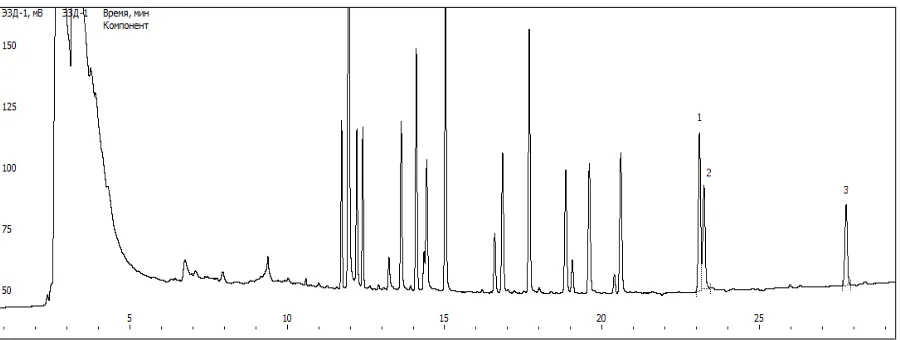
We studied the unmixing of substances con-tained in natural objects and showing similar prop-erties: OCPs, PCBs, PBDEs. With the standard solution mixtures of PBDEs, OCPs and PCBs in concentration of 0.1 g/cm3 under chromatography on DB-5 column, selected for 47 and BDE-99 determination, there was an overlap of BDE-47 and PCB-180 peaks having similar properties. In this case, when programming the column tempera-ture, with an increase in thermal phase duration, better splitting of the critical pair BDE-47 and BDE-180 was found. The best results were achieved with the temperature set from 90° C at 15
о/min to 220° C with its further raising up to 300°
C at 8°/min. This allows determination of BDE-47
and BDE-99 in the presence of OCPs and PCBs with similar properties, as well as to avoid frac-tionation of PCBs and PBDEs at sample prepara-tion stage.
When programming the temperature for DB-1 column with a reduced high-temperature phase at 300° C and temperature acceleration, the peak mode was improved, and its width reduced, which may be associated with a decrease in BDE-209 decomposition under temperature. Using the pro-gramming mode of DB-1 column (110° C - 30° C / min – 200° C (3 min) – 60° C – 300° C) allows high-temperature effect reduction on BDE-209, thus improving peak characteristics. Increasing the duration of the temperature phase in the program at 200° C allows effectively segregate impurities’ peaks on the chromatogram. The resulting chroma-tograms are shown in Figures 1-2.
Under optimum conditions of chromatography selected, we found that the dependency graphs of BDE-47 and BDE-99 peaks areas to the solutions concentration are linear in a wide range of 0.0001 – 0.1 g/cm3; the dependency graph of BDE-209 peak area to the solution concentration is linear at BDE-209 content in the range of 0.001 – 0.3 g/cm3. De-termination of BDE-47 and BDE-99 in fish and fish products at a sample weight of 5g is practicable at the level of 0.0002 mg/kg, and BDE-209 at the level of 0,002 mg/kg.
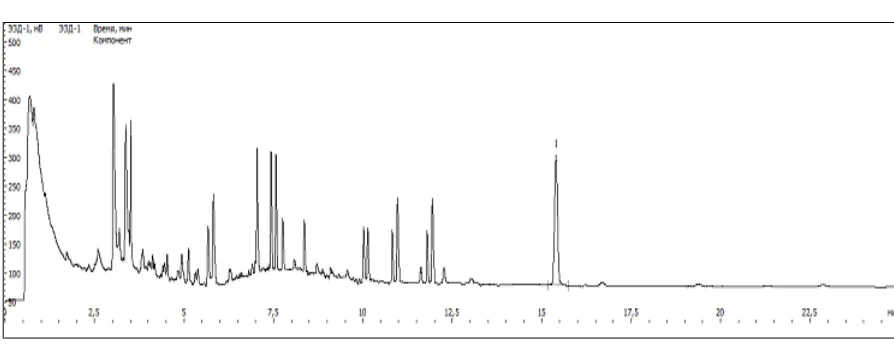
Fig. 2. Chromatogram of the fish sample with the standard BDE-209 solution introduced. Peaks: 1-BDE-209.
We studied the conditions of extract purifica-tion from the co-extracted lipids using lipids de-structive and non-dede-structive purification methods: with concentrated sulfuric acid; by redistributing between two immiscible fluids (liquid-liquid ex-traction, an extraction method); by column with adsorbents; by solid-phase extraction (SPE). With the extraction method used for purification we ap-plied biphasic systems "aliphatic hydrocarbon, i.e. polar organic solvent", as used to isolate hydro-phobic compounds such as OCPS, PCBs, hexane-DMF, hexane-DMSO, hexane-methyl cyanide. When studying extract purification by column chromatography, we applied neutral adsorbents (silica-gel, florisil), and solvents, and different po-larity solvents mixtures: hexane, hexane-diethyl ether (94:6, 85:15; 3:1), hexane-dichloromethane (1:1). The mass of an adsorbent taken was 4 - 8 g (further increasing the adsorbent mass leads to high consumption of solvents and long sample preparation time). Extract purification by SPE method was studied using silica-gel or florisil-based cartridges (SiOH, Florisil®, NH2, CN, OH) and cartridges with a combined adsorbent (SiOH-H2SO4/SA, SA/SiOH, NAN).
It is found that for extract treatment in deter-mining PBDEs in fish products a single exposure to concentrated sulfuric acid can be applied for 10 minutes at a phase ratio hexane-sulfuric acid (5:1). At the same time, lipids destruction for 82.3% takes place. Purification is applicable to the sam-ples with high fat content of up to 0.5 g. The sulfu-ric acid effect on PBDEs in the solution is minor. Treatment with concentrated sulfuric acid meets the conditions for quantification of 47, BDE-99 and BDE-209, however, is insufficient for fur-ther gas-chromatographic analysis.
We studied the extraction method for purifi-cation (redistribution between two immiscible liq-uids of different polarity, liquid-liquid extraction). There were biphasic systems used: aliphatic hydro-carbon, as polar organic solvent, applied for segre-gation of such hydrophobic compounds as OCPs, PCBs: hexane-DMF, DMSO, hexane-acetonitrile; determined the constant values for the distribution of BDE-47, BDE-99 and BDE-209, characterizing the efficiency of target components isolation, the recovery ratio [1].
It is found that by using DMF and DMSO as a polar phase, and the phase ratio hexane-polar solvent (1: 1), PBDEs distribution constants were less than a unity (0.11 - 0.30), i.e. the substance passes to the polar phase. The most effective PBDEs extraction from non-polar solvent results with dimethylformamide, the recovery ratio thereof made 88.7 – 89.6%. In all the systems of solvents studied the recovery ratio for BDE-209 was lower than for BDE-47 and BDE-99. Hexane-DMF (1:2) can be considered as an optimal phase ratio, with the purification degree of 74.2% and the recovery ratio of the studied PBDEs: 89.0 – 93.8%. Increas-ing the fat mass of the sample to 0.5 g did not sig-nificantly affect PBDEs recovery ratio. However, this method requires an extra purification step.
the purification degree of 74.2% and the recovery ratio of the studied PBDEs: 89.0 – 93.8%. Increas-ing the fat mass of the sample to 0.5 g did not sig-nificantly affect PBDEs recovery ratio. However, this method requires an extra purification step.
It was found, at eluting the mixture of OCPs, PCBs and PBDEs with non-polar solvent, no clear separation of the mentioned substances per fractions were observed: elution of OCPs and PCBs partly occurred together with PBDEs.
With an increase in the adsorbent mass, the ex-tract purification degree increased slightly. Move-ment of the lipid fraction was detected visually and went at the eluent flow rate. Lipid fraction recovery, as well as of PBDEs, was observed already in the first 10 cm3 of the eluent. PBDEs extraction degree in this case also did not change significantly. Similar results were obtained using florisil.
Thus, using column chromatography for ex-tract purification with silica-gel and florisil meets the conditions of BDE-47, BDE-99 and BDE-209 quantification, but does not provide for a sufficient separation from lipids, being labor- and time-consuming process.
In the study of PBDEs extract treatment by SPE, we found that when using silica-gel or florisil based cartridges (SiOH, Florisil®, NH2, CN, OH) and non-polar eluent (hexane), BDE-47, BDE-99 and BDE-209 recovered in full in the first non-polar fraction; in the subsequent fractions of higher po-larity no PBDEs were detected. The recovery ratio using these cartridges was 98.0 – 101.5% and dif-fered slightly for the various adsorbent modifica-tions. When using cartridges with a combined ad-sorbent (SiOH-H2SO4/SA, SA/SiOH, NAN), PBDEs recovered in the second low polarity frac-tion that appears to be associated with ionic interac-tion between PBDEs and adsorbent. The recovery rate was 98.5 – 101.7%.
It is shown that the eluent volume for PBDEs extract purification using cartridges of 3 cm3 should be not less than 9 cm3. The best purification results were obtained with the combined adsorbent cartridges (silica-gel mixed with a cation- meta-thetical benzyl sulphonic acid) at a fat content in a sample of up to 0.05 g.
Comparative analysis of the treatment meth-ods studied in determining BDE-47, BDE-99 and BDE-209 is given in Table 1.
Table 1 Purification methods’ comparative analysis
Parameters
Purification Method
1 2 3 4
Purification with concentrated sulfuric acid
Extractive purification
Purification with adsorbents
containing column Purification with SPE method
Fat mass in a sample, g < 0,5 < 0,3 < 0,2 < 0,1 PBDEs recovery ratio, % 98,4–99,2 92,5–96,8 97,4–98,5 98,5–101,3
Purification degree, % 82,3 62,5 63,5–79,3 81,5–83,2
Duration, min < 20 < 30 60–120 < 15
Solvents number, cm3 – 50–100 50–100 10–50
Accessories Not required Not required Not required Vacuum pump system for SPE
Disadvantages Aggressive
chemical –
Time-consuming (adsorbent preparation)
Expensive consumables (cartridges) Applicability for extract
purification
Basic
purification Basic purification Extra purification Extra purification
Thus, considering the amount of fat in the sample and purification degree, provided by this method, the methods 1 and 2 can be applied in the first stage of purification, methods 3 and 4 as an additional purification step. Methods 1, 2 and 4 took minimum time, which is important for sur-veillance studies, and, moreover, methods 1 and 4 had the advantage in the number of solvents used. A slight effect on the concentration of PBDEs studied in the process of extracts purification makes it possible to combine the studied methods.
The optimum is the combination of an extract puri-fication with concentrated sulfuric acid (method 1) and further purification on SPE cartridges with a combined adsorbent (method 4).
done with 30 cm3 of hexane-acetone (3:1) twice by centrifugation (10 min at 5000/rpm rotation speed). For further analysis, fat mass should be no more than 0.5 g.
After distilling the solvents off and dissolving the dry residue in 30 cm3 of hexane, the extract puri-fication is carried out with concentrated sulfuric acid in a separation funnel over 10 min. Phase ratio hexane-sulfuric acid is 5:1. The second purification step is carried out by SPE method with SiOH-H2SO4/SA cartridges and 10 cm3 of hexane as elu-ent.
Gas chromatographic analysis at determining BDE-47 and BDE-99 is carried out with a low-polar capillary column DB-5 (30m x 0.25mm x 0.25mm) setting the column temperature; when determining BDE-209, a non-polar capillary col-umn DB-1 (15m x 0.25mm x 0.1m) is used with setting the column temperature (programming conditions are given above).
Calculation of BDE-47 and BDE-99 content is carried out by calibration under internal standard (BDE-85); BDE-209 content is calculated with an absolute calibration method. In determining
BDE-209 we use matrix calibration. The concentrations range of the calibration solutions for determining BDE-47 and BDE-99: 0.005 - 0.05 mcg /cm3, BDE-209: 0.05 - 0.3 mcg/cm3. Measuring range for BDE-47 and BDE-99 is 0.0002 - 0.05 mg/kg of the prod-uct concerned; BDE-209 measuring range: 0.002 - 0.3 mg/kg.
The metrological profile of the method was rated. The extended standard measurement uncer-tainty for BDE-47, BDE-99 and BDE-209 made 27.4 - 37.2%.
Conclusion. Thus, we developed the method-ology for determining polybrominated diphenyl ethers in fish and fish products, including the extrac-tion step, extract purificaextrac-tion and quantificaextrac-tion by gas-liquid chromatography with electron-capture detection. The measuring range for BDE-47 and BDE-99 is 0.0002 - 0.05 mg/kg of the product con-cerned; measuring range for BDE-209: 0.002 - 0.3 mg/kg. The developed method allows control over PBDEs content in fish and fish products for the pur-pose of hygiene monitoring of food contamination with persistent organic pollutants in the Republic of Belarus.
References
1. Korenman I.M. Jekstrakcija v analize organicheskih veshhestv [Extraction in the analysis of or-ganic substances]. Moscow: Himija, 1970, 200 p. (in Russian).
2. Bayen S., Lee H. K., Obbard J. P. Determination of polybrominated diphenyl ethers in marine bi-ological tissues using microwave-assisted extraction. J. of Chromatography A, 2004, no. 1035, pp. 291– 294.
3. Covaci A., Voorspoels S., de Boer J. Determination of brominated flame retardants, with empha-sis on polybrominated diphenyl ethers (PBDEs) in environmental and human samples. Environment In-ternational, 2003, no. 29, pp. 735–756.
4. Martínez A., Ramil M., Montes R., Hernanz D., Rubi E., Rodriguez I., Cela R. Torrijos. Devel-opment of a matrix solid-phase dispersion method for the screening of polybrominated diphenyl ethers and polychlorinated biphenyls in biota samples using gas chromatography with electron-capture detec-tion. J. of Chromatography A, 2005, no. 1072, pp. 83–91.
5. Eljarrat E., de la Cal A., Barceló D. Potential chlorinated and brominated interferences on the polybrominated diphenyl ether determinations by gas chromatography – mass spectrometry. J. of Chro-matography A, 2003, no. 1008, pp. 181–192.
6. Rogers E., Petreas M., Park J.-S., Zhao G., Charles M. J. Evaluation of for capillary columns for the analysis of organochlorine pesticides, polychlorinated biphenyls and polybrominated diphenyl ethers in human serum for epidemiologic studies. J. of Chromatography B, 2004, no. 813, pp. 269–285.
7. Gensler M., Honikel K.O. Development and evaluation of a methods for the determination of polybrominated diphenylethers (PBDE) in food and feed. Tagung Brominated Flame Retardants 2007, Amsterdam, Niederlande, 24, 27.04.2007.
8. Hellstrom T. Brominated flame retardants (PBDE and PBB) in sludge – a problem? VAV, The Svedish Water and Wastewater Association: Report no. M 113 (eng), 2000, 31 p.
10. Król S., Zabiegała B., Namieśnik J. PBDEs in environmental samples: Sampling and analysis. Talanta, 2012, no. 93, pp. 1–17.
11. Liquori L., Bjørsvik H.R. Extraction, isolation, and purification of analytes from samples of ma-rine origin – A multivariate task. J. of Chromatography B, 2012, no. 910, pp. 46–53.
12. Bocio A., Llobet J.M., Domingo J.L., Corbella J., Teixido A., Casas C. Polybrominated diphe-nyl ethers (PBDEs) in foodstuffs: human exposure through the diet. J. Agric. Food Chem, 2003, no. 51, pp. 3191–3195.
13. Lind Y., Darnerud P.O., Atuma S., Aune M., Becker W., Bjerselius R., Cnattingius S., Glynn A. Polybrominated diphenyl ethers in breast milk from Uppsala County, Sweden. Environmental Research, 2003, no. 93, pp. 186–194.
14. Park H.-M., Hong S.-M., Augustin-Camacho M.R., Dirwono W., Lee K.-B. Pressurized liquid extraction for the simultaneous analysis of polychlorinated biphenyls and polybrominated diphenyl ethers from soil by GC-TOF-MS detection. J. of Chromatographic Science, 2009, no. 47, pp. 681–688.
15. Kolic T.M., Shen L., MacPherson K., Fayez L., Gobran T., Helm P.A., Marvin C.H., Arsenault G., Reiner E.J. The analysis of halogenated flame retardants by GC-HRMS in environmental samples. Journal of Chromatographic Science, 2009, no. 47, pp. 83–91.
16. Toxicological profile for polybrominated biphenyls and polybrominated diphenyl ethers – U.S. Department of health and human services. Public health service. Agency for toxic substances and disease registry, 2004, 619 p.