The Open Journal of Occupational Therapy
The Open Journal of Occupational Therapy
Volume 4
Issue 4 Fall 2016 Article 11
October 2016
Perceptions of Academic Fieldwork Coordinators Regarding the
Perceptions of Academic Fieldwork Coordinators Regarding the
Value of Fieldwork in Emerging Areas of Practice
Value of Fieldwork in Emerging Areas of Practice
Victoria G. Wilburn
University of Indianapolis - USA, [email protected]
Kate E. DeCleene Huber
University of Indianapolis - USA, [email protected]
Julie Gahimer
University of Indianapolis - USA, [email protected]
Candace Beitman
University of Indianapolis - USA, [email protected]
Elizabeth S. Moore
University of Indianapolis - USA, [email protected]
Follow this and additional works at: https://scholarworks.wmich.edu/ojot
Part of the Occupational Therapy Commons
Recommended Citation Recommended Citation
Wilburn, V. G., DeCleene Huber, K. E., Gahimer, J., Beitman, C., & Moore, E. S. (2016). Perceptions of Academic Fieldwork Coordinators Regarding the Value of Fieldwork in Emerging Areas of Practice. The Open Journal of Occupational Therapy, 4(4). https://doi.org/10.15453/2168-6408.1185
This document has been accepted for inclusion in The Open Journal of Occupational Therapy by the editors. Free, open access is provided by ScholarWorks at WMU. For more information, please contact
Perceptions of Academic Fieldwork Coordinators Regarding the Value of Perceptions of Academic Fieldwork Coordinators Regarding the Value of Fieldwork in Emerging Areas of Practice
Fieldwork in Emerging Areas of Practice
Abstract Abstract
This study investigated the perceptions of academic fieldwork coordinators (AFWCs) regarding emerging areas of practice as fieldwork experiences for entry-level occupational therapy (OT) students. Further, this study explored several aspects of fieldwork experiences in emerging areas of practice on student
personal and professional development, academic curriculum, partnering community agencies, and the profession at large. A survey designed through Qualtrics®, an electronic survey system, was sent to 163 AFWCs of fully accredited master’s and doctoral entry-level OT programs. Forty-four participants (27%) completed the 16-question survey. Significance at p < .05 was found in higher levels of Bloom’s taxonomy student performance when compared to traditional areas of practice. Common perceptions found among the AFWCs related to emerging areas of practice fieldwork experiences included: improved student professional and personal skills, increased connections and collaborations across and in health care disciplines, an enhanced ability to define and understand OT. Continued opportunities for fieldwork in emerging areas of practice are essential as the profession contemplates new markets and avenues in a changing health care environment.
Keywords Keywords
fieldwork, emerging areas of practice, student development, academic fieldwork coordinator
Cover Page Footnote Cover Page Footnote
The author would like to thank Dr. Rebecca Barton, of the University of Indianapolis, who is a trailblazer in fieldwork education. It is a great privilege to learn the fabric of fieldwork from you.
Credentials Display
Victoria G. Wilburn, DHSc, OTR; Kate E. DeCleene Huber, OTR, MS, OTD; Julie Gahimer, PT, HSD; Candace Beitman, EdD, OTR; Elizabeth S. Moore, PhD
Copyright transfer agreements are not obtained by The Open Journal of Occupational Therapy (OJOT). Reprint permission for this Topics in Education should be obtained from the
corresponding author(s). Click here to view our open access statement regarding user rights and distribution of this Topics in Education.
DOI: 10.15453/2168-6408.1185
People, systems, and markets are dynamic.
The landscapes of health care, the economy,
technology, and education are ever changing, and
health care professions are finding it difficult to
keep abreast of these changes. Occupational
therapy (OT) is one such profession, and
occupational therapists are well equipped to adapt
to most situations, as adaptability is a foundational
tenet of the profession (Bossers, Cook, Polatajko, &
Laine, 1997; Brachtesende, 2005; Holmes & Scaffa,
2009). Occupational therapists are beginning to
enter boldly into new areas of practice. In addition,
occupational therapists have begun to reestablish
their presence in once heavily practiced settings in
new and innovative ways. Collectively, these are
known as emerging areas of practice.
According to the American Occupational
Therapy Association (AOTA), emerging and
reemerging areas of practice exist “in which occupational therapy’s unique skills and training
can be used to meet new and growing societal
needs” and “currently may have fewer full-time practitioners than traditional practice arenas” (n.d.,
para. 1). Emerging areas of practice are challenging
the OT profession to more specifically serve its
consumers, the environments in which they live,
and contextual demands (Brachtesende, 2005). In
order for occupational therapists to maintain their
competency in serving new populations,
environments, and systems, they need exposure to
emerging areas of practice during their educational
fieldwork experiences.
Whenever possible, students need
immersion in emerging practice settings to better
understand new practice environments and
optimally position themselves to enter these
nontraditional arenas. The most logical immersion
occurs during fieldwork placements (Bossers et al.,
1997). The academic fieldwork coordinator
(AFWC) is responsible for orchestrating the
students’ experiences in emerging areas of practice.
Much of the research on emerging areas of practice
and their impact on the learning process is based on
students’ perspectives, and few studies have
focused on the perceptions of the AFWCs (Bossers
et al., 1997; Gat & Ratzon, 2014; Johnson, Koenig,
Piersol, Santalucia, & Wachter-Schutz, 2006). The
AFWCs’ perspectives regarding fieldwork
placement in emerging areas of practice must be
captured in order to better understand the benefits,
barriers, and influences, if any, of this type of
fieldwork on the profession as a whole.
Emerging Areas of Practice
In 2003, the AOTA created the Centennial
Vision, which challenged OT practitioners to seek
out new practice areas or reenter areas in which the
profession’s presence had been lost or diminished.
As stated in the Centennial Vision, “reinventing
aspects of occupational therapy in response to
emerging societal needs while remaining true to
core values” is crucial to the advancement of OT
(AOTA, 2006, p. 1). Table 1 shows examples of
the OT profession addressing new markets
emerging from society’s needs (Brachtesende,
Table 1
Identified Emerging Areas of Practice Market
Ergonomics
Design and Accessibility
Consulting and Home Modification Older Driver Assessment and Training Consulting to Assisted Living Facilities Technology and Assisted Living Facilities Health and Wellness
Low-Vision Rehabilitation
Addressing Alzheimer’s Disease and Caregiver Training
Addressing the Needs of Children and Youth Community Services
Fieldwork placements may differ based on
location and demand. Emerging areas of practice
are semidependent on the demographic region in
which they are located. For example,
community-based practice could be emerging in a rural setting
but may have been in existence for decades in an
urban setting (Holmes & Scaffa, 2009). Working in
emerging areas of practice also often requires
additional knowledge in the areas of business,
program development, marketing, and billing
(Brachtesende, 2005). Occupational therapists in
emerging areas of practice are required to assume
roles beyond traditional practice. Fidler (2000)
used the term “occupationalist” to describe “[one]
who will have a number of options for specialized
study,” including:
Services and programs of wellness, of prevention, of learning enhancement, and lifestyle counseling.
Community planning and design.
Organizational, agency, and institutional design and operations.
Treatment, restorative interventions, and rehabilitation. (p. 101)
Occupational therapists should embody these
qualities to expand OT successfully in the health
care arena. However, despite the charge from the
AOTA and some of the profession’s well known
and respected leaders, practitioners appear reluctant
to enter emerging workforces, with only 4.3%
reporting their primary practice setting as
community based or other (AOTA, 2010).
In a pilot study, Holmes and Scaffa (2009)
surveyed occupational therapists working in
emerging areas of practice about their perceptions
of working in these practice settings. Despite
reporting many benefits to working in emerging
areas of practice, including increased opportunities
for professional development, providing services to
underserved populations, and improving a client’s
quality of life, the occupational therapists identified
many barriers, which may be detering practitioners
from entering emerging areas of practice. Barriers
identified by the participants included regulatory
issues, the need for ongoing research, and time and
effort to develop OT services (Holmes & Scaffa,
2009).
Fieldwork Experience
OT fieldwork education provides an
experience where didactic instruction transitions
into real-life experience. For most OT students,
Level I fieldwork experiences occur during the first
semester of their academic program, thus beginning
the students’ application process of theoretical
principles in service of clients in a variety of
contexts and environments (AOTA, 2009). Rydeen,
Kautzmann, Cowan, and Benzing (1995) describe
two models of Level I fieldwork experiences. The
first model allows students to serve as “staff”
members and academic faculty to serve as
“supervisors,” and the second model allows
students to serve as “volunteers” in a variety of
programs and settings with off-site faculty members
supporting student supervision (Rydeen et al., 1995,
p. 113). Having an occupational therapist on site is
not a requirement for Level I fieldwork supervision,
as it is for Level II fieldwork (Johnson et al., 2006).
Educators of any background may help to develop
students’ professional behaviors during Level I
fieldwork.
Level I fieldwork allows students to sharpen
their skills in communication, the therapeutic use of
self, and time management through interdisciplinary
collaborations that are crucial in their development
as independent practitioners (Johnson et al., 2006).
In addition, during Level I fieldwork experiences,
students gain a greater understanding of the
profession of OT, their own professional identity,
increased autonomy, and greater flexibility to be
responsive to the changing needs of their consumers
(Cohn & Crist, 1995; Cooper & Raine, 2009).
Using Level I fieldwork as a platform to
introduce students to emerging areas of practice has
been explored by researchers at several academic
institutions (Cohn & Crist, 1995; Johnson, et al.,
2006). Cohn and Crist (1995), in their early work,
described how faculty and fieldwork educators must
work in collaboration to provide students with
fieldwork experiences in emerging areas of practice
in order to readily prepare them to reflect current
health care and educational trends. Johnson,
Koenig, Piersol, Santalucia, and Wachter-Schutz
(2006) urged academic programs to continue to
introduce emerging areas of practice in Level I
fieldwork, as it helps to empower new graduates to
enter the workforce in emerging areas.
Level II fieldwork occurs mainly in
traditional OT settings, such as hospitals, outpatient
therapy clinics, mental health facilities, school
systems, and skilled nursing facilities. Students are
expected to integrate their academic knowledge to
provide OT interventions under the supervision of
an experienced occupational therapist with one or
more years of practice experience (AOTA, 2012).
Part-time experiences, paid internships,
collaborations, and same-site models have all been
used in Level II fieldwork, but the most typical
scenario is two full-time, 12-week placements
(Evenson, Barnes, & Cohn, 2002).
As the OT profession evolves and some
academic programs begin to transition to the
entry-level doctoral, an additional experience is required.
This is referred to as the doctoral experiential
component (DEC). The DEC is a 16-week,
full-time experience that may include an additional
clinical fieldwork experience (Case-Smith, Page,
Darragh, Rybski, & Cleary, 2014). During the
DEC, there is an emphasis on learning new
professional skills, care coordination, advocacy, and
advanced practice skills (Case-Smith et al., 2014).
Outcomes of the DEC and entry-level doctoral are
expected to enhance the ability of graduates to more
readily address emerging health care needs
(Case-Smith et al., 2014).
Students’ Perspectives of Emerging Areas of Practice in Fieldwork
Participation in emerging areas of practice in
fieldwork is currently in the minority of fieldwork
opportunities for entry-level OT students. Only
emerging practice settings (Johnson et al., 2006).
Cooper and Raine (2009) identified several
advantages for emerging areas of practice
placements for fieldwork experiences, including
student reports of increased preparedness to work in
emerging areas and increased confidence in the
application of models and theories in clinical
practice. Bazyk, Glorioso, Gordon, Haines, and
Percaciante (2010) reported that students were able
to recognize the power of occupation more strongly
through exposure to non-traditional areas of
practice. Researchers used reflective journaling and
focus groups to capture the students’ perspectives
while they were exposed to non-traditional
experiences. The students initially wrestled with
identifying the use of occupation during their
experiences, but over time they more readily
identified occupation through the use of conditional
reasoning (Bazyek, Glorioso, Gordon, Haines, &
Percaciante, 2010). Higher clinical reasoning and
application on fieldwork can potentially position
OT students to enter new opportunities brought
forth through the Affordable Care Act, including
primary care, prevention and wellness activities,
and interventions (Braveman & Metzler, 2012).
Gat and Ratzon (2014) explored OT
students’ perceptions of Level I fieldwork in
traditional and nontraditional settings. The
nontraditional settings were, in some instances,
emerging areas of practice. The students perceived
gaining experience in emerging practice settings as
helpful not only to their personal development, but
also to their ability to be more culturally competent
(Gat & Ratzon, 2014). Fieldwork experiences in
emerging areas of practice prepare students to work
as practitioners with an increasingly diverse
population, including racial, socio-economic, and
religious diversity (Gat & Ratzon, 2014). These
qualities align with elements of the Centennial
Vision of becoming “a powerful, widely
recognized, science-driven, and evidence-based
profession with a globally connected and diverse
workforce meeting society’s occupational needs”
(AOTA, 2006, p. 2).
The AFWC
AOTA clearly defines the role of the AFWC
in five standards (2004). These include knowledge,
critical reasoning, interpersonal skills, performance
skills, and ethical reasoning. The AFWC
demonstrates knowledge in many areas, but most
notably is able to “demonstrate the expertise to be
able to facilitate the development of future leaders
in occupational therapy through student
development in supervised quality fieldwork
settings” (AOTA, 2004, p. 653). AFWCs hold a
unique perspective on the contribution that
fieldwork experiences have on their students’
professional development. They are responsible for
continually assessing areas of leadership, advocacy,
and managerial skills while students participate in
their fieldwork experiences (AOTA, 2009).
Investigating the AFWC’s perspective is
vital for harvesting further knowledge on how
didactic experiences integrate, more readily or not,
in emerging practice settings. This investigation
would help to increase the body of evidence
regarding the benefits of student fieldwork
experiences in emerging areas of practice. In their
study of community-centered experiences, some of
which included emerging areas of practice, Hansen
et al. (2007) state that positive fieldwork
experiences are the springboard to life-long learning
and positive community engagement for students.
The AFWCs skillfully pair students with settings
that enhance their individual development from
students to practitioners (AOTA, 2004).
AFWCs hold a unique position in the higher
education setting, as they are conduits for the
transmission of information to the community at
large about the OT profession, their academic
programs, and the university or college they
represent (AOTA, 2004). AFWCs must also
employ outstanding critical and ethical reasoning
skills, not only personally but also interpersonally,
with students and community educators (AOTA,
2004). They are often the first to meet with
potential community partners or fieldwork
affiliation sites performing marketing duties and
enhancing public relations (AOTA, 2009). These
values, knowledge, and attributes place the AFWC
in a position to uniquely contribute to the OT
profession.
Implications for the OT Profession
According to the values and purpose of
fieldwork education, fieldwork experience in the
community creates “a progressive, state-of-the-art
image to the professional community, consumers,
and other external audiences through its partnership
with the academic programs” (AOTA, 2009, p.
822). The student alone does not solely gain the
benefits of fieldwork experience. Fieldwork
educators also increase their own professional
development through these collaborative
experiences. Students provide fieldwork educators
with exposure to best practice and state-of-the-art
research, creating reciprocal value for the student
and educator alike, and, ultimately, enhancing the
knowledge of the community at large (AOTA,
2009).
Emerging areas of practice provide
practitioners with a platform to promote OT
services in a variety of ways to a variety of
consumers. Fieldwork experiences are the primary
opportunity for students to practice the development
of professional and interpersonal behaviors and
skills. Initial findings regarding students’
perspectives on Level I fieldwork experiences in
emerging areas of practice indicate that these
students are more likely to employ
occupation-based interventions than those placed in traditional
settings and are more likely to apply
occupation-based models and theories in future fieldwork
experiences and practice settings (Johnson et al.,
2006).
AFWCs play an integral part in creating
fieldwork experiences that not only enhance
academic coursework for students, but also
challenge the students to apply foundational skills
in innovative ways and to enhance the knowledge of
the supervising fieldwork educator. During the
early nineties, a national fieldwork education crisis
existed in which the number of available fieldwork
experiences were unable to meet the demand of a
large number of students (Cohn & Crist, 1995).
Today, the profession may face similar difficulties,
as the number of new OT programs applying for
accreditation continues to increase, producing more
fieldwork students than available traditional
fieldwork markets.
success of creating new avenues for the profession
while simultaneously increasing the demands of OT
services by the consumer and meeting changing
societal needs. Not yet fully explored is the
perspective of the AFWC in emerging areas of
practice in fieldwork experiences. This study will
further strengthen the understanding of how
offering such experiences impacts student
development, the academic curriculum, and the OT
profession. The purpose of this study was to
examine the perceptions of AFWCs regarding
fieldwork experiences in emerging areas of practice,
thus determining what factors influence OT student
development, the academic curriculum, and the OT
profession.
Method
A cross-sectional survey using a mixed
methods design was created to investigate the
AFWCs’ perspectives regarding fieldwork in
emerging areas of practice and to explore the factors
of their fieldwork programs. A mixed methods
design was used in order to obtain a holistic account
of the AFWCs’ perspectives unique to their
programs, yet also to attempt to obtain any
generalizable information across OT programs
(Murphy et al., 2013). A single method design does
not allow for comparison across datasets, whereas a
mixed methods design allows for such comparison,
thus producing a more accurate account of the
AFWCs’ perspectives (Murphy et al., 2013; Shutt,
2011). The AFWCs participated in the survey over
four-weeks. The survey was anonymous, did not
collect any identifiable information or have the
ability to retrace IP addresses, and was completed
entirely online. Potential participants were sent a
follow-up email 2 weeks after the initial survey was
sent to remind them to complete the survey. The
University of Indianapolis Institutional Review
Board approved the study with exempt status.
Participants
The participants of this study included
AFWCs from fully accredited OT programs
(master’s or doctoral). The participants included
AFWCs of any race, gender, ethnicity, religion, and
longevity of position. Excluded from the study
were AFWCs from entry-level OT programs with a
developing or applicant status as defined by the
Accreditation Council for Occupational Therapy
Education (ACOTE). AFWCs were identified
through the list of fully accredited programs found
on the AOTA’s website (AOTA, 2014). An excel
spreadsheet organized contact information for each
school’s AFWC email address. At the time of the
study, 163 fully accredited OT programs reported to
ACOTE (“Number of Programs,” 2014). A larger
number of OT programs (36%) exist in the
Northeast region (Connecticut, Delaware, Maine,
Maryland, Massachusetts, New Hampshire, New
Jersey, New York, Pennsylvania, Rhode Island, and
Vermont) as compared to the nation as a whole. A
response rate of at least 33% was deemed
acceptable for this study, given the average
response rate for electronic surveys found by Nulty
(2008) was 32.6%. The participants could
terminate their participation in the survey at any
time.
Procedure and Instruments
The researcher developed a self-designed
survey with Qualtrics®, an electronic questionnaire
survey system, to collect data from the AFWCs of
qualifying academic programs. Development of the
survey was modeled from findings by Gat and
Ratzon (2014) and Johnson et al. (2006) that
investigated students’ perceptions of the Level I
fieldwork experiences and fieldwork in emerging
areas of practice. The findings of Gat and Ratzon
and Johnson et al. were also integrated with the
knowledge and experience of an AFWC and a
former AFWC with 20 plus years of combined
experience to produce open-ended questions. The
researchers developed additional questions in order
to specifically capture the demographics of each
program. A committee comprised of a program
director in OT, a professor of OT, and a professor of
physical therapy reviewed the survey questions
prior to submission for construct validity. The
researchers made the necessary modifications based
on this feedback.
The participants received an email
description of the study’s purpose and a link to
participate in the survey through the Qualtrics®
survey system. The participants read an overview
of the study and the action of participants
proceeding with the survey indicated their consent.
The survey was two-tiered in order to
exclude programs that do not presently offer
emerging areas of practice in fieldwork experiences;
however, all of the participants received seven
demographic item questions. The exclusion
question on the survey was: “Do you require
fieldwork experience in an emerging area of
practice?” Those who answered no were directed to
a thank you screen, thus concluding their
participation in the survey.
AFWCs who offer fieldwork experiences in
emerging areas of practice were then directed to
four additional quantitative item questions and 12
qualitative questions. Five questions were designed
using a 5-point Likert scale to capture additional
quantitative results as used by Johnson et al. (2006)
in their study examining contexts and perceptions of
students on Level I fieldwork. Qualitative measures
included open-ended questions regarding the
AFWCs’ self-perceptions. At the conclusion of the
survey, the participants were redirected to a thank
you screen.
Data Analysis
The results of the quantitative questions
were exported from Qualtrics® directly into IBM®
Statistical Package for the Social Sciences®
(SPSS), version 22.0, for analysis. Nominal and
ordinal data were used; therefore, the results are
presented as frequencies and percentages. To
determine if there was a significant association in
responses to the Likert question (see Table 3),
Fisher’s Exact Tests or Pearson Chi-Square Tests
were conducted as appropriate. To determine if
there was a statistical significance for students in
traditional fieldwork compared to emerging
fieldwork, the Stuart-Maxwell Test was used to test
for marginal homogeneity for all categories
simultaneously (Abbasi, Dokoohaki, & Jamali,
2009). All tests were two-tailed and a significance
level of less than .05 was considered statistically
significant.
Due to the small number of responses for
several of the Likert categories, some responses
were combined to produce a more accurate response
across categories. Specifically, all disagree
agree categories (strongly agree and agree) were
combined to produce three categories of “disagree,
neither agreeor disagree, and agree.” In addition,
the type of fieldwork placement categories were
combined from five categories to four categories.
Lastly, the researchers combined responses for
supervision categories from seven categories to four
categories.
The qualitative questions were analyzed and
grouped for common themes relating to the
importance, implications, and barriers of emerging
areas of practice. This information was exported
from Qualtrics® and imported to Microsoft Word.
A qualitative analysis expert was used to ensure
validity. Strategies to ensure trustworthiness
included the researcher and the qualitative analysis
expert reading responses line-by-line multiple times
and verifying viewpoints with each other. The
researcher and the analysis expert completed
deconstruction of the text, including identification
and labeling, coding, and categorizing individually
and then together for triangulation (Hesse-Biber &
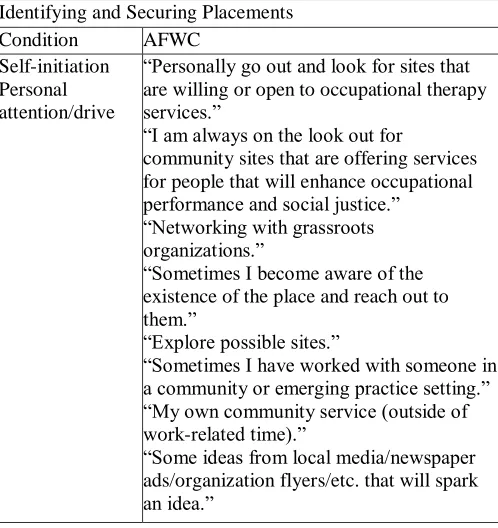
Leavy, 2011). A matrix helped to organize data and
investigate and identify frequency of key
conditions, which assists in the coding and
categorization of data (Shutt, 2011). The matrix
also provides a simplified version of the data to
highlight areas needed in additional analysis (Shutt,
2011). Both the researcher and the qualitative
analysis expert used Shutt’s method of data
organization. A sample of the data matrix is
provided in Table 2.
Table 2
Example of Data Matrix for Qualitative Data
Results Quantitative
Sixty-two participants responded to the
survey and 44 fully completed the survey,
producing a completion rate of 71% and a response
rate of 38%. Fifty-six participants responded to the
question “Do you offer a fieldwork experience in an emerging area?” Eighty-four percent of the 56
participants indicated they do offer fieldwork
placements in an emerging area. In addition, the
respondents reported that 87% of fieldwork
experiences in emerging areas occur during the
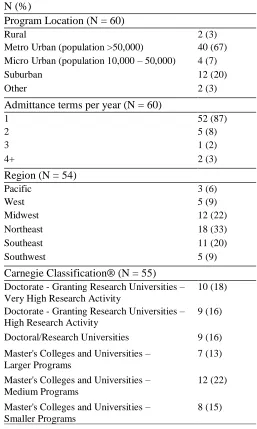
Level I experience. A majority (67%) of the
respondents indicated that their program was
located in a metro-urban-larger city that was
racially and economically diverse with a population
size greater than 50,000. The participants also
belonged to various levels of Carnegie
Classification® institutions. Identifying and Securing Placements Condition AFWC
Self-initiation Personal attention/drive
“Personally go out and look for sites that are willing or open to occupational therapy services.”
“I am always on the look out for
community sites that are offering services for people that will enhance occupational performance and social justice.”
“Networking with grassroots organizations.”
“Sometimes I become aware of the existence of the place and reach out to them.”
“Explore possible sites.”
“Sometimes I have worked with someone in a community or emerging practice setting.” “My own community service (outside of work-related time).”
“Some ideas from local media/newspaper ads/organization flyers/etc. that will spark an idea.”
Additional program demographics are
located in Table 3. A large percentage of the
AFWCs who responded belonged to programs that
offered master’s level programs only (91%), while
11% belonged to doctoral level programs. The
results examined the responses of the 46
participants who offer fieldwork experiences in
emerging areas of practice, with one missing data
response noted for Bloom’s taxonomy classification
(evaluation, synthesis, analysis, application,
comprehension, and knowledge), cognitive domains
in traditional and emerging areas of practice, and
level of fieldwork (Alford, Herbert, & Fragenheim,
2006).
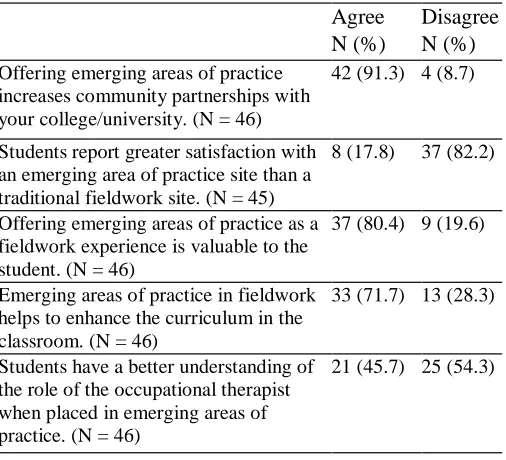
The results of the Likert scale questions (see
Table 4) explored the AFWCs’ perspectives of
emerging areas of practice influencing community
partnerships, student satisfaction, value to the
student, enhancing curriculum, and a better
understanding of the role of the occupational
therapist. Using a Fisher’s Exact Test, a higher
proportion (p = .030) of the AFWCs reported that
students do not easily understand the role of the
occupational therapist in the early course of their
programs (see Table 5). However, as the students
advance while on emerging areas of practice
fieldwork during Levels I and II and Advanced
Practice/Level III, the role is more deeply
understood. A higher proportion of the AFWCs (p
= .030) in the Northeast region (see Table 6)
reported student dissatisfaction with completing
fieldwork in emerging areas of practice settings.
Using the Stuart Maxwell Test to analyze marginal
homogeneity for all categories simultaneously, the
AFWCs reported a significant tendency (p = .020)
for students to learn at the synthesis level of
Bloom’s taxonomy while students participated in
emerging areas of practice (Abbasi et al., 2009;
Alford et al., 2006) (see Table 7).
Table 3
Participant Program Demographics
N (%)
Program Location (N = 60)
Rural 2 (3)
Metro Urban (population >50,000) 40 (67) Micro Urban (population 10,000 – 50,000) 4 (7)
Suburban 12 (20)
Other 2 (3)
Admittance terms per year (N = 60)
1 52 (87)
2 5 (8)
3 1 (2)
4+ 2 (3)
Region (N = 54)
Pacific 3 (6)
West 5 (9)
Midwest 12 (22)
Northeast 18 (33)
Southeast 11 (20)
Southwest 5 (9)
Carnegie Classification® (N = 55)
Doctorate - Granting Research Universities – Very High Research Activity
10 (18)
Doctorate - Granting Research Universities – High Research Activity
9 (16)
Doctoral/Research Universities 9 (16)
Master's Colleges and Universities – Larger Programs
7 (13)
Master's Colleges and Universities – Medium Programs
12 (22)
Master's Colleges and Universities – Smaller Programs
Table 4
Descriptive Statistics for Likert Scale Questions 1-5
Table 5
Students’ Understanding of the Role of the
Occupational Therapist when Placed in Emerging Areas of Practice During Level of Fieldwork (N = 45)
Table 6
Students’ Satisfaction with an Emerging Area of Practice Site Versus a Traditional Fieldwork Site by Participant Program Region (N = 41)
Table 7
Bloom’s Taxonomy Cognitive Domains Levels of Students While Participating in Emerging and Traditional Fieldwork (Alford et al., 2006).
Traditional areas of practice
Emerging areas of practice
N (%) N(%) p
Bloom’s
Taxonomy Level (N=45)
.020
Evaluation 16 (35.6) 11 (24.4) Synthesis 8 (17.8) 23 (51.1) Analysis 6 (13.3) 4 (8.9) Application 14 (31.1) 4 (8.9) Comprehension 0 (0) 1 (2.2) Knowledge 1 (2.2) 2 (4.4)
Qualitative
The researcher and the qualitative analysis
expert independently analyzed the responses from
the 12 qualitative questions. Qualitative responses
with increasing frequency included increasing
community partnerships, valuable to the student,
and enhancing curriculum in the classroom as
affirming the value of fieldwork experiences in
emerging areas of practice. The following themes
developed regarding offering fieldwork in emerging
areas of practice:
Professional development is enhanced.
Emerging fieldwork experiences create connections and collaborations across and in health care disciplines.
The ability to define OT is enhanced and greatly improved in students; an
“occupational thinker” emerges.
Offering emerging areas of practice in fieldwork is, in part, dependent on the curriculum, attitudes, and connections of the AFWC.
Perceived barriers and future implications.
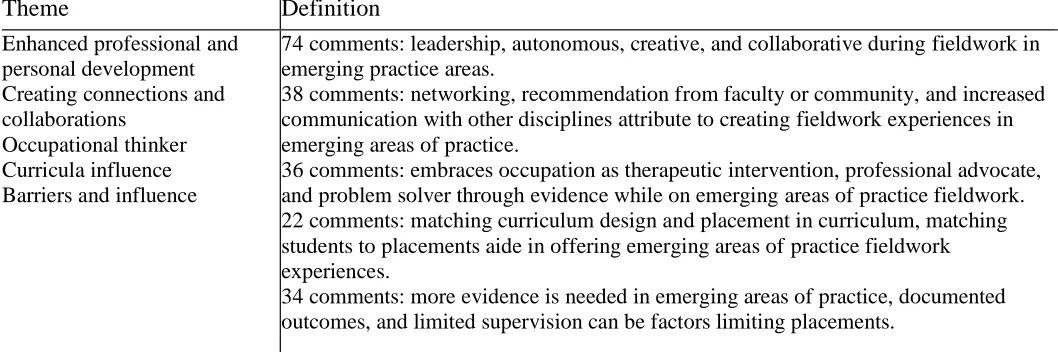
Further definitions of themes are located in Table 8.
Agree Disagree N (%) N (%)
Offering emerging areas of practice increases community partnerships with your college/university. (N = 46)
42 (91.3) 4 (8.7)
Students report greater satisfaction with an emerging area of practice site than a traditional fieldwork site. (N = 45)
8 (17.8) 37 (82.2)
Offering emerging areas of practice as a fieldwork experience is valuable to the student. (N = 46)
37 (80.4) 9 (19.6)
Emerging areas of practice in fieldwork helps to enhance the curriculum in the classroom. (N = 46)
33 (71.7) 13 (28.3)
Students have a better understanding of the role of the occupational therapist when placed in emerging areas of practice. (N = 46)
21 (45.7) 25 (54.3)
Agree Disagree N (%) N (%) p
Fieldwork Type .030
Level I 6 (13.3) 15 (33.3)
Level II 2 (4.4) 4 (8.9)
Level I & II 12 (26.7) 5 (11.1)
Level I, II, & III 1 (2.2) 0 (0)
Agree Disagree N (%) N (%) p
Region .030
Pacific 2 (4.9) 0 (0)
West 1 (2.4) 4(9.8)
Midwest 2 (4.9) 7 (17.1)
Northeast 1 (2.4) 12 (29.3)
Southeast 0 (0) 7 (17.1)
Southwest 0 (0) 5 (12.2)
Table 8
Thematic Findings: Summary and Definitions
Professional and personal development. The greatest number of responses reported
enhanced professional and personal development
occurring in students while on fieldwork placement
in emerging areas of practice. In regard to students’
professional development while on a fieldwork
experience in an emerging area of practice, one
respondent commented: “Students exhibit stronger
communications skills, creativity and ability to
think ‘outside the box,’ and better integrative skills
with the ability to make many connections with how
occupation is impacted by virtually anything.”
When asked to describe what five words
best describe the professional skills that emerge
from students as a result of fieldwork in emerging
areas of practice, the most frequently used words
were independent, confident, creative, innovator,
and problem solver. The five most frequently used
words to describe personal skills that emerge from
the student as perceived by the AFWCs included
confident, empathetic, communicator, organized,
and flexible. These words also matched with the
participants’ responses regarding the difference in
fieldwork experience between emerging and
traditional placements. One participant elaborated:
I think it is very different. The students
have to find a niche for themselves, and for
OT. Rather than follow the lead of what an
[occupational therapist] is already doing at a
traditional site, students in emerging areas of
practice have to identify what OT can offer
and lead the way.
Connections and collaborations. The participants reported improved relations with the
community when students were placed in emerging
areas of practice fieldwork sites. The participants
noted an improved relationship with the OT
program and the beginnings of a long-term
fieldwork partnership. One participant elaborated,
“we develop relationships starting with Level I
students, then building on long-lasting placements.”
Fieldwork sites begin to recognize the value of OT
students and program affiliations as their experience
with OT students increases. A value and
understanding of the profession emerges. As stated
by one participant, “some sites reach out to us,” and
Theme Definition
Enhanced professional and personal development Creating connections and collaborations
Occupational thinker Curricula influence Barriers and influence
74 comments: leadership, autonomous, creative, and collaborative during fieldwork in emerging practice areas.
38 comments: networking, recommendation from faculty or community, and increased communication with other disciplines attribute to creating fieldwork experiences in emerging areas of practice.
36 comments: embraces occupation as therapeutic intervention, professional advocate, and problem solver through evidence while on emerging areas of practice fieldwork. 22 comments: matching curriculum design and placement in curriculum, matching students to placements aide in offering emerging areas of practice fieldwork experiences.
“we begin to receive requests by agencies for our assistance.”
In addition to the AFWCs, the faculty as a
whole is instrumental in creating collaborations
within the department and across the community to
expose students to emerging areas of practice. The
participants noted, “Faculty members tell me about
a new practice setting,” and “sometimes there is an
intermediary that refers a site to me (faculty, other
college staff, etc.),” and “through connections that
our full or part-time faculty have in the
community.” In turn, an improved understanding of
the role of the occupational therapist surfaces for
the students placed in these settings.
Occupational thinker and increased understanding of the occupational therapist and the profession. One participant stated, “[Emerging areas of practice fieldwork] increases autonomy and
occupational thinking not tied to the constraints of
delivering OT in a reimbursement environment.”
Several phrases emerged regarding offering
fieldwork in emerging areas of practice, such as
“crucial to the profession” and “enhances the occupational therapist’s role” in the rehabilitation
sciences. Occupation as a central therapeutic
intervention is also better understood as students are
given the chance to discover opportunities for
occupation in a setting where it is yet to exist. One
response highlights the benefits of emerging areas
of practice in fieldwork on the profession as a
whole:
I believe that these emerging practice
experiences have tremendously expanded
the minds of future practitioners [in] two
ways that OT can meet society’s needs.
They have the time energy and skills to
demonstrate how OT can be part of the new
arenas, and that is a great benefit to society
and to the profession.
Influence of curriculum. The participants responded that their ability to match and place
students is, in part, dependent on their curriculum
and their curricular sequence, noting, “[There has to
be] a willingness to work with the school to meet
both the school’s and the organization’s objectives for the affiliation.” Opportunities for these
experiences have to align perfectly in the semester
that the experience is being offered and when a new
site is willing to accommodate the student. The site
must also match the curricular threads and have a
basic understanding of the value of occupation.
Perceived barriers and future implications. Despite the overwhelmingly favorable responses, the participants also
illuminated the barriers posed by emerging areas of
practice. Phrases that emerged in the area of
barriers and future implications included the “need
for more evidence-based practice” in emerging
areas, including the necessity of “outcome
measures”; students’ own negative or limited
perceptions regarding placement in these emerging
areas; and the challenge of limited supervision. The
participants reported wanting “more case studies [in
emerging areas],” “more evidence-based studies,”
and “more methods for training non-traditional OT supervisors.” In regard to students’ own negative or
limited perceptions regarding fieldwork placement
in emerging areas of practice, the AFWCs
responded, “Students sometimes have a difficult
time seeing the fit for OT because of their limited
experience.” Limited supervision responses included a “reluctance to accept students,” and a “need for experienced practitioners.” The AFWCs
reported a difficult time placing students in areas
that are typically reserved for other professionals,
like social work or psychology students.
Discussion
The results of this study demonstrated that
students placed in an emerging area of practice
fieldwork setting have a better understanding of the
role of the occupational therapist than students who
complete traditional fieldwork experiences.
Furthermore, students who participate in fieldwork
in an emerging area of practice function at a higher
level of learning as defined by Bloom’s taxonomy
and are reported to be better problem solvers with
the use of evidence when compared to those placed
in traditional areas of practice. The results of this
survey captured a proportional amount of responses
from each region, with the Northeast having the
most responses. The Northeast region currently
hosts many of the country’s OT programs, thus,
emerging areas of practice may be more readily
explored in this region compared to other regions.
Students more often request traditional fieldwork;
thus, students may perceive traditional sites as more
advantageous to their learning, which mirrors the
quantitative results of this survey. However, the
AFWCs were able to fully elaborate their
perceptions in the qualitative responses and noted
that although students may not be highly satisfied
they are more readily able to articulate the essence
of occupation while on emerging areas of practice
fieldwork. Further, as the students progressed
through their didactic programs and completed
additional fieldwork in emerging areas of practice,
their understanding of the professional role of the
occupational therapist was enhanced. This was
supported by both quantitative and qualitative
responses.
A positive impact of offering fieldwork in
emerging areas of practice is essential to the
advancement of the profession of OT as it continues
to offer dual single points of entry at the master’s
and doctoral level. Students are provided with the
opportunity to promote OT when placed in
fieldwork in emerging areas of practice (Johnson et
al., 2006). Through this promotion, they are able to
more clearly articulate the role of the occupational
therapist and advocate for the profession. As
highlighted by Brachtesende (2005), entering an
emerging area of practice requires the ability to
promote oneself. Students gain the ability to define
confidently their future profession and, as found in
this study, enhance their professional and personal
skills by becoming more confident, organized,
flexible, and empathetic. Gat and Ratzon (2014)
noted that students perceived of themselves as
creative and more culturally competent while
completing fieldwork in emerging areas of practice.
These acquired skills are beneficial to the students,
regardless of their future practice areas.
The AFWCs reported that students are
developing a higher level of autonomy while on
fieldwork in emerging areas of practice, which has
the potential to increase their “readiness” to enter
emerging areas of practice upon graduation.
Leadership skills emerge and the student’s personal
and professional skills are enhanced. Case-Smith,
occupational therapists of the twenty-first century
should take on numerous leadership roles, including
those in emerging areas of practice in community
services, health promotion, and primary practice.
Johnson et al. (2006) noted that students should be
given the opportunity to practice professional skills
across fieldwork Levels I and II in emerging areas
of practice. The results of this study indicated that
more opportunities currently exist in Level I
experiences than in Level II. This could be
explained by the AFWCs having greater success
with matching the timing of these placements in the
curriculum design and the needs of the site.
However, a growing number of programs responded
that students are able to participate in Level I and
Level II fieldwork in emerging areas of practice in
their respective programs.
Bossers et al. (1997) confirmed the value of
integrating emerging areas of practice throughout
the academic curriculum to promote student
engagement. Emerging areas of practice will need
to be interwoven in both the doctoral and master’s
curriculum, as AFWCs perceive that students gain
valuable professional skills far more during these
experiences than during traditional experiences.
Uniquely for doctoral programs, fieldwork in
emerging areas of practice supports requirements
for the DEC, including independence in decision
making, interprofessional leadership roles, and
enhanced communication skills (Case-Smith et al.,
2014).
The majority of the AFWCs in this study
reported that offering emerging areas of practice in
fieldwork is essential, crucial, and vital to the
profession and direction of OT. Bossers et al.
(1997) confirmed this finding in their study and
reported an overall awareness of the role of the
profession in the community where emerging areas
of practice fieldwork placements occurred.
Community collaborations and partnerships grow
out of ideas and collaborations not solely of the
AFWC, but of the OT faculty as a whole.
Innovation and ingenuity is shared, creating ideas
for future areas of practice. Further, organizations
not yet involved with OT programs begin to
recognize the value of the profession and request
affiliation agreements based on the positive
experiences of those organizations with long-term
partnerships. As supported by Cooper and Raine
(2009), fieldwork affiliation sites benefit greatly
from OT partnerships by introduction of specialized
skills, short-term voluntary “labor,” and the
potential for greater partnerships through research
that promotes evidenced-based interventions in new
settings.
Increased exposure of the OT profession to
the community at large, added support to the
doctoral curricula, and enhanced professional and
personal skills are unique contributions that
fieldwork in emerging areas of practice provides.
The need to prepare the future OT practitioner for
community-based models can only genuinely occur
during fieldwork in emerging areas of practice
(Cooper & Raine, 2009). The results of this study
support the benefits of student fieldwork placements
in environments and avenues where occupational
therapy may not currently exist.
Limitations and Future Research
Type II errors could exist due to the
decrease in power to detect a significant change in
difference. Limitations also include the original
design of the survey and limited construct validity.
Qualitative results also captured favorable
responses from the AFWCs in three areas that the
quantitative results did not. This may suggest the
Likert questions did not accurately capture the
participants’ responses.
An additional limitation existed with
adjustment to the Likert scale after nine responses
were recorded; combining of categories was
performed during analysis in order to better capture
all intended responses, thus potentially obscuring
marginality. The amount of time this survey took to
complete may have also been a limitation, as the
average time recorded was well over the anticipated
time noted by the researcher. A response bias may
also exist in this study. The perspectives of the
AFWCs who did not support emerging areas of
practice were not fully captured. This purposive
sample of AFWCs may have more of a vested
interest in emerging areas of practice fieldwork.
However, this study investigated an avenue that has
not yet been explored: the perspectives of the
AFWCs on emerging areas of practice.
Researchers should consider conducting
future studies in the areas of emerging practice.
Areas of research concentration may include
additional entry-level doctoral programs that reach
accreditation. Future studies could simultaneously
investigate student, AFWC, and emerging areas of
practice fieldwork site personnel perceptions in
order to further explore collaborative perceptions
about fieldwork placement in emerging areas of
practice.
Conclusion
This study illustrates the importance of
fieldwork placement in emerging areas of practice
as perceived by AFWCs. Increased student
confidence in articulating the role of the
occupational therapist and improved identification
of the importance of the occupational therapist in
community-based settings by other health care
professionals and community agency personnel
helps to strengthen the growth and direction of the
profession as a whole.
As reported by the AFWCs, students’ skills
are enhanced, both personally and professionally, in
unique ways that the didactic portion of the
curriculum and traditional fieldwork cannot
provide. As the profession of OT continues to grow
in the areas of community health and wellness,
homeless shelters, international practice, and
consultancy/advocacy roles, among others, it is
important to document the ways in which the
AFWCs and students are influencing and are
influenced by these emerging areas of practice.
Kate E. DeCleene Huber, OTR, MS, OTD is Associate Professor and Chair of the School of Occupational Therapy in the College of Health Sciences at University of
Indianapolis. At the time of the study, she was chair of this Doctor of Health Science Juried Project.
References
Abbasi, N., Dokoohaki, S., & Jamali, H. (2009). The application of Stuart-Maxwell Test in determining the identically distributed correct choice. Applied Mathematical Sciences, 3(9), 447-450. Retrieved from http://www.m-hikari.com/ams/ams-password- 2009/ams-password9-12-2009/abbasiAMS9-12-2009.pdf
Teachers Companion (pp. 176-224). ITC Publications.
American Occupational Therapy Association. (n.d.). Emerging practice areas. Retrieved from
http://www.aota.org/Practitioners/PracticeAreas/Eme rging.aspx
American Occupational Therapy Association. (2004). Role competencies for an academic fieldwork coordinator. American Journal of Occupational Therapy, 58(6), 653-654. Retrieved from
http://ajot.aota.org/article.aspx?articleid=1872039 American Occupational Therapy Association. (2006). AOTA’s
centennial vision. Retrieved from
https://www.aota.org/-/media/Corporate/Files/AboutAOTA/Centennial/Bac kground/Vision1.pdf
American Occupational Therapy Association. (2009). Occupational therapy fieldwork education: Value and purpose. American Journal of Occupational Therapy, 63(6), 821-822. http://dx.doi.org/10.5014/ajot.63.6.821 American Occupational Therapy Association. (2010).
Workforce trends in occupational therapy. Retrieved from
https://www.aota.org/-/media/Corporate/Files/EducationCareers/Prospective /Workforce-trends-in-OT.PDF
American Occupational Therapy Association. (2012). Fieldwork Level II and occupational therapy students: A position paper. American Journal of Occupational Therapy, 66, S75-S77.
http://dx.doi.org/10.5014/ajot.2012.66S75 American Occupational Therapy Association. (2014). OT
doctoral-level programs - Accredited. Retrieved from
http://www.aota.org/Education-Careers/Find-School/AccreditEntryLevel/DoctoralEntryLevel.aspx Bazyk, S., Glorioso, M., Gordon, R., Haines, J., &
Percaciante, M. (2010). Service learning: The process of doing and becoming an occupational therapist. Occupational Therapy in Health Care, 24(2), 171-187. http://dx.doi.org/10.3109/07380571003681194 Bossers, A., Cook, J., Polatajko, H., & Laine, C. (1997).
Understanding the role-emerging fieldwork placement. Canadian Journal of Occupational Therapy, 64(1), 70-81.
http://dx.doi.org/10.1177/000841749706400107
Brachtesende, A. (2005). New markets emerge from society’s needs. OT Practice, 23(1), 13-19. Retrieved from http://www.aota.org/~/media/Corporate/Files/Educati onCareers/StuRecruit/Working/4-3_NewMkts.ashx Braveman, B., & Metzler, C. (2012). Health care reform
implementation and occupational therapy. American Journal of Occupational Therapy, 66(1), 11-14. http://dx.doi.org/10.5014/ajot.2012.661001
Case-Smith, J., Page, S. J., Darragh, A., Rybski, M., & Cleary,
D. (2014). The professional occupational therapy doctoral degree: Why do it? American Journal of Occupational Therapy, 68, e55-e60.
http://dx.doi.org/10.5014/ajot.2014.008805 Cohn, E. S., & Crist, P. (1995). Back to the future: New
approaches to fieldwork education. American Journal of Occupational Therapy, 49(2), 103-106.
http://dx.doi.org/10.5014/ajot.49.2.103
Cooper, R., & Raine, R. (2009). Role-emerging placements are an essential risk for the development of the occupational therapy profession: The debate. British Journal of Occupational Therapy, 72(9), 416-418.
http://dx.doi.org/10.1177/030802260907200910
Evenson, M., Barnes, M, A., & Cohn, E. S. (2002).
Perceptions of Level I and Level II fieldwork in the same site. American Journal of Occupational Therapy, 56(1), 103-106.
http://dx.doi.org/10.5014/ajot.56.1.103
Fidler, G. S. (2000). Beyond the therapy model: Building our future. American Journal of Occupational Therapy, 54(1), 99-101. http://dx.doi.org/10.5014/ajot.54.1.99 Gat, S., & Ratzon, N. Z. (2014). Comparison of occupational
therapy students’ perceived skills after traditional and nontraditional fieldwork. American Journal of Occupational Therapy, 68, e47-e54.
http://dx.doi.org/10.5014/ajot.2014.007732
Hansen, A. M., Muñoz, J., Crist, P. A., Gupta, J., Ideishi, R. I., Primeau, L. A., & Tupé, D. (2007). Service learning: Meaningful, community-centered professional skill development for occupational therapy students. Occupational Therapy in Health Care, 21(1-2),
25-49. http://dx.doi.org/10.1080/J003v21n01_03
Hesse-Biber, S. N., & Leavy, P. (2011). The practice of qualitative research. Los Angeles, CA: Sage.
Holmes, W. M., & Scaffa, M. E. (2009). The nature of emerging practice in occupational therapy: A pilot study. Occupational Therapy in Health Care, 23(3), 189-206.
http://dx.doi.org/10.1080/07380570902976759
Johnson, C. R., Koenig, K. P., Piersol, C. V., Santalucia, S. E., & Wachter-Schutz, W. (2006). Level I fieldwork today: A study of contexts and perceptions. American Journal of Occupational Therapy, 60(3), 275-287. http://dx.doi.org/10.5014/ajot.60.3.275
Nulty, D. D. (2008). The adequacy of response rates to online and paper surveys: What can be done? Assessment & Evaluation in Higher Education, 33(3), 301-314.
http://dx.doi.org/10.1080/02602930701293231
Number of Programs. (2014, July). Program Director News. Retrieved from
https://www.aota.org/-/media/Corporate/Files/EducationCareers/Accredit/A nnouncements/PDenews/PD-News-Summer-2014.pdf
Rydeen, K., Kautzmann, L., Cowan, M. K., & Benzing, P. (1995). Three faculty-facilitated, community-based Level I fieldwork programs. American Journal of Occupational Therapy, 49(2), 112-118.
http://dx.doi.org/10.5014/ajot.49.2.112 Shutt, R. K. (2011). Investigating the social world. Los