Revised 3/13/15 to correct the Highlights and page 16.The corrected sentence on the Highlights reads: At DOE, a Sandia National Laboratories official estimated that Sandia attendance at a key conference declined by about half from 2011 through 2013. The corrected sentence on page 16 reads: An official from Sandia National Laboratories estimated its attendance at the Materials Research Society’s annual fall conference declined from 45 participants in 2011 to 23 participants in 2013.
DEFENSE SCIENCE
AND TECHNOLOGY
Further DOD and
DOE Actions Needed
to Provide Timely
Conference Decisions
and Analyze Risks
from Changes in
Participation
congressional committees
Why GAO Did This Study
To help fulfill DOD’s and DOE’s S&T missions, including mitigating emerging threats, the departments’ scientists attend conferences. In May 2012, OMB directed agencies, among other things, to establish senior-level review
processes for all hosted or attended conferences exceeding specific cost thresholds. DOD and DOE
implemented conference policies in 2012, with subsequent updates, to comply with OMB’s requirements. GAO was mandated to review the effects of OMB’s requirements on DOD’s and DOE’s S&T missions. Among other things, this report (1) examines S&T conference participation changes since policy implementation, and examines the extent to which DOD and DOE (2) face and have mitigated implementation challenges, and (3) have identified risks from conference participation changes and analyzed them for any potential effects. GAO reviewed conference policies, and interviewed and surveyed conference management and S&T officials from principal research labs. Survey results were not generalizable.
What GAO Recommends
GAO recommends that DOD and DOE (1) establish time frames for providing conference request decisions and (2) develop a plan to analyze and periodically reevaluate risks from conference participation changes. DOD partially concurred with the first recommendation, stating it will collect and analyze data to implement further solutions. GAO still believes the recommendation is valid, as discussed in the report. DOD concurred with the second recommendation and DOE concurred with both recommendations.
What GAO Found
Department of Defense (DOD) and Department of Energy (DOE) officials cited reduced attendance at science and technology (S&T) conferences by scientists and engineers since DOD and DOE implemented their conference policies. These policies, responding to Office of Management and Budget (OMB) requirements, established processes for senior-level review and approval of conference requests based on department-wide cost thresholds. Following policy implementation, DOD’s Army Research Laboratory officials stated that
conference attendance by personnel decreased from about 1,300 attendees in 2011 to about 100 attendees in 2013. At DOE, a Sandia National Laboratories official estimated that Sandia attendance at a key conference declined by about half from 2011 through 2013. DOD and DOE officials noted other factors that may have affected conference attendance, such as OMB’s mandatory reduction in travel, and sequestration.
The length of DOD’s and DOE’s conference review and approval processes, which has increased since implementing their policies, poses a challenge to timely decision making about conference requests that DOD and DOE have yet to fully mitigate. Information provided by DOD and DOE officials indicates the length of their conference review and approval processes has increased from a period of weeks to as much as 9 months after implementing their policies, in part, due to the multiple levels of review required. As a result, DOD and DOE officials stated that approval decisions are often not made until close to the start of a conference, which creates a disincentive for the departments’ scientists and engineers to take on active roles, such as presenting research or serving as a keynote speaker, and may lead to increased registration or travel costs. DOD and DOE have taken steps to streamline aspects of their review and approval processes, but these efforts have not always provided conference request decisions in a time frame that meets applicants’ needs. In particular, DOD and DOE have not established time frames for providing decisions based on
applicants’ needs. Federal internal control standardsstate that as agencies strive to improve their processes, management must assure that information is
communicated in a time frame that helps those who need it to carry out their responsibilities. Until DOD and DOE establish these time frames, scientists and engineers will continue to face uncertainty over whether they can commit to more active roles at a conference or take advantage of discounted registration fees. DOD and DOE officials have identified and communicated risks associated with changes in conference participation, but have not analyzed these risks for any potential effects on their departments’ S&T missions. Identified risks include a potential decline in the quality of scientific research, difficulty in recruiting and retaining qualified scientists and engineers, and a diminished leadership role for DOD and DOE within the global S&T community. However, GAO found that DOD and DOE officials have not developed a plan to analyze the risks for any potential effects to achieving the departments’ S&T missions or to periodically reevaluate these risks consistent with federal internal control standards. Without developing a plan to analyze and periodically reevaluate these risks, it will be difficult for DOD and DOE to manage any potential effects from these risks on their ability to achieve their S&T missions.
Vie contact Johana Ayers at (202) 512-5741 or
Letter 1
Background 6
DOD and DOE Implemented Conference Policies Addressing OMB Requirements, and Officials Identified Some Associated
Costs 11
DOD, DOE, and Professional Societies Cited Examples of Changes in Participation since Implementing Conference
Policies 15
Despite Streamlining Efforts, Length of Review and Approval Processes Has Posed a Challenge for DOD and DOE since
Conference Policy Implementation 20 DOD and DOE Have Identified and Communicated Risks from
Changes in Conference Participation but Have Not Analyzed
These Risks for Any Potential Effects on Their S&T Missions 28
Conclusions 33
Recommendations for Executive Action 34 Agency Comments and Our Evaluation 35
Appendix I Objectives, Scope, and Methodology 40
Appendix II Overview of Department of Defense and Military
Department Conference Review and Approval Authorities 45 Appendix III Comments from the Department of Defense 49 Appendix IV Comments from the Department of Energy 51
Appendix V GAO Contacts and Staff Acknowledgments 53
Tables
Table 1: Examples of Department of Defense (DOD) and
Table 2: Tiered Review and Approval Structure Outlined in the Department of Defense’s (DOD) Conference Policy, by
Military Department 47
Figures
Figure 1: Selected Department of Defense and Department of Energy’s National Nuclear Security Administration
Laboratories 8
Figure 2: Average Numbers of Days for Review and Approval of Conference Requests by Department of Defense (DOD)
Components before and after Policy Implementation 22 Figure 3: Timeline of Office of Management and Budget,
Department of Defense, and Military Department
Guidance 46
Abbreviations
DARPA Defense Advanced Research Projects Agency
DCMO Deputy Chief Management Officer
DOD Department of Defense
DOE Department of Energy
labs laboratories
NNSA National Nuclear Security Administration NSTC National Science and Technology Council
OMB Office of Management and Budget
OSTP Office of Science and Technology Policy S&T science and technology
This is a work of the U.S. government and is not subject to copyright protection in the United States. The published product may be reproduced and distributed in its entirety without further permission from GAO. However, because this work may contain copyrighted images or other material, permission from the copyright holder may be necessary if you wish to reproduce this material separately.
March 4, 2015
Congressional Committees
The United States depends on science, technology, and engineering to help protect the American people, advance national interests, and prepare to meet the challenges of an uncertain future. The defense science and technology (S&T) enterprise includes more than 129,000 scientists, engineers, and personnel across organizations under the Department of Defense (DOD) and its component services and agencies, and the Department of Energy’s (DOE) National Nuclear Security
Administration (NNSA).1
DOD and DOE scientists and engineers attend S&T conferences each year as part of their efforts to expand their knowledge and help them fulfill their missions.
The missions of the defense S&T enterprise include mitigating existing or emerging threats, developing new technologies to deter U.S. adversaries, managing and securing the nation’s nuclear weapons, and preventing the spread of nuclear weapons and related technology.
2
1Congress created NNSA as a semi-autonomous agency within DOE under title 32 of the
National Defense Authorization Act for Fiscal Year 2000. Pub. L. No. 106-65, § 3211 (1999).
In addition, DOD and DOE, like other executive branch agencies, sponsor conferences as well as allow personnel to attend conferences sponsored by other organizations to help personnel be more effective in their jobs. For those in the defense S&T enterprise,
conference participation can promote communication with peers in other U.S. agencies and academia, as well as those from other countries. In addition, this communication helps to provide leadership across an array of individual technical fields, ensure the technical quality of research, and recruit new scientists and engineers to work in the defense laboratories (labs), among other purposes. Members of Congress as well as White House, DOD, and DOE officials have noted the importance of conference participation for the defense S&T enterprise. For example, a February 2014 memorandum from the Under Secretary of Defense for Acquisition,
2A “conference” is defined in the Federal Travel Regulation as a “meeting, retreat,
seminar, symposium, or event that involves attendee travel.” The term “conference” also applies to training activities that are considered to be conferences under federal regulation (41 C.F.R. § 300-3.1).
Technology and Logistics stated that S&T conferences are potentially beneficial for scientists and engineers to remain technically competent and develop professionally in their field.3
Over the past several years, multiple Inspectors General have reported on excessive costs for conferences sponsored by certain executive branch agencies.4 In November 2011, the President signed an executive
order that cited the need for federal agencies to ensure efficient spending on conferences and other activities.5 To this end, the Office of
Management and Budget (OMB) issued a memorandum in May 2012 directing executive branch agencies to establish a review and approval process for all future conferences where net expenses by the agency would exceed $100,000 and to annually report on agency-sponsored conferences with net expenses to the agency exceeding $100,000, among other things.6 To implement the requirements of OMB’s May 2012
memorandum, DOD and DOE issued and later updated policies to review conference participation.7
3Under Secretary of Defense for Acquisition, Technology and Logistics, Participation in
Technical and Industry Conferences, Memorandum (Washington, D.C.: Feb. 24, 2014). However, since DOD and DOE implemented these policies, some members of Congress and White House, DOD, and DOE officials have expressed concerns about the policies’ potential effects on the defense S&T enterprise’s ability to successfully complete its missions. For example, an August 2013 memo from the Director of the White House Office of Science and Technology Policy (OSTP) stated that reductions in the ability of federal scientists and engineers to attend S&T conferences would, if continued, encourage the best scientists and
4For example, U.S. General Services Administration, Office of Inspector General, Office of
Investigations, Management Deficiency Report: General Services Administration Public Buildings Service, 2010 Western Regions Conference (Apr. 2, 2012); and U.S.
Department of Justice, Office of the Inspector General, Audit Division, Audit of Department of Justice Conference Planning and Food and Beverage Costs, Audit Report 11-43 (October 2011).
5White House, Executive Order 13589, Promoting Efficient Spending, 76 Fed. Reg.
70,861 (Nov. 9, 2011).
6Office of Management and Budget, Promoting Efficient Spending to Support Agency
Operations, Memorandum M-12-12 (May 11, 2012).
7See Department of Defense, Deputy Chief Management Officer, Implementation of
Updated Conference Oversight Requirements, Memorandum(Nov. 6, 2013); and Department of Energy, Improving Efficiency of the Conference Approval Process, Memorandum for the Secretary (Dec. 31, 2013).
engineers to leave federal service, ultimately degrading the overall quality of the workforce and its research, and diminishing the capabilities of the federal labs.8
The Senate report accompanying a bill for the National Defense Authorization Act for Fiscal Year 2014 mandated that we review the effects of conference policy implementation on the defense S&T enterprise, to include DOD and DOE’s NNSA.9
To address these objectives, the scope of our work included the S&T enterprises of DOD and DOE’s NNSA. Specifically, within DOD, we selected and reviewed the principal research labs operated by each military department, including the Army Research Laboratory, Naval Research Laboratory, and the Air Force Research Laboratory. At DOE, we selected and focused on NNSA and its three national labs, Lawrence Livermore National Laboratory, Los Alamos National Laboratory, and Sandia National Laboratories. The information we obtained from these selected labs is not generalizable to all DOD and DOE S&T components, but provides illustrative context from the experiences of this subset of organizations that are a part of the defense S&T enterprise. We also reviewed DOD and DOE entities responsible for overseeing conference management at the department level.
In this report, we (1) assess whether the DOD and DOE conference policies address OMB requirements, and identify any costs associated with implementing these policies; (2) examine any changes in S&T conference participation since DOD and DOE implemented their conference policies; (3) examine the extent to which DOD and DOE have faced and mitigated any challenges resulting from conference policy implementation; and (4) examine the extent to which DOD and DOE have identified the risks from changes in conference participation and analyzed these risks for any potential effects.
To assess whether the DOD and DOE conference policies address OMB’s requirements, and to identify any costs associated with
8National Science and Technology Council, Implementation of Federal Travel and
Conference Policies with Respect to Scientific and Technical Conferences, Memorandum for National Science and Technology Council Committees and Subcommittees (Aug. 5, 2013). OSTP provides administrative support to the National Science and Technology Council.
implementing these policies, we reviewed documents, including
conference policies and implementing guidance for DOD, for each of the military departments, DOE, and NNSA. For DOD, we reviewed
information included in our January 2014 report, in which we assessed the extent to which DOD’s conference policy was consistent with OMB requirements, and determined whether there was any change in DOD’s policy since we last reported on it.10
To examine any changes in S&T conference participation since DOD and DOE implemented their conference policies, we requested conference attendance data from the six labs selected for our review for 1 year prior to implementation of the agencies’ conference policies in 2012 through the first quarter of fiscal year 2014, the most recent full quarter available at the time of our request. The agencies generally could not provide us with complete conference attendance data. However, we interviewed DOD and DOE officials, including conference managers and S&T
program managers, to obtain their perspectives on changes in conference participation and reviewed the sources of those examples with the
officials, although we did not independently verify the reliability of the data provided in these examples. We determined that this information was sufficient for the purposes of illustrating agency officials’ opinions about changes in conference participation. We also spoke with OSTP officials about the availability of conference attendance data. Further, we
interviewed representatives from five professional societies that both sponsor conferences and had the largest numbers of conference publications by DOD and DOE scientists and engineers from 2004
For DOE, we assessed DOE’s conference policy against the elements specified in OMB’s May 2012 memorandum. Further, we interviewed DOD and DOE officials across multiple departmental and S&T organizations about DOD’s and DOE’s policies. To identify the costs associated with implementing the
conference policies, we requested information on any relevant
implementation costs. The agencies generally could not provide complete cost data, as discussed in this report. However, we obtained examples of implementation costs during interviews with DOD, DOE, and OSTP officials. We reviewed the sources of these examples with the officials and found the information sufficiently reliable for purposes of discussing possible implementation costs.
10GAO, Defense Management: DOD’s Conference Policy Is Generally Consistent with
through 2013 to corroborate DOD and DOE officials’ statements on changes in conference participation. The information we obtained from the representatives of these five professional societies is not
generalizable to all professional societies, but provides illustrative context from the experiences of this subset of societies.
To address our objectives regarding the extent to which DOD and DOE have faced and mitigated any challenges related to implementing their conference policies, and identified any risks from changes in conference participation and analyzed their potential effects, we conducted 34 interviews that included 141 DOD and DOE officials across multiple departmental and S&T organizations about these issues, and conducted a content analysis of these interviews. Based on this analysis, we
enumerated challenges and mitigation strategies as well as benefits identified as being at risk due to changes in overall conference
participation mentioned during these interviews. We then shared these lists with 44 conference manager and S&T program manager officials whom we selected based on their roles and responsibilities. We asked these officials to add any additional challenges and risks that may exist to ensure our lists were comprehensive. Following this, we then sent a survey to this same subset of officials, asking respondents to rate the effect of each potential mitigation strategy and prioritize steps for implementing the strategies. We received responses from 31 of the 44 officials who received the survey. The information we obtained from this survey is not generalizable to all DOD and DOE conference management and S&T program manager officials, but provides insights from this subset of officials who have roles and responsibilities related to their agency’s conference requests. Further, we reviewed relevant
documentation on DOD and DOE efforts to mitigate conference policy implementation challenges, including studies and proposed guidance. We also interviewed DOD, DOE, and OSTP officials and representatives from five professional societies that both sponsor conferences and had the largest numbers of conference publications by DOD and DOE scientists and engineers from 2004 through 2013 to obtain additional information on the benefits that may be at risk from changes in conference participation. Finally, we compared DOD’s and DOE’s efforts to mitigate any identified challenges and to analyze any potential effects from changes in
Internal Control in the Federal Government.11
We conducted this performance audit from February 2014 to March 2015 in accordance with generally accepted government auditing standards. Those standards require that we plan and perform the audit to obtain sufficient, appropriate evidence to provide a reasonable basis for our findings and conclusions based on our audit objectives. We believe that the evidence obtained provides a reasonable basis for our findings and conclusions based on our audit objectives.
We provide additional information about our scope and methodology in appendix I.
As part of its mission to protect U.S. interests, DOD’s strategic guidance includes a commitment to apply all elements of U.S. national power to address security challenges.12 One such element is DOD’s S&T-related
research efforts, which include basic research, applied research, and advanced technology development.13
11GAO, Standards for Internal Control in the Federal Government
DOD’s S&T research is conducted under the auspices of the Office of the Assistant Secretary of Defense for Research and Engineering. This office provides technical leadership and oversight of the various DOD components that have S&T research investments—known as the DOD S&T enterprise. This enterprise comprises numerous research labs and defense agencies, including the three principal research labs operated by the military departments: the Army Research Laboratory, Naval Research Laboratory, and Air Force Research Laboratory. S&T research efforts at DOD are diverse, ranging from computing sciences to sensor development for air and space
(Washington, D.C.: Nov. 1999).
12DOD, Sustaining U.S. Global Leadership: Priorities for 21st Century Defense
(Washington, D.C.: Jan. 2012).
13Basic research is systematic study directed toward greater knowledge or understanding
of the fundamental aspects of phenomena and of observable facts without specific applications toward processes or products in mind. Applied research is systematic study to gain knowledge or understanding necessary to determine the means by which a recognized and specific need may be met. Advanced technology development includes all efforts that have moved into the development and integration of hardware for field
experiments and tests.
Background
DOD’s and DOE’s Science
and Technology Missions
reconnaissance to medical research for protecting the health of military personnel. In its entirety, the DOD S&T enterprise employs approximately 100,000 scientists and engineers and, according to DOD budget data, received appropriations of about $12 billion in fiscal year 2014.
DOE also has a mission to promote U.S. security by using S&T efforts to address energy, environmental, and nuclear challenges. To help execute this mission, DOE’s NNSA is responsible for maintaining and enhancing the safety, reliability, and performance of the nation’s nuclear weapons, among other responsibilities.14 NNSA is responsible for overseeing a
network of sites and national labs to implement DOE’s nuclear security mission. NNSA’s national labs include Lawrence Livermore National Laboratory, Los Alamos National Laboratory, and Sandia National Laboratories.15
14See 50 U.S.C. § 2401(b).
S&T research efforts at these labs range from nuclear weapon sustainment to laser technologies. The three NNSA labs employ approximately 29,400 people, including scientists and engineers, and, according to DOE budget data, received an appropriation of about $4.8 billion in fiscal year 2014. Figure 1 shows the location of the DOD and DOE’s NNSA labs included in our review.
15Sandia National Laboratories includes two labs, one in Livermore, California, and one in
Figure 1: Selected Department of Defense and Department of Energy’s National Nuclear Security Administration Laboratories
To help support their missions as part of the defense S&T enterprise, DOD and DOE’s NNSA sponsor or send personnel to a variety of
conferences that bring together a broad range of scientists and engineers to present scientific results, discuss technologies, and expand
collaboration in scientific research. Conferences can be organized and sponsored by federal agencies or by members of a broader S&T
community.16 According to the National Academy of Sciences,
conferences provide a venue for researchers to collaborate with others in their technical fields by bringing together large concentrations of
researchers, and allow for access to the newest research findings, which may not be published in scientific journals in a timely fashion.17
OMB’s May 2012 memorandum outlines a series of requirements to ensure that federal funds are used appropriately on all conference-related activities, including S&T conferences, and that executive branch agencies reduce spending on conferences when practicable.18 According to OMB’s
memorandum, agencies should ensure that conference attendance and costs are limited to the levels required to carry out their assigned mission. The memorandum’s requirements include a Deputy Secretary-level review and approval of conferences with a net expense to the agency of more than $100,000.19
16For the purposes of this report, “S&T community” includes academia, private industry,
and professional societies that also conduct S&T research and organize and participate in S&T conferences. Conferences organized and sponsored by the S&T community may consist of multiple programs representing different technical fields that include lectures, poster sessions, and special sessions for speakers presenting their research.
The memorandum further prohibits costs in excess of $500,000 on a single conference without a signed waiver from the head of the respective agency, such as the Secretary of Defense or Energy. Finally, the memorandum requires each executive agency to report annually on the expenses for agency-sponsored conferences exceeding $100,000 and identifies specific reporting requirements for
17National Academy of Sciences, National Research Council, Strategic Engagement in
Global S&T: Opportunities for Defense Research (Washington, D.C.: 2014).
18See OMB Memorandum M-12-12. The memorandum characterizes conference activities
that must be reviewed by agencies as conferences sponsored by the reviewing agency and conferences sponsored by other federal or nonfederal entities. For purposes of this report, we are referring to conferences sponsored by the reviewing agency as DOD- and DOE-sponsored and to conferences sponsored by other federal or nonfederal entities as non-DOD- and non-DOE-sponsored, respectively.
19Under OMB’s memorandum, conference expenses include all direct and indirect costs
paid by agencies or reimbursed by agencies for a conference, except for funds paid under federal grants to grantees. The memorandum states that conference expenses should be net of any fees or revenue received by the agency through the conference, as well as certain other excluded costs.
OMB Memorandum on
Reviewing, Approving, and
Reporting Conference
Costs
these conferences.20
Following its May 2012 memorandum, OMB also issued two controller alerts related to conference oversight, among other topics. The first controller alert, issued in May 2013, noted that conferences may play an important role in government operations to, for example, facilitate
collaboration in the scientific community and provide an efficient means for presenting scientific findings.
In response, both DOD and DOE issued interim guidance and memorandums in 2012 and 2013, and both departments issued updated policies late in 2013 that remain in effect.
21 At the same time, the alert noted that
agencies should provide employees with guidelines on acceptable
conference expenses and identified several best practices for agencies to consider. The second controller alert, issued in January 2015, stated that the Secretary- or Deputy Secretary-level reviews required by OMB’s May 2012 memorandum could be delegated to a level deemed appropriate by these officials.22
Subsequent to OMB’s May 2012 memorandum, the Consolidated and Further Continuing Appropriations Act, 2013, established a requirement for executive branch agencies to notify their respective Inspector General of any agency-sponsored conference costing more than $20,000 within 15 days of the conference.
The alert noted that, by delegating the approval authority, agencies have found that the approver is more familiar with the subject of the conference. In addition, the alert suggested that, to prevent a lengthy and cumbersome review process that could hinder an agency’s ability to carry out its mission in an efficient and effective manner, agencies should pre-approve known reoccurring conferences and attendance at non-government-sponsored conferences.
23
20Specific reporting requirements include: the location, date, and total conference costs
incurred by the agency for the conference; a brief explanation of how the conference advanced the mission of the agency; and the total number of individuals whose travel costs or other conference costs were paid by the agency.
The notice must include the date and location of the conference, and the number of employees attending. The
21Office of Management and Budget, Controller Alert: Travel and Conferences (May 28,
2013).
22Office of Management and Budget, Controller Alert: Travel and Conferences (Jan.
2015).
23Pub. L. No. 113-6, § 3003(c), 127 Stat. 435 (2013). This requirement was also included
in the Consolidated Appropriations Act, 2014. Pub. L. No. 113-76, § 742, 128 Stat. 242 (2014).
act also requires agencies to submit annual reports to the Inspector General or a senior ethics official regarding the costs and contracting procedures related to each conference that costs the government more than $100,000.
DOD and DOE have implemented conference policies that address the requirements established in OMB’s May 2012 memorandum to oversee conference spending. Officials also identified some costs associated with the implementation of these policies, such as costs related to staff time and information systems, but could not provide complete information on the implementation costs of these policies.
In January 2014, we reviewed DOD’s conference policy including how DOD implemented its policy and the extent to which the policy was consistent with OMB’s requirements.24
DOD has a tiered review and approval structure in place to oversee conference spending that addresses the requirements established in OMB’s May 2012 memorandum. Specifically, DOD’s policy established three tiers for reviewing and approving conference spending requests. The total cost of the conference and whether it is DOD-sponsored or non-DOD-sponsored determines the review and approval tier. For example, a non-DOD-sponsored conference with total registration costs for attendees from the Departments of the Army, Navy, or Air Force over $100,000 must be reviewed and approved by the Secretary or Under Secretary of the particular military department. However, DOD-sponsored conferences costing between $100,000 and $500,000 can be reviewed and approved
Based on discussions with DOD officials and our further review of DOD’s policy, we determined that DOD’s policy has not changed since we issued our January 2014 report, and that the DOD and military departments’ conference policies address OMB’s requirements.
DOD and DOE
Implemented
Conference Policies
Addressing OMB
Requirements, and
Officials Identified
Some Associated
Costs
DOD and Military
Department Conference
Policies Address OMB’s
Requirements
by lower level officials, such as Commanders of Army and Air Force commands. DOD’s tiered review and approval structure varies from OMB’s 2012 memorandum by delegating the authority to (1) grant
waivers for conferences costing greater than $500,000 to the Secretary or Under Secretary of each military department, rather than retaining the authority at the Secretary of Defense level, and (2) approve spending on conferences costing greater than $100,000 to lower levels than specified by OMB’s requirements. According to DOD’s policy, these variances were made with OMB’s concurrence and stem from the department’s unique size and complexity.25
Despite these variances, DOD’s tiered review and approval structure includes provisions that exceed OMB’s requirements in other respects. For example, DOD’s policy calls for senior levels of review and approval of conferences costing less than $100,000, while OMB’s May 2012 memorandum does not have such requirements. In addition, DOD’s policy requires additional reporting on conference costs. Specifically, DOD requires quarterly internal reporting on conferences costing $20,000 or more, while OMB requires annual reporting on conferences costing more than $100,000. The details of DOD’s tiered review and approval structure are described in greater detail in appendix II.
Within DOD, the Office of the Deputy Chief Management Officer (DCMO) is responsible for implementing DOD’s conference policy, including issuing guidance and meeting reporting requirements. The DCMO also manages the DOD Conference Tool, a department-wide information system designed to track and report data on conference expenditures required by OMB, federal law, and DOD’s policy.
In addition to the DOD-wide policy, each military department has issued and updated policies for overseeing conference spending that are
consistent with DOD’s policy. The military departments’ policies generally require that applicants’ conference attendance requests explain how attendance will further the department’s mission and identify the cost, among other things. However, these conference policies vary because they establish different levels of delegated approval authority. For example, the Air Force delegated review and approval authority for Air Force-sponsored conferences under $100,000 and non-DOD-sponsored
25As stated, OMB’s controller alert issued in January 2015 indicated that such delegations
conferences under $20,000 from the Secretary of the Air Force and Under Secretary of the Air Force to the Commanders and Vice
Commanders of Air Force major commands and components, such as the Air Force Materiel Command, which oversees the Air Force Research Laboratory. In contrast, the Secretary of the Navy retained review and approval authority for Navy-sponsored conferences with costs exceeding $500,000 and non-DOD-sponsored conferences with costs exceeding $100,000. Approval authority for Navy-sponsored conferences with costs up to $500,000 and non-DOD-sponsored conferences with costs up to $100,000 was delegated by the Secretary of the Navy to the Department of the Navy Assistant for Administration.26
DOE’s conference policy, which covers NNSA, addresses the
requirements in OMB’s May 2012 memorandum. Under DOE’s policy, the Secretary of Energy must grant a waiver for conferences costing
$500,000 or more. The Deputy Secretary of Energy delegated review and approval authority for conferences with net costs between $100,000 and $500,000 to the Under Secretary level, which includes the Administrator of NNSA.27 According to a DOE memorandum providing guidance on
implementing the policy, delegating this authority would streamline the review and approval process without compromising its integrity.28
According to DOE officials, NNSA follows DOE’s conference policy and has not developed its own implementing policy or guidance. According to officials at the NNSA labs, the labs submit approval requests through the DOE Conference Management Tool, and each lab has its own process for tracking data on conference expenditures. Unlike DOD, DOE and
DOE’s Office of Management implements the conference policy, including issuing guidance and meeting reporting requirements, and manages DOE’s Conference Management Tool, a department-wide information system designed to track and report conference expenditure data required by OMB and federal law.
26The Department of the Navy Assistant for Administration provides administrative
management and support to the Office of the Secretary of the Navy, its 6,000 member Secretariat, as well as staff offices and other organizations.
27The May 2012 OMB memorandum identifies the Deputy Secretary as the approval
authority for conferences in this cost range.
28Department of Energy, Improving Efficiency of the Conference Approval Process,
Memorandum for the Secretary (Dec. 31, 2013).
DOE’s Conference Policy
Addresses OMB
Requirements, and NNSA
Follows DOE’s Policy
NNSA policies do not specify how to review and approve conference requests costing less than $100,000 and, according to officials, each lab has its own process for reviewing and approving conference costs less than $100,000. DOE officials emphasized that OMB’s thresholds for senior-level review and approval of conference requests are based on costs department-wide and, therefore, would encompass scientists and engineers across all of DOE, not just at the three NNSA labs.
While DOD and DOE do not maintain complete data on the costs of implementing their conference policies, officials from both departments identified some examples of such costs. Neither the DOD and DOE policies nor the OMB memorandum require the departments to gather and maintain data on costs to implement the conference policies. Since DOD and DOE could not provide complete data on costs before and after implementing their conference policies, we could not determine the extent to which the departments have incurred costs associated with
implementing their policies.
DOD and DOE officials were able to identify examples of staff resource costs associated with implementing their conference policies. Specifically, Naval Research Laboratory officials told us that an internal survey
covering October 1, 2013, to March 31, 2014, determined that more than 9,000 hours were spent on all conference oversight-related tasks, such as preparing and reviewing conference requests, and that the estimated cost of this time was about $824,000. Officials also noted that this cost
estimate did not include the hours that higher-level review and approval authorities spent reviewing the Naval Research Laboratory’s conference request packages. Similarly, DOE officials described examples of staff resource costs associated with implementing their conference policy. Los Alamos National Laboratory reported, in response to an April 2014 request for data by the National Science and Technology Council (NSTC), that annual spending for staff costs related to conference oversight increased from $0.2 million a year prior to the OMB May 2012 memorandum to $1.6 million in fiscal year 2013.29
29In April 2014, NSTC requested that federal departments and agencies provide data
related to conference policy implementation, such as the amount of time for conference approval and costs associated with implementing the policies. Agencies provided some examples of the staff time or other costs associated with reviewing conference
participation requests under their policies, but were not able to provide comprehensive data on how staff with different levels of experience were affected.
DOD and DOE Officials
Identified Some Costs
Associated with
Implementing Their
Conference Policies
DOD and DOE officials also identified costs incurred to develop or procure information technology systems to collect and manage the data required as part of the DOD or DOE conference policies. Both DOD and DOE developed department-wide conference management systems to track conference expenditures, and some of the military departments and NNSA labs developed or modified their own systems. For example, Army officials estimated that the cost of deploying the Army Conference
Reporting and Tracking Tool was about $658,000.30
DOD and DOE officials provided examples of changes in conference participation during the period since implementing the departments’ policies to address OMB requirements. However, a lack of complete data and other factors, such as mandated budget reductions, do not allow us to determine whether any changes in conference participation can be directly attributed to changes in their conference policies. Specifically, officials from both departments cited reduced attendance and differing expectations for scientists’ and engineers’ roles at S&T conferences. DOD and DOE do not have data that would allow us to reliably compare attendance before and after implementing conference policies to address OMB’s requirements as they are not required to maintain such data, but department officials provided examples of fewer scientists and engineers attending conferences, as well as other changes in how they participate at conferences. Professional society representatives also provided us with examples of reduced attendance at the S&T conferences they host. DOD and DOE officials also noted that other factors, such as
sequestration, may have contributed to reduced attendance in recent years.
The officials
described the tool as an online application designed to increase efficiency and decrease errors in the conference requesting and reporting process. They stated that, if used properly and to its fullest extent, the tool would reduce processing time for requesting and reporting data. Similarly, Los Alamos National Laboratory officials told us that the lab spent $708,500 to update an existing travel and expense management system to add
functionality and a reporting capability in response to OMB requirements for reporting conference costs.
30The Army officials stated it is challenging to estimate a specific cost because the work
conducted to deploy the Army Conference Reporting and Tracking Tool is part of an existing information technology contract that was also used for other information
technology services. The information from this tool is used to compile information needed for entry into DOD’s Conference Tool.
DOD, DOE, and
Professional
Societies Cited
Examples of Changes
in Participation since
Implementing
DOD and DOE officials, in 27 of 34 interviews we conducted with them, cited reduced conference attendance since implementing the
departments’ conference policies. The officials provided several examples of decreased conference attendance in recent years, such as the
following:
• Army Research Laboratory officials stated that conference attendance by its personnel decreased from approximately 1,300 attendees in 2011 to approximately 100 attendees in 2013.
• A Los Alamos National Laboratory official described a
high-performance computing conference to which the lab historically sent about 100 researchers but received approval for 40 to attend in 2014. • An official from Sandia National Laboratories estimated its attendance
at the Materials Research Society’s annual fall conference declined from 45 participants in 2011 to 23 participants in 2013.
Additionally, DOD and DOE officials in 12 of the 34 interviews we conducted—which included conference managers as well as scientists and engineers—stated that rejection of conference applications
contributed to reduced attendance at S&T conferences. DOD and DOE conference management officials explained that under the departments’ policies, conference requests are generally not denied in their entirety, but that the number of approved attendees for a particular conference may be less than what was requested. For example a conference management official at Los Alamos National Laboratory told us that 27 scientists from that lab requested to attend a 2014 American Nuclear Society conference but only 16 of the 27 were approved.
Prior to OMB’s May 2012 memorandum, DOD and DOE collected some data on conference attendance but were not required to track, and thus did not collect, complete conference attendance data. While DOD and DOE have implemented information systems to track and report conference expenditures as part of their efforts to address OMB’s requirements, the departments are not required to collect data on, for example, the number of individuals seeking approval and the number approved to attend conferences at all levels of cost, and do not use these information systems to do so. Moreover, these information systems do not include data related to other aspects of conference participation, such as whether the participants are speakers, as DOD and DOE are not required to collect such information. In addition, both the DOD and DOE Inspectors General recently issued reports that raised concerns about the
DOD and DOE Officials
Cited Reduced Attendance
by and Different Role
Expectations for Scientists
and Engineers as
Changes in Conference
Participation
reliability of the conference participation data in the agencies’ information systems, among other conference management issues.31
Representatives of professional societies responsible for sponsoring S&T conferences echoed DOD and DOE officials’ examples of reduced
conference attendance by DOD or DOE scientists since the departments implemented their policies. For instance:
Since the departments could not provide data on changes in their scientists’ and engineers’ conference attendance before and after OMB’s May 2012 memorandum, we were unable to analyze any potential effects of the departments’ policies on S&T conference attendance.
• Representatives of the Institute of Nuclear Materials Management stated that, for the society’s 2012 annual conference, federal
attendance—historically about one-third of total attendees—dropped by 50 percent compared to the prior year.
• Representatives from the International Society for Optics and Photonics stated that 648 DOD and DOE scientists attended the society’s Defense Security and Scanning conference in 2012, but that this number dropped to 206 in 2013.
• A representative from the Institute of Electrical and Electronics Engineers told us that, in 2014, the institute’s annual conference on lasers was held in Santa Fe, New Mexico, within 50 miles of several DOD and DOE labs or research centers that conduct laser-related research. However, only one DOE scientist attended that year’s conference.
• Representatives of the American Chemical Society said that the Army did not send any representatives to its Green Chemistry and
Engineering conference in 2014. They noted that the Army
participated in this conference in the past and this event would have entailed minimal travel expense for Army researchers as the
conference was held in close proximity to the Army Research
31See Department of Defense Inspector General, The Office of the Deputy Chief
Management Officer Needs to Improve Oversight of the DoD Conference Report, DODIG-2015-069 (Alexandria, Va: Jan. 21, 2015); and Department of Energy Office of Inspector General, Inspection Report: Management of Department of Energy-Sponsored
Conferences Costing More Than $20,000, INS-L-15-02 (Washington, D.C.: Feb. 11, 2015).
Laboratory. Army conference management officials confirmed that it did not receive any requests to attend the conference, but did not know whether requests were not submitted because the nature of the review process deterred participation or if other factors contributed. While many DOD and DOE officials we spoke with noted reduced conference attendance since the initial 2012 implementation of the departments’ conference policies, some officials told us that conference attendance in 2014 increased in comparison to the prior 2 years although they could not provide data to that effect. They attributed the 2014
increase, in part, to a better understanding of the departments’
conference policies. In addition, DOD officials attributed the lifting of some federal travel restrictions in 2014 as another reason for the change in conference attendance. Professional society representatives also observed such increases. Specifically, according to data provided by representatives from the International Society for Optics and Photonics, DOD and DOE attendance at the society’s Defense Security and Scanning conference rose to 378 in 2014 from 206 in 2013.
In addition to citing examples of reduced participation at conferences, DOD and DOE officials cited differences in the expectations of roles for scientists and engineers at conferences. For example, DOD and DOE officials told us that prior to implementing their conference policies, there was not an expectation for scientists and engineers to serve in an “active role” at a conference, such as keynote speaker, panel chair, or presenter. However, since implementing the policies, many DOD and DOE officials noted that scientists and engineers are sometimes called upon to serve in an active role to obtain approval to attend. According to a director of one research area at Los Alamos National Laboratory, some scientists and engineers may not have a paper or research to present, but need to attend a conference to learn about a new area they might be working in, or the latest issues in their current field. The expectation to have an active role can hinder the ability of scientists and engineers to attend
conferences for the purpose of learning about new areas or the latest issues. In addition, officials noted that scientists and engineers are more likely to be called upon to present the results of others’ research. For example, DOE officials stated that for one conference in 2013, Lawrence Livermore National Laboratory sent 50 individuals who presented 70 papers on lab research projects.
In addition to DOD’s and DOE’s conference policies, officials identified other factors, such as OMB-required travel reductions and sequestration, as contributing to changes in participation for scientists and engineers at S&T conferences. In addition to review, approval, and reporting
requirements, OMB’s May 2012 memorandum also directed each agency to spend at least 30 percent less on travel expenses in fiscal year 2013 than in fiscal year 2010, and maintain this reduced level of spending each year through fiscal year 2016. DOD and DOE officials noted that, to the extent conferences entailed travel costs, the OMB requirement to constrain these costs may have affected attendance. For example, Air Force Research Laboratory officials stated that overall travel
expenditures, which include conference expenses, decreased from $35 million in fiscal year 2010 to $7 million through the first 6 months of fiscal year 2014, although the officials could not estimate how much of the total travel expenditures were related to conferences. DOD and DOE officials also stated that additional overall budget reductions were required when the President ordered sequestration of discretionary and direct spending on March 1, 2013.32 For example, Army Fiscal Planning Guidance issued
in January 2013 directed staff to curtail attendance at or sponsoring of non-mission-critical conferences.33 However, while DOD and DOE
officials cited these factors as contributing to reduced attendance at S&T conferences, they could not provide data that would allow us to analyze the effect of each of these factors on conference participation.
32We previously reported on federal agencies’ implementation of sequestration in GAO,
2013 Sequestration: Agencies Reduced Some Services and Investments While Taking Certain Actions to Mitigate Effects
33U.S. Army, Fiscal Planning Guidance for Budgetary Uncertainty (Jan. 16, 2013).
Other Factors May Have
Contributed to Changes in
Conference Participation
DOD and DOE officials cited the length of their departments’ review and approval processes as having posed a challenge to timely decision making regarding conference requests since the implementation of their policies. Both departments have taken steps to mitigate this challenge by streamlining their review and approval processes. However, these steps have not ensured that applicants receive timely decisions on whether they are approved to attend a conference. In particular, the departments have not established time frames for providing conference review and approval decisions based on applicants’ needs.
DOD and DOE officials, in 29 of the 34 interviews we conducted, cited the increased length of their conference review and approval processes as a challenge since implementing the departments’ conference policies because scientists and engineers do not always receive timely decisions about whether their conference attendance is approved. Prior to OMB’s May 2012 memorandum, S&T program managers within the labs were responsible for reviewing and approving conference requests, according to DOD and DOE officials. For example, at NNSA, a resource analyst determined whether the lab had funds, then a line manager assessed the business case for participation, and lastly an associate director for
management at the lab approved or rejected conference requests. One Los Alamos National Laboratory official said this process typically took a period of weeks to complete. Similarly, Air Force and Army documents estimate the average time to respond to conference requests was less than a week prior to the 2012 conference policy implementation.
Since implementing the departments’ conference policies, DOD and DOE officials said conference requests take longer to be reviewed and
approved due, in part, to the multiple levels of review required. For example, the Principal Deputy Assistant Secretary of Defense for
Research and Engineering stated that one Army command’s review and approval process—the U.S. Army Research, Development and
Engineering Command—can take at least 3 to 4 months and involves 17 steps, as well as additional substeps, that end with a three- or four-star
Despite Streamlining
Efforts, Length of
Review and Approval
Processes Has
Posed a Challenge
for DOD and DOE
since Conference
Policy Implementation
Length of DOD’s and
DOE’s Review and
Approval Processes
Poses a Challenge to
Timely Decision Making
about Conference
general approving or rejecting conference requests.34 The command
conducted an analysis that showed the process of submitting and reviewing a conference request within the command took an estimated total of 132 hours, including 37 hours spent by the individual requesting to attend the conference for activities such as collecting information to draft documents and memos, before the request was forwarded to the next step in the review and approval process.35
34We also reviewed documentation that outlined the steps in the Army command’s review
and approval process.
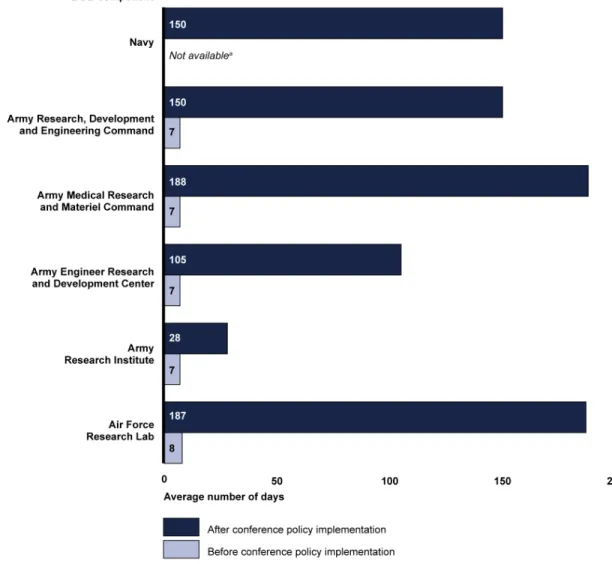
In response to NSTC’s April 2014 data request, DOD components also provided data illustrating the time frames for completing their review and approval processes both before and after implementing the department’s conference policy. Figure 2 shows the average number of days DOD components reported to NSTC for reviewing and approving conference requests before and after conference policy implementation.
35The official noted that the Army’s Research, Development and Engineering Command
conducted this analysis in March 2014 and that, with process changes since that time, the average time for reviewing and approving requests is now somewhat less. However, the command has not updated its analysis.
Figure 2: Average Numbers of Days for Review and Approval of Conference Requests by Department of Defense (DOD) Components before and after Policy Implementation
Note: In some instances, these data also include the time taken to prepare conference requests. Where necessary, we used an average of 30 days per month to convert data provided in months to days. Also, some DOD components provided a range of days for their review and approval processes. Whenever a range was given in the original data, the higher end of the range is depicted in the figure. Further, some responses indicated review and approval time frames prior to conference policy implementation were “less than 1 week.” In these cases we used 7 days in the figure to represent the highest possible value for the response time.
aThe Navy did not collect data on time frames for reviewing and approving conference requests prior to implementing the conference policy in response to OMB’s May 2012 memorandum.
In interviews with us, DOE officials also cited the increased length of their review and approval process since implementing the department’s
conference policy. For example, according to Lawrence Livermore
National Laboratory officials, the conference review and approval process may take up to 9 months as the requests are reviewed at both the lab level and higher levels of DOE, depending on the cost of the conference. Once a conference request moves from the lab to DOE headquarters, DOE officials said the final review process averages 49 days.
As a result of the increased length of their review and approval
processes, DOD and DOE scientists and engineers do not always receive timely decisions about whether their conference attendance is approved. Specifically, DOD and DOE officials stated that scientists and engineers often do not always receive approval decisions until close to the start of a conference. For example, Sandia National Laboratories officials provided an analysis of 10 key conferences held in 2013 which found that 51 approvals were received less than 20 days before the start of a conference.36
DOD and DOE officials and professional society representatives identified two potential effects if scientists and engineers do not know whether their conference attendance will be approved until close to the start of a conference. This includes a disincentive for scientists and engineers to take on an active role and increased costs for conferences. Specifically: • According to estimates provided by professional society
representatives, conference organizers may begin planning the agenda 3 to 6 months in advance of the event by requesting that researchers, including those from DOD and DOE, submit papers to present and by inviting keynote speakers. Scientists and engineers are less likely to submit papers or accept speaking invitations if they do not have assurance that a decision regarding attendance will be made in a timely fashion, DOD and DOE officials told us, because they may be concerned about their standing with peers in their technical communities if they have to cancel shortly before the conference begins because they did not get approval to attend in time. These officials along with professional society representatives
36In its response to the NSTC data request, Sandia National Laboratories provided data
illustrating late approvals to attend conferences. Further quantitative data are not available because the lab’s response focused on a qualitative analysis of 10 major conferences.
also told us that scientists and engineers could be excluded from future conferences as a result of cancelling their participation in a conference at which they had already agreed to speak or present. • Several DOD and DOE officials cited the potential for increased costs
if a decision regarding attendance is not approved until close to the beginning of a conference, as scientists and engineers may no longer be able to take advantage of reduced lodging, transportation, or registration costs. For example, one Los Alamos National Laboratory official said that for a recent American Chemical Society meeting, airfares increased $400 while the conference request was being reviewed, resulting in one individual’s airfare increasing to $1,400 for a domestic roundtrip for the conference due to a last-minute approval. DOD and DOE officials have taken steps to streamline their review and approval processes to mitigate the challenge posed by their length. DOD, the military departments, DOE, and NNSA have, among other actions, mapped their processes to better understand where opportunities for streamlining exist. Table 1 highlights examples of the steps taken by DOD, the military departments, DOE, and NNSA to streamline their conference review and approval processes.
DOD and DOE Have
Taken Some Steps to
Streamline Their Existing
Processes, but Have Not
Established Time Frames
for Providing Decisions
Based on Applicants’
Needs
Table 1: Examples of Department of Defense (DOD) and Department of Energy (DOE) Entities’ Steps to Streamline Conference Review and Approval Processes
Entity Streamlining steps taken
DOD DOD clarified in its policy that no-cost conferences do not require approval.
Army The Army’s Research, Development and Engineering Command initially required two legal reviews of its conference requests, the first at the subordinate-level organization and another at the command’s general counsel. Subsequently, an official from the command said the command revised its requirements to eliminate one of these reviews in response to an analysis done to identify bottlenecks in the review and approval process. According to Army documentation, under most circumstances removing this step can reduce the length of the review and approval process by about 20 days.a
Navy According to officials from the Department of Navy Assistant for Administration, the Assistant for Administration is briefed about conference requests on a daily basis, which has enabled a 2- to 3-day turnaround once the conference request arrives at the assistant’s office. In addition, Office of Naval Research and Naval Research Laboratory personnel submit all conference attendance requests directly to the Department of Navy Assistant for Administration for approval. The Department of Navy Assistant for Administration routinely approves attendance at local conferences with minimal or low cost to the government as well as requests made by the Office of Naval Research Global.b Air Force The Air Force delegated approval authority for non-DOD-sponsored conferences with Air Force-wide costs of $20,000
or less to the Commander of the Air Force Research Laboratory, among others, which shortened the review and approval process for these conferences.
DOE DOE worked to address the length of the review and approval process by developing a list of reoccurring annual non-DOE sponsored conferences that are subject to a streamlined review and approval process. Under this process, a full conference request package is not required for participation up to 125 percent of the cost of the previous year’s level. DOE officials told us this effort has decreased the length of time for reviewing requests for these conferences. NNSA The National Nuclear Security Administration (NNSA) obtained a DOE exemption from the conference review and
approval process for all international training and regularly occurring working meetings related to one of its initiatives.
Source: GAO analysis of DOD, DOE, and NNSA information. | GAO-15-278
aThe Army’s Research, Development and Engineering Command conducted an analysis of the review process for requests from the Army Research Lab and made some changes as a result, such as removing an additional legal review; however, the final analysis was not completed due to the Army developing an electronic conference package review system that is expected to address the challenges identified.
bThe Office of Naval Research Global promotes collaboration with international scientists through programs such as exchange visits and conferences.
DOD and DOE have taken other steps intended to provide applicants more timely decisions about their conference requests. These efforts, however, have not provided reasonable assurance that applicants always receive decisions in a timely manner that meets their needs. In particular, DOD and DOE conference managers, as they became more familiar with their respective review and approval processes, have provided guidance that calls for the submission of requests by specific deadlines. For example, the Air Force Research Laboratory provided lab personnel with a document that specifies when conference applicants should submit their requests to allow sufficient time for the review and approval process and increase the applicants’ chances of receiving an approval before a conference is held. Similarly, DOE has set deadlines to apply to attend
specific conferences working backwards from the registration deadlines to allow time for the review and approval process before the end of
discounted registration. While these deadlines may be helpful in letting applicants know when they need to submit their requests, the deadlines have two shortcomings:
• These deadlines are focused on when applicants should submit their conference requests, rather than providing time frames for when applicants should expect to receive decisions about their request. • Applicants may have different needs for the timing of decisions about
their conference requests based on whether they would like to take on an active role at a conference or take advantage of lower-cost travel arrangements. Since these deadlines are based on either the beginning of a conference or the early registration date, they do not help ensure timely decision making about conference requests that would allow applicants to more confidently commit to active
conference roles.
Based on our analysis, DOD’s and DOE’s conference policies do not establish specific time frames for when conference request decisions are to be provided, and their current guidance for submitting conference requests does not ensure that decisions are provided based on applicants’ needs.
DOD and DOE have ongoing streamlining efforts to reduce the length of their conference review and approval processes, but these efforts do not specifically include establishing time frames for providing conference request decisions based on applicants’ needs, according to DOD and DOE officials. For example, DOE officials told us they are conducting outreach sessions with lab directors to identify additional streamlining opportunities and have established a Conference Management Best Practices group. A DOE management official noted that, as part of these outreach sessions, the lack of decision time frames for those needing early approvals (e.g., because they hoped to have an active conference role) was identified as a process weakness. The official also noted that a process that allows for different approval time frames was informally discussed to address this weakness. However, DOE officials did not agree on plans for what adjustments would be made to DOE’s policy or what best practices would be implemented to ensure timely conference decisions. Additionally, an Office of the DCMO official said the office intends to make changes to DOD’s conference policy in fiscal year 2015, but did not specify the scope of any planned review of DOD’s policy,
including whether the review would focus on the time frames for providing conference review and approval decisions based on applicants’ needs.37
Standards for Internal Control in the Federal Government state that as programs change and agencies strive to improve processes,
management must continually assess and evaluate its internal controls to assure that control activities are effective and are updated when
necessary.
Furthermore, while OMB’s January 2015 controller alert stated that it was providing clarification that agencies could delegate conference approval authority to a level deemed appropriate by the Secretary or Deputy Secretary, neither DOD or DOE indicated any plans for further delegation of authority. Specifically, an Office of the DCMO official said he did not foresee any changes to DOD’s conference policy as a result of the OMB controller alert clarification, and a DOE management official said DOE had no position on the clarification provided by OMB’s alert.
38
37According to OSTP officials, NSTC is in the process of analyzing information provided in
response to its April 2014 request for data on conference policy implementation. An OSTP official said that NSTC will hold a forum for agencies to share best practices for
implementing their conference policies, but that the exact timing of the forum is uncertain as of February 2015.
Also, internal controls should provide reasonable assurance that the objectives of the agency are being achieved. Lastly, according to federal internal control standards, information should be recorded and communicated to management and others within the entity who need it and within a time frame that enables them to carry out their internal control and other responsibilities. OMB’s May 2013 controller alert noted that the conference review and approval requirements from its May 2012 memorandum, in part, ensure that conference expenditures are cost-effective and advance agencies’ missions and goals. While such
assurance is important for the effective and efficient use of federal funds, as the length of DOD’s and DOE’s conference review and approval processes increased following the implementation of their conference policies, scientists and engineers have not always received timely decisions about their requests. The departments have taken steps to provide more timely decisions by streamlining their review and approval processes to shorten their length and by setting specific deadlines for applicants to submit conference requests. However, DOD and DOE continue to lack decision making time frames, and therefore, do not always provide request decisions to applicants based on their needs for a