Department of the Chief Minister Level 14, NT House, 22 Mitchell Street, Darwin
PWC Structural Separation Program
Project Governance
2
Table of Contents
1. Introduction ... 3
2. Governance Principles ... 3
3. Governance Structure ... 4
4. Governance Roles and Responsibilities ... 6
5. Decision Authority ... 10
6. Forums and Meetings ... 12
7. Project Management Tools and Templates ... 14
3
1.
Introduction
1.1.
PWC Structural Separation Program
The Northern Territory Government has decided to divest the Power and Water Corporation (PWC) of the power generation and power retail functions, and to separately place these functions into two new Government Owned Corporations (GOCs), commencing 1 July 2014.
The key objectives of the PWC Structural Separation Program are to significantly improve the
financial transparency of PWC’s various lines of business, to empower more focussed and specialised Boards and management, and to remove certain deterrents to competition.
The Program has been divided into three main phases:
Phase 1 – Design Phase (December 2013 to January 2014)
o Design of the Governance framework
o Design of the Day 1 and Day X Operating Models
o Planning for the separation of PWC into three GOCs, and the achievement of the Day 1 Operating Model
Phase 2 – Implementation Phase (February to June 2014)
o Execution of activities to achieve the Day 1 Operating Model, and the legal and financial separation of the three GOCs
o Planning for the activities required to achieve the Day X Operating Model Phase 3 – Transition Phase (July 2014 to a date to be determined)
o Management of transition service agreements (TSAs)
o Execution of activities to achieve the Day X Operating Model, including transition off TSAs.
1.2.
Purpose of this Document
Governance, in the context of any major program of change, is defined as the framework of rules, relationships, systems and processes within and by which authority is exercised and controlled. This document outlines the planned design for the governance of the PWC Structural Separation
Program. This document may be subject to amendments over the course of the Program.
2.
Governance Principles
The following set of principles has guided development of the governance framework for the structural separation of PWC, and will be a reference for any future changes to the governance design as the project progresses.
4 1. Decisions are to be made independently by people who do not have a vested or conflict of
interest in the outcome of those decisions.
2. Clear accountability is to exist for all roles and responsibilities within the project. 3. Stakeholders are to be informed of the status of the project to ensure adequate
understanding of progress, impacts, decisions and actions required.
4. The rights and responsibilities of PWC’s existing Board and management are to be respected, while asking them to support and assist with the implementation of the Government’s direction.
5. Project governance and management processes are to be simplified and streamlined where possible, without sacrificing the ability to monitor progress towards deadlines.
6. The project is to proceed on the basis of a clear and agreed understanding of Day 1 and Day X operating models, and the deliverables and milestones required to be achieved throughout the project.
Together, compliance with these principles will ensure a governance structure that enables the right decisions to be made and implemented with regard to establishment of the new GOCs, while considering the impact on the residual Monopoly GOC.
3.
Governance Structure
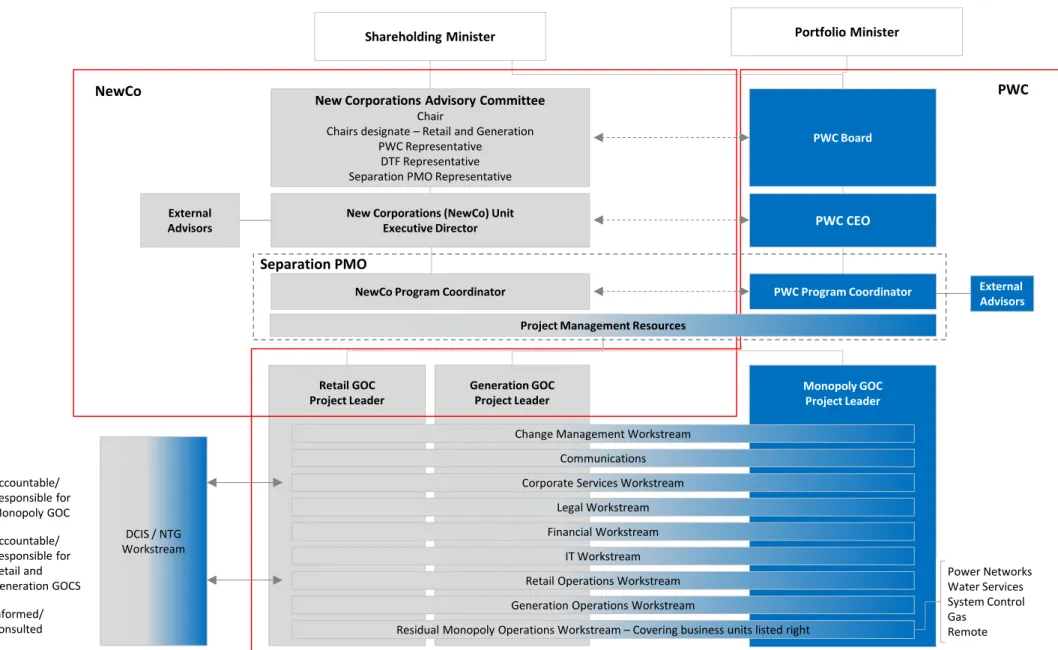
The governance structure on the following page outlines, at a conceptual level, how roles, responsibilities, and reporting lines will be organised.
5 Figure 1: PWC Structural Separation Governance Structure
New Corporations Advisory Committee
Chair
Chairs designate – Retail and Generation PWC Representative
DTF Representative Separation PMO Representative
Monopoly GOC Project Leader Retail GOC Project Leader Generation GOC Project Leader Portfolio Minister PWC Board External
Advisors PWC CEO
NewCo
New Corporations (NewCo) Unit Executive Director
Project Management Resources
Accountable/ Responsible for Retail and Generation GOCS Informed/ Consulted PWC Shareholding Minister Legal Workstream Financial Workstream IT Workstream Retail Operations Workstream Generation Operations Workstream Accountable/
Responsible for Monopoly GOC
DCIS / NTG Workstream
PWC Program Coordinator
Corporate Services Workstream Change Management Workstream
NewCo Program Coordinator Separation PMO
External Advisors
Residual Monopoly Operations Workstream – Covering business units listed right
Power Networks Water Services System Control Gas Remote Communications
6
4.
Governance Roles and Responsibilities
The key governance levels and their main roles and responsibilities are overviewed below.
4.1.
Shareholding Minister
Provide guidance as to the Government’s overall objectives and requirements for structural separation.
Achieve legislative amendments necessary to give effect to the structural separation agenda. Endorse senior appointments (chairs designate for the two new GOCs, and leadership of the
New Corporations Unit (NewCo)).
Endorse overall structural separation budget.
Endorse governance structure and resourcing for the structural separation project. Monitor overall progress of structural reform across both NewCo and PWC.
4.2.
New Corporations Unit (NewCo)/NewCo Executive Director
• Plan and manage all matters in relation to the creation of the two new GOCs prior to their legal establishment.
• Make all key decisions in relation to the creation of the two new GOCs, subject to appropriate consultation (see Decision Authority Section of this document).
• Ensure key risks have been identified and appropriate mitigation controls are in place. • Negotiate all necessary contracts and service level agreements on behalf of the two new
GOCs.
• Recommend project governance to the Shareholding Minister and Advisory Committee. • Coordinate and execute information flows to the Shareholding Minister and Advisory
Committee, as well as to the PWC Board and CEO. • Engage external advisors as necessary.
4.3.
NewCo Advisory Committee
Inform and advise the New Corporations Unit (NewCo).
Provide input and views on key decisions relating to design of the two new GOCs as well as the impact of structural separation on the Monopoly GOC.
Act as a sounding board before decisions are made on contentious issues. Monitor progress in the establishment of the two new GOCs.
Identify key risks and issues, and assist with resolution where possible. Advocate the interests of their respective stakeholder.
Facilitate awareness of the readiness of the two new GOCs and the residual Monopoly GOC for Day 1.
7
4.4.
Program Coordinators (separately for NewCo and PWC)
• Coordinate the program of work on behalf of the two new GOCs and PWC, respectively. • Manage and coordinate stakeholder relationships and communication.
• Act as the ‘eyes and ears’ of the two new GOCs and PWC, respectively.
• Identify, track and escalate issues and risks to NewCo and the PWC CEO relating to the successful achievement of the program objectives.
• Ensure that the objectives and targets are achieved through effective coordination between NewCo and PWC.
• Maintain the Program budget, which is cut by workstream and also separated into three Projects.
• Maintain project documentation for future reference or archiving, with the assistance of the Separation PMO.
4.5.
Project Management Office (PMO)/Support Resources
• Develop and maintain the Operating Models documentation for each GOC.
• Monitor separation planning and implementation to ensure alignment to Operating Model design decisions.
• Develop and maintain a central program master plan, master issue, risk and decision logs that are shared between NewCo and PWC.
• Monitor issues and risks, and assist in resolving separation issues and risks that do not neatly fit into a workstream or specific GOC Project.
Work with workstream leaders to gather project status, issues, risks and interdependencies. Develop program and project status reports, Executive Briefings and other governance
related stakeholder communications, as necessary.
Manage interdependencies between projects and workstreams and highlight issues in this area to the Program Coordinators.
Alert the NewCo ED and Program Coordinators to any difficulties, roadblocks or issues that need to be resolved to enable the timely delivery of project objectives.
Assist in maintaining appropriate records and documentation.
4.6.
Retail and Generation Project Leaders
Ensure the Retail and Generation GOCs are smoothly and successfully established and transitioned by the due date and within the budget they are allocated.
Drive detailed design of the Retail and Generation GOCs Operating Models, including ongoing monitoring of implementation against original design decisions.
Adopt an overall ‘whole of business’ perspective of the structural separation for the Retail and Generation businesses respectively, owning the overall design of the new organisations. Review the overall Retail and Generation Project Charters to ensure they capture all
necessary scope areas and activities.
Represent the Retail and Generation perspectives when advising NewCo or its ED on key decisions.
8 Contribute to the development of all necessary contracts and service level agreements with
the Monopoly GOC on behalf of the two new GOCs.
Support the Separation PMO in driving and monitoring Day 1 readiness of the two new GOCs, ensuring no disruption to operations.
Review workstream separation and transition plans and monitor implementation. Alert the Separation PMO to any difficulties in interactions or any unanticipated
activities/dependencies.
4.7.
Monopoly GOC Project Leader
Ensure the implications of the Retail and Generation separation on the Monopoly GOC are managed by the due date.
Drive design of the revised Monopoly GOC Operating Model, including ongoing monitoring of implementation against original design.
Adopt an overall ‘whole of business’ perspective of the structural separation for the Monopoly GOC business, owning the overall impact on the organisation.
Review the overall Monopoly GOC Project Charter to ensure it captures all necessary scope areas and activities.
Represent the Monopoly GOC perspective when advising NewCo or its ED on key decisions. Contribute to the development of all necessary contracts and service level agreements with
the two new GOCs on behalf of the Monopoly GOC.
Support the Separation PMO in driving and monitoring Day 1 readiness of the Monopoly GOC, ensuring no disruption to operations.
Review workstream separation and transition plans and monitor implementation. Alert the Separation PMO to any difficulties in interactions or any unanticipated
activities/dependencies.
4.8.
Workstreams
Prepare or endorse workstream charters, including scope, objectives, key dates and budget. Prepare separation plans, by GOC Project, for their workstream scope, in conjunction and
consultation with the GOC Project Leaders.
Ensure their respective workstream activities are completed by the due dates. Raise and report issues and risks and execute mitigating actions.
Provide input into budget estimates and report through any variance to budget.
Provide reports to the Separation PMO on workstream progress, status, budgets, decisions, interdependencies, issues and risks.
Alert the Separation PMO to any difficulties in interactions or any unanticipated activities/dependencies.
4.9.
PWC Board and CEO
Oversee all associated organisational changes within the Monopoly GOC, in time for separation on 1 July 2014.
9 Through negotiations with NewCo Executive Director, establish shared services
arrangements – whether transitional or ongoing in nature – and enter into the associated services level agreements or contracts with the new GOCs.
Through negotiations with NewCo Executive Director, develop commercial contracts for the purchase or sale of all power-related inputs or outputs.
Ensure continued delivery of PWC’s responsibilities for all aspects of the supply of electricity in the Territory until 30 June 2014.
10
5.
Decision Authority
5.1.
Separation decision-making
During the “design” and “implementation” phases of PWC’s structural separation, and until such time as the Boards of the new Corporations are in place, the NewCo Executive Director Alan Tregilgas1 will make – or (where he delegates decision making to the Program Coordinator or the project leaders) he will take responsibility for – all final decisions on behalf of the two new GOCs essential to their separation and establishment, including, but not limited to:
the Day 1, and Day X, operating models for the two new GOCs;
the additional Board members to be nominated for the Shareholding Minister’s approval; the appointment of the CEOs for the two new GOCs;
the Day 1 financial structure of the two new GOCs;
the budget and costs related to the establishment of the two new GOCs; and
any other matter which relates to the successful establishment and future success of the two new GOCs.
These decisions will be made on the basis of the NewCo Executive Director’s assessment as to which option, on balance, best achieves the Government’s objectives for implementation of structural separation, namely that structural separation occurs in ways that ensure:
the new Government Owned Corporations (GOCs) commence on 1 July 2014;
there is no inconvenience and disruption to residential and small business customers; the transition of employees to new entities occurs smoothly and ensures the fair and
equitable treatment of employees;
the additional costs involved are within a total budget approved by the Treasurer; no net costs are incurred by Territory power consumers, with additional costs incurred at
least offset by likely savings and other benefits made possible by structural separation; and the Government’s goals of more effective competition and/or regulation are also achieved. Decisions will only be taken:
after consultation with the Monopoly GOC about the costs and consequences (for the Monopoly GOC) of at least two alternative courses of action (“options”);
taking into account an estimate of the relative costs as well as the relative benefits of the main options to the respective new GOC; and
in the case of “key” decisions, after consultation with the NewCo Advisory Committee.
1
On 9 December 2013, the Shareholding Minister wrote to the PWC Board advising that he had “…asked Alan Tregilgas to take responsibility for establishment of the two new GOCs and I would ask that the Board do whatever needs to be done to allow him to complete this task consistent with the Government's stated objectives…”
11 The purpose of the above process is:
to obtain timely decisions, which is less likely when decisions are made by committee; and to ensure that separation decisions with respect to individual GOCs, whether the two new GOCs or the Monopoly GOC, are made on a whole-of-industry basis and in accordance with the shareholder’s requirements.
5.2.
Decision Matrix
The table below highlights a number of key decisions and the responsibilities of specific parties to assist in making the decisions.
Key Decisions Recommender Review Consultation Approver
High-Level Day 1 Operating Model for Retail and Generation GOC
Retail and Generation Project Leaders NewCo Advisory Committee Monopoly GOC Project Leader NewCo
High-Level Day X Operating Model for Retail and Generation GOC
Retail and Generation Project Leaders NewCo Advisory Committee Monopoly GOC Project Leader NewCo and Chair Designates High-Level Day 1 and
Day X Operating Model for Monopoly GOC
Monopoly GOC Project Leader
PWC CEO Retail and Generation Project Leaders, NewCo ED
PWC Board
Budget NewCo ED NewCo Advisory
Committee
PWC CEO Treasurer Service Agreements Retail and Generation
Project Leaders/ Monopoly GOC Project Leader NewCo Advisory Committee/ PWC CEO NewCo / PWC Board
Detailed decisions on level of functional separation from Monopoly GOC
Retail and Generation Project Leaders NewCo Advisory Committee PWC workstreams NewCo
12
6.
Forums and Meetings
To facilitate governance of the PWC structural separation project, the following schedule of meetings will be established for the duration of the project.
Forum Description Frequency Chair Attendees Preparation Requirements
Update to Treasurer
Monthly formal updates to the Treasurer Monthly N/A NewCo ED 1. Monthly Treasurer Update
Update to PWC Board and PWC CEO
Monthly formal updates to the PWC Board and PWC CEO Monthly NewCo ED PWC Board, PWC CEO, Monopoly GOC Leader
1. Monthly Update Report for PWC New Corporations Advisory Committee Meeting
• Two monthly meetings, on alternating fortnights:
o One General Meeting, focusing on strategic and high-level matters
o One Special Meeting focused on operational and technical matters
• The General Meeting, tentatively on the 2nd last Thursday of each month, will resemble a Board style meeting, at which the focus will be on high-level, strategic or whole of business issues, risks and decisions requiring discussion; and
• The Special Meeting, tentatively on the 1st Thursday of each month, where the focus will be on operational, management-level and technical issues, risks and
decisions requiring discussion, and so will not necessarily require the participation of the Chairs-Designate.
Monthly – General, with Chairs Designate Monthly - Special Meetings
NewCo ED Generation Chair Designate, Retail Chair Designate, NewCo Program Coordinator PWC Rep, DTF Rep
1. Fortnightly Status Report 2. Decisions Log
3. Risk and Issue Log 4. Critical Path
Core Team Meeting
Weekly Core Team meeting to:
• Review progress reports from workstreams
Weekly NewCo Program
NewCo ED, PWC Program
1. Weekly Status Report 2. Decisions Log
13 • Share workstream key priorities, risks and issues
• Align workstream activities to ensure that cross-stream dependencies can be actively managed • Highlight key decision requirements
Coordinator Coordinator Retail Lead, Generation Lead Separation PMO
3. Risk and Issue Log 4. Critical Path
PMO
Coordination Meeting
• Weekly Separation PMO meeting to align focus on critical current and upcoming items and coordinate efforts • Discuss project progress, required decisions, risks and
issues, priorities and milestones for the week
Weekly EY Program
Coordinators Project Management Resources
1. Status Report 2.Separation Plan 3. Issue / Risk Register 4. Decision Register Workstream
Meetings
• Weekly or fortnightly workstream meeting between workstream leads and Separation PMO (to be agreed with workstream leader and dependent on workstream scale and complexity) to discuss progress, risks and issues, and priorities and milestones for the week • Discuss any key decisions required
• Acts as input to the overall Program Status Report
Weekly Separation PMO
Workstreams Program Coordinators/ Project Leaders may attend if interested
1. Project Plan distributed 2. Latest issues and risks 3. Relevant section of the overall Program Status Report completed by the Separation PMO during the meeting
Project Oversight and Decision Meeting
• Fortnightly project status review to provide clarification and guidance to workstreams
Fortnightly NewCo ED Workstream Leaders Project Coordinators
1. Status Update 2. Decision Register
14
7.
Project Management Tools and Templates
A set of tools and templates will be used by the Structural Separation Program to facilitate the management and reporting of the program during the design and implementation phases, and possibly beyond this.
No. Tool/Template Description
1 Workstream Charter A short document which outlines the objectives and scope of a workstream including identifying the required resources, key risks, dependencies and activities
2 Detailed workstream workplans
A workplan includes all tasks and milestones that each workstream needs to complete for the separation and transition project
3 Separation and Transition Plan
A plan that consolidates all of the project level milestones and critical activities from the workstreams, in MS Project
4 Program Status Update A weekly status update document to be used for providing updates of key activities, risks, issues and decisions 5 Project Risks and Issues
Register
A register to capture and assess workstream or project wide risks and issues and identify mitigating actions
6 Decision Log A log to capture and track key workstream and project wide decisions, including accountabilities and status
7 AC - General Meeting Report A fortnightly report to provide a high-level progress update of the project to the Advisory Committee General meeting, including key decision points required and any risks to delivery of separation
7 AC – Special Meeting Report A more detailed fortnightly report to provide more detailed view on the progress of the separation, including key risks, issues, decisions made or required for review, etc
8 Executive Brief A monthly summary report to the PWC Board, Executive and NT Treasury to provide a progress update of the separation project
16 Budgets will be established according to a number of principles. Principles have also been agreed for the on-going tracking and monitoring of budgets across the project.
8.1.
Budget development principles
Budgets will be developed top down by NewCo and then validated with workstreams. This is required to ensure clear understanding of the potential recuperation of costs by PWC.
Each budget is split by:
o workstream.
o costs incurred pre-day 1 and post-day 1.
o internal and external resource costs.
Any additional ongoing costs will also need to be identified as inputs into pro-forma P&Ls.
Internal costs are only to be included in the budget where a full time backfill is required or the associated labour costs are material. Where backfill is required, the role and time required must be clearly stated. External costs are to be broken down into the following categories:
o travel and accommodation (number of personnel, frequency and duration of visit).
o consultants/contracted services.
o other third party suppliers.
o purchases/expenses.
Assumptions adopted by each workstream in developing their budget will be reviewed by the Program Coordinators and the NewCo ED.
Where costs are contingent on outcomes/decisions still to be made, the budget will be prepared on a best case scenario.
8.2.
Budget tracking and monitoring principles
The Program Coordinators will keep a central budget and will track adherence to that budget. A Cost Centre with separate activity codes for each Project (Retail, Generation, Monopoly and “Joint”) will be established to allow capture and allocation of costs incurred.
Actual workstream transition costs will be reviewed on a monthly basis against the agreed budgets. Workstream Leads and Project Leads will be required to justify any significant variances to budget. The
NewCo ED’s endorsement will be required before a revised budget is put to the Shareholding Minister for approval.
Any re-forecasting of budgets will require the endorsement of the NewCo ED and the approval of the Shareholding Minister.