9
Contingent Liabilities
Introduction
9.1 Th e fi nancial crises of the 1990s highlighted the shortcomings of conventional accounting systems in capturing the full extent of fi nancial exposures arising from traditional “off -balance-sheet” obligations, such as contingent liabilities, and from fi nancial derivatives contracts. Th e discovery of the magnitude and role of these obligations in these crises reinforced the need to monitor them. Th is chapter focuses on contingent liabilities. 1 Guidelines for monitoring fi nancial deriv-atives positions were provided earlier in the Guide . 9.2 Contingent liabilities have gained prominence in the analysis of public fi nance and the assessment of the fi nancial position of the public sector, because while “invisible” in good times, they may result in costly fi scal surprises. An increased monitoring of contingent liabilities, which might impose substan-tial fi scal costs and impair fi scal sustainability, helps countries safeguard their fi scal position. Further, the increasing awareness of international markets to the relevance of contingent liabilities in assessing sover-eign creditworthiness calls for more transparency. 9.3 Contingent liabilities are complex arrangements, and no single measurement approach can fi t all situa-tions; rather, comprehensive standards for measuring these liabilities and for better disclosure of informa-tion are still evolving. Indeed, experience has shown that contingent liabilities are not always fully covered in accounting systems, 2 although an increasing num-ber of countries are disseminating information on contingent liabilities in their national publications. 9.4 Creating and maintaining a reliable inventory of contingent liabilities is essential for managing them. In providing information on contingent liabilities, it is
important to ensure that the information is meaning-ful and understandable. To encourage the monitor-ing and measurement of contmonitor-ingent liabilities, with a view to enhancing transparency, this chapter provides some measurement approaches, aft er fi rst defi ning contingent liabilities and then providing some rea-sons for their measurement. More specifi cally, also provided is a table for the dissemination of external debt data on an “ultimate risk” basis, i.e., adjusting residence-based external debt data for certain cross-border risk transfers.
Defi nition
9.5 Contingent liabilities are obligations that arise from a particular discrete event(s) that may or may not occur. Th ey can be explicit or implicit. A key aspect of such liabilities, which distinguishes them from current fi nancial liabilities (and external debt), is that one or more conditions or events must be ful-fi lled before a ful-fi nancial transaction takes place. 9.6 In macroeconomic statistics, contingent liabilities are not recognized on the balance sheet as fi nancial assets or liabilities prior to the condition(s) being fulfi lled (see 2008 SNA, paragraph 3.40 and BPM6, paragraph 5.10). An exception is made for standard-ized guarantees where, although each individual arrangement involves a contingent liability, the num-ber of similar guarantees is such that an actual liability is established for the proportion of guarantees likely to be called (see 2008 SNA, paragraph 3.40).
9.7 Figure 9.1 provides an overview of the boundary between liabilities and contingent liabilities in macro-economic statistics. 3
1 Th is chapter draws on work at the World Bank and at the IMF. 2 See paragraphs 9.20 and 9.21, and Table 9.2 .
3 Th e Government Finance Statistics Manual (IMF, 2001)
recom-mends the treatment of liabilities for nonautonomous unfunded employer pension schemes as “liabilities,” while the SNA allows for some fl exibility (see 2008 SNA, paragraphs 17.191–17.199).
9.8 A distinction is made between explicit and implicit contingent liabilities. In all macroeconomic statistical systems, explicit contingent liabilities are defi ned as legal or contractual fi nancial arrangements that give rise to conditional requirements to make payments of economic value. Th e requirements become eff ec-tive if one or more stipulated conditions arise. Implicit contingent liabilities do not arise from a legal or con-tractual source, but are recognized aft er a condition or event is realized. While the focus of this chapter is largely on explicit contingent liabilities, the importance of implicit contingent liabilities is also discussed below. Table 9.1 provides a practical way of classifying the types of potential liabilities of the central government.
Explicit Contingent Liabilities
9.9 Explicit contingent liabilities are those defi ned by the 2008 SNA as contractual fi nancial arrangements that give rise to conditional requirements, i.e., the requirements become eff ective if one or more stipu-lated conditions arise, to make payments of economic value. 4 In other words, explicit contingent liabilities arise from a legal or contractual arrangement. Th e contingent liability may arise from an existing debt— such as an institution guaranteeing payment to a Figure 9.1 Overview of Liabilities and Contingent Liabilities in Macroeconomic Statistics
Contingent liabilities Liabilities Explicit contingent liabilities Other implicit contingent liabilities Net obligations
for future social security benefits Implicit contingent liabilities Other explicit contingent liabilities
Guarantees in the form of financial derivatives
Provisions for calls under standardized guarantee schemes
Other:
Special drawing rights Currency and deposits Debt securities Loans
Nonlife insurance technical reserves Life insurance and annuities entitlements
Pension entitlements, claims of pension funds on sponsors, and entitlements to nonpension funds Equity and investment fund shares Other financial derivatives and employee stock options
One-off guarantees
Loan and other debt instrument guarantees (publicly guaranteed debt) Other one-off guarantees •
Other accounts payable • • • • • • • • • Guarantees
Source: Based on the PSDS Guide.
4 The European System of Accounts: ESA 2010 defi nes contingent
Table 9.1 Fiscal Risk Matrix with Illustrative Examples 1
Liabilities
Direct
(obligation in any event)
Contingent
(obligation if a particular event occurs)
Explicit
Government liability as recognized by a law or contract
External and domestic sovereign bor-rowing (loans contracted and securi-ties issued by central government) Budgetary expenditures
Budgetary expenditures legally binding in the long term (government employment-related salaries and pensions)
Guarantees
Central government guarantees for nonsovereign borrow-ing and obligations issued to subnational governments and public and private sector entities (development banks) Umbrella central government guarantees for various types of loans (mortgage loans, agriculture loans, small business loans) 2 Trade and exchange rate guarantees issued by the central government
Guarantees on borrowing by a foreign sovereign government Central government guarantees on private investments
Other explicit contingent liabilities
Central government insurance schemes not included under standardized guarantee schemes
Potential legal claims, which are claims stemming from pending court cases
Indemnities (commitments to accept the risk of loss or damage another party might suffer)
Uncalled capital (obligation to provide additional capital on demand to an entity of which it is a
shareholder, e.g. offi cial international fi nancial institutions)
Implicit
Obligations that may be recognized when the cost of not assuming them could be unaccept-ably high
Net obligations for future public pensions (excluding government employment-related pensions) 3
Net obligations for future social security benefi ts other than net obligations for future public pensions (excluding government employment-related pensions)
Other implicit contingent liabilities
Bailouts of public enterprises, fi nancial institutions, subna-tional governments, and private fi rms that are either strate-gically important or “too big to fail”
Liability cleanup in entities under privatization Investment failure of a nonguaranteed pension fund Default of central bank on its obligations (foreign exchange contracts, currency defense, balance of payment stability) Bailouts following a reversal in private capital fl ows Environmental recovery, disaster relief, etc. Source: Adapted from Polackova Brixi (1999).
1 The liabilities listed refer to the fi scal authorities, not the central bank.
2 However, guarantees issued by governments on export credits or student loans are standardized guarantees; provisions for calls under these guarantees are recognized as actual liabilities in the Guide , in line with the 2008 SNA and BPM6 .
3 Excluding all government employment-related pensions (civil service pensions) and any public pension schemes for which a reserve was set aside to meet the entitlements; these should be recorded as explicit direct liabilities.
third party; or arise from an obligation to provide funds—such as a line of credit, which once advanced creates a claim; or arise from a commitment to com-pensate another party for losses—such as exchange rate guarantees.
9.10 Explicit contingent liabilities can take a variety of forms, although guarantees are the most common; however, not all contingent liabilities are guarantees
(see Box 9.1 ). Examples of explicit contingencies in a form other than guarantees include: (a) potential legal claims, which are claims stemming from pend-ing court cases; (b) indemnities, which are commit-ments to accept the risk of loss or damage another party might suff er; and (c) uncalled capital, which is an obligation to provide additional capital, on demand, to an entity of which it is a shareholder
Three classes of guarantees are considered in the 2008 SNA and BPM6: guarantees that meet the defi nition of a fi nancial derivative, standardized guarantees, and one-off guarantees.
Guarantees that meet the defi nition of fi nancial derivatives protect, on a guarantee-by-guarantee basis, the lender against certain types of risk arising from a credit relationship by paying the guarantor a fee for a specifi ed period. The guarantees covered are such that experience in the market allows the guarantor to apply standard master legal agreements or to make a reasonable estimate of the likelihood of the borrower defaulting and to calculate suitable terms for the fi nancial derivative. These fi nancial derivatives are referred to as credit derivatives, which are nondebt fi nancial assets or liabilities—not contingent assets or liabilities. For instance, credit default swaps are included in fi nancial derivatives as options (see BPM6 , para-graphs 5.68 and 5.93, Appendix 1, Part 1 of this Guide ).
Standardized guarantees are defi ned as those that are not provided by means of a fi nancial derivative (such as credit default swaps), but for which the probability of default can be well established. These guarantees cover similar types of credit risk for a large number of cases. Examples include guar-antees issued by governments on export credit or student loans. Generally, it is not possible to estimate precisely the risk
of any one loan being in default, but it is possible to make a reliable estimate of how many out of a large number of such outstanding loans will default. This default rate establishes a debt liability—not a contingent liability—which is referred to as “provision for calls under standardized guarantee schemes” (see BPM6, paragraphs 5.68 and 5.93, and Appendix 1, Part 1 of this Guide ).
One-off guarantees occur in situations in which the conditions of the loan or of the security that is guaranteed are so particular that it is not possible for the degree of risk associated with it to be calculated with any degree of precision. These guarantees are not recognized as economic assets until their activation, i.e., when the event occurs that makes the guarantor responsible for the liability. These are contingent assets until activated. In most cases, a one-off guarantee is considered a contingent debt liability of the guarantor. Debt under one-off guarantees continues to be attributed to the debtor, not the guarantor, unless and until the guarantee is called. However, one-off guarantees granted by governments to corporations in fi nancial distress that have a very high likelihood of being called are treated as if they were activated at inception (see BPM6, paragraph 5.68 and Appendix 3 of this Guide ).
Box 9.1 Types of Guarantees
5 Regulatory or policy-based guarantees are especially relevant in
infrastructure fi nancing. For more details and country-specifi c examples, see Irwin and others (1997).
(such as an international fi nancial institution). Some of the more common explicit contingent liabilities are set out below.
Loan and other payment guarantees
9.11 Loan and other payment guarantees are com-mitments by one party to bear the risk of nonpay-ment by another party—the guarantor guarantees the servicing (principal and/or interest) of the existing debt of other unit(s). Guarantors are only required to make a payment if the debtor defaults. Some of the common types of risks that are assumed by guaran-tors are commercial risk or fi nancial performance risk of the borrower; market risk, particularly that arising from the possibility of adverse movements in market variables, such as exchange rates and inter-est rates; political risk, including risk of currency inconvertibility and nontransferability of payments (also called transfer risk), expropriation, and political violence; and regulatory or policy risk, where imple-mentation of certain laws and regulations is critical to the fi nancial performance of the debtor. 5 Loan and
other payment guarantees usually increase the initial debtor’s access to international credit markets and/or improve the maturity structure of borrowing.
Credit guarantees and similar contingent liabilities
9.12 Lines of credit and loan commitments provide a guarantee that undrawn funds will be available in the future, but no fi nancial liability/asset exists until such funds are actually provided. Undrawn lines of credit and undisbursed loan commitments are contingent liabilities of the issuing institutions; namely, banks. Letters of credit are promises to make payment upon the presentation of prespecifi ed documents.
Contingent “credit availability” guarantees or contingent credit facilities
9.13 Underwritten note issuance facilities (NIFs) provide a guarantee that a borrower will be able to issue short-term notes and that the underwriting institution(s) will take up any unsold portion of the notes. Only when funds are advanced by the under-writing institution(s) will an actual liability/asset be created. Th e unutilized portion is a contingent liability. 9.14 Other note guarantee facilities providing contin-gent credit or backup purchase facilities are revolving
underwriting facilities (RUFs), multiple options facil-ities (MOFs), and global note facilfacil-ities (GNFs). Bank and nonbank fi nancial institutions provide backup purchase facilities. Again, the unutilized amounts of these facilities are contingent liabilities.
Implicit Contingent Liabilities
9.15 Implicit contingent liabilities do not arise from a legal or contractual source, but are recognized aft er a condition or event is realized, e.g., ensuring systemic solvency of the banking sector might be viewed as an implicit contingent liability of the central bank or the central government. 6 Likewise, covering the obligations of subnational (state and local) govern-ments or the central bank in the event of default might be viewed as an implicit contingent liability of the cen-tral government. Implicit contingencies may be con-sidered political or moral obligations that sometimes arise from expectations that government would inter-vene in the event of any exceptionally important crisis or disaster, and may be recognized when the cost of not assuming them is believed to be unacceptably high. 7 9.16 Th e relative importance of various types of gent liabilities is country-specifi c, but implicit contin-gent liabilities can be costly. For instance, the fi scal cost of support for the fi nancial system can be very high. 8, 9 9.17 Although implicit contingent liabilities are important in macroeconomic assessment, fi scal burden, and policy analysis, implicit contingent
liabilities are even more diffi cult to measure than explicit contingent liabilities. Also, until measure-ment techniques are developed, there is a danger of creating moral hazard risks in disseminating infor-mation on implicit contingent liabilities of the type set out in Table 9.1 . Th us, the rest of this chapter focuses only on the measurement of explicit contin-gent liabilities.
Why Measure Contingent Liabilities?
9.18 By conferring certain rights or obligations that may be exercised in the future, contingent liabilities can have a fi nancial and economic impact on the eco-nomic entities involved. When these liabilities relate to cross-border activity, and they are not captured in conventional accounting systems, it can be diffi cult to accurately assess the fi nancial position of an econ-omy—and the various institutional sectors within the economy—vis-à-vis nonresidents.9.19 Analysis of the macroeconomic vulnerability of an economy to external shocks requires informa-tion on both external debt obligainforma-tions and contin-gent liabilities. Experience has shown that contincontin-gent liabilities are not always fully covered in accounting systems. Moreover, there is an increasing realization, when assessing macroeconomic conditions, that con-tingent liabilities of the government and the central bank can be signifi cant, e.g., fi scal contingent claims
6 Th e central government may intervene in the banking sector
especially for recapitalization. A case in point is Indonesia, where the government’s domestic debt increased from practically noth-ing, in the period before the crisis (mid-1997), to 500 trillion Indonesian rupiah by the end of 1999, mostly due to the issuance of bonds to recapitalize the banking system. Th e increase in the government’s stock of domestic debt was accompanied by a rise in its assets, which were received in exchange for issuing bank-restructuring bonds. See also Blejer and Shumacher (2000).
7 See Cebotari, Contingent Liabilities: Issues and Practice (IMF, 2008). 8 For instance, Laeven and Valencia (2010) present
comprehen-sive data on the characteristics of systemic banking crises over the period 1970–2009, including the associated economic and fi s-cal costs. Th e cost of each crisis is estimated using three metrics: direct fi scal costs, output losses, and the increase in public sector debt relative to GDP. Th e economic cost of the 2007–2009 banking crises—concentrated in high-income countries—was on average much larger than that of past crises, both in terms of output losses and increases in public debt. Th e median output loss (computed as deviations of actual output from its trend) was 25 percent of GDP in most recent crises (2007–2009), compared to a historical median of 20 percent of GDP, while the median increase in public debt (over the three-year period following the start of the crisis) is
24 percent of GDP in 2007–2009 crises, compared to a historical median of 16 percent of GDP. Th ese diff erences, in part, refl ect an increase in the size of fi nancial systems, the fact that the 2007–2009 crises were concentrated in high-income countries, and possibly diff erences in the size of the initial shock to the fi nancial system. At the same time, direct fi scal costs to support the fi nancial sector were smaller, 5 percent of GDP in 2007–2009 crises, compared to 10 percent of GDP for past crises, as a consequence of relatively swift policy action and the signifi cant indirect support the fi nan-cial system received through expansionary monetary and fi scal policy, the widespread use of guarantees on liabilities, and direct purchases of assets that helped sustain asset prices (see Laeven and Valencia, Resolution of Banking Crises: The Good, the Bad, and the Ugly , IMF WP/10/146). Natural disasters and terrorist-related events have also been very costly, with economic losses sometimes reaching 200 percent of GDP (e.g., Hurricane Ivan in Grenada in 2004, see Cebotari [2008]).
9 Also, a sovereign debt restructuring may impair the fi nancial
position of domestic or foreign institutions to a degree that this threatens fi nancial stability and raises pressures for bank recapital-ization and offi cial sector bailouts (see Sovereign Debt Restructur-ings 1950–2010: Literature Survey, Data, and Stylized Facts , Das, Papaioannou, and Trebesch, IMF Working Paper/12/203).
can clearly have an impact on budget defi cits and fi nancing needs, with implications for economic pol-icy. Recognizing the implications of contingent liabili-ties for policy and analysis, the 2008 SNA (paragraph 11.24) states:
Collectively, such contingencies may be impor-tant for fi nancial programming, policy, and analysis. Th erefore, where contingent positions are important for policy and analysis, it is rec-ommended that information be collected and presented as supplementary data. Even though no payments may eventually be due for contin-gent liabilities, the existence of a high level of them may indicate an undesirable level of risk on the part of those units off ering them.
Measuring Contingent Liabilities
Treatment of Contingent Liabilities
9.20 Data dissemination of contingent liabilities based on contractual obligations (i.e., explicit con-tingent liabilities) is already recommended under international statistical standards. Table 9.2 sum-marizes the treatment of contingent liabilities under statistical and accounting standards in relation to their recognition as liabilities and their data report-ing requirements.
9.21 Th e Guide does not recognize contingent liabili-ties within external debt, recognizing a liability only if and when the liability actually materializes and is matched by a claim, i.e., the creditor owns a claim
Table 9.2 Treatment of Contingent Liabilities under Statistical and Accounting Standards: Recognition as Liabilities and Data Reporting Requirements 1
Recognition of Contingent Liabilities as Liabilities
Data Reporting on Contingent Liabilities
Cash Accounting (IPSAS 19) Only when the contingency is called and cash payments need to be made.
Encouraged. Under cash accounting standards no disclosure—meaning reported in notes or narratives that are regarded as an integral part of the fi nan-cial statement—is currently required by IPSAS, but supplementary disclosure in line with that under accrual standards is recommended.
Accrual Accounting (IPSAS 19)
The expected cost of contractual contingent liabilities, such as guarantees and legal claims, should be recognized—meaning formally recorded in the fi nancial statements of the government as a liability—if: (i) it is more likely than not (50 percent) that the event will occur; and (ii) the amount of the obligation can be measured with suffi cient reliability. Liabilities that do not satisfy these criteria should not be recognized.
The disclosure of the nature of contractual contin-gent liabilities in the notes to fi nancial statements is required as long as the possibility of the payment is not remote (i.e., loss more likely than not, or loss less than likely but more than remote) for both contingent liabilities recognized as balance sheet liabilities and contingent liabilities not recognized on the balance sheet.
Statistical Reporting (the Guide )
A liability is recognized only if and when the contingency actually
materializes, and is matched by a claim, i.e., the creditor owns a claim on the debtor.
Private sector debt owed to nonresidents and guar-anteed by the public sector—through a contractual arrangement—should be presented in tables based on a public-sector–based approach (Chapter 5). Debt of nonresidents, not owned by residents, guaranteed by a resident entity may be presented in Table 9.3 (column 2).
Data on a narrow range of contingent liabilities are presented in a memorandum table in Chapter 4. This table covers external debt of one sector guaranteed by another sector, and the cross-border provision of guarantees.
In all these instances, it is recommended that the contingency be valued in terms of the maximum exposure loss (full face value).
1 Contingent liabilities in the table correspond to the defi nition used in this chapter, not to their accounting defi nition (see paragraph 9.21, footnote 10).
on the debtor. International Public Sector Account-ing Standards (IPSAS) for the public sector, which do not require a matching creditor claim for the recog-nition of liability, recognize on an accrual basis con-tractual contingent liabilities such as guarantees and legal claims at the moment of initiation if: (1) the probability that the contingency will occur and hence a payment would have to be made is more than 50 percent; and (2) these payments can be reasonably measured. 10, 11
Measuring the Value of Contingent Liabilities
9.22 Contingent liabilities give rise to obligations that may be realized in the future, but because of their complexity and variety, establishing a single method for measuring them may not be appropriate. Several alternative ways of measuring contingencies are out-lined below. Th e relevance of each will depend on the type of contingency being measured and the availabil-ity of data.
9.23 A fi rst step in accounting for contingent lia-bilities is for economic entities to record all such contingent liabilities as they are created, such as with an accrual-based reporting system. But how should such liabilities be valued?
9.24 The various ways in which the value of
explicit contingent liabilities could be mea-sured include: (1) the face value or maximum loss; 12 (2) the expected costs, which can also be viewed as the most government can lose at an about
Box 9.2 Disclosing the Contingent Liabilities: Country Examples
Contingent liabilities are disclosed in an increasing number of countries, either in budget documents or other fi scal reports sent to parliament. New Zealand and Australia were pioneers in disclosing contingent liabilities, a practice that was subsequently picked up in a few other OECD countries, and in several emerging markets (Brazil, Chile, Colombia, Indonesia, Peru, and South Africa). The type of contingent liabilities disclosed varies across countries, in part refl ect-ing their relative signifi cance. Information on explicit loan guarantees (whether to public enterprises, fi nancial institutions, private companies, or students) is reported by virtually all countries disclosing contingent liabilities. Disclosure of guarantees related to public-private partner-ships (PPPs)–type arrangements, such as minimum revenue guarantees or exchange rate guarantees, is generally more limited (Chile, Colombia, Indonesia, Peru, and the United Kingdom). Other types of contingent liabilities are also reported, including those from pension guarantees (Chile and the United States); deposit guarantees (Chile and the United States); litigation (Australia, Brazil, Colombia, Indo-nesia, New Zealand, and the United States); liabilities of
the central bank (Australia and Chile); and natural disasters (Indonesia).
When contingent liabilities can be quantifi ed, their fi scal signifi cance is reported through a variety of measures. These include: (1) the face value or the maximum loss under guarantees; (2) the expected cost of the guarantees; or (3) the unexpected cost of the guarantee, i.e., the most govern-ment can lose at, e.g., a 95 to 99 percent confi dence level (the so-called cash fl ow at risk). The latter two measures are reported either as expected annual payments over a certain time span or as the net present value of these payments. Most countries do not disclose implicit contingent liabilities. It would generally be inappropriate to quantify and report implicit obligations as explicit contingent liabilities, since this would reinforce moral hazard if the private sector interprets this disclosure as a commitment or as an indication that the gov-ernment is likely to provide future fi nancial assistance. When such considerations are not at play or when the country has a clear history of taking on implicit liabilities, these are sometimes discussed in the context of contingent liability reports.
Note: See detailed information on country practices in Cebotari (2008).
10 In IPSAS, contingent liabilities that meet these criteria and are
recognized in fi nancial statements are called “provisions” (defi ned as liabilities of uncertain timing and amount), with the remaining contingent liabilities defi ned as “contingent liabilities.” A short-coming of this approach is that, from an economic point of view, drawing a distinction between probable and improbable losses is not always useful; a 10 percent chance of losing $10 million is worse than a 90 percent chance of losing $1 million.
11 Increasingly, international accounting standard setters are
requiring explicit contingent liabilities to be recognized at fair value. Th e rationale is that the contractual obligation itself is not conditional and therefore is a liability in full right. Th e uncertainty about future events is refl ected in the valuation of the liability rec-ognized, rather than whether it is recognized or not. Th is approach is consistent with the methods already used in Sweden and the United States, where an estimate of the expected payment is made for all guarantees (see Cebotari [2008]).
12 In the case of guarantees covering deep-discount bonds and
zero-coupon bonds, the maximum loss should be measured by the nominal value of the security at the reference period.
50 percent confi dence level; (3) unexpected (or tail risk) costs, i.e., the most government can lose at, e.g., a 95 to 99 percent confi dence level (also called cash fl ow at risk); or (4) the market value of the guarantee.
Face value
9.25 Th e fi rst approach is to record contingent liabilities at full face value or maximum exposure loss. Th us, a guarantee covering the full amount of a loan outstanding would be recorded at the full nominal value of the underlying loan. Th e face value approach is by far the most commonly used by coun-tries. Th is approach does not require quantifi cation of probabilities that the contingent guarantee would be called. It is also a convenient measure in cases when individual contingent liabilities are disclosed, given that the provision of the estimated expected loss could either give rise to moral hazard (if the benefi ciary of the guarantee infers that the guaran-tor is prepared to sustain a loss on the guarantee) or could damage the guarantor’s case in courts or in negotiations. Hence, many countries report the face value in the case of guarantees or insurance pro-grams (Australia, New Zealand, the United States, and Chile) or of lawsuits (Chile, Colombia, and the United States). 13
9.26 Only a few countries provide information on the nature and scope of unquantifi able risks (Australia, Canada, and New Zealand). Th ese risks include vari-ous indemnities (e.g., against prosecution for public offi cials or unauthorized disclosure of confi dential information), land claims, costs of decontaminating defense sites, potential future litigation, legal chal-lenges against legislation, insurance against terrorist acts, and others.
9.27 For instance, the New Zealand government rou-tinely publishes the maximum potential loss to the government of quantifi able and nonquantifi able con-tingent liabilities, 14 including guarantees and indem-nities, uncalled capital to international institutions,
and potential settlements related to legal proceedings and disputes.
9.28 Likewise, the Australian government identifi es quantifi able and nonquantifi able contingencies. 15 In addition, it identifi es “remote” contingent losses (mostly guarantees), including nonquantifi able “remote” contingencies. Th e Indian government reg-ularly reports the direct guarantees provided by the central government on external borrowings of pub-lic sector enterprises, development fi nancial institu-tions, and nonfi nancial private sector corporations. 16 Th e guarantees are presented by sector and at nominal value.
9.29 Th e maximum potential loss method has an obvious limitation: there is no information on the likelihood of the contingency occurring. Especially for loan and other payment guarantees, the maxi-mum potential loss is likely to exceed the economic value of the contingent liability because there is no certainty that a default will occur (i.e., the expected probability of default is less than unity). Th eoretically, a better approach is to measure both the maximum possible loss and the expected loss, but calculating the expected loss requires estimating the likelihood of losses, which can be diffi cult.
Estimating expected cost or market value
9.30 Several alternative methods of valuing the expected loss exist. Th ese range from relatively simple techniques requiring the use of historical or market data, to quantitative models, such as complex options-pricing techniques and simulations.
9.31 Th e expected or unexpected costs measures require, in addition to the face value, an assessment of the probability that the guarantees would be called. For estimating expected losses, a judgment would need to be made as to whether there was at least a 50 percent probability that a guarantee would be called. Some countries disclose the expected losses under various probabilities and types of guarantees (Chile, Colombia, and Peru) and some also disclose “unex-pected” losses (Chile at a 95 percent confi dence level, 13 See Table 5 in Cebotari (2008) for detailed country practices.
14 New Zealand Treasury, Budget Economic and Fiscal Update
(Wellington, annual). As the name suggests, nonquantifi able con-tingent liabilities cannot be measured and arise from either insti-tutional guarantees that have been provided through legislation or from agreements and arrangements with organizations.
15 Aggregate Financial Statement (Australia, annual).
16 See the Ministry of Finance’s annual publication on external
Colombia at a 99 percent level). 17 Another way to deal with the diffi culty of quantifying probabilities for a variety of possible outcomes, is to provide a range of estimated losses , e.g., as done by the United States in the case of some lawsuits.
9.32 Simulation models can be used as a method for estimating the expected or unexpected cost measures. For instance, these models estimate the probability distribution of losses from a guarantee by simulat-ing, rather than assumsimulat-ing, the evolution of relevant risk factors underlying the guarantee. Th is distribu-tion is then used to price the guarantees (estimate the expected loss) and also allows estimation of the maximum losses that may occur at a given confi dence level (e.g., the maximum payments at a 95 percent confi dence level means that the probability of higher payments [than these maximum ones] being called is 5 percent). Th ese models are employed for valuing guarantees associated with demand behavior, such as infrastructure guarantees (e.g., road concessions with revenue guarantees).
9.33 Calculating probabilities requires detailed mar-ket information, but such information is oft en unavail-able. Th is is particularly true in situations of market failure or incomplete markets. A fi nancial market-place is said to be complete when a market exists with an equilibrium price for every asset in every possible state of the world. Other means are then required to estimate the probability to value a contingency. One possibility is to use historical data on similar types of contingent operations, e.g., if the market price of a loan is not observable, but historical data on a large number of loan guarantees and defaults associated with those guarantees are available, then the prob-ability distribution of the default occurrences can be used to estimate the expected cost of a guarantee on the loan. Th is procedure is similar to that employed by the insurance industry to calculate insurance
premiums. Rating information on like entities is oft en used to impute default value on loan guarantees as well. Th e U.S. Export-Import Bank employs this method for valuing loan guarantees that it extends. 9.34 Bank regulatory guidelines established by the Basel Committee on Banking Supervision also draw on historical data to measure risks in banks’ off -bal-ance-sheet activities and could be used in the absence of good market information for calculating probabili-ties. For traditional off -balance-sheet items like credit contingent liabilities, the so-called Basel II guidelines provide “credit conversion factors” which, when mul-tiplied with the notional principal amount, provide an estimate of the expected “payout” from the con-tingent liability. Th e conversion factors are derived from the estimated size and likely occurrence of the credit exposure, as well as the relative degree of credit risk. Th us, stand-by letters of credit have a 100 percent conversion factor; the unused portion of commit-ments with an original maturity of over one year is 50 percent; and RUFs, NIFs, and similar arrangements are assigned a 50 percent conversion factor as well. 9.35 If the expected loss can be calculated, the loss(es) can be valued in present-value terms—expected pres-ent value. In other words, since any paympres-ent will be in the future and not immediate, the expected future payment streams could be discounted using a market rate of interest faced by the guarantor, i.e., the pres-ent value. As with all prespres-ent-value calculations, the appropriate interest rate to use is crucial. A common practice with government contingent liabilities is to use a risk-free rate like the treasury rate. Under this present-value approach, when a guarantee is issued, the present value of the expected cost of the guaran-tee could be recorded as an outlay or expense (in the operating account) in the current year and included in the position data, such as a balance sheet.
9.36 Market-value measures use market informa-tion to value a contingency. Th is methodology can be applied across a wide range of contingent liabilities, but it is particularly useful for valuing loan and other payment guarantees, on which the following discus-sion focuses. Th is methodology assumes that com-parable instruments with and without guarantees are observable in the market and that the market has fully assessed the risk covered by the guarantee. Under this method, the value of a guarantee on a fi nancial 17 Th e expected loss is the average loss, i.e., the mean of a loss
dis-tribution. Th e unexpected loss is the diff erence between the total exposure at the target risk tolerance level and the expected loss; for instance, total exposure at the 99 percent confi dence level rep-resents the level of loss where a larger loss has a 1 percent chance of occurring. In the banking industry, expected losses are referred to as the “normal” losses that occur frequently as part of everyday business, whereas unexpected losses are the “unusual” losses that occur rarely and have a high severity.
instrument is derived as the diff erence between the price of the instrument without a guarantee and the price inclusive of the guarantee. In the context of a loan guarantee, the nominal value of the guaran-tee would be the diff erence between the contractual interest rate ( ip ) on the unguaranteed loan and the contractual interest rate ( ig ) on the guaranteed loan times the nominal value of the loan ( L ): ( ip − ig ) L . Th e market value of the guarantee would use market, not contractual, rates. 18
9.37 Yet another approach to valuing contingent lia-bilities applies option-pricing techniques from fi nance theory. 19 With this method, a guarantee can be viewed as an option: a loan guarantee is essentially a put option written on the underlying assets backing the loan. 20 In a loan guarantee, the guarantor sells a put option to a lender. Th e lender, who is the purchaser of the put option, has the right to “put” (sell) the loan to the guarantor. For instance, consider a guarantee on a loan with a nominal value of F and an underlying value of V . If V − F < 0, then the put option is exercised and the lender receives the exercise price of F . 21 Th e value of the put option at exercise is F − V . When V > F , the option is not exercised. Th e value of the guarantee is equivalent to the value of the put option. If the value of the credit instrument on which a guarantee is issued is below the value at which it can be sold to the guaran-tor, then the guarantee will be called.
9.38 Although the option-pricing approach is rela-tively sophisticated, it is being applied in the pricing of guarantees on infrastructure fi nancing and inter-est and principal payment guarantees. 22 But stan-dard option pricing has its limitations as well. Th is is because the standard option-pricing model assumes an exogenous stochastic process for underlying asset prices. However, it can be argued that the very
presence of a guarantee (especially a government guarantee) can aff ect asset prices. 23
Recommended Measures
9.39 Th e Guide encourages the measurement and monitoring of contingent liabilities, especially of guarantees, and has outlined some measurement techniques. However, it is recognized that compre-hensive standards for measuring contingent liabilities are still evolving. Consequently, only the recording of a narrow, albeit important, range of contingent liabili-ties is specifi ed ahead: the value of guarantees of resi-dents’ external debt liabilities (including guarantees of domestic private sector external debt by the public sector), and the cross-border provision of guarantees. In both instances, it is recommended that the con-tingency should be valued in terms of the maximum exposure loss (full face value).
Guarantees of residents’ external debt liabilities
9.40 Table 4.7 summarizes the value of guarantees of residents’ external debt liabilities by sector of the guarantor—liabilities of a unit of a resident sector, the servicing of which is contractually guaranteed by a unit of another sector resident in the same economy as the debtor 24 —and cross-border guarantees given by residents. 25
9.41 In Chapter 5, the dissemination of data on pub-licly guaranteed private sector debt—i.e., the value of private sector debt that is owed to nonresidents and is guaranteed by the public sector through a contractual arrangement—is discussed.
Ultimate risk
9.42 Table 9.3 shows a format that presents external debt according to an “ultimate” risk concept—aug-menting residence-based data to take account of the extent to which external debt is guaranteed by resi-dents for nonresiresi-dents. Countries could potentially have debt liabilities to nonresidents in excess of 18 For further discussion of market-value methods see Towe (1990)
and Mody and Patro (1996).
19 An option agreement is a contract giving the holder the right,
but not the obligation, to buy (i.e., call) or sell (i.e., put) a specifi ed underlying asset at a pre-agreed price (the exercise or strike price), either at a fi xed point in time (the European option ) or at a time chosen by the holder until maturity (the American option ).
20 Robert C. Merton (1977) was the fi rst to show this.
21 In options, the exercise price (or strike price) is the fi xed price at
which the owner of an option can purchase (in the case of a call) or sell (in the case of a put) the underlying item.
22 See Irwin and others (1997) and Borensztein and Pennacchi
(1990).
23 See Sundaresan (2002) for a detailed exposition on this issue. 24 Th ese liabilities are covered in the gross external debt position as
debt of the sector of the original debtor, whereas in Table 4.7 they are presented as contingent liabilities (guarantees) of the sector of the guarantor.
25 Cross-border guarantees given by residents are included in Table
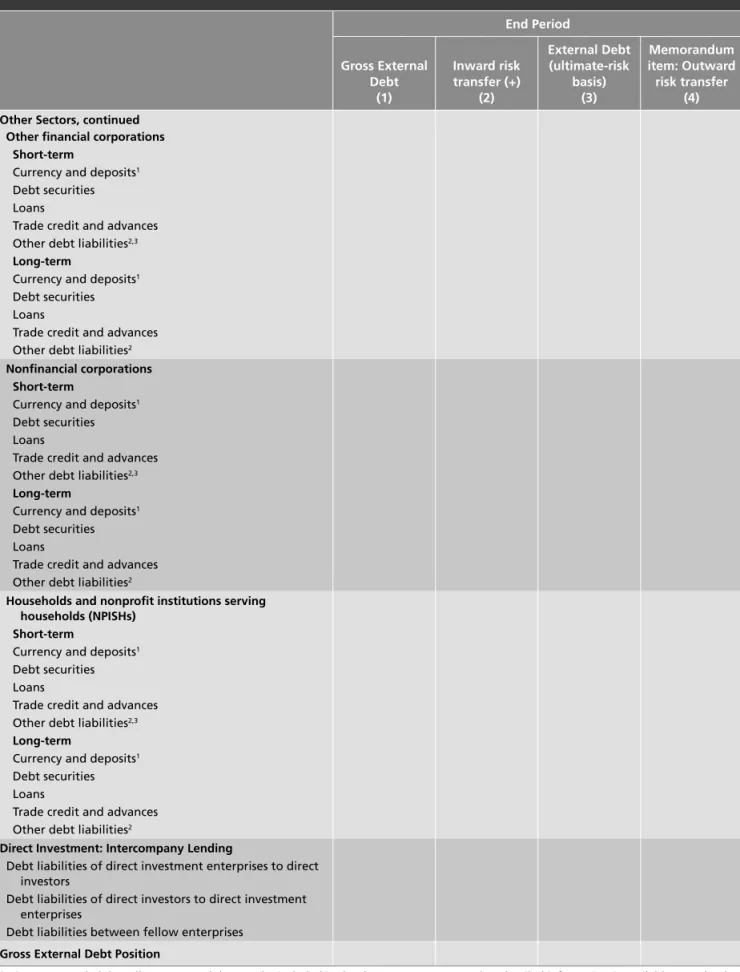
Table 9.3 Gross External Debt Position: Ultimate Risk Basis End Period Gross External Debt (1) Inward risk transfer (+) (2) External Debt (ultimate-risk basis) (3) Memorandum item: Outward risk transfer (4) General Government Short-term
Currency and deposits 1 Debt securities Loans
Trade credit and advances Other debt liabilities 2, 3 Long-term
Special drawing rights (allocations) Currency and deposits 1
Debt securities Loans
Trade credit and advances Other debt liabilities 2
Central Bank Short-term
Currency and deposits 1 Debt securities Loans
Trade credit and advances Other debt liabilities 2, 3 Long-term
Special drawing rights (allocations) Currency and deposits 1
Debt securities Loans
Trade credit and advances Other debt liabilities 2
Deposit-Taking Corporations, except the Central Bank Short-term
Currency and deposits 1 Debt securities Loans
Trade credit and advances Other debt liabilities 2, 3 Long-term
Currency and deposits 1 Debt securities Loans
Trade credit and advances Other debt liabilities 2
Other Sectors Short-term
Currency and deposits 1 Debt securities Loans
Trade credit and advances Other debt liabilities 2, 3 Long-term
Currency and deposits 1 Debt securities Loans
Trade credit and advances Other debt liabilities 2
End Period Gross External Debt (1) Inward risk transfer (+) (2) External Debt (ultimate-risk basis) (3) Memorandum item: Outward risk transfer (4)
Other Sectors, continued
Other fi nancial corporations Short-term
Currency and deposits 1 Debt securities Loans
Trade credit and advances Other debt liabilities 2, 3 Long-term
Currency and deposits 1 Debt securities Loans
Trade credit and advances Other debt liabilities 2
Nonfi nancial corporations Short-term
Currency and deposits 1 Debt securities Loans
Trade credit and advances Other debt liabilities 2, 3 Long-term
Currency and deposits 1 Debt securities Loans
Trade credit and advances Other debt liabilities 2
Households and nonprofi t institutions serving households (NPISHs)
Short-term
Currency and deposits 1 Debt securities Loans
Trade credit and advances Other debt liabilities 2, 3 Long-term
Currency and deposits 1 Debt securities Loans
Trade credit and advances Other debt liabilities 2
Direct Investment: Intercompany Lending
Debt liabilities of direct investment enterprises to direct investors
Debt liabilities of direct investors to direct investment enterprises
Debt liabilities between fellow enterprises
Gross External Debt Position
Table 9.3 Gross External Debt Position: Ultimate Risk Basis (Concluded )
1 It is recommended that all currency and deposits be included in the short-term category unless detailed information is available to make the short-term/long-term attribution.
2 Other debt liabilities comprise insurance, pension, and standardized guarantee schemes, and other accounts payable—other in the IIP state-ment. In the absence of information to make the short-term/long-term attribution, it is recommended that insurance, pension, and standard-ized guarantee schemes be classifi ed as long term.
those recorded as external debt on a residence basis if their residents provide guarantees to nonresidents that might be called. Also, branches of domestic institutions located abroad could create a drain on the domestic economy if they ran into diffi culties and their own head offi ces needed to provide funds. Indeed, the latter circumstances arose for some econ-omies during the global crisis of 2008–2009.
9.43 In Table 9.3 , residence-based external debt data (column 1) is increased by the amount of debt of non-residents, not owned by non-residents, that is guaranteed by a resident entity (inward risk transfer, column 2). Column 3 is the adjusted external debt exposure of the economy. Th e table is set out in this manner so that external debt on an ultimate-risk basis can be related back to the gross external debt position mea-sured on a residence basis.
9.44 Th e intention of column 2 is to measure any additional external debt risk exposures of residents arising from contingent liabilities. Th e defi nition of contingent liabilities adopted is deliberately narrow. To be included in this defi nition of contingent liabili-ties, the debt must exist, so lines of credit and similar potential obligations are not included. Th e data on the inward transfer of risk cover only the debt of a nonresident to a nonresident on which, and as part of the agreement between debtor and creditor, pay-ments are guaranteed to the creditor(s) by a resident entity under a legally binding contract. Th e guarantor will most commonly be an entity that is related to the debtor (e.g., the parent of the debtor entity), and debt of a legally dependent nonresident branch of a resident entity that is owed to a nonresident. If debt is partially guaranteed, such as if principal payments or interest payments alone are guaranteed, then only the present value of the amount guaranteed should be included in columns 2 or 4. To avoid double counting the same
external debt risk exposure, the following should be excluded from column 2: all debt liabilities of non-resident branches to other nonnon-resident branches of the same parent entity; and any amounts arising from external debt borrowings of nonresidents that were guaranteed by a resident entity and on-lent by the nonresident borrower to that same resident entity or any of its branches. Th is guidance is not intended to exclude debt exposures of residents from the ultimate risk concept, as defi ned above, but to ensure that they are counted only once.
9.45 External debt is the liability of the debtor econ-omy. However, as a memorandum item, the amount of external debt of the economy that is guaranteed by nonresidents is also presented (outward risk transfer, column 4). Th e data on the transfer of risk outward covers only external debt on which, and as part of the agreement between debtor and creditor, payments are guaranteed (or partially guaranteed) to the creditor(s) by a nonresident under a legally binding contract. Th e guarantor will most commonly be an entity that is related to the debtor (e.g., the parent of the debtor entity), and external debt of a resident entity that is a legally dependent branch of a nonresident entity. 9.46 No reallocation of risk is made because of the provision of collateral by the debtor, or because a debt instrument is “backed” by a pool of instruments or streams of revenue originating from outside of the economy. Because the intention of Table 9.3 is to mon-itor the potential risk transfer from the debtor side, no reallocation of risk is made if the risk transfer is initi-ated from the creditor side, without any involvement of the debtor, e.g., the creditor has paid a premium to a guarantor, such as an export credit agency unrelated to the debtor, to insure against payment default or has purchased a credit derivative that transfers credit risk exposure.