Falls from plasterers’ work platforms in Australia
S Cowley and S Leggett
Stephen Cowley, PhD, BSc (Hons), MSc, GCert(Ed), is a Senior Lecturer, and Susan Leggett, BAppSc, is a Research Fellow and Lecturer, both at VIOSH Australia, School of Science and Engineering, University of Ballarat.
Address for correspondence: Dr S Cowley, VIOSH Australia, School of Science and Engineering, University of Ballarat, PO Box 663, Ballarat, Victoria 3353, Australia. Disclaimer: The research conclusions and views expressed in this article are those of the authors and do not necessarily reflect those of WorkCover NSW.
Abstract
Plasterers are over-represented in falls-related injury data. When accessing work at height, it is common for plasterers to use stilts, trestles, scaffolds and ladders, as well as other conveniently available items, as work platforms. To determine the prevalence of injuries sustained through the use of work platforms, a review of workers compensation claims recorded between 31 July 2002 and 30 September 2007 in New South Wales and Victoria was undertaken. During this period, 283 workers compensation claims (costing A$19.3m) were recorded. The greatest number of falls was from ladders, followed by scaffolds and trestles. Sixty-one claims (costing A$1.5m) were made for injuries sustained while alighting (stepping off) platforms. Very few injury reports implicated stilts. It is possible that this is associated with the veracity of the data within the claims databases or an under-reporting phenomenon. The findings have implications for policy formulation and demonstrate the need for empirical research that is not dependent on injury data.
Keywords: falls; plasterers; wallboard; construction; stilts
Introduction
In the health and safety literature, there is relatively little information relating to plastering (wallboard installation).1,2 Furthermore, very few reports of empirical research appear to have focused on the risks associated with the use of plasterers’ stilts and trestles or other work platforms, and no quantitative data exist to demonstrate the hazards associated with the use of stilts.3
What reports there are originate almost exclusively from the United Sates, where building practices differ from those used in other countries (such as Australia).
Differences in practices are fundamental. Wallboard or drywall installation is undertaken in Australia by plasterers who represent a specialised occupational group that is traditionally described as ‘‘fibrous plasterers’’, whereas drywall specialists in the US are often classified as ‘‘carpenters’’. Domestic (residential) construction carpenters in the US undertake work associated with groundbreaking/layout, framing, roofing, interior finish other than drywall, exterior finish and remodel/demolition, as well as installing drywall.4 Other differences include board size, architectural and building practice variations, and the use of local materials and formulations in plastering products. In the United Kingdom, plasterboard is usually fixed to the wall vertically, whereas in Australia it is fixed horizontally, and in the UK, plasterers are generally associated with the application of solid or wet plaster. Fibrous plasterers in Australia fix and finish plasterboard. This involves fixing (hanging) sheets of plasterboard to walls and ceilings, filling (stopping) the joints between sheets with a joint compound and tape, and sanding (finishing) the joint. These and other differences make direct comparisons and the wholesale adoption of knowledge from other countries inappropriate.
What is commonly accepted internationally is the significance of the risks that plasterers are exposed to, especially in the area of falls and manual handling.2,5,6,7,8,9,10,11,12
The need for plasterers to reach varying heights to work, and the prevalence of falls-related injuries linked to such work, makes height access and height access equipment an issue of interest. When accessing work at height, it is common for plasterers to use stilts, trestles, scaffolds and ladders (as well as conveniently available items such as upturned milk crates and buckets) as work platforms.
Although some limited attention has been given to plasterers’ work platforms, it is generally as part of a broader investigation, and there is limited detail of the specific platforms or the nature of the problems with them, although falls from ladders are often implicated.10,11,13
Among the few studies that specifically address drywall installers’ work platforms, it has been reported that, among drywall installers, stilts are rated as the most hazardous of three work platforms (stilts, scaffolds and stepladders).14
Subsequently, it was reported in another study that the fall potential while applying tape and skim coats was perceived to be significantly greater when stilts were being used.15 However, when workers were asked about all of the tasks that they perform, it was perceived that stilts did not present a significantly greater fall potential or physical stress than the other platforms.
Whitaker provides the only report of a study that focuses exclusively on the incidence and nature of stilts-related injuries.16 The author analysed 276 workers compensation claims filed with the Washington State Department of Labor and Industries from 1996 to 2002. The greatest number of claims was associated with finishing tasks. Falls were the most common type of occurrence, accounting for 65% of claims. Overexertion (musculoskeletal) injuries comprised 11% of claims. Trips were identified as the leading cause of stilts-related claims, accounting for 38% of all
injuries. Poor maintenance of stilts was said to be associated with 8% of claims, and falls while putting on or taking off stilts with 5% of claims. Whitaker refers to some claims being associated with striking of the head against sprinklers or door jambs (4%), losing balance (4%), or falling while bending over (2%). The study found that a total of US$3.4m was paid on the 276 claims analysed. Pan et al have subsequently undertaken an evaluation of the potential for loss of balance associated with the use of stilts and found that stilt height, foot placement width, and foot placement direction all had significant effects on postural stability and sway.17
Wearing stilts created greater postural instability than wearing no stilts, and instability increased with the height of the stilts.
Plasterers’ stilts and trestles represent the principal means by which plasterers on residential sites in Australia achieve height access. Stilts are widely used as a work platform when finishing plasterboard on domestic construction sites, when stopping (applying jointing compound to the joins in plasterboards), and when hanging cornice. Stilts are not used on commercial construction sites, and they are generally not used while hanging plasterboard (except by screw gun operators who are working in a team with hangers).
Stilts used in Australia are generally imported from the US. There is a range of models and brands but they are relatively similar in construction. Most stilts are constructed using aluminium alloy box or tubular section, and are adjustable and sprung such that the footplate mimics heel and toe movement during normal ambulation.
Among the various individuals and groups associated with the plastering industry in Australia, much contention exists over the use of stilts. Some defend the use of stilts and suggest that, in addition to increased productivity, the risk of injury is reduced because workers may operate at a consistent and comfortable height during finishing instead of repetitively mounting and dismounting trestles and step ladders in order to move to the next work area. Conversely, some contend that workers are at an increased risk of falling and that there is the potential for other musculoskeletal issues to arise, for example, the occurrence of knee joint damage.
Such concerns over the perceived increased falls risk and other stilts-related problems have been expressed by regulators in Australia. WorkCover NSW has advised industry representatives that the use of stilts is considered dangerous and unacceptable.18
WorkSafe Victoria has for some time maintained a position that stilts are unacceptable as a work platform.19
However, in a current guidance note, WorkSafe Victoria advises that the approach to the use of plasterers’ stilts has been relaxed and the use of stilts is sanctioned when a risk assessment has been completed and builders have comprehensively adopted the principles of ‘‘plaster-readiness’’ (that is, the building site working environment is ready to receive and store plasterboard first, and then for wall and ceiling activities to be undertaken).20
Internationally, California, New York City and the Province of Ontario, Canada, are examples of jurisdictions which similarly prohibit the use of stilts.3,17
To gain a clearer picture of the size and nature of the injury problem associated with plasterers’ work platforms in Australia, an analysis of injury data was undertaken relating to the falls risks and manual handling injuries associated with the use of stilts and trestles and other work platforms.
Methods
Workers compensation bodies (authorities) in each of the six states in Australia were requested to supply injury data pertaining to plasterers’ platform use for the period 31 July 2002 to 30 September 2007. A letter of request was sent to each workers compensation body requesting that they search their databases for the occurrence of a broad range of terms pertaining to plasterers’ platforms. These search terms were selected on the basis of experience in the field, consultations with industry representatives, and a desire to be as inclusive as possible.
Acquisition and review of the workers compensation data from Australian OHS regulators and workers compensation bodies was approved by the University of Ballarat Human Research Ethics Committee prior to the commencement of the work. Datasets were received from New South Wales and Victoria only. Representatives from each of the remaining state authorities within Australia declined to provide the information on the basis that stilts were not widely used in their jurisdiction or that their claims database was not sufficiently detailed to identify claims that were associated with stilt, trestle or other platform usage.
Included in the NSW dataset were 1,621 injury claims. Included in the Victorian dataset were 8,137 claims. A claim in NSW is defined as an injury reported to the employer’s insurer. A claim in Victoria is defined as an injury that results in more than 10 days’ lost time or medical costs that are in excess of approximately A$500 (this figure is indexed annually and therefore varied during the period under study). Claims that do not reach either the days’ lost or medical costs threshold are considered to be minor claims.
The details of each claim were reviewed and claims were retained for analysis if they: (1) pertained to an injury that was a direct result of using a work platform during a plastering activity in the construction sector; and (2) pertained to an injury that was sustained while stepping off the platform (ie while alighting) or as a result of a fall (ie an uncontrolled rapid descent of the body and striking the floor or other surface or object with part of the body) from the platform. The claims that satisfied these conditions were categorised with regard to injuries that resulted from working on, falling from, mounting or alighting stilts, trestles, scaffolds, ladders, scissor lifts, or other work platforms.
Results
Falls
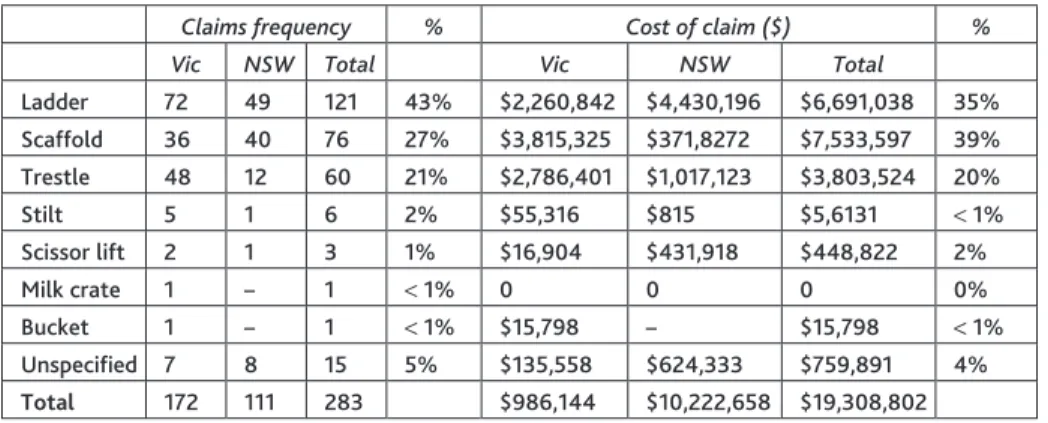
Among the claims made to the NSW and Victorian workers compensation system between 31 July 2002 and 30 September 2007, a total of 283 claims (costing a total of A$19,308,801) were associated with falls from stilts, trestles, scaffolds, ladders,
scissor lifts or other unspecified work platforms. The majority of falls were from ladders, but the greatest cost was associated with scaffolds (see Table 1). In Victoria, 16,849 work days were lost (mean = 98; median = 16) as a result of the falls injuries that were sustained. Of the claims, 44 were made for injuries that resulted in no lost time (claims were made for medical costs only). Details of lost time were not provided by the NSW authority.
Table 1: Frequency and cost of falls from plasterers’ work platforms in NSW and Victoria
Claims frequency % Cost of claim ($) %
Vic NSW Total Vic NSW Total
Ladder 72 49 121 43% $2,260,842 $4,430,196 $6,691,038 35% Scaffold 36 40 76 27% $3,815,325 $371,8272 $7,533,597 39% Trestle 48 12 60 21% $2,786,401 $1,017,123 $3,803,524 20% Stilt 5 1 6 2% $55,316 $815 $5,6131 < 1% Scissor lift 2 1 3 1% $16,904 $431,918 $448,822 2% Milk crate 1 – 1 < 1% 0 0 0 0% Bucket 1 – 1 < 1% $15,798 – $15,798 < 1% Unspecified 7 8 15 5% $135,558 $624,333 $759,891 4% Total 172 111 283 $986,144 $10,222,658 $19,308,802
Among the NSW claims for falls-related injuries, stilts were implicated in one claim that was associated with a back strain injury. However, the coding in this claim was ambiguous and implied that the injured worker was employed in the vegetable growing industry but was undertaking plastering work. The claim was included in the analysis as it is possible that the injury was sustained by a plasterer who was engaged in the hanging or finishing of plaster at a vegetable growing facility. Alternatively, the injury may have been sustained by an employee who was engaged in a vegetable growing activity (eg picking) and was using stilts as part of the work being undertaken. This would mean that the injury was miscoded in the claims database.
The greatest numbers of injuries resulting from falls from all platforms were fractures, muscle strain and contusions (see Table 2), and the wrist, back and knee were the most frequent location of injury.
Table 2: Nature and location of injuries resulting from falls from all work platforms in NSW and Victoria combined
Nature of injury Frequency %
Fracture 94 33%
Muscle strain 61 22%
Table 2: Nature and location of injuries resulting from falls from all work platforms in NSW and Victoria combined
Back strain/injury 21 7% Joint/ligament 22 8% Dislocation 7 2% Muscle/tendon tear 5 2% Laceration 6 2% Intracranial 2 1% Other 36 13% Location of injury Wrist 37 13% Back 35 12% Knee 35 12% Shoulder 32 11% Ankle 22 8% Leg 22 8% Trunk 16 6% Arm 17 6% Foot 9 3% Hand 12 4% Hip 6 2% Elbow 7 2% Neck 6 2% Ribs 7 2% Head 5 2% Other 15 5%
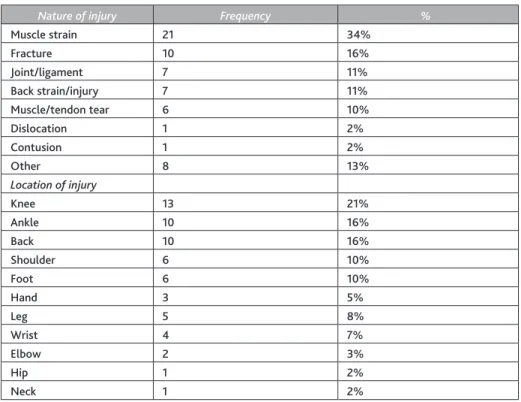
Among the claims made to the NSW and Victorian workers compensation system, 61 were associated with stepping off (ie while alighting) work platforms, and the majority of these injuries were associated with ladders (see Table 3). The majority of the injuries were muscle strain and the knee, ankle and back were the most frequently injured bodily locations (see Table 4). In Victoria, 784 work days were lost (mean = 18; median = 2) as a result of the stepping-off injuries sustained. Ten claims were made for injuries that resulted in no lost time and were thus made for medical costs only. Details of lost time were not provided by the NSW authority.
Table 3: Frequency and cost of injuries resulting from stepping off all work platforms in NSW and Victoria
Claims frequency % Cost of claim ($) %
Vic NSW Total Vic NSW Total
Ladder 24 7 31 51% $549,645 $646,573 $1,196,218 80%
Trestle 10 6 16 26% $78,324 $110,937 $189,261 13%
Table 3: Frequency and cost of injuries resulting from stepping off all work platforms in NSW and Victoria
Unspecified 2 2 3% $1,004 $1,004 0%
Total 44 17 61 100% $683,327 $811,690 $1,495,017 100%
Table 4: Nature and location of injuries resulting from stepping off all work platforms in NSW and Victoria combined
Nature of injury Frequency %
Muscle strain 21 34% Fracture 10 16% Joint/ligament 7 11% Back strain/injury 7 11% Muscle/tendon tear 6 10% Dislocation 1 2% Contusion 1 2% Other 8 13% Location of injury Knee 13 21% Ankle 10 16% Back 10 16% Shoulder 6 10% Foot 6 10% Hand 3 5% Leg 5 8% Wrist 4 7% Elbow 2 3% Hip 1 2% Neck 1 2% Discussion
The injury data from NSW and Victoria confirm that there are a significant number of injuries associated with falls from work platforms. However, it should be emphasised that the databases represent compensable injuries only; therefore, there are likely to be injuries that did not result in claims and these are unrecorded.
There was no evidence of musculoskeletal damage (other than that suffered during a fall or while alighting) as a result of the use of a platform. Given the cumulative nature of many musculoskeletal injuries, this is perhaps unsurprising and may be explained by the inability of a claimant to attribute an injury to a specific platform or task.
It is also not surprising that there is a greater number of injury claims associated with falls from platforms than those associated with stepping off. The greatest number of falls was from ladders (43%), followed by scaffolds (27%) and trestles (21%), and this
may reflect the relative frequency of use. However, it was not possible to separate domestic (residential) construction workers’ claims from commercial. Scaffolds are likely to be used more frequently in commercial work and trestles in residential, and separation of the data may have changed the relative frequency of claims.
Stepping-off injuries are of interest, given the anecdotal evidence that plasterers jump off platforms like trestles and low scaffolds when alighting, rather than climbing down. Plasterers’ anecdotes regarding jumping and landing awkwardly are supported by the high number of knee injuries (21%) found in this study associated with stepping off.
Fractures were the most common injuries (33%) resulting from falls, with the wrist (13%), back (12%) and knee (12%) being the most common locations of injury. Muscle strain was the most common (34%) stepping-off injury and the knee (21%) was the most common location of injury. It is likely that the stepping-off injuries resulted in awkward landings and stumbling, resulting in muscle strains and knee injuries. Falls are more likely to result in the plasterer striking the floor or another structure with greater velocity, and thus fractures.
Importantly, there are very few reports of injuries within the reviewed claims data that implicate stilts in the injuries sustained. Given the widespread use of stilts, prima facie the findings suggest that the risk of injury while using stilts is low relative to the use of ladders and trestles. However, intuitively, and supported by the work of Whitaker,16
one expects a greater number of injury claims within the datasets to make reference to stilts. The very low number of claims may be attributable to a number of factors. One may be related to the veracity of the data within the claims databases that is dependent on the quality of the information provided by the claimant and the ability of the person entering the data to find coding that represents the actual circumstance and consequences of an event.21
Further, codes in workers compensation injury datasets do not generally include a term that identifies stilts. This is the case in Australia and in at least some states of the US.13 Further confounding analysis of the injury data is the generally accepted underreporting of injuries in the domestic construction sector.
Compounding this problem is the likelihood that reports of injuries involving stilts omit reference to the devices due to reluctance on the part of the claimant to be identified as a user in a jurisdiction that either prohibits or discourages the use of stilts (both NSW and Victoria either prohibit or discourage such use). In Victoria, stilts were prohibited until recently, and there remains much confusion and misunderstanding among plasterers in regard to their current legitimacy of use.
Conclusion
It is evident that falls from work platforms are significant. However, in the absence of any reliable data with which to construct an evidence base, policy and rules regarding the acceptability and use of plasterers’ platforms will continue to be based on subjective assessments of risk. Given that plasterers will, by necessity, work above floor level, some form of platform will be required to complete their work and thus an assessment of relative risk is important in objectively determining a preference.
Having identified a preferred platform, guidance may be provided with regard to its use and appropriate messages prepared to encourage its use (and alternatively discourage the use of platforms that expose users to greater risk). In concurring with the recommendations of earlier research,7
further work is required regarding the safety of plasterers’ platforms while undertaking different plastering tasks.
Acknowledgments
This research was funded under the WorkCover NSW WorkCover Assist Program.
1 Lipscomb, H, Cameron, W and Siverstein, B. Back injuries among union carpenters in Washington State, 1989–2003. American Journal of Industrial Medicine 2008, 51: 463–474.
2 Cowley, S and Leggett, S. Prevention of falls and manual handling injuries among plasterers: the case for intervention. Journal of Occupational Health and Safety — Australia and New Zealand 2003, 19(5): 447–456.
3 Pan, C, Miller, KM, Chiou, S and Wu, JZ. Evaluation of a computer-simulation model for human ambulation on stilts. Journal of Mechanics in Medicine and Biology 2004, 4(3): 283–303.
4 Lipscomb, H, Dement, J, Li, L and Nolan, J. Work-related injuries in residential and drywall carpentry. Applied Occupational and Environmental Hygiene 2003, 18(6): 479–488 at p 481.
5 Pan CS, Chiou, SS, Hsaio, H, Wassell, JT and Keane, P. Assessment of perceived traumatic injury hazards during drywall hanging. International Journal of Industrial Ergonomics 1999, 25(1): 29–37. 6 Lipscomb, H, Dement, J, Loomis, D, Silverstein, B and Kalat, J. Surveillance of work-related
musculoskeletal injuries among union carpenters. American Journal of Industrial Medicine 1997, 32: 629–640.
7 Chiou, SS, Pan, CS, Zwiener, J, Long, D and Cantis, D. Assessment of fall potential associated with drywall lifting. Advances in Occupational Ergonomics and Safety 2001, 4: 55–61.
8 Health and Safety Laboratory. Musculoskeletal problems in bricklayers, carpenters and plasterers: literature
review and results of site visits. Report no ERG/01/01. Sheffield: Health and Safety Executive, January
2001.
9 Construction Safety Association of Ontario. Dust and disorders — drywall finishing study. Network
News 2003, April: 1–2.
10 Chiou, SS, Pan, CS and Keane, P. Traumatic injury among drywall installers, 1992 to 1995. Journal
of Occupational and Environmental Medicine 2000, 42(11): 1101–1108.
11 Field, B, Larsson, TJ, Kenningham, L and Lee, S. Falls from heights: a report on claims, fatalities and
injury severity outcomes. Policy research report no 8. Melbourne: Victorian WorkCover Authority, June
2000.
12 Lipscomb, H, Dale, AM, Kaskutas, V, Sherman-Voellinger, R and Evanoff, B. Challenges in residential fall prevention: insight from apprentice carpenters. American Journal of Industrial Medicine 2008, 51: 60–68.
13 Lipscomb, H, Leiming, L and Dement, J. Falls among union carpenters. American Journal of
Industrial Medicine 2003, 44: 148–156.
14 Pan, C and Chiou, S. Analysis of biomechanical stresses during drywall lifting. International Journal
15 Pan, CS, Chiou, SS, Hsaio, H, Becker, P and Akladios, M. Assessment of perceived traumatic hazards during drywall taping and sanding. Advances in Occupational Ergonomics and Safety 1999, 3: 313–318.
16 Whitaker, C. Stilts injuries in construction. Professional Safety 2006, September: 39–44.
17 Pan, C, Chiou, S, Tsui-Ying, K, Bhattacharya, A and Ammons, D. Effects of foot placement on postural stability of construction workers on stilts. Applied Ergonomics 2009, 40(4): 781–789. 18 Personal communication. Association of the Wall and Ceiling Industries (NSW), 5 September
2008.
19 WorkSafe Victoria. Why WorkSafe will not tolerate the use of stilts for construction work. Melbourne: WorkSafe Victoria, 2002 July.
20 WorkSafe Victoria. Use of plasterers’ stilts. Melbourne: Victorian WorkCover Authority, May 2007. 21 21. Viner, D, Harvey, J and Borys, D. A critical evaluation of the Australian accident classification