Application of Knowledge Management
Approach on Agricultural Development in
Developing Countries
Research Paper
M. Senapathy
Corresponding author: [email protected]
Department of Rural Development and Agricultural Extension College of Agriculture Wolaita Sodo University
Ethiopia
M. Pandikumar
Corresponding author: [email protected] Ultra Engineering College and Technology Madurai, Tamil Nadu, India
About the authors
M. Senapathy received his Ph.D in Rural Development in Gandhigram Rural University, India. He has been doing research with in the field of agriculture management for more than 25 years. He is experienced in the evaluation studies related to Watershed Management Projects at the district level in Tamil Nadu, India. In 2012, he joined Wolaita Sodo University where he is teaching both Rural Development and Agriculture Knowledge Management. His primary research interests include rural development, environment, sustainable development and climate change.
Abstract
Agriculture is a core stone of the economy for the most of the developing countries in the world and it is going to be fundamental base for further development of the other sectors as well. Nowadays, we can witness a period of dynamic changes and transformations that affect the rural areas in particular and the society in general. Today, Ethiopian agriculture is transforming from subsistence farming into market-oriented sector of economy. Thus, leveraging knowledge is an essential element for the transformation of Ethiopian agriculture from subsistence farming into commercially successful sector. The main objective of the research study is to identify the current level of managing tacit and explicit knowledge by smallholders, and to examine the application of the Nonaka’s knowledge management approach in the agriculture of the developing countries. The study was conducted in the Wolaita Zone in Southern Nations Nationalities and Peoples Region (SNNPR) of Ethiopia covering 21 rural districts and 3 urban districts. Among them only 3 districts, such as Humbo, Areka from Boloso Sore Woreda and Boditti from Damot Gale Woreda, have been selected for this research study. In the total, 128 farmers were selected by using simple random sampling method. The research findings were measured and interpreted based on quantitative and qualitative data techniques. The study concluded that despite the education level of the smallholder farmers integration of new technologies is in need. It is also recommended to create a possible model of linking appropriate knowledge with responsible institution for successful KM process in the country for further development.
Keywords:Knowledge economy, Knowledge management, Scientific knowledge, Agricultural development, Agriculture professionals
Introduction
and thus contributes to the alleviation of rural poverty.
Evolution of Knowledge Management
The knowledge economy is also seen as the latest stage of development in global economic restructuring. Thus far, the developed world has transitioned from an agricultural economy into industrial economy. The knowledge economy is the use of knowledge to generate the tangible and intangible values. The knowledge society is called as Information Society term knowledge has combined both information and data. The knowledge is the resource or capital or asset of the particular community or society which the societies hold for productive purposes. The pioneer of Knowledge Management Peter Ducker also defines “knowledge” “as the capacity for effective action, clearly distinguishing it from data and information.” Knowledge and Knowledge Management are words and terms that are being bantered around quite a bit today. Peter makes an observation that these are terms that have become fads. He makes the point that Knowledge Management is just another term in the on-going continuum of business management evolution.
Most of the researchers have recognized the hybrid nature of the Indigenous Knowledge (IK) and the Scientific Knowledge (SK) which are part of creative synthesis of local, national, global, insider and outsider and a traditional form of knowledge Zent (2009). The potential use of IK in the economic development of local farmers are highly recognised all over the world (Iyoro and Ogungbo 2013; Maisri, 2017; WIPO, 2010), as it is seen as a set of techniques, perceptions, data, information and behaviour that helps the local farmers’ community to use their land and natural resources effectively (Iyoro and Ogungbo, 2013).
The concept of Knowledge management is growing increasingly popular in all sectors of the global econ-omy because of its confirmed importance in fostering knowledge creation, codification, preservation and transfer, and the ability to greatly improve the knowledge capital of an organization (Fullwood and Rowley, 2017; Njiraine, Ocholla and Onyancha, 2010, Pathak and Nigam, 2017). Furthermore, the application of KM is still in its infancy in most developing countries. Therefore, it is important to promote KM practices in rural farming communities.
Indigenous Knowledge
The knowledge or know-how (Skill or capability derived from knowledge and experience) is that people carry in their heads. Compared with explicit knowledge, tacit knowledge is more difficult to articulate or write down. So it tends to be shared between people through discussion, stories and personal interactions. It also includes skills, experiences, insight, intuition and judgment.
Tacit Knowledge is personal knowledge embedded in individual experience and involves intangible factors such as personal belief, perspective, and the value system. It is hard to articulate with formal language. Still it can be communicated into words, models or numbers that can be understand. Tacit knowledge resides in the mind of the farmers.
terms: traditional knowledge, indigenous knowledge, village knowledge, farmers’ knowledge, local knowledge, traditional ecological or environmental knowledge, aboriginal tradition, traditional wisdom or traditional science, cultural patrimony, folklore and cultural heritage (Ngulube and Onyancha, 2017); Ngulube, 2002; WIPO, 2006). However, the uses of IK seem to have become more popular than others (Ngulube and Onyancha, 2017).
Indigenous knowledge is basically local. It is actually oral and mostly undocumented (Ellen and Harris, 1996). It is more practical, rather than theoretical, and repeating in time (Ranger, 1983). It is highly functional and therefore, rediscovered in time. Indigenous knowledge is generated through informal exper-iments by trial and error, intimate understanding of the environment in a given culture and accumulation of generation-wise intellectual reasoning of day-to-day life experiences (Mapara, 2009; Ngulube, Dube and Mhlongo, 2015). It is characterized by being embedded in culture and being unique to a given society (Boven and Morohashi, 2002). It is referred to as the know-how, skills, innovations, practices, teachings and learning, resulting from intellectual activity and developed within a traditional context (WIPO, 2012).
Indigenous knowledge (IK) is socio-economically viable and effective, involves minimum risk to rural farm-ers, and is an important asset for their livelihood and for conserving natural resources. IK is an important on many fields; including agriculture, health, veterinary services, arts and crafts. For instance, agricultural activities have been increasingly productive, sustainable and ecologically sound, even under difficult con-ditions, due to the utilisation of IK in developing countries (Mugurusi, 2001). Indigenous knowledge is a cumulative body of knowledge created over decades, representing over the generations of creative ecosystem of countries of residence, in an effort to cope up with an ever-changing agro-ecological and socio-economic environment (Kaniki and Mphahlele, 2002). IK is a social capital of the majority of the poor in developing countries and a source of their social strategies.
It is unfortunate that IK has largely been marginalized, neglected and suppressed due to ignorance and arrogance, politics and the dominant ideology of a particular historical period (Ocholla and Onyancha, 2005). In spite of these positive developments, IK is threatened by socialization, the education system, the influence of western technology, and the lack of availability of certain crops, which limit the local people’s especially youths’, use of IK in these developing countries (Dube and Musi, 2002). The IK was not properly documented due to lack of recognition and unimportant for future utility. There is an urgent need to store, record, document of the IK because it has greater impact on agriculture particularly in the developing countries. It also needs Patent right. It is important to store those unrecognised IK to enhance its availability for development initiatives before much of it is completely lost.
Support of Indigenous Knowledge for Agriculture
sustainable only under low-input-low-output regimes. The introduction of mechanization, fertilizers and phytomedicines turned some of these systems into high-input-high-output systems, most of which were ei-ther not sustainable or did not produce the high yield that were expected (Aluma, 2004). The modernization of agriculture has also reduced the genetic variability of crops and livestock. It is estimated by the Food and Agricultural Organization (FAO) that 30% of animal genetic resources are at high risk of loss due to neglecting IK in favour of conventional scientific findings (Muyungi and Tillya, 2003). However, in develop-ing countries, indigenous farmdevelop-ing has received little agricultural research attention. Thus, development of indigenous farming methods rely on the farmers’ observation, experimentation, adaptation, and propagation of new ideas gained through experience. There is a need to continuously recognise, identify, validate, preserve and disseminate indigenous skills and practices for improved agricultural activities.
Scientific Knowledge
Scientific Knowledge is often referred to as Western Knowledge. Technology is stated that the systematic, conceptual, time bound and technological innovation which speculates the cause and effect of the determined events. It requires specialized knowledge atmosphere like laboratory situation in which the scientists could invent new hybrid varieties according to the demand of the farmers and to fulfill the expectations of the nation’s growth and development. Scientific Farming is the scientific knowledge of ecology and modern technology with traditional farming practices based on naturally occurring biological processes. It is about soil, plant, water, rain, insecticide, fungicide, machinery, irrigation, meteorology and so on.
Explicit Knowledge can be recorded digitally in documents, records, patents and other intellectual prop-erty artefacts. Explicit knowledge can be manipulated within the digital domain, can be articulated into formal language, words, numbers, in the documents manuals, can be processed by a computer, transmitted electronically or stored in databases.
Knowledge is that can be expressed, articulated easily in words or numbers, and can be shared through discussion or by writing it down and putting it into documents, manuals or databases. Examples might include a telephone directory, an instruction manual, or a report of research findings. Explicit knowledge is the knowledge management model in most developing countries has been based on acquiring, organising and preserving explicit knowledge, which is mainly generated by researchers, agricultural scientists, laboratories and universities (Ngulube, 2002). At the same time, the dominant approach to research and extension still follows the pattern of transfer-of-technology, based on the assumption that knowledge is created by scientists, to be packaged and disseminated by extension agents, and to be applied by the farmers at greater extent (Assefa, Waters-Bayer, Fincham and Mudahara, 2009).
Support of Scientific Knowledge for Agriculture
are examples of structured knowledge because the data or information are organized for future retrieval. In contrast, e-mails, images, training courses, and audio & video selections are examples of unstructured knowledge because the information are not referenced for retrieval. There are around 50 Agriculture Re-search Stations are in Ethiopia releasing new hybrid variety seeds on every years to the village farmers. Scientific method of agricultural process needs improved seeds, chemical fertilizers including equipment’s for easy operations. The rate of growth of agricultural yield will increase by the effective scientific method of cultivation practices. Scientific knowledge is otherwise called as explicit knowledge.
Application of Knowledge Management Approach
Knowledge management encompasses the managerial efforts in facilitating the activities of acquiring, storing, sharing, defusing, developing and deploying knowledge by individuals and groups (Fullwood and Rowley, 2017; Rowley, 2001; Soliman and Spooner 2000). Knowledge management is become so important because of the pace of change (Hanson and Kararach, 2011; Pathak and Nigam 2017). When change occurs, whether external or internal to an organization, institution, community, society or any entity, people need new knowledge to enhance their existing knowledge to do their work efficiently. Knowledge management has been successfully applied by many formal organizations to build their competitive strength and achieve a sustainable growth pattern (Ichijo and Nonaka, 2007). Knowledge can be both Tacit and Explicit (Lwoga and Ngulube, 2007; Von Krogh, Ichijo and Nonaka, 2000), irrespective of whether it is indigenous or Western. The difference between knowledge in the Western tradition and IK is that the latter are largely undocu-mented or unrecorded and predominantly Tacit (Lwoga and Ngulube, 2007). Tacit and Explicit knowledge can be by managed using KM approaches, Lwoga, Ngulube and Stilwell (2010), observe that IK is hard to manage because it is mainly Tacit in nature or embedded in practices and experiences that are highly personal and difficult to codify and diffuse.
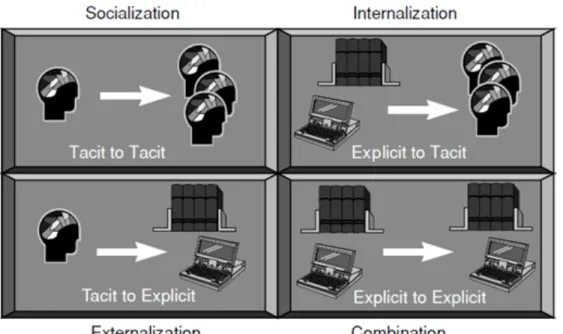
Although Indigenous Knowledge is basically tacit, which can be articulated both tacitly and explicitly through artefacts (Traditional technologies and tools) produced by indigenous people in the form of music, storytelling, dance, knowledge sharing and through the KM methods such as the Socialization, Externalisa-tion, Combination and Internalization (SECI) model developed by Nonaka, Toyama and Konno, 2000). The SECI knowledge creation model links Tacit and Explicit knowledge through four phases and has a potential of converting Tacit Knowledge into Explicit Knowledge and vice versa. By using the SECI model of Nonaka of KM methods to understand the practical utility of the ground level knowledge by the village farmers.
A few studies (Boateng, 2006; Ha et al., 2008; Noeth, 2004) have attempted to analyse the role of KM approaches in managing farmers’ knowledge and there has been little attempt to examine the use of KM approaches and the role of ICT in managing IK in the local communities.
Knowledge Management Conceptual Framework
Drawing from Ngulube (2018), the conceptual framework drew from several sources, theories and models. The conceptual framework employed for this research study is Nonaka’s (1994) dynamic model of knowledge creation and the improved model of knowledge creation described by Nonaka et al. (2000). Nonaka and Takeuchi’s (1995) model emphasized the creation of knowledge through the conversion of Tacit into Explicit knowledge and vice versa. Through: Socialization (from Tacit to Tacit knowledge through shared experi-ences); Externalization (from Tacit to Explicit knowledge with the help of metaphor, models and analogies, such as printed materials and rock paintings); Combination (from Explicit to Explicit knowledge through ICT), and Internalization (from Explicit to Tacit through learning by doing or translating theory into prac-tice). Boisot’s (1987) knowledge category model supports the Nonaka model by regarding organizational knowledge as either codified or uncodified, and as diffused or undiffused refers to knowledge that is difficult to share. In contrast, Probst et al. (2000) put major emphasis on KM processes, which include knowledge identification, acquisition, development, retention, distribution and utilisation.
Nonaka’s (1991) dynamic model of organisational knowledge creation posits that organisational knowledge is created through a continuous dialogue between Tacit and Explicit knowledge through four patterns of interactions: Socialization, Externalization, Combination and Internalization processes Nonakaet al. (2000)
further improved the model of knowledge creation to include two elements: 1. The SECI process, the process of knowledge creation through Socialization, Externalisation, Combination and Internalization and 2. The knowledge is shared in the agricultural environment and village conditions within knowledge is shared, created and utilised. According to Nonakaet al. (2000) the knowledge-creating process is necessarily context-specific in which the farmers and how they participate and acquire the new knowledge are according to the situation available in the village environment.
SECI MODEL
The SECI Model(Socialization, Externalization, Combination and Internalization) was developed in 1991 by Professor Ikujiro Nonaka of Japan Institute of Science and Technology. According to the Professor Ikujiro Nonaka, knowledge creation is a spiraling process of interactions between explicated and tacit knowledge. The interactions between the explicit and tacit knowledge lead to the creation of new knowledge. The combination of the two categories makes it possible to conceptualize four conversion patterns. Nonaka also suggests a different approach which facilitates the knowledge conversion for his SECI Knowledge Creation Model.
Socialization (Tacit to Tacit). This process is due to the interaction with many individuals to share tacit knowledge with each other on open environment at any natural settings. The study found that majority of the smallholder farmers have acquired the Tacit knowledge from Grandparents (91, 71.13%) followed by Farmers personal experience (89, 69.5%) and Friends & Relatives (73, 57.1%). Agriculture Indigenous knowledge was basically acquired and mutually shared within local communities. Farmers preferred to hear FM Radio, and watch community TV but, limited use of reading pamphlets, newspaper and bit notice due to lack of education. It is, therefore, indicated that IK is spontaneously created and shared within local and informal social networks with limited exposure to outside knowledge. The same type of research was conducted in Nigeria (Olatokun and Ayanbode, 2008).
This mode enables the conversion of tacit knowledge through interaction between individuals. One important point to note here is that a model farmer has received the new agriculture technology from the Development Agents that he might explain to his fellow farmers in the village. This interaction of the farmers will have greater effect because both are from the same village. Generally, the farmers have greater confidence building with his native farmer. These six villages of the three district that the smallholder farmers are mostly illiterate. The dissemination of tacit knowledge with the help of the farmer to farmers in these village were comfortable of acquiring the indigenous knowledge. The field demonstration was an incident in the farmers’ field itself has more clarity of understanding the reality by direct observation. The key to acquiring tacit knowledge is experience. Without some form of shared experience, it is extremely difficult for people to share each other’s thinking process.
knowledge but this kind of practice at a very low rate. This was due to lack of education and expressing their ideas in a technical way was very limited in the local communities. Now a days, under graduate students are entering into the agriculture could succeed in expressing the tacit into explicit knowledge. The externalization process has become successful that there might be chances of making patent rights for the indigenous tacit knowledge. The research study findings showed that only (21, 16%) smallholder farmers were involved in Farmer Researcher Group. The study recommends that farmers have to become the member of as many as formal and informal organization at the village level.
The farmers are used to address their demand to the concerned agriculture offices in the study area. Externalization is the process of delivering the tacit knowledge from the farmers to agriculture professionals. It requires the expression of tacit knowledge and its translation into comprehensible forms that can be understood by agriculture specialists. In philosophical terms, the individual transcends the inner and other boundaries of the self. During the externalization stage of the knowledge creation process, individual commits to the group, and thus becomes one with the group. The sum of the individual’s intentions and ideas fuse and become integrated with the group’s mental world. In practice, externalization is supported by two keys factors. First, the articulation of tacit knowledge, that is, the conversion of tacit into explicit knowledge, involves techniques that help to express one’s ideas or images as words, concepts, Figurative language (such as metaphors, analogies or narratives) and visuals. Dialogues, listening and contributing to the benefit of all participants, strongly support externalization.
Combination (Explicit to Explicit). Combination involves the conversion of explicit knowledge into more complex sets of explicit knowledge. In this stage, the key issues are communication and diffusion processes and the systemization of knowledge. Here, new knowledge generated in the externalization stage transcends the ground in analogues or digital signals. Combination integrates two different types of explicit knowledge for single activity in order to strengthen the event. If a farmer learnt the lesson from the training that 50Kg of DAP for 1 hectare of land then the Ethiopian farmers used to attend the Training in Farmer Training Centre (FTC) or ATVET Colleges thereafter they might have got more explicit knowledge ideas successfully. After some years, the knowledge is growing day by day, so it must be updated the content of the explicit knowledge frequently. If a farmer becomes strong in explicit knowledge then it will lead to equip him /her for another stage. For instance, a farmer has the knowledge of operating cell phones then he will have a chance to learn to connect many social networks like Cooperatives, MFIs and Ethiopian Commodity Exchange (ECX) etc. The research finding showed that there was low interaction with ICTs devices and due to lack of education that the farmers are not ready to read any books, pamphlets (3, 2.3%) of explicit knowledge. The observation of FM Radio and TV has great impact of Farmer’s explicit knowledge.
transformation. The process of internalizing could be blocked by many variables like age, education, land size, economic status and attitude of the smallholder farmers in general. The study observed that ICT usage like Cell phone accessed by very few farmers because it needs practice of operating technically.
Internalization of newly created knowledge is the conversion of explicit knowledge into the organization’s tacit knowledge. This requires the individual to identify the knowledge relevant for one’s self within the organizational knowledge. That again requires finding one’s self in a larger entity.
To put it in nutshell, all the four types of Nonaka and Takeuchi’s (1995) knowledge creation model SECI were practiced by the farmers in the villages. These results were similar to earlier studies of Ha, Okigo and Igboaka (2000). The farmers easily acquired the knowledge through Socialization and Combination process, but Externalization and Internalization were not successful because of the farmers were reluctant to use these process continuously.
Methodology
The research study was conducted in three districts of Wolaita Zone in Southern Ethiopia viz., Humbo, Areka (Boloso Sore District) and Boditti (Damot Gale District). The study districts were selected on the basis of agro-ecological nature of the locations such as Humbo district-low land, Areka district (Boloso Sore Woreda) and Boditti (Damot Gale District) are in mid-highland areas. Wolaita Zone is bounded by Kambatta and Hadiya zone in the north, Dawro in the West, Sidama in the East and Oromiya in the southeast and Gamo Zone in the South.
Wolaita seats between 6.40 through 7.10 north latitude and 37.40 through 38.20 east longitudes. Wolaita area is roughly 438,370 hectare or 4500 square kilo meters. Its population falls at different censuses taken in the nation between 2 million and 1.7 million. Its population density is 222 persons in square kilo meters. Wolaita consists of highland, mid-land, low-land climatic zones. The mean rain fall of Wolaita ranges between 600mm through 1400mm and its attitude range 1200m through 2800m above sea level (CSA, 2008).
The main activity of Wolaita people is mixed agriculture. This economic activity is supplemented by trade and handicrafts. The chief produce of Wolaita consists of Enset (false banana), taro (cocco yam), sweet potato, Irish potato, cassava from root crops, sorghum, barley, wheat and maize from grain crops and ginger, coffee, tobacco and cotton from cash crops. The cultural pattern of Wolaita comprises arti-crafts, handicrafts, traditional belief, costume, custom, mores and folklore, creative culture, language, traditional dietary, mourning and marriage.
Humbo Woreda’s population is 1677,012. In rural area there are Male and Female population which gives the total of 158,698 and 8,312 are urban population. In rural area, the number of women is 79,136 and the Male number is 79,562. In urban area the number of women is 3,942 and the male is 4,372. The total Male headed households are 22,130 and total Female head of the area are 5,954, thus totally 28,084.
Fig. 2 Map of the Wolaita Zone, 2018
There are two main cropping seasons in the area such as Belg and Meher. The Belg season begins from late February to early April where Maize, haricoat bean, Enset, sweet potato and Irish potato were planted. The Meher cropping season begins from late June up to the end of the September. Crops like Wheat, Barley, Teff, Sweet potato, Irish potato are planted in the Wolaita Zone (WZARDO, 2007).
Results and Discussion
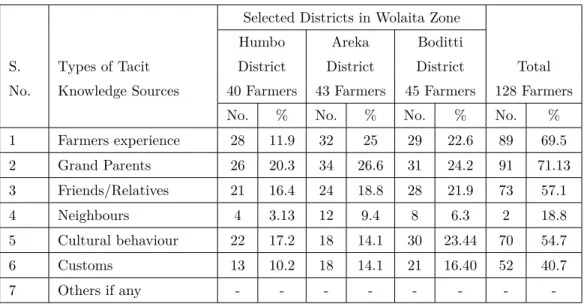
Table 1 Tacit Knowledge Acquisition / Exposure
Selected Districts in Wolaita Zone
Humbo Areka Boditti
S. Types of Tacit District District District Total
No. Knowledge Sources 40 Farmers 43 Farmers 45 Farmers 128 Farmers
No. % No. % No. % No. %
1 Farmers experience 28 11.9 32 25 29 22.6 89 69.5
2 Grand Parents 26 20.3 34 26.6 31 24.2 91 71.13
3 Friends/Relatives 21 16.4 24 18.8 28 21.9 73 57.1
4 Neighbours 4 3.13 12 9.4 8 6.3 2 18.8
5 Cultural behaviour 22 17.2 18 14.1 30 23.44 70 54.7
6 Customs 13 10.2 18 14.1 21 16.40 52 40.7
7 Others if any - - -
-help of Checklists from Focus Group Discussion and Key Informants Interview.
The Quantative data was triangulated with Qualitative data in order to check the validity of the research study. There were six Focus Group Discussion and six members from each FGD thus totally 36 FGD members who were the model farmers, Development Agents, Agriculture Officials, and the subject matter specialists. There were six Key Informants Interview having six members from each KII, thus totally 36 KII members who were community elders, religious leaders and aged agriculturists. Finally, the total non-sampled respondents were 72. Both sampled (128) and non-sampled respondents (72) were 200.
The research findings are consistent with the Probstet al. (2000). Knowledge Management model showed that the acquisition of tacit knowledge or Indigenous Knowledge of agriculture involves from internal and external sources of the organization. The research findings showed that Tacit Knowledge is otherwise called as Indigenous Knowledge was mainly acquired through local resources such as Grandparents (91, 71.13%), followed by Farmers personal experience (89, 69.5%), Friends & Relatives (73, 57.1%), cultural behaviour aspects practiced over the generation (70, 54.7%), custom practice existed in the rural community (52, 40.7%) and only few from neighbour source (2, 18.8%). These findings were supported by the results of the similar studies in other developing countries such as Uzbekistan, Wall (2006), and other African countries like Nigeria (Olatokun and Ayanbode, 2008). These research findings have concluded that most of the farmers are highly depended on their own personal knowledge and their grandparents to carry out their farming activities.
Fig. 3 Tacit Knowledge Acquisition by Smallholder Farmers
Note: The percentages in the parenthesis are based on the total numbers of the respondents since multiple responses were accepted.
first of acquiring the tacit knowledge.
Acquisition of Explicit Knowledge or Scientific Knowledge of
Agriculture
Explicit knowledge is otherwise called as Scientific knowledge that can be easily articulated, recorded, stored and it can be easily retrieved the information and knowledge as and when you need. Explicit knowledge is from the scientists, experts, subject matter specialists, agriculture researchers who are working in the respective institutions like training institute, universities and research centres in Ethiopia context.
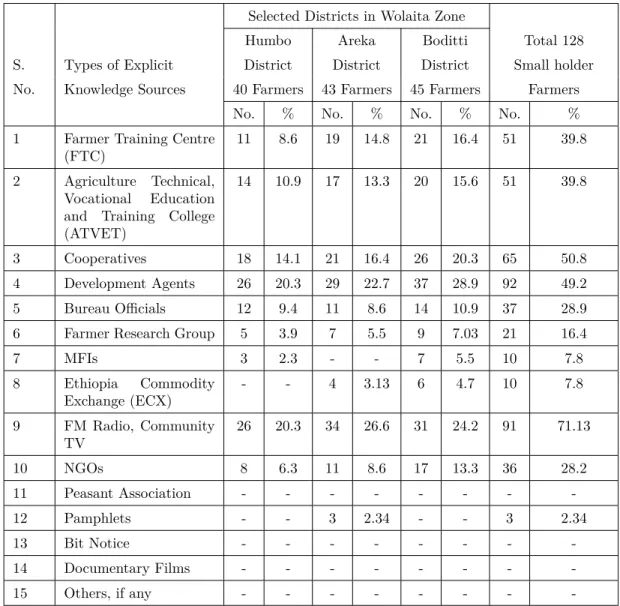
Table 2 Explicit Knowledge Acquisition / Exposure by the Smallholder Farmers
Selected Districts in Wolaita Zone
Humbo Areka Boditti Total 128
S. Types of Explicit District District District Small holder
No. Knowledge Sources 40 Farmers 43 Farmers 45 Farmers Farmers
No. % No. % No. % No. %
1 Farmer Training Centre
(FTC) 11 8.6 19 14.8 21 16.4 51 39.8
2 Agriculture Technical, Vocational Education and Training College (ATVET)
14 10.9 17 13.3 20 15.6 51 39.8
3 Cooperatives 18 14.1 21 16.4 26 20.3 65 50.8
4 Development Agents 26 20.3 29 22.7 37 28.9 92 49.2
5 Bureau Officials 12 9.4 11 8.6 14 10.9 37 28.9
6 Farmer Research Group 5 3.9 7 5.5 9 7.03 21 16.4
7 MFIs 3 2.3 - - 7 5.5 10 7.8
8 Ethiopia Commodity
Exchange (ECX) - - 4 3.13 6 4.7 10 7.8
9 FM Radio, Community
TV 26 20.3 34 26.6 31 24.2 91 71.13
10 NGOs 8 6.3 11 8.6 17 13.3 36 28.2
11 Peasant Association - - -
-12 Pamphlets - - 3 2.34 - - 3 2.34
13 Bit Notice - - -
-14 Documentary Films - - -
-15 Others, if any - - -
-Note: The percentages in the parenthesis are based on the total numbers of the respondents since multiple responses were accepted.
Fig. 4 Explicit Knowledge Acquisition and Exposure by Smallholder Farmers
among the farmers.
Challenges
There were many serious challenges existing in the study area where poor and variable rainfall, difficult topography and infertile soils, encompassing a host of other conditions such as low levels of irrigation, poor transportation, infrastructure and limited access to markets, agricultural extension and the like. The result was that they were characterized by the high levels of diversity, of both natural resources and livelihoods. This diversity means that it is unlikely that an individual new innovation, such as a crop variety, will be suitable for a large number of users or a high proportion of the cultivated land area. The standard models of agricultural research are not well suited to such situations of diversity, where innovations need to be tailored to the needs of relatively small groups of potential users. The argument is that greater farmer participation in the identification of problems to be researched, the choice of possible solutions, the design, and implementation of trials, the identification of indicators of successetc. will increase the practical value of research outputs to producers in these diverse, poorly endowed areas. Drawing on both the multiple sources of innovation model and the new enthusiasm for “local knowledge”, the argument can be further developed as follows. Farmers have an intimate knowledge of their local environment, conditions, problems, priorities and criteria for evaluation and actively engage in experimentation as part of their farming routine. This knowledge, experience and experimentation are normally out of the reach of ‘outsiders’.
Conclusion
cooper-atives, MFIs, ICT, FTC, ATVET, Telecommunication services and rural libraries in a given environment. The following recommendations will be more suitable for Ethiopia as well as African countries in general.
Supplementary Conceptual Framework
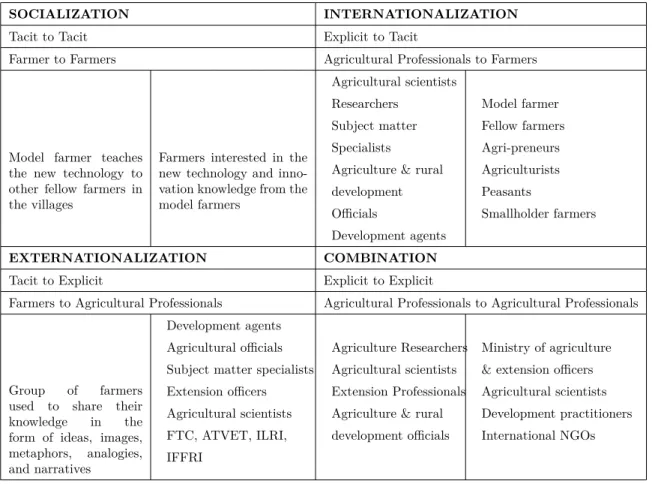
This is the additional conceptual framework of the SECI Knowledge Management approach designed by the authors as similar to the Professor Ikujiro Nonaka of Japan Institute of Science and Technology. The authors have modified it according to the stakeholders and institutional interventions in Ethiopian context.
Farmer’s Participation in Agricultural Research
It is new idea to the developing countries that the farmers’ participation on the agriculture research. Anyhow, a village farmer is one of the stakeholders in the agriculture research. The agriculture scientists are normally expecting the local farmers’ participation because the Indigenous knowledge has important value in the local context. That is why; Explicit to Tacit leads to Internalization process could become successful in order
Table 3 SECI Knowledge Management Approach Portrays the Stakeholders and Institutional Inter-ventions in Ethiopia for Knowledge Sharing and Acquiring
SOCIALIZATION INTERNATIONALIZATION
Tacit to Tacit Explicit to Tacit
Farmer to Farmers Agricultural Professionals to Farmers
Model farmer teaches the new technology to other fellow farmers in the villages
Farmers interested in the new technology and inno-vation knowledge from the model farmers
Agricultural scientists Researchers
Subject matter Specialists
Agriculture & rural development Officials
Development agents Model farmer Fellow farmers Agri-preneurs Agriculturists Peasants Smallholder farmers EXTERNATIONALIZATION COMBINATION
Tacit to Explicit Explicit to Explicit
Farmers to Agricultural Professionals Agricultural Professionals to Agricultural Professionals
Group of farmers used to share their knowledge in the form of ideas, images, metaphors, analogies, and narratives
Development agents Agricultural officials Subject matter specialists Extension officers Agricultural scientists FTC, ATVET, ILRI, IFFRI
Agriculture Researchers Agricultural scientists Extension Professionals Agriculture & rural development officials
to give the equal chance to the village farmers in the agricultural research. The knowledge disseminating process call for increased farmer’s participation in agricultural research is rooted in a view that poor producers farming in less well-endowed areas have failed to benefit from public investments in agricultural research. The challenge posed by these areas for research and for development policy more generally goes beyond. It is not correct to assume that the only motive for increasing the farmer participation in agricultural research was to increase its effectiveness. There must be a clear distinction between what we term as “research driven” and “development driven” farmer participatory research activities.
Research-driven Farmer Participatory Research
It is most essential to improve the effectiveness of formal agricultural research. It is very important to know the type of the research focus on the agro-climatic conditions of the regions of the country. While the ultimate goal may be a positive impact on the livelihoods of the poor farmers, this goal is approached through the development of new or improved agricultural technology.
Development-driven Farmer Participatory Research
The types of activities are often associated with projects, community organization efforts and group-based approaches. Farmer participatory research is seen to contribute to the wider objective of empowerment through the transfer of research skills, increased self-reliance and the idea that local people can be in a stronger position vis-à-vis formal research and extension institutions. The active involvement of the village farmers with whole spirit can bring fruitful result at the end. The following vital supplementary recommendations will also be more pertinent for any developing countries context:
• The Indigenous Tacit Knowledge should have a positive recognition by the community as a whole. • It also indigenous tacit knowledge should have a Patent right to preserve the local knowledge
forever.
• Support of the ICTs equipment’s like Radio, TV, Cell phones, computer including print media have to support the indigenous tacit knowledge thereafter promoting the explicit efficiently and effectively.
• NGOs have to involve in the projects like Indigenous technology in order to presence those obstacle knowledge from the history of development.
• Intellectual Property Rights should have agreements with the local communities and the Govern-ment has to protect their knowledge for future use.
Acknowledgement
References
Aluma, J. (2004). “Sustainable Agriculture and Rural Livelihoods: Local Knowledge Innovations in De-velopment from World Bank (2007).” Local Pathways to Global DeDe-velopment: Indigenous Knowledge (pp.24-29). Retrieved on March 21, 2019 from http://worldbank.org/EXTINDKNOWLEDGE/Resources/ ikcomplete.pdf.
Assefa, A., Waters-Bayer, A., Fincham, R. and Mudahara, M. (2009). Comparison of Frameworks for Studying Grassroots Innovation: Agricultural Innovation Systems (AKIS). Retrieved on August 18, 2019 fromhttp://www.innovationafrica.net/pdfs3_assefa_full.pdf.
BoARD (2007). Bureau of Agriculture and Rural Development. Wolaita Zone, SNNPR, Ethiopia. Retrieved on Sept. 30, 2017 fromhttp://www.fao.org/docrep/010/ah880e/ah880e00.htm.
Boateng, W. (2006). “Knowledge Management Working Tool for Agricultural Extension: The Case of Ghana.” Knowledge Management for Development Journal, Vol. 2, Issue 3, pp. 19-29.
Boisot, M. (1987). Information and Organizations: The Manager as Anthropologist. London, Fontana, Collins.
Boven, K. and Morohashi, J., (2002). Best Practices Using Indigenous Knowledge: A Joint Publication by Nuffic, UNESCO/MOST, Paris, France. Retrieved on February 18, 2017 fromhttp://www.unesco.org/ most/bpikpub.htm.
CSA (2008). Central Statistical Agency. Summary and Statistical Report of the 2007: Population and Hous-ing Census, Addis Ababa, Ethiopia. Retrieved on February 18, 2017 fromhttp://unstats.un.org/unsd/ censuskb20/Attachment489.aspx?AttachmentType=1.
Davenport, T. H. (2007). “Information Technologies for Knowledge Management. In K. Ichijo, and I. Nonaka (Eds.).” Knowledge Creation and Management: New Challenges for Managers (pp. 97-109). Oxford, Oxford University Press.
Dube, M. A., and Musi, P. J. (2002). Analysis of Indigenous Knowledge in Swaziland: Implications for Sus-tainable Agricultural Development. Retrieved on November 11, 2006 from http://www.atpsnet.org/ content/files/documents/working%20paper%20series%2034.pdf
Ellen, R. and Harris, H. (1996). Concepts of Indigenous Technical Knowledge in Scientific and Developmen-tal Studies Literature: A Critical Assessment. Retrieved on December 15, 2016 fromhttp://lucy.ukc. ac.uk/Rainforest/SML_files/Occpap/indigknow.occpap_5.html.
Fullwood, R. and Rowley, J. (2017). “An Investigation of Factors Affecting Knowledge Sharing Amongst UK Academics.” Journal of Knowledge Management, Vol. 21, Issue 5, pp. 1254-1271.
Ha, L., Okigbo, R. N. and Igboaka, P. (2008). “Knowledge Creation and Dissemination in Sub-Saharan Africa.” Management Decision, Vol. 46, Issue 3, pp. 392-405.
docs/occasional%20paper12.pdf
Hart, T. and Vorster, I. (2006). Indigenous Knowledge on the South African Landscape: Potentials for Agricultural Development. Urban, Rural and Economic Development Research Programme Occasional Paper 1. Cape Town, Human Sciences Research Council. Retrieved on March 1, 2007 from http: /www.prolinnova.net/South_Africa/a%20-20indigenous_knowledge7E952006100711AM1.pdf Kaniki, A. M. and Mphahlele, M. E. K. (2002). “Indigenous Knowledge for the Benefits of All: Can
Knowl-edge Management Principles be Used Effectively?” South African Journal of Library and Information Science, Vol. 68, Issue 1, pp. 1-15.
Hart, T. G. B. (2007). “Local Knowledge and Agricultural Applications: Lessons from a Ugandan Parish.” South African Journal of Agricultural Extension, Vol. 36, pp. 229-248.
Ichijo, K. and Nonaka, I. (2007). “Knowledge as Competitive Advantage in the Age of Increasing Global-ization, in K. Ichijo & I. Nonaka (eds.).” Knowledge Creation and Management: New Challenges for Managers. Oxford University Press, Oxford.
Ichijo, K. and Nonaka, I. (2007). Knowledge Creation and Management. New York, Oxford University Press.
Iyoro, A. and Ogungbo, W. O. (2013). “Management of Indigenous Knowledge as a Catalyst towards Im-proved Information Accessibility to Local Communities: A Literature Review.” Chinese Librarianship: An International Electronic Journal, Vol. 35, pp. 87-98.
Lwonga, E. T., Ngulube, P and Stilwell, C. (2010). “Understanding Indigenous Knowledge: Bridging the Knowledge Gap through a Knowledge Creating Model for Agricultural Development.” South African Journal of Information Management, Vol. 11, Issue 1, pp. 1-22.
Maisiri, E. (2017). “Utilization of Indigenous Knowledge for Competitiveness among Curio Makers of Ma-tobo National Park, Zimbabwe, in P. Ngulube (ed).” Handbook of Research on Social, Cultural, and Educational Considerations of Indigenous Knowledge in Developing Countries (pp.202-225). IGI Global, Hershey, PA.
Mapara, J. (2009). “Indigenous Knowledge Systems in Zimbabwe: Juxtaposing Postcolonial Theory.” The Journal of Pan African Studies, Vol. 3, Issue 1, pp. 139-155.
Mella, E. E., Kulindwa, K. Shechambo, F. and Mesaki, S. (2007). The Integrated Assessment of Organic Agriculture in Tanzania: Policy Options for Promoting Production and Trading Opportunities for Organic Agriculture. Retrieved August 20, 2009 from https://www.academia.edu/29144182/The_ Integrated_Assessment_of_Organic_Agriculture_in_Tanzania_Policy_Options_for_Promoting_ Production_and_Trading_Opportunities_for_Organic_Agriculture.
Mosia, L. N. (2002). Knowledge Sharing and Distribution in an Open System: A Case Study of the Eastern Cape Estuaries Management Programme. Pietermaritzburg, University of KwaZulu-Natal, South Africa. Mosia, L. N, and Ngulube, P. (2005). “Managing the Collective Intelligence of Local Communities for the Sustainable Utilisation of Estuaries in the Eastern Cape, South Africa.” South African Journal of Libraries and Information Science, Vol.71, Issue 2, pp. 175 186.
Local/-Indigenous Knowledge, Bagamoyo, Tanzania, June 11-13, 2001. Retrieved on June 15, 2007 from http://www.worldbank.org/afr/ik/report.pdf.
Muyungi, R. and Tillya, A. F. (2000). “Appropriate Institutional Framework for Coordination of Indigenous Knowledge.” FAO LinKS Project Report, Vol. 9. Retrieved on June 13, 2007 fromhttp://www.fao.org/ sd/LINKS/documents_download/Rep%209%20TILLYa.
Neoth, A. J. (2004). Knowledge Management for Service Delivery in Rural Communities (Masters Thesis). Pretoria, University of South Africa.
Ngulube, P. (2002). “Managing and Preserving Indigenous Knowledge in the Knowledge Management Era: Challenges and Opportunities.” Information Development, Vol. 18, Issue 2, pp. 95-100.
Ngulube, P. (2018). “Overcoming the Difficulties Associated with Using Conceptual and Theoretical Frame-works in Heritage Studies, in P. Ngulube (ed.).” Handbook of Research on Heritage Management and Preservation, pp.1-23. IGI Global, Hershey, PA.
Ngulube, P., Dube, L. and Mhlongo, M. (2015). “Towards a Cartography of Indigenous Knowledge Systems in Library and Information Science Training and Education in Anglophone Eastern and Southern Africa.” Indilinga: African Journal of Indigenous Knowledge Systems, Vol. 14, Issue 2, pp. 145-168.
Ngulube, P. and Onyancha, B. O. (2017). “Conceptualizing the Knowledge of Traditional and Indigenous Communities Using Informetrics Approaches, in P. Ngulube (ed.).” Handbook of Research on Theoret-ical Perspectives on Indigenous Knowledge Systems in Developing Countries, pp. 198-224. IGI Global, Hershey, PA.
Njiraine, N., Ocholla, D. N. and Onyancha, O. B. (2010). “Indigenous Knowledge Research in Kenya and South Africa: An Informetric Study.” Indilinga African Journal of Indigenous Knowledge Systems, Vol. 9, Issue 2, pp. 194-210.
Nonaka, I. (1994). “A Dynamic Theory of Organizational Knowledge Creation.” Organization Science, Vol. 5, pp. 14-37.
Nonaka, I. and Takeuchi, H. (1995). The Knowledge Creating Company: How Japanese Companies Create the Dynamics of Innovation. Oxford University Press, New York.
Nonaka, I., (1991). “The Knowledge Creating Company.” Harvard Business Review, No. 69, pp. 96 104. Nonaka, I., Toyama, R. and Konno, N. (2000). “SECI, Ba and Leadership: A Unified Model of Dynamic
Knowledge Creation.” Long Range Planning, Vol. 33, Issue 1, pp. 5-34.
Ocholla, D. N., and Onyancha, O. B. (2005). “The Marginalized Knowledge: An Informetric Analysis of In-digenous Knowledge Publications (1990-200).” South African Journal of Libraries and Information Sci-ence, Vol. 71, Issue 3, pp. 247-258.
Olatokun, W. M. and Ayanbode, O. F. (2008). “Use of Indigenous Knowledge by Rural Women in the De-velopment of Ogun State.” INDILINGA: African Journal of Indigenous Knowledge Systems, Vol. 7, Issue 1, pp. 47-63.
Probst, G., Raub, S. and Romhardt, K. (2000). Managing Knowledge: Building Blocks for Success. New York, Wiley.
Ranger, T. (1983). “The Invention of Tradition in Colonial Africa, in E.J. Hobsbawm and T. Ranger (eds.).” The Invention of Tradition, pp. 211-262. Cambridge University Press, Cambridge.
Rowley, J. (2001). “Knowledge Management in Pursuit of Learning: The Learning with Knowledge Cycle.” Journal of Information Science, Vol. 27, Issue 4, pp. 227-237.
Soliman, F. and Spooner, K. (2000). “Strategies for Implementing Knowledge Management: Role of Human Resource Management.” Journal of Knowledge Management, Vol. 4, Issue 4, pp. 337-345.
United Nations Development Programme (UNDP) (2003). Human Development Report 2003: Millennium Development Goals: A Compact among Nations to End Human Poverty. Retrieved on February 5, 2010 from http://hdr.undp.org/en/reports/global/hdr2003.
Wall, C. R. L. (2006). Knowledge Management in Rural Uzbekistan: Peasant, Project and Post-Socialist Perspectives in Khorezm (PhD thesis), Faculty of Philosophy, University of Bonn. Retrieved on November 26, 2007 fromhttp://hss.ulb.unibonn.de/diss_online.
WIPO (2006). Customary Law Traditional Knowledge and the Intellectual Property: An Outline of Issues. Retrieved on June 12, 2018 from https://www.wipo.int/export/sites/www/tk/en/resources/pdf/ overview_customary_law.pdf.
WIPO (2010). The Sixteenth Session of the Intergovernmental Committee on Intellectual Property and Genetic Resources, Traditional Knowledge and Expressions of Folklore (IGC), Geneva, Switzerland, 3-7 May 2010. Retrieved on March 13-7, 2013-7 from http://www.un.org/esa/socdev/unpfii/documents/ WIPO.pdf.
WIPO (2012). The Protection of Traditional Knowledge: Draft Articles, Twenty-First Session, Geneva, 16–20 April, 2012 WIPO/GRTKF/IC/21/4. Retrieved on March 22, 2017 from http://www.wipo.int/ edocs/mdocs/tk/en/wipo_grtkf_ic_21/wipo_grtkf_ic_21_4.pdf.
WZARDO (2007). Wolaita Zone Agriculture and Rural Development Office, Wolaita Zone. Research and Community Services. Annual report of 2007 fiscal year. Retrieved on August 18, 2007 fromhttp://www. wsu.edu.et/sites/default/files/WSU%20RCS%20ANNUAL%20REPORT%20OF%202007_Compressed.pdf. Zent, S. (2009). “A Genealogy of Scientific Representations of Indigenous Knowledge, in S. Heckler (ed.).”