Optimal Path Pair Routes through Multi-Criteria
Weights in Ad Hoc Network Using Genetic
Algorithm
Nyoman Gunantara
1, Agus Dharma
11
Department of Electrical Engineering and Computer, Universitas Udayana, Bali, Indonesia
Abstract: An ad hoc network can establish cooperative
communication through path pair routes. The path pair route formed depends on the number of hops and multi-criteria used. The cross-layer criteria observed is power consumption, signal-to-noise ratio (SNR), and load variance optimized using multi-criteria optimization through scalarization with varying weights. With many path pair routes and complicated computing then in finding the optimal value genetic algorithm method was used. From the simulation results, the optimal path pair routes were obtained with varying weights; greater weight had higher priorities and produced optimum performance and computing time for scalarization function with varying weights having a very small difference even almost identical. Different computing time will be seen when compared in an exhaustive manner.
Keywords: Multi-criteria optimization, scalarization, Varying
weights, Genetic algorithm, Computing time.
1.
Introduction
Cooperative communication is a system where the source node cooperates and coordinates with nodes that function as a relay before reaching the destination node. Nodes in the ad hoc network using a single antenna in multi-node scenario can utilize the antenna of each node thus creating cooperative diversity. An ad hoc network can establish cooperative communication through path pair routes. These path pair routes are formed depending on the number of hops and multi-criteria used.
The selection of paths in ad hoc networks can be done depending on the criteria used. It can be done based on SNR [1] - [4], the outage probability [5] - [7], mutual information [8], and the symbol error rate [9]. But papers in [1] - [9] apply cooperative diversity using a single-objective criterion whereas in the selection of paths in ad hoc networks used a combination of several criteria. The selection of pair paths in ad hoc networks used the criteria of power consumption, SNR, and load variance using Pareto and scalarization methods with the same weight [10] whereas the application of a multi-criteria wireless ad hoc network requires different criteria or performance. So in that respect, weight selections become very important. The weights determine the priority of the performance of the scalarization process [11]. Great weight given to these criteria indicates that
these criteria
have a higher priority than the smaller weights. In
determining
the weight in the scalarization other than thesame weight, there are two approaches available, namely weighting election rank order centroid (ROC) weights and rank-sum (RS) weights [12]. With the ROC weights, these criteria must be ranked [13] while RS weights put any criteria in a proportionate position [14]. This paper was to examine the use of RS weights on scalarization and find the optimal path pair routes with complex computing using GA.
The main contribution of this paper is, first, the use of varying weights on scalarization process to determine the priority of performance used and determine cumulative value for all the three criteria. Lastly, to determine the computation time required in finding the optimal path pair routes of the system using GA.
This paper is organized as follows, a description of cooperative communication, multi criteria weights, and GA process. Finally, the section explains the model configuration, parameter simulation, optimization results and conclusion.
2.
Cooperative Communication
Cooperative communication can be described by a graph , where is the set of nodes and
is the set of links/hops. In multihop ad hoc network are pairs of sources and destination nodes that communicate involving other nodes as to a relay forming multihop paths. These path pair routes are formed depending on the number of hops. If the total number of nodes (including source and destination pairs) is , then there is one single-hop solution, 2-hop solution,
3-hop solution,
4-hop solution, and so on for source and the destination pairs. In this study, the maximum number of hops to be considered for a path is restricted to 3. From the set of paths with a maximum of 3 hops, there are a number of combinations to form path pairs. Let denote a set of all path pairs with and hops, denote permutations of l and k paths, and denotes the number of path pairs. The combination of path pairs can be in the form of = solution which consists of two paths each with one hop and two hops,
= solution consisting of two paths each with one hop and three hops, =
solution consisting of 2 paths each with 2
hops dan 2 hops, = solution
= ( solution of 3 hops and 3 hops. At the receiver, the value of the power sources of each path pair combined with maximal ratio combining (MRC).
It is assumed that broadcast routing uses amplify and forward (AF) relay, where the source sends information to all nodes that could potentially be a relay so that information can arrive at a destination [15]. Broadcast routing is selected so that the data transmitted can be received by all neighboring nodes simultaneously thus saving transmission time.
The mechanism of the protocol of the system model can be described as follows:
- Sources can identify the destination position in a way that each node detects the other nodes that are connected directly via a single hop and transmit information to all nodes within one hop [16].
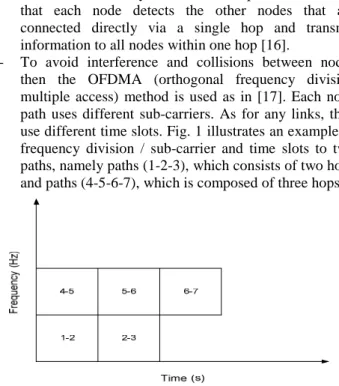
- To avoid interference and collisions between nodes then the OFDMA (orthogonal frequency division multiple access) method is used as in [17]. Each node path uses different sub-carriers. As for any links, they use different time slots. Fig. 1 illustrates an example of frequency division / sub-carrier and time slots to two paths, namely paths (1-2-3), which consists of two hops and paths (4-5-6-7), which is composed of three hops.
Figure 1. OFDMA Method for Path (1-2-3) and (4-5-6-7)
3.
Multi Criteria Optimization
It is assumed that the transmit power for all nodes is the same and the gain of transmitting and receiving antennas, and , is the same. Thus receive power through the wireless channel length can be calculated by the following equation [18]:
(1)
where denotes shadowing loss (dB) having normal distribution with a standard deviation of .
3.1 Power Consumption
Power consumption on the path is the overall power requirements needed in sending data from a source to a destination that passes through several relays in each path. If it is assumed that all nodes have uniform transmit power, the power consumption at the- path consisting of -hop is [10]:
(2)
While the amount of power consumption for path pair is obtained from the following equation [10]:
(3)
where , and denote the power
consumption of the path with hop, hop, as well as the path pairs with hop and hop, respectively.
The power consumption for optimal path pair is power consumption that has the smallest value of all path pairs:
(4) where represents optimal power consumption of all path pairs.
3.2 SNR
SNR at each hop is the ratio between the power received by the noise power at the node, , where , is the noise power assumed to be equal on each node. It is assumed that each relay does amplify and forward, so the overall SNR on a path depends on SNR in each hop [19]:
(5)
with is SNR value on the- hop.
While the amount of SNR for a path pair is obtained from the following equation:
(6)
where , , and represent SNR path pairs with hop, hop, as well as hop and hop respectively. For ad hoc networks, optimal SNR for a path pair is the maximum value of all path pairs determined by the following equation :
(7) with denotes optimal SNR for path pair.
3.3 Load Variance
Load variance is the variance of the traffic loads of all nodes, inversely proportional to the load balancing or fairness [20]. In wireless ad hoc network, load balancing is very important because some of the nodes may have a greater opportunity to become a relay. In pair paths where node i is used as a relay then load of node becomes:
(8)
with and respectively the traffic load itself and the traffic load leading to the node .
(9)
Based of variances that occur in all path pairs then the optimal path pair can be determined by finding one with the lowest traffic load variance:
)
(10) where denotes optimal load variance of the network for all path pairs and denotes the load variance of path pair with and hop.
3.4 Scalarization
In scalarization, each criterion is arranged into scalar forms by giving weight to each criterion [21]. Minimizing function is given a negative sign, while maximizing function is given a positive sign. In this research to gain a sense of justice every problem is given equal weight and normalized with root mean square (rms). This normalization is used in order to provide a sense of justice among each criterion.
Scalarization shape of the three criteria becomes:
(11)
where denotes fitness function, , , denotes a criteria function of - 1,2,3, and , , denotes weight . , , dan are respectively calculated by Equation (4), (7), and (10). In this study, the weight is determined by RS weights. RS weights can be determined by the following equation [14]:
(12)
where denotes indexes of criteria and denotes the number of criteria with dan . For = 3 then the resulting weight is = 0.500, = 0.333, dan
= 0.167.
From the weights obtained then there are three scalarizations which can be formed as follows:
(13)
(14)
(15)
Three scalarizations are compared with the scalarization of the same weight as follows:
(16)
Fourth the scalarization results in four equations with different fitness functions. Fitness function with greater weight criterion indicates that the priority is higher than the smaller weights. For example, in Equation (13) with weight of power consumption is 0.5 and weight of SNR is 0,333 means that the priority criteria for higher power consumption by the load variance.
4.
Genetic Algorithm
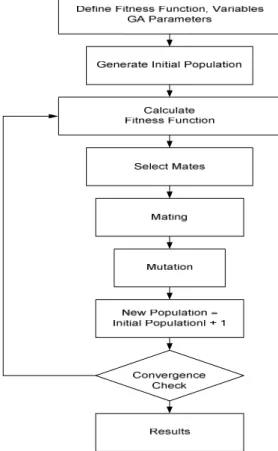
Genetic Algorithm (GA) are successfully used for decoding of block codes [22] and search of good tailbiting codes [23]. Since there is a great number of searches of the existing cooperative pair paths based on the model configuration in determining the optimal value, optimization methods can be applied such as GA. GA is a search method that is done randomly and not linearly based on the principles of natural selection. More detailed stages can be seen in Fig. 2 [24]. Each chromosome has a relationship with the fitness function. In the sense that each chromosome represents any value of fitness function. Set of chromosomes make up a population. Then evaluation is made on the fitness function of the chromosomes. From the evaluation of the fitness function, ranking is then performed. The ranking aims to locate the desired chromosome. Chromosomes which are not used are subsequently removed from their group. The chosen chromosomes crossover to produce offspring. Parents reproduce enough to offset the chromosomes discarded. Thus the total number of chromosomes is fixed in each iteration. The next process is the evaluation of the fitness function of the chromosomes. Chromosomes that do not survive will have mutations in the chromosome while superior ones crossover to produce offspring. This process will be repeated until the number of iterations is reached or a solution has been obtained [24].
The following explains the stages of the GA process: a. Define fitness function, variables, and GA
parameters.
This stage is defining the fitness function and the parameters of the GA. Fitness function used are the Equation (13) to (16).
Figure 2. Stages of the GA Process
The population is a collection of some chromosomes. Each chromosome is made up of a
collection of genes. The whole population is
( which in this study =
32, the population of path pairs amounts to 1.33e + 32. In this study, the population generated is 1000 in the form of path pairs.
c. Calculating the fitness function for each population. This stage is the calculation of fitness function and is adapted to the populations they represent. This means that any population already has a value of fitness function.
d. Select mates.
After each population has the fitness function value then at this stage of the choice or selection is made against those populations. Selected population will be used for crossover.
e. Mating.
Populations resulting from the selection process are then crossover. The purpose of this crossover is to produce new offspring in lieu of the population that has been discarded. This process can be called by elitism. Elitism is copying the selected population to form a new population.
f. Mutation.
At this stage the populations who are not selected will be discarded, causing mutational events. Population removed was replaced by a new population and the results of elitism to produce a new population.
g. Convergence
This stage will check the iterations that have been carried out. The iteration aims to stop algorithm. In
ideal conditions, the algorithm will stop when all the population produced are the same, in this case that the algorithm has to produce the same path. To achieve this condition requires a large number of iterations. As an approach in this study 50 iterations are used.
5. Numerical Results
5.1 Model Configuration
We observe a wireless ad hoc network on conditions outside the building. The model that will be shown in this paper is one of the examples of the results of the simulations carried out 500 times. The configuration for the sample observed can be seen in Fig. 3. For the conditions outside the building, all the nodes are in the open space with an area of 40 m x 40 m. In this configuration there are 32 nodes in a random position. Node 1 acts as a source, node 32 as a destination, and the other nodes can act as a relay.
The parameters of the simulation are taken based on the adoption of WLAN in ad hoc wireless networks shown in Table 1.
Table 1. Parameters of Simulation
Parameter : Value
Path loss exponent , : 4
Standard deviation of shadowing, : 8 dB Wall transmission coefficient, : 0.3
Power Transmit, : 1 W
Transmit antenna gain, : 2 dB
Receive antenna gain, : 2 dB
Frequency, : 2.5 GHz
Bandwidth, : 20 MHz
Noise, : - 101 dBm
0 5 10 15 20 25 30 35 40
0 5 10 15 20 25 30 35 40
node position (m)
n
o
d
e
p
o
s
it
io
n
(
m
)
1 2
3 4 5
6
7 8
9 10
11 12
13 14 15
16 17
18
19 20
21 22
23 24
25 26
27
28 29
30
31 32
Figure 3. Model Configuration
relatively lower load. In this example five pairs of nodes that use the path 4-12-29-32, 7-11-19-25, 10-19-22-23, 16-12-14-2 and 25-20-12-6. It is assumed that source node 4, node 7, node 10, node 16, node 25 respectively transmit the data consecutively by 5 Mbps, 3 Mbps, 8 Mbps, 7 Mbps, 2 Mbps, and 11 Mbps while other nodes are assumed to have random load of 2 Mbps, 7 Mbps, 12 Mbps, or 17 Mbps.
5.2 Optimization Results
In determining the results of this optimization we do the simulation 500 times. This section will describe one of the simulation results. Simulations carried out for all three criteria with weights that vary based on configuration models. For the fitness function 1 is the power consumption with a weight of 0.5, SNR with weights of 0333, and load variance with the weight of 0167 result in the fitness value of 0.3983. Cooperative pair path chosen is (1-12-32) and (1-22-17-32). In the fitness function 2 is load variance with a weight of 0.5, the power consumption by the weight of 0333 and SNR with a weight of 0.167 produces fitness value of 0.0324. Cooperative path chosen is (1-12-28-32) and (1-11-23-32) while the fitness function 3 that SNR with a weight of 0.5, load variance with 0333 weights, and power consumption with the weight of 0167 resulted in the fitness value of -0.0348. Cooperative pair path chosen is (1-7-18-32) and (1-11-21-32).
The three scalarizations with varying weights are compared with the fitness function with the same weight on each criterion [10]. The resulting fitness value is equal to 0.1319 with the cooperative pair path selected is (1-5-15-32) and (1-9-18-32). The values of the different fitness function cause the different cooperative path pair selection are also caused by the weights on different scalarizations.
Then the results of the 500-time simulations are shown in Fig. 4 and Fig. 6. The simulation results were analyzed focusing on a comparison of the three scalarizations with varying weights with scalarization with equal weights in each criterion.
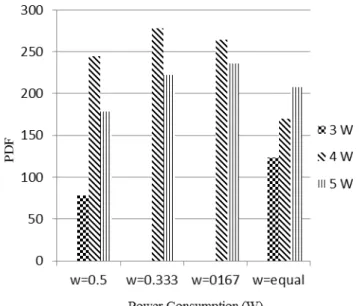
From Fig. 4, it can be seen that the value of the pdf of Power Consumption with varying weights are compared with the same weight for the fourth scalarization. First, the pdf value of power consumption with the weight of 0.5 is 3W, 4 W and 5 W. Second, the pdf value of the Power consumption with the weight of 0333 is 4 W and 5 W with accumulation of 4 W more than the 5 W. Third, Power consumption value of the pdf with the weight of 0167 is 4 W and 5 W with the accumulation of 4 W is more than the 5 W. Compared with the weight of 0.333, the accumulation of 4 W is less but the accumulation of 5 W is more. Fourth, the pdf value of Power consumption with equal weight is 3W, 4 W and 5 W. The composition of the accumulated value is equal to the accumulated weight of 0.5 is reduced but the accumulation of 4 W 3 W and 5 W increases. Thus the weight of power consumption on the fitness function indicates the desired priorities of the three criteria. 0.5 Thickness produce smaller power consumption compared with other weights. It is shown from the selected cooperative pair paths composed of 2 hops and 3 hops while the other weights have cooperative path pairs composed of 3 hops and 3 hops.
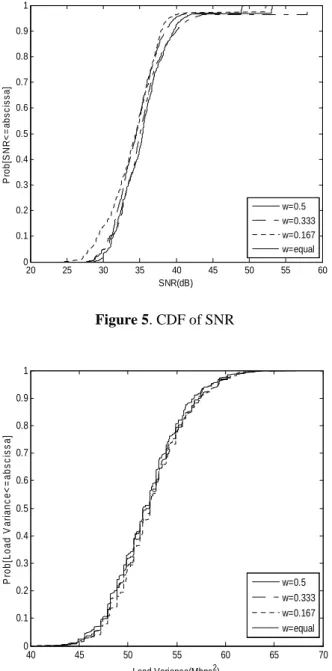
Cdf value of SNR with varying weights compared with the same weight for the fourth scalararization can be seen in Figure 5. Fig. 5 shows that, first, cdf value of SNR with a weight of 0.5 has a range of SNR values ranging between 28.70 and 53.19 dB. Second, cdf value of SNR with 0.333
weights ranged between 27.88 and 58.05 dB. Third, the cdf value of SNR with weights of 0,167 has a range of SNR values ranging between 24.61 and 52.32 dB. Fourth, cdf value of SNR with an equal weight namely ranges between 27.73 and 49.29 dB. From the range of SNR values obtained, then the next point to be reviewed is the median value. The median value of the SNR ranges with weights of 0.5, 0.333, 0.167, and equal respectively are 35.40, 35.02, 34.44, and 34.53 dB. Based on the cdf value and median, then the SNR from large to small values are respectively 0.5; 0.333; and 0.167. Meanwhile, SNR with equal weights has SNR value greater than the SNR with a weight of 0167 but lower than the SNR with weights 0.333 and 0.5. Thus, the SNR with a weight of 0.5 has a higher priority yielding the largest SNR value compared with other weights.
Figure 4. PDF of Power Consumption
20 25 30 35 40 45 50 55 60 0 0.1 0.2 0.3 0.4 0.5 0.6 0.7 0.8 0.9 1 SNR(dB) P ro b [S N R < = a b s c is s a ] w=0.5 w=0.333 w=0.167 w=equal
Figure 5. CDF of SNR
40 45 50 55 60 65 70
0 0.1 0.2 0.3 0.4 0.5 0.6 0.7 0.8 0.9 1
Load Variance(Mbps2)
P ro b [L o a d V a ri a n c e < = a b s c is s a ] w=0.5 w=0.333 w=0.167 w=equal
Figure 6. CDF of Load Variance
5.3 Computation Time
The computing time is calculated through 500 times simulation for the four scalarization functions. Computing time obtained for varying weights to first scalarization to fourth scalarization respectively amounted to 116 minutes, 116.18 minutes, 115.63 minutes, and 115.81 minutes. These results have very little difference even almost identical but when compared without using GA optimization i.e. in an exhaustive way, by checking the overall solution. In comparison, in an exhaustive manner, computation time required for scalarization with the same weight is 430.80 minutes. So the comparison of computing time with GA optimization and exhaustive manner is 1: 3.72. This means that the computing time with GA optimization takes an average of 3.72 faster than the exhaustive way. This is caused by the optimization GA done randomly and it depends on the number of population and the generated iteration. These computational results are obtained through the simulation of Matlab Version 8.1.0.604 (R2013a) performed on a computer with Intel Core Processor specifications 5 - 3230M CPU 2.60 GHz and 4 GHz RAM.
6. Conclusions
The performance analyzed is varying weights for scalarization function in determining the optimal path pair routes. Based on the analysis of optimization results, some conclusions can be arrived at. First, with varying weights on the scalarization function, the different optimal pair paths are selected according to the fitness value generated. Second, with a weight of 0.5 it has a higher priority yielding the greatest performance values (for the maximizing functions) or the value of the smallest performance (for the minimizing function) compared to other weights. Lastly, the computing time required for the scalarization function with varying weights has a very small difference even almost identical. The different computing time will be seen when compared in an exhaustive manner by checking the overall solutions. The computing time with exhaustive manner requires 3.72 longer compared to using the GA optimization.
Acknowledgment
The research work of N. Gunantara has been supported by a Hibah Unggulan Udayana 2016 Contract No. 641-16/UN14.2/PNL.01.03.00/2016 from Research and Community Service for Prosperity, Univeristas Udayana.
References
[1] J. N. Laneman, D. Tse, G. W. Wornell, “Cooperative diversity in wireless networks: Efficient protocols and outage behavior,” IEEE Trans. Inf. Theory, Vol. 50, No. 12, pp. 3062–3080, 2004.
[2] A. Adiyoni, Y. Fan, H. Yanikomeroghu, H. V. Poor, F. Al-Shaalan, ”Performance of Selection Relaying and Cooperative Diversity,” IEEE Trans. On Wireless Communications, Vol. 8, No. 12, 2009.
[3] J. B. Si, Z. Li, Z. J. Liu, “Threshold Based Relay Selection Protocol for Wireless Relay Networks with Interference,“ IEEE International Conference on Communications (ICC), 2010.
[4] M. A. B. Melo, D. B. Costa, “An Efficient Relay-Destination Selection Scheme for Multiuser Multirelay Downlink Cooperative Networks,” IEEE Trans. On Vehicular Technology, Vol. 61, No. 5, 2012.
[5] Z. Ding, Y. Gong, T. Ratnarajah, C. F. N. Cowan, “Opportunistic Cooperative Diversity Protocols for Wireless Networks,“ IEEE Information Theory Workshop on Information Theory for Wireless Networks, 2007.
[6] W. Su, X. Liu, “On Optimum Selection Relaying Protocols in Cooperative Wireless Networks,” IEEE Trans. on Communications, Vol. 58, No. 1, pp. 52-57, 2010.
[7] K. G. Seddik, A. K. Sadek, W. Su, K. J. R. Liu, “Outage Analysis and Optimal Power Allocation for Multinode Relay Networks,” IEEE Signal Processing Letters, Vol. 14, No. 6, 2007.
[8] T. Ratnarajah, M. Sellathurai, Z. Ding, “On The Performance of Cooperative Communication Via Best Relay Path, ”The 18th Annual IEEE International Symposium on Personal, Indoor, and Mobile Radio Communication, 2007.
[9] L. Song, “Relay Selection for Two-Way Relaying With Amplify-and-Forward Protocols,“ IEEE Trans. On Vehicular Technology, Vol. 60, No. 4, 2011.
[10]N. Gunantara, G. Hendrantoro, “Multi-Objective Cross-Layer Optimization for Selection of Cooperative Path Pairs in Multihop Wireless Ad hoc Networks,” Journal of Communications Software and Systems, Vol. 9, No. 3, 2013. [11]---, “Multi-Criteria Analysis: A Manual,” Department for
Communities and Local Government, London, 2009.
[13]F. H. Barron, B. E. Barrett, “Decision Quality Using Ranked Attribute Weights,” Management Science, Vol. 42, No. 11, 1996.
[14]H. J. Einhorn, W. McCoach, “A Simple Multiattribute Utility Procedure for Evaluation,” Behavioral Science, Vol. 22, Issue 4, 1977.
[15]R. Ranjan Roy, “Handbook of Mobile Ad hoc Networks for Mobility Models,” Springer, London, 2011.
[16]S. Capkun, M. Hamdi, J. P. Hubaux, “GPS-free positioning in mobile Ad-Hoc networks,” Proceedings of the 34th Hawaii International Conference on System Sciences, 2001.
[17]M. Salem, A. Adinoyi, M. Rahman, H. Yanikomeroglu, D. Falconer, Kim Young-Doo, E. Kim, Y. C. Cheong, “An Overview of Radio Resource Management in Relay-Enhanced OFDMA-Based Networks, IEEE Communications Surveys & Tutorial, Vol. 12, No. 3, 2010.
[18]N. Gunantara, G. Hendrantoro, “Multi-Objective Cross-Layer Optimization with Pareto Method for Relay Selection in Multihop Wireless Ad hoc Networks,” WSEAS Transaction on Communications, Vol. 12, Issue 3, 2013.
[19]S. M. Hussain, M. Alouini, M.O. Hasna, “Performance analysis of best relay selection scheme for amplify-and-forward cooperative networks in identical Nakagami-m channels,”IEEE Eleventh International Workshop on Signal Processing Advances in Wireless Communications (SPAWC), 2010.
[20]J. W. Wong, J. P. Sauve, J. A. Field, “A Study of Fairness in Packet Switching Networks,” IEEE Transactions on Communications, Vol. 30, No. 2, 1982.
[21]M. Ehrgott, “Multicriteria Optimization,” Springer, Germany, 2005.
[22]S.Nouh, I. Chana, M. Belkasmi, ”Decoding of Block Codes by using Genetic Algorithms and Permutations Set”, International Journal of Communication Networks and Information Security (IJCNIS), Vol. 5, No. 3, 2013.
[23]P. Remlein, D. Szlapka, ”Genetic Algorithm used om Search of good Tailbiting Codes”, International Journal of Communication Networks and Information Security (IJCNIS), Vol. 1, No. 3, 2009.