2
3
4
5
6
7
8 9
Document Number: DSP0200 Date: 2009-07-29 Version: 1.3.1
CIM Operations over HTTP
Document Type: Specification Document Status: DMTF Standard Document Language: E
Copyright Notice 10
Copyright © 2009 Distributed Management Task Force, Inc. (DMTF). All rights reserved. 11
12 13 14 15 16 17 18 19 20 21 22 23 24 25 26 27 28 29 30
DMTF is a not-for-profit association of industry members dedicated to promoting enterprise and systems management and interoperability. Members and non-members may reproduce DMTF specifications and documents, provided that correct attribution is given. As DMTF specifications may be revised from time to time, the particular version and release date should always be noted.
Implementation of certain elements of this standard or proposed standard may be subject to third party patent rights, including provisional patent rights (herein "patent rights"). DMTF makes no representations to users of the standard as to the existence of such rights, and is not responsible to recognize, disclose, or identify any or all such third party patent right, owners or claimants, nor for any incomplete or
inaccurate identification or disclosure of such rights, owners or claimants. DMTF shall have no liability to any party, in any manner or circumstance, under any legal theory whatsoever, for failure to recognize, disclose, or identify any such third party patent rights, or for such party’s reliance on the standard or incorporation thereof in its product, protocols or testing procedures. DMTF shall have no liability to any party implementing such standard, whether such implementation is foreseeable or not, nor to any patent owner or claimant, and shall have no liability or responsibility for costs or losses incurred if a standard is withdrawn or modified after publication, and shall be indemnified and held harmless by any party implementing the standard from any and all claims of infringement by a patent owner for such implementations.
For information about patents held by third-parties which have notified the DMTF that, in their opinion, such patent may relate to or impact implementations of DMTF standards, visit
http://www.dmtf.org/about/policies/disclosures.php. 31
CONTENTS
3334 35 36 37 38 39 40 41 42 43 44 45 46 47 48 49 50 51 52 53 54 55 56 57 58 59 60 61 62 63 64 65 66 67 68 69 70 71 72 73 74 75 76 77 78 79 80 81 82 83 84 85
Foreword ... 6
Introduction ... 7
1 Scope ... 9
2 Normative References... 9
2.1 Other References... 10
3 Terms and Definitions... 10
4 Abbreviated Terms and Document Conventions... 12
4.1 Abbreviated Terms... 12
4.2 Document Conventions... 12
5 CIM Message Syntax and Semantics ... 12
5.1 Well-Formed, Valid, and Loosely Valid Documents ... 13
5.2 Operational Semantics... 13
5.3 CIM Operation Syntax and Semantics... 15
5.3.1 Method Invocations... 15
5.3.1.1 Simple Operations ... 15
5.3.1.2 Multiple Operations ... 16
5.3.1.3 Status Codes ... 16
5.3.2 Intrinsic Methods... 18
5.3.2.1 GetClass ... 19
5.3.2.2 GetInstance... 20
5.3.2.3 DeleteClass... 22
5.3.2.4 DeleteInstance ... 22
5.3.2.5 CreateClass ... 23
5.3.2.6 CreateInstance... 24
5.3.2.7 ModifyClass ... 25
5.3.2.8 ModifyInstance... 27
5.3.2.9 EnumerateClasses... 28
5.3.2.10 EnumerateClassNames ... 29
5.3.2.11 EnumerateInstances ... 30
5.3.2.12 EnumerateInstanceNames ... 32
5.3.2.13 ExecQuery ... 32
5.3.2.14 Associators ... 33
5.3.2.15 AssociatorNames... 35
5.3.2.16 References... 36
5.3.2.17 ReferenceNames ... 37
5.3.2.18 GetProperty... 38
5.3.2.19 SetProperty ... 39
5.3.2.20 GetQualifier... 39
5.3.2.21 SetQualifier ... 40
5.3.2.22 DeleteQualifier ... 40
5.3.2.23 EnumerateQualifiers ... 41
5.3.2.24 Pulled Enumeration Operations... 41
5.3.3 Namespace Manipulation Using the CIM_Namespace Class ... 61
5.3.3.1 Namespace Creation ... 61
5.3.3.2 Namespace Deletion ... 62
5.3.3.3 Manipulation and Query of Namespace Information ... 62
5.3.3.4 Use of the __Namespace Pseudo Class (DEPRECATED)... 62
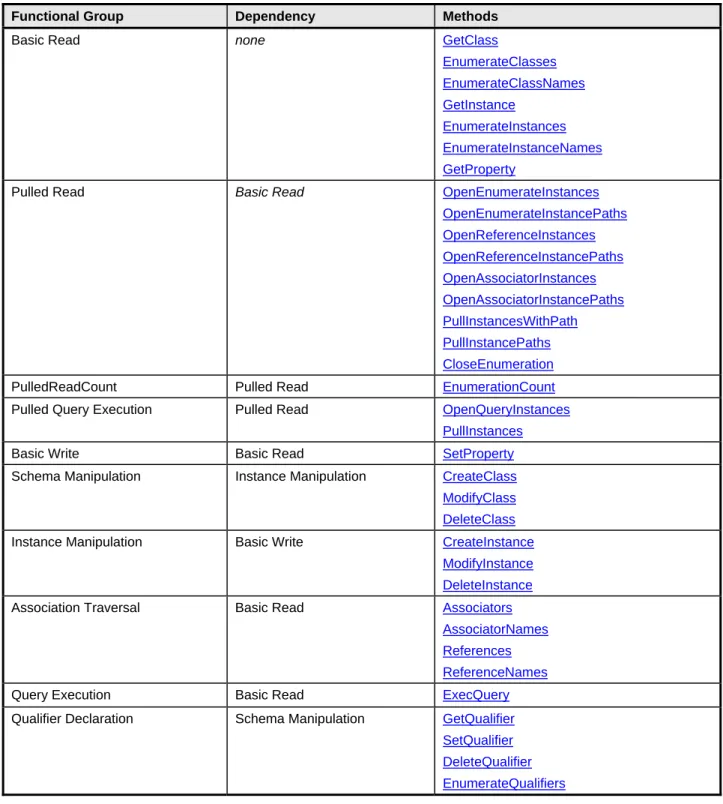
5.3.4 Functional Profiles ... 62
5.3.5 Extrinsic Method Invocation... 64
5.4 CIM Export Syntax and Semantics ... 64
5.4.1 Export Method Invocations ... 64
5.4.1.2 Multiple Export ... 65
86 87 88 89 90 91 92 93 94 95 96 97 98 99 100 101 102 103 104 105 106 107 108 109 110 111 112 113 114 115 116 117 118 119 120 121 122 123 124 125 126 127 128 129 130 131 132 133 134 135 136 137 138 139 140 141 5.4.1.3 Status Codes ... 65
5.4.2 Export Methods... 66
5.4.2.1 ExportIndication ... 68
5.4.3 Functional Profiles ... 68
6 Encapsulation of CIM Messages... 69
6.1 CIM Clients, CIM Servers, and CIM Listeners ... 69
6.2 Use of M-POST... 70
6.2.1 Use of the Ext Header ... 70
6.2.2 Naming of Extension Headers ... 70
6.3 Extension Headers Defined for CIM Message Requests and Responses ... 71
6.3.1 Encoding of CIM Element Names within HTTP Headers and Trailers ... 71
6.3.2 Encoding of CIM Object Paths within HTTP Headers and Trailers ... 72
6.3.3 CIMOperation... 73
6.3.4 CIMExport ... 74
6.3.5 CIMProtocolVersion ... 74
6.3.6 CIMMethod ... 75
6.3.7 CIMObject ... 75
6.3.8 CIMExportMethod ... 76
6.3.9 CIMBatch ... 77
6.3.10 CIMExportBatch... 78
6.3.11 CIMError ... 78
6.3.12 CIMRoleAuthenticate ... 79
6.3.13 CIMRoleAuthorization ... 79
6.3.14 CIMStatusCodeDescription ... 79
6.3.15 WBEMServerResponseTime... 80
7 HTTP Requirements and Usage ... 80
7.1 HTTP Support ... 80
7.2 Use of Standard Headers ... 80
7.2.1 Accept ... 80
7.2.2 Accept-Charset ... 80
7.2.3 Accept-Encoding... 81
7.2.4 Accept-Language... 81
7.2.5 Accept-Ranges ... 81
7.2.6 Allow ... 81
7.2.7 Authorization ... 82
7.2.8 Cache-Control... 82
7.2.9 Connection... 82
7.2.10 Content-Encoding ... 82
7.2.11 Content-Language ... 82
7.2.12 Content-Range... 83
7.2.13 Content-Type ... 83
7.2.14 Expires ... 83
7.2.15 If-Range ... 83
7.2.16 Proxy-Authenticate... 83
7.2.17 Range ... 83
7.2.18 WWW-Authenticate... 83
7.3 Errors and Status Codes ... 84
7.4 Security Considerations ... 85
7.5 Determining CIM Server Capabilities... 86
7.5.1 Determining CIM Server Capabilities through CIM Classes... 86
7.5.2 Determining CIM Server Capabilities through the HTTP Options ... 88
7.5.2.1 CIMSupportedFunctionalGroups ... 89
7.5.2.2 CIMSupportsMultipleOperations... 89
7.5.2.3 CIMSupportedQueryLanguages ... 90
7.6 Other HTTP Methods... 90
142 143 144 145 146 147 148 149 150 151 152 153 154 155 7.7 Discovery and Addressing ... 90
7.8 Internationalization Considerations... 91
Tables
Table 1 – Status Codes Returned by an <Error> Subelement ... 17Table 2 – Mapping of Intrinsic Method Pseudo-Types to XML Elements... 19
Table 3 – Root-Directed Tree of Functional Profile Dependencies ... 63
Table 4 – Symbolic Names for Referencing Error Codes... 66
Table 5 – Mapping of Export Method Pseudo-Types to XML Elements ... 68
Table 6 – Functional Groups of Export Methods ... 69
Table B-1 – Comparison of Properties Returned by GetInstance in Versions 1.0 and 1.1 ... 116
Foreword
156Introduction
158159 160 161 162 163
This document defines a mapping of CIM messages to the Hypertext Transfer Protocol (HTTP) so that implementations of CIM can operate in an open, standardized manner. It also defines the notion of
conformance in the context of this mapping, and it describes the behavior an implementation of CIM shall exhibit to be a conforming CIM implementation.
This document is structured as follows:
• Clause 5 describes the CIM messages that form the HTTP payload using XML. It specifies the syntax and semantics of the message requests and their corresponding responses.
164 165
• Clause 6 describes the encapsulation of these messages in HTTP request and response messages, with examples of each. It also describes the extension headers used to convey additional CIM-specific semantics in the HTTP Header.
166 167 168
• Clause 7 presents details of other aspects of the encapsulation: 169
170 171 172 173
174 175 176 177
– HTTP version support
– Use of standard HTTP headers – HTTP error codes
– Security considerations
Requirements
There are many different ways CIM messages can be represented in XML and encapsulated within HTTP messages. To attain interoperability among different implementations of CIM, both the XML
representation and the HTTP encapsulation must be standardized. The XML representation is defined in DSP0201 and DSP0203. This document uses that XML representation to define the HTTP encapsulation. 178
The following criteria are applied to the representation of CIM messages in XML using DSP0201 and 179
DSP0203: 180
181 182 183 184 185 186 187 188 189 190 191 192 193 194 195 196 197
• Each CIM message is completely described in XML; completeness is favored over conciseness. • The set of CIM messages provides enough functionality to enable implementations of CIM to
communicate effectively for management purposes. This release of the mapping does not provide a complete set of messages. Rather, the goal is to define the mapping so that it admits straightforward extension (by the addition of further features) in future versions.
• The set of CIM messages is classified into functional profiles to accommodate a range of implementations varying from complete support of all messages to support of a minimal subset. The number of functional profiles is kept as small as possible to encourage interoperability, and mechanisms provided by different CIM implementations can declare their level of support. The following criteria are applied to the HTTP encapsulation of CIM Messages herein:
• In recognition of the large installed base of HTTP/1.0 systems, the encapsulation is designed to support both HTTP/1.0 and HTTP/1.1.
• The encapsulation does not introduce requirements that conflict with those stated in HTTP/1.0 or HTTP/1.1.
• Use of the encapsulation should be straightforward over the current base HTTP infrastructures. Some features anticipate and exploit enhancements to this base, but no aspects of the
• The encapsulation avoids the use of pure HTTP tunneling or URL munging (for example, the use of the "?" character) in favor of a mechanism that allows existing HTTP infrastructures to control content safely.
198 199 200 201 202 203 204 205 206
• The encapsulation exposes key CIM message information in headers to allow efficient firewall/proxy handling. The information is limited to essentials so that it does not have a significant impact on the size of the header. All CIM-specific information in a header also appears within the CIM message.
• There is a clear and unambiguous encapsulation of the CIM message payload within the HTTP message. Conciseness of the encapsulation is of secondary importance.
CIM Operations over HTTP
207
1
Scope
208
The Common Information Model (CIM) (DSP0004) is an object-oriented information model defined by the Distributed Management Task Force (DMTF) that provides a conceptual framework for describing management data.
209 210 211
The Hypertext Transfer Protocol (HTTP) (RFC 1945, RFC 2068, RFC 2616) is an application-level protocol for distributed, collaborative, hypermedia information systems. This generic stateless protocol can be used for many tasks through extension of its request methods, error codes, and headers. 212
213 214
The Extensible Markup Language (XML) is a simplified subset of SGML that offers powerful and extensible data modeling capabilities. An XML document is a collection of data represented in XML. An
XML schema is a grammar that describes the structure of an XML document. 215
216 217
218 This document defines a mapping of CIM messages onto HTTP that allows implementations of CIM to interoperate in an open, standardized manner. It is based on the CIM XML DTD (DSP0201 and 219
DSP0203) that defines the XML schema for CIM objects and messages. 220
222 223 224 225
2
Normative References
221
The following referenced documents are indispensable for applying the information in this document while developing an implementation of CIM. For dated references, only the edition cited applies. For undated references, the latest edition applies, including any amendments.
DMTF DSP0004, Common Information Model (CIM) Infrastructure 2.5, http://www.dmtf.org/standards/published_documents/DSP0004_2.5.pdf 226
227 DMTF DSP0201, Specification for the Representation of CIM in XML 2.3, http://www.dmtf.org/standards/published_documents/DSP0201_2.3.pdf 228
229 DMTF DSP0203, CIM XML DTD 2.3,
http://www.dmtf.org/standards/published_documents/DSP0203_2.3.dtd 230
IETF RFC 1766, Tags for the Identification of Languages, March 1995, http://www.ietf.org/rfc/rfc1766.txt 231
IETF RFC 1945, Hypertext Transfer Protocol – HTTP/1.0, May 1996, http://www.ietf.org/rfc/rfc1945.txt 232
IETF RFC 2068, Hypertext Transfer Protocol – HTTP/1.1, January 1997, http://www.ietf.org/rfc/rfc2068.txt 233
234 IETF RFC 2069, An Extension to HTTP: Digest Access Authentication, January 1997, http://www.ietf.org/rfc/rfc2069.txt
235
236 IETF RFC 2277, IETF Policy on Character Sets and Languages, January 1998, http://www.ietf.org/rfc/rfc2277.txt
237
238 IETF RFC 2279, UTF-8, a transformation format of Unicode and ISO 10646, January 1998, http://www.ietf.org/rfc/rfc2279.txt
239
IETF RFC 2376, XML Media Types, July 1998, http://www.ietf.org/rfc/rfc2376.txt 240
IETF RFC 2616, Hypertext Transfer Protocol – HTTP/1.1, June 1999, http://www.ietf.org/rfc/rfc2616.txt 243
244 IETF RFC 2617, HTTP Authentication: Basic and Digest Access Authentication, June 1999, http://www.ietf.org/rfc/rfc2617.txt
245
IETF RFC 2774, HTTP Extension Framework, February 2000, http://www.ietf.org/rfc/rfc2774.txt 246
247 W3C Recommendation, Extensible Markup Language (XML), Version 1.0, August 2006, http://www.w3.org/TR/REC-xml-names/
248
W3C Recommendation, Namespaces in XML, Jan 1999, http://www.w3.org/TR/1999/REC-xml-names-249
19990114/ 250
W3C, XML Schema Part 1: Structures, May 2001, http://www.w3.org/TR/2001/REC-xmlschema-1-251
20010502/ 252
W3C, XSL Transformations (XSLT), Version 1.0, November 1999, http://www.w3.org/TR/xslt 253
255
2.1 Other References
254ISO/IEC Directives, Part 2, Rules for the structure and drafting of International Standards, http://isotc.iso.org/livelink/livelink.exe?func=ll&objId=4230456&objAction=browse&sort=subtype 256
258
3
Terms and Definitions
257
Throughout this document, the following terms and definitions apply. This specification uses the same notational conventions and basic parsing constructs that are defined in RFC 2068.
259
261 262
264 265
267 268 269
271 272 273
275 276
278 279
3.1
260can
used for statements of possibility and capability, whether material, physical, or causal
3.2
263
cannot
used for statements of possibility and capability, whether material, physical, or causal
3.3
266
conditional
indicates requirements that must be strictly followed to conform to the document when the specified conditions are met
3.4
270mandatory
indicates requirements that must be strictly followed to conform to the document, with no permitted deviations
3.5
274may
indicates a course of action permissible within the limits of the document
3.6
277
need not
3.7
280optional 281
282
284 285 286
288 289 290
292 293 294
296 297
299 300
302 303
305 306
308 309 310
312
indicates a course of action permissible within the limits of the document
3.8
283
shall
indicates requirements that must be strictly followed to conform to the document, with no permitted deviations
3.9
287shall not
indicates requirements that must be strictly followed to conform to the document, with no permitted deviations
3.10
291should
indicates that among several possibilities, one is recommended as particularly suitable, without
mentioning or excluding others, or that a certain course of action is preferred but not necessarily required
3.11
295
should not
indicates that a certain possibility or course of action is deprecated but not prohibited
3.12
298
unspecified
indicates that this profile does not define any constraints for the referenced CIM element or operation
3.13
301
CIM Message
a well-defined request or response data packet used to exchange information among CIM products
3.14
304
CIM Operation Message
a CIM message used to invoke an operation on the target namespace
3.15
307
CIM Export Message
a CIM message used to communicate information about a CIM namespace or element that is foreign to the target
3.16
311Operation Request Message
an XML document that is loosely valid with respect to the CIM XML DTD and that contains a <MESSAGE> subelement under the root <CIM> node that has a <MULTIREQ> or <SIMPLEREQ> subelement under this subelement
313 314 315
4
Abbreviated Terms and Document Conventions
316
4.1
Abbreviated Terms
317The following symbols and abbreviations are used in this document. 318
320 321
323 324
326 327
329 330
332
334
336
339
341 342 343 344 345 346 347 348 349 350
4.1.1 319
CIM
Common Information Model
4.1.2 322
DTD
document type definition
4.1.3 325
HTTP
Hypertext Transfer Protocol
4.1.4 328
XML
Extensible Markup Language
4.2
Document Conventions
331Throughout this document, any deprecated element is indicated by one of the following labels:
• The “DEPRECATION NOTE:” label preceding a paragraph indicates that the paragraph explains a 333
deprecated element.
• The “DEPRECATED.” label before a list item indicates that the information in that list item is 335
deprecated.
• The “(DEPRECATED)” label after a heading applies to the entire clause for that heading. 337
• The “(DEPRECATED)” label at the end of a line in a code fragment or an example indicates that the 338
particular line of the code fragment or example is deprecated.
5
CIM Message Syntax and Semantics
340
This specification defines all interactions among CIM products as CIM messages. A CIM message is a well-defined request or response data packet for exchanging information among CIM products. The two types of CIM messages are as follows:
• CIM operation message. This type of message is used to invoke an operation on the target namespace.
• CIM export message. This type of message is used to communicate information about a CIM namespace or element that is foreign to the target. It is informational only and does not define an operation on the target CIM namespace or even imply the existence of a target namespace. This clause describes the syntax and semantics of CIM messages independently of their encapsulation within a particular protocol such as HTTP. XML is used as the basis for this description, and in particular the CIM XML DTD (DSP0201 and DSP0203).
5.1
Well-Formed, Valid, and Loosely Valid Documents
352In this discussion, any reference to well-formed or valid XML documents has the standard meaning defined in
353
Extensible Markup Language (XML). 354
355 356
XML document type definitions (DTDs) are restricted to be either well-formed or valid. However, this document also uses the term loosely valid to apply to XML that removes any attributes or elements in the XML document that do not appear in the CIM XML DTD. The resulting document is valid with respect to the
357
CIM XML DTD and is therefore loosely valid. 358
In effect, a loosely valid document is valid with respect to the CIM XML DTD apart from having additional attributes or elements not defined by that DTD. The concept is very similar to that of an open content model as defined by the working draft on
359 360
XML Schemas, expressed within the more limited scope of DTDs. One corollary of this definition is that any XML document that is valid with respect to the 361
CIM XML 362
DTD is also loosely valid. 363
364 The motivation for introducing the loosely valid class of XML documents is to relax the restrictions on a DefCIMClient, CIM server, or CIM listener when parsing received XML documents defined within the scope of this mapping. Not all clients (including their respective CIM servers or CIM listeners) should be required to validate each received CIM message response (or its respective CIM message request) because such a requirement would place too heavy a processing burden on the validating entity at the expense of footprint and performance, most notably in communication between robust and conformant implementations of this mapping.
365 366 367 368 369 370 371 372 373 374 375 376 377 378 379 380
Instead, the following requirements are set forth in this specification. In all cases, a CIM client has a respective alternative CIM server or CIM listener, and a received CIM message response has a respective alternative CIM message request:
• A CIM client may include a DOCTYPE element in a CIM message request. If so, an external declaration should be used. In-lining of the complete DTD within a message is discouraged. • A CIM client may elect to validate a received CIM message response.
• If a CIM client elects not to validate a received CIM message, then loose validation shall be enforced.
The behavior of a CIM server or CIM listener with respect to a received CIM message request is covered in detail in 7.3.
5.2
Operational Semantics
381The CIM XML DTD (DSP0201 and DSP0203) defines a subelement under the root <CIM> element called <MESSAGE>, which contains one of the following subelements:
382 383 384 385 386 387 388 389 390 391 392 393
• CIM operation message subelements – <SIMPLEREQ>
– <SIMPLERSP> – <MULTIREQ> – <MULTIRSP>
• CIM export message subelements – <SIMPLEXPREQ> – <SIMPLEXPRSP> – <MULTIEXPREQ> – <MULTIEXPRSP>
In the remainder of this document, the following terms denote an XML document that is loosely valid with respect to the CIM XML DTD:
394 395 396 397 398 399 400 401 402 403 404 405 406 407 408 409 410 411 412 413 414 415 416 417 418 419 420 421 422 423 424 425 426 427 428 429 430 431 432 433 434 435 436
• Operation request message. Contains under the root <CIM> node a <MESSAGE> subelement that has a <MULTIREQ> or <SIMPLEREQ> subelement under it.
• Operation response message. Contains under the root <CIM> node a <MESSAGE> subelement that has a <MULTIRSP> or <SIMPLERSP> subelement under it.
• Export request message. Contains under the root <CIM> node a <MESSAGE> subelement that has a <MULTIEXPREQ> or <SIMPLEEXPREQ> subelement under it.
• Export response message. Contains under the root <CIM> node a <MESSAGE> subelement that has a <MULTIEXPRSP> or <SIMPLEEXPRSP> subelement under it.
The phrase CIM message request refers to either an operation request message or an export request message. The phrase CIM message response refers to either an operation response message or an export response message.
A CIM message request shall contain a non-empty value for the ID attribute of the <MESSAGE> element. The corresponding CIM message response shall supply the same value for that attribute. Clients should employ a message ID scheme that minimizes the chance of receiving a stale CIM message response. Any CIM message conforming to this specification shall have a minimum value of "1.0" and a maximum value that is equal to the latest version of this specification for the PROTOCOLVERSION attribute of the <MESSAGE> element.
An operation response message sent in response to an operation request message shall specify the same value for the ID attribute of the <MESSAGE> element that appears in the request message and contain one of the following:
– A <MULTIRSP> subelement, if the operation request message contains a <MULTIREQ> subelement.
– A <SIMPLERSP> subelement, if the operation request message contains a <SIMPLEREQ> subelement.
A simple operation request is an operation request message that contains a <SIMPLEREQ> subelement. A simple operation response is an Operation Response Message that contains a <SIMPLERSP>
subelement.
A multiple operation request is an operation request message that contains a <MULTIREQ> subelement. A multiple operation response is an operation response message that contains a <MULTIRSP>
subelement.
An export response message sent in response to an export request message shall specify the same value for the ID attribute of the <MESSAGE> element that appears in the export request message and shall contain one of the following:
– A <MULTIEXPRSP> subelement if the export request message contained a <MULTIEXPREQ> subelement, or
– A <SIMPLEEXPRSP> subelement if the export request message contained a <SIMPLEEXPREQ> subelement.
A simple export request is an export request message that contains a <SIMPLEEXPREQ> subelement. A simple export response is an export response message that contains a <SIMPLEEXPRSP> subelement. A multiple export request is an export request message that contains a <MULTIEXPREQ> subelement. A multiple export response is an export response message that contains a <MULTIEXPRSP> subelement.
5.3
CIM Operation Syntax and Semantics
437This clause describes method invocations, intrinsic methods, and namespace manipulation. 438
440 441 442 443 444 445 446 447 448 449 450 451 452 453 454 455 456 457 458 459 460 461 462 463 464 465 466 467 468 469 470 471 472 473 474
476 477
5.3.1 Method Invocations 439
All CIM operation requests defined for this CIM-to-HTTP mapping are defined as invocations of one or more methods. A method can be either:
• An intrinsic method, which is defined for the purposes of modeling a CIM operation. • An extrinsic method, which is defined on a CIM class in a schema.
In addition, intrinsic methods are made against a CIM namespace. Extrinsic methods are invoked on a CIM class (if static) or instance otherwise. Intrinsic methods are defined in 5.3.2.
An extrinsic method call is represented in XML by the <METHODCALL> element, and the response to that call is represented by the <METHODRESPONSE> element.
An intrinsic method call is represented in XML by the <IMETHODCALL> element, and the response to that call is represented by the <IMETHODRESPONSE> element. An input parameter has an IN qualifier (with a value of true) in the method definition, andan output parameter has an OUT qualifier (with a value of true). A parameter can be both an input and an output parameter.
The <METHODCALL> or <IMETHODCALL> element names the method to be invoked and supplies any input parameters to the method call. Note the following rules about parameters:
• Each input parameter shall be named using the name assigned in the method definition. • Input parameters may be supplied in any order.
• Each input parameter of the method, and no others, shall be present in the call, unless it is optional.
The <METHODRESPONSE> or <IMETHODRESPONSE> element defines either an <ERROR> or an optional return value and output parameters if it is decorated with the OUT qualifier in the method definition. In the latter case, the following rules about parameters apply:
• Each output parameter shall be named using the name assigned in the method definition. • Output parameters may be supplied in any order.
• Each output parameter of the method, and no others, shall be present in the response, unless it is optional.
• The method invocation process can be thought of as the binding of the input parameter values specified as subelements of the <METHODCALL> or <IMETHODCALL> element to the input parameters of the method. This binding is followed by an attempt to execute the method using the bound input parameters with one of the following results:
– If the attempt to call the method is successful, the return value and output parameters are bound to the subelements of the <METHODRESPONSE> or <IMETHODRESPONSE> element.
– If the attempt to call the method is unsuccessful, an error code and optional human-readable description of that code is bound to the <METHODRESPONSE> or <IMETHODRESPONSE> element.
5.3.1.1 Simple Operations 475
A simple operation invokes a single method. A simple operation request is represented by a
If the method is intrinsic, then the <SIMPLEREQ> element shall contain an <IMETHODCALL> element, which in turn contains a <LOCALNAMESPACEPATH> subelement identifying the local CIM namespace against which the method is to execute. If the method is
478 479
extrinsic, then the <SIMPLEREQ> element shall contain a <METHODCALL> element that in turn contains one of the following subelements:
480 481 482 483 484 485
487 488 489 490 491 492 493 494 495 496
• A <LOCALCLASSPATH> subelement identifying the CIM class on which the method is to be invoked if the method is static.
• A <LOCALINSTANCEPATH> subelement identifying the CIM instance on which the method is otherwise to be invoked.
5.3.1.2 Multiple Operations 486
A multiple operation requires the invocation of more than one method. A multiple operation request is represented by a <MULTIREQ> element, and a multiple operation response is represented by a <MULTIRSP> element.
A <MULTIREQ> (or its respective <MULTIRSP>) element is a sequence of two or more <SIMPLEREQ> (or their respective <SIMPLERSP>) elements.
A <MULTIRSP> element shall contain a <SIMPLERSP> element for every <SIMPLEREQ> element in the corresponding multiple operation response. These <SIMPLERSP> elements shall be in the same order as their <SIMPLEREQ> counterparts so that the first <SIMPLERSP> in the response corresponds to the first <SIMPLEREQ> in the request, and so forth.
Multiple operations conveniently allow multiple method invocations to be batched into a single HTTP message. Batching reduces the number of roundtrips between a CIM client and a CIM server and allows the CIM server to make internal optimizations if it chooses. Note that multiple operations do not confer any transactional capabilities in processing the request. For example, the CIM server does not have to guarantee that the constituent method calls either all fail or succeed, only that the entity make a "best effort" to process the operation. However, servers shall finish processing each operation in a batched operation before executing the next one. Clients shall recognize that the order of operations within a batched operation is significant.
497 498 499 500 501 502 503 504 505
507 508 509 510 511 512 513 514 515 516 517 518 519 520
Not all CIM servers support multiple operations; the way they declare support for this feature is defined in 7.5.
5.3.1.3 Status Codes 506
This clause defines the status codes and detailed error information that a conforming CIM server application can return. The value of an <ERROR> subelement within a <METHODRESPONSE> or <IMETHODRESPONSE> element includes the following parts:
• a mandatory status code
• an optional human-readable description of the status code • zero or more CIM_Error instances
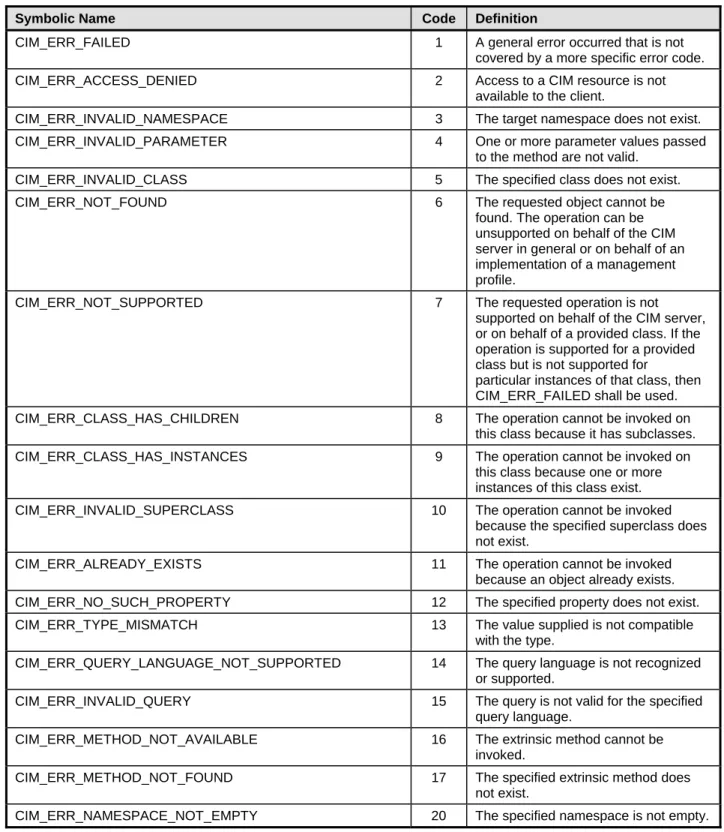
Table 1 defines the status codes that a conforming CIM server application can return as the value of the CODE attribute of an <ERROR> subelement. In addition to a status code, a conforming CIM server may return zero or more <INSTANCE> subelements as part of an <ERROR> element. Each <INSTANCE> subelement shall be an instance of CIM_Error. For each instance of CIM_Error, the value of
CIMStatusCode shall comply with the definition of expected error codes for the CIM operation request. A CIM client may ignore any <INSTANCE> subelements.
The symbolic names defined in Table 1 do not appear on the wire. They are used here solely for convenient reference to an error in other parts of this specification.
Not all methods are expected to return all the status codes listed in Table 1. For intrinsic methods, the relevant clause on each method in this specification defines the error codes expected to be returned. For extrinsic methods,
521 522 523
524
5.3.5 specifies which of the codes in Table 1 can be used.
Table 1 – Status Codes Returned by an <Error> Subelement
Symbolic Name Code Definition
CIM_ERR_FAILED 1 A general error occurred that is not covered by a more specific error code. CIM_ERR_ACCESS_DENIED 2 Access to a CIM resource is not
available to the client.
CIM_ERR_INVALID_NAMESPACE 3 The target namespace does not exist. CIM_ERR_INVALID_PARAMETER 4 One or more parameter values passed
to the method are not valid.
CIM_ERR_INVALID_CLASS 5 The specified class does not exist. CIM_ERR_NOT_FOUND 6 The requested object cannot be
found. The operation can be unsupported on behalf of the CIM server in general or on behalf of an implementation of a management profile.
CIM_ERR_NOT_SUPPORTED 7 The requested operation is not supported on behalf of the CIM server, or on behalf of a provided class. If the operation is supported for a provided class but is not supported for
particular instances of that class, then CIM_ERR_FAILED shall be used. CIM_ERR_CLASS_HAS_CHILDREN 8 The operation cannot be invoked on
this class because it has subclasses. CIM_ERR_CLASS_HAS_INSTANCES 9 The operation cannot be invoked on
this class because one or more instances of this class exist. CIM_ERR_INVALID_SUPERCLASS 10 The operation cannot be invoked
because the specified superclass does not exist.
CIM_ERR_ALREADY_EXISTS 11 The operation cannot be invoked because an object already exists. CIM_ERR_NO_SUCH_PROPERTY 12 The specified property does not exist. CIM_ERR_TYPE_MISMATCH 13 The value supplied is not compatible
with the type.
CIM_ERR_QUERY_LANGUAGE_NOT_SUPPORTED 14 The query language is not recognized or supported.
CIM_ERR_INVALID_QUERY 15 The query is not valid for the specified query language.
CIM_ERR_METHOD_NOT_AVAILABLE 16 The extrinsic method cannot be invoked.
CIM_ERR_METHOD_NOT_FOUND 17 The specified extrinsic method does not exist.
Symbolic Name Code Definition
CIM_ERR_INVALID_ENUMERATION_CONTEXT 21 The enumeration identified by the specified context cannot be found, is in a closed state, does not exist, or is otherwise invalid.
CIM_ERR_INVALID_OPERATION_TIMEOUT 22 The specified operation timeout is not supported by the CIM Server. CIM_ERR_PULL_HAS_BEEN_ABANDONED 23 The Pull operation has been
abandoned due to execution of a concurrent CloseEnumeration operation on the same enumeration. CIM_ERR_PULL_CANNOT_BE_ABANDONED 24 The attempt to abandon a concurrent
Pull operation on the same
enumeration failed. The concurrent Pull operation proceeds normally.
CIM_ERR_FILTERED_ENUMERATION_NOT_SUPPORTED 25 Using a filter in the enumeration is not supported by the CIM server.
CIM_ERR_CONTINUATION_ON_ERROR_NOT_SUPPORTED 26 The CIM server does not support continuation on error.
CIM_ERR_SERVER_LIMITS_EXCEEDED 27 The CIM server has failed the operation based upon exceeding server limits.
CIM_ERR_SERVER_IS_SHUTTING_DOWN 28 The CIM server is shutting down and cannot process the operation.
5.3.2 Intrinsic Methods 525
This clause describes the Intrinsic methods defined outside the schema for CIM operations. These methods can only be called on a CIM namespace, rather than on a CIM class or instance.
526 527
528 The notation used in the following subclauses to define the signatures of the intrinsic methods is a pseudo-MOF notation that extends the standard MOF BNF (DSP0004) for describing CIM methods with several pseudo-parameter types enclosed within angle brackets (< and >).
529 530 531 532
This notation decorates the parameters with pseudo-qualifiers (IN, OUT, OPTIONAL, and NULL) to define their invocation semantics. These qualifiers are for description purposes only within the scope of this specification; in particular, a CIM client shall not specify them in intrinsic method invocations.
533 534 535 536 537 538 539 540 541 542 543 544 545
This notation uses the IN qualifier to denote that the parameter is an input parameter. This notation uses the OUT qualifier to denote that the parameter is an output parameter.
A CIM client may omit an optional parameter by not specifying an <IPARAMVALUE> element for that parameter if the required value is the specified default. It shall not omit a parameter that is not marked as optional. A CIM server may omit support for an optional parameter. Any attempt to call a method with an optional parameter that is not supported shall return either CIM_ERR_NOT_SUPPORTED or
CIM_ERR_INVALID_PARAMETER.
This notation uses the NULL qualifier for parameters whose values can be specified as NULL in a method call. A NULL (unassigned) value for a parameter is specified by an <IPARAMVALUE> or
<PARAMVALUE> element with no subelement. For parameters without the NULL qualifier, the CIM client shall specify a value by including a suitable subelement for the <IPARAMVALUE> or <PARAMVALUE> element.
All parameters shall be uniquely named and shall correspond to a valid parameter name for that method as described by this specification. The order of the parameters is not significant.
546 547 548 549 550 551 552 553 554
The non-NULL values of intrinsic method parameters or return values modeled as standard CIM types (such as string and Boolean or arrays thereof) are represented as follows:
• Simple values use the <VALUE> subelement within an <IPARAMETER> element for method parameters or within an <IRETURNVALUE> element for method return values.
• Array values use the <VALUE.ARRAY> subelement within an <IPARAMETER> element for method parameters or within an <IRETURNVALUE> element for method return values.
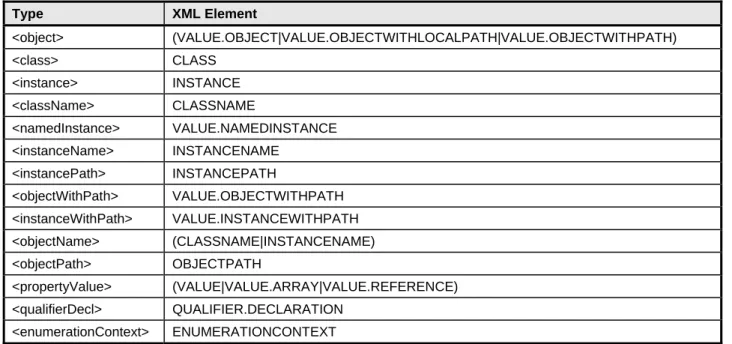
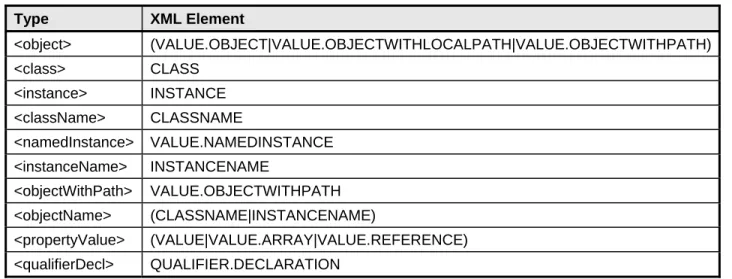
Table 2 shows how each pseudo-type used by the intrinsic methods shall be mapped to an XML element described in DSP0201 in the context of both a parameter value (subelement of <IPARAMVALUE>) and a return value (subelement of <IRETURNVALUE>).
555 556
557 Table 2 – Mapping of Intrinsic Method Pseudo-Types to XML Elements
Type XML Element
<object> (VALUE.OBJECT|VALUE.OBJECTWITHLOCALPATH|VALUE.OBJECTWITHPATH) <class> CLASS
<instance> INSTANCE <className> CLASSNAME
<namedInstance> VALUE.NAMEDINSTANCE <instanceName> INSTANCENAME
<instancePath> INSTANCEPATH
<objectWithPath> VALUE.OBJECTWITHPATH <instanceWithPath> VALUE.INSTANCEWITHPATH <objectName> (CLASSNAME|INSTANCENAME) <objectPath> OBJECTPATH
<propertyValue> (VALUE|VALUE.ARRAY|VALUE.REFERENCE) <qualifierDecl> QUALIFIER.DECLARATION
<enumerationContext> ENUMERATIONCONTEXT
5.3.2.1 GetClass 558
The GetClass operation returns a single CIM class from the target namespace: 559
560 GetClass
<class>GetClass (
561
[IN] <className> ClassName,
562 563 564 565 566 567 568 569 570 571
[IN,OPTIONAL] boolean LocalOnly = true,
[IN,OPTIONAL] boolean IncludeQualifiers = true, [IN,OPTIONAL] boolean IncludeClassOrigin = false, [IN,OPTIONAL,NULL] string PropertyList [] = NULL )
The ClassName input parameter defines the name of the class to be retrieved.
If the LocalOnly input parameter is true, any CIM elements (properties, methods, and qualifiers), except those added or overridden in the class as specified in the classname input parameter, shall not be included in the returned class. If it is false, no additional filtering is defined.
If the IncludeQualifiers input parameter is true, all qualifiers for that class (including qualifiers on the class and on any returned properties, methods, or method parameters) shall be included as
<QUALIFIER> elements in the response. If it is false, no <QUALIFIER> elements are present in the returned class.
572 573 574 575 576 577 578 579 580 581 582 583 584 585 586 587 588 589 590 591 592 593 594 595 596 597 598 599 600
602 603
If the IncludeClassOrigin input parameter is true, the CLASSORIGIN attribute shall be present on all appropriate elements in the returned class. If it is false, no CLASSORIGIN attributes are present in the returned class.
If the PropertyList input parameter is not NULL, the members of the array define one or more property names. The returned class shall not include elements for properties missing from this list. Note that if
LocalOnly is specified as true, it acts as an additional filter on the set of properties returned. For example, if property A is included in the PropertyList but LocalOnly is set to true and A is not local to the requested class, it is not included in the response. If the PropertyList input parameter is an empty array, no properties are included in the response. If the PropertyList input parameter is NULL, no additional filtering is defined.
If the PropertyList contains duplicate elements, the server shall ignore them but otherwise process the request normally. If the PropertyList contains elements that are invalid property names for the target class, the server shall ignore them but otherwise process the request normally.
If GetClass is successful, the return value is a single CIM class thatshall include all CIM elements (properties, methods, and qualifiers) defined in or inherited by that class, reduced by any elements excluded as a result of using the LocalOnly or PropertyList filters.
If GetClass is unsuccessful, this method shall return one of the following status codes, where the error returned is the first applicable error in the list, starting with the first element and working down. Any additional method-specific interpretation of the error is enclosed in parentheses:
• CIM_ERR_ACCESS_DENIED • CIM_ERR_INVALID_NAMESPACE
• CIM_ERR_INVALID_PARAMETER (including missing, duplicate, unrecognized or otherwise incorrect parameters)
• CIM_ERR_NOT_FOUND (The request CIM class does not exist in the specified namespace.) • CIM_ERR_FAILED (Some other unspecified error occurred.)
5.3.2.2 GetInstance 601
The GetInstance operation returns a single CIM instance from the target namespace: GetInstance
<instance>GetInstance (
604
[IN] <instanceName> InstanceName,
605 606 607 608 609 610 611 612 613 614 615
[IN,OPTIONAL] boolean LocalOnly = true, (DEPRECATED)
[IN,OPTIONAL] boolean IncludeQualifiers = false, (DEPRECATED)
[IN,OPTIONAL] boolean IncludeClassOrigin = false, [IN,OPTIONAL,NULL] string PropertyList [] = NULL )
The InstanceName input parameter defines the name of the instance to be retrieved.
DEPRECATION NOTE: With the 1.2 release of this specification, the LocalOnly parameter is
DEPRECATED. LocalOnly filtering, as defined in 1.1, will not be supported in the next major revision of this specification. In the 1.1 version of this specification, the definition of the LocalOnly parameter was incorrectly modified. This change introduced a number of interoperability and backward compatibility
problems for CIM clients using the LocalOnly parameter to filter the set of properties returned. The DMTF strongly recommends that CIM clients set LocalOnly to false and do not use this parameter to filter the set of properties returned. To minimize the impact of this recommendation on CIM clients, a CIM server may choose to treat the value of the LocalOnly parameter as false for all requests. A CIM server shall consistently support a single interpretation of the LocalOnly parameter. Refer to
616 617 618 619 620 621 622 623 624 625 626 627 628 629 630 631 632 633 634 635 636 637 638 639 640 641 642 643 644 645 646 647 648 649 650 651 652 653 654 655 656 657 658 659 660
ANNEX B for additional details.
DEPRECATION NOTE: The use of the IncludeQualifiers parameter is DEPRECATED and it may be removed in a future version of this specification. The IncludeQualifiers parameter definition is ambiguous and when it is set to true, CIM clients cannot be assured that any qualifiers will be returned. A CIM client should always set IncludeQualifiers to false. To minimize the impact of this
recommendation on CIM clients, a CIM server may choose to treat the value of the
IncludeQualifiers parameter as false for all requests. The preferred behavior is to use the class operations to receive qualifier information and not depend on any qualifiers existing in this response. If the IncludeQualifiers input parameter is true, all qualifiers for that instance (including qualifiers on the instance and on any returned properties) shall be included as <QUALIFIER> elements in the
response. If it is false, no <QUALIFIER> elements are present.
If the IncludeClassOrigin input parameter is true, the CLASSORIGIN attribute shall be present on all appropriate elements in the returned instance. If it is false, no CLASSORIGIN attributes are present. If the PropertyList input parameter is not NULL, the members of the array define one or more property names. The returned instance shall not include elements for properties missing from this list. Note that if
LocalOnly is true, this acts as an additional filter on the set of properties returned. For example, if property A is included in the PropertyList but LocalOnly is set to true and A is not local to the requested instance, it is not included in the response. If the PropertyList input parameter is an empty array, no properties are included in the response. If the PropertyList input parameter is NULL, no additional filtering is defined.
If the PropertyList contains duplicate elements, the server shall ignore the duplicates but otherwise process the request normally. If the PropertyList contains elements that are invalid Property names for the target instance, the server shall ignore them but otherwise process the request normally. Properties with the NULL value may be omitted from the response, even if the CIM client has not
requested the exclusion of the property through the LocalOnly or PropertyList filters. The CIM client shall interpret such omitted properties as NULL. Note that the CIM client cannot make any assumptions about properties omitted as a result of using LocalOnly or PropertyList filters.
If GetInstance is successful, the return value is a single CIM instance with all properties defined in and inherited by its class reduced by any properties excluded as a result of using the LocalOnly or
PropertyList filters and further reduced by any NULL valued properties omitted from the response. If GetInstance is unsuccessful, the method shall return one of the following status codes where the error returned is the first applicable error in the list, starting with the first element and working down. Any additional method-specific interpretation of the error is enclosed in parentheses:
• CIM_ERR_ACCESS_DENIED • CIM_ERR_INVALID_NAMESPACE
• CIM_ERR_INVALID_PARAMETER (including missing, duplicate, unrecognized, or otherwise incorrect parameters)
• CIM_ERR_INVALID_CLASS (The CIM class does not exist in the specified namespace.) • CIM_ERR_NOT_FOUND (The CIM class does exist, but the requested CIM instance does not
• CIM_ERR_FAILED (some other unspecified error occurred) 661
663 664 665
5.3.2.3 DeleteClass 662
The DeleteClass operation deletes a single CIM class from the target namespace: DeleteClass
void DeleteClass (
[IN] <className> ClassName
666 667 668 669 670 671 672 673 674 675 676 677 678 679 680 681 682 683 684
686 687 688
)
The ClassName input parameter defines the name of the class to be deleted.
If DeleteClass is successful, the CIM server removes the specified class, including any subclasses and any instances. The operation shall fail if any one of these objects cannot be deleted.
If DeleteClass is unsuccessful, this method shall return one of the following status codes, where the error returned is the first applicable error in the list, starting with the first element and working down. Any additional method-specific interpretation of the error is enclosed in parentheses:
• CIM_ERR_ACCESS_DENIED • CIM_ERR_NOT_SUPPORTED • CIM_ERR_INVALID_NAMESPACE
• CIM_ERR_INVALID_PARAMETER (including missing, duplicate, unrecognized, or otherwise incorrect parameters)
• CIM_ERR_NOT_FOUND (The CIM class to be deleted does not exist.)
• CIM_ERR_CLASS_HAS_CHILDREN (The CIM class has one or more subclasses that cannot be deleted.)
• CIM_ERR_CLASS_HAS_INSTANCES (The CIM class has one or more instances that cannot be deleted.)
• CIM_ERR_FAILED (Some other unspecified error occurred.) 5.3.2.4 DeleteInstance
685
The DeleteInstance operation deletes a single CIM instance from the target namespace. DeleteInstance
void DeleteInstance (
[IN] <instanceName> InstanceName
689 690 691 692 693 694 695 696 697 698 699 700
)
The InstanceName input parameter defines the name (model path) of the instance to be deleted. Deleting the instance may or may not cause the automatic deletion of additional instances. For example, the deletion of an instance may cause the automatic deletion of all associations that reference that instance. Or the deletion of an instance may cause the automatic deletion of instances (and their associations) that have a Min(1) relationship to that instance.
If DeleteInstance is successful, the CIM server removes the specified instance.
If DeleteInstance is unsuccessful, this method shall return one of the following status codes, where the error returned is the first applicable error in the list, starting with the first element and working down. Any additional method-specific interpretation of the error is enclosed in parentheses.
• CIM_ERR_NOT_SUPPORTED (by the CIM server for this operation) 701
702 703 704 705 706 707 708 709 710 711
713 714 715 716
• CIM_ERR_INVALID_NAMESPACE
• CIM_ERR_INVALID_PARAMETER (including missing, duplicate, unrecognized, or otherwise incorrect parameters)
• CIM_ERR_INVALID_CLASS (The CIM class does not exist in the specified namespace.) • CIM_ERR_NOT_SUPPORTED (This operation is not supported for the class of the specified
instance, if provided.)
• CIM_ERR_NOT_FOUND (The CIM class does exist, but the requested CIM instance does not exist in the specified namespace.)
• CIM_ERR_FAILED (This operation is not supported for the specified instance, or some other unspecified error occurred.)
5.3.2.5 CreateClass 712
The CreateClass operation creates a single CIM class in the target namespace. The class shall not already exist:
CreateClass
void CreateClass (
[IN] <class> NewClass
717 718 719
)
The NewClass input parameter defines the new class. The proposed definition shall be a correct class definition according to DSP0004.
720 721 722 723 724 725 726 727 728 729 730 731 732 733 734 735 736 737 738 739 740 741 742 743
In processing the creation of the new class, the CIM server shall conform to the following rules: • The server shall ignore any CLASSORIGIN and PROPAGATED attributes in the NewClass. • If the new class has no superclass, the NewClass parameter defines a new base class. The
server shall ensure that all properties and methods of the new class have a CLASSORIGIN
attribute whose value is the name of the new class.
• If the new class has a superclass, the NewClass parameter defines a new subclass of that superclass. The superclass shall exist. The server shall ensure that the following conditions are met:
– Any properties, methods, or qualifiers in the subclass not defined in the superclass are created as new elements of the subclass. In particular, the server shall set the
CLASSORIGIN attribute on the new properties and methods to the name of the subclass and ensure that all others preserve their CLASSORIGIN attribute value from that defined in the superclass.
– If a property is defined in the superclass and in the subclass, the value assigned to that property in the subclass (including NULL) becomes the default value of the property for the subclass.
– If a property or method of the superclass is not specified in the subclass, then it is inherited without modification by the subclass.
– Any qualifiers defined in the superclass with a TOSUBCLASS attribute value of true shall appear in the resulting subclass. Qualifiers in the superclass with a TOSUBCLASS attribute value of false shall not be propagated to the subclass.
– Any qualifier propagated from the superclass cannot be modified in the subclass if the
to specify such a qualifier in the NewClass with a definition different than that in the superclass (where definition encompasses the name, type, and flavor attribute settings of the <QUALIFIER> element and the value of the qualifier).
744 745 746 747 748 749 750 751 752 753 754 755 756 757 758 759
761 762 763
If CreateClass is successful, the CIM server creates the specified class.
If CreateClass is unsuccessful, this method shall return one of the following status codes, where the error returned is the first applicable error in the list, starting with the first element and working down. Any additional method-specific interpretation of the error is enclosed in parentheses.
• CIM_ERR_ACCESS_DENIED • CIM_ERR_NOT_SUPPORTED • CIM_ERR_INVALID_NAMESPACE
• CIM_ERR_INVALID_PARAMETER (including missing, duplicate, unrecognized, or otherwise incorrect parameters)
• CIM_ERR_ALREADY_EXISTS (The CIM class already exists.)
• CIM_ERR_INVALID_SUPERCLASS (The putative CIM class declares a non-existent superclass.)
• CIM_ERR_FAILED (Some other unspecified error occurred.) 5.3.2.6 CreateInstance
760
The CreateInstance operation creates a single CIM Instance in the target namespace. The instance shall not already exist:
CreateInstance
<instanceName>CreateInstance (
764
[IN] <instance> NewInstance
765 766 767 768 769 770
)
DEPRECATION NOTE:The use of qualifiers on instances is DEPRECATEDand may be removed in a future version of this specification. A CIM client cannot rely on any qualifiers included in the NewInstance to have any impact on the operation. It is recommended that the CIM server ignore any qualifiers included in the instance. The NewInstance input parameter defines the new instance. The proposed definition shall be a correct instance definition for the underlying CIM class according to DSP0004.
771 772 773 774 775 776 777 778 779 780 781 782 783 784 785
In creating the new instance, the CIM server shall conform to the following rules and ensure that they are applied:
• The server shall ignore any CLASSORIGIN and PROPAGATED attributes in the NewInstance. • DEPRECATED. Any qualifiers in the instance not defined in the class are created as new
elements of the instance.
• All properties of the instance preserve their CLASSORIGIN attribute value from that defined in the class.
• If a property is specified in the NewInstance parameter, the value assigned to that property in the instance (including NULL) becomes the value of the property for the instance. Note that it is a client error to specify a property that does not belong to the class.
• If a property of the class is not specified in the instance, then the instance inherits that property without modification.
• DEPRECATION NOTE: Use of the TOINSTANCE attribute is DEPRECATED. Servers may choose to ignore TOINSTANCE. Servers that do not ignore TOINSTANCE shall interpret it so
that any qualifiers defined in the class with a TOINSTANCE attribute value of true appear in the instance. Qualifiers in the class with a value of false shall not be propagated to the instance.
786 787 788 789 790 791 792 793 794
• DEPRECATED. Any Qualifier propagated from the class cannot be modified in the instance if the OVERRIDABLE attribute of that qualifier is set to false in the class. It is a client error to specify such a qualifier in the NewInstance with a definition different than that in the class (where definition encompasses the name, type, and flavor attribute settings of the
<QUALIFIER> element and the value of the qualifier).
If CreateInstance is successful, the return value defines the object path of the new CIM instance relative to the target namespace created by the CIM server (that is, the model path as defined by DSP0004). It is returned if one or more of the new keys of the instance are dynamically allocated during creation rather than specified in the request.
795 796 797 798 799 800 801 802 803 804 805 806 807 808 809 810 811
813 814 815 816
If CreateInstance is unsuccessful, this method shall return one of the following status codes, where the error returned is the first applicable error in the list, starting with the first element and working down. Any additional method-specific interpretation of the error is enclosed in parentheses.
• CIM_ERR_ACCESS_DENIED
• CIM_ERR_NOT_SUPPORTED (by the CIM server for this operation) • CIM_ERR_INVALID_NAMESPACE
• CIM_ERR_INVALID_PARAMETER (including missing, duplicate, unrecognized, or otherwise incorrect parameters)
• CIM_ERR_INVALID_CLASS (The CIM class for the new instance does not exist.)
• CIM_ERR_NOT_SUPPORTED (This operation is not supported for the class of the specified instance, if provided.)
• CIM_ERR_ALREADY_EXISTS (The CIM instance already exists.)
• CIM_ERR_FAILED (This operation is not supported for the specified instance or some other unspecified error occurred.)
5.3.2.7 ModifyClass 812
The ModifyClass operation modifies an existing CIM class in the target namespace. The class shall already exist:
ModifyClass
void ModifyClass (
[IN] <class> ModifiedClass
817 818 819
)
The ModifiedClass input parameter defines the set of changes to be made to the current class definition, which shall be correct amendments to the CIM class as defined by DSP0004.
820 821 822 823 824 825 826 827
In modifying the class, the CIM server shall conform to the following rules:
• The CIM server shall ignore any CLASSORIGIN and PROPAGATED attributes in the
ModifiedClass.
• If the modified class has no superclass, the ModifiedClass parameter defines modifications to a base class. The server shall ensure that the following conditions are met:
– All properties and methods of the modified class have a CLASSORIGIN attribute whose value is the name of this class.
– Any properties, methods, or qualifiers in the existing class definition that do not appear in the ModifiedClass parameter are removed from the resulting modified class.
828 829 830 831 832 833 834 835 836 837 838 839 840 841 842 843 844 845 846 847 848 849 850 851 852 853 854 855 856 857 858 859 860 861 862 863 864 865 866 867 868 869 870 871 872
• If the modified class has a superclass, the ModifiedClass parameter defines modifications to a subclass of that superclass. The superclass shall exist, and the client shall not change the name of the superclass in the modified subclass. The server shall ensure that the following conditions are met:
– Any properties, methods, or qualifiers in the subclass not defined in the superclass are created as elements of the subclass. In particular, the server shall set the CLASSORIGIN
attribute on the new properties and methods to the name of the subclass and shall ensure that all other others preserve their CLASSORIGIN attribute value from that defined in the superclass.
– Any property, method, or qualifier previously defined in the subclass but not defined in the superclass, and which is not present in the ModifiedClass parameter, is removed from the subclass.
– If a property is specified in the ModifiedClass parameter, the value assigned to that property (including NULL) becomes the default value of the property for the subclass. – If a property or method of the superclass is not specified in the subclass, then the subclass
inherits it without modification. Any previous changes to such an element in the subclass are lost.
– If a qualifier in the superclass is not specified in the subclass and the qualifier is defined in the superclass with a TOSUBCLASS attribute value of true, then the qualifier shall still be present in the resulting modified subclass. A propagated qualifier cannot be removed from a subclass.
– Any qualifier propagated from the superclass cannot be modified in the subclass if the
OVERRIDABLE attribute of that qualifier is set to false in the superclass. It is a client error to specify such a qualifier in the ModifiedClass with a definition different than that in the superclass (where definition encompasses the name, type, and flavor attribute settings of the <QUALIFIER> element and the value of the qualifier).
– Any qualifiers defined in the superclass with a TOSUBCLASS attribute value of false shall not be propagated to the subclass.
If ModifyClass is successful, the CIM server updates the specified class. The request to modify the class shall fail if the server cannot consistently update any existing subclasses or instances of that class. If ModifyClass is unsuccessful, this method shall return one of the following status codes, where the error returned is the first applicable error in the list, starting with the first element and working down. Any additional method-specific interpretation of the error is enclosed in parentheses.
• CIM_ERR_ACCESS_DENIED • CIM_ERR_NOT_SUPPORTED • CIM_ERR_INVALID_NAMESPACE
• CIM_ERR_INVALID_PARAMETER (including missing, duplicate, unrecognized, or otherwise incorrect parameters)
• CIM_ERR_NOT_FOUND (The CIM class does not exist.)
• CIM_ERR_INVALID_SUPERCLASS (The putative CIM class declares a non-existent or incorrect superclass.)
• CIM_ERR_CLASS_HAS_CHILDREN (The modification could not be performed because the subclasses of the class could not be updated consistently.)
• CIM_ERR_CLASS_HAS_INSTANCES (The modification could not be performed because the instances of the class could not be updated consistently.)
873 874 875
877 878 879 880
• CIM_ERR_FAILED (Some other unspecified error occurred.) 5.3.2.8 ModifyInstance
876
The ModifyInstance operation modifies an existing CIM instance in the target namespace. The instance shall already exist:
ModifyInstance
void ModifyInstance (
[IN] <namedInstance> ModifiedInstance,
881 882 883 884 885 886 887 888 889 890 891 892 893 894 895 896 897 898 899 900 901 902 903 904 905 906 907 908 909 910 911 912 913 914 915
[IN, OPTIONAL] boolean IncludeQualifiers = true, (DEPRECATED)
[IN, OPTIONAL, NULL] string propertyList[] = NULL )
The ModifiedInstance input parameter identifies the name of the instance to be modified and provides the new property values.
DEPRECATION NOTE: Use of the IncludeQualifiers parameter is DEPRECATED, and it may be removed in a future version of this specification. The behavior of the IncludeQualifiers parameter is not specified. A CIM client cannot rely on IncludeQualifiers to have any impact on the operation. It is recommended that the CIM server ignore any qualifiers included in ModifiedInstance. If the
IncludeQualifiers input parameter is true, the qualifiers are modified as specified in
ModifiedInstance. If the parameter is false, qualifiers in ModifiedInstance are ignored and no qualifiers are explicitly modified.
The set of properties to be modified shall be determined as follows:
If the PropertyList input parameter is not NULL, the members of the array define one or more property names. Only properties specified in the PropertyList are modified. Properties of the ModifiedInstance that are missing from the PropertyList are ignored. If the PropertyList is an empty array, no properties are modified. If the PropertyList is NULL, the set of properties to be modified consists of those of
ModifiedInstance with values different from the current values in the instance to be modified.
If the PropertyList contains duplicate elements, the server shall ignore them but otherwise process the request normally. If the PropertyList contains elements that are invalid property names for the instance to be modified, the server shall reject the request. If a property to be modified as previously defined cannot be modified because it is a key property, non-writable, or cannot be modified at this time for any other reason, the server shall reject the request. Non-writable properties are those defined to be non-writable in the schema implemented for the creation class of the instance to be modified. The value of the WRITE qualifier as defined in the schema for the creation class (or any of its superclasses) has no effect on the behavior of ModifyInstance.
In modifying the instance, the CIM server shall conform to the following rules and ensure their application: • The server shall ignore any CLASSORIGIN and PROPAGATED attributes in the
ModifiedInstance.
• The class shall exist, and the client shall not change its name in the instance to be modified. • DEPRECATED.Any qualifiers in the instance not defined in the class are created as new
elements of the instance if IncludeQualifiers is true.
• All properties of the instance to be modified preserve their CLASSORIGIN attribute value from that defined in the class.