Delivering Cloud Services
Executive Summary
When it comes to cloud service delivery, providers must address several key
business challenges: Contain the cost of customer acquisition, eliminate barriers
to customer adoption and differentiate on more than just the price of service.
If you can’t meet these challenges, you can’t reach the market with
the services that customers are clamoring for – at least not quickly
or efficiently enough to see a solid return on your investment.
That’s the bad news.
The good news is that you can meet these challenges for delivering cloud services
successfully and profitably, if you have the right identity management capabilities.
This paper outlines the five infrastructure essentials for successfully delivering
cloud services to a rapidly growing customer base:
• Unification of customer identity data across various
applications and services
• Multi-tenancy capabilities for keeping each customer’s
data separate and secure
• Performance at scale to keep pace with constant growth
in demand for services
• Virtualization to keep the hardware costs down when
scaling up to meet demand
• Auditing to provide proof of authorized access to
providers, customers and regulators
You’ll learn how the five infrastructure essentials can benefit both you, the cloud
services provider, and your customer, the cloud services consumer – to your
ultimate economic benefit. You’ll also see why traditional identity management
infrastructures fall short, and how a new approach is the key to building the
essentials into your business.
Meeting the challenges of successful
cloud service delivery
There are tremendous benefits to delivering cloud services. Providers can look forward to profiting by creating new value for customers through an unprecedented scope of services. At the same time, they can expect to keep operational costs low by reducing their IT hardware and software spend.
But there are a number of disruptive forces at work today that are making it difficult for providers to fully realize the benefits of the cloud. These include:
• Rapid growth, both organic and through mergers and acquisitions
• Consumer demands for more targeted, personalized services with privacy assurances • The increasing urgency of achieving high levels of customer satisfaction
• Commoditization and the importance of establishing value for the price • The need to decrease churn
Under these circumstances, the benefits of the cloud can be fully realized only if service providers can provide high-value services to the most customers possible, at the lowest possible cost. To do that, they must have the scalability, data-sharing capabilities and differentiation to meet business challenges. Without the ability to scale, providers will struggle, in the face of high customer acquisition costs, to deliver services reliably and cheaply as the number of users, applications and transactions grows. Without the ability to share data easily and securely, customers may be reluctant to put their data into the cloud, creating an impossibly high barrier to using the service provider’s offerings. And without the ability to differentiate themselves on something other than just price, providers can find it impossible to compete.
Contain the cost of customer acquisition
The traditional IT infrastructure — one in which every application has its own database of customer identity data — presents an insurmountable cost-of-customer-acquisition challenge for cloud service providers. There is simply too much customer, application and transaction data to scale up in a reasonable amount of time and at a reasonable cost. The solution is to expose the data in a usable way that scales, so that it can be shared with applications at speed regardless of how rapidly the data grows. That way, no matter how many applications or users are added, the customer acquisition cost stays low compared to building a unique, private infrastructure for each new service.
Reusable Data
Limited Sharing
App
Eliminate barriers to customer adoption
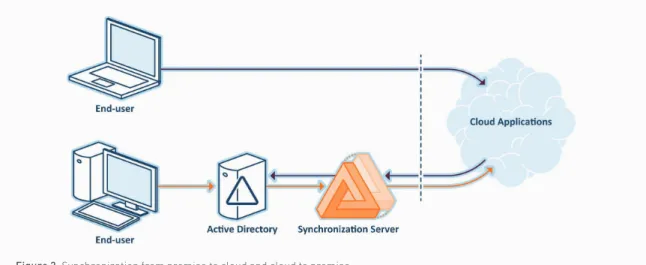
The inability to easily share data from cloud to premise and premise to cloud can pose a significant barrier to customer adoption. Customers generally want the same easy, secure exchange of data that’s possible with premise data to be possible with cloud data. They want, for example, to use their existing on-premise data to provision and de-provision accounts in cloud applications automatically. They may also want the ability to easily retrieve data from an application for use in other cloud-hosted applications, or to update attributes in the cloud based on on-premise data. The solution is a service that can securely expose data from cloud to premise and vice-versa.
Customers whose companies operate multiple departments or locations face a secondary data-sharing challenge. For example, even though each department in a company may buy cloud services on its own, the company still must be able to share common identity information across those departments. Or if a multi-national company has one cloud deployment for one geographical region and another for a second region, the company still must be able to roam across that data. These requirements can present a challenge when each department or region essentially has its own database. What’s needed is a way to synchronize data from multiple sources when a company has multiple components operating separately in the cloud.
Differentiate on more than just the price of service
As cloud service delivery becomes increasingly competitive, service providers can no longer afford to rely on price of service as their main point — or, worse, only point — of differentiation. Emphasis on price has led to a sort of commoditization in which no one provider can stand out. To compete effectively, it’s important to differentiate in areas such as delivering a superior customer experience, improving data security and keeping costs low. The five essential capabilities described in the next section of this paper all contribute to the ability to differentiate on more than price.
Five essential capabilities to overcome
obstacles to success
To address the challenges of delivering cloud services, you need an identity management infrastructure that demonstrates the following five capabilities.
1. Unification of customer identity data
Customers expect cloud service providers to have a unified view of who they are across various applications and services. It’s a reasonable expectation, but a challenge for providers when each new application or service has its own private identity infrastructure — which is likely, since resources are
this heterogeneity and leverage technology to synchronize data. Data integrity and privacy laws make it important to seek a solution that can selectively copy only the data that’s needed by a particular
application, rather than the complete dataset. This is especially important for providers who are delivering services all over the world, and must meet different regulatory requirements in different countries.
2. Multi-tenancy
When multiple customers are getting services from the cloud, providers must define multiple service level agreements (SLAs) and policies (such as access controls, logging, replication, data views and operational metrics) on a per-tenant basis. The greater the number of customers, the greater the scalability challenge this presents. The provider must keep up with each customer’s changing demands and, at the same time, keep their data separate and secure within the services delivery infrastructure. Achieving both requires an identity management solution that 1) supports virtualization and flexibility to accommodate changes in the identity data model and 2) can isolate and contain data where it lives, whether in one repository or many, in order to fully protect it. That in turn requires the ability to apply security, policy and logging on a per-customer basis.
3. Performance at scale
Successful cloud providers can expect tremendous growth — in the number of users, the number of applications being provided and the amount of data behind these users and applications. This growth often results in datasets that even a large, powerful system struggles to accommodate. What’s needed is an identity infrastructure that can keep pace with the growth in demand for services. It’s important to keep in mind, however, that some solutions can make things worse instead of better, because they require an inordinate amount of on-disk space, very large RAM requirements or rigid partitioning schemes. To achieve low response times with high transaction rates for hundreds of millions of users and their associated datasets, cloud service providers need an identity management solution that has both the scalability and memory optimization features to deliver services reliably without crippling existing servers or requiring expensive, non-commodity hardware.
4. Virtualization
Accommodating rapid changes in the number of users, applications and transactions in the cloud service delivery environment requires a low-cost, commodity hardware infrastructure that can be scaled up quickly and cost-effectively — and that means virtualization. In a virtualized environment, virtual machines can be added as growth dictates, in less time and at a fraction of the cost of adding physical hardware. Hosted applications can be moved between data centers in real time in a “follow the sun” model, improving customer experience by putting the infrastructure closer to the end users. This requires a platform-independent identity management solution that supports virtualization.
5. Auditing
Auditing provides proof that only authorized users are accessing cloud applications. This gives assurance of data privacy and security to cloud service providers, their customers and the regulatory bodies that require proof of compliance with laws governing the integrity and privacy of data.
Using identity management solutions from
UnboundID in the cloud
The UnboundID® Directory Services Suite is designed to provide the five essential capabilities that a
successful cloud service delivery environment requires. UnboundID solutions provide the following capabilities in support of cloud services.
Synchronization
UnboundID solutions address the challenges of creating a unified view of the customer and sharing customer identity data between the customer premise and the cloud, specifically supporting real-time or scheduled synchronization of data from multiple sources. Highly customizable synchronization helps ensure compliance with data privacy policies, local regulations and customer desires.
Flexibility to support multi-tenancy
UnboundID solutions provide an open, shared data store that supports defining multiple policies on a per-tenant basis – and that can adapt nimbly to inevitable changes. UnboundID offers a data schema designed to evolve over time, enabling providers to cost-effectively support new applications, adapt to increasing
Capability Result Benefit to Cloud Provider Benefit to Cloud Consumer 1. Unification of customer
identity data • Unification of customer data across applications and services
• Cloud-to-premise synchronization for access to provisioning and authentication from on-premise data repositories (LDAP- or SQL-based)
• Access to essential identity data for authentication, personalization and provisioning
• Improved customer experience with a smoother log-in and the carry-over of preferences between applications and services • Ability to keep sensitive data
on-premise and automate cloud provisioning
2. Multi-tenancy • Ability to provide tenant-specific SLAs
• Privacy and control: Separation of customer data within the common cloud infrastructure
• Security, policy and logging performed on a per-customer basis
• Secure common
infrastructure for delivering cloud services to multiple customers
• Ability to offer fine-grained billing based on SLAs or data policy customization
• Data security, privacy and protection
3. Performance at scale • Ability to handle large numbers of users and large amounts of user data • Ability to scale on all three
axes: number of users, throughput and low latency
• Ability to easily and cost-effectively meet SLAs
• Assurance of quality of service (QoS)
4. Virtualization • Virtualized infrastructure on commodity hardware with elastic scalability
• Rapid expansion of capacity as required without significant systems investment
• Low cloud services pricing
5. Auditing • A fine-grained record of all data access and configuration changes
• Proof of compliance with data integrity- and security-related policies and regulations
• Evidence with which to meet compliance goals
where it lives, whether in one repository or many, with the ability to keep different customers’ data separate and secure within one common cloud infrastructure and to perform security, policy and logging on an individual-customer basis.
Built for performance at scale
UnboundID solutions are designed to accommodate all three types of performance at scale: large amounts of data, high transaction rates and low latency response times. On-disk and in-memory storage enable affordable scalability. An entry balancing capability automatically distributes data across multiple sets of small, relatively inexpensive servers, rather than relying on a single, more powerful system to keep the entire data set cached in memory.
Virtualization support
UnboundID offers the only directory services solution in the industry that is VMware certified. The UnboundID Directory Services Suite combines virtualization support with a platform-independent architecture to provide the most flexible option possible for dynamically growing and expanding the services delivery infrastructure.
Auditing and security
Understanding who had access to what resources is the key to secure operations, successful audit performance and consistent regulatory compliance. UnboundID solutions have extensive auditing and logging capabilities, providing the ability to exert fine-grained control over how privileges are granted and how logging configurations are set up. The logging subsystem is capable of multiple configuration options, such as separate logs for different applications, or filtered logs that sent alerts based on specific pre-determined criteria.
Conclusion
Delivering cloud services successfully means being able to scale operations and share data – regardless of how much and how quickly the number of users, applications and transactions grows.
Meeting the challenges of containing customer acquisition costs, eliminating barriers to adoption and differentiating on more than price requires an identity management infrastructure with five key capabilities: unification of customer identity data, multi-tenancy, performance at scale, virtualization and auditing. These essentials deliver benefits to both providers and customers that make the delivery of cloud services sustainable over the long term.
UnboundID directory services solutions are specifically designed to deliver the capabilities that the cloud service delivery environment demands. They provide a stable yet flexible infrastructure that is both effective and cost-efficient.
Talk to us today
Learn more about supporting cloud services deliverywith directory services solutions from UnboundID®.
Call +1 512 600 7700 or visit www.unboundid.com for more information.
About UnboundID Corp.
UnboundID is a leading provider of real-time identity management software for cloud, mobile and social applications. UnboundID is a privately-held company based in Austin, Texas and is funded by Silverton Partners.
UnboundID and the UnboundID logo are trademarks of UnboundID Corp. All other product or service names are trademarks of their respective companies.