Original Contribution
Association between Lung Function and Mental Health Problems among Adults
in the United States: Findings from the First National Health and Nutrition
Examination Survey
Renee D. Goodwin1, Shirley Chuang2, Nicole Simuro1, Mark Davies2, and Daniel S. Pine3
1
Department of Epidemiology, Mailman School of Public Health, Columbia University, New York, NY. 2
Department of Child Psychiatry, College of Physicians and Surgeons, Columbia University, New York, NY. 3Division of Intramural Research, National Institute of Mental Health, Bethesda, MD.
Received for publication October 5, 2004; accepted for publication July 18, 2006.
The objective of this study was to determine the association between lung function and mental health problems among adults in the United States. Data were drawn from the First National Health and Nutrition Examination Survey (19711975), with available information on a representative sample of US adults aged 25–74 years. Lung function was assessed by spirometry, and provisional diagnoses of restrictive and obstructive airway disease were assigned based on percentage of expected forced expiratory volume. Mental health problems were assessed with the General Well-Being scales. Restrictive lung function and obstructive lung function, compared with normal lung function, were each associated with a significantly increased likelihood of mental health problems. After adjustment for differences in demographic characteristics, obstructive lung function was associated with significantly lower overall well-being (p¼0.025), and restrictive lung function was associated with significantly lower overall well-being (p<0.001), general health (p<0.0001), vitality (p<0.0001), and self-control (p¼0.001) and with higher depression (p ¼ 0.002) subscale scores compared with no lung function problems. Consistent with previous findings from clinical and community-based studies, these results extend available data by providing evidence of a link between objectively measured lung function and self-reported mental health problems in a representative sample of community adults. Future studies are needed to determine the mechanisms of these associations. adult; asthma; mental health; respiratory function tests
Abbreviations: FEV1, forced expiratory volume in 1 second; FVC, forced vital capacity; GWB, General Well-Being.
Mounting data suggest an association between respiratory disease and mental disorders. These data come mainly from four sources. First, studies using epidemiologic samples have linked respiratory disease and mental disorders among youth and adults in the community. For instance, several community-based samples have shown strong links between asthma and anxiety and mood disorders (1) and between respiratory disease and panic attacks (2–4). Among youth, a number of studies have shown associations between asthma and anxiety disorders, and panic attacks (5, 6). Sec-ond, data from clinical studies of psychiatric patients with
anxiety disorders have shown respiratory abnormalities in those with anxiety disorders compared with those with no mental disorders in controlled laboratory settings. For in-stance, Pine et al. (7) found that youth with anxiety disor-ders, compared with those without mental disordisor-ders, showed respiratory abnormalities in response to carbon dioxide challenge.
Third, data from medical patient populations show in-creased rates of anxiety and depressive disorders among patients with respiratory disease. For instance, Goodwin and Eaton (3) found significantly higher rates of panic Correspondence to Dr. Renee D. Goodwin, Department of Epidemiology, Mailman School of Public Health, Columbia University, 722 West 168th Street, Room 1706, New York, NY 10032 (e-mail: [email protected]).
attacks among primary care patients with asthma compared with those without asthma. Similarly, Koltek et al. (8) have shown an elevated rate of asthma among inpatients with posttraumatic stress disorder. Fourth, smaller clinical stud-ies have shown evidence of links between anxiety and emo-tion and lung funcemo-tion in youth and adults (9, 10).
Despite the consistency of findings to date, several meth-odological features of previous studies leave important questions unanswered. Specifically, although several community-based studies have shown linkages between re-spiratory disease and mental disorders, previous community-based studies have relied on self-reported asthma or respiratory diseases (or parental report of asthma in youth), with one exception in which a physician report of asthma was used (1). Thus, previous studies have not been able to directly examine the relation between physiologic measures of lung function and mental health. Specifically, with ob-structive lung disease, the airways are narrowed, which re-sults in an increased duration of time required to empty the lungs and difficulty in breathing (11). Restrictive lung dis-ease is categorized by a loss of lung tissue, a decrdis-ease in the lung’s capacity for expansion, and/or a decrease in the lung’s ability to transfer oxygen and carbon dioxide (11). Whether and to what degree each type of lung function is directly related to psychiatric symptoms in an unselected (nonclini-cal) sample is not known.
The goal of the current study was to examine the associ-ation between lung function and mental health problems among adults in the United States. We hypothesized that, compared with normal lung function, impaired lung func-tion (restrictive and obstructive) would be associated with a significantly higher level of mental health problems among adults in the community.
MATERIALS AND METHODS Sample
Data were drawn from the First National Health and Nutrition Examination Survey conducted by the National Center for Health Statistics. This instrument was a survey of a probability sample of the civilian, noninstitutionalized, US population aged 25–74 years (12, 13) from 1971 to 1975.
Mental health
The General Well-Being (GWB) scale (13–17) was used to assess symptoms of mental health. Specific items directly describing perceptions of mental health were selected from the scale and were administered by trained personnel at mobile examination centers during the First National Health and Nutrition Examination Survey (13). This scale has been widely used as an index of general subjective psychological well-being or happiness in relation to mental health (15). The GWB scale consists of 18 items including a mixture of six-point Likert-type and 10-point analogue-scales re-sponses (15). For each of the items, a score of 0 to 5 is in-dicated. The range of scores for the GWB scale is 0–110.
The GWB scale consists of six separate subscales: positive well-being, anxiety, depression, self-control, vitality, and general health.
Spirometry
A total of 6,913 participants included in the First National Health and Nutrition Examination Survey sample were eligible to undergo the forced expiratory spirogram (18). Spirometric data were obtained from participants in the cardiorespiratory module by using an Ohio Medical Instru-ments 800 spirometer (18). The forced expiratory spirogram was administered by technicians trained for the First Na-tional Health and Nutrition Examination Survey, and the procedure consisted of five maximal expiration tests (13). Participants were instructed how to use the spirometer dur-ing a practice attempt. To ensure that the exhalation was recorded properly, the participant placed the tube of the spirometer into his or her own mouth (over the tongue) and exhaled as quickly and completely as possible (18). Each participant was given a rest period at the end of each trial. After five trials were completed, data were analyzed to make sure the trials were reproducible.
The primary criterion for reproducibility for trials with three liters of volume was that the results had to be within 5 percent of each other for the two best trials, whereas results of trials with less than three liters were required to be within 10 percent of each other (18). A best trial for each subject was chosen, using the simple criterion of highest summed forced vital capacity (FVC) and forced expiratory volume in 1 second (FEV1). A provisional diagnosis was made based
on the FEV1/FVC ratio and the relation between predicted
and observed FVCs, and a diagnostic code of normal, re-strictive, or obstructive was included (18). This diagnostic code was provided for 5,544 participants. Technicians were trained to recognize procedural errors, such as inhalation artifacts or extra breaths, and were forced to void these trials (13). Participants were excluded from the analysis if they either did not perform spirometric tests or had results that were not reliable. Participants with no trials free of proce-dural errors were not included. In addition, a number of persons were excluded from participation because they gen-erally failed to comprehend the procedure because of lan-guage difficulties, mental insufficiency, physical disabilities, or excessive discomfort (18).
Finally, several quality control systems were enforced during data collection. In particular, qualified spirometric consultants were involved in periodic field visits to the mo-bile examination centers to observe administration of the tests and review the samples (18). A biomedical engineer routinely checked all equipment and made any necessary repairs and adjustments. Prior to each testing day and peri-odically throughout the day, the barometric pressure, tem-perature, and water level of each spirometer were noted and recorded.
Restrictive lung diseases were assessed by measuring FVC, which is the maximal amount of air that can be force-fully expelled from the lungs during maximal inhalation. These measurements can reveal mechanical defects and de-formities of the chest cage and wall, as well as loss of lung
tissue and elasticity. Obstructive lung diseases were exam-ined by the objective method of quantitating flow-rate measurements, FEV1.0and FEV25–75 percent(19). Two
mea-surements were involved in the diagnoses: 1) maximum FVC (the maximum of the best two trials, or the best trial if only one was available) and 2) the ratio of the best FEV1
to the best FVC (FEV1/FVC). If the maximum FVC was less
than 80 percent of the predicted FVC, a diagnosis of ‘‘re-strictive lung disease’’ was recorded. If the ratio between the maximum FEV1and the maximum FVC was less than 70
percent of the predicted FEV1/FVC ratio, the diagnosis of
‘‘obstructive lung disease’’ was recorded. The equations for the predicted values may be found in a publication by Discher and Palmer (20).
Data analysis
Analysis of variance was used to determine differences in GWB subscales (continuous measures) between adults with and without either restrictive or obstructive respiratory func-tion. Multiple logistic regression analyses were then used to determine the association of lung function with anxiety and depressive symptoms, adjusting for differences in demo-graphic characteristics.
RESULTS Prevalence
Impairment in lung function (either obstructive or restric-tive) was found among 13.85 percent of adults.
Demographic characteristics associated with lung function
Obstructive lung function was more common among males, those of racial minority status, and those who were older, and it was less common among those who were mar-ried (table 1). Restrictive lung function was also more com-mon acom-mong adults who were older, were less likely to be married, and were Caucasian.
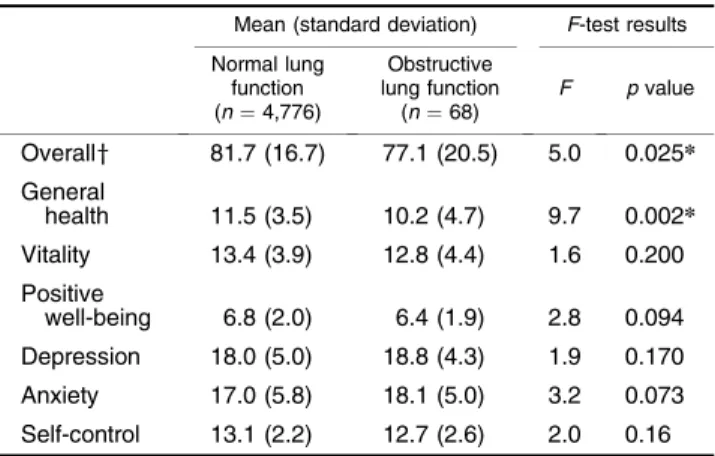
Obstructive lung function and mental health problems Obstructive lung function was associated with signifi-cantly lower scores on the overall GWB total score and on the general health subscale (table 2). On other subscales, there were no statistically significant differences between those with and without restrictive lung function, although several others (i.e., positive well-being, anxiety) approached statistical significance. After adjustment for differences in demographic characteristics, the association between ob-structive lung function and overall GWB scale score re-mained statistically significant, but the link with general health subscale score was no longer significant (table 3). Restrictive lung function and mental health problems
For those participants with restrictive lung function, com-pared with those without, we found an association with
significantly lower scores on the overall GWB total score and the general health, vitality, positive well-being, and self-control subscales (table 4). Significantly higher scores on the depression subscale were found for those with restrictive lung function compared with those without. After adjust-ment for differences in demographic characteristics, the as-sociations between restrictive lung function and overall GWB score and for scores on the general health, vitality,
TABLE 1. Demographic characteristics associated with lung function among adults in the community, First National Health and Nutrition Examination Survey, United States, 1971–1975
Normal lung function (n¼4,776) Obstructive lung function (n¼68) Restrictive lung function (n¼642)
% No. % No. % No.
Mean age in years (standard deviation) 46.2 (13.9) 55.0***(12.6) 53.5***(13.2) Gender Male 44.6 2,129 57.4* 39 46.6 299 Female 55.4 2,647 42.6 29 53.4 343 Race Minority 8.9 426 25.0*** 17 30.4 195 White 91.1 4,350 75.0 51 69.6*** 447 Marital status Married 80.0 3,820 61.8** 42 69.5*** 446 Widow 6.8 327 16.2 11 11.2 72 Never married 6.0 286 10.3 7 8.6 55 Separated/ divorced 7.1 341 11.8 8 10.7 69 *p<0.05;**p<0.01;***p<0.0001.
TABLE 2. Association between lung function and mental health among adults in the community, First National Health and Nutrition Examination Survey, United States, 1971–1975 Mean (standard deviation) F-test results Normal lung function (n¼4,776) Obstructive lung function (n¼68) F pvalue Overally 81.7 (16.7) 77.1 (20.5) 5.0 0.025* General health 11.5 (3.5) 10.2 (4.7) 9.7 0.002* Vitality 13.4 (3.9) 12.8 (4.4) 1.6 0.200 Positive well-being 6.8 (2.0) 6.4 (1.9) 2.8 0.094 Depression 18.0 (5.0) 18.8 (4.3) 1.9 0.170 Anxiety 17.0 (5.8) 18.1 (5.0) 3.2 0.073 Self-control 13.1 (2.2) 12.7 (2.6) 2.0 0.16 *p<0.05.
depression, and self-control subscales remained statistically significant (table 3). The association between restrictive lung function and positive well-being subscale score was no longer significant after adjustment.
DISCUSSION
The goal of this study was to investigate the relation between lung function and mental health problems among adults in the United States. Our results suggest that obstruc-tive lung function and restricobstruc-tive lung function are associ-ated with significantly increased levels of mental health problems. These linkages appeared to persist after adjusting for differences in demographic characteristics. These data are consistent with and extend previous findings from clin-ical and community studies showing links between respira-tory diseases and mental health problems by providing
evidence of a consistent link between physiologic measures of lung function and mental health problems in a represen-tative community of US adults. A key limitation of previous research in this area has been the nearly exclusive use of self-reported respiratory problems. Our results addressed that limitation and provide consistent evidence in support of this previously reported link.
The mechanism of the association between lung function and mental health problems is not known and cannot be determined from these data. It may be that restricted lung function leads to a decreased sense of well-being due to functional limitations associated with physical disease. It is also conceivable that subjective distress over poor phys-ical health, even in the absence of limitations on function-ing, is related to increased depression and worry, resulting in decreased well-being, as observed here. Alternatively, it may be that mental health problems lead to decreased lung function or respiratory disease. It is not yet clear through what mechanism this may occur except via a common en-vironmental factor. For instance, depression and anxiety are associated with increased cigarette smoking. Cigarette smoking is also associated with increased risk of respira-tory problems and impaired lung function. Because mental health problems, especially anxiety disorders (21–23) and major depression, are strongly related to cigarette use and nicotine dependence, various levels of cigarette smoking may mediate the relation between mental health problems and respiratory disease (24, 25).
It is also possible that another factor not assessed here explains this risk. In this analysis, as well as in numerous previous studies, differences in sociodemographic differ-ences were adjusted for, and, whereas the strength of asso-ciations was somewhat attenuated after adjustment in most instances, they did remain statistically significant. Our goal was to examine simply whether there was any link between physiologically assessed lung function and mental health, although the study was not capable of explaining the path-way for the observed link.
The association we observed between restrictive lung function and obstructive lung function and mental health symptoms was not identical. Our results showed more
TABLE 3. Association between lung function and mental health adjusted for age, sex, marital status, and race among adults in the community, First National Health and Nutrition Examination Survey, United States, 1971–1975
Obstructive lung function Restrictive lung function
ORy 95% CIy AORy 95% CI OR 95% CI AOR 95% CI Overall 0.99* 0.97, 0.99 0.99* 0.98, 0.998 General health 0.91* 0.86, 0.97 0.94 0.89, 1.0 0.93* 0.91, 0.95 0.97* 0.95, 0.99 Vitality 0.96 0.91, 1.02 0.96 0.91, 1.02 0.95* 0.93, 0.96 0.95* 0.93, 0.97 Positive well-being 0.91 0.81, 1.02 0.93 0.83, 1.05 0.94* 0.90, 0.98 0.97 0.93, 1.01 Depression 1.03* 1.02, 1.09 1.03 0.98, 1.07 1.04* 1.02, 1.08 1.02* 1.01, 1.06 Anxiety 0.96 0.92, 1.004 0.95* 0.91, 0.99 0.99 0.98, 1.02 0.99 0.98, 1.01 Self-control 0.93 0.85, 1.03 0.94 0.85, 1.03 0.95* 0.91, 0.98 0.96* 0.93, 0.99 *p<0.05.
yOR, odds ratio; CI, confidence interval; AOR, adjusted odds ratio.
TABLE 4. Association between restrictive lung function and mental health among adults in the community, First National Health and Nutrition Examination Survey, United States, 1971–1975
Mean (standard deviation) F-test results Normal lung function (n¼4,776) Restrictive lung function (n¼642) F pvalue Overally 81.7 (16.7) 78.6 (19.3) 18.7 <0.0001** General health 11.5 (3.5) 10.6 (4.2) 43.5 <0.0001** Vitality 13.4 (3.9) 12.4 (4.5) 31.3 <0.0001** Positive well-being 6.8 (2.0) 6.5 (2.2) 10.2 0.001* Depression 18.2 (4.8) 18.8 (4.3) 10.0 0.002* Anxiety 18.1 (5.7) 18.1 (5.0) 0.001 0.98 Self-control 13.1 (2.2) 12.8 (2.5) 10.3 0.001* *p<0.001;**p<0.0001.
consistent linkages between restrictive lung function and GWB scales, where only the link between obstructive lung function and overall GWB score remained significant after adjustment. The reason for this discrepancy is not clear from these data. Needed are future studies that can replicate the findings that mental health is linked with obstructive and not restrictive lung function and follow up by further investigat-ing the potential mechanism of these links, takinvestigat-ing into ac-count both lung function—diagnoses of specific respiratory or other types of physical disease—and mental health.
Limitations of this study should be considered carefully when interpreting our results. First, we did not have infor-mation on specific respiratory diseases or diagnoses; there-fore, these results cannot be directly applied to one specific respiratory disease in the population. Second, our measure of mental health problems did not assess mental disorders, as previous studies have used measures based on the Di-agnostic and Statistical Manual of Mental Disorders, Fourth Edition (26). Therefore, conclusions regarding the associa-tion between lung funcassocia-tion and mental disorders cannot be drawn from these data. As such, these results can be inter-preted as only suggesting an association between respiratory disease and mental health problems. The GWB scale is a well-validated measure of ‘‘psychological status/well being’’; therefore, although the scale does not directly assess psychopathology, it does reflect mental health using a widely accepted scale (14–17). Future studies that include respira-tory disease diagnoses, as well as physiological measures of lung function, and mental disorders defined according to the
Diagnostic and Statistical Manual of Mental Disorders, Fourth Edition would be a useful next step in understanding whether this link applies to the relation between specific respiratory diseases and specific mental disorders.
Third, the inaccessibility of information on potential common risk factors (e.g., family history, cigarette smok-ing) prohibited us from further investigating possible mech-anisms of this association in this study to test this potential pathway, as described earlier. Fourth, note that the strength of the observed links was not overwhelming in each case, and the large sample size may have contributed to these out-comes. Yet, we did use continuous measures, thereby show-ing an increase with each numeric increase in score on the GWB subscales, not merely a dichotomous measure, and only those measures significant at thep <0.01 level were included. Finally, lack of information on the association between another form of physical limitation, for comparison with restrictive/obstructive lung function, in the link with mental health prevented a relative comparison of the degree to which lung function, compared with another physical limitation, is related to mental health.
In sum, these data imply linkages between decreased lung function and mental health problems. A long history of the-ory and research suggests links between respiratthe-ory prob-lems and emotional health. These results provide evidence of a link between the two in an unselected sample of adults representative of the United States. Because major depres-sion and anxiety disorders are the most common mental disorders, and respiratory diseases, such as chronic obstruc-tive pulmonary disease, are among the leading causes of morbidity and premature mortality among adults in the
United States, future studies that replicate and further in-vestigate the mechanism of this association may have im-portant public health implications regarding both primary and secondary prevention.
ACKNOWLEDGMENTS
This work was supported in part by grant MH-64736 from the National Institute of Mental Health (Dr. Goodwin).
Conflict of interest: none declared.
REFERENCES
1. Goodwin RD, Jacobi F, Thefeld W. Mental disorders and asthma in the community. Arch Gen Psychiatry 2003;60: 1125–30.
2. Goodwin RD, Pine DS. Respiratory disease and panic attacks among adults in the United States. Chest 2002;122: 645–50.
3. Goodwin RD, Eaton WW. Asthma and the risk of panic attacks among adults in the community. Psychol Med 2003;33: 879–85.
4. Hasler G, Gergen PJ, Kleinbaum DG, et al. Asthma and panic in young adults: a 20 year prospective community study. Am J Respir Crit Care Med 2005;171:1224–30.
5. Ortega AN, McQuaid EL, Canino G, et al. Comorbidity of asthma and anxiety and depression in Puerto Rican children. Psychosomatics 2004;45:93–9.
6. Goodwin RD. Asthma and anxiety disorders. Adv Psychosom Med 2003;24:51–71.
7. Pine DS, Klein RG, Coplan JD, et al. Differential carbon dioxide sensitivity in childhood anxiety disorders and nonill comparison group. Arch Gen Psychiatry 2000;57:960–7. 8. Koltek M, Wilkes TC, Atkinson M. The prevalence of
post-traumatic stress disorder in an adolescent inpatient unit. Can J Psychiatry 1998;43:64–8.
9. Rietveld S, Prins PJ. The relationship between negative emo-tions and acute subjective and objective symptoms of child-hood asthma. Psychol Med 1998;28:407–15.
10. Rietveld S. Paradoxical breathlessness in asthma. Behav Res Ther 2000;38:1193–203.
11. Shah NS, Koller SM, Janower ML, et al. Diaphragm levels as determinants of P axis in restrictive vs obstructive pulmonary disease. Chest 1995;107:697–700.
12. National Center for Health Statistics. Plan and operation of the HANES I Augmentation Survey of adults 25–74 years, United States, 1974–75. Hyattsville, MD: National Center for Health Statistics, 1978. (Vital and health statistics, series 1: programs and collection procedures, no. 14) (DHEW publication no. (PHS) 78-1314).
13. National Center for Health Statistics. Plan and operation of the Health and Nutrition Examination Survey, United States, 1971–73. Hyattsville, MD: National Center for Health Statis-tics, 1973. (Vital and health statisStatis-tics, series 1: programs and collection procedures, no. 10a) (DHEW publication no. (HSM) 73-1310).
14. Dupuy HJ. The Psychological General Well-Being (PGWB) Index. In: Wenger NK, Mattson ME, Furberg CD, et al, eds.
Assessment of quality of life in clinical trials of cardiovascular therapies. New York, NY: Le Jacq Publishing, 1984:184–8. 15. Fazio AF. A concurrent validational study of the NCHS
General Well-Being Schedule. Hyattsville, MD: National Center for Health Statistics, 1977:1–53. (Vital and health statistics, series 2: data evaluation and methods research, no. 73) (DHEW publication no. (HRA) 78-1347).
16. Norman R, Malla AK, McLean T, et al. The relationship of symptoms and level of functioning in schizophrenia to general well being and the Quality of Life Scale. Acta Psychiatr Scand 2000;102:3039.
17. Monk M. Blood pressure awareness and psychological well-being in the Health and Nutrition Examination Survey. Clin Invest Med 1981;4:184–8.
18. Public use data tape documentation: spirometry-best trials only, ages 25–74. National Health and Nutrition Examination Survey, 1971–75. Hyattsville, MD: US Department of Health and Human Services, Public Health Service, National Center for Health Statistics, 1985. (Tape no. 4250).
19. Palmer A, Hamill PV, Drizd TA. Methodologic problems in children’s spirometry. Vital Health Stat 2 1997;72:1–43.
20. Discher DP, Palmer AH. Development of a new motivational spirometer—rationale for hardware and software. J Occup Med 1972;14:67985.
21. Grant BF, Hasin DS, Chou P, et al. Nicotine dependence and psychiatric disorders in the United States. Arch Gen Psychi-atry 2004;61:1107–15.
22. Fergusson DM, Goodwin RD, Horwood LJ. Major depression and cigarette smoking: results of a 21-year longitudinal study. Psychol Med 2003;33:1357–67.
23. Kandel DB, Huang FY, Davies M. Comorbidity between pat-terns of substance use dependence and psychiatric syndromes. Drug Alcohol Depend 2001;64:233–41.
24. Zvolensky MJ, Feldner MT, Leen-Feldner EW, et al. Smoking and panic attacks, panic disorder, and agoraphobia: a review of the empirical literature. Clin Psychol Rev 2005;25:761–89. 25. Goodwin RD, Hamilton SP. Relationship between cigarette
smoking and panic: the role of neuroticism. Am J Psychiatry 2002;159:1208–13.
26. American Psychiatric Association. Diagnostic and statistical manual of mental disorders: DSM-IV. 4th ed. Washington, DC: American Psychiatric Association, 1994.