Fraud Detection for Next-Generation Networks Name of company/ies submitting case study:
University of Deusto
Web links to company/ies submitting case studies:
http://www.deusto.es
http://www.fundacion-deusto.deusto.es/
Name of author(s): Igor Ruiz-Agundez Yoseba K. Penya
Authors’ email address(es):
[email protected] [email protected]
Contact for further information (to be posted on TM Forum website): Igor Ruiz-Agundez ([email protected])
Applicable TM Forum technical areas IPDR
Applicable Industry Areas:
VIEWPOINT: NETWORK TECHNOLOGIES:
X Service provider perspective Mobile GSM/GPRS
X Software vendor perspective Mobile CDMA/EVDO
Hardware vendor perspective Mobile Edge/UMTS System integrator perspective ATM
SONET/SDH MPLS
SERVICES: Ethernet
Voice Frame Relay
X Video X Converged network
X Data Cable
X VoIP Satellite
X IPTV Broadband
VPN Fixed Line
X Content DSL
X IP
CASE STUDY SUMMARY:
Next-Generation networks (NGN) introduce new services and infrastructures, posing a new scenario of risks and security issues. Together with classical security risks that are adapting to NGN’s special conditions, brand new threats will emerge. In order to face these risks, Fraud Management Systems (FMS) need to evolve to adequately tackle such new challenge.
This Case Study describes a fraud management system implementation deployed for VoIP and other IPDR services as defined in their respective service specifications. The FMS is based on misuse detection techniques that can be combined with other
complementary fraud detection techniques in order to guarantee the stability and the revenues of the provided services.
FULL CASE STUDY:
• Business Problem to be solved:
In order to guarantee the legitimate use of the provided services, service providers have to face many security risks such as classical security attacks (e.g. denial of service (DoS), sniffing, spoofing or spam) or brand new threats. Standing out in this latter group, fraud is considered to be the most harmful.
Fraud from employees, consumers, third-party, computer crime, insurance or financial fraud increases every year. More accurately, in our target area, telecommunications, the increment has reached the 52% from 2003 to 2005.
With the objective of tackling these risks, Fraud Management Systems (FMS) detect and analyze fraud and suggest counteractions. Traditional FMS, however, are service specific and depend on the underlying network infrastructure. As NGN introduce new services and infrastructures, FMS need to adapt themselves too.
• Working towards a solution:
The University of Deusto has worked in information security and fraud management in different scopes, from the foundry industry failure detection to information security consulting.
Deception in telecommunications includes subscription frauds, where the cheater accesses the services without being subscribed. Users can also suffer line or identify theft, being charged for services used by others. Telecommunication operators can oversee users that exceed their download quote and rate performing illegal service redistribution, sometimes for an economic profit. Finally, cloning or unauthorized access to services may lead to compromising privacy.
Technology and security advance in parallel; this reason complicates foreseeing future risk scenarios and, consequently, the ways to face them. As the technology evolves, so do the security needs. In this way, we consider that the security risks can be catalogued according to their effect on the system or the client.
For instance, the system may suffer a service continuity interruption, ranging from attacks as Denial of Service (DoS) or physical attacks to the network or service provider hardware. Moreover, there may be abuses based on logical attacks such as insufficient validation of the services or abuses of functionality (using a service for not expected task). This latter thread is related to information disclosures due to predictable resource location, information leakage, or directory indexing.
Furthermore, intrusions may compromise network systems by executing unauthorized commands, taking advantage from architectural or design vulnerabilities. Privacy of the clients or the stored data may be exposed too by several techniques like sniffing,
spoofing, spamming or phising. Access to services can be bypassed with authentication attacks (e.g. brute force or password inference) or with authorization attacks (e.g. credential prediction or insufficient authorization schemes).
Note that we focus here on the possible risks that fraud can cause to service providers, customers and stakeholders. Fraud is defined as "a deliberate act of obtaining access to services and resources by false pretences and with no intention of paying".
Anyway, the most common types of fraud on telecommunications are subscription fraud and identity theft. After those, voice mail fraud and calling card fraud prevail. The analysis of the different fraud techniques points out that the tendency is a convergence of the fraud, which increases the complexity of its detection.
Fraud Management Systems have proved to be a suitable tool to detect fraud in different networks with diverse techniques: self-organizing maps (SOM), general data mining or rules. Nevertheless, there is none to our knowledge that works on fraud detection for VoIP services in NGN with use cases.
• Solution:
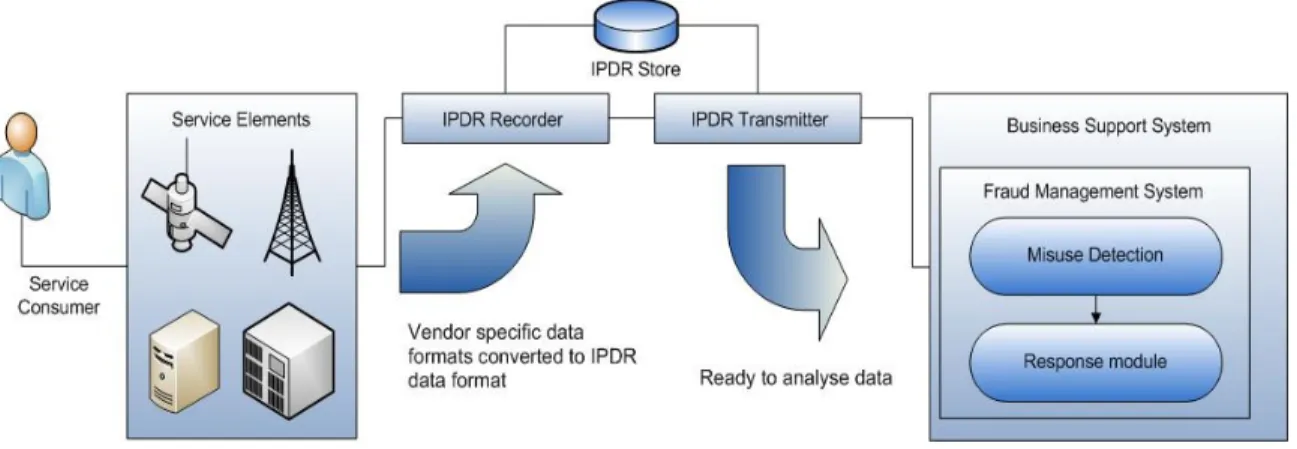
The FMS meets the IPDR architecture as shown in Fig.1. It is allocated in the business support system and receives data in IPDR format for its analysis. When the system receives an IPDR as an input data the fraud detection process starts. Each IPDR is sent to a rule engine containing expert knowledge about fraud in order to detect a possible violation.
Fig. 1 Fraud Management System for IPDR
The FMS is allocated in the business support system and receives data in IPDR format for its analysis. Once the FMS receives an IPDR as an input data the fraud detection process starts. Each IPDR is sent to the rule engine that contains the expert knowledge about fraud in order to detect a possible violation using misuse detection techniques. If the FMS detects a possible fraud, it reports the incident to the response module. This final module can trigger a fraud notification alarm to the system operator or it can block all the present and future connections of a suspicious client.
The skeleton of our system is based on software agents (say small autonomous software programs). More accurately, this software agent uses current perceptions from the sensors as input, returning an action to the actuators as an output. Moreover, it selects the most suited action to perform on the basis of the current perception, the current IPDR. We can consider this agent a simple reflex one because its decision making is based only on the current input data.
Our system uses an existing framework, Drools, that provides a full set of tools to define our knowledge base. Drools is a Rule Engine that uses a rule-based approach to
expert in the domain of the security in telecommunications. These rules are defined with previous knowledge and are limited to the scope of the misuse detection in this specific domain. Anomaly detection, or other boundary cases, is not under the field of this experiment.
• Results:
We introduce a misuse-detection-based system to detect fraud on Voice over IP and other services on Next-Generation Networks, in order to improve fraud management systems for NGN. We believe that detecting potential security risks contributes to the deployment of these networks by providing extra stability. Besides, the investments on infrastructures and development by telecommunication operators are stepped up.
We believe that misuse detection is the best approach to build a fraud management system that controls these risks. Our analyses show that this paradigm works and is able to react when a fraud attempt occurs.
This reactive capacity provides a faster detection of deception use of services. This reaction time is essential for a service provider for taking the necessary countermeasure guaranteeing the integrity of its services.
These categories will be used for placement on the TM Forum website and to make your case study retrievable by the TM Forum website search engine:
Applicable TAM Application Framework Categories:
Market/Sales Resource Management
Campaign Management Workforce Management
Channel Sales Management Resource Specification Management
Corporate Sales Management Resource Inventory Management
Resource Design / Assign
Product Management Resource Provisioning / Configuration
X Product Performance Management Resource Logistics
Product Catalog Management Resource Testing Management
Product Strategy/Proposition Management
Resource Activation
Product Lifecycle Management Resource Planning / Optimization
Customer Management Resource Domain Management (IT
Computing, IT Application, Network)
X Customer Information Management Resource Performance Monitoring /
Management
Customer Self Management Resource Problem Management
Customer Contact, Retention & Loyalty
Correlation & Root Cause Analysis
X Order Management Resource Status Monitoring
Quotation Engine Resource Data Mediation
X Customer QoS/SLA Management Arbitrage Management
Customer Service/Account Problem Resolution
Voucher Management
X Customer Billing Management X Billing Data Mediation
X Invoicing X Real-time Billing Management
X Collections Management Enterprise Management
X Bill Formatting X Revenue Assurance Management
Receivables Management HR Management
Financial Management
Service Management Asset Management
X Service Specification Management X Security Management
Service Inventory Management Knowledge Management
X Service Configuration Management X Fraud Management
Service Design/Assign
SLA Management Supplier/Partner Manager