Eurasian Integration
Regional Integration in the Heart of the Continent:
Neofunctionalism, Liberal Intergovernmentalism
and the Eurasian Integration Process
Leiden University, the Netherlands Master Public Administration:
International and European Governance 9 June 2015
Author: Bram Liplijn (s1592637) Supervisor: Prof. Dr. A.K. Yesilkagit Second reader:
ABSTRACT
- Vladimir Putin -
“A new geopolitical reality of the 21st century is born”
TABLE OF CONTENTS
Abstract 3
List of Abbreviations 7
List of Figures 8
1 Regional Integration in Eurasia 9
1.1 Introducing the Theories 10
1.2 Theoretical and Societal Relevance 11
1.3 From Broad to Small 12
1.4 Central Argument and Outline 13
2 Theories on Regional Integration 15
2.1 The Intellectual Background: Functionalism and Federalism 15
2.2 Political Approaches to Regional Integration: Neofunctionalism 16
2.3 Political Approaches to Regional Integration: (Liberal) Intergovernmentalism 18
2.4 Contemporary Theories on Regional Integration: Supranational Governance 20
2.5 Contemporary Theories on Regional Integration: Postfunctionalist Theory 21
2.6 Economic Approaches to Regional Integration 21
2.7 The Choice for Neofunctionalism 22
3 Methodology 24
3.1 Causal Mechanisms: Functional and Political Spillover 24
3.2 Case Selection 26
3.3 Data Collection 27
3.4 Data Analysis 28
4 The Evolvement of Eurasian Integration 30
4.1 Commonwealth of Independent States (CIS) 31
4.1.1 CIS Governance Structure 32
4.1.2 Policy Areas 33
4.2 Eurasian Economic Community (EurAsEC) 34
4.2.1 EurAsEC Governance Structure 35
4.2.2 Policy Areas 37
4.3 Eurasian Customs Union (ECU) and the Single Economic Space (SES) 3 7
4.3.3 Court of the Customs Union 40
4.3.4 Policy Areas 41
4.4 Eurasian Economic Union (EAEU) 41
4.4.1 EAEU Governance Structure 42
4.4.2 Policy Areas 43
4.5 Prospects of the EAEU 44
4.5.1 Russia 44
4.5.2 Kazakhstan 45
4.5.3 Belarus 46
4.5.4 Armenia 47
4.5.5 Kyrgyzstan 47
4.6 The Eurasian Integration Project in Hindsight 48
5 Analyzing the Eurasian Integration Process 50
5.1 Broadening Sectoral Integration and Political Disintegration 51
5.2 The Stagnating Community 51
5.3 The Relative Success of the Customs Union and the Single Economic Space 52
5.4 The Uncertain Future of the Economic Union 53
5.5 The Marginal Role of the Commission 54
5.6 The Customs Union Court Ruling 54
5.7 The Key Role of the Heads of State 55
5.8 Liberal Intergovernmentalism as an Alternative 56
5.9 Neofunctionalism Versus Intergovernmentalism 57
6 Conclusion 58
6.1 Generalizability of the Case: Strengths and Weaknesses 58
6.2 Theoretical Relevance 59
6.3 Recommendations for Further Research 59
LIST OF ABBREVIATIONS
ASEAN - Association of South East Asian Nations
CSTO - Collective Security Treaty Organization
CUC - Customs Union Commission
EAEU - Eurasian Economic Union
EAC - Eurasian Commission
EC - Economic Court
ECSC - European Coal and Steel Community
ECU - Eurasian Customs Union
EDB - Eurasian Development Bank
EEC - European Economic Community
EEU - Eurasian Economic Commission
EIPA - Eurasian Inter-Parliamentary Assembly
EurAsEC - Eurasian Economic Community
CBGC - Council of Borders of Guard Commanders
CDM - Council of Defense Ministers
CET - Common External Tariff
CFM - Council of Foreign Ministers
CHG - Council of the Heads of Government
CHS - Council of the Heads of State
CIS - Commonwealth of Independent States
CPR - Council of Permanent Representatives
CU - Customs Union (noun)
CUC - Customs Union Commission
IC - Integration Committee
IPA - Inter-Parliamentary Assembly
MS - Member State
SCO - Shanghai Cooperation Organization
LIST OF FIGURES
Figure 2.3 Stages of Economic Integration 22
Figure 3.1 Causality of Neofunctionalism 24
Figure 3.2 Functional Spillover 25
Figure 3.3 Political Spillover 25
Figure 4.0 Evolvement of Eurasian Economic Integration 30
Figure 4.1 Structure CIS 33
Figure 4.2 Structure EurAsEC 36
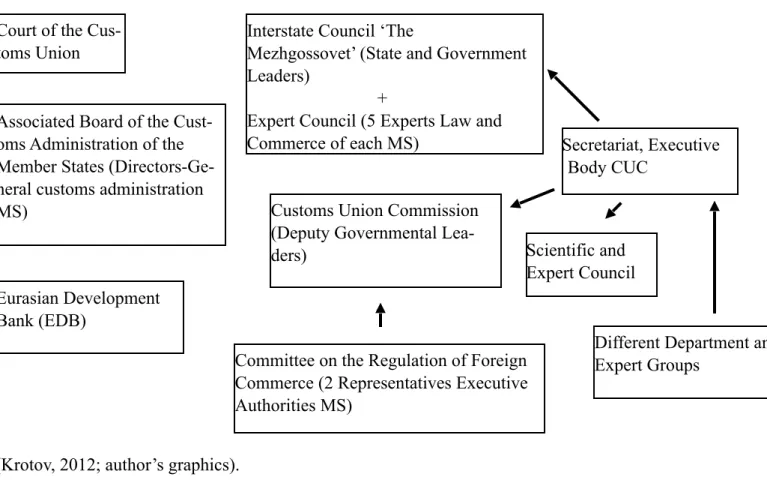
Figure 4.3 Structure ECU and SES in the framework of the EurAsEC 39
1
REGIONAL INTEGRATION IN EURASIA
On the first of January 2015, the newly created Eurasian Economic Union (EAEU) came into effect. In May of the previous year, the presidents of Russia, Belarus and Kazakhstan had signed the treaty to create this Union. At the time, president Putin of Russia stated that “the just-signed treaty is of epoch-making, historic importance” (Russia Today, 2014a). President Nazarbayev of Kazakhstan added that “a new geopolitical reality of the 21st century is born” and furthermore stated: “We see this as an open space and a new bridge between the growing economies of Europe and Asia” (Rus-sia Today, 2014a). The Eura(Rus-sian Economic Union is the largest common market in the former-So-viet sphere, comprising over 170 million people. On the 2nd of January, so immediately after the launch of the EAEU, the first enlargement took place with Armenia joining the Union, adding 3 million people to the integration project. In the same round of negotiations, agreements between the leaders of the EAEU and Kyrgyzstan were signed about the accession of the latter (Russia Today, 2014b). The accession of the Kyrgyzstan faced several delays, because Bishkek had to make serous efforts to adapt its national legislation to the requirements of the Union. Though after the heads of state of the member states and the Kyrgyz President Atambayev signed a number of protocols at the beginning of May, the small Central Asian state finally joined on the 21st of May 2015 (Kazinform, 2015; Putz, 2015).
as the great example and inspiration of the EAEU, the European Union. The EU is still facing grave economic consequences of the continent-wide recession. The Kazakh president Nazarbayev said: “The point is that none of the participating countries were subject to de-industrialization, and tradi-tional industries did not suffer. Lessons from the European recession are in this” (Russia Today, 2014a).
The creation of the of the Eurasian Economic Union is not deemed to be a success and has also been criticized. The New York Times wrote that “the alliance that comes into force on the 1st of January will be a pale imitation of what the members first envisioned: an eastern version of the 28-member European Union” (MacFarquhar, 2014). In addition, Nargis Kassenova, the director of the Central Asian Studies Center at Kimep University in Almaty questions the outcome of the inte-gration process. “Three weak economies getting together and integrating: How much good can come out of it?” (MacFarquhar, 2014). Moreover, the current Western economic sanctions on Rus-sia might reverberate through the Kazakh and BelorusRus-sian economy.
Among the member states of the EAEU, there is an ongoing disagreement about the directi-on of the regidirecti-onal cooperatidirecti-on. The Belorussian president Lukashenko acknowledged that the Unidirecti-on as constituted was something less than he had anticipated. According to the official concept, the economic union would be followed by political and military unity, somewhat restoring the ‘Soviet-empire’, but this was rejected by Kazakhstan. Kazakhstan’s first deputy prime minister and lead ne-gotiator, Bakytzhan Sagintayev stated that the countries are only forming a purely economic union. He called it a ‘pragmatic means to get benefits’ and highlighted the a-political character by saying that the member states will not interfere in each others’ foreign policies (MacFarquhar, 2014). In line with the Belorussian position, also Russia stresses the importance of cooperation on multiple terrains, including other realms than economic. Russia has proposed several attributes that mirror the European Union, including a common passport and currency, a collective parliament, a common border force and a common economic foreign policy (MacFarquhar, 2014; Russia Today, 2015). All these suggestions have been blocked by the Kazakh side. This raises questions about how the Eura-sian Economic Union will evolve.
1.1 Introducing the Theories
Regional Integration in Eurasia
Community, which was later followed by further European integration (EEC, EC, EU). Though the formation of regional alliances has also occurred outside of Europe, this has been mainly cooperati-on, rather than integration.The most prominent theories in the field of regional integration are neo-functionalism and (liberal) intergovernmentalism, Both theories are inspired by and built on functi-onalism. The core idea of functionalism is that there is a mismatch between political authority and the territorial scale of human problems. This mismatch generates problems pressuring for jurisdicti-onal reform (Obydenkova, 2011). To put it simply, jurisdictijurisdicti-onal reform is fostered by the welfare benefits of supranationalism. In this respect, the European Union is the single most important example. Neofunctionalism and liberal intergovermentalism have been inductively developed ta-king the European integration process as a model, and thus can be considered as ‘Eurocentric’.
This raises questions about regional integration in other parts of the world. Can regional in-tegration processes on other continents be explained using specific grand ‘Eurocentric’ theories? How much explanatory value has neofunctionalism outside the European context? The aim of this research is to give new insights in how countries start to cooperate and even integrate with each other as well as to develop and enhance the grand theories that explain this phenomenon.
1.2 Theoretical and Societal Relevance These questions are related to the theoretical relevance of this thesis. Generally speaking, the value of a theory is that it can be tested, and applied to, different cases. More specifically, with this re-search, I want to discuss to what extent it is possible for the neofunctionalist theory to explain regi-onal integration outside the European context. Neofunctiregi-onalism neatly fitted the integration pro-cess in the 50s and early 60s in Europe, though subsequent events led to the demise of neofunctio-nalism and the rise of intergovernmentalism. Going back to the roots of the regional integration theories is still of much relevance since all regional integration theorizing, in and outside the Euro-pean context, is based on this grand debate, either building on it or rejecting it. Furthermore, little research has been done in the case of regional integration in Eurasia. Scholars like Libman and Obydenkova have focused on specific organizations in the Eurasian integration process, like the Commonwealth of Independent States and the Eurasian Economic Community. There is no re-search, as far as I am aware off, that connects all the organizations that embody this integration pro-cess and tries to constitute a red line within this propro-cess.
presidents of the member states committed their countries to a project that will greatly influence their political, economic and social situation. Broadly speaking, more and more countries in the world choose to group together and combine their strengths to form some sort of regional coopera-tion. These organizations, in their various forms, heavily influence the lives of the people within the participating countries. It is of significant importance to research how these organizations are esta-blished, what the role of the member states is within them and how these often supranational orga-nizations in return influence the member states.
Regional Integration in Eurasia
1.4 Central Argument and Outline In this thesis, I will try to establish a link between the neofunctionalist theory and Eurasian integra-tion. In doing so, I will make use of the mechanisms of functional and political spillover. The re-sults of this research are unsurprising, showing little explanatory power for neofunctionalism in the case of the Eurasian integration project. The only exceptions are a court ruling by the Customs Union Court and the growing independent role of the Eurasian Commission (EAC), though only compared to its predecessors. The research shows that both sectoral broadening and political deepe-ning, were initiated and guided by the Heads of State of the member states. The presidents of Rus-sia, Kazakhstan, Belarus and to a far lesser extent of Armenia and Kyrgyzstan, can be considered as the ultimate motors of regional integration in Eurasia, confirming the liberal intergovermentalists view that regional integration is intergovernmentally led.
In building this argument, I will introduce the relevant integration theories in chapter 2. The idea of regional integration was initially captured in functionalism and federalism. Later on, neo-functionalism emerged as the first grand integration theory. It gained a lot of criticism by intergo-vernmentalist theorists and its liberal successor. In addition, contemporary perspectives on regional integration will be briefly highlighted.
Chapter 3 focuses on the methodology used to conduct this research. First, the concept of spillover will be explained and divided into a functional and political variant. Secondly, the selected cases will be presented. Thirdly, the data collection methods and data analysis will be elaborated on.
In chapter 4 the selected cases will be discussed. These are the Commonwealth of Indepen-dent State (CIS), the Eurasian Economic Community (EurAsEC), the Eurasian Customs Union (ECU) combined with the Single Economic Space (SES) and the Eurasian Economic Union (EAEU). For each organization, I will highlight the governance structure and the policy areas co-vered by the various frameworks. In addition, I will elaborate on the prospects for the Eurasian Economic Union by focusing on the position of Russia, Kazakhstan, Belarus, Armenia and Kyr-gyzstan, its current members.
2
THEORIES ON REGIONAL INTEGRATION
The two main theories, as described in the introduction, are neofunctionalism and liberal intergo-vernmentalism. Though these theories cannot be isolated and discussed separately. They are part of a broader debate on theorizing integration. I will first focus on functionalism and federalism as laid down by respectively David Mitrany and Altiero Spinelli. This is the ‘intellectual background’ of the later established integration theories. Secondly, I will focus on Ernest Haas’ neofunctionalism since it was the first grand theory that tried to explain why states integrate with each other. This theory embodies the early stages of theory building on regional integration. In the late 60s, Stanley Hoffmann developed intergovernmentalism as a critique to neofunctionalism, because the latter could not explain the events happening with its main case of observation: the European project. In-tergovernmentalism itself was later on criticized by Andrew Moravcsik who designed its liberal successor. In addition, I will briefly describe two ‘contemporary’ integration theories. Alec Stone Sweet and Wayne Sandholtz developed the approach of ‘supranational governance’ and Liesbet Hooghe and Gary Marks introduced a Postfunctionalist perspective to the integration theorizing. Lastly, I will briefly highlight economic approaches to regional integration and the stages of eco-nomic integration.
2.1 The Intellectual Background: Functionalism and Federalism In 1943, the main proponent of functionalism, David Mitrany, wrote an essay titled A working
key economic and social plans and not from ‘high’ politics. The global economic integration would bring prosperity and guarantee a stable and peaceful international system. Mitrany’s idea was that “economic unification will ultimately lead to political unification” (Mattli, 1999: 23). The weakness of Mitrany’s functionalism is that it is a rather normative method. It failed to specify the conditions necessary to attain peaceful coexistence.
The federalist idea came up during the Second World War in the ranks of various Resistance movements and it also aimed to guarantee peace, though in a different way. Altiero Spinelli, the leading figure of the federalist movement envisioned a transfer of political authority, going against national sovereignty, to supersede nationalism. Spinelli was also a strong proponent of a federal constitution for Europe, fearing that the seemingly new democratic states would eventually be ruled by privileged classes. The re-establishment of the European states would lead to the return of natio-nal jealousies and eventually to war (Bache et al., 2011). In 1941, being imprisoned on the island of Ventotene, Spinelli and Ernesto Rossi wrote the Ventotene Manifesto in which their federalist vision for Europe was set out. In this manifesto, originally called ‘Towards a Free and United Europe’, they proposed a supranational European federation of states. The primary goal was to connect the European countries in such a way that it would be impossible to start a war ever again (European Commission, 2015). This way, the national governments would be subordinated to an overarching federal authority.
Theories on Regional Integration
This means that future levels of integration are determined by the starting or current level of inte-gration. In other words, the integration process is endogenous (Hill & Smith in Carlsnaes et al., 2013). There can be made a distinction between functional spillover and political spillover. “Functi-onal spillover is based on the assumption that the different sectors of a modern industrial economy are highly interdependent and that any integrative action in one sector creates a situation in which the original goal can be assured only by taking further actions in related sectors, which in turn crea-te a further condition and a need for more action, and so forth” (Mattli, 1999: 25). To put it simply, cooperation in one sector necessarily leads to cooperation in other sectors. This is followed by poli-tical spillover. “Polipoli-tical spillover describes the process of adaptive behavior, that is, the incremen-tal shifting of expectations, the changing of values, and the coalescing at the supranational level of national interest groups and political parties in response to the sectoral integration” (Mattli, 1999: 26). Thus, various actors shift their attention to the strengthened supranational level. As stated abo-ve, further integration was mainly fostered by social actors. These (national) key social actors came to support deeper and more expansive integration. “New supranational institutions became focal points for such actors, not least because these actors were able to envisage these new centers of au-thority as potential suppliers of outcomes that were consistent with their preferences” (Haas, 1958: 292). Thus, the shift of authority to a ‘higher’ level also changed the focus of social actors, from the level of the nation-state to the supranational level.
their citizens. Thus, the nation states’ inability to act upon problems at the domestic level requires cooperation at a supranational level.
There has been a lot of critique on neofunctionalism over time, especially, and not surprisin-gly, from the realist approach. The main argument is that the theory is too linear and that it takes into account too many different pressures for integration (McCormick, 2008). In the early stages of the European Communities, when the scope of the organization became broader, spillover was the perfect explanation for this process. However, from the mid 60s cooperation between the member states became more difficult and entered a long phase of stagnation and even backsliding. These possible setbacks in cooperation were not allowed in neofunctional theory (Jackson & Sorensen, 2010). This is why it is argued by many scholars that neofunctionalism is a ‘dead’ theory, since even Ernest Haas himself called the theory ‘obsolete’, mainly based on the ‘empty chair’ crisis and the 1
following eurosclerosis. Though, this argument is countered by the fact that this theory of integrati-on is inseparably cintegrati-onnected to the debate integrati-on regiintegrati-onal integratiintegrati-on. Neofunctiintegrati-onalism is represented as an ‘other’ against which current mainstream theories, such as liberal intergovernmentalism, can be defined. Neofuncitionalism is used as a starting point and as a mirror for other integration theo-ries. Scholars as Anastasia Obydenkova and Ben Rosamond argue that neofunctionalism still holds valuable insights and that it is too easy to dismiss the whole theory, solely based on the current state of the European integration project. Rosamond states that the theory is treated too statically and that opponents of neofunctionalism focus too much on the static aspect of spill-over (Rosamond, 2005). To have a complete overview of the debate between neofunctionalism and (liberal) intergovernmen-talism, I will now focus on the latter.
2.3 Political Approaches to Regional Integration: (Liberal) Intergovernmentalism From the 60s onward, a counter-theory from within a broadly state-centered perspective emerged, that emphasized the importance of the global context. The main critique of intergovernmentalism on neofunctionalism is formulated by Stanley Hoffmann. He argues that the focus of the neofunctiona-lists lies too much on the internal dynamic and that it takes the international background as ‘fixed’. In Hoffmann’s eyes this claim is false, pointing at the changes in the global economic situation in the early 70s. Another critique is that neofunctionalists overplay the role of interest groups (Mc-Cormick, 2008). Hoffmann states that European integration was guided by the protection and The French government recalled its minister and permanent representative from Brussels and announced that French
1
Theories on Regional Integration
motion of national interests (that coincided). “Political calculations were driven by domestic con-cerns, particularly in relation to the impact of integrative decisions on the national economy and on the electoral implications for the governing party” (Bache et al., 2011; 11). Intergovernmentalism takes national governments as the ultimate arbiters of key decisions, based on legal sovereignty and political legitimacy. Intergovernmentalist theorist do not deny the increasing power of the suprana-tional institutions of the European Communities, but they argue that this happened because governments believed it to be in their national interest (Bache et al., 2011). In contrast with the neo-functionalists they state that integration has exogenous causes. Each further step in the integration process depends on the actors’ interests rather than on a teleological process (Hill & Smith, 2011). In short, governments have more autonomy and legitimacy, which makes the integration process essentially intergovernmental.
intergovernmentalism. “Where neo-functionalism emphasizes the active role of supranational offi-cials in shaping bargaining outcomes, liberal intergovernmentalism stresses instead passive institu-tions and the autonomy of national leaders” (Moravcsik, 1993: 518). Considering the national prefe-rences of state leaders, economic interests are more important than political biases or security con-cerns. The demand for more integration is channeled through national governments rather than su-pranational actors. These transnational alliances can “not simply circumvent national governments as the gatekeepers of EU decision making” (Borzel in Carlsnaes, 2013: 505).
2.4 Contemporary Theories on Regional Integration: Supranational Governance Following the debate of neofunctionlism versus intergovernmentalism, other theories on regional integration processes have been developed. Though, these theories also focus on the EU, because theorizing on regional integration cannot be distinguished from the European case, since the EU has the highest level of integration compared to other parts of the world. Stone Sweet and Sandholtz go against the ‘aggressive superiority’ of intergovernmentalism and in doing so builds on neofunctio-nalist assumptions as the importance of supranational institutions in fostering integration (Stone Sweet & Sandholtz, 1997). Not only neofunctionalism is a starting point for the theory of supranati-onal governance, but it also drew on transactisupranati-onalism and new institutisupranati-onalism.
Stone Sweet and Sandholtz state that the EU should not be studied as an international re-gime, but rather as a series of regimes active in different policy sectors. Furthermore, they argue that the increase in transactions across national boundaries will create a supranational society with subsequent supranational institutions and rules that govern it (Bache et al., 2011). This transnational activity is marked by Stone Sweet and Sandholtz as the motor of European integration. They argue that the rise of transnational exchange reduces costs in a specific domain, while making maintaining disparate national rules expensive. This is an incentive for governments to change their policy posi-tion in favor of supranaposi-tional governance. Once this supranaposi-tional authority is established, it will generate a ‘self-sustaining dynamic’ (for example by secondary legislation) that deepens integration and strengthens its position (Stone Sweet & Sandholtz, 1997).
Theories on Regional Integration
Sweet and Sandholtz because of its low generalizability by not placing the analysis in a global con-text (Bache et al., 2011). Furthermore, the ‘self-sustaining dynamic’ strongly reminds of the neo-functional concept of spillover.
2.5 Contemporary Theories on Regional Integration: Postfunctionalist Theory Liesbet Hooghe and Gary Marks (2008) emphasize the key role of identity in the process of Euro-pean integration. In accordance with the neofunctionalist and intergovernmentalist theorizing, they state that integration is “triggered by a mismatch between efficiency and existing structures of au-thority” (Bache et al., 2011: 17). Though Hooge and Marks argue that not the functional pressures (for cooperation) determine the outcome of this process. On the contrary, they suggest that one should take into account the ‘communal identities’ within political conflict. Hog and Marks state that the integration process within the EU has become politicized in elections and referendums and as a result of this, the public opinion and the position of national political parties shape jurisdictio-nal outcomes. Identity is considered as the most important factor in creating contestation on Europe (Hooghe & Marks, 2008). Furthermore, these scholars argue that the discussion on integration should go beyond the preoccupation with economic interests and functional pressures, which is the focus of the neofunctional-intergovernmental dichotomy (Bache et al., 2011). “Functional pressures are one thing, regime outcomes are another. Community and self governance, expressed in public opinion and mobilized by political parties, lie at the heart of jurisdictional design” (Hooghe & Marks, 2008: 23).
Supranational governance and the post functionalist theory of integration can be considered as new branches of the same tree: the neofunctionalist versus intergovernmentalist debate. The aim of this thesis is not to explore these new assumptions, but rather to go back to the roots of the inte-gration debate, since neofunctionalism and intergovernmentalism still hold valuable insights, as will be argued in the concluding paragraph of this chapter.
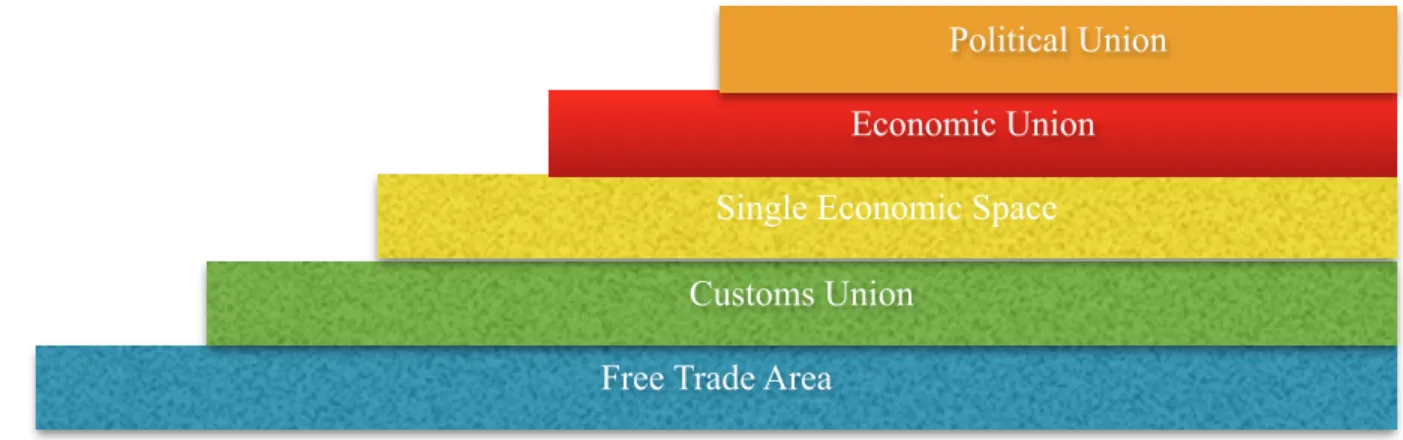
nor concerned with institutions. Economic approaches, such as the customs union theory and the optimal currency area theory have a different focus. The former is concerned with markets for goods: the elimination of trade barriers within the union and the equalization of tariffs on imports from non-member states. The latter has a broader perspective and focuses on money, markets for goods, and markets for production factors and seeks to understand under which conditions it is eco-nomically viable to establish a currency union (Matlli, 1999). Formal economic integration is based on these theories and begins with the removal of barriers to trade and can potentially develop in a full political union. The stages of economic integration as illustrated in figure 2.3 constitute the ge-neral blueprint for regional economic integration is structured.
Figure 2.3 Stages of Economic Integration
(Author’s graphics, 2015).
2.7 The Choice for Neofunctionalism To conclude, I will highlight the main differences in the debate between neofunctionalism and in-tergovernmentalism. This dichotomy is characterized by the opposing views on the transfer of po-wer to a higher authority. Neofunctionalist theory is centered around the concept of spill-over: the continuous transfer of policy domains to the supranational level, moving away from the scope of the nation state. This entails a transfer of loyalty, since supranational institutions show themselves to be more effective in dealing with specific problems than nation-states. Liberal intergovernmenta-lism argues the opposite way. States remain in control of the process of integration. They do not lose sovereignty and cooperation at the supranational level is the result of calculated state interest.
Both theories present themselves as a overarching general theories of regional integration, but few studies have been developed to research to what extent this is true. There is little knowledge
Free Trade Area Customs Union
Single Economic Space Economic Union
Theories on Regional Integration
about the applicability of neofunctionalism on more recent projects of regional integration since most scholars of political science have abandoned the idea that this theory holds any value. The op-posite accounts for liberal intergovernmentalism, which has widespread support. “Within the aca-demic discourse neofunctionalism has been treated very much as a component of the ‘old’ (as oppo-sed to the ‘new’) regionalism” (Rosamond, 2005: 251). In other words, there is an academic ‘void’ when it comes to the contemporary use of neofunctionalism.
3
METHODOLOGY
The two political integration theories that are presented in the theoretical framework form the core of the regional integration debate. Liberal intergovernmentalism is perceived by many scholars as having more explanatory power in the respect, though scholars as Obydenkova and Rosamond (see previous chapter) argue that neofunctionalism is not a dead theory and still holds some valuable in-sights. To test this assumption, I will combine the neofunctionalist theory with the case of regional integration in the Eurasian context. Firstly, I will elaborate on the causal mechanisms used to esta-blish a link between the theory and the case. Spillover is the main mechanism within neofunctiona-lism and can be separated in functional and political spillover. Furthermore, I will discuss the data collection methods used to conduct this research and the way this data will be analyzed.
3.1 Causal Mechanisms: Functional and Political Spillover As stated above, neofunctionalism, as an integration theory, will be used to explain integration in
the Eurasian region. The most important concept to measure neofunctionalism is spillover. Spillover entails that cooperation and giving authority to a higher level in one sector will automatically lead to the same process in other, linked sectors. Furthermore, this sectoral broadening implies that au-thority has to be shifted to the supranational level and that also the decision making procedure be-comes largely supranational instead of intergovernmental (see figure 3.1).
Figure 3.1 Causality of Neofunctionalism
(Mattli, 1999; author’s graphics).
More decision making po-wer at the supranational level. Loss of sovereignty at the level of the nation-states
Area specific cooperation leads to a transition of authority to the suprana-tional level
Methodology
This implies two mechanisms. First of all, functional spillover which focuses on the inclusion of more and more sectors in the integration project, the so-called sectoral broadening. Secondly, politi-cal spillover is taking place since it implies a transfer of authority from the national to the suprana-tional level. Funcsuprana-tional and political spillover can be displayed in the following way (See figure 3.2 and 3.3). It is only possible to speak of a ‘significant’ spill-over effect when both functional and po-litical spillover are taking place at the same time. The two mechanisms cannot be isolated from each other and thus it is impossible to speak of neofunctionalism when both functional and political or even one of these mechanisms cannot be observed. An important element of spillover is that the process is endogenous. Previous levels of integration determine the future levels and this process is ongoing, it cannot be reversed.
I will measure functional and political spillover by focusing on two aspects of the organiza-tions in the Eurasian integration process. First of all, I will look at the governance structure of the organizations that embody this process. The governance structure in an organization gives insights in where the authority lies. What are the most important actors and how can these actors can be characterized; as intergovernmental or supranational? The shift of authority away from states can be defined as “a collectivity of established, legitimate authorities to other sources of power” (Strange, 1995: 67). The governance structure shows if political spillover is taking place. Secondly, I will fo-cus on the policy areas that are covered by these organizations. The fofo-cus here is on sectoral broa-dening, every organization should include more policy areas. This shows if functional spillover can be observed. Since spillover is an endogenous process, the expectation is that every new organizati-on that was established included more policy areas.
Figure 3.2 Functional Spillover
Figure 3.3 Political Spillover
(Mattli, 1999; author’s graphics).
Authority at the supranational level Authority at the national level
Another important mechanism within neofunctionalist theory is the shift of interest representation of various state and non-state (social) actors, such as local governments and NGO’s, from the natio-nal to the supranationatio-nal level. This shift is taking place because these actors detect a transfer of au-thority from the national level to this higher platform and consequently try to in influence the deci-sions made at the supranational level. This mechanism is not included in this research because of some constraints. Measuring the activities of these social actors is difficult considering the language barrier. Much ‘formal’ information about the organizations that are taken as cases is also published in English, while much of the content published by the interest groups is only available in Russian.
In combining functional and political spillover, the main mechanism of neofunctionalism, with the Eurasian case, I have formulated the following research question:
To what extent is the Eurasian integration process characterized by the neofunctionalist concept of
spillover: the inclusion of more and more sectors with a subsequent transfer of authority to the
su-pranational level?
Based on the main research question, I have formulated two hypotheses that capture that mecha-nism of spillover. It is once again important to note that spillover is an ongoing process that does to allow for any fallbacks to happen. This is the reason why these hypotheses grasp all the organizati-ons and thus the complete Eurasian integration process.
Hypothesis 1 on functional spillover: Every new organization that was established came with the inclusion of more policy areas.
Hypothesis 2 on political spillover: The inclusion of more and more policy areas, the sectoral broa-dening, was accompanied by a shift in authority from the national to the supranational level.
Methodology
my research is that it creates two very testable hypothesis. But it also has its obvious shortcomings. Using a case study gives limited control and it will be hard to establish cause-and-effect relations.
The organizations that I have chosen to include as cases are the Commonwealth of Indepen-dent States (CIS), the Eurasian Economic Community (EurAsEC), the Eurasian Customs Union (ECU) in combination with the Single Economic Space (SES), and the Eurasian Economic Union (EAEU). These four organizations constitute the red line in the post-Soviet integration process in Eurasia. The CIS was established in 1991 as a loose association of states. This was followed by the EurAsEC in 2000. The EurAsEC was later broadened and and enhanced with the ECU which came into effect in 2010 and the SES which was fully operational two years later. Both the EurAsEC and the ECU/SES ceased to exist with the establishment of the EAEU on the 1st of January 2015. The CIS still exists, but is included, because it was the starting point of the process of integration in the direction of the EAEU. Other international/supranational organizations that cover the same region, such as the Collective Security Treaty Organization (CSTO) and the Shanghai Cooperation Organi-zation (SCO), are not included since these are mostly military alliances, while the focus of this re-search is on economic and (possible) political integration.
3.3 Data Collection
The data that I have collected for this research can be divided into four broad categories. First of all, articles by (major) international news outlets and magazines that focus on international politics are included. Examples are Russia Today, Kazinform, The New York Times, EU Observer and Foreign Affairs.
Secondly, I have included reports by think tanks and other issue specific organizations. Such as; the Centre for Studies on Federalism, with its First International Democracy Report (2011) on the CIS and the EurAsEC. In addition, I have used briefing papers by Chatham House, the Royal Institute of International Affairs. Also special Reports on the EAEU by the Centre of European Po-licy Studies were very insightful. Furthermore, in-depth analyses of the signing of the Eurasian Economic Union by the Directorate-General for External Policies of the European Parliament and Country reports provided by the European Council on Foreign Relations are included in the re-search.
Also the founding treaties of these organizations (if available in English) are included. This catego-ry is the only one that includes primacatego-ry sources, all the other categories entail secondacatego-ry sources.
Lastly, I have selected articles by scholars who made a study about the Eurasian integration process such as Bordachev, Krotov, Vinokurov, among others, who respectively wrote articles about Russia’s integration policies, the Customs Union within the framework of the Eurasian Economic Community and the Customs Union and the Single Economic Space.
Finding relevant information has proven quite difficult in the case of Eurasian integration, since many reports, news articles, and a considerable part of the organizations’ websites are only available in Russian. That is why one of the major pitfalls of this research is the language limitation. This undoubtedly leads to a ‘Western’ bias, since most of the articles that are written in English have a Western origin. My aim is to compensate for this shortcoming by including various sources of data, as highlighted above, and by also including sources from the Russian speaking world. Examples are Russia Today and Kazinform, but also scholars such as the ones mentioned above, Obydenkova and Dragneva & Wolczuk.
3.4 Data Analysis I will make use of a content analysis based on the four categories of sources mentioned in the
para-graph above. I will not use interviews, since I will not be able to travel to the region to meet with key figures within and around the organizations, due to time and other limitations. I am aware the generalizability of this study is low, considering that it is a case study. Though I am convinced that the results will contribute to the discussion about the generalizability of Eurocentric theories, such as neofunctionalism.
Methodology
4
THE EVOLVEMENT OF EURASIAN INTEGRATION
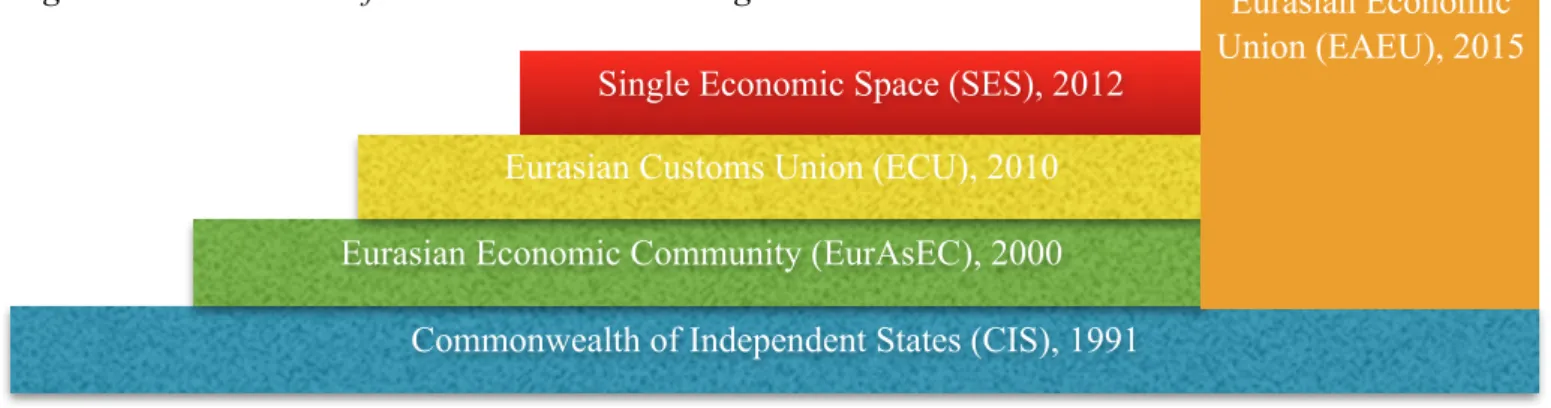
Regional (economic) integration was initiated immediately after there break-up of the Soviet Union, although the forms that occurred differed widely. The main reason for these various forms of coope-ration and integcoope-ration was to salvage the economic and business ties between the newly established republics. “While the main priority for all the newly established states was to achieve full economic and political sovereignty, it was understood that economic development and improving living standards would be much more difficult to achieve unless ties were preserved” (Eurasian Economic Commission, 2013: 6). The level of integration in the region has varied over time. The Eurasian Development Bank has created a ‘System of Indicators of Eurasian Integration’ that measures the level of integration in the former-Soviet Union. Generally speaking, there is a trend of decline of integration in this region since 2000, but Russia, Kazakhstan and Belarus have become more inte-grated. These three economies form an ‘integration core’ in the post-Soviet space (Vinokurov, 2012). To describe the process of intended integration in the Eurasian region, I will highlight four organizations that roughly embody the integration process: the Commonwealth of Independent Sta-tes (CIS), the Eurasian Economic Community (EurAsEC), the Eurasian Customs Union (ECU) combined with the Single Economic Space (SES) and the Eurasian Economic Union (EAEU) (See figure 4.0). Furthermore, I will give insights on the future prospects of the EAEU, since the Union has only been established very recently. In addition, I will give a short overview of the political and economic position of the current member states of the EAEU.
Figure 4.0 Evolvement of Eurasian Economic Integration
(Eurasian Commission, 2015; author’s graphics).
Commonwealth of Independent States (CIS), 1991 Eurasian Economic Community (EurAsEC), 2000
Eurasian Customs Union (ECU), 2010 Single Economic Space (SES), 2012
The Evolvement of Eurasian Integration
4.1 Commonwealth of Independent States (CIS) The treaty establishing the Commonwealth of Independent States (CIS) was signed on the 8th of December 1991 by the presidents of Belarus, Russia and Ukraine at a meeting in Belovezhskaya Pushcha in Belarus. Other former Soviet republics endorsed the CIS two weeks later at a special summit in Alma-Ata, the current Almaty (Kazakhstan) (Eurasian Economic Commission, 2013). The president of Kazakhstan, Nursultan Nazarbayev had been an advocate of republican sovereign-ty but also wanted to maintain the single economic space and was in this respect the initiator of the CIS. The original idea of the bigger Soviet republics (Belarus, Russia and Ukraine) was to form a ‘Slavic Union’, but Nazarbayev convinced the leaders of these countries to form a broader, more inclusive commonwealth (Zhalimbetova & Gleason, 2001).
The initial goal of the CIS was to collaborate in re-creating a common economic space and to set up principles of cooperation through coordinated institutions. The common economic space would be based on a free-trade area, which was immediately the final goal of the Commonwealth leaders. They did not, and still do not, want to create a form of regional integration other than a free-trade zone (Eurasian Economic Commission, 2013). The sovereignty of the newly independent republics had to be ensured and the signatories believed that this goal could be accomplished wit-hout sacrificing the former Soviet unified economic space. Though this proved to be an illusion, because the Soviet successor states rapidly found themselves at odds with one another on a wide range of trade and security issues. “The Post-Soviet states moved towards the market at different speeds, and with differing emphasis, creating policy asymmetries and conflicts with their neigh-bors” (Zhalimbetova & Geason, 2001). Moreover, Russia played an ambiguous role in the CIS. It frequently fell back into its role as ‘ruler’ and tried to play the role of the Eurasian ‘center’. Alt-hough it can be argued that Russia’s efforts to make the CIS a success were aimed at restoring poli-cy harmony, the other countries interpreted it as motivated by Moscow’s nostalgia for empire in-stead of a desire to restore cooperation.
were usually never implemented. This is also highlighted by the diminishing importance of the CIS. The presence of presidents of the member states at summits seems to be decreasing from year to year (Libman, 2011).
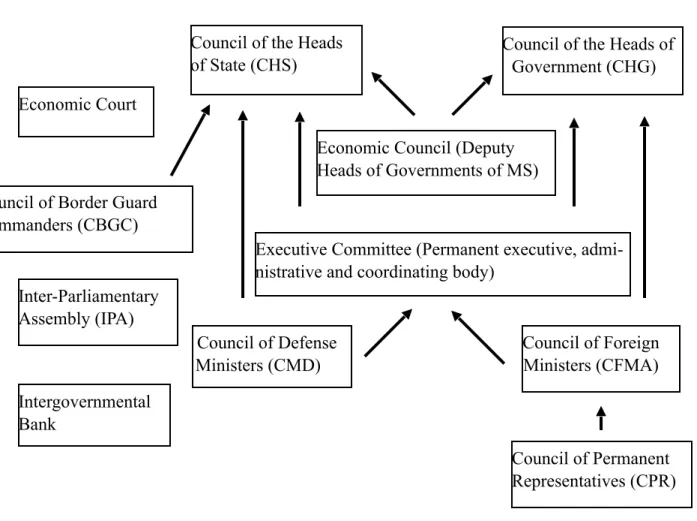
4.1.1 CIS Governance Structure The integration of the CIS member states is executed by the so-called coordinating institutions. These include the charter bodies, the executive bodies and the bodies of branch cooperation of the CIS (CISSTAT, 2015). The charter bodies of the CIS are: the Council of the Heads of State (CHS), the Council of the Heads of Governments (CHG), the Council of Foreign Ministers (CFM), the Council of Defense Ministers (CDM), the Council of Borders Guard Commanders (CBGC), the In-ter-Parliamentary Assembly (IPA), and the Economic Court (EC) (See figure 4.1) (Libman, 2011). This institutional design was already set up at the Minsk agreement, but took its present shape through the CIS Articles that followed. The three highest bodies of the CIS; the CHS, the CHG and the CFM are purely intergovernmental and include officials from each member state. The most im-portant decision are made, and the general agenda is set, by the heads of state of the member coun-tries within the framework of the CHS. Its presidency functions on the basis of rotation and decisi-ons are purely cdecisi-onsensus-based (Libman et al., 2011). The CHG on the other hand, has an agenda mostly concentrated on economic affairs and social policy, as well as monitoring the CIS agencies. It works on the same principle as the CHS. Both these Councils have to sole right and ability to pass binding decisions, the other institutions, such as the Executive Bodies of the CIS , only have the 2
advisory capability (Libman et al., 2011). The last CIS institution that is worth mentioning is the Economic Court (EC). The EC mostly deals with interstate economic disputes, though the judge-ments made by the Court are generally not legally binding. This makes the impact of the EC rather limited and insignificant (Libman, 2011).
“The Executive Bodies of the CIS are: the Economic Council, the Council of Permanent Plenipotentiary Representati
2
The Evolvement of Eurasian Integration
Figure 4.1 Structure CIS
(Libman, 2011; author’s graphics).
In 2007, a ‘Development Concept’ was launched to institutionally transform the CIS, to strengthen the role of the CPR, the Economic Council and the IPA and most important, to focus on the economic area as the main goal. The institutional reforms suggested by the Concept maintained the existing institutional structure of the organization, but was an attempt to be more efficient by reducing redundancies. As stated by Libman: “There seems to be little or no movement to the esta-blishment of the supranational institutions and only a limited increase of the capacity of the IPA” (Libman, 2011: 17-18). Thus, the CIS will remain (and would also remain in this proposal) largely based on a intergovernmental governance structure in which only the heads of state and government have the authority to pass binding decisions, and only by consensus.
4.1.2 Policy Areas As mentioned above, the initial goal of the CIS was to collaborate in re-creating the common eco-nomic space of the Soviet Union. Many arrangements adopted at the creation of the CIS were
in-Council of the Heads of State (CHS)
Council of the Heads of Government (CHG) Economic Court
Council of Border Guard Commanders (CBGC)
Economic Council (Deputy Heads of Governments of MS)
Council of Defense Ministers (CMD)
Council of Foreign Ministers (CFMA) Executive Committee (Permanent executive, admi-nistrative and coordinating body)
Inter-Parliamentary Assembly (IPA)
Intergovernmental Bank
tended to coordinate monetary, customs, employment, tax, and investment policies and thus pointed in this direction (Zhalimbetova & Gleason, 2001). Multiple agreements followed the initial Minsk agreement of ’91. May 1993 marked the adoption of the declaration to establish an Economic Union Treaty. The goal of this treaty was to foster a free trade area, create common external tariffs, reduce internal tariffs and establish a system of payments and settlements. The Treaty was enhanced with impressing sounding but ultimately ineffective subsidiary agreements on free trade (April 1994), payments, (October 1994), and customs (January 1995), legal harmonization (January 1996), customs classification lists (February 1996), and railway tariffs (October 1996). Many of these trea-ty outcomes were never adopted and implemented by the member states and currently the CIS has restricted its attention to specific areas of functional cooperation, such as electricity, railroads, avia-tion and humanitarian issues (Libman, 2011).
The Evolvement of Eurasian Integration
Closely connected the the Community is the Eurasian Development Bank (EDB), which was established by Russia and Kazakhstan in 2006 as a regional development bank for the former Soviet region. Armenia, Belarus and Tajikistan later joined the EDB. The main focus of the organization is not to provide common institutions and to facilitate formal cooperation, but rather to supply finan-cing for specific projects as a means to intensify regional cooperation (Libman, 2011).
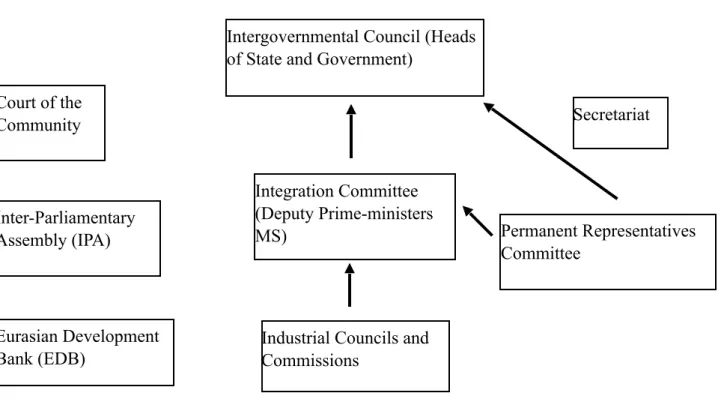
4.2.1 EurAsEC Governance Structure While the EurAsEC was not intended to limit the sovereignty of the participating states, it did pro-vide for the delegation of some negotiating responsibilities within international organizations. Examples of these are the Integration Committee, the Inter-Parliamently Assembly, and the EurAs-EC Court (See figure 4.2). In this respective, it had greater enforcement powers than its predecessor. This optimism can be tempered by making a comparison between the competences of the Commis-sion and the Court compared to its European counterparts: the European CommisCommis-sion and the Court of Justice. Although, it can be seen as first step in building a strong law-based community (Block-mans, 2012).
Figure 4.2 furthermore shows that, in line with the CIS, the Heads of State and Government; the Intergovernmental Council, was the most important body of the EurAsEC. Its task was to devel-op the key directions of further integration of the organization. In line with the CHS and the CHG, the decisions of the Council were mandatory for the member states and as a consequence had to be implemented through national legislation. Though decisions were consensus-based, which questions its efficiency. (Libman, 2011). The extensiveness of control of the Interstate Council is made clear by Article 3 of the EurAsEC founding treaty. It states that the Interstate Council is authorized to terminate the functioning of the integration management bodies (The World Bank, 2000).
in-tegration and ensured a good cooperation between the Community and the member states. Decisi-ons within this body were based on a weighted voting system and taken by two-third majority, which basically gave Russia a veto power . Lastly, the Court of the Community resolved the dispu3
-tes that arose between the member sta-tes over the implementation of EurAsEC decisions. Since 2004, the functions of the Court were delegated to the Economic Court of the CIS, so there was no longer a special Community institution established in this area. The Court could only make decision based on a two-third majority, which is more limited compared to the CIS Economic Court, though the decisions made by the Court of the Community were binding for the member states.
Figure 4.2 Structure EurAsEC
(Libman, 2011; author’s graphics).
An important feature of the EurAsEC that was later added is its permanent supranational regulatory body, the Eurasian Customs Commission (ECC) (later Eurasian Economic Commission). This Commission had basically the same functions as the Integration Committee (Libman, 2011). The parties involved, Belarus, Kazakhstan and Russia worked out an agreement on the EEC on No-vember 18th 2011. Based on this agreement, the EEC began working on the 2nd of February 2012.
“The headcount of parliamentary delegations at the IPA is as follows: Republic of Belarus: 16 parliamentarians, Repu
3
-blic of Kazakhstan: 16 parliamentarians, Kyrgyz Repu-blic: 8 parliamentarians, Russian Federation: 42 parliamentarians, Republic of Tajikistan: 8 parliamentarians, Republic of Uzbekistan: 16 parliamentarians. Therewith, every parliamenta-rian shall have one vote” (Eurasian Economic Community, 2006: Chapter III).
Industrial Councils and Commissions
Permanent Representatives Committee
Inter-Parliamentary Assembly (IPA)
Integration Committee (Deputy Prime-ministers MS)
Secretariat Court of the
Community
Intergovernmental Council (Heads of State and Government)
The Evolvement of Eurasian Integration
In addition to the tasks mentioned above, it was also the regulatory body of the ECU and the SES, which highlights the interconnectedness of the different treaties and organizations (Eurasian Eco-nomic Commission, 2013). Because the Commission’s main task was coordination of the ECU and the SES, I will discuss these bodies in the next paragraph.
4.2.2 Policy Areas
As stated above, the main function of the EurAsEC was to promote further integration and pave the way for the Single Economic Space and the Eurasian Customs Union. It thus had a clear economic agenda and roughly followed the same goals as the CIS in doing so. The EurAsEC failed to achieve an unrestricted free trade area and only 60% of tariffs were harmonized. Moreover, it did not ceed in the creation of common agricultural and energy policies (Libman, 2011). The biggest suc-cess of the Community was paving the way for the establishment of the Eurasian Customs Union and the Single Economic Space.
4.3 Eurasian Customs Union (ECU) and the Single Economic Space (SES) Following the CIS, countries that wanted to go further with the economic cooperation began to con-sider new forms of integration. In 1995, the idea was launched to establish a customs union between Belarus, Kazakhstan and Russia, though no formal agreement was signed by these countries at the time. A year later the three ‘frontrunners’ of integration in the region, plus Kyrgyzstan, signed the Treaty on Increased Integration in the Economic and Humanitarian Fields (Eurasian Economic Commission, 2013). After Tajikistan joined in December 1998, the group became known as the ‘Big Five’ agreement. “At the beginning, this ‘union’ was nothing more than a pledge of the parties to observe the provisions of the CIS agreements that were already in place” (Zhalimbetova & Glea-son, 2001). With the IIEHF treaty, basic goals of integration were set up, such as the creation of common markets for goods, services, capitals, labour and developing single transport, energy and information systems (Eurasian Economic Commission, 2013).
Be-larus, Kazakhstan and Russia would step up efforts aimed at installing the CU. Kyrgyzstan and Ta-jikistan would join later after implementing more preparatory measures. Based on these arrange-ments the Treaty on the Establishment of the Common Customs Territory and Formation of the Customs Union between Belarus, Kazakhstan and Russia was signed in October 2007. By 2009, the integration stages and the timeline of creating the single customs area were defined. The ‘troika’ officially established the Eurasian Customs Union and the Single Economic Space on the 1st of Ja-nuary 2010, although it took two more years before the SES came into effect and was fully operati-onal.
The development of the ECU and the SES has been of crucial importance for the success of Eurasian regional integration, because it encompasses the vital processes of trade in goods and ser-vices, movement of labour, macroeconomic coordination, financial integration, common technical regulations, and regulatory convergence. Moreover, the ECU was the first major initiative that was actually implemented. It was following its written rules and actually developing as a proper institu-tion (Schenkkan, 2014). In relainstitu-tion to this, the Eurasian Economic Commission, as the regulatory body of the Eurasian Economic Community (see below) was the first truly supranational institution in the two decades of post-Soviet reintegration (Vinokurov, 2012).
The Evolvement of Eurasian Integration
Figure 4.3 Structure ECU and SES in the framework of the EurAsEC
(Krotov, 2012; author’s graphics).
4.3.2 Customs Union Commission At the same time as the ECU Treaty, the Agreement Establishing the Customs Union Commission (2007) was signed. The Customs Union Commission, also referred to as the Eurasian Economic Commission, was established to ensure the proper functioning and development of the ECU and the SES at the supranational level, and it can be seen as the successor or replacement of the Integration Committee (Blockmans, 2012). The CUC consisted out of the deputy governmental leaders of the member states who passed binding decisions for the member states on the basis of consensus. The functions of the CUC as a regulatory body are recorded in article 1 of the 2011 Treaty. The most important task of this body was to monitor the implementation of its decision by the member states. “The CUC acts on the authority of member states and its functions include implementing the resolu-tions passed by the Mezhgossovet, issuing recommendaresolu-tions on the formation and functioning of the CU, implementing international agreements and cooperating with the governmental agencies of member states” (Krotov, 2012: 130). The exact competences of the Commission in major policy areas were not specifically stated in the Treaty. Clear is that the role of the CUC was skewed to-Court of the
Cus-toms Union
Associated Board of the Cust-oms Administration of the Member States (Directors-Ge-neral customs administration MS)
Interstate Council ‘The
Mezhgossovet’ (State and Government Leaders)
+
Expert Council (5 Experts Law and Commerce of each MS)
Scientific and Expert Council Customs Union Commission
(Deputy Governmental Lea-ders)
Secretariat, Executive Body CUC
Different Department and Expert Groups
Committee on the Regulation of Foreign Commerce (2 Representatives Executive Authorities MS)
wards its executive functions. On the one hand, it had the authority to enforce legally binding deci-sions which enabled it to create new legislation and it is authorized to make non-binding recom-mendations (Krotov, 2012). On the other hand, it was constrained in doing so by decisions made by the Interstate Council and by existing legislation (Blockmans et al., 2012). In addition, although the executive role of the CUC is laid down in Article 6 of the 2011 Treaty (implementation and monito-ring compliance), the mechanisms it had to do so were rather weak. The Commission could start an infringement procedure to force a member states to implement legislation or correct in the case of an alleged breach of Community law, though the procedure was long and included multiple other bodies. The decision to ‘notify’ a member state of an infringement had to be taken by a two-third majority. If a MS did not comply, the issue could be referred to the Commission’s Council or the EurAsEC Court. The Commission was furthermore constrained by the Interstate Council when it comes to its budgetary rights. Lastly, when it comes to negotiate trade agreements with third coun-tries, on behalf of the Customs Union, this right ‘may be granted’ by the Interstate Council (Block-mans et al., 2012: 14).
The Evolvement of Eurasian Integration
law, thus (indirectly) prescribing the national authorities to apply the CU law over conflicting natio-nal rules” (Blockmans: 2012: 18). The Court’s ruling was upheld by the Appeal Chamber a month later, thus confirming the principle of primacy of Customs Union law over conflicting national law.
4.3.4 Policy Areas This Single Economic Space covered various subjects: from the coordination of macroeconomic and fiscal policies to labour migration, energy and technical regulation (Vinokurov, 2012). To put it simply, the primary goal of the SES was to promote the four freedoms as we know them in the Eu-ropean context: the free movement of goods, capital, services and people. It was envisioned that the SES would increase competition and create equal conditions for all business and investors, regard-less of their country of origin. The ECU has also been successful in eliminating all quantitative re-strictions. Moreover, the import duties between the member states were removed and a Common External Tariff (CET) was established. Though not all barriers have been lifted, the existing exemp-tions for CET and harmonizing tariffs still have to be eliminated to complete the formation of the ECU (Blockmans et al., 2012).
4.4.1 EAEU Governance Structure According to Bordachev (2014), the countries are united on the basis of pragmatic cooperation and the creation of common institutions to regulate their economic activity. In this respect, the EEC is modeled on the EU, just like the former EurAsEC. It has a Moscow-based supranational executive body; the Eurasian Economic Commission, and a political body; the Supreme Eurasian Economic Council, where member states’ heads of state take decisions by unanimity. Strongly linked to the Supreme or Interstate Council is the Intergovernmental Council, consisting out of the heads of government of the member states. It is in charge of strategically important issues of the develop-ment of the Eurasian economic integration remained with no consensus when discussed in the Commission. In addition, in the upcoming decade, the EEC aims to create its own court in Minsk, a financial regulator in Astana and, possibly, to open Eurasian Economic Commission offices in Ast-ana, Bishkek, Minsk, and Yerevan (Bordachev, 2015). It is made clear by the Eurasian Economic Commission that authority remains at the level of the member states. “The EAEU operates within the competence granted by the Member-States subject to the Treaty on the Union, based on the res-pect to the established principles of international law, including the principles of Member-States’ sovereign equality and territorial integrity; based on the respect to the specifics of the Member-Sta-tes’ political order; based on the promotion of mutually beneficial cooperation, equal rights and the Parties’ national interests; based on application of the principles of market economy and fair com-petition” (Eurasian Commission, 2015).
The tasks of the Commission have been largely discussed in the previous paragraph on the EurAsEC. Within the Union it is still the permanent supranational regulatory body. It is composed out of the Commission Council and the Commission Board. The former exists out of the deputy prime minsters of the member states, and thus currently has five members. The latter is formed by three Commissioners by each member states, fifteen in total, and are referred to as ‘ministers’ (Eu-rasian Economic Commission, 2015).
The Evolvement of Eurasian Integration Figure 4.4 Structure EAEU
(Eurasian Commission, 2015; author’s graphics).
4.4.2 Policy Areas Taking over the four freedoms from the ECU, the EAEU aims to extend its single market to 40 other services sectors, such as construction services, wholesale/retail trade services, agricultural services etc., with pharmaceuticals next in line in 2016 (Rettman, 2015). Furthermore, the member states agreed to pursue a coordinated energy policy and later on will form a common energy market. In addition, the treaty establishing the Union entails long-term priorities of transport policy. Another important feature is the single labour market which has started operating as of the 1st of January 2015. It covers the freedom of movement of labour, a common labour market, in which the citizens of the member states will work in equal conditions. In the future, the member states of the Union agreed to establish by 2025 a single supranational body for financial regulation, to ensure coordina-ted regulation of financial markets (Eurasian Economic Commission, 2015).
Supreme Eurasian Economic Council (Heads of State MS)
Court of the Eurasian Economic Union
Eurasian Inter-Parliamentary Assembly (EIPA)
Eurasian Economic Commission (Council and Board)
Council of the Commission (Deputy Prime Minister MS)
Board of the Commission (12 Commissioners) Intergovernmental Council
(Heads of Governments MS)
4.5 Prospects of the EAEU Although the Eurasian Economic Union was established on the 1st of January 2015 with great ce-remonial fanfare, the prospects for the Union are mostly negative. The launch of the EAEU marked the start of a different project than what was originally envisioned. According to Giragosian (2015) there are three main reasons why the Union is less attractive and viable than it was first conceived. First of all, the recent crisis in Ukraine and the country’s turn towards the West made that it cannot be considered as a potential member anymore. This seriously undermines the trade and economic potential of the EAEU. “Russia’s own aggression has triggered the loss of the sizable Ukrainian economy, making the Eurasian Union much less viable as a project for regional (re)integration” (Giragosian, 2015). Secondly, the role of Russia as the ‘motor’ of EAEU integration is diminishing because of the impact of the Western sanctions imposed on the Russian economy, which are also indirectly targeting the other countries of the Union. These sanctions against Russia are working and the its economy is more fragile than Moscow expected, also having implications for Armenia, Belarus, Kazakhstan and Kyrgyzstan. “If Russia’s economy hits bottom in 2015, as many are predicting, Central Asia and the Caucasus will hit bottom along with it” (Schenkkan, 2014). Lastly, the motivation for integration is largely based on coercion and pressure (by the heads of state), and in this respect both Belarus and Kazakhstan have taken a more reserved standpoint (Giragosian, 2015). These factors make the member states of the EAEU wary to integrate further and to delegate authorities to the institutions that they have established. All these factors make that, according to Schenkkan, the EAEU is dead in all but name. “It will survive as another hollow post-Soviet multilateral institution celebrated with presidential summits but producing no progress to-ward its stated goals” (Schenkkan, 2014). This image is largely confirmed when looking at the poli-tical and economic standpoints of the current EAEU member states.