Steps in Balancing Equations
The half-equation method separates the oxidation and reduction of a redox reaction in half reactions. Overall scheme for the half reaction method:
Step 1: Split reaction into half-reactions (reduction and oxidation) Step 2: Balance the charge or oxidation number with electrons Step 3: Balance O by adding H2O
Step 4: Balance H by adding H+
Step 5: Multiply by some integer to make electrons (lost) = electrons (gained)
Step 6: Add half equations and cancel substances on both sides Step 7: (only in basic solution): add OH- and cancel H
20
Mg + HCl
MgCl
2+ H
2Mg is Oxidized and is the reducing agent H is Reduced and is the oxidation agent
Mg Mg2+
+2e-H+ +e- H
2 becomes 2H+ +2e- H2
---Mg + 2H+ +2e- Mg2++2e- + H 2
Fe + V
2O
3
Fe
2O
3+ VO
Fe is Oxidized and is the reducing agent V is Reduced and is the oxidation agent
V2O3 VO 6e- + 6H++ 3V
2O3 6VO +3H2O Fe Fe2O3
---2Fe + 3V2O3 Fe2O3 + 6VO
+ H2O 2H+ + 2
2e- + (Multiple by 3)
6e-KMnO4 + KNO2 + H2SO4 MnSO4 + H2O + KNO3 + K2SO4
MnO
4- + NO
2-+ H+ Mn
2++ NO
3
-+ H
2O
NO2- is Oxidized and is the reducing agent
MnO4- is Reduced and is the oxidation agent
MnO4- Mn2+
NO2- NO3
-
---2MnO4- + 5NO2- 6H+5NO
3- 2Mn2++3H2O
+ 4H2O 8H+ +
5e- +
H2O + + 2H+ +
2e-Multiple by 2
Electron Transfer Reactions
Electron Transfer Reactions
•
Electron transfer reactions are
oxidation-reduction
or
redox
reactions.
•
Results in the generation of an electric
current (electricity) or be caused by
imposing an electric current.
•
Therefore, this field of chemistry is often
Review:Terminology for Redox
Reactions
Review:Terminology for Redox
Reactions
What is OXIDATION?
loss of electron(s) by a species; increase in oxidation number; increase in oxygen.
What is REDUCTION?
gain of electron(s); decrease in oxidation number; decrease in oxygen; increase in hydrogen.
What is an OXIDIZING AGENT?
electron acceptor; species is reduced. What is a REDUCING AGENT?
electron donor; species
is oxidized.
What is OXIDATION?
loss of electron(s) by a species; increase in oxidation number; increase in oxygen.
What is REDUCTION?
gain of electron(s); decrease in oxidation number; decrease in oxygen; increase in hydrogen.
What is an OXIDIZING AGENT?
electron acceptor; species is reduced.
What is a REDUCING AGENT?
REMEMBER:
You can
’
t have one… without the other!
• Reduction (gaining electrons) can’t happen without an
oxidation to provide the electrons.
• You can’t have 2 oxidations or 2 reductions in the same
equation. Reduction has to occur at the cost of oxidation
LEO
the lion says
GER
!
Again…. Another way to remember
OXIDATION-REDUCTION
REACTIONS
OXIDATION-REDUCTION
REACTIONS
Direct Redox Reaction
Oxidizing and reducing agents in direct
contact.
Cu(s) + 2 Ag+(aq) --->
OXIDATION-REDUCTION
REACTIONS
OXIDATION-REDUCTION
REACTIONS
Indirect Redox Reaction
A battery functions by transferring electrons through an external wire from the reducing
Why Study Electrochemistry?
Why Study Electrochemistry?
•
Batteries
•
Corrosion
•
Industrial production
of chemicals
such
as Cl
2, NaOH, F
2and Al
•
Biological redox
reactions
Electrochemical Cells
Electrochemical Cells
•
An apparatus that allows a
redox reaction to occur by
transferring electrons
through an external
connector.
•
Product favored reaction
--->
voltaic or galvanic cell
----> electric current
•
Reactant favored reaction
--->
electrolytic cell
--->
electric current used to
cause chemical change.
Anode
Cathode
Basic Concepts
CHEMICAL CHANGE --->
ELECTRIC CURRENT
CHEMICAL CHANGE --->
ELECTRIC CURRENT
With time, Cu plates out
onto Zn metal strip, and
Zn strip “disappears.”
With time, Cu plates out
onto Zn metal strip, and
Zn strip “disappears.”
•
Zn is oxidized
and is the reducing agent
Zn(s) ---> Zn
2+(aq) +
2e-•
Cu
2+is reduced
and is the oxidizing agent
•
To obtain a useful current,
we separate the oxidizing
and reducing agents so that
electron transfer occurs thru
an external wire.
CHEMICAL CHANGE --->
ELECTRIC CURRENT
CHEMICAL CHANGE --->
ELECTRIC CURRENT
This is accomplished in a
GALVANIC
or
VOLTAIC
cell.
A group of such cells is called a
battery
.
•Electrons travel thru external wire.
•
Salt bridge
allows anions and cations to movebetween electrode compartments.
•Electrons travel thru external wire.
•
Salt bridge
allows anions and cations to move between electrode compartments.Zn --> Zn2+ + 2e- Cu2+ + 2e- --> Cu
CELL POTENTIAL, E
•
For Zn/Cu cell,
potential
is
+1.10 V
at 25 ˚C and
when [Zn
2+] and [Cu
2+] = 1.0 M.
•
This is the
STANDARD CELL
POTENTIAL, E
o•
—a quantitative measure of the tendency of
Calculating Cell Voltage
•
Balanced half-reactions can be added
together to get overall, balanced
equation.
Zn(s) ---> Zn
2+(aq) +
2e-Cu
2+(aq) + 2e- ---> Cu(s)
---Cu
2+(aq) + Zn(s) ---> Zn
2+(aq) + Cu(s)
Zn(s) ---> Zn
2+(aq) +
2e-Cu
2+(aq) + 2e- ---> Cu(s)
---Cu
2+(aq) + Zn(s) ---> Zn
2+(aq) + Cu(s)
If we know E
ofor each half-reaction, we
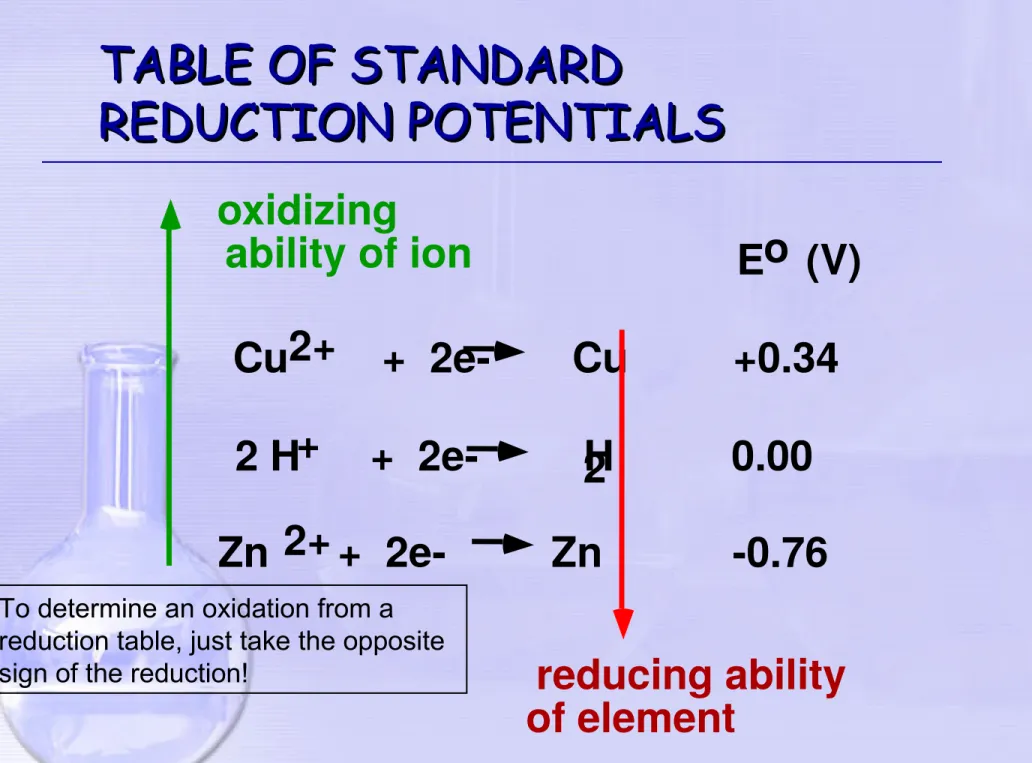
TABLE OF STANDARD
REDUCTION POTENTIALS
TABLE OF STANDARD
REDUCTION POTENTIALS
2
Eo (V)
Cu2+ + 2e- Cu
+0.34
2 H+ + 2e- H
0.00
Zn 2+ + 2e- Zn
-0.76
oxidizing
ability of ion
reducing ability
of element
To determine an oxidation from a
Zn/Cu Electrochemical Cell
Zn(s) ---> Zn
2+(aq) + 2e-
E
o= +0.76 V
Cu
2+(aq) + 2e- ---> Cu(s)
E
o= +0.34 V
---Cu
2+(aq) + Zn(s) ---> Zn
2+(aq) + Cu(s)
E
o= +1.10 V
Cd --> Cd
2++
2e-or
Cd
2++ 2e- --> Cd
Fe --> Fe
2++
2e-or
Fe
2++ 2e- --> Fe
E
ofor a Voltaic Cell
From the table, you see
• Fe is a better reducing
agent than Cd
• Cd
2+is a better oxidizing
agent than Fe
2+More About
Calculating Cell Voltage
Assume I
-ion can reduce water.
2 H
2O + 2e-
--->
H
2+ 2 OH
-Cathode
2 I
---->
I
2
+ 2e-
Anode
---2 I
-+ 2 H
2
O
-->
I
2+ 2 OH
-+ H
22 H
2O + 2e-
--->
H
2+ 2 OH
-Cathode
2 I
---->
I
2
+ 2e-
Anode
---2 I
-+ 2 H
2
O
-->
I
2+ 2 OH
-+ H
2Assuming reaction occurs as written,
E˚ = E˚
cat+ E˚
an= (-0.828 V) - (- +0.535 V) =
-1.363 V
Minus E˚ means rxn. occurs in opposite direction
(the connection is backwards or you are
Charging a Battery
When you charge a battery, you are forcing the electrons backwards (from the + to the -). To do this, you will need a higher voltage backwards than forwards. This is why the ammeter in your car often goes slightly higher while your battery is charging, and then returns to normal.
In your car, the battery charger is called an alternator. If you have a dead battery, it
could be the battery needs to be replaced OR the alternator is not charging the battery
Dry Cell Battery
Anode (-)
Zn ---> Zn
2++
2e-Cathode (+)
2 NH
4++ 2e- --->
Alkaline Battery
Nearly same reactions as in common dry cell, but
under basic conditions.
Anode (-):
Zn + 2 OH
----> ZnO + H
2
O +
-Mercury Battery
Anode:
Zn is reducing agent under basic conditions
Cathode:
-Lead Storage Battery
Anode (-) Eo = +0.36 V
Pb + HSO4- ---> PbSO
4 + H+ +
2e-Cathode (+) Eo = +1.68 V
PbO2 + HSO4- + 3 H+ + 2e-
Ni-Cad Battery
Anode (-)
Cd + 2 OH- ---> Cd(OH)
2 +
2e-Cathode (+)
-H
2
as a Fuel
Cars can use electricity generated by H
2/O
2fuel cells.
Balancing Equations
for Redox Reactions
Some redox reactions have equations that must be balanced by special techniques.
MnO4- + 5 Fe2+ + 8 H+ ---> Mn2+ + 5
Fe3+ + 4 H 2O
Mn = +7 Fe = +2
Fe = +3
Balancing Equations
Consider the reduction of Ag+ ions with
copper metal.
Balancing Equations
Step 1: Divide the reaction into half-reactions, one for oxidation and the other for reduction.
Ox Cu ---> Cu2+
Red Ag+ ---> Ag
Step 2: Balance each element for mass. Already done in this case.
Step 3: Balance each half-reaction for charge by adding electrons.
Ox Cu ---> Cu2+ +
Balancing Equations
Step 4: Multiply each half-reaction by a factor so that the reducing agent supplies as many electrons as the
oxidizing agent requires.
Reducing agent Cu ---> Cu2+ +
2e-Oxidizing agent 2 Ag+ + 2 e- ---> 2 Ag
Step 5: Add half-reactions to give the overall equation. Cu + 2 Ag+ ---> Cu2+ + 2Ag