E-books in academic publishing:
Theory, practices and technical issues
(Master Thesis)
MA: Book and Digital Media Studies
Ksenia Papazova
s1244302
15 August 2014
Readers:
Peter Verhaar
2
Table of contents
Introduction ……….……..3
Chapter 1. Interdependence between e-book formats, types of content and reading devices ……….….7
Types of content ……….…….8
Academic work and its relationship with reading devices and formats ………11
Which e-book format is dominant? ………..……14
EPub: a choice between a reflowable and fixed-layout format ……….…17
HTML and academic publishing ………20
Interdependence between e-book formats and content types ……….23
Chapter 2. EPub vs PDF: trade format vs academic format ………26
Pagination functionality ……….28
Search and printing functionality ……….29
Annotation and bookmarking functionality ………..31
Software reading systems for academic work ……….……32
EPub as a format for academic e-books ………..33
Typographical aesthetics of e-books ………..35
EPub3 and PDF as accessible formats (reflowable PDF, text-to-speech, zooming modes) ………..38
Chapter 3. Changing formats and their implementations in academic publishing today ……….…43
E-book statistics ……….44
Pricing ……….….….46
Third parties and business models ……….…..50
A shift towards a business-to-customer model ……….…..55
A look to the future……….…….57
Conclusions ……….….59
3
Introduction
Technical progress has brought about a disruptive change in the publishing industry. The
e-book, a modern invention, is seen as being set to soon achieve dominance in the consumer
market. However, academic publishing has begun to experience this e-ntrusion somewhat later
than the trade sector has: the onward march of e-books in academic publishing is still blocked
for a number of reasons. Among them, the lack of available content, issues with formats and
pricing, the absence of viable business models, and readers’ personal preferences for paper
over digital copies play an important role.
Much of the research into the e-book market focuses mainly on trade publishing;
relatively little research has been carried out on digital academic publishing. At the centre of the
current paper is the battle between e-book formats, which will be discussed in the following
chapters from different perspectives. The first two chapters directly deal with the issues of
formats by discussing their suitability to being used as formats for academic e-books. The last
chapter debates the challenges digital academic publishing is facing today (pricing models for
different formats, publishers’ choice of a suitable format, and changes in academic publishing
caused by the development of technologies and formats in particular).
In this paper, digital publishing is understood, in a broad sense, as the production of
digital products for digital distribution. The production of e-books is therefore a specific form of
digital publishing. An e-book is understood as ‘a digital object with textual and/or other content,
which arises as a result of integrating the familiar concept of a book with features that can be
provided in an electronic environment.’1 Scholarly and academic publishing are considered
synonymous and do not include the publishing of textbooks.
The comparison between academic publishing and trade publishing is unavoidable
because digital trade publishing will determine the market and readers’ expectations of e-books
in general; however, what may be crucial for successful trade e-books may be of little relevance
for academic e-books, and vice versa. The relation between e-books and e-journals can be seen
in the same light as the influence of the e-book trade sector on academic publishing, because
4
STM publications at the moment determine the direction taken by the academic e-market: the
academic community is likely to make the same demands of academic e-books as it already has
for e-journals in terms of fast and easy access, regular updates and so on. It is important to
mention that this paper deals with the European and American academic markets. Another
caveat is that it was not possible to cover every area of academic publishing, as the paper would
have become unreasonably long. Thus, some issues related to VAT, DRM, piracy, and
distribution channels were intentionally omitted.
One of the most important issues in digital publishing is format. The wide range of
available formats makes it difficult to decide which one of them should be used to deliver
e-books to end-users. The problem becomes even more complicated because of the range of
reading devices that are compatible – or not – with a particular format. There have been
numerous articles and debates about the best format, but only a few discuss the issue in the
context of academic publishing or of the needs of the academic community. The objective of
this paper is not to find the best format, but rather the opposite: to show that there is no
format that can meet all the requirements of all the content it may be required to deliver. Thus,
the first chapter of this paper will be devoted to a description of different types of content and
their amenability to digital delivery. It will examine the most common formats for academic
e-books and demonstrate that the choice of format is determined by different factors (by the type
of content, reading device and modes of reading). It will do this by discussing the nature of
academic work and by exploring an interdependence of formats, types of content, reading
devices and reading modes.
The second chapter will go on to test the suitability of formats to perform the tasks that
academic work requires. A range of functions (pagination, searching, printing, annotation and
bookmarking functionality) vital to academic work, will be scrutinized in different software
reading systems. The second chapter will focus on only two formats (PDF and ePub) which can
be seen as the yin and yang of the genre – so different are their natures (i.e. their technical
specifications and thus their areas of use). A conflict emerged when one of the formats (ePub),
initially ‘born’ within trade publishing, started to target the alien turf of academic publishing,
5
the ‘ePub as a format for academic e-books’ section. Furthermore, this paper will discuss the
issues of typographical niceties in e-books as relevant for the academic community. The last
section of this chapter is devoted to a new trend in publishing, i.e. accessibility of e-books.
Issues of the accessibility of e-books are not directly connected to academic publishing but
cannot be ignored in the light of this ongoing battle between the different formats.
The third chapter will introduce practical matters important in academic publishing and
related to e-books and their distribution. A discussion of challenges posed by the harvesting of
statistics relating to e-book will open the last chapter, followed by a section on pricing models.
Another sticking point comes with the selection of third party vendors and business models – an
acknowledged area of concern for many publishers.2 Traditional distribution channels in
academic publishing – aimed at libraries – cannot satisfy the need of individuals to own their
own books. Moreover, their close ties with libraries and educational institutions have for a long
time in fact hindered publishers in developing an academic book market for individuals. With
the development of the Internet and digital technologies, however, these needs can be
addressed more successfully. Thus, there are nowadays visible signs of a shift from the
dominant business-to-business model to a business-to-customer approach. In addition, while
discussing business models, their dependence on the type of content will be referred to. The
chapter concludes with speculation on the future fate of academic publishing in the digital age,
both in the short and the longer term.
For the examination of this thesis, various types of sources were consulted. For the
theoretical framework (first chapter), concepts and theoretical models were adopted from
works of sociologists (mainly from J.B. Thompson) and researchers of digital reading and
usability of different reading devices. For the description of the formats’ functionality (second
chapter), facts and ideas were predominantly taken from technical manuals, how-to guides,
tutorials, users’ guides, Help and FAQ sections of the software developers’ websites.
Information specifically about practical issues of e-books (third chapter) was drawn from
different field guides, publishers’ surveys and reports, and press releases. All three parts were
6
reinforced further by information found in a variety of electronic sources, including official
7
Chapter 1. Interdependence between e-book formats, types of content and
reading devices
As electronic publishing matures, publishers unavoidably need to decide how they are going to
enter the quicksand that is an e-book market. It is true that e-books found their place faster in
the field of trade publishing ‘where the growth of e-book distribution and sales have
skyrocketed over the past five years’,3 but until recently they could not be considered potential
rivals for printed academic books. Beside e-books, however, new technologies have affected
academic publishing in different ways: new developments have surfaced that are still unknown
in trade publishing, e.g. open access, nanopublications and semantic enrichments. These
possibilities have clearly emerged within the world of academic publishing and have not yet
crossed over into trade publishing. Currently, enhanced publications – mainly developed for the
educational and research markets – are slowly entering the world of trade: more and more
experiments are being done to introduce this technology into fiction and non-fiction
publications (for example, the boutique publishing house Atavist4,which specialises in enhanced
non-fiction).
In 2009, the Association of Learned and Professional Society Publishers submitted a
report on academic book publishers’ policies and practices. One of the challenges the authors
had to face in order to design the survey was the heterogeneity of academic products and the
way different types of books are used by their end-users. As J. Cox et al puts it,
Textbooks, monographs, reference works, handbooks, manuals, conference
proceedings, and technical reports serve different purposes, and are read by different
readers who reach them by different routes. The functionality that is being developed
3 T.A., Carpenter, ‘It Time for Scholarly Journal Publishers to Begin Distributing Articles Using EPUB 3?’, The
Scholarly Kitchen, March 19, 2013, n.pag. < http://scholarlykitchen.sspnet.org/2013/03/19/is-it-time-for-scholarly-journal-publishers-to-begin-distributing-articles-using-epub-3/> (Accessed 6 April 2014).
8
for each type is specific to the type and purpose of the content itself. As a result, book
publishing has been slower to develop online products than journal publishing.5
In this regard, it is useful to analyse different types of content and their suitability to being
disseminated online or accessed via different devices (mobile phones, dedicated e-readers,
laptops, etc.). Additionally, this chapter will explore the requirements placed by academic work
on formats (ePub, HTML, PDF6).
Types of content
According to J.B. Thompson, who distinguishes between four main groups of content (namely
data, information, knowledge and narrative), not all forms of content are equally amenable to
electronic dissemination (Fig. 17). In terms of publishing, educational, scholarly and trade
publishing are less well-fitted for online dissemination, while reference, professional and journal
publications are likely to be more ‘online-friendly’. The reasons for such inequality lie in the
nature of content itself: the more it is fragmented or ‘bitty’ (as in case with data and
information, the examples of which are stock rates and reports about the results of experiments
correspondently), the more it is subject to online dissemination. Moreover, the context in which
content is situated can be another reason for successful or hindered dissemination. For
example, in the case of reference works, such as dictionaries and encyclopaedias, a reader is
unlikely to read the content from cover to cover, and the context of each reference entry is not
important: the information is mainly organised in an alphabetical order or, roughly speaking, at
random. The context is not meant to add any additional information or ‘value’ to it, thus these
bitty or fragmented pieces of information can be easily independently distributable. Quite
opposite, content that urges storytelling and unbreakable or ‘unbitty’ narrative cannot be
presented separately in its parts because it can function successfully only in its full ‘linear’ form,
as something is missing otherwise. Successful examples of narrative non-fiction genres for
5 J. Cox et al, Scholarly Book Publishing Practice: An ALPSP Survey of Academic Book Publishers’ Policies and
Practices, First Survey, (ALPSP, 2009), pp. 6-7.
6 Although there is no separate section on the PDF format, it is discussed in detail in the second chapter of this
study.
9
online dissemination include diaries or travel notes. Their nature – bitty texts compiled date by
date8 – is perfectly suited for online presentation, perhaps even better than for paper
presentation.
At this point, it is important to explain that J.B. Thompson’s idea of a successful or
hindered online dissemination is twofold it entails not only distributing content online (via
websites, for example) but also the possibility to consume it while online. For instance, the
regularity of the releases (twice per month) and the brevity of the shelf life (one month) of Mills
& Boon series titles made them perfect for online dissemination9, but their is likely to take place
‘offline’ while reading them on tablets or e-readers, after the files have been successfully
downloaded and saved. Stock exchange records are a good example of content that is perfect
for online dissemination and consumption due to its bitty and dynamic nature.
Types of publishing Online dissemination
journal
professional more amenable
reference
educational
scholarly
trade less amenable
Although it is not possible to provide a comprehensive account of all factors affecting a
successful dissemination of content online, it may be useful to discuss this issue in more detail.
J.B. Thompson does not actually identify the factors that help or hamper online dissemination,
but on the basis of Thompson’s speculations about different types of content, the following
factors can be considered: the length of content, the need for frequent updates, searchability,
presence of or possibilities for multimedia and cross-referencing, the importance of speedy
8 The examples of nonfiction online travel notes and diaries: A Journall with Observations on my travail... 1697,
<http://mytravail1697.blogspot.nl/>; The Diary of Samuel Pepys: Daily Entries from the 17th Century London Diary,
<http://www.pepysdiary.com> (Accessed 15 June 2014).
9 L. Bennett, E-book Strategies: The Essential ALPSP Guide on How to Develop Your E-book Offer, (ALPSP, 2011), p.
78.
10
dissemination, availability and accessibility from different locations, etc. For all types of content,
these factors or characteristics can be of much or little relevance; however, the success of every
type of content in being disseminated online is determined by a particular set of such factors.
Thus, the subfield of academic books or monographs may be presented as 1) long; 2) with
medium or high importance of speedy dissemination; and 3) having cross-referencing and
searchability, regular updates (especially important for SMT monographs) and 24/7 availability
and easy accessibility from different places; 5) while the presence of multimedia may be an
extra feature.
Thompson’s classification of different types of content10, although written in 2005, is still
applicable today. However, some remarks should be made. By entering the world of digital
dissemination, a publisher takes a risky move if it deals with educational (= pedagogical
knowledge), scholarly (=sustained argument) and trade publications (=narrative).11 It can be
useful to scrutinise Thompson’s conclusions about these three types of content on relevance for
the present-day situation. It is still true nowadays that narrative (= trade) publications are
unlikely to be consumed online, but for a different reason: with the advent of new generations
of e-readers, they are read mainly on the dedicated devices, and later on tablets, but not while
sitting in front of the screen of a laptop or a PC(the growing sales of trade e-books – fiction or
non-fiction – as well as sales of e-readers and tablets serve as an evidence of it). Thus, narrative
content has fairly easily transitioned to the new medium of e-readers and tablets and received
the new form of e-book, delivered in different formats. Roughly speaking, an e-book is a
self-contained system that can work independently without using the Internet after being
downloaded if this functionality is provided by publishers. As for educational publishing, it has
developed a new product – the e-textbook – enhanced by new possibilities for distance learning
and other educational features, made possible because of the embedded multimedia.
Academic publishing, which include academic journals, academic monographs and books
as well reference works and primary sources, is making its move into a digital realm too.
Transferring journals into e-journals does not require much explanation: this ‘shift to online
10 In this paper, the forms and types of content are interchangeable.
11
dissemination has been quick, dramatic and irreversible’,12 and the burgeoning number of
e-journals, to a large extent, speaks for itself. Reference and primary sources are also available
online and are in great demand. For instance, Macmillan’s decision to stop printing paper
dictionaries ‘was based on a choice that had been made by their users’13 as there has been a
constant decline in sales of paper dictionaries but the usage of the online dictionaries was on
the rise. The greater issue is with making academic monographs and books available online or
digitally as an e-book. First of all, publishers still face a great challenge from the academic
community, as its general preference for paper books over e-books is still high, with some
difference between the disciplines.This is connected to the nature of academic work: reading
an academic book implies reading in-depth and intensively. Reading online while scrolling down
a web page does not work with long articles, not to mention academic books. Also, note
making, bookmarking, dog-earing, highlighting and underlining some parts of the text may be
needed – a function that the HTML format cannot satisfy at the moment. In this case, the only
solutionis to follow trade publishing and to convert academic books into e-books – a means
that, in most cases, can offer a solution for academic needs because various e-book formats can
offer support for annotations or for other functionalities scholars need.
Academic work and its relationship with reading devices and formats
The nature of reading for academic purposes (for short this type of reading will be referred as
‘academic reading’) is different from everyday reading or reading for pleasure (fiction still
constituted approximately 70 per cent of all e-books sales in 201014). According to S.Schomisch
et al15, everyday reading can be seen as a consumptive activity, while scholarly reading is
productive, as such reading is done not only for the sake of reading but in order to produce
something new (a new text, knowledge, etc.). In the former case, any device used for reading
12 J.B. Thompson, Books in the Digital Age, (Polity Press, 2011), p. 329. 13 ‘Why has Macmillan Stopped Printing Dictionaries?’ August 2013
< http://mec.helpserve.com/Knowledgebase/Article/View/1059/0/why-has-macmillan-stopped-printing-dictionaries> (Accessed 15 June 2014)
14 L. Bennett, E-book Strategies: The Essential ALPSP Guide on How to Develop Your E-book Offer, (ALPSP, 2011), p.
138.
15 S. Schomisch et al, ‘Are E-readers Suitable Tools for Scholarly Work? Results from a User Test’, Online Information
12
should be able to support linear texts, but for academic needs the capabilities of such a device
should go much further: from archiving to rereading and extracting and much more.It should be
noted that there have been numerous research projects aiming at shedding some light on
usability and functionality of different devices and consumers’ attitudes toward a particular
device. However, not much research has been done on their suitability for academic work. For
instance, to my knowledge, there has been no research conducted on using smartphones for
academic reading.
Nowadays reading can be done on several types of devices: laptops, PCs, dedicated
e-readers, tablets and smartphones, the suitability of which for academic reading will be
discussed in the rest of the section. The question is whether they are suitable for academic
reading and which format is preferred by scholars. All in all, there is some evidence that,
between books in PDF and ePub, the latter would be the favoured only in terms of readability of
textual information,16 meaning its adjustment to everyday reading.The limitations and
capabilities of formats will be addressed in more detail in the following chapter.
As the research conducted by M. Pölönen et al showed, watching motion scenes or viewing content with fewer details (like images with little text) on near-to-eye or small-sized
displays does not seem to cause any problems for the users, but using the same displays for
reading is likely to cause eyestrain, especially when reading lasts more than 20 min.17 Although
this research is device-dependent and the results for specific devices may vary, it can be
concluded that reading on devices with small-sized screens is not the most comfortable or most
suitable means of continuous, long-session, in-depth reading, meaning that it is unsuited for
reading, especially for academic purposes. The format ‘tailored’ for reading on such devices is
ePub, and here we can also assume that ePub is an appropriate format for reading trade books
for the same reasons. It is usually forgotten that the IDPF (the International Digital Publishing
Forum, a non-profit organisation responsible for the development of ePub) began in trade
16 S. Schomisch et al, ‘Are E-readers Suitable Tools for Scholarly Work? Results from a User Test’, Online Information
Review, Vol. 37(3) (2013), p. 397.
17 M. Pölönen et al, ‘Reading E-books on a Near-to-Eye Display: Comparison between a Small-Sized Multimedia
13
publishing, which was reflected in the functionality of former versions of ePub.18 In the
following chapter, the connection between ePub and trade reading will be described in detail.
The next device under examination, which supports reflowable (i.e. a type of a digital
format that can adjust its presentation to a particular output device) and fixed-layout formats, is
the dedicated e-reader. Again, any research conducted into dedicated e-readers will be
device-dependent as there can be differences in the implementation of certain functions on devices or
in the formats supported.19 S.Schomisch et al20 tested three dedicated e-readers and one tablet
for their suitability to academic use by examining basic functionalities, which support active
examination of the text while reading. Although their findings cannot be considered final due to
the small sample scale and scope of the tested devices, the conclusions are telling. Most of the
group does not use e-books for intensive reading but instead prints out the most important
parts from them. In addition, the functionalities and usability of the tested e-readers proved to
be neither sufficient nor suitable for scholarly work. The same study on the dedicated e-readers
showed that they cannot really compete with all-purpose devices such as PCs, tablets or
notebooks. A different study, conducted in 2010 by M. Aaltonen21et al, showed that most of
the respondents would use e-readers for reading a novel (reading for leisure) and consider them
unsuitable for academic papers with complicated layout, with laptops being still preferred due
to their better functionality. Another study conducted by the digital education team at Barnes &
Noble on finding an optimal digital study device showed that the best device at the moment is
the laptop, which can be used for heavy studying and content parsing, with tablets being used
‘as an on-the-go solution for reading and annotation’.22
Due to their bigger screens, tablets can offer a more comfortable reading experience for
the user than smaller devices. In addition, their annotation capacities are clearly superior. For
18 B. Kasdorf, ‘EPub 3 (Not Your Father’s ePub): Opening Pandora’s Box in the World of E-books’, Information
Standards Quarterly, Vol. 23(2) (2011), p. 7.
19 S. Schomisch et al, ‘Are E-readers Suitable Tools for Scholarly Work? Results from a User Test’, Online Information
Review, Vol. 37(3) (2013), p. 395.
20 Ibid., pp. 391-392.
21M.Aaltonen et al, ‘Usability and Compatibility of E-book Readers in an Academic Environment: A Collaborative
Study’, IFLA Journal, Vol. 37(1) (2011), pp. 16-27.
22D. McCarthy, ‘Mobile Perspectives on E-books. E-Reading: The Transition in Higher Education’, EDUCAUSE
14
instance, there are special applications for PDF e-books (such as GoodReader, iAnnotate) which
enable users to highlight in different colours, inserting blank pages in PDF files for making notes
on them, and so on. Although a detailed discussion of their user-friendliness is beyond the
scope of the study, it is obvious that they can offer more extended opportunities for scholarly
work than dedicated e-readers or small-screen devices. To summarize, at the moment devices
with bigger screens and greater functionality (such as laptops and tablets) seem to be more
acceptable in the academic environment.
Which e-book format is dominant?
In order to become ‘e’, paper books have to be converted into a suitable e-format. A range of
formats and standards is available: from open and free to proprietary. It is not so easy to say
which are the most widespread formats for e-books. Some consider ePub the most common
format for electronic books,23 and quite often these claims have no argumentation behind
them. In this regard, given the absence of comprehensive and reliable statistics on format
coverage, an interesting attempt was made by D. Johnson to use Google to check the presence
of formats on the web in a very simple but effective way, by conducting searches for file types.
Although there are some limitations to this approach (the exclusion of HTML and HTM files,
which represent the vast majority of files on the Internet; changes in search algorithms, etc.),
the results are worth mentioning here (Fig. 224). The most striking feature is the absolute
dominance of PDF files and the absence of ePub until 2014, when this format registered only 1.4
per cent of all file types.25
23 P.K. Ryan, Careers in Electronic Publishing, (Rosen Classroom, 2014), p. 59.
24The figure is taken from:D. Johnson, ‘The 8 most Popular Document Formats on the Web’, February 17, 2014,
n.pag. <http://duff-johnson.com/2014/02/17/the-8-most-popular-document-formats-on-the-web/> (Accessed 15 June 2014).
25 D. Johnson, ‘The 8 most Popular Document Formats on the Web’, February 17, 2014, n.pag. <
15
Figure 2. Percentage of electronic formats on the Internet (April 2011 - February 2014)
The results of Johnson’s study are more intriguing if they are compared to the results of
survey reports on digital book publishing conducted by the Association of American University
Presses since 2009. The table (Table 1) below should be treated with care because the number
of participants and the types of presses in the survey differed each year, thus it cannot be
considered as absolute and comprehensive and not all the formats in the survey are presented
here; some formats have since come and others have since gone. Moreover, although presses
can produce e-books in different formats, no record is made of the percentage of e-book
production covered by a single format, meaning that even if less than one per cent of books
published by a particular press is made in ePub, this percentage will be counted. However, some
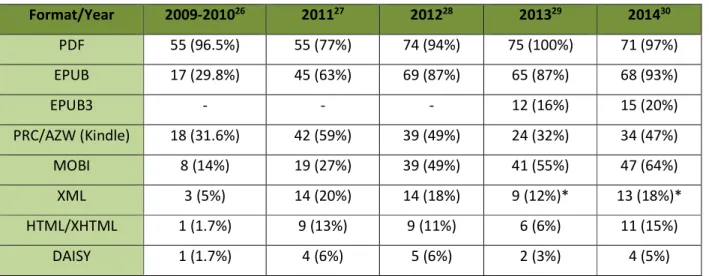
trends can be seen: firstly, PDF is still the most widely used format; secondly, if PDF is not the
only format offered by publishers, they are still not eager to take many risks (surprisingly, ePub3
has not made any great progress since 2013, although it was launched in 2011 – only three new
16
Table 1. # and % of presses which make content available in different formats, 2009-2014
Format/Year 2009-201026 201127 201228 201329 201430
PDF 55 (96.5%) 55 (77%) 74 (94%) 75 (100%) 71 (97%) EPUB 17 (29.8%) 45 (63%) 69 (87%) 65 (87%) 68 (93%)
EPUB3 - - - 12 (16%) 15 (20%)
PRC/AZW (Kindle) 18 (31.6%) 42 (59%) 39 (49%) 24 (32%) 34 (47%)
MOBI 8 (14%) 19 (27%) 39 (49%) 41 (55%) 47 (64%)
XML 3 (5%) 14 (20%) 14 (18%) 9 (12%)* 13 (18%)*
HTML/XHTML 1 (1.7%) 9 (13%) 9 (11%) 6 (6%) 11 (15%)
DAISY 1 (1.7%) 4 (6%) 5 (6%) 2 (3%) 4 (5%)
* XML (other than ePub)
In this regard, the statement that ePub and PDF ‘are rapidly becoming the main ones
that academic publishers use’31 seems inaccurate because, based on my observation and the
information presented above, I would claim that ePub has been adopted mainly in trade
publishing, while ‘serious’ academic publishing tends to choose PDF in line with the preferences
of academic libraries. All in all, it looks like it is too early to claim that ePub is one of the most
common formats for academic e-books, although PDF certainly is. For instance, Cambridge
University Press offers its books only in PDF for institutional access,32 although it does not rule
out that its third-party distributors will offer e-books in other formats.
26Digital Book Publishing Strategies in the AAUP Community: Winter 2009-2010, p. 3. 27Digital Book Publishing Strategies in the AAUP Community: Spring 2011, p. 4. 28Digital Book Publishing Strategies in the AAUP Community: Spring 2012, p. 6. 29 Digital Book Publishing Strategies in the AAUP Community: Spring 2013, p. 6. 30Digital Book Publishing Strategies in the AAUP Community: Spring 2014, p. 6.
31 L. Bennett, E-book Strategies: The Essential ALPSP Guide on How to Develop Your E-book Offer, (ALPSP, 2011), p.
2.
32 FAQ: About Cambridge Books Online, n.pag. <http://ebooks.cambridge.org/faq.jsf?pageTitle=FAQ> (Accessed 29
17
Figure 3. E-book formats created
In addition, some data concerning e-book formats (Fig. 333) has emerged from a
comprehensive survey of academic book publishers’ policies and practices conducted by the
ALPSP in 2009. The extent to which the results of this report are still plausible and relevant in
the present situation of a rapidly changing digital world is difficult to say, but at least they do
give an overview of the recent past and be used as a reference point. Moreover, they do not
contradict the above-mentioned surveys.
EPub: a choice between a reflowable and fixed-layout format
The choice of a format is determined by different factors (target readership and possible use of
a product, devices or platforms through which it should be delivered [distribution channels],
possibilities of a publisher to produce a particular format); however, it also depends on the
content type it should deliver. Thus, it may be assumed that most trade fiction books are
text-oriented but lack a sophisticated page layout, images or passages in different languages and
complicated tables and formulas. Where this is the case, the preferred format for such books
33 J. Cox et al, Scholarly Book Publishing Practice: An ALPSP Survey of Academic Book Publishers’ Policies and
18
may be ePub. EPub, ‘unlike print books or PDF files, is designed to change’34 meaning that it
allows content to become reflowable and malleable: any text will be adjusted for a particular
display or a given reader’s needs; the size of the display is not a factor. Thus, the format
specification makes reading possible on even small devices (as mobile phones or smartphones)
with tiny screens. In its turn, mobile reading has an advantage which may also be considered a
disadvantage from a different perspective: it usually implies reading on the way (while
commuting or waiting for someone). This type of reading can be characterised as discontinuous,
extensive, lacking depth, and often accompanied by scanning or skimming over the reading
material. To familiarise oneself with something while in transit or to use a small-screen mobile
device for a quick reference or refreshing some facts, mobile reading (in case if this information
is easily discoverable) is an ideal invention at the moment. In this regard, quite telling are the
results of a study on e-book usage conducted by B.L. Folb et al: most users reported using an e-book for reference purposes regardless of whether this e-e-book was published as a texte-book,
reference source or any other type.35
When a sophisticated page layout is involved – with images, tables and formulas – ePub
is available to the publisher in its ‘fixed’ variant (Kindle, Apple and Sony formats have a similar
functionality36). In this case, every page is treated as a separate unit and text is reflowable
within page boundaries. This hinders visualisation of the content and can hamper reading. Its
limitations are that it may not be optimized for all e-readers and then it works in a way similar
to PDF files where you can zoom in to or out of a page. On the other hand, Bedford e-Book to
Go offers PDF-based e-books with an extended compatibility with Apple mobile and Android
devices37 (beyond that of Bedford’s usual e-books). Fixed ePub is a part of the ePub2 standard
which, at present, is not supported by all e-readers (the current revision of the ePub standard is
ePub3). It is particularly interesting to point out the practice that, not a reader, but ‘De Gruyter
34 EPUB 3 Fixed-Layout Documents: Purpose and Scope <http://www.idpf.org/epub/fxl/> (Accessed 15 June 2014). 35 B.L. Folb et al, ‘Clinical and Academic Use of Electronic and Print Books: The Health Sciences Library System
E-book Study at the University of Pittsburgh’, Journal of the Medical Library Association, Vol. 99(3) (July 2011), p. 220.
36 EPUB 3 Fixed-Layout Documents: Appendix B. Mapping Tables <http://www.idpf.org/epub/fxl/> (Accessed 15
June 2014)
37 Compare E-books, n.pag.
19
decides what ePUB format is most suitable for each digital publication’38 (between fixed and
reflowable formats).
The idea behind ePub3 is in diametric opposition to the PDF format – ‘content
presentation should adapt to the user rather than the user having to adapt to a particular
representation of content.’39 The developers of ePub are aware that this cannot work for all
types of content;40 however, a fixed layout was not officially supported in the original EPUB3
specification and only in March 2012 was a new specification for e-books with a fixed layout
developed.41 That is why ‘when fixed-layout content is necessary, the author's choice of
mechanism will depend on many factors including desired degree of precision, file size,
accessibility, etc.’42 Thus, ePub3 offers a choice between a reflowable or pre-paginated (= fixed
layout) document and then allows its structure to be defined by adding to it a landscape,
portrait or auto (= no constraints) value or, in lay terms, spine orientation. After ‘spread
property’ has been defined, page orientation can be applied locally to any part of the document
when needed. By defining the page’s dimensions in fixed pixel measurements for XHTML, SVG
(Scalable Vector Graphics) and bitmap images, it is even possible to achieve right-to-left page
progression direction for a document (usually used for Japanese manga). However, few people
know that ePub 2.0.1 offers right-to-left reading because software reading systems have not
supported this ability.43
EPub3 is a new step towards making the ePub format suitable for academic publishing.
Academic books may contain passages in different scripts (like those for Arabic or Asian
languages) which are read from right to left or from top to bottom, as well as a sophisticated
page layout with images, tables and formulas. To reflow ‘simple text’ trade book in ePub is fairly
38 FAQ ePUB: Can I Choose the Specific EPub Format? <http://www.degruyter.com/page/902#Format Wahl>
(Accessed 15 June 2014)
39 EPUB 3 Fixed-Layout Documents: Purpose and Scope, n.pag. <http://www.idpf.org/epub/fxl/> (Accessed 15 June
2014)
40 Ibid., n.pag.
41Field Guide to Fixed Layout for E-books, Version 1.1., ed. Cramer D., (Book Industry Study Group, September
2013), p. 12.
42 EPUB 3 Fixed-Layout Documents: Purpose and Scope, n.pag. <http://www.idpf.org/epub/fxl/> (Accessed 15 June
2014)
43 B. Kasdorf, ‘EPub 3 (Not Your Father’s ePub): Opening Pandora’s Box in the World of E-books’, Information
20
easy, but turning an academic book into ePub may demand additional proofreading and
checking of the above mentioned aspects. Initially, it was a problem of the format itself to display them in an appropriate way, and it remains to some extent. Then it became a problem
of software reading systems which cannot support all the functionality.The year 2014 looks like
it is marking a very important milestone in the development and wider use of ePub in academic
publishing because this year several academic publishers have announced their adoption of
ePub. Among them is Elsevier which ‘will move its new e-books to EPUB3, becoming the first
major STM publisher to commit to the latest, most advanced e-book format available’;44 the
problem of compatibility of the formats will be solved as EPUB2 devices ‘will "see" Elsevier's
EPUB3 e-books as EPUB2 files.’45 One month later (in May 2014), two more academic publishers
made known their decision to use ePub: Wiley (ePub3) as its new standard for e-books in
reflowable format (as of February 1, 2014),46 and De Gruyter (ePub2) as a format in addition to
its PDF e-books47 (as of May 2014). It is worth noting that that none of these publishers has
abandoned the production of e-books in PDF.
HTML and academic publishing
HTML, a mark-up language for creating web pages, is a format widely used in e-journals and to
present news or short texts and articles online, especially for archiving and institutional access
(for instance, The Chronicle of Higher Education offers some of its articles in full-text HTML: however, they are printable and can be listened to). In this case, it may have fairly simple or
even unpretentious layout: without images, almost with no text formatting (some coloured
44Elsevier Embraces EPUB3 Format, Ensuring More Enriched and Interactive E-book Experience for Readers, PRNewswire, April 22, 2014, n.pag. < http://www.prnewswire.com/news-releases/elsevier-embraces-epub3-format-ensuring-more-enriched-and-interactive-ebook -experience-for-readers-256164711.html> (Accessed 15 June 2014)
45Ibid., n.pag.
46 K. Sugeno, ‘Improving the Reader Experience with EPUB 3’, Exchanges, May 16, 2014, n.pag.
<http://exchanges.wiley.com/blog/2014/05/16/improving-the-reader-experience-with-epub-3/> (Accessed 15 June 2014)
21
subheadings can be present). If the text is longer than a ‘screen page’48 at a time, it is more
difficult for a reader to remember the place where one has stopped reading or found anything
he may need to return to later. Absence of spatial cues on the screen, as well as of fixity of the
text on the screen which is manipulated through scrolling, do not allow one to measure whether
the text has been moved a sufficient distance – all of these add an additional load to the brain’s
visuospatial processing.49
In the case of HTML there is no pagination: the text is scrolled down until it ends.
Sometimes the text is ‘divided’ into pages, and a user needs to click a page button to move
further. Absence of an annotation functionality and bookmarking (an article can be
bookmarked but not the place you are reading) does not make it very ‘scholarly friendly’ either.
Inability to annotate texts is ‘an odd quirk of digital content distribution, since the potential for
capturing and sharing annotations in a digital environment make notations potentially so much
more valuable’.50 There have been some attempts to bring annotations to web browsers since
1993 when the web browser Mosaic was released; however, after commercialisation of it as
Netscape, annotating was ‘relegated to the back-burner of nice-to-have Web services’.51 Other
attempts as in case with Third Voice (launched in 1999) or Fleck.com (aired in 2005), for a
number of reasons, failed as well. As for the present day, for instance, Opera 23.0 has a built-in
Foxit Reader Plug-in for managing PDF files. A PDF file can be highlighted, or comments can be
left while working with the file in the web browser and after finishing all the annotation work it
can be downloaded and all the changes will be preserved in the downloaded file. The usefulness
of this plug-in is not obvious because it is unclear why one should use this plug-in to work online
while a file can be downloaded to work with it offline.
Whether it is possible to develop a site on which users can bookmark fragments of text
in HTML is another story, but at the moment the common practice is that the sites on the
48 i.e. a text which is longer than a user’s screen can display at a time and which needs scrolling further for reading
till the end.
49 E. Wästlund, Experimental Studies of Human: Computer Relations: Working Memory and Mental Workload in
Complex Cognition, (2007), pp. 7-40.
50 T.A. Carpenter, ‘iAnnotate - Whatever Happened to the Web as an Annotation System?’, The Scholarly Kitchen,
April 30, 2013, n.pag. < http://scholarlykitchen.sspnet.org/2013/04/30/iannotate-whatever-happened-to-the-web-as-an-annotation-system/> (Accessed 6 April 2014).
22
Internet do not offer this function regardless a rendering medium, i.e. a web-browser. The
absence of appropriate annotating tools was even listed as one of the ‘reasons for persistence
of the PDF’.52 The only alternative is to use different plug-ins installed on the browser, which will
partially serve as a substitute to paper annotating. In this regard, remarkable and timely is the
decision of Elsevier to acquire Mendeley in 2013.53 This desktop, web and mobile programme
for managing and sharing research papers and collaborating online serves also as a PDF viewer
where sticky notes, text highlighting and full-screen reading are at readers’ disposal. Whatever
the objectives of acquiring Mendeley (much is speculated about improving Elsevier’s
reputation54 or getting data from Mendeley’s users’ searching and sharing55), it is likely that
publishing will be more and more involved with digital services and products, other than
electronic replicas of paper books, in the nearest future, for instance by providing semantic
enrichment of content and facilitating the discoverability of information through semantic
tagging which will show the relevance of the surrounding context to a particular query when a
key word is found.
Printing a web page is an easy thing, but the results can hardly satisfy users’
expectations. Not all articles in HTML offer a printer-friendly version: in this case, a scholar will
get an article surrounded by unnecessary information such as advertisements, links to other
web sites, etc. They can be very distracting. Moreover, the layout of articles in HTML, once
printed, can look very messy and not very suitable for reading because of overlaps of different
parts of the web page.
52Ibid., n.pag.
53Elsevier Acquires Mendeley, an Innovative, Cloud-based Research Management and Social Collaboration
Platform, Elsevier, 9 April, 2013, n.pag. < http://www.elsevier.com/about/press-releases/corporate/elsevier-acquires-mendeley,-an-innovative,-cloud-based-research-management-and-social-collaboration-platform> (Accessed 15 June 2014).
54M. Ingram, ‘The Empire Acquires The Rebel Alliance: Mendeley Users Revolt Against Elsevier Takeover’, Gigaom,
April 9, 2013, n.pag. < http://gigaom.com/2013/04/09/the-empire-acquires-the-rebel-alliance-mendeley-users-revolt-against-elsevier-takeover/> (Accessed 15 June 2014).
55 D. Dobbs, ‘When the Rebel Alliance Sells Out’, The New Yorker, April 12, 2013, n.pag.
23
To conclude, it should be mentioned that reading comprehension on the screen is lower
than while reading a paper book.56 Thus, it can be suggested that online reading, as well as the
HTML format that serves mostly as a medium for it, are not tailored for academic purposes to
the extent that may be supposed. However, HTML is widely used for primary sources and
reference works when the material is presented in ‘bits’.
Interdependence between e-book formats and content types
To present the conclusions made in previous sections, we will return to J.B. Thompson’s
classification of content types one more time, which for ease of reference is reproduced here
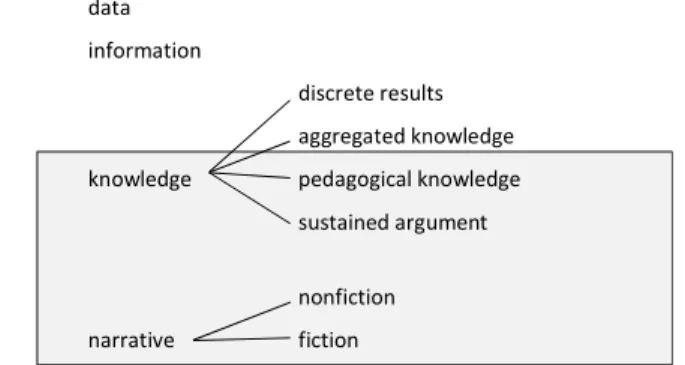
(Fig. 457): data information
discrete results aggregated knowledge knowledge pedagogical knowledge
sustained argument nonfiction
narrative fiction
According to this classification, academic publishing deals mainly with the sustained knowledge form of content that should be delivered in an appropriate format. The figure shown below (Fig. 5) is a modified version of Thompson’s figure of Forms of Content (Fig. 4) combined with his Technologies and Types of Publishing figure (Fig. 1). A new column of Formats was added. It should be mentioned that this figure does not aim to include all the types of formats
used for a particular content type at the moment (for instance, .doc, .djvu). Conversely, it
presents only those formats which are within the scope of this study and which seem to be
better able to deliver a particular content type according to the conclusions of the study. It
should be stressed that the first column deals with the formats which are used as an
56 A. Mangen, B. R., Walgermo, K. Brønnick, ‘Reading Linear Texts on Paper Versus Computer Screen’, International
Journal of Educational Research, Vol. 58 (2013), pp. 61-68.
57 J.B. Thompson, Books in the Digital Age, second edition (Polity Press, 2011), p. 327.
24
Figure 5. Forms of content and formats for their dissemination
product’ (for example, nowadays many books are made in XML, which allows the creation of
further different delivery formats, such as PDF and ePub). Another modification of the original
figure is the remapping of the borders of content types that are less amenable to online
dissemination. The content types ‘pedagogical knowledge’ and ‘sustained argument’ are still
more commonly used in their paper form while for the content type ‘narrative’ a shift to ‘e’ is
noticeable.
Formats Forms of content Types of publishing (examples)
HTML data financial, scientific data without any interpretation HTML information collections of documents, primary sources (court cases, etc.) HTML discrete results journal articles, mostly for SMT
HTML knowledge aggregated knowledge reference works, encyclopaedias, dictionaries PDF/enhanced format pedagogical knowledge textbooks
PDF sustained argument journal articles, scholarly monographs & books
*Less amenable to online dissemination
PDF/ePub nonfiction biograhies, autobiograhies, historical writing, etc. ePub narrative fiction novels, stories, etc.
The conclusions of this chapter will echo the message of another study on different
types of content based on the ontology Functional Requirements for Bibliographical Records: no
single technology or format performs well when dealing with all categories of content because
of the different requirements placed on them.58 Thus, a publisher should think carefully before
adding a new format or abandoning another, as the most popular format cannot always meet
the expectations of end-users and deliver a particular type of content in an adequate fashion.
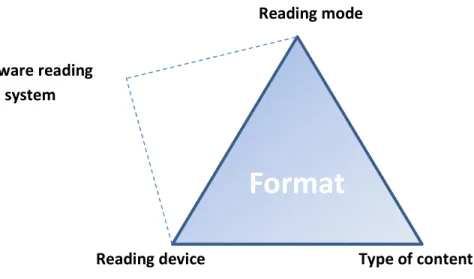
To illustrate the interdependence of formats, types of content, reading devices and
reading modes, the following model is useful (Fig. 6). This model should be read as follows: the
choice of a format is determined by the three factors - types of content, reading devices and
reading modes (in-depth or skimming reading, etc.). The advantage of this model is that it can
be applied to any of the factors. For instance, by positioning ‘reading device’ in the centre of the
triangle we can see that the choice of a reading device depends on types of content, formats
and reading modes.
58 Pettifer, S. et al, ‘Ceci n’est pas un Hamburger: Modelling and Representing the Scholarly Article’, Learned
25
Reading mode
Reading device Type of content
Two caveats should be mentioned: in this paper hardware issues (memory, processors, etc.) of reading devices are omitted due to the scope of the research. Thus, ‘reading device’ should be understood as a generic type of devices: laptops, PCs, smartphones, tablets, e-readers, etc. Secondly, although software reading systems are undoubtedly important for scholarly work (they will be discussed in the following chapter), they are quite easily interchangeable with other software reading systems, that’s why they are placed on the periphery of the given model.
Format
Figure 6. Model of an interdependence of formats, types of content, reading devices and reading modes
26
Chapter 2. EPub vs PDF: trade format vs academic format
Before discussing how ePub and PDF formats compete with each other in terms of functionality,
some general remarks about software reading systems will be made. In this work, ‘software
reading systems’ are understood as software programmes for PCs and laptops that enable users
to read e-books in different formats such as ePub, PDF, Kindle, etc. For this research, several
free software reading systems for ePub were examined (some of them support PDF files as
well). In order to delimit the scope of the study, the restriction was applied to them. There are
only a few software reading systems that are designed exclusively for a particular format (ePub3
Reader, for example); in many cases, one software reading system supports several formats
simultaneously. For instance, FB Reader supports .epub, .fb2, .chm (stands for ‘Compiled HTML’,
a Microsoft proprietary format). In this case, such a software reading system is treated as one
which is exclusively developed for the ePub format. The second restriction is that the study was
mainly limited to ePub and PDF formats as the most popular and influential; however, when
applicable, some remarks are made on Kindle, and other formats are also considered. The
results are based on the testing of at least two e-books for one format made by different
publishers.
Software reading systems for PDF are excluded from the scope of this study because of
Adobe Reader’s widespread popularity (it dates back to 1993). In case of ePub – a young format
first released in 2007 – many software reading systems are competing to win the field, and that
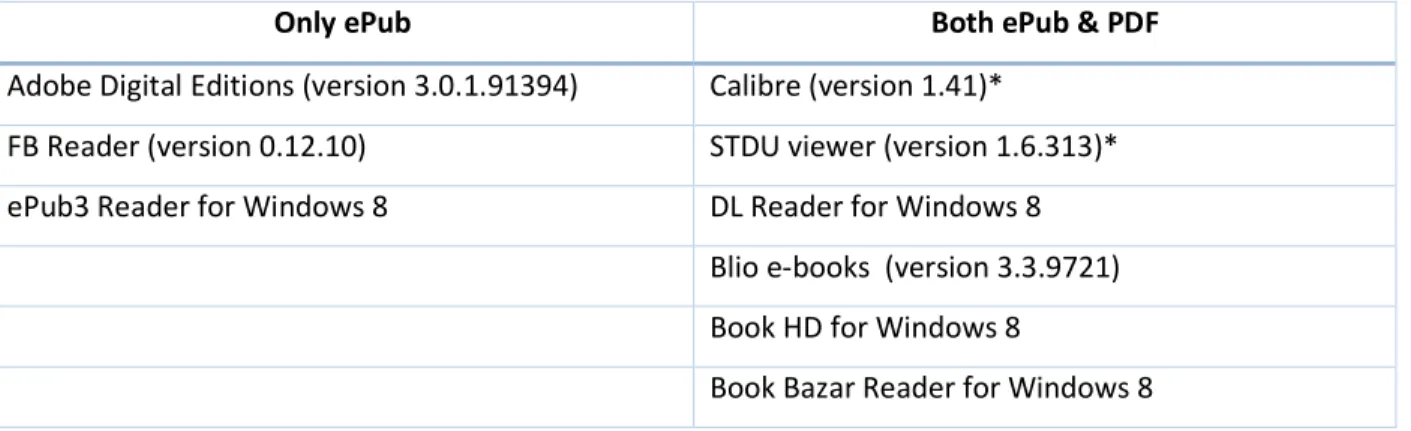
is why it was important to parse them here. The table (Table 2) below presents the software
reading systems organised according to the formats they support:
Table 2. Tested ePub and PDF software reading systems
Only ePub Both ePub & PDF
Adobe Digital Editions (version 3.0.1.91394) Calibre (version 1.41)*
FB Reader (version 0.12.10) STDU viewer (version 1.6.313)* ePub3 Reader for Windows 8 DL Reader for Windows 8
Blio e-books (version 3.3.9721) Book HD for Windows 8
27 * These are multiple format software reading systems.
Although STDU Viewer states that TIFF, PDF, DjVu, XPS, JBIG2, WWF are the most
popular formats for scientific and technical documentation,59 as far as can be seen today the
main battle will be fought between ePub and PDF, and the recent decision (first half of 2014) of
De Gruyter, Elsevier and Wiley to offer their titles in ePub (separately from PDF) in its attempt
to break into the mobile market, supports this idea. Among the reasons for making ePub the
second available format are its full-text searchability, onfile presentation (quite often a PDF
e-book is downloadable chapter by chapter but not as one file), and a possibility of audio and
video inclusion.60 Some of these features will be covered in detail later, while here it will suffice
to say that the choice of functions that are discussed in this study was made on the basis of the
conclusions drawn in different studies on device usability, users’ expectations and experience61,
as well as my own observations. Remarkably, Leiden University Library has entries about
printing, copying-pasting, annotating and sharing in the Frequently Asked Questions section on
e-books.62 Thus, this chapter will explore the pagination, search and printing, annotation and
bookmarking functionalities of software reading systems and their importance for the academic
environment.
On the other hand, some of these issues are equally important for publishers, who have
concerns about e-book paginations or search possibilities of particular formats. The overview of
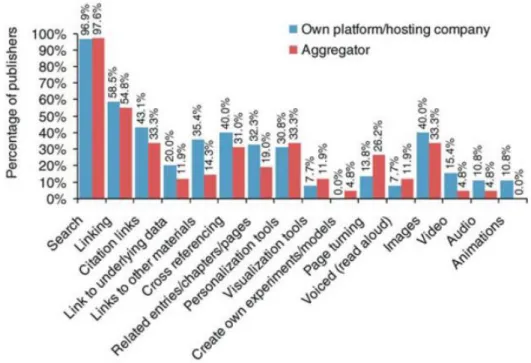
the functionality provided by or for e-book publishers in 200963 is given in the figure below (Fig.
764). Not of the least importance is an issue of typographical refinement of printed books and
the lack of these niceties in books. In addition, a newly arising development of accessible
e-books will be discussed in the closing section in this chapter.
59STDU Viewer, <http://www.stdutility.com/stduviewer.html> (Accessed 15 June 2014)
60 EPub, <http://www.degruyter.com/page/853> (Accessed 15 June 2014)
61 These studies are too numerous to list them all here; for instance, B.L. Folb et al, ‘Clinical and Academic Use of
Electronic and Print Books: The Health Sciences Library System E-book Study at the University of Pittsburgh’,
Journal of the Medical Library Association, Vol. 99(3) (July 2011), pp. 218-228.
62Leiden University Library: FAQ about E-books, n.pag. <http://www.library.leiden.edu/help/faq/faqs-over-ebook
s.html> (Accessed 15 June 2014).
63 To my knowledge, no recent updates on functionality are available at the moment.
64 J. Cox et al, Scholarly Book Publishing Practice: An ALPSP Survey of Academic Book Publishers’ Policies and
28
Figure 7. Functionality provided by or for e-book publishers
Pagination functionality
Reading an e-book from bigger screens such as those of e-readers and tablets seems to be
viable and closer in terms of comfort to reading from paper. The dedicated devices (for
instance, Kobo Reader, Nook, Sony Reader) support ePub, and it can be handy to reflow the text
for every screen size. However, the layout of the same book will appear in a different way on
every device (not only dedicated e-readers, tablets and mobiles but also in software reading
systems for PC and laptops) because ePub is based on XHTML and CSS. This disadvantage does
actually count when we deal with educational and academic books because the most important
thing is pagination. For instance, if a group of students work with the same ePub book in class, it
is very likely to be problematic for them to quickly find the same part in the book, because ePub
do not have static page numbers: if the font is adjusted, the number of pages in the book will
change. For the same reason the citation will be complicated. As David McCarthy suggests, ‘the
current optimal e-reading solution for higher education is a robust laptop home base with an
ecosystem that interacts with tablets and e-readers for mobile consumption.’65
65 D. McCarthy, ‘Mobile Perspectives: On E-books. E-Reading: The Transition in Higher Education’, EDUCAUSE
29
Until recently, PDF was the main format in which e-books were created for commercial
purposes because of its relative cheapness and publishers’ inability to operate XML.66 The great
advantage of PDF is the correspondence of e-pagination to the paper original, which makes PDF
e-books perfectly suited for academic use (if judged by this particular criterion) where citing or
referring to a particular page is essential. Adobe Digital Editions provides an opportunity to see
which page is being read in ePub too (there is a special box to present the number of pages in
the book and the page you are currently on). Furthermore, the page number is presented in a
small font to the right of the text (in order not to distract readers’ attention, as we can guess).
The page number also appears for a while when a page is turned over but disappears when you
are reading, for example in DL Reader, or can be shown as a percentage of total pages as in
Book HD (whereas PDF files display normal pagination). Only ePub3 Reader has no pagination
functionality. Despite of the availability of e-pagination in software reading systems in one form
or another, it is likely that the scholarly community, quite soon, will have to work out new rules
for reference and citation not only for ePub but for all digital products. In this regard, an
interesting solution for referencing is offered by calibre: pagination is visible (and can even be
presented as a non-integer number such as 2.2 or 5.8) but in ‘Reference Mode’, a number is
given to each paragraph: for instance ‘5.2’ means that this is the second paragraph of the fifth
chapter/section of the book. No matter how innovative this solution is, it is unclear how a
scholar would use it in one’s work. On the other hand, it looks like to be particularly useful for
e-books in ePub. However, if it is implemented in other software reading systems, pagination is
likely to be read in a different way by various software reading systems and in all probability
scholars will be forced to use the same software reading system to obtain the same pagination
results.
Search and printing functionality
One of the best-known features of ePub are its possibilities for searching within a document
(possible in PDF as well), and some software reading systems offer even more: searching
outside the document with the help of Google for instance. However, three of the software
66 L. Bennett, E-book Strategies: The Essential ALPSP Guide on How to Develop Your E-book Offer, (ALPSP, 2011), p.
30
reading systems tested – namely ePub3 Reader, DL Reader and Book HD – do not offer any
search function: taking into consideration the fact that the latter two support both formats, it
can be assumed that these are the limitations of the particular software reading systems than of
the formats themselves. On the other hand, the current search functions of ePub cannot be
considered to be superior to those of PDF because the days of making PDF files as static scanned
images are gone and PDF is produced in XML; older images need to be rekeyed in order to be
made full-text searchable.
Another very useful function of PDF files is that of printing out the document. The
culture of the academic community and the larger general reading community is still connected
to the printed ‘object’; even when a book is delivered electronically, many prefer to print out
the document for in-depth, thorough reading, and the print function is evaluated as (very)
important in scholarly work.67 Besides all, the PDF format contributes to our notion of a real
‘book’ because its layout resembles paper books so much. EPub books as a new medium, quite
oppositely, may be felt to be alien, though this feeling is unlikely to be shared by following
generations of digital natives, for they will not be subjected to paper reading to the same extent
as previous generations used to be.
The print function, so natural for PDF files (as is PDF’s ability to print out the file with
your comments either in the same position as you entered them or as a list or summary68), is for
some reason not always present in ePub software reading systems (among those that were
tested, it was only present in Adobe Digital Editions, calibre, , and STDU viewer; the latter two
support many formats beside ePub and PDF; Kindle for PC does not allow printing either). This
seems to suggest that ePub, perhaps not intentionally, has itself cut off from a large group of
academic users. It is important to note that dedicated e-readers do not allow printing either.
Printing from tablets is technically possible but this function can be missing from the particular
reading software system installed on it. Even if this is the case, printing is still possible but takes
more time and persistence – it can usually be done via copy & paste or by making screenshots.
67 S. Schomisch et al, ‘Are E-readers Suitable Tools for Scholarly Work? Results from a User Test’, Online Information
Review, Vol. 37(3) (2013), p. 399.
31
Annotation and bookmarking functionality
As Todd Carpenter puts it,
Readers and researchers were annotating texts long before the invention of the printing
press. While annotating texts has been relatively easy for centuries thanks to the
margins of paper texts, annotating digital items remains difficult.69
PDF is usually available via Adobe Reader, which in most cases is already installed on one’s PC or
laptop and does not require additional software installation to deal with e-books as ePub does.
It can be used for all PDF files and not just for e-books using PDF: the two are in fact the same. It
offers annotation functions, such as highlighting, strikethrough (for Adobe Reader XI), note
making and even copying and pasting into .doc or other documents70: it does not allow for
bookmarking.
Annotation possibilities for software reading systems for ePub are very limited: for
instance, DL Reader and Book HD offer only bookmarking but no highlighting, strikethrough or
note taking, nor printing or copying. As for mobile applications, Aldiko for instance provides
highlighting and note taking for ePub (but not for PDF – while it supports both formats) only for
its premium customers. However, ePub3 is going to offer to academic publishers ‘improved
viewing of footnotes, citation, and references – click on or hover over a reference and the
reference pops up instead of taking you away from the page to the location of the reference.’71
No less surprising is the absence of the copy-paste function in some software reading
systems (for example in the cases of Book HD, FB Reader, DL Reader, and in Kindle for PC too).
As the two software reading systems mentioned above support both formats, it can be assumed
that ePub could be the reason why this function has not been implemented in them. If so, this is
69 T.A. Carpenter, ‘iAnnotate - Whatever Happened to the Web as an Annotation System?’, The Scholarly Kitchen,
April 30, 2013, n.pag. < http://scholarlykitchen.sspnet.org/2013/04/30/iannotate-whatever-happened-to-the-web-as-an-annotation-system/> (Accessed 6 April 2014).
70 Adobe Reader, version XI and X, was used.
71 Elsevier EmbracesEPUB3 Format, Ensuring More Enriched and Interactive e-book Experience for Readers, April