HOW EFFECTIVE WERE TRANSITIONAL JUSTICE MEASURES IN POST-AUTHORITARIAN IBERIA?
Breanna F. Kerr
A thesis submitted to the faculty at the University of North Carolina at Chapel Hill in partial fulfillment of the requirements for the degree of Master of Arts in the TransAtlantic Master’s
Program in the Political Science Department.
Chapel Hill 2020
ABSTRACT
Breanna Kerr: How Effective were Transitional Justice Measures in Post-Authoritarian Iberia? (Under the direction of Milada A. Vachudova and Claudia Matthes)
The October 2019 exhumation of the mortal remains of the former Spanish dictator Francisco Franco had political repercussions that are still being felt across the Iberian Peninsula today. One of the main conflicts that this exhumation raised was the tension between
remembering the authoritarian past and burying it for the sake of consensual politics. This thesis takes the Valley of the Fallen case and applies several theories of democratization in order to report findings on the state of Iberian democracy as a whole. My research then looks to Portugal to contrast the modes of transition to democracy and resulting transitional justice practices, which I argue led to a quicker and stronger consolidation of democracy in Portugal than in Spain. The varying democratization practices and the resurgence of an authoritarian past in both
ACKNOWLEDGEMENTS
I would not have been able to write this thesis had it not been for Milada A. Vachudova’s fall 2018 course Political Transitions and Democratization in Comparative Perspective. This course opened my eyes to the theories of democratization behind what I had observed for two years living in Spain. At the end of the course, I wrote my term paper on the controversial
memorial I used to see on train rides through the Sierra de Guadarrama: The Valley of the Fallen. This paper served as the jumping off point for what would become my Master’s thesis. I would like to thank Milada for being a wonderful professor, mentor, and thesis advisor. I could not have done this without your advice and support.
I would also like to thank the TAM Class of 2020 for their transatlantic friendship, as well as my friends in the EuroMasters program and the German Turkish Master’s program for
TABLE OF CONTENTS
LIST OF FIGURES……….. vi
LIST OF ABBREVIATIONS……….. vii
CHAPTER 1: LAYING THE THEORETICAL FOUNDATIONS……….. 8
Introduction……….... 8
Authoritarian Legacies, Politics of the Past and Transitional Justice………... 12
CHAPTER 2: SPAIN: A PACTED TRANSITION OR WILLFUL AMNESIA?………... 22
Introduction………... 22
Transition to Democracy………... 22
Eruptions/Irruptions of Memory………... 26
The Valley of the Fallen………... 29
Analysis of Political Discourse……… 32
CHAPTER 3: THE REVOLUTIONARY ROAD TO CONSOLIDATED DEMOCRACY IN PORTUGAL……… 38
The Carnation Revolution……… 39
Legal and ‘Wildcat’ Purges……….. 40
The Case of the Museu Salazar……… 44
Legislative Discourse Analysis……… 48
CHAPTER 4: THE QUALITY OF IBERIAN DEMOCRACY………... 51
LIST OF FIGURES
Figure 1 – Attitudes towards the Franco Regime ……… 23
Figure 2 – January 2020 Party Representation in Congress ……… 33
Figure 3 – Spaniards Opinion’s on the Exhumation ………...………. 36
Figure 4 – Number of individuals removed or suspended from public office, whether it be
LIST OF ABBREVIATIONS
BE Bloco de Esquerda (Left Bloc)
CDS Centro Democrâtico e Social Partido Popular (People’s Party) ERC Esquerra Republicana de Catalunya (Republican Left of Cataluyna) MFA Movimento das Forças Armadas (Movement of the Armed Forces) PEV Partido Ecologista ‘Os Verdes’ (Green Party)
PP Partido Popular (Popular Party)
PSD Partido Social Demócrata (Social Democratic Party) PS Partido Socialista (Socialist Party)
PSOE Partido Socialista Obrero Español (Spanish Socialist Workers Party) PREC Processo Revolucionário em Curso (Ongoing Revolutionary Process) TJ Transitional Justice
8
CHAPTER 1: LAYING THE THEORETICAL FOUNDATIONS
Introduction
The exhumation of Francisco Franco on October 24th, 2019 brought to light a number of issues in Spanish democracy that had been set aside when Franco was buried in El Valle de los Caídos (The Valley of the Fallen) over four decades ago. It has polarized a country that already
struggles with cleavages that divide north from south, east from west and particularly the old from the young. It began when Prime Minister Pedro Sánchez of the Partido Socialista Obrero Español (PSOE) declared that exhuming Franco would be part of his government’s mandate in
June 2018. This decision was made when Sánchez took power as a continuation of the legacy of former Prime Minister José Luis Rodriguez Zapatero, who broke the “pact of silence” about Spain’s past once and for all in 2004 when he demanded justice for the victims of Francoism in
legislative terms as well as in terms of public debate. Therefore, exhuming Franco became the last step in “closing wounds from the past” (El País 2018). The process of exhumation itself was
caught in various legal battles with the Franco family and the Francisco Franco Foundation until the country’s Supreme Tribunal finally gave the green light in September of 2019.
Why is it important to consider the political repercussions of this exhumation? The fact that Spanish politics in 2020 are still centered around a man who took power in 1936 suggests that the country has come up short in dealing with his legacy, and perhaps also in fully
marble tomb, but it has also unearthed a number of judicial and societal arguments that reveal multiple cleavages still present in Spain. There are aspects of Franco’s legacy that have not been worked through because, instead of doing so, transition era politicians simply chose a “pact of forgetting” model, prioritizing the creation of the new government.
One example of a societal cleavage that developed into a state crisis recently was the referendum for independence in Cataluña in 2017. Another challenge for the country is the rise of the far-right populist party VOX, which has continued to win more and more popular support since breaking into the Andalusian parliament in December 2018 (El País 2018). VOX is the first far-right party to be represented in the national parliament since the Franco era: I argue that harmful nationalist ideologies have been festering in Spanish society due to absence of
discussion about and reckoning with the past. These have manifested themselves in support for the VOX party at the polls. The connection between Franco’s legacy and the quality of Spain’s democracy therefore can be seen through 20th century political beliefs gaining support on the fringes of the political spectrum, which I argue harm consolidated democracies.
The example of the Valley requires an analysis of the politics of the past not only in Spain, but in all of Southern Europe. The first country to spark the “Third Wave” of democracy
social and political purges in the years directly following the revolution. These purges resulted in many powerful removals as well as a complete overhaul in the political system. This
revolutionary atmosphere did not exist in Spain. I argue in this thesis that the implementation of transitional justice measures early on in Portugal eventually created a stronger liberal democracy.
I use the Portuguese case to show how transitional justice can lead more rapidly to a fully consolidated democracy where the legacy of authoritarian rule no longer shapes society as strongly as we see in Spain. How are they different? For one, there are no large monuments or polemic burial sites to examine in Portugal because most of them were banned or destroyed after the fall of Salazar. Salazar’s small, modest grave is relatively inconspicuous and very far from the seat of power in the capital of Lisbon. While there have been proposals to create a prominent museum about Salazar, it is unlikely ever to be built. Why has Portugal drawn a line under their post-World War II dictatorship while Spain is experiencing renewed contestation and discord about how to remember and memorialize its brutal dictatorship of the same era?
I argue in this thesis that the quality of Iberian democracy is shaped today by the quality of the Transitional Justice (TJ) that took place at the time of transition. This is because the type of TJ mechanisms used — whether it be legal purges, exiles, truth committees, victim
compensation or reburials — was a direct effect of the nature of regime change and the respective institutions that were built in the early years of democracy. The process of regime change in Spain and Portugal was very different: In Spain, after Franco’s death, the transition to democracy was “elite pacted” and lacked a popular movement. The elites chose to focus on
celebrations marked a complete rupture with the past. A revolutionary spirit widespread among Portuguese citizens led to a grassroots movement demanding that the perpetrators of the crimes of the authoritarian regime be brought to justice.
My research question is therefore twofold: How has the implementation of Transitional Justice measures affected the quality of democracy in Portugal from the Carnation Revolution to today? And in Spain, how has the lack of TJ measures affected its quality of democracy from the death of Francisco Franco to today? The first years of transition were characterized by large-scale purges of former secret police members and demands for the resignations of elites connected to the Salazar regime from positions across the public and private spheres of Portuguese society. Thanks to an early implementation of TJ measures in Portugal, this open dialogue has made the past largely irrelevant in politics today. But in Spain, the pact of silence regarding the wounds from the Civil War and from the Franco dictatorship has forced these issues to reappear in public discourse through various ‘irruptions’ decades later (Wilde 1999).
The rest of this thesis is divided into four chapters. In the following section, I present the theories of authoritarian legacies, transitional justice, and the politics of the past in a review of the current literature on the topic. Then I zoom in on Transitional Justice and explain the methods of how it can be done, through which institutional bodies, and why it is so crucial for democratic consolidation. This section lays the foundational base for my argument linking the implementation of TJ measures — or not doing so — with the quality of democracy today in Spain and Portugal. The purpose of this literature review is therefore to explore the existing theory before delving into the country cases and resulting analyses of political discourse.
resurfaced today. Then, I outline how both countries transitioned from authoritarian to democratic rule. I focus on the Valley of the Fallen as an example of historical memory that ‘irrupted’ into political discourse due to a lack of effort to work through past divides. Then I examine politicians’ reactions to the idea of the Museu Salazar and/or Centro Interpretativo do
Estado Novo in an attempt to make a comparison between authoritarian legacies in Spain and
Portugal. In Chapter 4, I analyze the political discourse surrounding both of the monuments corresponding to the Transitional Justice framework and respective measures that were implemented. I conclude by examining how these discussions affect the Iberian idea of ‘democracy’ and how this concept plays out in today’s society. Finally, I explain why the TJ
measures which were implemented in the mid 1970s in Portugal prevented a resurgence in the types of nationalist and far-right politics that can be observed in Spain today, and I make a statement on what that means for the quality of Iberian democracy.
Authoritarian Legacies, Politics of the Past and Transitional Justice Theories This section sketches the existing literature on the Southern European wave of
democratization with a focus on the parallels in the Southern Cone. I focus on the Spanish and Portuguese cases in order to set up the following chapters in which I compare the political discourse surrounding the Valley of the Fallen to the Salazar Museum. I also introduce António Costa Pinto’s theoretical framework, which I use to help us understand how the legacy of
authoritarians can shape domestic politics years later (Pinto and Morlino 2017). I draw on these theories of authoritarian legacies, politics of the past and Transitional Justice in order to explain the many ways in which the legacies of an authoritarian regime can affect democratic society.
about the ways which work well and the ways that do not work very well? Second, how can the legacy of authoritarian rule shape domestic politics even decades later? What do scholars tell us about this? The first set of questions is necessary to understand the theoretical basis upon which I explore the ties between authoritarian legacies and its effects on the quality of democracy. The second set of questions will help the reader to understand how current national crises such as the Valley of the Fallen or the rise of the far-right VOX party are related to the absence of a national reckoning with the country’s divisive past after the fall of Franco.
The process of democratization in the Southern European countries started on April 25th 1974 with the Carnation Revolution in Portugal. This famously non-violent revolution triggered the Third Wave of democratization which today is generally considered to include the countries who turned away from authoritarian regimes in the 1970s across Southern Europe and in Latin America. These countries include Spain, Portugal, Greece, Italy, Brazil, Chile, Argentina and Uruguay. Many of these countries’ transitions to democracy were not fully consolidated until the 1980s, which is when a formal study of this Third Wave began.
Before moving on, it is pertinent to provide a definition of a fully “consolidated
democracy.” Many scholars have debated just what are the criteria for a consolidated democracy — and many others have wondered whether this term is a useful or failsafe measure at all (Linz
and Stepan 1996). For the sake of this paper, I use Juan Linz and Alfred Stepan’s definition of consolidated democracy presented in their most important work, Problems of Democratic Transition and Consolidation: Southern Europe, South America, and Post-Communist Europe
reinforcing arenas: a free civil society, an autonomous political society, the rule of law, a bureaucracy, and an economic society in which institutions and regulations mediate the relationship between the market and the state.
Since then, an entire field has emerged that is focused on the democratization of Third Wave countries. This movement can also go so far as to include the Eastern European countries that democratized after the Iron Curtain fell in 1989. These countries are outside of the scope of this thesis, however, and I do not evaluate the Eastern European democratization process further. Many researchers in the democratization field tie Latin America to Southern Europe, however, because of the shared experiences with military dictatorships. For example, comparisons have been made by Omar G. Encarnación between Augusto Pinochet in Chile and Francisco Franco in Spain, arguing that Pinochet’s trial in the early 2000s forced Spaniards to confront their
authoritarian past as well. This shared transatlantic history presented by Morlino and Pinto are useful to understand the variety of authoritarians that ruled for the majority of the 20th century. In addition, their findings are helpful in that they address TJ efforts and their effects across Southern Europe and the Southern Cone.
Before delving deeper into the post-authoritarian theories, it is important to give an overview of what we know about how to deal with authoritarian rule and transitions to democracy. By assessing which ways work well and which do not, I lay the theoretical
foundations for the argument in later sections in an attempt to directly tie authoritarian legacies to the quality of democracy. In Philippe C. Schmitter and Terry Lynn Karl’s 2002 article
“Concepts, Assumptions & Hypothesis about Democratization: Reflections on ‘Stretching’ from South to East,” the authors address the broad question of what happens when an authoritarian
these paradigm shifts observed in Eastern Europe and routinely compared to Southern Europe or the Southern Cone are not necessarily always transitioning ‘to democracy,’ but rather, transitions ‘from autocracy’ (Schmitter and Karl 2002: 9). Essentially, there is no normative catch-all set of
structures that explain transitions from authoritarian rule.
There are however, structural conditions that help explain enduring or “high quality”
democracies. These conditions include the process of liberalization, the formation or resurrection of a civil society, and the convocation of fair elections with an uncertain result (Schmitter and Karl 2002). The existence of this conditional framework supports my argument tying legacies to the quality of democracy because we can point to a set of conditions that were either established or tampered with by the regime change makers. In light of an absence of these conditions, a weakly consolidated democracy with the potential for future issues could result. I argue that the role that the elites played in the Spanish transition to democracy and the preservation of Franco-era institutions as part of the democratic state has led to a weak state. This in turn has contributed to the rise of the far-right in recent years and nationalist challenges like the Catalan vote for independence in August 2018 – as I explain below.
Now that the transitology aspects have been addressed and presented in order to support the framing of my argument, I move on to theories of what causes variation in how polities function after regime change. I argue that the most important variation leading to long-term effects in the quality of democracy is the implementation of Transitional Justice (TJ) measures, although I briefly address the other two theories as well. The edited volume Dealing with the Legacy of Authoritarianism: The ‘Politics of the Past’ in Southern European Democracies by
memorialization studies (Pinto and Morlino 2017). This volume’s scope once again spans from Southern Europe to the Southern Cone.
The theories that I pull out from this volume with the support of various authors are the following: authoritarian legacies, politics of the past and transitional justice. Though I choose to apply the lens of Transitional Justice (TJ) in this thesis, it is important to explain and understand the other two as well since they are interrelated in essence and cannot exist without one another. The findings presented in this volume support my argument tying authoritarian legacies to the quality of modern democracies in Southern Europe today. Additionally, through the exploration of different case studies I can examine and compare which ways of dealing with the authoritarian past work better than others and why.
I turn first to the power of authoritarian legacies. Authoritarian legacies encompass all behavioral patterns, rules, relationships, social and political situations, and also norms,
procedures and institutions, either introduced or strengthened by the immediately preceding authoritarian regime (Hite and Morlino 2004). They may take the form of latent repressive memories activated and manipulated by social and political actors at particular moments and they may be supported by specific actors, interests or identities. There are two fundamental types of legacies: those that concern the values, institutions, and behaviors introduced by the
authoritarian regime and those that reinforce, strengthen, or entrench previous values and existing institutions by establishing new ones that create or reproduce these subsequent behavioral habits.
means that legacies can permeate post-authoritarian society in both positive and negative manners, and it can therefore be observed that Iberians have more positive attitudes about the authoritarian past than their counterparts in Germany, for example. This finding is relevant because it shows how a presence of tolerance or nostalgia for the past can shape public opinion and perhaps even domestic politics years later.
The second theory is called politics of the past. Politics of the past is defined in Pinto and Morlino’s edited volume as “an ongoing process in which elites and society under democratic
rule revise the meaning of the past in terms of what they hope to achieve in the present” through a set of different actions (Morlino 168). It is important to recognize that this process mostly happens on an elite level. Alexandra Barahona de Brito and Maria Sznajder argue that politics of the past consist of policies of truth and justice in transition which are expressed through official or public memory. The politics of memory also raise several problems, though. The puzzle therefore becomes: to forget or to revive the past? To hide or to unveil the memory of
authoritarianism and/or resistance? To face or to avoid the authoritarian past? Is it possible to choose between confronting the past or forgetting? I seek to find some answers to these problems in the final chapter of this thesis.
However, even after the consolidation of democracy, “the old cleavages of transition do not disappear like a miracle, they can reappear at specific junctures” (Pinto 2017: 29).
Immediately, the Spanish case comes to mind where some scholars argue that the
overwhelmingly two-party system is simply a continuation of the authoritarian regime’s politics. In an interview at the University of Lisbon on January 25th 2020, Costa called these reappearing cleavages in Iberia ‘irruptions of memory.’ I explain this term, coined by Alexander Wilde, at the
The third theoretical basis I examine is Transitional Justice (TJ). TJ is introduced as encapsulating “a whole series of measures taken during the democratization process that go
beyond the mere criminalization of the authoritarian elite and its collaborators and repressive agents, which also involve a wide range of extra-judicial efforts to eradicate the legacy of previous repressive rule, such as official historical investigations of the authoritarian record, purges, reparations, dissolutions of institutions, truth commissions, and other measures taken during a process of transition to democracy” (Cesarini 2009: 498-499). Transitional Justice is at
the same time a consequence and a part of a process of regime change, and as some scholars note, it can be a sort of ‘jumping off point’ required of the broader politics of the past process that is inherent to the consolidation of liberal democracies. Barahona de Brito defines TJ as “an
umbrella term that covers a range of disparate practices (truth commissions, trials, compensation policies, amnesties, purges) to address a violent past in a period of regime transition and to establish a moral and political break with a repressive non-democratic past” (Barahona de Brito 1997). This is the definition I use from here on out when I refer to TJ practices.
Now it is pertinent to mention the TJ measures and various residual legacies instituted in Spain and Portugal after the transition from autocracy. There are many domestic and
relationship with the past democracy propagated the Franco-era myth that Iberians were ‘unfit’ for it and perhaps similar attitudes exist today (Encarnación 2013). In Portugal, the long dictatorship is the only observable historical legacy, in which Salazar also utilized this myth of unfitness for democratic rule.
Other factors that shape TJ are authoritarian legacies, broader historical legacies, and regional and international conditions (Barahona de Brito 2017: 67). In the following sections, I go into further detail on the historical legacies and international conditions — such as accession to the European Union and colonial legacy — that influenced the type of transition in both Spain and Portugal. In fact, I argue that the legacy of the colonial wars in Africa in the 1970s plays a greater role in political discourse today in Portugal than the legacies of the Estado Novo. These domestic and international factors, as well as the human rights movement of the late 1970s, show us how the legacy of authoritarians can shape politics years later in unthinkable ways at the time.
I focus on Transitional Justice as my main theoretical framework because it is the most concrete and quantifiable. TJ theory lays out specific measures that are easy to analyze across the Iberian Peninsula that are designed to show the effects leading to — or not leading to — a
consolidated democracy. Some of these measures include, but are not limited to: truth
commissions, historical memory making, memorials, recognition, judicial trials and eventually, forgiveness. Obviously, some things such as ‘forgiveness’ are not easily measured. However, the
One cannot mention Transitional Justice without referencing ‘irruptions’ of memory, a concept presented by Alexander Wilde in 1999. He said that TJ is a first step in what becomes a series of endless memory cycles interrupted by ‘irruptions.’ This unconventional spelling of
eruption closely matches the Spanish irrumpir which means to break or burst in, and conveys a sense of sudden intrusion. Exhuming Franco’s remains from the Valley of the Fallen became an ‘irruption’ in Spanish politics in the past decade, for example. This term was first introduced in Wilde’s work on the transition to democracy in post-Pinochet Chile. He elaborates: “Irruptions
of memory are part of a counterpoint of what might be called the expressive dimension of transitional politics, conditioning its character as they interrupt the flow of normal bargaining over budgets and public policies” (Wilde 1999). For example, the trial of Pinochet summoned the country’s divided historical memory surrounding the dictatorship, an effect that reverberated
across the Atlantic to Spain as well.
Before continuing with the closing of this chapter, I offer a roadmap of the analytical approaches that I take in the chapters to follow. I apply the framework of Barahona de Brito’s TJ measures in the Spanish and Portuguese chapters in order to compare both countries’ processes towards consolidated democracy. I zoom in on the Valley of the Fallen and the Museu Salazar as specific ‘irruptions’ of historical memory that exemplify the cracks in the implementation of TJ
measures to various extents in the respective cases. Then, I also perform an analysis on political speeches and quotes from newspaper articles surrounding both monuments to glean what importance these controversies have on modern democracy and how the legacy of these
president José Luís Rodriguez Zapatero. I use sources such as El País, La Sexta, and Twitter. In the Portuguese case, I entirely perform a legislative analysis on Portuguese Parliament’s “Voto de Condenação no. 876/XIII-4a” presented on September 10th, 2019. The main difference here is
CHAPTER 2: SPAIN: A PACTED TRANSITION OR WILLFUL AMNESIA?
Introduction
In this chapter setting out the Spanish case, I begin with a brief history of the Franco regime. I also sketch the transition to democracy, sparked by Franco’s death on November 20th, 1975. I describe the various transitional justice measures that were or were not introduced in this period. Next, I address the Valley of the Fallen and describe what this monument is and why it is important in contemporary Spain. Finally, I address Franco’s exhumation in September 2019,
analyzing the political discourse surrounding the exhumation and explaining what this political controversy means in the context of modern Spain. I perform the political discourse analysis described above in order to gain a greater understanding on the effects TJ measures had in Spain. Transition to Democracy
The ideas of democracy and democratic institutions were beginning to grow more favorable, with a 76 percent approval rate among the population surveyed in 1976 (Aguilar Fernández and Humlebaek 2002). In the midst of these pressures, coupled with persistent terrorist violence from the Basque separatist group ETA, Franco named King Juan Carlos his successor in 1969. This hesitant appointment eventually led to King Juan Carlos becoming head of state in 1975. And finally, international forces such as pressures from the European Community with vested economic interest also come into play here. We know from the work of many historians and social scientists that the transition to democracy was not sparked by protests, but by decisions by elite actors in the regime and in its immediate aftermath.
Figure 1: Attitudes towards the Franco regime. Source: Aguilar Fernández & Humlebaek (2002)
Let us now review the chronology of the Spanish transition to democracy as briefly and succinctly as possible. On July 22nd, 1969 Juan Carlos was named successor to Franco. Franco died on November 20th, 1975 and Juan Carlos was sworn in as King of Spain two days later. The King gave Adolfo Suarez, a former Falangist, the task of initiating reforms. One of the most important first steps was to legalize the Spanish Communist Party, otherwise known as the opposition. Suarez’s government (from July 1976 to 1981) was responsible for carrying out the
Democratic Center) received 34.8% of the votes in the first free Spanish elections (1977); Felipe Gonzalez of PSOE received (29.4%) the second largest number of votes; the Communists got 9% of the vote and the AP (Popular Alliance) received only 8% of the vote. The new bicameral legislature voted for a new constitution in October of 1978 (Aguilar Fernández and Humlebaek 2002: 132).
Circling back to the spirit of democratic transition, one can observe a willing ignorance through the unwritten ‘pact of forgetting’ (pacto de olvido) which dominated the post-Franco political mood. The process that took place during the transition years was based on the pre-existing institutions leftover from the regime, including many Falangist elites who were simply reshuffled into new positions. There was no recourse to revolutionary matters, no major political dismissals from office, and no attempts to bring secret police agents who had perpetrated
violence, torture and murder at the behest of the Franco regime to justice (Medina 1995).
was characterized by a respect for the authoritarian system in terms of political structure, institutional frameworks and the judicial framework (Humlebaek 2011: 74).
Franco succeeded in leaving many enduring legacies that still shape the Spain’s polity and society, but one that stands out is how it shaped early democratic politicians. Many of the decision makers in the transition period (which we will consider for the sake of this thesis being from 1975 to 1982 at the dawn of the first exchange of power) were old enough to remember the rancor that the Civil War brought up, and so they institutionalized a ‘never again’ policy. Franco then proceeded to use the Civil War as a tool for legitimacy during his regime by propagating the myth that Spaniards were unfit for democracy and therefore needed an authoritarian ruler. A similar attitude can be observed in the Portuguese case: “If [democratic rebirth] fails, and a
military dictatorship moves in once again, it will lend credence to the almost racist, but among many Portuguese and Spaniards alike widely held idea that Iberians are inherently incapable of democracy” (Harvey 1978: 8). Both Franco and Salazar, who were not close friends but simply
geographical allies, cultivated an ‘unfit for democracy’ discourse that made democratic
consolidation a fraught affair (Humbelaek 2011: 74). This narrative worked to the advantage of both dictators during their rule and even afterwards in their legacies.
Though this unspoken pact was originally informal, it was eventually translated into three legal initiatives concerning amnesty for political crimes, the most important being the Amnesty Law of 1977. This law, passed nearly unanimously by the newly democratically elected
parliament, most importantly gave amnesty to political prisoners and Basque and Catalan
nationalists who had suffered oppression during the regime. But just as importantly, the law gave perpetrators of the dictatorship’s crimes amnesty against persecution (Aguilar Fernández 1997).
Therefore, it effectively ended the idea of having any Transitional Justice measures implemented in post-Franco Spain before the process even began.
Politics of the past would still continue to play an important role in democratic
consolidation, though. Many Spanish politicians of the time negotiated with the spirit of reaching consensual democracy above all else. This is why the first democratic elections of 1977 were so important: their success legitimized the new democracy and disproved the Francoist myth of ‘an unfit Iberian character’ once and for all. Moreover, the Constitution of 1978 was passed in
December with near unanimous approval by Spanish voters, giving an extra boost of legitimacy to the nascent democracy. Despite the general support for democratic consolidation, Humbelaek called this Constitution “a precise embodiment of the informal agreement not to instrumentalize the past for political gain.” And as the theories I presented expect, when the past is not
appropriately dealt with in a society, there are inevitably going to be irruptions of memory that put it back on the political agenda. This leads me to my next section, in which I resume the timeline of democratic transition in the 1980s by focusing on the positions of the two main political parties in relation to the agreement not to deal with the past.
At the dawn of Spanish democracy, a new political structure and a set of institutions had to be rebuilt. The left-wing political parties emerged from the shadows after years of clandestine activity under Franco. These parties included PSOE, PCE (Partido Comunista de España) as well as Basque and Catalan nationalist parties. The right-wing parties had to reinvent themselves as anti-dictatorship, despite the fact that many elites from the party had trickled down from the Falangist party. The more conservative, traditional PP party was formed out of the Popular Alliance (Alianza Popular) and the Democratic Center Union party (Unión de Centro Democrático) (Hanley 2006). Although the left and the right represented radically different
attitudes towards the past, they each had certain things to gain from agreeing to an Amnesty Law and to a general pact of silence/forgetting. “The right obtained legal amnesty in exchange for
relinquishing their monopoly on power, while the left gained longed-for democratic rights in exchange for extending the amnesty to include infringements committed by Francoists during the dictatorship” (Humlebaek 2011: 78).
However, starting in 1979 an explosive growth in the number of legislative initiatives relating to the authoritarian past were passed. Among these legal initiatives that sought
reparations for the regime’s victims were pensions for the widows of Republican soldiers. On the
local level, municipalities began to exhume Civil War era mass graves in order to give the
remains proper reburials. The first case of its kind took place in Torremejía, Extremadura and the funeral service was attended by nearly 1000 people in the village. This ceremony marked a paradigm shift in Spanish society known as the first stage in the “recuperation of historical memory” (Humlebaek 2011: 80). Although this shift did not receive much media attention nor
These ‘openings’ towards dealing with the past were rejected in the attempted military
coup led by Civil Guard lieutenant Antonio Tejero on February 23rd, 1981 (Humlebaek 2011: 80). Not only was the public exposed to a reactivation of fear of military repression, but the social movement that was well underway which sought to recuperate historical memory was interrupted. All in all, the failed putsch of 1981 marked a doubling down on the agreement to forget because politicians on both sides of the aisle saw what military intervention in politics could do and were afraid of the past repeating (Humlebaek 2011). In the end, the 1980s saw the least amount of legislation passed regarding the authoritarian past despite the center left’s grip on power.
PSOE did not instrumentalize the past for political gain until its power was threatened in the 1993 elections. In this case, PSOE felt threatened by PP, so they argued that PP’s Francoist past would be harmful to democracy if they were to take power. This marked the first time that the pact of silence was broken and utilized to win an election (which they eventually did). The year 2000 initiated the second wave of legislation focused on the authoritarian past. In November 2002, the PP and all other political parties signed a common declaration condemning the war and the dictatorship. Then, in 2004, a series of reparation laws and measures were enacted under President José Luís Rodríguez Zapatero. Zapatero was the first head of government belonging to the ‘generation of the grandchildren’ — or the generation who lived neither during the war nor
during the dictatorship, and were therefore never socialized by either experience (Humlebaek 2011: 84). He did, however, come from a family that suffered losses in the civil war.
Civil War and the Franco dictatorship. Moreover, it principally recognizes the victims on both sides of the civil war, gives rights to the victims and the descendants of victims of the Civil War and the subsequent dictatorship of Franco, and formally condemns the Franco Regime” (Ley 52/2007 de 26 de Diciembre). Francoist symbols were removed from public buildings and spaces
and, of central importance my analysis in this thesis, political events were banned from taking place at the Valley of the Fallen (Boletín Oficial del Estado 2007).
In essence, it wasn’t until the implementation of this law that the Spanish state began to
formally introduce Transitional Justice measures, over 30 years after the death of the regime’s leader. This piece of legislation and the political sentiment that surrounds it on both sides of the aisle is crucial to understanding what came next in Spanish society. This is particularly true in the case of the Valley of the Fallen. Zapatero’s government set the foundational stage for the
PSOE government of Pedro Sánchez today through making demands for Transitional Justice part of the party’s agenda. These goals were concretized in the Historical Memory Law, so when the
Sánchez government took power in June 2017, he picked up where Zapatero left off. This
continuation of the narrative that socialist governments would demand for justice at the Valley of the Fallen eventually led to the exhumation of Franco’s mortal remains in October 2019.
This section on the transition period in Spain has led to what I argue is the greatest irruption of historical memory in contemporary Spanish society: the controversy of the Valley of the Fallen and the eventual exhumation of the mortal remains of Franco. In the following section, I briefly review the history of the Valley. Then, I analyze the political discourse that surrounded the monument from its inception in the 1950s until Franco’s exhumation in October 2019. I conclude by considering how it has shaped on the quality of Spanish democracy.
The Valley of the Fallen sits in the Cuelgamuros Valley, in the Sierra Guadarrama some 54 kilometers to the northwest of Madrid. The most prominent piece of the monument, which was built over twenty years and officially opened to the public in 1959, is an enormous cross which towers 300 feet over the basilica below. The cross is the first thing that visitors see upon their arrival, beginning their ascent to the basilica that holds Franco’s remains. Due to its unique
setting in the mountains, this gargantuan cross can be seen from many miles away. This was a very deliberate act that was typical of Franco’s conservatism at the time when he commissioned the construction of this monument.
“This was a towering monument to Franco’s sense of his place in history. Not only did Franco doubtless hope that this vast temple to himself would compensate for his physical and sexual shortcomings and gain him immortality, but it remained a looming and
permanent reminder to the Republicans that they had been defeated and destroyed by nothing short of a demigod” (Stockey 2013: 48).
Visitors to the Valley can ascend to the top on foot through a steep mountain climb along a path which is dotted with many symbolic images and crosses that were meant as a reminder of the religious nature of the site. The visitor is therefore essentially forced onto a pilgrimage to the top, and through this physical exertion, the visitor who walks along this path not only recalls the suffering of Jesus, but also offers a penance to mark Christ’s sacrifice on their behalf (Stockey
2013: 45). This is the first implicit connection of Catholicism to the regime which erected the monument and the way in which Franco had imagined visitors should arrive to the Valley.
represent the Christian Ten Commandments). The coat of arms is the traditional insignia of Spanish fascism is the most outward example of political symbolism, and was not removed or altered even after the Spanish transition to democracy in 1975.
In order to understand the controversies that have followed, it is indispensable to know who built the monument in the Valley and who is buried there. The Franco regime used forced labor from the defeated Republican forces of the Spanish Civil War over a period of almost twenty years. This forced labor was part of Franco’s campaign to completely stamp out and punish the enemy. This victors vs. vanquished metaphor was crucial to understanding the cultural universe in which the Valley was built. It is in this context in which Silent Sam in
Chapel Hill and the Valley of the Fallen differ greatly. Most of the monuments to the war dead in Spain were erected immediately after the war under the direction of the regime or local political elites, but also at the behest of local groups and individuals (Stockey 2013: 31).
These monuments were also deliberately used to divide society and remind the vanquished who was in charge. If they were not doing forced labor on the Valley, the former Republican supporters were in prison camps, forced into prostitution, or exiled from the country entirely. “The rhetoric of the civil war as a heroic crusade against the forces of ‘anti-Spain’ —
fashioned in the rebel zone from the start of the civil war — became institutionalized and ubiquitous under the Franco regime after 1939” (Stockey 2013: 55). The motivations behind the
construction of the Valley of the Fallen were clear in that Franco meant to remind Spaniards for generations to come who won the war and who gained power after. I argue that this deliberate and divisive act supports the socialist party’s call for its removal today.
those who died in the war. This message of ‘reconciliation’ of both sides after the Spanish Civil
War was what Franco wanted to convey to the international world, and he succeeded to a certain extent. Though Franco-era Spain was a very closed country until the 1960s, the Valley of the Fallen had a number of high-profile visitors such as American President Richard Nixon and West German Chancellor Konrad Adenauer. Radio Vatican even reported the day of the inauguration that the site “is not a classic unilateral monument to the victors” but instead is a tribute to all who
fell in the Spanish Civil War (Stockey 2013:75).
The name of the monument also raises another interesting point: who are the fallen? Thousands of people — Republican and Nationalists alike — are buried at the Valley of the Fallen. Only two graves, however, are named. These belong to Franco, who was buried there in 1975, and José Antonio Primo de Rivera, who has been buried in the Valley since its foundation. Primo de Rivera, the founder of the Falange party, was revered during the war by the Nationalist faction and regarded as a martyr after he was killed by Republican forces in Alicante in 1936. The fact that the ‘fallen’ Republican soldiers are also buried in the Valley is widely used as an
argument by the right-wing parties today that the monument represents a post-war reconciliation effort and therefore should not be altered or removed. Despite the fact that historians and social scientists have argued that this monument was divisive, the official narrative of the Spanish state has remained that it was created for all.
Analysis of Political Discourse
This overview of the Valley’s construction and cultural importance helps us understand the modern-day resurgence in political discourse regarding the monument. In this section, I situate the resurgence in the ‘Generation of Grandchildren’ in the 21st century as part of the final
the opening of public discourse surrounding the Valley which was triggered by the PSOE government takeover in the summer of 2017 (El País 2019). Then, I chronologically detail the steps towards the October 24th exhumation, and I analyze the surrounding political discourse in order to make an argument regarding politicians’ views on Spanish democracy as a whole.
The idea of exhuming Franco’s mortal remains from the Valley of the Fallen came from a proposed initiative to “develop the law of historical memory from the socialist government of José Luis Rodríguez Zapatero” passed on May 17th, 2017 with support of PSOE, Podemos and
Ciudadanos parties. The PP and Catalan nationalist party voted against the measure. On June 18th, 2018, Sánchez made an official statement to the Spanish public declaring his government’s
firm plans to exhume the remains of dictator Franco: “The wounds have been open for many years, too many, and the time has arrived to close them. Our democracy will have symbols that unify the population” (El País June 2018). Sánchez’s wording implies that the Valley was
actually a symbol that divided the Spanish population, contradicting the Franco-era message of the monument as a ‘reconciliation’ between the two sides of the civil war. By saying that the Valley was a divisive symbol, Sánchez’s discourse reframes the monument as harmful to
Figure 2: January 2020 Party Representation in Congress. Source: eldiario.es
Politicians from the other side of the aisle had contradictory opinions. The speaker of PP Rafael Hernando accused Sánchez right away of questioning the constitutional pact of 1978 (El País 2018). He is referring to the informal pact of not instrumentalizing the past for political gain
that I describe in Chapter 1. Pablo Casado, also of PP, echoed the same hard stance against exhumation and called the statement ‘incendiary’ and ‘fracturing to Spanish society’. The PP calling the proposed exhumation a ‘violation’ of this informal pact — which I argue was already
broken in 2004 — supports my argument that the Spanish conservatives would rather continue to ignore the past and reap the benefits their party inherited from the Francoist past than to deal with it and move forward. In their eyes, the exhumation is no more than a political move by their opponents, and it does not make Spanish democracy better.
After an amendment to the Law of Historical Memory and back and forth debates with the Franco family regarding the details of reburial, the exhumation was pushed through Congress and eventually approved in September 2019. I turn now to statements from prominent politicians regarding the exhumation and link their comments to effects on democracy. Sanchez made a speech on October 24th in which he said that the exhumation of the late dictator “ends a moral affront: the exaltation of a dictator in a public place … one more step towards reconciliation has been taken by Spanish society.” Moreover, Sánchez said that the Valley “was more than
anachronistic and anomalous: it was an affront to Spanish democracy” and that “today’s Spain is the result of forgiveness, but it cannot be the result of forgetting,” (El País 2019). This is a clear
It is clear that the discourse on the left wing viewed the Valley as harmful to democracy on a holistic level. But right-wing politicians use broad themes such as focusing on the present instead of resurfacing the past to argue for the strengthening of the current system. The statement “let’s not reopen the wounds of the past” is repeated often. For example, take the statement by PP party leader Casado: “We have to look to the future. I would like to talk about the Spain of
my children and not the Spain of my grandparents. The transition [to democracy] was exemplary and there is nothing to rewrite” (El País 2019).
Far-right wing party VOX claims to be the only political party to have vehemently opposed the exhumation. “And so the socialist campaign starts: desecrate tombs, exhuming
hatreds, questioning the legitimacy of the monarchy. Only VOX will oppose head-on, because only VOX has the courage to defend liberty and common sense in the face of totalitarianism and the tricks of electoral propaganda” (@Santi_ABASCAL 24/09/19 Twitter). Rocío Monasterio,
president of the VOX party in Madrid, echoed these remarks using accusatory and inflammatory language.
“Moreover, we believe that this [exhumation] has been used in a partisan way to divide Spaniards, and Spaniards had done an incredible job of scarring up wounds, of leaving behind themes of the past, of trying to unite ourselves, and some politicians and other responsible people are dedicated to opening these mass graves that separate all of us and what they are really accomplishing is that the debate goes to the streets and that a lot of people who had closed these hurtful memories from a time in which both sides had a bad time, now they have to face those memories again and many people, especially many old people who lived through it and had a bad experience, will be hurt again. I think that this exercise is a huge irresponsibility” (La Sexta 2018).
VOX spokespeople attack the PSOE government in power and accuse them of ‘dividing’ and ‘hurting’ Spaniards. In performing a discourse analysis on these short speeches, I observe the
far-right wing trying to challenge history to gain sympathy for the ‘fallen’ on the Francoist side. Moreover, by calling PSOE and Sánchez a totalitarian propaganda machine, Abascal tries to reframe the conflict with PSOE as the oppressors of freedom and liberty. Through using this discursive practice and attempting to rewrite the narrative, Abascal demonstrates a malleable definition of liberal democracy, one which he can manipulate and use to his advantage.
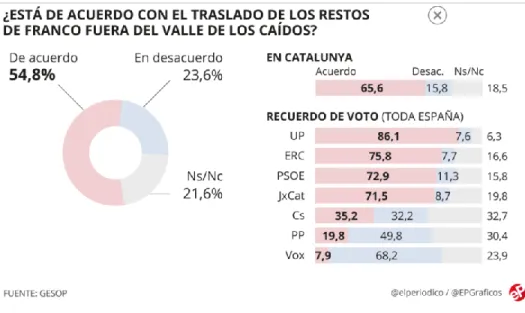
Figure 3: Spaniards’ Opinions on the Exhumations. Source: El Periódico
ERC speaker Joan Tardà demanded that the measure include more support for Franco’s victims in exchange for his party’s vote. Tardà criticized PSOE’s efforts in the past as being futile and
having created “a cloud of absolute amnesia” (RTVE 2018). On this issue, the ERC wanted leading PSOE party to go even further left on the measure. What do these results mean for Spanish democracy? I argue that this partisan competition and debate among parties is healthy for Spanish democracy overall. The most worrisome response comes from far-right VOX party. I believe the party’s calls to ‘Make Spain Great Again’ and return to the past times are gaining
CHAPTER 3: THE REVOLUTIONARY ROAD TO CONSOLIDATED DEMOCRACY IN PORTUGAL
Introduction
In the previous section, I have argued that the ‘irruption of memory’ in the case of the
Valley of the Fallen was directly linked to the Spanish style of pacted transition to democracy. The transition was characterized by a pact of forgetting and based on the existing institutions and negotiated by elites from the former regime. The Portuguese transition, sparked by the Carnation Revolution on April 25th, 1974, could not have been any more different. Highly charged with a revolutionary spirit and grassroots celebrations, this transition was marked by a radical break with the past. The Carnation Revolution was triggered by a military coup on the streets of Lisbon featuring classic revolutionary characteristics. An anti-fascist, anti-capitalist wrath consumed the population, which resulted in a transition by complete systemic rupture. A grassroots movement led by the people forced thousands of right wingers into social exile, and many were even forced to leave the country in what were coined ‘wildcat purges’ (Pinto 21). These purges, as I will go
into further detail about in this chapter, were of both legal and ‘wild’ nature. Their ‘wild’ nature sometimes got out of control, however, as they were clearly not without controversy (Pinto 22). The military aspect and power of the Movimento das Forças Armadas (MFA) makes the
In this chapter, I give a brief overview of the Carnation Revolution and the underlying forces leading up to the fall of the Estado Novo in Portugal. Then I illustrate the type of transition and explain the most important characteristics of this process, highlighting the key Transitional Justice measures that were implemented such as truth committees, amnesty trials, and legal and ‘wild’ purges. I compare the Portuguese transition to democracy to that of Spain in
order to support my argument that the Portuguese transition was more effective in preventing an enduring authoritarian legacy. I cannot make this argument without noting that the years directly after the revolution were tumultuous and democracy was uncertain. The end of the colonial wars in Africa and the fact that the military led the revolution, and therefore intervened in politics, complicated the transition greatly. I conclude this chapter with a discussion of how the politics of the past eventually disappeared from public discourse.
The Carnation Revolution
When Paulo de Carvalho’s 1974 Eurovision Contest song “E Depois do Adeus” began to
Despite the overwhelming joy felt in those first few revolutionary days, uncertainty plagued the process of democratic consolidation. This period of disputes between the new leftist parties and the MFA leaders was called the Processo Revolucionário Em Curso (PREC) and lasted until the first democratic elections in 1975 (Raimundo 2015: 9). In fact, some scholars have called this period a state crisis because the MFA forces, who had the people’s support,
would not cede power to the political parties. One of the most powerful forces during transition was the intervention of the military into politics, and therefore the role that those actors played in Portuguese democratic consolidation.
These forces in the political sphere also affected the types of Transitional Justice doled out to the former authoritarian elites in the transition years. This type of post-coup TJ affected the institutions, the elite, collaborators and civil servants and even extended to the private sector (Pinto 2006). Many of the punitive measures taken against the most infamous Estado Novo collaborators were based on ‘revolutionary legitimacy’ and therefore exist outside of democratic
institutions such as a judiciary (Pinto 2017: 56). These measures included the criminalization and denunciation of the authoritarian apparatus (especially the political police), the dissolution of all respective institutions, legal purges as well as ‘wildcat’ purges and even the dismissal of
managers in private firms. The last two measures are in response to the powerful anti-capitalist wave that can be observed in various left-wing and extreme left segments of the population during this time (Pinto 2017: 56).
Legal and ‘Wildcat’ Purges
The figure below illustrates the number of individuals expelled or suspended from the public sector, either from purge committees or in a ‘wildcat’ manner until December 1974. The
Antonio Costa Pinto in Lisbon in January 2020, he told the story of a professor from the Catholic University of Lisbon who was physically barred from entering the classroom in the summer 1974 because of his right-wing political views and ties to the regime.1
Figure 4: Number of individuals removed or suspended from public office, whether it be through a truth committee or in a ‘wildcat’ manner (until December 1974). Source: Pinto
2008
It’s important to mention at this time that for many historians and social scientists, the idea of a ‘purge’ is still problematic. Purges are unfair at times and can hinder rather than help
the country move forward into democracy. I argue that while the ‘wildcat’ purges in Portugal were effective at ridding the Portuguese political system of Salazar supporters, the violence was sometimes counterproductive. In fact, the removal of public officials was not legalized until July 1975 when the Constitutional Law 8/75 provided for judicial trials of the political police and government officials directly responsible for repression (Pinto 2006: 43).
This threat of violence was particularly frightening due to the military’s position of power and interjections into politics. That is why the two years after the Carnation Revolution were highly tumultuous and no one was exactly sure if these efforts would result in a
consolidated democracy (Bermeo 2007). In order to further problematize these purges, I cast a wider net and explore the ideas of other scholars in the field. As Russian history expert Zbigniew Brzezinski noted in his 1958 article “The Pattern of Political Purges,” a purge is an inherent characteristic of a totalitarian regime and the term is still highly linked to Joseph Stalin’s Great Purges in the 1950s (Brzezinski 1958). The term therefore still holds a great deal of negative connotations and allusions to violence.
How do transitional democracies deal with officials who have involvement in the prior regime? Should they be excluded and exiled, or should they be incorporated into the new democracy? Roman David tries to answer this question in his 2011 book, Lustration and
Transitional Justice: Personnel systems in the Czech Republic, Hungary and Poland. David does
The essence of the arguments lays in the need to answer this puzzle: How do transitional policies — as well as their absence — negatively impact democratization? The result, he argues, very
well could be an incomplete democracy. Even if these policies designed to deal with personnel inherited from previous regimes have been instituted, such as in Portugal, problems can arise. “The policies of wholesale dismissal, if implemented, are very problematic in terms of their
constitution to successful political transformation. They may inhibit rather than facilitate democratization (David 2011: 3). By simply purging anyone who was involved in the former regime, those people do not get the chance to redemocratize themselves and perhaps even form new political identities. This paradox, therefore, is the key problem with these large-scale wild purges that happened in Portugal in the transition years.
In 1975, a group of extreme left-wingers of the MFA attempted to perform another military coup in order to institute a communist government. This attempt on the first
democratically elected government failed, and a counter coup took place to neutralize the radical left-wing military. A new settlement between political parties and the military was created and called the Second Pact (Pinto 2017: 63). After this threat, political parties began to cooperate more with a common goal: “forming an implicit democratic coalition with the aim of
establishing a liberal democracy” (Jalali 2007: 76). Though this political pact at first glance
looks like the Spanish one, it is important to remember that there was no agreed upon element of forgetting the past for the sake of democracy in Portugal. In the end, Portugal became another
example of the dominant process of democratic consolidation in Southern Europe:
“consolidation through parties” (Morlino 1998: 249). The Partido Socialista (PS), Partido Social
The purges soon ended and were even reevaluated as perhaps an overstep of the early transitional period according to Portuguese scholars such as Antonio Costa Pinto, Filipa
Raimundo and Pedro Magalhães. The late 1970s and early 1980s therefore marked a shift in the transition period, one which prioritized democratic coalitions with the aim of establishing a liberal democracy just like in the Spanish case. It is at this critical historical juncture when Raimundo argues that the past stopped constituting a relevant matter. She argues that this is because starting in the 1980s, the political elite started to prepare for the European integration process and, due to the disappearance of the far-right forces in politics, politicizing the past became irrelevant.
Costa argues that the variety of transition in Portugal must be correlated with the absence of the veto capacity of former authoritarian elites and institutions caused by their collapse. Mainly, a correlation can also be observed between the variety of transition and with the process of state crisis and military intervention in politics after the fall of the regime (Costa 2017: 69). It is important to recognize the legacy of the new political cleavages that emerged in the
‘revolutionary juncture’ of 1975 where therefore the consolidation of democracy was much more
concerned with coping with the legacies of transition and much less concerned with the previous authoritarian regime. A clear line can be drawn at this crucial juncture between the past and the politicization of it. This link supports my argument that the legacy of Salazar and the Estado Novo has less importance in modern day Portugal and therefore not as many cases of ‘irruptions’
of historical memory can be found. The Case of Museu Salazar
modern day Portugal thanks to the successful TJ measures implemented in the 1970s. These include trials, truth committees and truth documents as well as amnesty laws. The idea of a Museum to Salazar has been floated around for a few years by the mayor of the town where Salazar was born. This hypothetical museum is a worthy case to study in comparison to the Valley of the Fallen due to its similar exalting nature of the dictator. In this section, I give an overview of the proposed museum and trace the timeline of the first announcement of the idea in 2016 until the current situation today. Then I perform a discourse analysis on the various quotes and stances taken by politicians across different parties in order to make an observation on how the legacy of authoritarians can shape domestic politics years later. I argue that a very similar rhetoric along party lines actually took place in Portugal when the parliament took up the measure and ruled that the museum would not be built.
The idea to have a Museu Salazar in the deceased dictator’s birthplace of Vimeiro was first mentioned in a survey conducted in 2016 by a group of social scientists at the University of Lisbon. The survey titled “Memória da Oposição e Resistência ao Estado Novo” sought to find
out what the victims of the regime — mostly men around the age of 70 — thought in light of the 90-year anniversary of the May 1926 military coup through which the dictatorial regime was installed (Público 2016). The survey had several interesting findings. First, in response to a Museu Salazar, 51 percent of the 131 people surveyed said that this museum should not be
permitted. Twenty-three percent were in favor, and 26 percent gave no opinion (Público 2016). But in regards to the renaming of the Ponte Salazar to the Ponte 25 Abril, 85 percent surveyed agreed that this was a positive thing and only 5 percent disagreed.
Filipa Raimundo, the head of this study and a key figure in the Portuguese
evaluation of the authoritarian regime amongst the ex-members of the resistance and of the general population. Ninety-four percent of the victims of the Estado Novo surveyed said that the regime had more negative things than positive things whereas only 47 percent of the general population agreed with this statement. Another interesting question that this survey posed was in relation to the effectiveness of post-1974 Transitional Justice measures. Raimundo found that 72 percent of those surveyed consider that the victims still haven’t obtained the recognition they
deserve. Moreover, 95 percent of victims of the regime surveyed agreed that in democracy the perpetrators of the dictatorship were not ‘dealt with enough justice’ and 65 percent of the general
population shared that opinion (Público 2016). “Those who were victims of repression and who directly suffered the consequences of political/ideological persecution clearly considered the measures adopted to punish those responsible for the repression to be insufficient,” (Raimundo
2016).
The case of the Museu Salazar was largely left to rest after the publication of this
damning survey. But in July 2019, the mayor of Santa Comba Dão Leonel Gouveia declared his intent to construct and open a museum dedicated to his town’s most infamous resident by the end of the summer. He said, “This will be a place for the study of the history of the Estado Novo. It won’t be a sanctuary for nationalists nor a museum where the statesman of Santa Comba Dão will be demonized” (Expresso 2019). Gouveia, elected from the Socialist Party, did not initially reveal the ‘scientific direction’ or responsible actors for the project. The only detail announced
was that the museum would be built in the former Escola-Cantina Salazar, next to the old house of the president of the Council of Ministers (Expresso 2019).
Novo. He told the Expresso newspaper that Gouveia contacted him about the subject but that he
rejected any type of collaboration with that ‘pseudo interpretive center’ which he considers to be ‘a mere decoy of political tourism’ despite possible well intentions (Público 2019). Hundreds of
other historians, economists, social scientists and even politicians agree with Rosas.
In August 2019, a petition called ‘Museu Salazar, NÃO!’ was published and collected nearly 5000 signatures in the first 48 hours (Expresso 2019). The open letter addressed to Prime Minister António Costa demanded that he block the creation and development of this planned museum. The petition, supported by 204 ex-political prisoners, was delivered to the President of the Republic as well as the Prime Minister on August 14, 2019 (Expresso 2019). The petition argues that the museum claims to “clarify and explain the fascist regime to the younger
generations,” but in actuality, “its creation would be overshadowed as an instrument in service of white-washing the past and serve as a center of pilgrimage for the Salazarists of the regime toppled on April 25” (Expresso 2019).
After this petition was signed by thousands of Portuguese in the following months, this expression of opposition was open to the public. A particularly hard stance from the Portuguese of African descent suggests a double legacy of authoritarianism and war in some of the former colonies such as Angola, Mozambique, Cabo Verde, Guinea Bissau and Timor Leste. Joaquim Cavalho was interviewed by Deutsche Welle Portugal and told his story about being arrested in Angola under the regime for merely speaking aloud about his country’s history ‘in a nationalist way’ (DW 2019). He argued that creating a museum glorifying a ‘dangerous figure’ would be
The summer of debate and public outrage was put to a stop when the national parliament voted on the measure on September 11, 2019. With the votes of PS, BE, PCP and PEV and the abstentions from the PSD and the CDS, Parliament ruled that the construction of a Centro de Interpretação do Estado Novo is “an affront to democracy, to the values consecrated into the
Constitution of the Republic and an offense to the memory of the victims of the dictatorship”
(Diario de Noticias 2019). Since this parliamentary decision, construction and development on the museum has halted.
In the following section, I further examine the discourse and reactions surrounding this decision by various politicians of the left, right and center. I also try to establish a linkage connecting authoritarian legacies and politics of the past to the theme of the ‘quality’ of
democracy. I argue that the implementation of TJ measures (the creation of truth commissions, reparations for the victims, etc.) that took place in the direct aftermath of the Carnation
Revolution have softened the blow when it comes to ‘irruptions’ of historical memory, but
clearly, they still happen and I try to find out why. Legislative Discourse Analysis
In this section which marks the end of my chapter on Portugal, I use the theories presented in previous sections and knowledge presented about the Portuguese transition to democracy to examine the unique nature of the case of the Museu Salazar and Parliament’s decision to vote on a measure that does not even exist. I start by presenting a series of statements from various political parties reacting to the Parliament’s condemning decision against the