Liquidated Damages: An Analysis of Their Use and
Effectiveness
Alfredo N. Aragon
California Polytechnic State University San Luis Obispo, CA
A construction company’s success and/or failure is dependent upon project completion with respect to time and budget. Failure to meet the contract completion date results in a loss of profit for owners and contractors alike. In order to help mitigate project delays, liquidated damage clauses have been included into construction contracts. Incorporating provisions within the construction contracts in the form of liquidated damages aims to help shift the financial burden when there is a failure to meet contractual obligations, hopefully offering quick compensation for delays. Unlike general or actual damages, liquidated damages are pre-defined and agreed upon prior to entering project construction. These daily monetary amounts are chargeable against finances due to the contractor. This paper will discuss the features and requirements of liquidated damages as well as define the established laws that are written on liquidated clauses. Both prime contractor and subcontractor approaches to this clause will be discussed and analyzed. Finally, this paper will examine both the usefulness and effectiveness of including liquidated damages to mitigate project delays.
Keywords: liquidated damages, contractual obligations, actual damages, project completion
Introduction
The construction industry is synonymous with risk. Projects, more often than not, are a delicate balance of a strict budget and a concise schedule. According to the Global Construction Survey, r. Liquidated damages are
incorporated into construction contracts as a form of risk mitigation, in terms of project completion and damage compensation, to the parties involved. When this clause becomes applicable and what its corresponding monetary value is, is dependent upon a number of aspects defined within the construction contract.
The following information will outline and discuss necessary information on the creation and limitations of liquated damages.
Contractual Completion Date
Liquated damages within construction pertain to chargeable monetary amounts for failure to meet and maintain contractual obligations. These contractual obligations are most commonly broken with regards to the project’s contract completion date or interim completion dates. Defined within the construction contact, the contractual completion date, and any interim completion dates are typically established as “the number of days of performance instead of a specific date of completion in order to accommodate the uncertainty of when a project may be
authorized to proceed” (FindLaw). A liquidated damage provision is thus applied to any day that exceeds this completion date. In addition, interim dates commonly referred to as milestones, can be defined within the contract and thus failure to meet milestones can also result in liquidated damages.
Since liquidated damages follow each day after the contractual completion date, “completion” must also be defined. What constitutes “completion” is often disputed within the parties involved and can result in disagreements within owner and contractors. Within construction, the concept of substantial completion has filled this void to help clarify contractor completion. Substantial completion is defined within the US legal system as compliance with the contract, consisting of the following:
b) The owner has received all required warranties and documentation c) The owner may enjoy beneficial use or occupancy and may use, operate,
and maintain the project in all respects, for tis intended purpose.
(USLegal.com)
Types of Delay
As the contractual completion date is defined and the critical path is developed. Delay on a project can be classified under three main categories; excusable, compensable, and unexcused delay. Understanding which type of delay has taken place will better allow the contracted parties to understand who may be at fault, and whether or not a party may be entitled to compensation in the form of liquidated damages.
Excusable Delay
An extension will be allotted to the contractor or subcontractor if the delay is under the category of an excusable delay. AIA form A201 titled “General Conditions”, states what may permit an excusable delay.
“If the Contractor is delayed at any time in the commencement or progress of the Work by an act or neglect of the Owner or Architect, or of an employee of either, or of a separate contractor employed by the Owner; or by changes ordered in the Work; or by labor disputes, fire, unusual delay in deliveries, unavailable casualties or other causes beyond the Contractor’s control; or by delay authorized by the Owner pending mediation and arbitration; or by other causes that the Architect determines may justify delay, then the Contract Time shall be extended by Change Order for such reasonable time as the Architect may determine” (AIA A201).
In conclusion, all delays that arise that are above the control of the contractor are admissible as excusable delays. This can include any unforeseeable delays such as abnormal weather and unusually severe weather.
Compensable Delay
“Compensable delays are a subset of excusable delays for which the contractor is entitled not only to a time extension, but also to compensation” (Ness). This category of delay includes any breach of contractual obligations from the owner that prohibit the contractor’s ability to work.
Unexcused Delay
Unexcused delay will permit neither time extensions or compensation for the contractor. Any delays that fall under the risk assumed by the contractor, “such as the availability and quality of labor; the availability, delivery, and quality of materials; submission of adequate shop drawings and submittals; the performance of subcontractors and suppliers; site conditions and work restrictions identified in the contract; and safety” will fall under unexcused delay days (Ness). Delays under this category allow the owner the right to recover these delay damages, often in the form of liquidated damages.
Liquidated Damages Law
Though often perceived as a penalty by contractors, the amount cannot be determined based on what the owner estimates would force the contractor to complete the project by the contractual completion date, but rather, the liquidated damage provisions must be calculated based on what is predicted as the actual daily loss if the project was to be finished past the contract period (UpCounsil).
Methodology
This paper aims to examine liquidated damages and their ability to mitigate delay through conducting several interviews with industry professionals. The individuals that consented to interviews as well as their respective company names will be deleted in order to maintain full confidentiality. This promotes honest, forthright, and sincere responses that will be collected as data for the purpose of this paper.
The interviews took place over the phone and followed a set of questions that are included within the appendix of this paper. The questions were developed to gather data on specific material, yet, interviews were able to flow naturally which allowed for open ended discussion. Each of the respondents was a principal and decision maker regarding the liquidated damages inclusion or exclusion in contracts.
Interview Results
Interview One Results
Interviewee: Industry Professional A
Profession: Owner of General Construction Company, Construction Management, Consulting
When asked the viewpoint of damages included within the construction contracts, the participant answered that damage clauses are typically avoided by this company. It is the company’s general consensus that liquidated damages are “onerous and arbitrary amounts that don’t get to the heart of the matter”. This person recognized that liquated damages were originally developed as quick forms of rightful compensation against delays (payable to the owner), yet felt they have developed into a heavy-handed tool that developers use to get money for schedule delays. Whether it truly affects the financial outcome of the project or not.
In contracts where the participant is acting as the general contractor for an owner/developer, “we typically try to remove all liquidated damages clauses” during contract negation. If no other options can be pursued, this company asks that there be consequential liquidated damages against the owner and their design team for any delays that they may cause during the project’s duration.
In respect to past projects that included damages provisions, owners have attempted and successfully enforced liquidated damages against the participant as a general contractor. A recent project was brought to light in which damages were enforced after having been incorporated into a prime contract. The project was heavily behind schedule, mainly due to unforeseen weather delays. The owner withheld all payment to the general contractor, as the job neared the end, claiming liquidated damages. Since ownership refused to recognize the schedule delays that were submitted, the participant’s company brought this conflict to court and sued under the weather delay clause within the contract. Of the amount the owner withheld, only 20% was awarded off the original damage estimate. In this case it amounted to $137,862.00 instead of $700,000.00 held by the owner of the project.
When asked about contract negotiation between this company and hired subcontractors, the participant stated that if the owner will require a liquidated damage clause, then this company will carry that clause into their contracts with subcontractors. When asked if he sees liquidated damage clauses as motivational tools for subcontractors, the participant responded, “They only see liquidated damages as a penalty for a delay. Subcontractors will often want to negotiate the rate but will not negotiate out of it”. It is understood by the participant that liquidated damage clauses are not a useful tool to keep subcontract work on schedule. If a project runs behind contract schedule, the participant has observed that usually the subcontractor has misunderstood the schedule or has run into material or labor supply issues. He does not see these delay issues being mitigated due to liquidated damage claims, no matter their cost estimate. It would be much more beneficial to provide for incentive bonuses to the subcontractors as well. This option has proven itself to be more of an inducement to perform than only the penalty portion of liquidated damages.
Interview Two Results
Interviewee: Industry Professional B
Profession: Owner, Subcontractor – Drywall Company
When asked about the viewpoint of liquidated damages being included within contract clauses to the participant’s company, he responded “We try to negotiate liquidated damages and any damage claims out of the contract completely”. When they are unavoidably included, the participant stated that his company will strenuously word conditions into a contract such as a mandatory schedule analysis. Such a schedule analysis establishes a very clear project time-line data-point. This should determine if the project has delay issues at the time this subcontractor begins their scope of work. The participant explained that added conditions such as a schedule analysis, helps mitigate damages being unjustly taken from their company. This schedule analysis condition was described as requiring the owner or general contractor to provide an analysis on the current project’s schedule. The participant stated, “This will show whether or not the project is running behind, and reasons for any current project delays. Failure to provide us with a schedule analysis will void the entire liquidated damage paragraph.” It also helps in clearly identifying when time in a schedule is accelerated by the general contractor and helps determine additional compensation or costs for acceleration as provided in the contract as well.
When asked if an owner or general contractor has tried to pursue collecting liquidated damages, the participant stated that they are currently in a lawsuit regarding such provisions. The case involves an owner suing the general contractor after the owner kept approximately 8% of a 35-million-dollar contract as liquidated damages. The general contractor is refusing to charge the daily liquidated damages estimate. This lawsuit has trickled down the line and now each of the subcontractors are being accused for the of the delays as well.
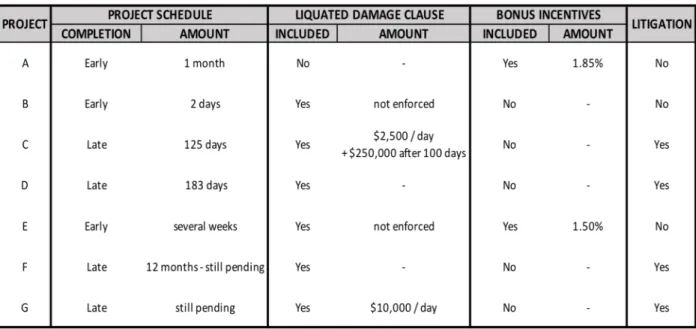
Table 1: Project Examples and Data
Interview Analysis
The data depicted in Table 1 was collected during the interviews previously disclosed. In an effort to maintain full confidentiality, project titles, owner names, and project costs were deleted. The data demonstrates seven different projects, including information regarding schedule, completion, damage clauses, bonus incentives, and whether the project entered further litigation following completion. The data provides evidence that inclusion of liquated damages within contracts does not mitigate project delays. The four projects that were delayed past contractual completion dates, all included liquidated damages, as well as included no bonus incentives. These same four projects have pursued lawsuits, increasing costs and losses for all parties involved. Three of seven projects finished before project deadlines, the two which (A and E) included bonus incentives offered to subcontractors. The two projects that included bonus incentives finished the earliest, resulting in awards to subtractors that totaled 1.85% and 1.5% added to the total contract amount. The same projects were also finished within budget.
Conclusions and Future Research
The participant interviews demonstrated that both prime contractors as well as subcontractors do not view liquidated damages as a useful tool for mitigating project delays. The participant general contractor believed that these
estimated amounts proved to be unnecessary punitive while the subcontractor generally saw the same clause as a way for general contractors and owner to bolster their bottom line. The collected data supported their viewpoints, showing no early or on-time project trends correlated to the inclusion of liquidated damages. Furthermore, each project that was delayed and included liquidated damages went into litigation. Lawsuits are known cost all entities further monetary losses rendering any perceived speedy compensation due to liquidated damages useless. Damage clauses and the litigation that immediately followed enforcing those monetary estimates, continued to place added burden on the projects, delaying them further. Delay has shown to be extremely difficult to quantity into a
reasonable estimate of actual damages. In these situations, liquated damages may not beneficially serve the project owner since it results in avoidable litigation.
While not the primary focus of this paper, it was observed that bonus incentives were often linked to the projects that finished the farthest ahead of schedule. For finishing early, these projects payed a percentage on top of the contracted amount, yet still remained within total project budget.
References
“AIA A201.” General Conditions of the Contract for Construction, 2017. PDF.
KPMG. Global Construction Survey. 2018. PDF.
“Liquidated Damages Construction: Everything You Need to Know.” UpCounsel. URL. www.upcounsel.com/liquidated-damages-construction.
Participant A. Phone Interview by Alfredo Aragon, May 13th, 2019.
Participant B. Phone Interview by Alfredo Aragon, May 15th, 2019.
“Section 2-718.” The 191st General Court of the Commonwealth of Massachusetts. URL.
malegislature.gov/Laws/GeneralLaws/PartI/TitleXV/Chapter106/Article2/Section2-718
“The Estimation of Construction Contract Liquidated Damages.” Findlaw. URL.
httpcorporate.findlaw.com/litigation-disputes/the-estimation-of-construction-contract-liquidated-damages.html
US Legal, Inc. “Substantial Completion Law and Legal Definition.” Substantial Completion Law and Legal Definition | USLegal, Inc. URL. definitions.uslegal.com/s/substantial-completion/
Appendix A – Interview Questions
What is your viewpoint on liquidated damages clause being included in construction contracts?
Do you pursue trying to incorporate liquidated damages within your construction contracts?
In past projects that included liquidated damages provision within the contract:
Has your company tried to collect liquidated damages?
Has your company been able to enforce and receive compensation through liquated damages?
Do you attempt to negotiate liquidated damages out of a contract?
Do you see liquidated damages as a valuable/useful/motivational tool to mitigate project delays?
If liquidated damages are not included: Are you worried about actual damages?
Can you provide examples of past projects that have and have not included liquated damage clauses as well as explain their use?
During these past jobs, what did you see as the main deterrent from delay?