Sharif University of Technology
Scientia IranicaTransactions B: Mechanical Engineering www.scientiairanica.com
Navier-Stokes computation of some gas mixture
problems in the slip ow regime
I. Zahmatkesh
a;, H. Emdad
band M.M. Alishahi
ba. Department of Mechanical Engineering, Mashhad Branch, Islamic Azad University, Mashhad, Iran. b. School of Mechanical Engineering, Shiraz University, Shiraz, Iran.
Received 11 November 2012; received in revised form 11 April 2014; accepted 26 April 2014
KEYWORDS Gas mixture; Rareed ow; Slip ow regime; Navier-Stokes equations; Nozzle; Microchannel.
Abstract. Several kinetic descriptions have already been utilized for the simulation of rareed gas mixture ows. Although such developments are important, Navier-Stokes computation can nd extended use in engineering applications. Recently, the authors have derived new velocity-slip and temperature-jump boundary conditions for slip ows of gas mixtures. Appealing to these new boundary conditions, Navier-Stokes computation of rareed gas mixture problems has become feasible. In the present contribution, the proposed conditions, in conjunction with the Navier-Stokes equations and an equation for the conservation of species, are solved for some binary gas mixture problems in the slip ow regime. Applications include low pressure ow in a converging-diverging nozzle, wall-cooling of a nozzle under rareed condition, and parallel mixing in a microchannel. Simulation results are presented in terms of the distributions of overall Knudsen number, Mach number, pressure, temperature, and concentration.
© 2015 Sharif University of Technology. All rights reserved.
1. Introduction
The physics of rareed single-component gas ows has been extensively studied in the past, and a number of interesting phenomena, which vanish at the continuum limit, have been observed. In practice, however, one deals with gas mixtures more often than with single gases and, thereby, attention must be paid to the simulation of such ows. In gas mixture ows, several new phenomena can lead to a somehow surprising behavior, compared with single-component cases. As an example, diusion can be observed due to imposed pressure, temperature, and concentration gradients. Additionally, concentration gradients may lead to the transfer of heat. Mixture problems also require dras-tically higher computational eort, as a result of the large number of additional parameters involved in their
*. Corresponding author. Tel.:+98 915 5109399 E-mail address: [email protected] (I. Zahmatkesh)
calculations. Consequently, it is not surprising to see that rareed gas mixture ows have not been analyzed extensively in the past. Some recent works are as follows.
Yan and Farouk [1] simulated the mixing problem of two parallel gas streams entering a microchannel initially separated by a splitter plate. They used the Direct Simulation Monte Carlo (DSMC) method and concluded that the mixing decreases with increasing the inlet-outlet pressure dierence, and that the mixing process for nearly specularly-reective walls is much slower than for perfectly diusing walls. Such a problem was further analyzed by Wang and Li [2] that claried the importance of main ow velocity as well as temperature on the degree of gas mixing. A recent analysis of this ow problem was undertaken by Darbandi and Lakzian [3].
The developed ow of binary mixtures of noble gases between parallel plates driven by small pressure, temperature, and concentration gradients was analyzed by Naris et al. [4]. They utilized the McCormack model
of the Boltzmann equation [5] and presented some ow features for the whole range of gas rarefaction. Concerning their results, they concluded that the hard-sphere molecular interaction model did not provide reliable results when mixture ow problems were stud-ied. This problem was again analyzed by Kosuge and Takata [6]. They constructed a ux database for binary mixtures of noble gases that covers the entire range of Knudsen number and concentration, and a wide range of temperature. Later, Naris et al. [7] extended their previous formulation (i.e. [4]) to developing ows through microchannels.
Sharipov et al. [8] calculated heat ux magnitudes through rareed binary mixtures of noble gases con-ned between parallel plates. Their solution was based on the McCormack model [5] and led to the conclu-sion that using the hard-sphere molecular interaction model, accurate heat uxes would not be resulted. Recently, DSMC simulation of this problem was un-dertaken by Strapasson and Sharipov [9]. Comparison of the results of the two approaches demonstrated that, in small temperature dierences, the McCormack model provided reliable results with an uncertainty of 2%.
Raines [10] solved the Boltzmann equation for the ow of binary mixtures between parallel plates and presented some ow aspects for a wide range of Knudsen number.
A lattice Boltzmann model was derived for mi-croscale gas ows of binary mixtures by Guo et al. [11]. The proposed model utilizes a collision operator with multiple relaxation times.
Szalmas and Valougeorgis [12] analyzed the ow of gas mixtures through triangular and trapezoidal microchannels. They solved the McCormack kinetic model [5] and presented some ow features for the whole range of gas rarefaction.
Steady, one-dimensional ow of a binary mixture of hard-sphere gases in contact with an absorbing planar wall was studied by Frezzotti et al. [13] through the DSMC method. Recently, they extended their investigation to two-dimensional circumstances [14].
Although such developments are important, the Navier-Stokes description can nd extended use in engineering applications due to its (i) simplicity and familiarity, (ii) computational eciency, (iii) applica-bility to monatomic, as well as polyatomic, gases, (iv) exibility for possible extension to multicomponent problems, (v) suitability for simple, as well as complex, geometries.
In spite of that, to the authors' knowledge, Navier-Stokes equations have not been employed for the computation of microscale gas mixture ows, since little have been known about the near wall behavior of the gas mixture. Some models have been proposed for velocity-slip, temperature-jump, and
concentration-jump in rareed mixture ows over catalytic surfaces (e.g. [15,16]). Nevertheless, the inclusion of surface reaction has made them quite complex. Meanwhile, for most gas mixtures, no reaction occurs on the surface, and near wall behavior is not so sensitive to local ow properties.
Recently, Zahmatkesh et al. [17] derived new velocity-slip and temperature-jump boundary condi-tions for gas mixture ows under rareed condicondi-tions. Appealing to these boundary conditions, the Navier-Stokes computation of gas mixture ows in the slip ow regime has become feasible.
To continue this eort, in the present contribu-tion, the proposed boundary conditions, in conjunction with Navier-Stokes equations and an equation for the conservation of species, are solved for some binary gas mixture problems in the slip ow regime. Applications include low pressure ow in a converging-diverging noz-zle, wall-cooling of a nozzle under rareed condition, and parallel mixing in a microchannel. Since previous investigations in the context of rareed gas mixtures have been restricted to straight microchannels, the rst originality of the current study goes back to the analysis of more complex geometries. This contribu-tion can also be regarded as the rst Navier-Stokes computation of gas mixture problems under rareed conditions.
2. Conservation equations
For simplicity of exposition, binary mixtures in two space dimensions are analyzed in this contribution. Accordingly, uid dynamics of the binary systems are described by Navier{Stokes equations, with an additional equation, expressing the conservation of mass for the rst component. This additional equation, in conjunction with mass conservation for the whole mixture, implies the conservation of mass for the second component as well. In a generalized curvilinear two-dimensional coordinate system, the conservation equations are:
@ ~Q @t +
@~F @ +
@ ~G @ =
@~Fv
@ + @ ~Gv
@ ; (1)
where: Q = 8 > > > > < > > > > : E u v c 9 > > > > = > > > > ;
; F = 8 > > > > < > > > > :
(E + p)u u u2+ p
uv uc 9 > > > > = > > > > ; ; G = 8 > > > > < > > > > :
(E + p)v v uv v2+ p
vc 9 > > > > = > > > > ;
; Fv=
8 > > > > < > > > > :
uxx+ vxy qx
0 xx yx jx 9 > > > > = > > > > ; ;
Gv = 8 > > > > < > > > > :
uxy+ vyy qy
0 xy yy jy 9 > > > > = > > > > ; : (2)
Here, is the mass density of the mixture and c is the mass fraction of the constituent, . Moreover, u, v, qx,
and qy are the components of velocity and heat ux
vector. ij is the viscous stress tensor and E is the
total energy per unit volume. Meanwhile;
~F = 1J (Fx+ Gy) ; G =~ J1 (Fx+ Gy) ;
~
Q = J1Q; ~Fv= J1(Fvx+ Gvy);
~
Gv =J1(Fvx+ Gvy): (3)
with:
J = @(; )
@(x; y) = xy yx: (4) In this formulation, j is the molecular mass ux vector, which is dened as [18]:
j = Dbrc + kTr ln T + kpr ln pc: (5)
Here, the rst term represents diusion due to con-centration gradients, while the contributions associated with temperature gradients and pressure gradients are incorporated in the second and the third terms, respectively. The coecient, D, is the binary diusion coecient. Meanwhile, kT and kp can be calculated
from the mixture composition as [19]:
kT = 0:0663
"
mm
(cm+ (1 c)m)2
#
; (6)
kp= (m m)c(1 c)
c m+
1 c m
: (7)
These coecients become inuential in problems with large temperature/pressure gradients. During com-putations, it must be borne in mind that kT is not
vanishing in the absence of one of the constituents. The viscous stress tensor and the heat ux vector are obtained from:
xx= 4 3 @u @x 2 3 @v @y ; (8)
xy = yx=
@u @y + @v @x ; (9) yy= 4 3 @v @y 2 3 @u @x ; (10)
qx= @T@x + 2
X
i=1
hijx;i; (11)
qy= @T@y + 2
X
i=1
hijy;i; (12)
with and being the thermal conductivity and viscosity of the gas mixture, respectively, and hi being
the partial specic enthalpy of the ith species. It is noteworthy that the second terms in the right-hand side of Eqs. (11) and (12) represent the contribution of inter-diusion on the transfer of heat. Here, jx;i
and jy;iare the components of the molecular mass ux
vector for the i's species. For instance:
jx;= D
@D @x + kT T @T @x + kp T @p @x : (13)
The evolution equations are supplemented by the ideal gas equation of state, which expresses pressure, p, in terms of mass density, , specic internal energy, e, mass fraction, c, and the ratio of the specic heats, : p(; e; c) = ((c) 1)e; (14) where:
(c) = ccp
v =
cp;c + cp;(1 c)
cv;c + cv;(1 c): (15)
Here, cv;, cv;, cp; and cp; are the specic heats
at constant volume and constant pressure for the component species, respectively.
The conservation equations, in conjunction with the proposed velocity-slip and temperature-jump boundary conditions (that will be described in the forthcoming section), are solved invoking the explicit ux dierencing of Roe's scheme [20]. In this method, the inviscid terms are calculated based on the eval-uation of eigenvalues and eigenvectors of the Euler equations. The viscous terms are also discretized using a central dierencing. Moreover, an upwinding method is applied to the equation of the continuity of the species. During the current computations, transport coecients of the constituents are taken from Bergman et al. [21], while the Wassiljewa's correlation [22] is adopted for the thermal conductivity of the mixture.
3. The proposed boundary conditions
The proposed velocity-slip and temperature-jump boundary conditions for a binary system take the form
of [17]:
us uw= 2 overall @u@n s+
3 4
T
@T @s
s; (16)
Tg Tw= 22 T T
bcs+ (1 cs)c
svs
h
cs2+1cv;+ (1 cs)2+1cv;
i @T @n
s;(17)
with s and n being the streamwise and normal coor-dinates, respectively. overall is the overall Knudsen
number of the gas mixture:
overall = cs+ (1 cs): (18)
Moreover, us and uw are the slip and wall velocities,
Tg and Tw are the gas and wall temperatures, and
is the ratio of specic heats. Subscript s stands for surface conditions. Coecients and T are the
tangential-momentum-accommodation coecient and the thermal-accommodation coecient, respectively. vsis the mean molecular speed of the gas mixture:
vs=
8
kTs
m 0:5
: (19)
Meanwhile, is the viscosity coecient of the gas mixture that can be determined in terms of the mixture composition, as:
=
1+G
M
M
1
+
1+G
M
M
1
; (20) with:
G=
1 +q=pM=M
2
2p2(1 + M=M) ; (21)
G=
1 +q=pM=M
2
2p2(1 + M=M) : (22)
Here, Mand M denote molar masses.
4. Simulation results
In this section, simulation results are presented for three distinct gas mixture problems in the slip ow regime. Nitrogen and oxygen are regarded as the mix-tures constituents. The current applications include low pressure ow in a converging-diverging nozzle, wall-cooling of a nozzle under rareed condition, and parallel mixing in a microchannel. The accuracy of
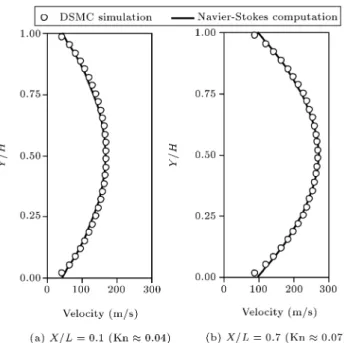
Figure 1. Simulated velocity proles at two dierent sections along the microchannel compared with DSMC results.
the employed Navier-Stokes solver for the description of these ow problems in the continuum ow regime has been established during our previous investigations [23-26]. Now, the validity of this solver in the computation of the slip ow regime is examined. For this purpose, and in the absence of any analytical or experimental data in the current ow problems, a He-Ne ow in a 1 4 m microchannel is computed, and the corre-sponding results are compared with those of the DSMC simulation of Wang et al. [27]. Here, the inlet and outlet pressures are taken to be 300 kPa and 100 kPa, respectively. Moreover, a temperature of 300 K and a concentration of 0.2 are assigned to the inowing gas stream. Under this circumstance, the overall Knudsen number of the mixture is about 0.1 in the outgoing gases, and a slip ow establishes in the microchannel. Figure 1 compares the simulated velocity proles at two dierent sections along the microchannel with those of the DSMC method. The centerline distributions of pressure are also indicated in Figure 2. Inspection of the gures demonstrates that the two approaches lead to almost the same simulation results. This provides condence to the developed Navier-Stokes solver for further studies in rareed circumstances. Consequently, in the forthcoming sections, it is used to simulate the aforesaid gas mixture problems in the slip ow regime.
4.1. Low pressure ow in a converging-diverging nozzle
As the rst example, a low pressure gas mixture ow in a converging-diverging nozzle is regarded. The schematic of the nozzle is depicted in Figure 3. The
Figure 2. Simulated centerline distribution of pressure compared with DSMC results.
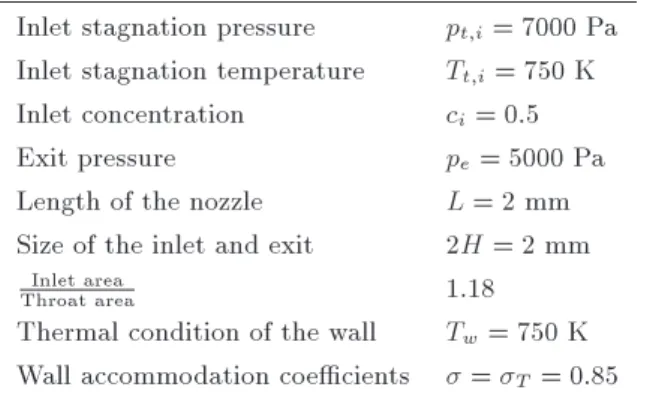
Figure 3. Schematic of the rst mixture problem. Table 1. Specications of the rst ow problem in Case I.
Inlet stagnation pressure pt;i= 7000 Pa Inlet stagnation temperature Tt;i= 750 K Inlet concentration ci= 0:5
Exit pressure pe= 5000 Pa
Length of the nozzle L = 2 mm Size of the inlet and exit 2H = 2 mm
Inlet area
Throat area 1.18
Thermal condition of the wall Tw= 750 K Wall accommodation coecients = T= 0:85
computations are undertaken for three distinct cases in the slip ow regime. Specications of the rst case (Case I, henceforth) are illustrated in Table 1. Under this circumstance, the overall Knudsen number of the mixture remains below 0.001 over the entire ow eld. Consequently, this case represents the lower limit of the gas rarefaction in the slip ow regime.
In regard to the second case (Case II), the degree of gas rarefaction is increased by assigning pt;i =
700 Pa and pe = 500 Pa at the boundaries. Other
specications are maintained identical to Case I. This makes the maximum value of the overall Knudsen number about 0.01. The last case (Case III), however, corresponds to a ow in the upper limit of the gas rarefaction in the slip ow regime (i.e., with Kn 0:1). This is attained by prescribing 70 Pa and 50 Pa at the inlet and outlet, respectively.
The ow cases are simulated using 10500 (70 150) nodes based on a grid renement study. In what concerns the centerline distribution of Mach number, simulation results for the three cases of the gas rarefaction are illustrated in Figure 4. Here, results
Figure 4. Centerline distribution of Mach number in the rst mixture problem.
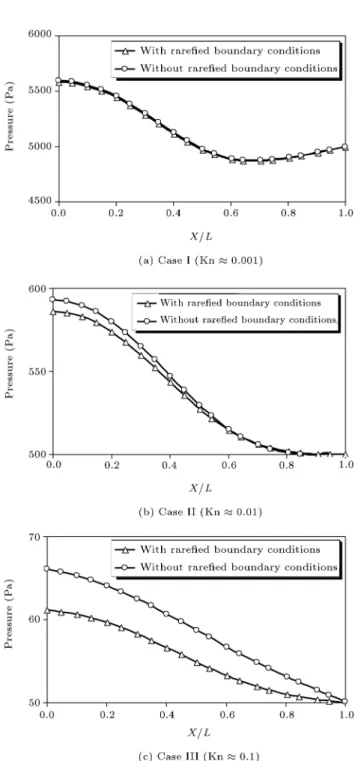
obtained without the rareed boundary conditions (i.e., with no-slip/no-temperature jump conditions) are also provided for comparison. Obviously, in all of the current cases, the centerline Mach number increases along the nozzle and a maximum value is attained at the downstream side of the throat. This proceeds with a slight decrease in the diverging part of the nozzle. The behavior is attributed to strong viscous eects in these low Reynolds ow elds. Notice that with an increase in the overall Knudsen number, the centerline Mach numbers diminish. This occurs despite the pressure ratios that are maintained identical here. The physical reasoning for this behavior is the fact that, as the degree of gas rarefaction increases, velocity-slip becomes more pronounced and, thereby, more uniform velocity proles establish in each section through the nozzle. The aforesaid variations in the Mach number make the centerline distributions of the temperature and pressure as depicted in Figures 5 and 6.
Comparing the results obtained with the proposed boundary conditions and those obtained without such conditions, in the three cases of gas rarefaction, is in-structive. Evidently, as the gas becomes more rareed, the discrepancies that appear between the results of the two approaches enhance, and, thereby, the inuence of the implemented rareed boundary conditions becomes more pronounced.
4.2. Wall-cooling of a nozzle under rareed condition
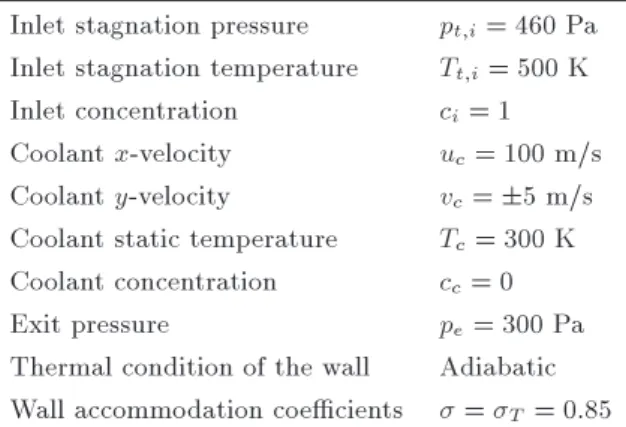
As the second example, wall-cooling of a converging-diverging nozzle under rareed condition is analyzed here. For this purpose, the same nozzle geometry as in the preceding example is chosen. Figure 7 depicts the schematic of this ow problem. It is assumed that nitrogen enters from the inlet of the nozzle and oxygen, as a coolant, is blown from the walls downstream of the throat. Flow conditions for this case are illustrated in Table 2.
The problem is solved employing a 155335 grid. Figure 8(a) presents the distribution of overall Knudsen number in the nozzle. Obviously, the lowest values
Table 2. Specications of the second ow problem. Inlet stagnation pressure pt;i= 460 Pa Inlet stagnation temperature Tt;i= 500 K Inlet concentration ci= 1 Coolant x-velocity uc= 100 m/s Coolant y-velocity vc= 5 m/s Coolant static temperature Tc= 300 K Coolant concentration cc= 0
Exit pressure pe= 300 Pa
Thermal condition of the wall Adiabatic Wall accommodation coecients = T = 0:85
Figure 5. Centerline distribution of temperature in the rst mixture problem.
of the Knudsen number appear in the vicinity of the oxygen blowing. This occurs since molecular collisions are more frequent between the oxygen molecules that are larger than the nitrogen ones. Notice that the over-all Knudsen number lies between 0.0095 and 0.0145, which, again, falls into the slip ow regime.
Simulation results, in terms of the distributions of concentration, Mach number, and temperature, are plotted in Figure 8(b) to (d). Concerning the contour plots of concentration in Figure 8(b), the view of the observer is directed towards the coolant that is blown and convected downstream. Inspec-tion of Figure 8(c) demonstrates that due to oxygen
Figure 6. Centerline distribution of pressure in the rst mixture problem.
blowing at the diverging part, the eective shape of the nozzle is converging instead of the converging-diverging nozzle. Moreover, temperature distribution provided in Figure 8(d) indicates that high temper-ature gradients appear in the vicinity of the diverg-ing part of the nozzle walls, wherein the coolant is blown.
4.3. Parallel mixing in a microchannel
As the last example problem, simulation results are presented for the mixing ow system depicted in Figure 9. Here, the parallel streams of oxygen and
Figure 7. Schematic of the second mixture problem.
Figure 8. Simulation results for the second mixture problem.
nitrogen, which are initially separated by a splitter plate, enter the mixing chamber. Specications of this ow problem are illustrated in Table 3.
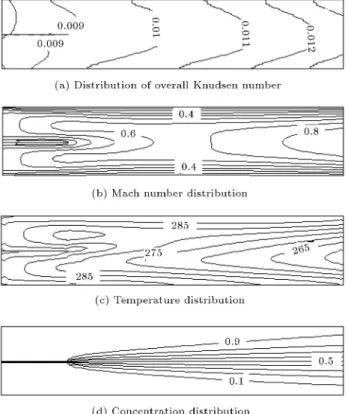
The problem is solved using 7171 (71 101) nodes based on a grid renement study. Figure 10(a) presents the distribution of overall Knudsen number in the gas mixture. Evidently, as one proceeds along the microchannel, the gas becomes more rareed. It is clear that the overall Knudsen number of this mixture problem remains below 0.02 over the entire
Table 3. Specications of the third ow problem. Inlet stagnation pressures pN2
t;i = pOt;i2= 15 kPa Inlet stagnation temperatures TN2
t;i = Tt;iO2= 300 K
Exit pressure pe= 7:5 kPa
Thermal condition of the wall Adiabatic Wall accommodation coecients = T = 0:85 Height of the microchannel H = 100 m Aspect ratio of the microchannel L=H = 5
Figure 9. Schematic of the third mixture problem.
Figure 10. Simulation results for the third mixture problem.
ow eld. Consequently, a slip ow establishes inside the microchannel.
In what concerns the distributions of Mach num-ber, temperature, and concentration, simulation results are depicted in Figure 10(b) to (d). Inspection of Fig-ure 10(b) demonstrates that the ow is accelerated in accordance with the density drop brought about by the decrease in pressure, in a way that is consistent with the mass conservation principle. As a consequence of this ow acceleration, a low temperature region gradually forms in the downstream side of the microchannel,
which is obvious in Figure 10(c). The mixing pat-tern of the two parallel gas streams is illustrated in Figure 10(d). Previous observations of Zahmatkesh et al. [23] provide evidence that during the parallel mixing, the heavier species diuses towards the other gas stream. This is attributed to the higher momentum of the heavier particles during molecular collisions in the mixing layer. In spite of that, molecular masses of nitrogen and oxygen are almost identical, and the current parallel mixing is not so intense.
5. Concluding remarks
In this contribution, recently proposed velocity-slip and temperature-jump boundary conditions were adopted, and several Navier-Stokes computations were under-taken for some gas mixture problems in the slip ow regime. Inspection of the presented results for the low pressure nozzle ow demonstrated that the inclusion of the proposed boundary conditions has prominent consequences on the establishment of the ow elds. The method was also successful in the description of wall-cooling of a nozzle under rareed condition and parallel mixing in a microchannel
The employed Navier-Stokes description can nd extended use in the simulation of gas mixture ows in microelectromechanical systems due to its (i) simplicity and familiarity, (ii) computational eciency, (iii) ap-plicability to monatomic, as well as polyatomic, gases, (iv) exibility for possible extension to multicomponent problems, (v) suitability for simple, as well as complex, geometries.
References
1. Yan, F. and Farouk, B. \Numerical simulation of gas ow and mixing in a microchannel using the direct simulation Monte Carlo method", Microscale Thermophys. Eng., 6, pp. 235-251 (2002).
2. Wang, M. and Li, Z. \Gas mixing in microchannels using the direct simulation Monte Carlo method", Int. J. Heat Mass Transfer, 49, pp. 1696-1702 (2006).
3. Darbandi, M. and Lakzian, E. \Mixing enhancement of two gases in a microchannel using DSMC", Appl. Mech. Mater., 307, pp. 166-169 (2013).
4. Naris, S., Valougeorgis, D., Kalempa, D. and Sharipov, F. \Gaseous mixture ow between two parallel plates in the whole range of the gas rarefaction", Physica A, 336, pp. 294-311 (2004).
5. McCormack, F.J. \Construction of linearized kinetic models for gaseous mixture and molecular gases", Phys. Fluids, 16, pp. 2095-2105 (1973).
6. Kosuge, S. and Takata, S. \Database for ows of binary gas mixtures through a plane microchannel", Eur. J. Mech. B. Fluids, 27, pp. 444-465 (2008).
7. Naris, S., Valougeorgis, D., Kalempa, D. and Sharipov, F. \Flow of gaseous mixtures through rectangular mi-crochannels driven by pressure, temperature, and con-centration gradients", Phys. Fluids, 17, pp. 100607.1-12 (2005).
8. Sharipov, F., Cumin, L.M.G. and Kalempa, D. \Heat ux between parallel plates through a binary gaseous mixture over the whole range of the Knudsen number", Physica A, 378, pp. 183-193 (2007).
9. Strapasson, J.L. and Sharipov, F. \Ab initio simu-lation of heat transfer through a mixture of rareed gases", Int. J. Heat Mass Transfer, 71, pp. 91-97 (2014).
10. Raines, A.A. \Heat transfer in a gas mixture between parallel plates", Comput. Math. Math. Phys., 48, pp. 306-311 (2008).
11. Guo, Z., Asinari, P. and Zheng, C. \Lattice Boltzmann equation for microscale gas ows of binary mixtures", Phys. Rev. E, 79, pp. 026702-9 (2009).
12. Szalmas, L. and Valougeorgis, D. \Rareed gas ow of binary mixtures through long channels with triangular and trapezoidal cross sections", Microuid Nanouid, 9, pp. 471-487 (2010).
13. Frezzotti, A., Ghiroldi, G.P. and Gibelli, L. \Rareed gas mixtures ows driven by surface absorption", Vacuum, 86, pp. 1731-1738 (2012).
14. Frezzotti, A., Ghiroldi, G.P., Gibelli, L. and Bonucci, A. \DSMC simulation of rareed gas mixtures ows driven by arrays of absorbing plates", Vacuum, 103, pp. 57-67 (2014).
15. Scott, C.D. \Wall boundary conditions with slip and catalysis for multicomponent nonequilibrium gas ows", NASA TM X-5811 (1973).
16. Kiryutin, B.A. and Tirskii, G.A. \Slip boundary con-ditions on a catalytic surface in a multicomponent gas ow", Fluid Dyn., 31, pp. 134-143 (1996).
17. Zahmatkesh, I., Alishahi, M.M. and Emdad, H. \New velocity-slip and temperature-jump boundary condi-tions for Navier-Stokes computation of gas mixture ows in microgeometries", Mech. Res. Commun., 38, pp. 417-424 (2011).
18. Hirschfelder, J.O., Curtiss, C.F. and Bird, R.B., Molec-ular Theory of Gases and Liquids, Wiley, New York (1954).
19. Landau, L.D. and Lifshitz, E.M., Fluid Mechanics, 6, Pergamon Press (1963).
20. Roe, P.L. \Discrete models for numerical analysis of time-dependent multidimensional gas dynamics", J. Comput. Phys., 63, pp. 458-476 (1986).
21. Bergman, T.L., Lavine, A.S., Incropera, F.P. and De-witt, D.P., Fundamentals of Heat and Mass Transfer, 7th Ed., John Wiley & Sons (2011).
22. Reid, R.C. and Sherwood, T.K., The Properties of Gases and Liquids, 2nd Ed., McGraw-Hill, New York (1966).
23. Zahmatkesh, I., Emdad, H. and Alishahi, M.M. \Eect of temperature level on parallel mixing of two gas streams", Mech. Res. Commun., 38, pp. 141-145 (2011).
24. Zahmatkesh, I., Emdad, H. and Alishahi, M.M. \Vis-cous and inviscid solutions of some gas mixture prob-lems", Heat Transfer Res., 42, pp. 233-250 (2011).
25. Zahmatkesh, I., Emdad, H. and Alishahi, M.M. \Im-portance of molecular interaction description on the hydrodynamics of gas mixtures", Scientia Iranica B, 18, pp. 1287-1296 (2011).
26. Zahmatkesh, I., Emdad, H. and Alishahi, M.M. \Two-uid analysis of a gas mixing problem", Scientia Iranica B, 20, pp. 162-171 (2013).
27. Wang, Q., Yan, X. and He, Q. \Heat-ux-specied boundary treatment for gas ow and heat transfer in microchannel using direct simulation Monte Carlo method", Int. J. Numer. Methods Eng., 74, pp. 1109-1127 (2008).
Biographies
Iman Zahmatkesh obtained BS and MS degrees in Mechanical Engineering from Ferdowsi University of Mashhad, Iran, and a PhD degree in the same subject from Shiraz University, Iran. He is currently Assistant Professor and Head of the Mechanical Engineering Department at the Islamic Azad University, Mashhad, Iran. He has published about twenty ISI papers in areas of computational uid dynamics.
Homayoun Emdad earned his BS degree in Aerospace Engineering from Washington University, USA, and MS and PhD degrees in the same subject from Kansas University, USA. He is currently Associate Professor of Mechanical Engineering at Shiraz Univer-sity, Iran. His research interests are computational uid dynamics, aerodynamics, uid mechanics and two-phase ow analysis.
Mohammad Mehdi Alishahi earned his BS degree in Aerospace Engineering from Sharif University of Technology, Tehran, Iran, and MS and PhD degrees in the same subject from the Massachusetts Institute of Technology, USA. He is currently Professor of Mechan-ical Engineering at Shiraz University, Iran. His main research interests are computational uid dynamics, aerodynamics, and uid mechanics.